

- Market Size (2026)
- USD 881.0 Mn
- Forecast (2036)
- USD 4419.0 Mn
- CAGR (2026 to 2036)
- 17.5%
How big is Surgical Training Simulators & Robotics Market in 2026?
USD 881.0 million in 2026 and USD 4,419.0 million by 2036 at a 17.5% CAGR.
Demand for surgical training simulators & robotics is projected to push the valuation from USD 881.0 million in 2026 to USD 4,419.0 million by 2036 at a 17.5% CAGR between 2026 and 2036, driven by structured skills assessment around new robotic systems. Intuitive reported in its July 2025 Form 10-Q that the installed base reached 10,488 da Vinci systems after 395 second-quarter placements. Every new console requires orientation and supervised practice before a clinical team can use it routinely. Demand in the medical robots category therefore creates a direct training requirement rather than a separate education project.
Country adoption differs because hospital networks solve different training constraints with the same underlying technology. United States programs place greater weight on documented credentialing and data export across several robotic platforms. Indian hospitals often favor shared skills laboratories that spread equipment use across surgeons and operating-room staff. SS Innovations reported in November 2025 that nine-month revenue reached USD 28.0 million after its installed base expanded to 127 SSi Mantra systems by September. Capital approval still depends on protected faculty time and dependable service coverage alongside the equipment cost. Investment in digital transformation in healthcare strengthens the case for training platforms that connect learner records with clinical implementation plans.
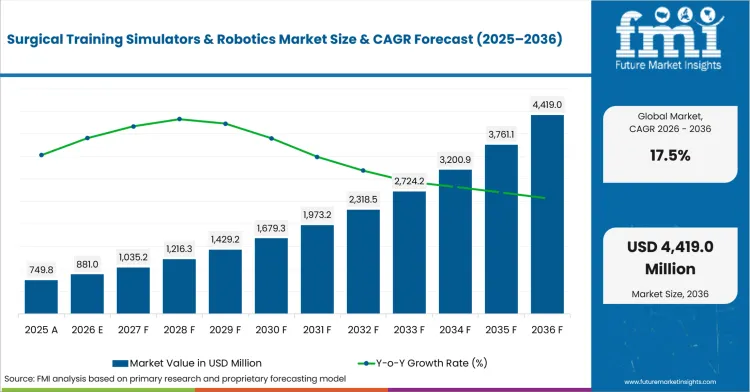
Key Takeaways of Surgical Training Simulators & Robotics Market
- Demand for surgical training simulators and robotics is driven by training moving into the same approval cycle as robotic system investment, with hospital education teams requiring repeatable practice before staff enter supervised clinical cases.
- By product, VR surgical simulators are expected to lead with 36.0% share in 2026, supported by reusable training modules and widespread adoption across surgical residency programs.
- Laparoscopy training is the dominant application segment, projected to hold 30.0% share in 2026, driven by its relevance across multiple minimally invasive surgical specialties.
- Hardware is estimated to lead the component category with 46.0% share in 2026, reflecting substantial upfront investment in simulation consoles, haptic devices, and physical training interfaces.
- Credentialing frameworks and protected teaching time remain critical to adoption, increasing the value of recorded performance and clearly defined progression standards across clinical departments.
- China, Japan, and the United States are expected to form the higher-growth country tier, advancing at 20.5%, 19.5%, and 18.5% CAGR respectively through 2036, supported by domestic platform commercialization, remote-surgery research, and hospital credentialing requirements.
- Competition centers on Surgical Science, VirtaMed, Intuitive Surgical, Medtronic, MicroPort MedBot, and SS Innovations, with vendors differentiating through procedure-specific software portfolios, physical interface design, and integration with robotic system rollout.
Analyst Perspective
"Simulation technology delivers lasting value only when it becomes part of a structured clinical education program rather than a standalone training resource. Teaching hospitals are looking beyond procedural realism to determine whether simulation platforms improve learner progression, support consistent faculty assessment, and produce objective performance records that guide clinical readiness. Vendors that help institutions standardize training across specialties while simplifying curriculum integration and performance evaluation will be better positioned as competency-based medical education continues to expand."
-Nikhil Kaitwade,Principal Analyst at Future Market Insights
Source: FMI's proprietary forecasting model and primary research
How is the Surgical Training Simulators and Robotics Market segmented?
The market is segmented by product, application, component, end user, pricing model, and region.
Product analysis separates VR systems from robotic console simulators and mixed-reality tools used for procedure-specific rehearsal. Application analysis covers laparoscopy training and robotic credentialing alongside endoscopy and open-surgery use across several specialties. Component analysis distinguishes physical hardware from software content and support services that carry different cost profiles. End-user analysis compares teaching hospitals with residency programs and medical device companies under distinct training duties. Pricing analysis tracks subscriptions and capital purchase alongside service or grant-funded models used by institutions. Regional coverage connects these choices with local approval pathways and available clinical faculty across each market. Growth in AR and VR in training helps institutions compare immersive content with the physical interfaces required for surgical skill assessment.
How does VR surgical simulation shape demand within the product category?
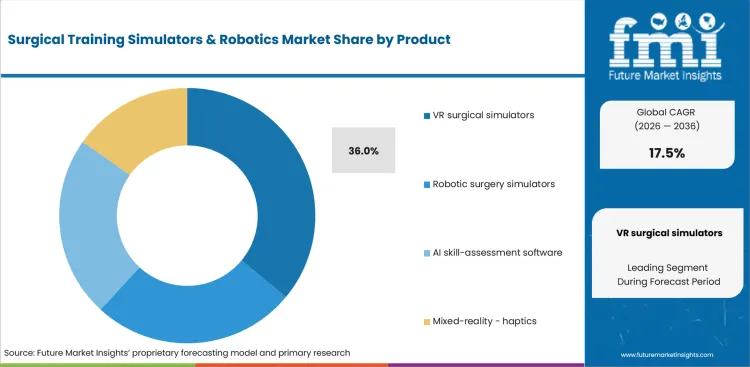
VR platforms allow repeated practice in instrument control and procedural sequence without consuming operating-room capacity. Surgical Science reported that its Simbionix acquisition agreement was valued at USD 305 million and that the acquired business recorded USD 40.8 million in 2020 sales. In April 2025, the company reported SEK 364.3 million in 2024 simulator hardware and software sales within Educational Products. Interest in mixed reality surgery broadens the visual options available to surgical education teams.
- By product category, VR surgical simulators are projected to account for 36.0% share in 2026, supported by reusable task libraries and broad residency use. The format allows repeated practice without consuming clinical instruments or scheduled theatre time reserved for patient procedures.
- Residency programs draw demand toward VR surgical simulators because clinical schedules limit supervised practice during normal operating hours. Program directors can schedule shorter sessions around service duties and repeat difficult tasks without patient risk.
What supports demand for laparoscopy training within the application category?
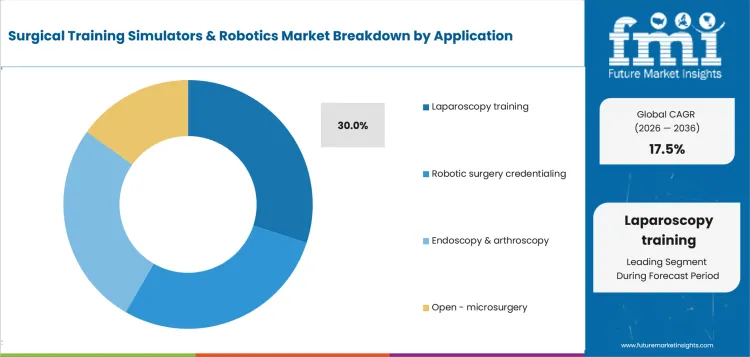
Laparoscopy remains an entry point for minimally invasive surgery training because camera navigation and instrument control apply across several specialties. The American College of Surgeons announced in August 2025 that its Simulation in Surgical Education course would run for four days during November. The program combined instruction with hands-on simulation and curriculum planning for surgical education faculty members. Use of robotics-assisted telesurgery creates another reason to establish basic console discipline before teams handle remote coordination.
- In 2026, laparoscopy training is expected to represent 30.0% share within the application category, reinforced by established curricula and wide procedural use. Box trainers and VR modules support camera control and bimanual skills before supervised cases begin. The share reflects a training route that does not depend on one robotic brand or a narrow surgical specialty.
- Teaching hospitals purchase laparoscopy training systems for large learner groups that need repeated access throughout the academic year. Faculty can compare progress across cohorts through familiar tasks and defined error measures within one curriculum.
How is hardware positioned within the component category?
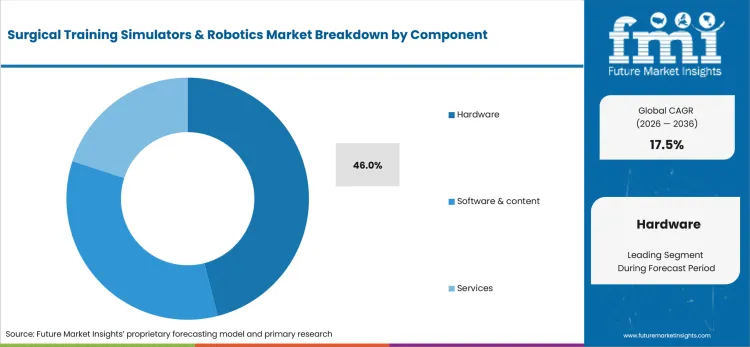
Hardware remains the physical base for realistic rehearsal because consoles and instrument interfaces shape hand position during every task. Intuitive reported in January 2026 that 303 da Vinci 5 systems were placed during the fourth quarter of 2025. A larger robotic base increases the need for system-specific orientation and supervised practice before clinical rollout. Institutions comparing haptic feedback test platforms must separate realistic resistance from unsupported claims about clinical readiness.
- By component category, hardware is forecast to hold 46.0% share in 2026, attributable to consoles and physical interfaces with meaningful upfront cost. Devices must reproduce instrument position and visual control with enough consistency for repeated assessment across learner groups. Hospital teams should compare service coverage and replacement terms since downtime can interrupt scheduled courses across several clinical departments.
- Simulation centers favor modular hardware that supports several specialties and learner groups under one access plan. Shared devices improve utilization if task libraries and instrument sets match each curriculum and teaching schedule.
What makes teaching hospitals central to the end-user category?
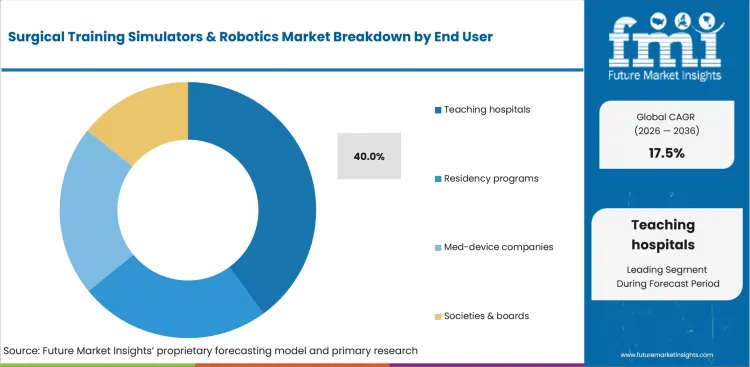
Teaching hospitals connect simulator access with faculty supervision and progression into patient care across several departments. The Royal College of Surgeons of England reported in March 2025 that more than three million surgical training opportunities had been lost since March 2020. Limited theatre access increases the value of scheduled practice outside routine service delivery and normal operating lists.
- Teaching hospitals are projected to hold 40.0% share in 2026 within the end-user category, underpinned by residency duties and multidisciplinary training demand. Teaching hospitals can spread simulator cost across several departments through a coordinated schedule and shared faculty plan.
- Medical schools and hospital networks concentrate purchasing on teaching-hospital platforms that support supervised practice and documented competency. Central laboratories can standardize training across affiliated sites and reduce duplicate equipment purchases within one governance plan.
How do subscriptions and licenses influence purchasing?
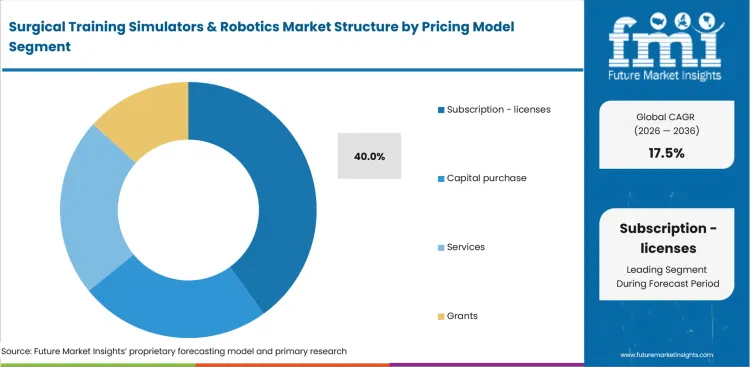
Subscription pricing lowers the initial barrier for software content but shifts attention toward utilization and renewal value. Surgical Science announced in January 2025 that all da Vinci 5 systems would carry its simulation software under subscription terms running through 2028. The arrangement tied content revenue directly to robotic system deployment rather than a separate simulator purchase. Hospitals need contract language that covers user access and data retention across the full teaching period. A low starting fee offers limited value if module availability changes during a credentialing program.
- The pricing category is estimated to be led by subscriptions and licenses at 40.0% share in 2026, owing to recurring content updates and flexible access. Annual fees can align spending with active learner numbers across several departments and learner groups. Hospital teams should confirm data retention and module availability at renewal since a lower first-year price can hide future switching cost.
- Hospital education departments favor subscriptions that provide regular content updates and several named users under one contract. The model supports phased rollout across learner groups without a large content purchase at the start. Commercial risk rises if renewal terms remain unclear or usage data cannot be exported to the institution after the contract ends.
What are the drivers, restraints, and opportunities in the Surgical Training Simulators and Robotics Market?
The market is projected to expand at a 17.5% CAGR from 2026 to 2036, driven by robotic platform adoption; governance gaps limit routine implementation; shared skills laboratories create a commercial opening for multi-team training.
- Driver: Robotic system expansion increases demand for structured console orientation and documented skills assessment before supervised clinical use.
- Restraint: Inconsistent credentialing rules make it harder for hospitals to compare simulator scores and define common progression standards across platforms.
- Opportunity: Shared skills laboratories can spread hardware and faculty cost across several departments and regional hospital networks.
One of the factors supporting growth is the expansion of robotic platforms that require structured team preparation before routine clinical use. Medtronic reported in April 2025 that Hugo was used in more than 25 countries across five continents and supported by over 200 independent papers. Wider clinical activity gives hospitals a practical reason to invest in repeatable orientation and documented skills assessment programs. The 3D imaging surgical solutions category reinforces this need by adding visual planning tools that staff must understand before they enter a live procedure.
Growth in the industry remains limited by the fragmentation of training standards and governance frameworks across robotic technologies. The Royal College of Surgeons of England reported in December 2025 that the NHS lacked standardized protocols and minimum training requirements for robotic surgery. Hospitals therefore have to define local thresholds and supervision duties before simulator scores can influence credentialing. The extra governance work can delay purchases or restrict use to isolated departments even after a technically suitable platform has been selected.
A lucrative opportunity lies in shared skills laboratories that serve several professional groups under one faculty plan. Max Healthcare and Medtronic opened a surgical skill laboratory in New Delhi during September 2025 for surgeons, nurses, operating-theatre technicians, and paramedics across India. The facility combines structured modules with hands-on practice in minimally invasive techniques for several professional groups. Similar centers can improve equipment utilization by distributing cost across hospital departments and external learners.
Which country CAGRs are profiled in the surgical training simulators and robotics market?
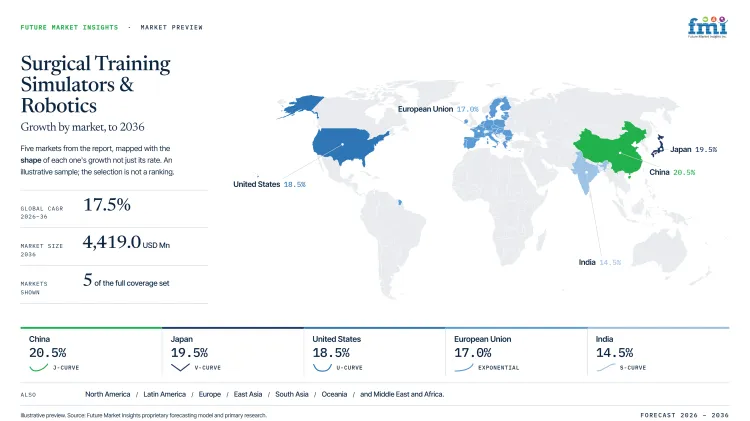
| Country | CAGR |
|---|---|
| China | 20.5% |
| Japan | 19.5% |
| United States | 18.5% |
| European Union | 17.0% |
| India | 14.5% |
How do country-level CAGRs compare in the Surgical Training Simulators and Robotics Market?
The country comparison is defined less by the six-point CAGR range and more by the shape of market development. Each health system follows a different path from robotic system installation to structured surgical training and routine clinical use.
- China shows a J-shaped trajectory as manufacturer-led training networks create broader momentum during the later forecast years.
- Japan follows a progressive compounding pattern as remote-surgery research expands training beyond console operation into communication and contingency planning.
- The United States displays a steady upward curve supported by recurring demand from residency programs and hospital credentialing processes.
- The European Union follows a more measured S-shaped path as adoption develops across different governance systems and national training requirements.
- India shows a V-shaped trajectory as early access constraints give way to wider use of domestic platforms and shared training laboratories.
Markets with similar CAGRs can therefore follow substantially different training and adoption paths. These differences affect market entry timing and the level of institutional support required for sustained clinical use. The full report provides country-level CAGR analysis across North America, Latin America, Europe, East Asia, South Asia, Oceania and the Middle East and Africa.
- China has built a training network around domestic robotic systems rather than relying entirely on imported platforms. Adoption of surgical simulators and robotics in China is estimated to expand at a 20.5% CAGR through 2036, led by commercial activity around locally developed systems. Shanghai MicroPort MedBot reported in April 2025 that it conducted more than 1,600 Toumai training sessions during 2024 for over 2,000 participants. The activity covered more than 40 countries and supports a wider instructor base for local training centers. Integration with surgical navigation systems raises the need for procedure-specific orientation across each robotic workflow.
- Japan combines a concentrated surgical robotics base with research on remote clinical operation across long distances. Surgical training simulators and robotics demand in Japan is forecast to rise at a 19.5% CAGR over the forecast period, aided by system-specific preparation for the hinotori platform. NTT Communications reported in June 2025 that a remote-surgery demonstration connected Strasbourg and Kobe across roughly 23,000 kilometers. The trial required clinical teams to manage network performance and separate on-site responsibilities during remote procedures. Medicaroid and its clinical partners therefore need training that covers communication and contingency planning alongside console skills. Investment decisions should test whether simulation content reflects the workflow used at both ends of a remote procedure.
- United States hospitals operate within formal graduate medical education and institution-specific credentialing structures across several surgical specialties. The United States market is projected to record an 18.5% CAGR during the forecast period, underpinned by new robotic platforms and documented progression requirements. The Accreditation Council for Graduate Medical Education recorded 365 accredited surgery programs for the 2024 to 2025 academic year in its January 2026 data book. The program base creates recurring demand for structured practice across large resident cohorts and faculty groups.
- European Union demand is shaped by hospital governance and the expansion of robotic systems across national markets. Surgical simulator and robotics sales in the European Union are forecast to expand at a 17.0% CAGR by 2036, reinforced by new system access and local training requirements. CMR Surgical reported in February 2025 that more than 29,000 Versius procedures had been completed globally as its KEBOMED partnership expanded into Sweden. The wider clinical base gives European hospitals more peer experience for system-specific education and governance planning. Training providers still need to adapt content to local credentialing and language requirements across participating hospitals.
- India is expanding surgical robotics through locally developed systems and shared training facilities that serve several hospitals. India is estimated to post a 14.5% CAGR over the forecast period, shaped by lower-cost robotic platforms and organized surgeon education. SS Innovations reported in November 2025 that more than 1,400 robotic surgeons had trained on the SSi Mantra by September 30. The training base gives hospitals access to instructors with direct platform experience and teaching roles. Domestic clinical centers can spread equipment use across specialties and visiting teams under one access plan.
Who are the notable companies in the Surgical Training Simulators and Robotics Market?
Notable companies include Surgical Science Sweden AB, VirtaMed AG, Intuitive Surgical, Inc., Medtronic plc, CMR Surgical Ltd., Shanghai MicroPort MedBot (Group) Co., Ltd., Medicaroid Corporation, and SS Innovations International, Inc.
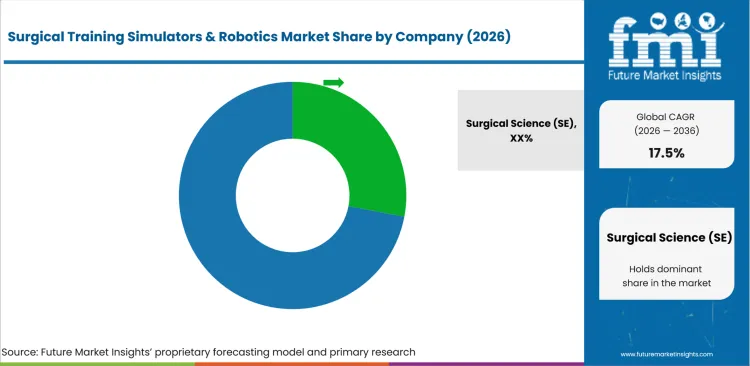
Competition follows two commercial models that place different responsibilities on hospitals and training providers during implementation. Surgical Science Sweden AB and VirtaMed AG sell simulation platforms that can serve several device ecosystems. Intuitive Surgical and five robotic system companies connect training more directly with their own console workflows and support programs. Independent platforms offer broader procedure coverage, while robotic companies control system-specific content and implementation support. Growth in medical automation increases demand for measurable staff preparation across connected clinical tools and digital workflows. Hospital groups should decide whether cross-platform flexibility or deeper system integration carries more value for their training plan.
- Surgical Science Sweden AB and VirtaMed AG compete through procedure libraries and performance analytics that can support several clinical specialties. Their commercial advantage depends on content breadth and physical realism across several clinical module areas. Hospital networks should test whether data exports and faculty tools remain consistent across modules before committing to one simulation platform.
- Intuitive Surgical, Inc. and Medtronic plc connect training with their own robotic systems and digital education services. Their control over platform workflows can simplify implementation for one device family and learner group. The trade-off is lower flexibility for hospitals that need comparable assessment across several robotic brands within the same credentialing pathway.
- CMR Surgical Ltd. and Shanghai MicroPort MedBot (Group) Co., Ltd. combine robotic system growth with structured clinical education. Both companies need training capacity that expands with installed systems across several countries and training centers. Hospitals should compare local instructor availability and service coverage rather than relying on platform specifications alone.
- Medicaroid Corporation and SS Innovations International, Inc. use regional clinical partnerships to support system-specific training. Their market position depends on converting early installations into repeatable programs for surgeons and operating-room teams. Buyers should examine course frequency and faculty access before treating an installed training center as evidence of routine capacity.
Competitive Benchmarking: Surgical Training Simulators & Robotics Market
| Company | Simulation Portfolio | Robotic Console Training | Skills Analytics | Team Training | Training Network | Geographic Reach |
|---|---|---|---|---|---|---|
| Surgical Science Sweden AB | High | High | High | Medium | Medium | Global |
| VirtaMed AG | High | Medium | High | Medium | Medium | North America, Europe, and China |
| Intuitive Surgical, Inc. | Medium | High | High | High | High | Global |
| Medtronic plc | Medium | High | Medium | High | High | More than 25 countries |
| CMR Surgical Ltd. | Medium | High | Medium | High | High | Europe, Australia, Brazil, and United States |
| Shanghai MicroPort MedBot (Group) Co., Ltd. | Medium | High | Medium | High | High | China and selected overseas markets |
| Medicaroid Corporation | Low | High | Low | Medium | Medium | Japan, Singapore, and Malaysia |
| SS Innovations International, Inc. | Low | High | Low | High | High | India and selected overseas markets |
Scoring basis: High indicates documented depth across the named capability and several relevant use cases. Medium indicates partial or platform-specific coverage, while Low indicates limited public evidence for the named capability. Geographic reach describes documented commercial or training activity across countries and does not represent a competitive rating.
Source: Official company product information and corporate announcements cited in the bibliography.
Key Developments in the Surgical Training Simulators & Robotics Market
- In March 2025, Shanghai MicroPort MedBot (Group) Co., Ltd. received Chinese market approval for the Toumai SP laparoscopic surgical robot in urology, general surgery, and gynecology. The single-port platform adds another system that needs console orientation and procedure-specific rehearsal across each approved specialty.
- In March 2025, Surgical Science Sweden AB confirmed that its purchase of Intelligent Ultrasound closed on February 18. The acquisition added volumetric ultrasound technology and expanded Surgical Science’s ultrasound simulation portfolio in the United Kingdom. Simulation centers can compare surgical and image-guided training within one vendor relationship.
- In July 2025, Medtronic plc received European CE Mark approval for LigaSure vessel-sealing technology on the Hugo robotic-assisted surgery system. The integration expands the system workflow that surgeons and operating-room teams must learn during implementation. Training programs need to cover instrument selection and energy use alongside console control during system implementation. Hospitals should update course content whenever an approved platform gains a new procedural tool in clinical use.
- In December 2025, CMR Surgical Ltd. received United States clearance for the Versius Plus robotic surgical system. The clearance created a new hospital implementation requirement in a market with established credentialing structures and several robotic platforms.
Key Players in the Surgical Training Simulators & Robotics Market
Simulation platform companies
- Surgical Science Sweden AB
- VirtaMed AG
Robotic system companies with integrated training
- Intuitive Surgical, Inc.
- Medtronic plc
- CMR Surgical Ltd.
- Shanghai MicroPort MedBot (Group) Co., Ltd.
- Medicaroid Corporation
- SS Innovations International, Inc.
Surgical Training Simulators & Robotics Market - Report Scope
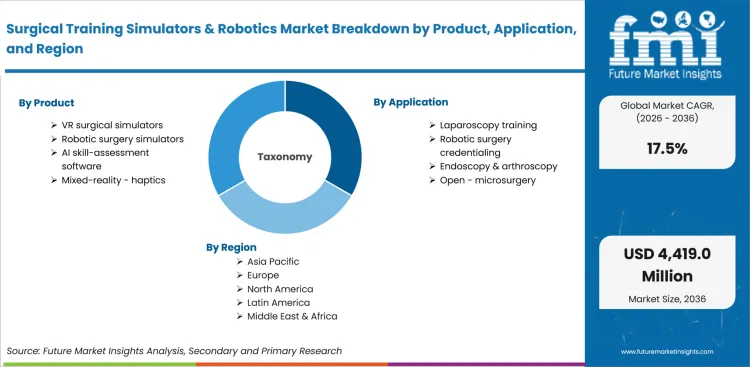
| Coverage field | Report scope |
|---|---|
| Market breakdown | Product, application, component, end user, pricing model, and region. |
| Quantitative Units | USD Million, CAGR in %. |
| Market Definition | The market covers digital and physical systems used to rehearse surgical tasks, assess technical skills, and prepare clinical teams for robotic or minimally invasive procedures. |
| Regions Covered | North America, Latin America, Europe, East Asia, South Asia, Oceania, and Middle East and Africa. |
| Countries Covered | China, Japan, United States, European Union, India, and 20+ countries within the regional model. |
| Key Companies Profiled | Surgical Science Sweden AB, VirtaMed AG, Intuitive Surgical, Inc., Medtronic plc, CMR Surgical Ltd., Shanghai MicroPort MedBot (Group) Co., Ltd., Medicaroid Corporation, SS Innovations International, Inc. |
| Forecast Period | 2026 to 2036. |
| Approach | Hybrid bottom-up and top-down market sizing supported by primary interviews and official desk research. |
Surgical Training Simulators & Robotics Market - Research Methodology
| Method | Approach |
|---|---|
| Primary Research | FMI analysts gathered input from manufacturers, service providers, technology developers, distributors, end users, procurement teams, and subject-matter experts. Interviews examined purchasing decisions, product or service evaluation, adoption barriers, approval requirements, pricing considerations, and expectations for technical or commercial support. Respondents were also asked what evidence is required before a trial, pilot, or initial order develops into regular purchasing. |
| Desk Research | Desk research covered government statistics, regulatory publications, trade data, industry associations, technical literature, standards, company filings, product information, and official corporate announcements. Sources were reviewed for relevance, publication date, geographic coverage, and consistency with the defined market scope. Claims relating to performance, applications, approvals, capacity, investment, and commercial activity were retained only when supported by credible public evidence. |
| Market Sizing and Forecasting | The market model combined the baseline value with historical performance, segment structure, pricing and volume indicators, adoption levels, company participation, and country-level demand conditions. Forecast assumptions considered economic activity, investment trends, regulatory developments, technology adoption, purchasing cycles, supply availability, and barriers to wider market use. Segment and regional estimates were reconciled before the final market total was calculated. |
| Data Validation | Estimates were checked against multiple independent indicators, including public data, company activity, trade patterns, industry developments, and findings from primary interviews. Validation also tested whether products, services, applications, and company revenues fell within the defined market boundaries. Adjacent categories, unsupported claims, overlapping revenues, and activities without direct market relevance were excluded to reduce double counting and maintain consistency across segments and countries. |
Source: Future Market Insights (FMI) analysis, based on proprietary forecasting model and primary research
Surgical Training Simulators & Robotics Market by Segments
Product
- VR surgical simulators
- Robotic surgery simulators
- AI skill-assessment software
- Mixed-reality and haptic systems
Application
- Laparoscopy training
- Robotic surgery credentialing
- Endoscopy and arthroscopy training
- Open surgery and microsurgery training
Component
- Hardware
- Software and content
- Services
End User
- Teaching hospitals
- Residency programs
- Medical device companies
- Professional societies and boards
Pricing Model
- Subscriptions and licenses
- Capital purchase
- Service contracts
- Grant-funded acquisition
Surgical Training Simulators & Robotics Market by Region:
- North America
- United States
- Canada
- Latin America
- Brazil
- Mexico
- Argentina
- Europe
- Germany
- France
- United Kingdom
- Italy
- Spain
- Nordics
- Benelux
- Rest of Europe
- East Asia
- China
- Japan
- South Korea
- South Asia
- India
- ASEAN
- Rest of South Asia
- Oceania
- Australia
- New Zealand
- Middle East and Africa
- GCC Countries
- South Africa
- Türkiye
- Rest of Middle East and Africa
Research Sources and Bibliography
- Intuitive Surgical, Inc. (2025, July 22). Quarterly report for the period ended June 30, 2025. USA Securities and Exchange Commission.
- Intuitive Surgical, Inc. (2026, January 22). Intuitive announces fourth quarter earnings.
- SS Innovations International, Inc. (2025, November 4). Investor presentation, November 2025.
- Surgical Science Sweden AB. (2025, April 14). Annual report 2024.
- American College of Surgeons. (2025, August 19). Simulation in Surgical Education course offers didactic and hands-on learning.
- Royal College of Surgeons of England. (2025, March 7). NHS surgical training yet to recover five years on from start of COVID-19 pandemic.
- Surgical Science Sweden AB. (2025, January 15). Surgical Science transitions to a fully subscription-based revenue model with Intuitive.
- Medtronic plc. (2025, April 26). Medtronic Expand URO USA Clinical Trial Meets Safety and Effectiveness Primary Endpoints for Hugo Robotic-Assisted Surgery System.
- Royal College of Surgeons of England. (2025, December 9). New guidance demands training and governance as robotic surgery rolls out across NHS hospitals.
- Medtronic plc. (2025, September 18). Max Healthcare Partners with Medtronic to Launch State-of-the-Art Surgical Skill Lab at Max Hospital, Saket.
- Shanghai MicroPort MedBot (Group) Co., Ltd. (2025, April 30). Annual report 2024.
- NTT Communications Corporation. (2025, June 17). Demonstration of remote surgery using the hinotori Surgical Robot System between Europe and Japan.
- Accreditation Council for Graduate Medical Education. (2026, January). Data Resource Book, Academic Year 2024-2025.
- CMR Surgical Ltd. (2025, February 6). CMR Surgical and KEBOMED expand partnership to bring Versius to Sweden.
- Surgical Science Sweden AB. (2022, April 11). Annual Report 2021.
- Shanghai MicroPort MedBot (Group) Co., Ltd. (2025, March 20). Toumai SP laparoscopic surgical robot receives NMPA market approval in China.
- Surgical Science Sweden AB. (2025, March 19). Surgical Science acquires Intelligent Ultrasound.
- Medtronic plc. (2025, July 15). Medtronic Shaping Future of Surgery, Secures CE Mark for LigaSure Technology on Hugo Robotic-Assisted Surgery System.
- CMR Surgical Ltd. (2025, December 16). CMR Surgical secures 510(k) clearance of Versius Plus robotic surgical system.
- Surgical Science Sweden AB. (n.d.). Surgical simulation products and services.
- VirtaMed AG. (n.d.). Surgical simulation portfolio.
- Intuitive Surgical, Inc. (n.d.). Da Vinci learning.
- Medtronic plc. (n.d.). Hugo robotic-assisted surgery training and education.
- CMR Surgical Ltd. (n.d.). Versius training and support.
- Shanghai MicroPort MedBot (Group) Co., Ltd. (n.d.). Toumai surgical robot and training activities.
- Medicaroid Corporation. (n.d.). Hinotori Surgical Robot System.
- SS Innovations International, Inc. (n.d.). SSi Mantra surgical robotic system.
This bibliography is provided for reader reference and is not exhaustive. The full report contains the complete reference list and detailed citations
This Report Answers
- What market value is stated for 2026 and 2036?
- What CAGR is projected from 2026 to 2036?
- Which product and application segments hold the stated 2026 shares?
- How do hardware and subscription models change hospital purchasing requirements?
- Which factors support growth and which conditions slow routine implementation?
- How do country CAGRs compare across China, Japan, United States, European Union, and India?
- Which companies compete through independent simulation platforms or integrated robotic training?
- Which corporate developments changed the market during 2025?
- What should surgical education leaders assess before selecting a training platform?
Frequently Asked Questions
What is driving growth in the Surgical Training Simulators & Robotics Market?
Robotic platform adoption increases demand for structured console practice and documented skills assessment across hospital teams. Hospital credentialing programs convert that need into planned simulator and software spending within clinical education budgets.
Who are the key players in the Surgical Training Simulators & Robotics Market?
Surgical Science Sweden AB and VirtaMed AG provide multi-specialty simulation platforms for hospital training programs. Intuitive Surgical, Medtronic, CMR Surgical, MicroPort MedBot, Medicaroid, and SS Innovations connect training with robotic systems.
What is a notable restraint in the Surgical Training Simulators & Robotics Market?
Inconsistent credentialing rules make simulator scores difficult to compare across hospitals and robotic platforms during implementation. Local governance work can delay routine use after equipment selection and weaken confidence in reported performance.
Why should executives track the Surgical Training Simulators & Robotics Market?
The Surgical Training Simulators & Robotics Market links robotic system investment with recurring software and education budgets. Platform choices can affect equipment use and staff readiness throughout multiyear implementation programs across hospital networks.
What business problem does the Surgical Training Simulators & Robotics Market address?
The Surgical Training Simulators & Robotics Market gives clinical teams a controlled setting for repeated procedural practice. Structured simulation reduces dependence on limited operating-room time and supports consistent faculty feedback between sessions.
What should surgical education leaders evaluate in the Surgical Training Simulators & Robotics Market?
Surgical education leaders should compare curriculum fit and faculty capacity with equipment realism across learner groups. Contracts need clear terms for software access and learner data throughout the complete teaching period.
What limits return on investment in the Surgical Training Simulators & Robotics Market?
Low utilization weakens returns from capital equipment and annual content fees across the contracted period. Shared schedules improve value by serving several departments and learner groups during each teaching week.
What supports long-term commercial confidence in the Surgical Training Simulators & Robotics Market?
Reliable service and transparent assessment methods reduce operating risk across repeated learner cohorts and departments. Clear upgrade and data-retention terms support longer hospital relationships with simulation and robotic training providers.
Preview the report firsthand - request a free sample
Get SampleGet the brochure for pricing and purchase details.
Get PDFTable of Content
- Key Takeaways
- Market Size and CAGR
- Top Growth Driver
- Fastest Growing Segment
- Leading Region
- Key Companies
- Emerging Opportunities
- Executive Summary
- Global Market Outlook
- Demand-side Trends
- Supply-side Trends
- Technology Roadmap Analysis
- Analysis and Recommendations
- Analyst Perspective (What is happening? Why now? What should investors know?)
- Key Questions Answered
- How large is the market?
- What is the CAGR?
- What are key trends?
- Which region dominates?
- Who are the leaders?
- Market Overview
- Market Coverage / Taxonomy
- Market Definition / Scope / Limitations
- Research Methodology
- Chapter Orientation
- Analytical Lens and Working Hypotheses
- Market Structure, Signals, and Trend Drivers
- Benchmarking and Cross-market Comparability
- Market Sizing, Forecasting, and Opportunity Mapping
- Research Design and Evidence Framework
- Desk Research Programme (Secondary Evidence)
- Expert Input and Fieldwork (Primary Evidence)
- Tooling, Models, and Reference Databases
- Data Engineering and Model Build
- Quality Assurance and Audit Trail
- Market Background
- Market Dynamics (Drivers, Restraints, Opportunity, Trends)
- Scenario Forecast (Optimistic, Likely, Conservative)
- Impact Analysis
- AI Impact
- Sustainability Impact
- Regulatory Impact
- Technology Impact
- Consumer / Buyer Analysis
- Purchase Drivers
- Adoption Barriers
- Buyer Journey
- Opportunity Map Analysis
- Product Life Cycle Analysis
- Supply Chain Analysis
- Investment Feasibility Matrix
- Value Chain Analysis
- PESTLE and Porter's Analysis
- Regulatory Landscape
- Regional Parent Market Outlook
- Production and Consumption Statistics
- Import and Export Statistics
- Global Market Analysis and Forecast, 2021 to 2036
- Historical Market Size Value (USD Mn) Analysis, 2021 to 2025
- Current and Future Market Size Value (USD Mn) Projections, 2026 to 2036
- Y-o-Y Growth Trend Analysis
- Absolute $ Opportunity Analysis
- Global Market Pricing Analysis, 2021 to 2036
- Global Market Analysis and Forecast, By Product, 2021 to 2036
- Introduction / Key Findings
- Historical Market Size Value (USD Mn) Analysis By Product, 2021 to 2025
- Current and Future Market Size Value (USD Mn) Analysis and Forecast By Product, 2026 to 2036
- VR surgical simulators
- Robotic surgery simulators
- AI skill-assessment software
- Mixed-reality - haptics
- VR surgical simulators
- Y-o-Y Growth Trend Analysis By Product, 2021 to 2025
- Absolute $ Opportunity Analysis By Product, 2026 to 2036
- Global Market Analysis and Forecast, By Application, 2021 to 2036
- Introduction / Key Findings
- Historical Market Size Value (USD Mn) Analysis By Application, 2021 to 2025
- Current and Future Market Size Value (USD Mn) Analysis and Forecast By Application, 2026 to 2036
- Laparoscopy training
- Robotic surgery credentialing
- Endoscopy & arthroscopy
- Open - microsurgery
- Laparoscopy training
- Y-o-Y Growth Trend Analysis By Application, 2021 to 2025
- Absolute $ Opportunity Analysis By Application, 2026 to 2036
- Global Market Analysis and Forecast, By Component, 2021 to 2036
- Introduction / Key Findings
- Historical Market Size Value (USD Mn) Analysis By Component, 2021 to 2025
- Current and Future Market Size Value (USD Mn) Analysis and Forecast By Component, 2026 to 2036
- Hardware
- Software & content
- Services
- Hardware
- Y-o-Y Growth Trend Analysis By Component, 2021 to 2025
- Absolute $ Opportunity Analysis By Component, 2026 to 2036
- Global Market Analysis and Forecast, By End User, 2021 to 2036
- Introduction / Key Findings
- Historical Market Size Value (USD Mn) Analysis By End User, 2021 to 2025
- Current and Future Market Size Value (USD Mn) Analysis and Forecast By End User, 2026 to 2036
- Teaching hospitals
- Residency programs
- Med-device companies
- Societies & boards
- Teaching hospitals
- Y-o-Y Growth Trend Analysis By End User, 2021 to 2025
- Absolute $ Opportunity Analysis By End User, 2026 to 2036
- Global Market Analysis and Forecast, By Pricing Model, 2021 to 2036
- Introduction / Key Findings
- Historical Market Size Value (USD Mn) Analysis By Pricing Model, 2021 to 2025
- Current and Future Market Size Value (USD Mn) Analysis and Forecast By Pricing Model, 2026 to 2036
- Subscription - licenses
- Capital purchase
- Services
- Grants
- Subscription - licenses
- Y-o-Y Growth Trend Analysis By Pricing Model, 2021 to 2025
- Absolute $ Opportunity Analysis By Pricing Model, 2026 to 2036
- Global Market Analysis and Forecast, By Region, 2021 to 2036
- Introduction
- Historical Market Size Value (USD Mn) Analysis By Region, 2021 to 2025
- Current Market Size Value (USD Mn) Analysis and Forecast By Region, 2026 to 2036
- North America
- Latin America
- Western Europe
- Eastern Europe
- East Asia
- South Asia and Pacific
- Middle East & Africa
- Market Attractiveness Analysis By Region
- North America Market Analysis and Forecast, By Country, 2021 to 2036
- Historical Market Size Value (USD Mn) Trend Analysis By Market Taxonomy, 2021 to 2025
- Market Size Value (USD Mn) Forecast By Market Taxonomy, 2026 to 2036
- By Country
- USA
- Canada
- By Product
- By Application
- By Component
- By End User
- By Pricing Model
- By Country
- Market Attractiveness Analysis
- By Country
- By Product
- By Application
- By Component
- By End User
- By Pricing Model
- Key Takeaways
- Latin America Market Analysis and Forecast, By Country
- Historical Market Size Value (USD Mn) Trend Analysis By Market Taxonomy, 2021 to 2025
- Market Size Value (USD Mn) Forecast By Market Taxonomy, 2026 to 2036
- By Country
- Brazil
- Mexico
- Chile
- Rest of Latin America
- By Product
- By Application
- By Component
- By End User
- By Pricing Model
- By Country
- Market Attractiveness Analysis
- By Country
- By Product
- By Application
- By Component
- By End User
- By Pricing Model
- Key Takeaways
- Western Europe Market Analysis and Forecast, By Country
- Historical Market Size Value (USD Mn) Trend Analysis By Market Taxonomy, 2021 to 2025
- Market Size Value (USD Mn) Forecast By Market Taxonomy, 2026 to 2036
- By Country
- Germany
- UK
- Italy
- Spain
- France
- Nordic
- BENELUX
- Rest of Western Europe
- By Product
- By Application
- By Component
- By End User
- By Pricing Model
- By Country
- Market Attractiveness Analysis
- By Country
- By Product
- By Application
- By Component
- By End User
- By Pricing Model
- Key Takeaways
- Eastern Europe Market Analysis and Forecast, By Country
- Historical Market Size Value (USD Mn) Trend Analysis By Market Taxonomy, 2021 to 2025
- Market Size Value (USD Mn) Forecast By Market Taxonomy, 2026 to 2036
- By Country
- Russia
- Poland
- Hungary
- Balkan & Baltic
- Rest of Eastern Europe
- By Product
- By Application
- By Component
- By End User
- By Pricing Model
- By Country
- Market Attractiveness Analysis
- By Country
- By Product
- By Application
- By Component
- By End User
- By Pricing Model
- Key Takeaways
- East Asia Market Analysis and Forecast, By Country
- Historical Market Size Value (USD Mn) Trend Analysis By Market Taxonomy, 2021 to 2025
- Market Size Value (USD Mn) Forecast By Market Taxonomy, 2026 to 2036
- By Country
- China
- Japan
- South Korea
- By Product
- By Application
- By Component
- By End User
- By Pricing Model
- By Country
- Market Attractiveness Analysis
- By Country
- By Product
- By Application
- By Component
- By End User
- By Pricing Model
- Key Takeaways
- South Asia and Pacific Market Analysis and Forecast, By Country
- Historical Market Size Value (USD Mn) Trend Analysis By Market Taxonomy, 2021 to 2025
- Market Size Value (USD Mn) Forecast By Market Taxonomy, 2026 to 2036
- By Country
- India
- ASEAN
- Australia & New Zealand
- Rest of South Asia and Pacific
- By Product
- By Application
- By Component
- By End User
- By Pricing Model
- By Country
- Market Attractiveness Analysis
- By Country
- By Product
- By Application
- By Component
- By End User
- By Pricing Model
- Key Takeaways
- Middle East & Africa Market Analysis and Forecast, By Country
- Historical Market Size Value (USD Mn) Trend Analysis By Market Taxonomy, 2021 to 2025
- Market Size Value (USD Mn) Forecast By Market Taxonomy, 2026 to 2036
- By Country
- Kingdom of Saudi Arabia
- Other GCC Countries
- Türkiye
- South Africa
- Other African Union
- Rest of Middle East & Africa
- By Product
- By Application
- By Component
- By End User
- By Pricing Model
- By Country
- Market Attractiveness Analysis
- By Country
- By Product
- By Application
- By Component
- By End User
- By Pricing Model
- Key Takeaways
- Key Countries Market Analysis
- USA
- Pricing Analysis
- Market Share Analysis, 2025
- By Product
- By Application
- By Component
- By End User
- By Pricing Model
- Canada
- Pricing Analysis
- Market Share Analysis, 2025
- By Product
- By Application
- By Component
- By End User
- By Pricing Model
- Mexico
- Pricing Analysis
- Market Share Analysis, 2025
- By Product
- By Application
- By Component
- By End User
- By Pricing Model
- Brazil
- Pricing Analysis
- Market Share Analysis, 2025
- By Product
- By Application
- By Component
- By End User
- By Pricing Model
- Chile
- Pricing Analysis
- Market Share Analysis, 2025
- By Product
- By Application
- By Component
- By End User
- By Pricing Model
- Germany
- Pricing Analysis
- Market Share Analysis, 2025
- By Product
- By Application
- By Component
- By End User
- By Pricing Model
- UK
- Pricing Analysis
- Market Share Analysis, 2025
- By Product
- By Application
- By Component
- By End User
- By Pricing Model
- Italy
- Pricing Analysis
- Market Share Analysis, 2025
- By Product
- By Application
- By Component
- By End User
- By Pricing Model
- Spain
- Pricing Analysis
- Market Share Analysis, 2025
- By Product
- By Application
- By Component
- By End User
- By Pricing Model
- France
- Pricing Analysis
- Market Share Analysis, 2025
- By Product
- By Application
- By Component
- By End User
- By Pricing Model
- India
- Pricing Analysis
- Market Share Analysis, 2025
- By Product
- By Application
- By Component
- By End User
- By Pricing Model
- ASEAN
- Pricing Analysis
- Market Share Analysis, 2025
- By Product
- By Application
- By Component
- By End User
- By Pricing Model
- Australia & New Zealand
- Pricing Analysis
- Market Share Analysis, 2025
- By Product
- By Application
- By Component
- By End User
- By Pricing Model
- China
- Pricing Analysis
- Market Share Analysis, 2025
- By Product
- By Application
- By Component
- By End User
- By Pricing Model
- Japan
- Pricing Analysis
- Market Share Analysis, 2025
- By Product
- By Application
- By Component
- By End User
- By Pricing Model
- South Korea
- Pricing Analysis
- Market Share Analysis, 2025
- By Product
- By Application
- By Component
- By End User
- By Pricing Model
- Russia
- Pricing Analysis
- Market Share Analysis, 2025
- By Product
- By Application
- By Component
- By End User
- By Pricing Model
- Poland
- Pricing Analysis
- Market Share Analysis, 2025
- By Product
- By Application
- By Component
- By End User
- By Pricing Model
- Hungary
- Pricing Analysis
- Market Share Analysis, 2025
- By Product
- By Application
- By Component
- By End User
- By Pricing Model
- Kingdom of Saudi Arabia
- Pricing Analysis
- Market Share Analysis, 2025
- By Product
- By Application
- By Component
- By End User
- By Pricing Model
- Türkiye
- Pricing Analysis
- Market Share Analysis, 2025
- By Product
- By Application
- By Component
- By End User
- By Pricing Model
- South Africa
- Pricing Analysis
- Market Share Analysis, 2025
- By Product
- By Application
- By Component
- By End User
- By Pricing Model
- USA
- Market Structure Analysis
- Competition Dashboard
- Competition Benchmarking
- Market Share Analysis of Top Players
- By Regional
- By Product
- By Application
- By Component
- By End User
- By Pricing Model
- Emerging Startups
- Innovation Benchmarking
- Competition Analysis
- Competition Deep Dive
- Surgical Science (SE)
- Overview
- Product Portfolio
- Profitability by Market Segments
- Sales Footprint
- Strategy Overview
- Marketing Strategy
- Product Strategy
- Channel Strategy
- CAE Healthcare (CA)
- VirtaMed (CH)
- Osso VR (US)
- Surgical Science (SE)
- Case Studies
- Success Stories
- Recent Developments
- Competition Deep Dive
- Assumptions & Acronyms Used


