

- Market Size (2026)
- USD 2.9 Bn
- Forecast (2036)
- USD 4.6 Bn
- CAGR (2026 to 2036)
- 4.7%
How big is Plastic Storage Bins Market in 2026?
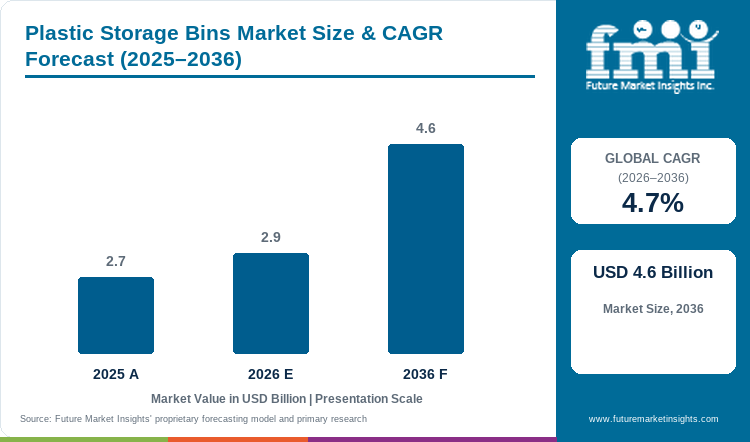
USD 2.9 billion in 2026 and USD 4.6 billion by 2036, expanding at 4.7% CAGR.
Sales of plastic storage bins are expected to rise at 4.7% CAGR through 2036. Valuation moves from USD 2.7 billion in 2025 to USD 2.9 billion in 2026 and reaches USD 4.6 billion by 2036. Automation-specific tote design is making dimensional repeatability part of system fit. ORBIS reported in August 2026 that its AROS family includes automation-engineered totes and AutoStore bins. Warehouse teams use each bin as both a storage address and a handling interface. A cracked rim or distorted base can interrupt scanning or conveyor travel.
The U.S. Census Bureau reported in August 2026 that unadjusted second-quarter retail e-commerce sales reached USD 329.5 billion and rose 12.4% year over year. South Korea's Ministry of Data and Statistics reported July 2026 online shopping value of KRW 25.0954 trillion and 7.3% year-over-year growth. Statistics Canada recorded a 2.7% November 2025 increase in warehousing and storage output. U.S. and South Korean fulfillment networks process high online order volumes while Canadian operators manage storage across dispersed logistics centers. Germany adds established intralogistics constraints. Japan adds compact operating footprints. Country demand therefore depends on handling intensity and the cost of qualifying another bin family.
Key Takeaways
- Warehousing teams treat bins as both storage locations and material-flow interfaces when picking frequency rises.
- Stackable bins are expected to hold 29.0% of bin type in 2026. This happens because modular footprints use vertical cube without fixing each container to one rack.
- HDPE is expected to account for 39.0% of material in 2026 as impact tolerance and moisture resistance support repeated handling.
- The 10-30 L range is expected to represent 36.0% of capacity in 2026 because it balances shelf density with manual handling. Industrial distributors are expected to hold 36.0% of sales channel in 2026 because stocked breadth shortens replacement.
- PPWR reuse targets from 2030 create a stronger specification route for eligible bins used as transport packaging.
- Key companies include Akro-Mils, IPL Schoeller, SSI Schaefer, Quantum Storage Systems, ORBIS, Uline, BITO, Craemer, Rehrig Pacific, and Buckhorn.
Analyst Perspective
"Which bin characteristic becomes the binding constraint when storage moves into automation? Nominal capacity matters less once a tote must clear fixed conveyor guides and robotic interfaces. Suppliers that can hold base flatness and barcode placement across production runs reduce qualification work for operators. The commercial test is whether one bin family can stay interchangeable across installed racks and automated handling without forcing frequent revalidation."
- Rahul Pandita, Principal Analyst at Future Market Insights
How is the plastic storage bins market segmented?
The plastic storage bins market is segmented by bin type, material, end use, capacity, sales channel and Region.
The plastic storage bins market is segmented by bin type, material, end use, capacity, sales channel and region for the 2026 to 2036 assessment period. Bin type separates stackable and nestable formats from shelf, attached-lid and ESD storage designs. Material distinguishes HDPE and PP from recycled, conductive and clear polymers. End use identifies the workflow that sets handling requirements. Capacity captures the trade-off between cube use and manual movement. Sales channel shows whether buying teams prioritize stocked access, direct specification or project integration.
What makes stackable bins central to the bin type category?
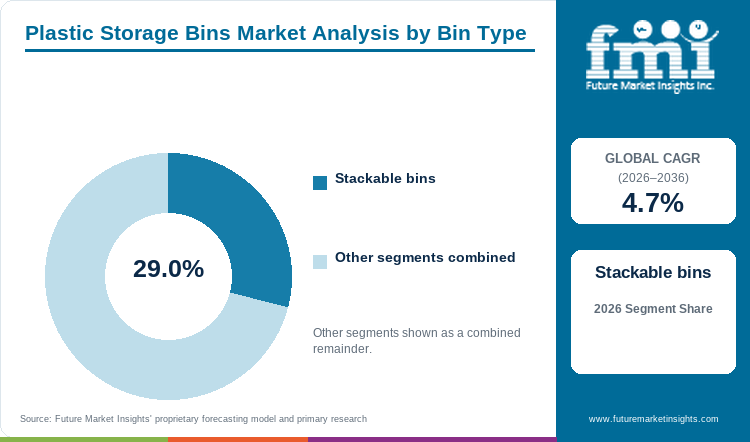
Stackable bins support vertical storage without fixing every container to one rack location. Their repeated footprint helps operators move the same container between shelving and carts. Automated sites also need stable geometry when warehouse robotics transfer totes through storage and picking. The format stays useful in manual areas because dividers and labels can change around the item mix. Nestable bins suit empty-return routes. Shelf bins favor direct access while attached-lid formats protect closed-loop movement. Stackable bins lead because they balance cube use with portability. Akro-Mils currently documents AkroBins that stack or hang from louvered racks with dividers and lids available.
- By bin type, stackable bins are expected to hold 29.0% in 2026 owing to modular vertical storage across shelving and work cells.
- Compatible warehouse racking lets one footprint move between reserve storage and forward-pick locations.
Why does HDPE suit repeated handling within the material category?
HDPE fits repeated industrial handling because it combines stiffness with impact tolerance and moisture resistance. High-density polyethylene gives molders room to form reinforced rims and label areas without adding metal parts. That matters when bins move between shelves and carts or when they are washed between uses. PP remains useful where lower mass or different stiffness is preferred. Recycled plastic carries more buying interest as circular requirements tighten. Conductive formulations serve electronics. Clear polymer helps with visual checks. HDPE keeps the broadest fit across warehouse and manufacturing duty. Rehrig Pacific documents a reusable HDPE bin with washable material and reinforced rim features for repeated handling.
- HDPE is set to account for 39.0% of the material category in 2026 because repeated-impact performance and moisture resistance support repeated handling.
- Injection molded plastic supports repeatable walls and molded label zones across high-volume bin production.
How does warehousing shape the end use category?
Warehousing creates a bin requirement at storage and at many points inside an order path. Bins hold reserve stock and feed forward-pick locations before they move through replenishment. Goods-to-person systems add another use because totes become part of the automation interface. Material handling equipment also exposes bins to repeated contact during routine transfers. Retail logistics uses many of the same formats but adds store replenishment and returns. Manufacturing ties bins to line-side supply. Healthcare and labs add cleaning or security requirements. Warehousing leads because one asset can support both storage and movement. ORBIS currently documents automation-engineered AROS totes and AutoStore bins for goods-to-person storage systems.
- In 2026, warehousing is expected to represent 30.0% of end use as recurring pick and replenishment cycles create defined bin positions.
- Automation raises the value of stable tote geometry when storage and picking share one container family.
What supports 10-30 L leadership in the capacity category?
The 10-30 L range gives operators useful pick volume without turning routine moves into bulky lifts. It fits common shelf depths and leaves room for dividers. That balance suits small parts and mixed kits across receiving or line-side work. Below 10 L serves fasteners and electronics. The 30-75 L range handles larger components or order consolidation. Above 75 L shifts more handling toward dollies and plastic pallets or fixed locations. Plastic crates overlap with transport-heavy applications but the mid-range storage bin stays easier to hand-pick. The category leads through a practical trade-off between cube use and manual access. Uline currently lists a 15 x 8 x 7 inch stackable bin with a 60 pound load rating and one divider.
- Within capacity, the 10-30 L range is expected to reach 36.0% in 2026 as shelf density and practical handling support repeat replenishment.
- Dividers let the same mid-range footprint carry small parts or mixed kits without changing the outer geometry.
Why do industrial distributors lead the sales channel category?
Industrial distributors reduce the transaction cost of a fragmented storage purchase. A buyer can combine bins with dividers and label holders in one replenishment order. Local stock matters when a damaged unit removes a pick face from service. Retail and e-commerce channels fit small self-directed purchases. Direct manufacturer sales suit larger volume or custom tooling. Material handling dealers add value when bins sit inside a broader rack or automation project. Returnable transport packaging programs can shift larger reusable-container projects toward direct supply. Industrial distributors lead routine storage-bin purchasing because stocked breadth shortens replacement time. Uline currently stocks stackable bins with dividers and label holders alongside compatible bin storage systems.
- By sales channel, industrial distributors are expected to hold 36.0% in 2026 owing to stocked breadth and rapid replacement access.
- Direct routes become more important when one footprint is customized for a network or automated installation.
What are the drivers, restraints and opportunities in the Plastic Storage Bins Market?
Higher handling intensity expands installed bin positions, installed-system qualification slows switching, and reusable transport programs create a path for premium engineered totes.
- Driver: Automation and higher pick intensity increase demand for standard reusable bin footprints.
- Restraint: Installed racks and conveyors make dimensional site testing a switching cost.
- Opportunity: PPWR reuse targets create demand for shown service life and recovery in eligible transport bins.
Automation turns dimensional consistency into a recurring replacement requirement
Warehouse automation increases the value of a bin that can repeat the same footprint through storage and picking. ORBIS said in August 2026 that its AROS tote family includes products engineered for automated storage and AutoStore systems. The design logic matters because every more goods-to-person movement exposes bases and rims to repeated mechanical contact. Warehouse teams also need stable label zones so scanners can identify the same location through many cycles. More order lines therefore create a requirement for both installed positions and replacement stock. Demand becomes more concentrated when sites add automated modules or standardize a bin family across many buildings.
Installed interfaces make a cheaper bin costly if geometry fails site testing
Site testing becomes the main restraint once bins interact with installed equipment. A lower unit price does not offset a base that deflects on a conveyor or a rim that misses a guide. Rehrig Pacific wrote in May 2026 that operations can face cracked bins and designs that complicate sanitation or efficient stacking. BITO also describes warping and unreliable handling as problems for automated storage totes. Operators therefore test dimensions and loaded behavior before replacing an established container. This process can slow switching across large installed fleets. It can also favor the incumbent size even when another supplier offers stronger price and service terms.
Reusable transport rules reward shown service life and recovery
Reusable transport rules create an opening for bins that combine long service life with shown recovery. The European Commission confirmed that the PPWR applies across the EU from August 12 2026. From 2030 at least 40% of specified transport packaging used within the Union must be reusable within a reuse system. The listed formats include foldable plastic boxes and plastic crates. Recycled plastic packaging specifications also gain weight because minimum recycled-content requirements phase in from 2030. Plastic bins gain a clearer specification route when they serve as transport packaging inside repeatable logistics loops. BITO's ECOMotion tote uses recycled polypropylene for automated storage.
Which country CAGRs are profiled in the Plastic Storage Bins Market?
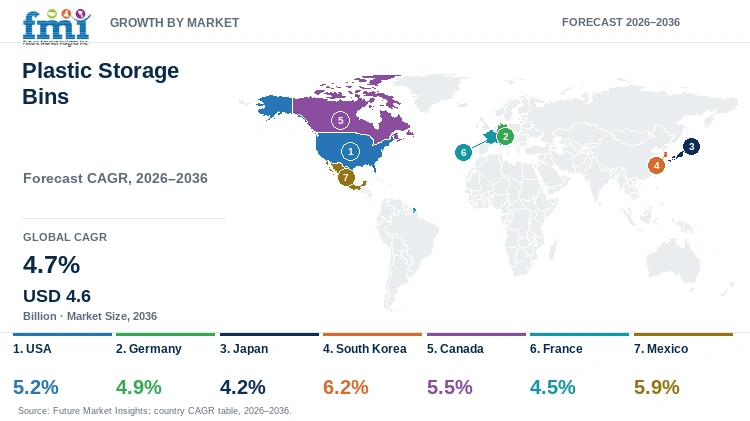
| Country | CAGR |
|---|---|
| USA | 5.2% |
| Germany | 4.9% |
| Japan | 4.2% |
| South Korea | 6.2% |
| Canada | 5.5% |
| France | 4.5% |
| Mexico | 5.9% |
How do country-level CAGRs compare in the Plastic Storage Bins Market?
Country CAGRs range from 4.2% to 6.2%, but the commercial mechanisms differ. South Korea links bin site testing to dense automated fulfillment. Mexico depends more on local industrial service and dealer stock. Canada and the USA emphasize replacement supply across distributed networks. Germany and France add packaging records when bins serve transport functions. Japan places more weight on compact footprints and stable molding. Each forecast should be read beside its national operating model.
- South Korea rewards automation-ready tolerances and fast replacement access in high-cycle fulfillment operations.
- Mexico places more weight on dealer stock and local application support around industrial corridors.
- Canada values regional inventory and nesting efficiency across long replenishment routes.
- The USA rewards multi-site standardization plus broad stocked access for common footprints.
- Germany combines standardized intralogistics with stronger material records for reusable systems.
- France adds circular buying requirements when bins function as reusable transport packaging.
- Japan favors compact footprints and stable molding during longer site testing routines.
Comparable CAGRs can still produce different purchasing conditions because site-testing steps and application demand vary by country. The full report provides country-level CAGR analysis for North America, Latin America, Western Europe, Eastern Europe, East Asia, South Asia and Pacific, and the Middle East and Africa.
Country-wise Analysis
- Plastic storage bin demand in the USA is expected to rise at 5.2% CAGR over the forecast period, supported by high order-line volumes across established distribution networks. The U.S. Census Bureau reported unadjusted retail e-commerce sales of USD 329.5 billion in the second quarter of 2026. Sales were 12.4% above the same quarter of 2025. High online order volumes keep pick faces and replenishment zones active across large networks. Multi-site operators standardize footprints so replacement stock and labels remain interchangeable. Conversion can take longer across established rack and conveyor fleets. Regional stock reduces downtime when a qualified bin fails. Broad stocked ranges paired with dimensional consistency help sites replace approved formats without creating site-specific exceptions.
- Germany is expected to record 4.9% CAGR during the assessment period as mature online purchasing sustains dense fulfillment activity. Destatis reported in August 2026 that 85% of German internet users aged 16 to 74 had shopped online during 2025. High participation keeps recurring picking and replenishment active across established distribution networks. German operations also rely on standardized intralogistics systems with narrow dimensional tolerances. EU packaging rules add material records when bins serve transport functions. Existing racks and conveyors can make a small dimensional change expensive to qualify. Stable molding and local replacement access therefore matter after one bin family is approved across many sites.
- Japan's plastic storage bins outlook is expected to advance at 4.2% CAGR over the assessment period, shaped by compact storage footprints and disciplined site testing routines. METI reported domestic B2C e-commerce of JPY 26.1 trillion in 2024. The value rose 5.1% from the prior year. Compact operations place a premium on cubic efficiency and repeatable external dimensions. Visual identification also matters across tightly organized picking areas. A new tote can require extended validation when shelves or automated equipment have narrow tolerances. Modular heights reduce the number of footprints that a site must manage. Stable molding quality limits fit problems during replacement. Local technical support helps operators qualify another size without redesigning the surrounding system.
- Adoption of plastic storage bins in South Korea is expected to expand at 6.2% CAGR through 2036, accelerated by e-commerce activity and automated fulfillment. The Ministry of Data and Statistics reported July 2026 online shopping transaction value of KRW 25.0954 trillion. The value was 7.3% above July 2025. High order throughput raises the penalty for a tote that warps or loses barcode readability. Automated storage also requires stable bases and repeatable identification zones. Supply matters because a damaged bin can remove a location from service. Automation-ready sizes reduce site-testing work during expansion. Local inventory shortens replacement time. The strongest offer combines dimensional control with fast replenishment instead of relying on catalog breadth alone.
- Plastic storage bin demand in Canada is expected to rise at 5.5% CAGR over the forecast period, conditioned by long replenishment routes between logistics centers. Statistics Canada reported that warehousing and storage output increased 2.7% in November 2025. The national network serves facilities spread across long distances and many regional hubs. Freight can outweigh a small unit-price difference when empty bins move between locations. Nesting efficiency lowers reverse-logistics volume during network rebalancing. Coordinated size families also reduce spare inventory across sites. Regional stock helps operators replace a qualified bin without waiting for cross-country replenishment. Stable dimensions combined with local supply support multi-site standardization while limiting excess safety stock.
- France is expected to post 4.5% CAGR over the forecast period because mature e-commerce keeps fulfillment assets in repeated use. FEVAD reported EUR 196.4 billion of French e-commerce sales in 2025 and a 7% increase from 2024. Frequent online ordering increases picking and replenishment touches across distribution networks. EU packaging rules also affect reusable bins that serve transport functions. Reuse targets from 2030 increase the value of service-life records and recovery planning for eligible formats. Washability and material composition remain important during site testing. Local replacement channels reduce downtime after one size is approved. Reusable ranges with clear material records help buying align operating fit with circular requirements.
- Plastic storage bin sales in Mexico are expected to expand at 5.9% CAGR by 2036, supported by warehousing activity and manufacturing corridors that rely on local technical response. Data Mexico reported 1,337 warehousing and storage economic units in May 2026. Jalisco had 142 units while Mexico City had 138. Industrial operators need replacement stock during line changes or work-cell launches. Imported lead times can make a small specification problem expensive when production depends on one footprint. Dealer inventory reduces downtime around major industrial clusters. Bilingual application support also helps teams match bin geometry to line-side handling. Configurable formats with consistent molding can support both storage and replenishment across manufacturing sites.
Who are the notable companies in the Plastic Storage Bins Market?
Akro-Mils, IPL Schoeller, SSI Schaefer, Quantum Storage Systems, ORBIS Corporation, Uline, BITO Lagertechnik, Craemer, Rehrig Pacific and Buckhorn are active within the defined plastic storage bins market.
Competition turns on stocked product breadth and automation fit. Industrial-bin specialists serve routine replacement work. Intralogistics and reusable-container specialists become more relevant when dimensions or tracking form part of the installed system.
- Akro-Mils and Quantum Storage Systems compete through stocked storage-bin assortments. Uline and Buckhorn add broad order access for standard formats.
- SSI Schaefer and BITO connect bins with shelving or automated handling. ORBIS also competes directly in AutoStore and other automation-ready tote applications.
- IPL Schoeller and Rehrig Pacific combine reusable containers with tracking or recovery services. Craemer adds durable plastic stack-and-nest formats for industrial use.
- RFID-integrated smart packaging can extend persistent identification to reusable assets when bins carry compatible tags.
Competitive Benchmarking: Plastic Storage Bins Market
| Company | Storage Bin and Tote Range | Storage-System Fit | Identification / Accessory Breadth | Geographic Reach |
|---|---|---|---|---|
| Akro-Mils | High | High | High | North America |
| IPL Schoeller | High | High | High | North America, Continental Europe and United Kingdom |
| SSI Schaefer | High | High | High | Global |
| Quantum Storage Systems | High | High | High | North America with distributor coverage |
| ORBIS Corporation | High | High | Medium | North America and selected global programs |
| Uline | High | High | High | United States, Canada and Mexico |
| BITO Lagertechnik | High | High | Medium | Europe and North America |
| Craemer | Medium | Medium | High | Europe, North America and selected export markets |
| Rehrig Pacific | High | High | High | North America |
| Buckhorn | High | Medium | High | North America and selected global programs |
Scoring basis: High range breadth requires at least three shown storage-bin or tote families. Medium requires two families and Low requires one shown family. High storage-system fit requires direct rack or automation integration. Medium requires stacking or hanging evidence and Low requires standalone storage use. High identification or accessory breadth requires at least three shown options. Medium requires one or two options and Low requires the base container only. Options can include labels and dividers. Lids can also be counted. Barcode or RFID capability can add identification breadth.
Key Developments in the Plastic Storage Bins Market
- In August 2026, ORBIS said its PACK EXPO display would include the AROS tote family and AutoStore bins engineered for goods-to-person automation.
- In June 2026, SSI Schaefer announced its appointment for Oriola's new Finnish distribution center. The turnkey system scope includes storage totes with conveying and picking technologies.
- In early 2026, Quantum Storage Systems published new stackable shelf bins for industrial storage. The polypropylene bins use rear hangers for louvered panels or rails plus front label slots and optional dividers.
Key Players in the Plastic Storage Bins Market
Stocked industrial storage-bin specialists
- Akro-Mils
- Quantum Storage Systems
- Uline
- Buckhorn
Intralogistics and automation-oriented providers
- SSI Schaefer
- BITO Lagertechnik
- ORBIS Corporation
Reusable logistics and circular-container providers
- IPL Schoeller
- Craemer
- Rehrig Pacific
Plastic Storage Bins Market - Report Scope
| Coverage field | Report scope |
|---|---|
| Market breakdown | By bin type, material, end use, capacity, sales channel and region. |
| Quantitative Units | USD billion. |
| Market Definition | Revenue from completed rigid plastic storage bins sold for commercial, industrial and institutional storage or handling within the listed segmentation universe. Downstream goods, racks, pallets, bulk pallet boxes, disposable packaging and automation services are excluded. |
| Regions Covered | North America, Latin America, Western Europe, Eastern Europe, East Asia, South Asia and Pacific, and Middle East and Africa. |
| Countries Covered | USA, Germany, Japan, South Korea, Canada, France, Mexico and 25+ additional countries included in the full report. |
| Key Companies Profiled | Akro-Mils, IPL Schoeller, SSI Schaefer, Quantum Storage Systems, ORBIS Corporation, Uline, BITO Lagertechnik, Craemer, Rehrig Pacific and Buckhorn. |
| Forecast Period | 2026 to 2036. |
| Approach | Primary and secondary research with market triangulation. |
Plastic Storage Bins Market - Research Methodology
| Method | Approach |
|---|---|
| Primary Research | FMI analysts gathered input from manufacturers, service providers, technology developers, distributors, end users, procurement teams, and subject-matter experts. Interviews examined purchasing decisions, product or service evaluation, adoption barriers, approval requirements, pricing considerations, and expectations for technical or commercial support. Respondents were also asked what evidence is required before a trial, pilot, or initial order develops into regular purchasing. |
| Desk Research | Desk research covered government statistics, regulatory publications, trade data, industry associations, technical literature, standards, company filings, product information, and official corporate announcements. Sources were reviewed for relevance, publication date, geographic coverage, and consistency with the defined market scope. Claims relating to performance, applications, approvals, capacity, investment, and commercial activity were retained only when supported by credible public evidence. |
| Market Sizing and Forecasting | The market model combined the baseline value with historical performance, segment structure, pricing and volume indicators, adoption levels, company participation, and country-level demand conditions. Forecast assumptions considered economic activity, investment trends, regulatory developments, technology adoption, purchasing cycles, supply availability, and barriers to wider market use. Segment and regional estimates were reconciled before the final market total was calculated. |
| Data Validation | Estimates were checked against multiple independent indicators, including public data, company activity, trade patterns, industry developments, and findings from primary interviews. Validation also tested whether products, services, applications, and company revenues fell within the defined market boundaries. Adjacent categories, unsupported claims, overlapping revenues, and activities without direct market relevance were excluded to reduce double counting and maintain consistency across segments and countries. |
Plastic Storage Bins Market by Segments
Plastic Storage Bins Market segmented by Bin Type:
- Stackable bins
- Nestable bins
- Shelf bins
- Attached-lid bins
- ESD storage bins
Plastic Storage Bins Market segmented by Material:
- HDPE
- PP
- Recycled plastic
- Conductive/ESD plastic
- Clear polymer
Plastic Storage Bins Market segmented by End Use:
- Warehousing
- Retail logistics
- Manufacturing
- Healthcare/labs
- Foodservice
Plastic Storage Bins Market segmented by Capacity:
- 10-30 L
- Below 10 L
- 30-75 L
- Above 75 L
Plastic Storage Bins Market segmented by Sales Channel:
- Industrial distributors
- Retail/e-commerce
- Direct manufacturer sales
- Material handling dealers
Plastic Storage Bins Market by Region:
- North America
- United States
- Canada
- Latin America
- Brazil
- Mexico
- Argentina
- Chile
- Rest of Latin America
- Western Europe
- Germany
- France
- United Kingdom
- Italy
- Spain
- Benelux
- Nordics
- Rest of Western Europe
- Eastern Europe
- Poland
- Czech Republic
- Romania
- Hungary
- Rest of Eastern Europe
- East Asia
- China
- Japan
- South Korea
- South Asia and Pacific
- India
- ASEAN
- Australia and New Zealand
- Rest of South Asia and Pacific
- Middle East and Africa
- GCC Countries
- South Africa
- Türkiye
- Israel
- Rest of Middle East and Africa
Research Sources and Bibliography
- U.S. Census Bureau. (2026, August 18). Quarterly Retail E-Commerce Sales, Second Quarter 2026.
- Federal Statistical Office of Germany (Destatis). (2026, August 25). Online shopping is widespread in 2025: Germany above the EU average.
- Ministry of Economy, Trade and Industry, Japan. (2025, August 26). Results of FY2024 E-Commerce Market Survey Compiled.
- Ministry of Data and Statistics, Republic of Korea. (2026, September 1). Online Shopping in July 2026.
- Statistics Canada. (2026, January 30). Gross Domestic Product by Industry, November 2025.
- FEVAD. (2026, February 11). E-commerce in France in 2025: French consumers spent nearly EUR 200 billion online.
- Data Mexico, Ministry of Economy. (2026, May). Warehousing and Storage: Wages, Production, Investment, Opportunities and Complexity.
- European Commission, Directorate-General for Environment. (2026, August 11). New EU rules on packaging enter into application.
- European Union. (2025, January 22). Regulation (EU) 2025/40 on packaging and packaging waste.
- ORBIS Corporation. (2026, August 13). ORBIS to Showcase Reusable Packaging Solutions at PACK EXPO International 2026.
- ORBIS Corporation. (2026, June 4). ORBIS Expands AutoStore Bin Production to Texas.
- SSI Schaefer. (2026, June 11). Oriola Selects SSI Schaefer as their Intralogistics Solution Provider for its New Distribution Center.
- SSI Schaefer. (2025). Plastic Containers Catalogue 2024/2025.
- BITO Lagertechnik Bittmann GmbH. (n.d.). ECOMotion reusable containers for automated storage and conveyor handling. Retrieved September 21, 2026.
- Rehrig Pacific Company. (2026, May 7). Why So Many Protein Operations Are Rethinking Bin Quality.
- Quantum Storage Systems. (2026). New stackable shelf bins.
- Akro-Mils. (2026). AkroBins Plastic Storage Bins.
- Quantum Storage Systems. (2025). 2025 Quantum Storage Systems Catalog.
- Uline. (2026). Plastic Stackable Bins - 15 x 8 x 7 inches.
- Craemer Group. (2025). Product Overview: Plastic Containers.
- IPL Schoeller. (n.d.). Stackable containers. Retrieved September 21, 2026.
- Buckhorn Inc. (n.d.). Straight wall hand-held containers. Retrieved September 21, 2026.
- Myers Industries, Inc. (2026, July 30). Myers Industries announces 2026 second quarter results.
- SSI Schaefer. (2026, March 10). Driving innovation together: Schaeffler and SSI Schaefer expand partnership with new logistics hub.
- IPL Schoeller. (2025, July 2). Completion of the merger of IPL and Schoeller Allibert.
- IPL Schoeller. (n.d.). SmartLink: Track and trace your assets. Retrieved September 21, 2026.
- Rehrig Pacific Company. (n.d.). Reusable HDPE material-handling containers. Retrieved September 21, 2026.
This bibliography is provided for reader reference and is not exhaustive. The full report contains the complete reference list and detailed citations.
This Report Answers
- How large is the plastic storage bins market in 2026 and 2036?
- Which site conditions expand bin positions inside warehouses and fulfillment sites?
- Why do stackable bins lead the bin type category in 2026?
- Why does HDPE hold the leading material position in 2026?
- Which national conditions shape country CAGRs from 2026 through 2036?
- Which companies combine stocked product breadth with automation-ready storage tote capability?
- How do installed racks and conveyors make supplier switching more difficult?
- What role do reusable packaging rules play in bin specification and recovery?
Frequently Asked Questions
How big is the plastic storage bins market in 2026?
The plastic storage bins market is valued at USD 2.9 billion in 2026. Demand is supported by growing use of organized storage solutions across residential, commercial, and industrial environments.
What is the CAGR of the plastic storage bins market from 2026 to 2036?
The plastic storage bins market is expected to grow at 4.7% CAGR between 2026 and 2036. Growth is driven by rising demand for durable, reusable, and space-efficient storage products across end-use sectors.
Which bin type leads the plastic storage bins market?
Stackable bins are expected to account for 29.0% of the plastic storage bins market by bin type in 2026. Their space-saving design and ease of inventory organization support widespread adoption.
Which material leads the plastic storage bins market?
HDPE is expected to hold 39.0% of material demand in the plastic storage bins market in 2026. Its durability, chemical resistance, and long service life make it a preferred material for storage applications.
Which country is expected to record the highest growth among the listed countries?
South Korea is expected to grow at 6.2% CAGR through 2036 among the profiled countries. Expanding industrial activity and increasing investment in efficient storage and logistics solutions support market expansion.
What is a central purchasing constraint in the plastic storage bins market?
Installed-system fit remains a central need during site testing for replacement programs. Buyers often prioritize compatibility with existing storage systems to avoid operational disruptions and additional conversion costs.
Preview the report firsthand - request a free sample
Get SampleGet the brochure for pricing and purchase details.
Get PDFTable of Content
- Key Takeaways
- Market Size and CAGR
- Top Growth Driver
- Fastest Growing Segment
- Leading Region
- Key Companies
- Emerging Opportunities
- Executive Summary
- Global Market Outlook
- Demand-side Trends
- Supply-side Trends
- Technology Roadmap Analysis
- Analysis and Recommendations
- Analyst Perspective (What is happening? Why now? What should investors know?)
- Key Questions Answered
- How large is the market?
- What is the CAGR?
- What are key trends?
- Which region dominates?
- Who are the leaders?
- Market Overview
- Market Coverage / Taxonomy
- Market Definition / Scope / Limitations
- Research Methodology
- Chapter Orientation
- Analytical Lens and Working Hypotheses
- Market Structure, Signals, and Trend Drivers
- Benchmarking and Cross-market Comparability
- Market Sizing, Forecasting, and Opportunity Mapping
- Research Design and Evidence Framework
- Desk Research Programme (Secondary Evidence)
- Expert Input and Fieldwork (Primary Evidence)
- Tooling, Models, and Reference Databases
- Data Engineering and Model Build
- Quality Assurance and Audit Trail
- Market Background
- Market Dynamics (Drivers, Restraints, Opportunity, Trends)
- Scenario Forecast (Optimistic, Likely, Conservative)
- Impact Analysis
- AI Impact
- Sustainability Impact
- Regulatory Impact
- Technology Impact
- Consumer / Buyer Analysis
- Purchase Drivers
- Adoption Barriers
- Buyer Journey
- Opportunity Map Analysis
- Product Life Cycle Analysis
- Supply Chain Analysis
- Investment Feasibility Matrix
- Value Chain Analysis
- PESTLE and Porter's Analysis
- Regulatory Landscape
- Regional Parent Market Outlook
- Production and Consumption Statistics
- Import and Export Statistics
- Global Market Analysis and Forecast, 2021 to 2036
- Historical Market Size Value (USD Billion) Analysis, 2021 to 2025
- Current and Future Market Size Value (USD Billion) Projections, 2026 to 2036
- Y-o-Y Growth Trend Analysis
- Absolute $ Opportunity Analysis
- Global Market Pricing Analysis, 2021 to 2036
- Global Market Analysis and Forecast, By Bin Type, 2021 to 2036
- Introduction / Key Findings
- Historical Market Size Value (USD Billion) Analysis By Bin Type, 2021 to 2025
- Current and Future Market Size Value (USD Billion) Analysis and Forecast By Bin Type, 2026 to 2036
- Stackable bins
- Nestable bins
- Shelf bins
- Attached-lid bins
- ESD storage bins
- Y-o-Y Growth Trend Analysis By Bin Type, 2021 to 2025
- Absolute $ Opportunity Analysis By Bin Type, 2026 to 2036
- Global Market Analysis and Forecast, By Material, 2021 to 2036
- Introduction / Key Findings
- Historical Market Size Value (USD Billion) Analysis By Material, 2021 to 2025
- Current and Future Market Size Value (USD Billion) Analysis and Forecast By Material, 2026 to 2036
- HDPE
- PP
- Recycled plastic
- Conductive/ESD plastic
- Clear polymer
- Y-o-Y Growth Trend Analysis By Material, 2021 to 2025
- Absolute $ Opportunity Analysis By Material, 2026 to 2036
- Global Market Analysis and Forecast, By End Use, 2021 to 2036
- Introduction / Key Findings
- Historical Market Size Value (USD Billion) Analysis By End Use, 2021 to 2025
- Current and Future Market Size Value (USD Billion) Analysis and Forecast By End Use, 2026 to 2036
- Warehousing
- Retail logistics
- Manufacturing
- Healthcare/labs
- Foodservice
- Y-o-Y Growth Trend Analysis By End Use, 2021 to 2025
- Absolute $ Opportunity Analysis By End Use, 2026 to 2036
- Global Market Analysis and Forecast, By Capacity, 2021 to 2036
- Introduction / Key Findings
- Historical Market Size Value (USD Billion) Analysis By Capacity, 2021 to 2025
- Current and Future Market Size Value (USD Billion) Analysis and Forecast By Capacity, 2026 to 2036
- 10-30 L
- Below 10 L
- 30-75 L
- Above 75 L
- Y-o-Y Growth Trend Analysis By Capacity, 2021 to 2025
- Absolute $ Opportunity Analysis By Capacity, 2026 to 2036
- Global Market Analysis and Forecast, By Sales Channel, 2021 to 2036
- Introduction / Key Findings
- Historical Market Size Value (USD Billion) Analysis By Sales Channel, 2021 to 2025
- Current and Future Market Size Value (USD Billion) Analysis and Forecast By Sales Channel, 2026 to 2036
- Industrial distributors
- Retail/e-commerce
- Direct manufacturer sales
- Material handling dealers
- Y-o-Y Growth Trend Analysis By Sales Channel, 2021 to 2025
- Absolute $ Opportunity Analysis By Sales Channel, 2026 to 2036
- Global Market Analysis and Forecast, By Region, 2021 to 2036
- Introduction
- Historical Market Size Value (USD Billion) Analysis By Region, 2021 to 2025
- Current Market Size Value (USD Billion) Analysis and Forecast By Region, 2026 to 2036
- North America
- Latin America
- Western Europe
- Eastern Europe
- East Asia
- South Asia and Pacific
- Middle East and Africa
- Market Attractiveness Analysis By Region
- North America Market Analysis and Forecast, By Country, 2021 to 2036
- Historical Market Size Value (USD Billion) Trend Analysis By Market Taxonomy, 2021 to 2025
- Market Size Value (USD Billion) Forecast By Market Taxonomy, 2026 to 2036
- By Country
- United States
- Canada
- By Bin Type
- By Material
- By End Use
- By Capacity
- By Sales Channel
- By Country
- Market Attractiveness Analysis
- By Country
- By Bin Type
- By Material
- By End Use
- By Capacity
- By Sales Channel
- Key Takeaways
- Latin America Market Analysis and Forecast, By Country
- Historical Market Size Value (USD Billion) Trend Analysis By Market Taxonomy, 2021 to 2025
- Market Size Value (USD Billion) Forecast By Market Taxonomy, 2026 to 2036
- By Country
- Brazil
- Mexico
- Argentina
- Chile
- Rest of Latin America
- By Bin Type
- By Material
- By End Use
- By Capacity
- By Sales Channel
- By Country
- Market Attractiveness Analysis
- By Country
- By Bin Type
- By Material
- By End Use
- By Capacity
- By Sales Channel
- Key Takeaways
- Western Europe Market Analysis and Forecast, By Country
- Historical Market Size Value (USD Billion) Trend Analysis By Market Taxonomy, 2021 to 2025
- Market Size Value (USD Billion) Forecast By Market Taxonomy, 2026 to 2036
- By Country
- Germany
- France
- United Kingdom
- Italy
- Spain
- Benelux
- Nordics
- Rest of Western Europe
- By Bin Type
- By Material
- By End Use
- By Capacity
- By Sales Channel
- By Country
- Market Attractiveness Analysis
- By Country
- By Bin Type
- By Material
- By End Use
- By Capacity
- By Sales Channel
- Key Takeaways
- Eastern Europe Market Analysis and Forecast, By Country
- Historical Market Size Value (USD Billion) Trend Analysis By Market Taxonomy, 2021 to 2025
- Market Size Value (USD Billion) Forecast By Market Taxonomy, 2026 to 2036
- By Country
- Poland
- Czech Republic
- Romania
- Hungary
- Rest of Eastern Europe
- By Bin Type
- By Material
- By End Use
- By Capacity
- By Sales Channel
- By Country
- Market Attractiveness Analysis
- By Country
- By Bin Type
- By Material
- By End Use
- By Capacity
- By Sales Channel
- Key Takeaways
- East Asia Market Analysis and Forecast, By Country
- Historical Market Size Value (USD Billion) Trend Analysis By Market Taxonomy, 2021 to 2025
- Market Size Value (USD Billion) Forecast By Market Taxonomy, 2026 to 2036
- By Country
- China
- Japan
- South Korea
- By Bin Type
- By Material
- By End Use
- By Capacity
- By Sales Channel
- By Country
- Market Attractiveness Analysis
- By Country
- By Bin Type
- By Material
- By End Use
- By Capacity
- By Sales Channel
- Key Takeaways
- South Asia and Pacific Market Analysis and Forecast, By Country
- Historical Market Size Value (USD Billion) Trend Analysis By Market Taxonomy, 2021 to 2025
- Market Size Value (USD Billion) Forecast By Market Taxonomy, 2026 to 2036
- By Country
- India
- ASEAN
- Australia and New Zealand
- Rest of South Asia and Pacific
- By Bin Type
- By Material
- By End Use
- By Capacity
- By Sales Channel
- By Country
- Market Attractiveness Analysis
- By Country
- By Bin Type
- By Material
- By End Use
- By Capacity
- By Sales Channel
- Key Takeaways
- Middle East and Africa Market Analysis and Forecast, By Country
- Historical Market Size Value (USD Billion) Trend Analysis By Market Taxonomy, 2021 to 2025
- Market Size Value (USD Billion) Forecast By Market Taxonomy, 2026 to 2036
- By Country
- GCC Countries
- South Africa
- Türkiye
- Israel
- Rest of Middle East and Africa
- By Bin Type
- By Material
- By End Use
- By Capacity
- By Sales Channel
- By Country
- Market Attractiveness Analysis
- By Country
- By Bin Type
- By Material
- By End Use
- By Capacity
- By Sales Channel
- Key Takeaways
- Key Countries Market Analysis
- United States
- Pricing Analysis
- Market Share Analysis, 2025
- By Bin Type
- By Material
- By End Use
- By Capacity
- By Sales Channel
- Canada
- Pricing Analysis
- Market Share Analysis, 2025
- By Bin Type
- By Material
- By End Use
- By Capacity
- By Sales Channel
- Mexico
- Pricing Analysis
- Market Share Analysis, 2025
- By Bin Type
- By Material
- By End Use
- By Capacity
- By Sales Channel
- Brazil
- Pricing Analysis
- Market Share Analysis, 2025
- By Bin Type
- By Material
- By End Use
- By Capacity
- By Sales Channel
- Chile
- Pricing Analysis
- Market Share Analysis, 2025
- By Bin Type
- By Material
- By End Use
- By Capacity
- By Sales Channel
- Germany
- Pricing Analysis
- Market Share Analysis, 2025
- By Bin Type
- By Material
- By End Use
- By Capacity
- By Sales Channel
- United Kingdom
- Pricing Analysis
- Market Share Analysis, 2025
- By Bin Type
- By Material
- By End Use
- By Capacity
- By Sales Channel
- Italy
- Pricing Analysis
- Market Share Analysis, 2025
- By Bin Type
- By Material
- By End Use
- By Capacity
- By Sales Channel
- Spain
- Pricing Analysis
- Market Share Analysis, 2025
- By Bin Type
- By Material
- By End Use
- By Capacity
- By Sales Channel
- France
- Pricing Analysis
- Market Share Analysis, 2025
- By Bin Type
- By Material
- By End Use
- By Capacity
- By Sales Channel
- India
- Pricing Analysis
- Market Share Analysis, 2025
- By Bin Type
- By Material
- By End Use
- By Capacity
- By Sales Channel
- ASEAN
- Pricing Analysis
- Market Share Analysis, 2025
- By Bin Type
- By Material
- By End Use
- By Capacity
- By Sales Channel
- Australia and New Zealand
- Pricing Analysis
- Market Share Analysis, 2025
- By Bin Type
- By Material
- By End Use
- By Capacity
- By Sales Channel
- China
- Pricing Analysis
- Market Share Analysis, 2025
- By Bin Type
- By Material
- By End Use
- By Capacity
- By Sales Channel
- Japan
- Pricing Analysis
- Market Share Analysis, 2025
- By Bin Type
- By Material
- By End Use
- By Capacity
- By Sales Channel
- South Korea
- Pricing Analysis
- Market Share Analysis, 2025
- By Bin Type
- By Material
- By End Use
- By Capacity
- By Sales Channel
- Poland
- Pricing Analysis
- Market Share Analysis, 2025
- By Bin Type
- By Material
- By End Use
- By Capacity
- By Sales Channel
- Hungary
- Pricing Analysis
- Market Share Analysis, 2025
- By Bin Type
- By Material
- By End Use
- By Capacity
- By Sales Channel
- Türkiye
- Pricing Analysis
- Market Share Analysis, 2025
- By Bin Type
- By Material
- By End Use
- By Capacity
- By Sales Channel
- South Africa
- Pricing Analysis
- Market Share Analysis, 2025
- By Bin Type
- By Material
- By End Use
- By Capacity
- By Sales Channel
- United States
- Market Structure Analysis
- Competition Dashboard
- Competition Benchmarking
- Market Share Analysis of Top Players
- By Regional
- By Bin Type
- By Material
- By End Use
- By Capacity
- By Sales Channel
- Emerging Startups
- Innovation Benchmarking
- Competition Analysis
- Competition Deep Dive
- Akro-Mils
- Overview
- Product Portfolio
- Profitability by Market Segments
- Sales Footprint
- Strategy Overview
- Marketing Strategy
- Product Strategy
- Channel Strategy
- IPL Schoeller
- SSI Schaefer
- Quantum Storage Systems
- ORBIS Corporation
- Uline
- BITO Lagertechnik
- Craemer
- Rehrig Pacific
- Buckhorn
- Akro-Mils
- Case Studies
- Success Stories
- Recent Developments
- Competition Deep Dive
- Assumptions & Acronyms Used


