

- Market Size (2026)
- USD 14.8 Bn
- Forecast (2036)
- USD 24.6 Bn
- CAGR (2026 to 2036)
- 5.2%
How big is Plastic Vacuum Forming Market size?
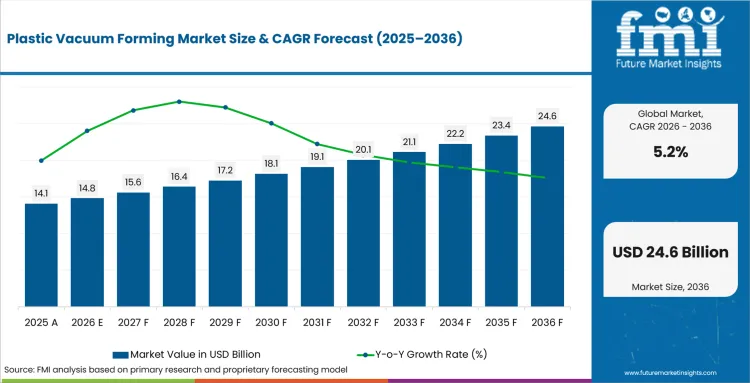
USD 14.8 billion in 2026 and USD 24.6 billion by 2036 at a 5.2% CAGR.
Sales of plastic vacuum forming are estimated to rise at 5.2% CAGR through 2036, increasing valuation from USD 14.8 billion in 2026 to USD 24.6 billion by 2036. Thermoformed plastics provide packaging manufacturers with cost-effective trays and protective components without requiring extensive tooling investments. Selecting the correct plastic sheet directly determines the achievable draw depth and the final accepted-part cost throughout commercial production runs. The Council of the European Union established mandatory recycled-content targets of 65.0% for single-use plastic bottles by 2040 during December 2024. Strict material regulations actively push manufacturers to document exact resin compositions during package qualification and formal production approval.
Purchasing teams across Canada and Germany strongly prefer verified recycled-content records alongside highly stable sheet performance. Manufacturing programs throughout Japan and Mexico focus their evaluations on dimensional repeatability and rapid local tooling responses. HM Revenue & Customs announced a 30.0% recycled-plastic exemption threshold under its mass-balance measure during November 2025. Escalating evidential duties naturally drive industry interest toward fully traceable sheet inputs and rigorously controlled production records.
Key Takeaways for the Plastic Vacuum Forming Market
- Demand for plastic vacuum forming is supported by economical tooling and shorter product-development cycles.
- Direct sales are likely to garner 42.0% share of distribution channel in 2026, backed by direct engineering contact influencing tool correction and material approval during qualification.
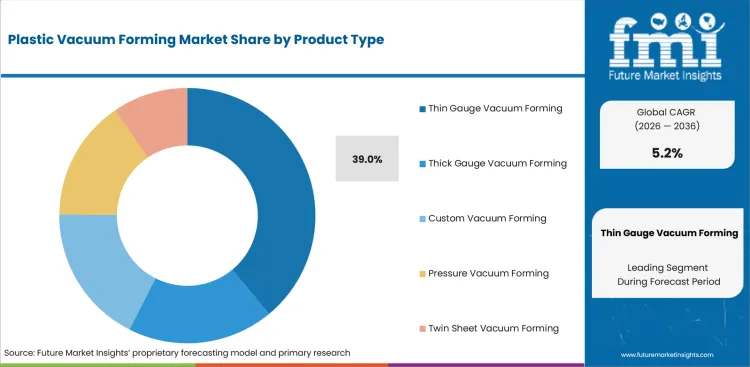
- Thin gauge vacuum forming is estimated to lead product type with 39.0% share in 2026, helped by packaging programs favouring efficient sheet conversion across trays and clamshells.
- Uneven wall thickness and trim waste restrict accepted-part economics across difficult geometries. Recycled-content verification adds documentation duties across resin and sheet records.
- Competition focuses on Novolex, TOPPAN Packaging, Greiner Packaging, Placon, Amcor, Brentwood Industries, Anchor Packaging, and TekniPlex. Suppliers differentiate through tool engineering and application support.
Analyst Perspective
“Plastic vacuum forming produces commercial value through controlled wall distribution and dependable accepted-part economics. Buyers examine sheet utilisation and trim recovery during supplier review. Better order conversion follows production evidence collected under customer operating conditions.”
- Nikhil Kaitwade, Principal Analyst, Future Market Insights
How is Plastic Vacuum Forming Market segmented?
The plastic vacuum forming industry is segmented by product type, application, end user, distribution channel, material, and region.
The plastic vacuum forming industry is segmented by product type, application, end user, distribution channel, material, and region. Product type coverage includes thin gauge vacuum forming, thick gauge vacuum forming, custom vacuum forming, pressure vacuum forming, and twin sheet vacuum forming. Application coverage includes packaging, automotive, healthcare, consumer goods, and industrial equipment. End-user coverage spans the food and beverage industry, automotive industry, healthcare industry, consumer electronics, and industrial manufacturing. Distribution channel coverage includes direct sales, industrial distributors, packaging solution providers, online sales, and retail and dealer networks. Material coverage comprises polyethylene terephthalate (PET), polystyrene (PS), polypropylene (PP), polyvinyl chloride (PVC), and other plastics. Regional coverage includes North America, Latin America, Western Europe, Eastern Europe, East Asia, South Asia and Pacific, Middle East and Africa.
What keeps thin gauge vacuum forming central to product type selection?
Thin gauge vacuum forming supports packaging programs requiring shallow draws and efficient sheet conversion. Designers compare wall distribution and trim layout during tool approval. Placon reported machine-jam reductions exceeding 50.0% for custom recycled-PET vending containers in January 2025, demonstrating recurring performance across automated vending programs. Formed-part geometry influences maintenance interruptions and customer service performance.
- Based on product type, thin gauge vacuum forming is predicted to represent 39.0% share in 2026 due to shallow-draw packaging and efficient sheet conversion. Tray and clamshell programs favour rapid cycles with controlled corners and sealing flanges.
- Thick gauge vacuum forming and custom vacuum forming address housings and lower-volume industrial parts requiring greater rigidity. Early tool simulation limits correction costs across approved geometries and material gauges.
Why does packaging lead application demand?
Greiner Packaging reported an 80.0% weight reduction for a thermoformed PET spice package in January 2025, reinforcing package comparisons across sauces and spices. Lower package mass supports freight efficiency without removing sealing requirements. Packaging converts plastic sheet into trays and containers used across food and consumer programs. Product protection requires stable sealing surfaces and dependable dimensional repeatability.
- In 2026, Packaging is anticipated to hold 36.0% share owing to its position across high-volume packaging programs. Recurring food and retail programs support demand across thermoformed trays and clamshell formats.
- Consumer goods and industrial equipment create separate geometry and compliance requirements. Supplier review covers tool maintenance and material performance across each operating environment.
What supports food & beverage industry across end user demand?
Food & Beverage Industry uses formed packaging for portion control and refrigerated distribution. Shelf-life requirements influence resin choice and flange design throughout package development. Placon launched Fresh ’n Clear dip cups across 4 sizes in March 2025, demonstrating product expansion across refrigerated food packaging. Standard sizes shorten package selection for producers preparing new hummus and spread programs.
- By end user, food & beverage industry is likely to account for 32.0% share in 2026 as it is driven by recurring demand for formed food packages. Qualification covers sealing performance and line compatibility under commercial filling conditions.
- Automotive industry and industrial manufacturing purchase formed parts for protection and structural duties. Shared tooling disciplines improve production transfer across rigid food containers and industrial components.
Why does direct sales lead distribution channel selection?
Placon opened a 150,000-square-foot Costa Rica warehouse in June 2025, extending distribution coverage for medical-packaging customers. Regional inventory reduces supply interruptions and avoidable package revalidation. Direct sales connect part design and production approval inside one commercial relationship. Complex parts require prompt technical exchange between customer engineers and forming specialists.
- Direct sales are forecast to capture 42.0% share of distribution channel in 2026, driven by direct engineering review during customer qualification. Account teams coordinate drawings and resin records throughout customer qualification.
- Packaging solution providers and retail & dealer network serve standard formats and smaller orders. Channel viability rests on stock availability and suitable technical support.
How does polyethylene terephthalate (pet) shape material selection?
Placon reported 25.0% post-consumer recycled PET in its comb-honey clamshell during August 2025, expanding recycled-content options across comb-honey packaging. Material evidence supports approval across production and retail presentation. Polyethylene terephthalate (PET) combines clarity and forming performance across PET packaging programs. Food-contact applications require traceable resin handling and dependable extrusion behaviour.
- Polyethylene terephthalate (PET) is set to garner 31.0% share, backed by clarity and food-contact forming performance. Clear packaging and established recycled-resin channels support its position across transparent plastic packaging.
- Polyvinyl chloride (PVC) and other plastics retain roles linked to heat resistance and impact performance. Material substitution requires renewed testing across sealing and transport conditions.
What are drivers, restraints, and opportunities in Plastic Vacuum Forming Market?
Shorter product programs support formed-part demand and weak yield control slows commercial conversion. Recycled-content designs create expansion potential across qualified packaging and component programs.
- Driver: Packaging and component teams seek economical tooling across moderate production volumes. Vacuum forming supports prompt sampling during design approval and customer testing.
- Restraint: Uneven wall distribution and trim losses weaken accepted-part economics across complex geometries. Production transfer creates rework exposure if heating profiles vary between sites.
- Opportunity: Mono-material structures and recovered sheet content improve access to circular packaging specifications. In-line trim recovery strengthens material efficiency across recurring production programs.
Food producers require varied package formats without committing to injection-moulding tool expense. Greiner Packaging reported in November 2025 stating its thermoformed Flapper Lid used up to 35.0% less plastic than an injection-moulded lid, supporting comparison with injection-moulded closures. Material reduction improves package economics under accepted sealing and handling performance.
Recycling requirements increase documentation duties across resin purchase and sheet extrusion. Environment and Climate Change Canada reported a plastics recycling rate below 10.0% in April 2024, establishing a national baseline for packaging recovery. Weak recovery intensifies scrutiny of formed packaging lacking credible collection pathways.
Self-separating designs create an opening for recyclable thermoforms serving established food programs. Greiner Packaging reported recyclability of up to 98.0% for its K3 r100 package in February 2025, supporting retailer adoption across established food programs. Easier material separation improves compatibility with sorting and recycling processes.
How are country CAGRs aligned in Plastic Vacuum Forming Market?
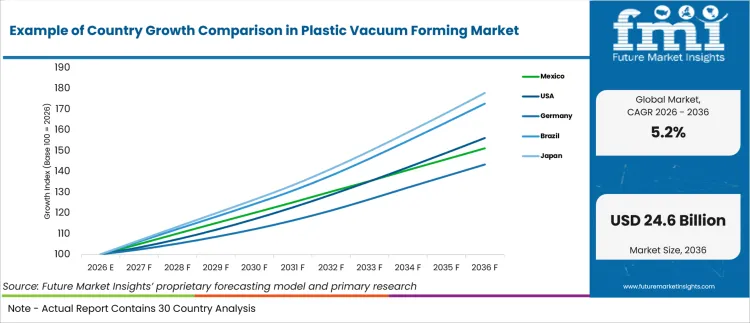
| Country or Market | CAGR |
|---|---|
| Canada | 6.4% |
| Japan | 5.9% |
| Brazil | 5.6% |
| UK | 5.0% |
| USA | 4.5% |
| Mexico | 4.2% |
| Germany | 3.7% |
Source: Future Market Insights analysis, 2026.
How do country-level CAGRs compare in Plastic Vacuum Forming Market?
Country comparison shows a gradual step-down across profiled countries. Canada occupies the upper end of the range, followed by Japan. Brazil and United Kingdom form the middle forecast band. United States and Mexico follow under established production systems. Germany completes the disclosed comparison. A 2.7 percentage-point spread separates Canada from Germany. Profiled rates reflect comparable expansion prospects under distinct operating conditions.
- Canada is anticipated to lead the comparison and place North America at the upper forecast position.
- Japan is likely to follow Canada and maintain a limited difference from the leading rate.
- Brazil is expected to occupy the next band through food-packaging demand and local resin access.
- The United Kingdom and United States are projected to form the central rate group under documentation-led approval systems.
- Mexico is likely to follow United States through automotive integration and cross-border production.
- Germany is predicted to complete the comparison under recycling and specification controls.
- Profiled rates create a gradual downward slope without sharp national separation.
Markets carrying similar CAGRs are expected to present distinct entry conditions based on tooling approval and service access. Full report coverage includes North America, Latin America, Western Europe, Eastern Europe, East Asia, South Asia and Pacific, Middle East and Africa.
Country-wise Analysis
- Plastic vacuum forming market in Canada is forecast to expand at 6.4% CAGR between 2026 and 2036, guided by food-packaging use and resin-reporting duties. Statistics Canada recorded 96,000 employees in plastics and rubber products manufacturing during December 2025, reinforcing manufacturing capability across formed-product programs. Local qualification favours dependable sheet supply and engineering response.
- Kao Corporation reported 9 companies participating in a PET chemical-recycling initiative during May 2025, connecting industrial film and bottle feedstocks with resin recovery. Cross-industry collection supports material development across packaging and formed-component programs. Demand in Japan is estimated to rise at 5.9% CAGR during the study period, aided by strict material review and dimensional approval.
- Local resin availability supports formed packaging across food and consumer applications in Brazil. Industry in Brazil is projected to record 5.6% CAGR from 2026 to 2036, reflecting established converting demand and recycled-material access. Braskem reported approximately 85,000 tonnes of recycled-content resins sold during 2024 in its May 2026 release, expanding documented material choices for plastic forming.
- Sales in the United Kingdom are anticipated to scale at 5.0% CAGR during the forecast period, underpinned by regulated packaging use and established converting activity. HM Revenue & Customs reported a 51.0% share of remaining declared tonnage meeting its recycled-content threshold in August 2025, highlighting widespread use of qualifying recycled material. Tax records encourage traceable material specifications during formed-package approval.
- U.S. Bureau of Labor Statistics recorded 590,500 plastics-product manufacturing jobs in December 2025, demonstrating the scale of domestic plastics employment. Manufacturing depth supports technical access and recurring qualification across food and medical programs. Industry in the United States is predicted to grow at 4.5% CAGR during the assessment period, backed by established forming capacity and customer approval procedures.
- Automotive integration supports shaped components and transport trays across Mexican production sites. Demand in Mexico is projected to record 4.2% CAGR from 2026 to 2036, helped by cross-border manufacturing and local tool support. National Institute of Statistics and Geography reported 3,709,533 light vehicles produced during 2025 through its December 2025 publication, sustaining component qualification across automotive supply networks.
- Industry in Germany is forecast to expand at 3.7% CAGR between 2026 and 2036, driven by disciplined packaging approval and industrial demand. German Environment Agency reported a 70.0% material-recycling rate for plastic packaging during 2024 in its January 2026 release, reinforcing expectations for sortable structures and verified resin composition. Technical selection favours precision and stable production yield.
Who are notable companies in Plastic Vacuum Forming Market?
Novolex, TOPPAN Packaging, Greiner Packaging, Placon, Amcor, Brentwood Industries, Anchor Packaging, and TekniPlex are the notable companies shaping thermoformed containers competition.
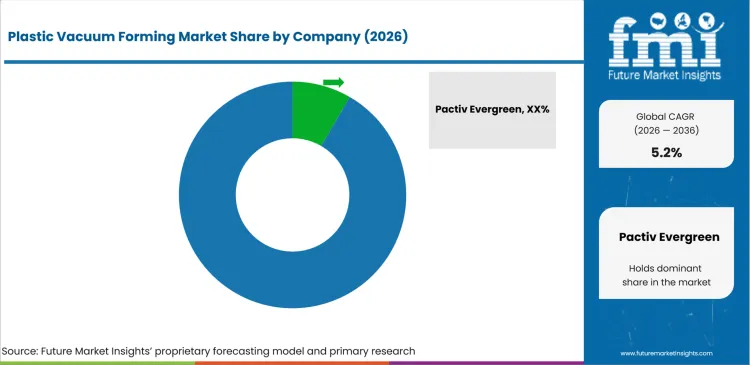
Competition centres on thermoforming depth and application engineering across food and medical programs. Integrated packaging groups combine material access with multiple manufacturing sites. Specialist thermoformers focus on geometry control and short development cycles. Medical suppliers emphasise cleanroom production and validation support. Buyer review covers tool ownership and production transfer during supplier approval.
- Novolex and TOPPAN Packaging compete based on extensive food-packaging portfolios and multiple production sites. Customer teams assess material consistency and technical response across recurring programs.
- Greiner Packaging and Placon compete led by thermoforming knowledge connected with recycled PET and custom package design. Product teams examine tool development and accepted-part quality during commercial review.
- Amcor and Brentwood Industries compete driven by medical and industrial forming capabilities. Regulated customers assess cleanroom production and validation support during supplier selection.
- Anchor Packaging and TekniPlex compete due to foodservice containers and processor trays. Buyers examine product protection and material options across filling and distribution conditions.
Competitive Benchmarking: Plastic Vacuum Forming Market
| Company | Thermoforming Portfolio | Material Capability | Application Engineering | Service Reach |
|---|---|---|---|---|
| Novolex | High | High | Medium | North America |
| TOPPAN Packaging | High | High | High | Multi-country |
| Greiner Packaging | High | High | High | Multi-country |
| Placon | High | High | High | North and Central America |
| Amcor | High | High | High | Global |
| Brentwood Industries | High | Medium | High | North America and selected international programs |
| Anchor Packaging | Medium | High | Medium | North America |
| TekniPlex | High | High | High | Global |
Source: Future Market Insights competitive analysis, 2026.
Key Developments in the Plastic Vacuum Forming Market
- In January 2025, TekniPlex presented processor trays made from 100.0% PET with post-consumer recycled content. Product availability expanded material choices for clear protein trays using established PET recovery streams.
- In April 2025, TOPPAN Holdings completed its acquisition of Sonoco’s Thermoformed and Flexible Packaging business. Integration expanded food and medical packaging capability across North and South America.
- In October 2025, Amcor launched AmSecure APET-based thermoformed trays and rollstock. New formats extended medical-packaging options across standard sterilisation processes and multiple qualified material sources.
Plastic Vacuum Forming Market Report Scope
| Coverage field | Report scope |
|---|---|
| Market breakdown | Product Type, Application, End User, Distribution Channel, Material, and Region. |
| Market Definition | Plastic vacuum forming covers thin-gauge and heavy-gauge plastic products manufactured through heated-sheet forming over tools using vacuum pressure. Coverage includes packaging, foodservice, medical, automotive, industrial, and consumer applications. Injection-moulded products and machinery revenue without formed-product output are excluded. |
| Regions Covered | North America, Latin America, Western Europe, Eastern Europe, East Asia, South Asia and Pacific, Middle East and Africa. |
| Countries Covered | Canada, Japan, Brazil, UK, USA, Mexico, Germany, and additional countries included within the full regional model. |
| Key Companies Profiled | Novolex, TOPPAN Packaging, Greiner Packaging, Placon, Amcor, Brentwood Industries, Anchor Packaging, and TekniPlex. |
| Forecast Period | 2026 to 2036 |
| Approach | Hybrid bottom-up and top-down methodology uses segment shares and country CAGRs. Company activity and buyer qualification evidence support final market reconciliation. |
Source: Future Market Insights analysis, 2026.
Plastic Vacuum Forming Market - Research Methodology
| Method | Approach |
|---|---|
| Primary Research | FMI analysts gathered input from manufacturers, service providers, technology developers, distributors, end users, procurement teams, and subject-matter experts. Interviews examined purchasing decisions, product or service evaluation, adoption barriers, approval requirements, pricing considerations, and expectations for technical or commercial support. Respondents were also asked what evidence is required before a trial, pilot, or initial order develops into regular purchasing. |
| Desk Research | Desk research covered government statistics, regulatory publications, trade data, industry associations, technical literature, standards, company filings, product information, and official corporate announcements. Sources were reviewed for relevance, publication date, geographic coverage, and consistency with the defined market scope. Claims relating to performance, applications, approvals, capacity, investment, and commercial activity were retained only when supported by credible public evidence. |
| Market Sizing and Forecasting | The market model combined the baseline value with historical performance, segment structure, pricing and volume indicators, adoption levels, company participation, and country-level demand conditions. Forecast assumptions considered economic activity, investment trends, regulatory developments, technology adoption, purchasing cycles, supply availability, and barriers to wider market use. Segment and regional estimates were reconciled before the final market total was calculated. |
| Data Validation | Estimates were checked against multiple independent indicators, including public data, company activity, trade patterns, industry developments, and findings from primary interviews. Validation also tested whether products, services, applications, and company revenues fell within the defined market boundaries. Adjacent categories, unsupported claims, overlapping revenues, and activities without direct market relevance were excluded to reduce double counting and maintain consistency across segments and countries. |
Source: Future Market Insights analysis, 2026.
Plastic Vacuum Forming Market by Segments
Plastic Vacuum Forming Market segmented by Product Type:
- Thin Gauge Vacuum Forming
- Thick Gauge Vacuum Forming
- Custom Vacuum Forming
- Pressure Vacuum Forming
- Twin Sheet Vacuum Forming
Plastic Vacuum Forming Market segmented by Application:
- Packaging
- Automotive
- Healthcare
- Consumer Goods
- Industrial Equipment
Plastic Vacuum Forming Market segmented by End User:
- Food & Beverage Industry
- Automotive Industry
- Healthcare Industry
- Consumer Electronics
- Industrial Manufacturing
Plastic Vacuum Forming Market segmented by Distribution Channel:
- Direct Sales
- Industrial Distributors
- Packaging Solution Providers
- Online Sales
- Retail & Dealer Network
Plastic Vacuum Forming Market segmented by Material:
- Polyethylene Terephthalate (PET)
- Polystyrene (PS)
- Polypropylene (PP)
- Polyvinyl Chloride (PVC)
- Other Plastics
Plastic Vacuum Forming Market segmented by Region:
- North America
- United States
- Canada
- Latin America
- Brazil
- Mexico
- Argentina
- Chile
- Western Europe
- Germany
- France
- United Kingdom
- Italy
- Spain
- Benelux
- Nordics
- Eastern Europe
- Poland
- Czech Republic
- Romania
- Hungary
- East Asia
- China
- Japan
- South Korea
- South Asia and Pacific
- India
- ASEAN
- Australia and New Zealand
- Middle East and Africa
- GCC Countries
- South Africa
- Türkiye
- Israel
Research Sources and Bibliography
- Amcor. (2025, October 16). Amcor launches AmSecure™ thermoformed trays and rollstock, part of the HealthCare™ portfolio.
- Braskem. (2026, May 17). Integration among industry, brands, and cooperatives drives plastic recycling in Brazil.
- Council of the European Union. (2024, December 16). Sustainable packaging: Council signs off on new rules for less waste and more re-use in the EU.
- Environment and Climate Change Canada. (2024, April 22). The Government of Canada requires producers to take more responsibility for the plastic they put on the market.
- German Environment Agency. (2026, January 27). Facts against myths: Packaging waste recycling in Germany is working.
- Greiner Packaging. (2025, January 20). Which solution for sauces and spices really scores: Glass or plastic?
- Greiner Packaging. (2025, February 26). UK retailers choose Greiner Packaging’s self-separating K3® r100 packaging.
- Greiner Packaging. (2025, November 25). Maximum user-friendliness: The Flapper Lid.
- HM Revenue & Customs. (2025, August 28). Plastic Packaging Tax (PPT) statistics commentary.
- HM Revenue & Customs. (2025, November 26). Plastic Packaging Tax: mass balance approach and removal of pre-consumer plastic.
- Kao Corporation. (2025, May 14). Cross-industry collaboration in PET chemical recycling to expand sourcing of feedstocks for non-food contact materials.
- National Institute of Statistics and Geography. (2025, December 8). Administrative record of the light vehicle automotive industry: November 2025.
- Placon. (2025, January 14). Placon Wins 2025 WorldStar Award for Farmer’s Fridge Vending Containers.
- Placon. (2025, March 31). Placon Launches New Dip Cup Container Line.
- Placon. (2025, June 2). Placon Announces New Costa Rica Warehouse and Distribution Facility.
- Placon. (2025, August 7). Placon Wins 2025 AmeriStar Award for Comb Honey Packaging.
- Statistics Canada. (2026, March 17). Manufacturing labour in 2025: Losses down the line amid trade headwinds.
- TekniPlex. (2025, January 10). At IPPE, TekniPlex Consumer Products to Highlight New US Facility for Specialty Molded Fiber, and Its Range of Sustainability-minded Processor Trays.
- TOPPAN Holdings Inc. (2025, April 1). TOPPAN Holdings Completes Acquisition of Sonoco’s Flexible & Thermoformed Packaging Business.
- U.S. Bureau of Labor Statistics. (2025, December). Table B-1a. Employees on nonfarm payrolls by industry sector and selected industry detail, seasonally adjusted.
This bibliography is provided for reader reference and is not exhaustive. The full report contains the complete reference list and detailed citations.
This Report Answers
- How do product type and application influence demand across plastic vacuum forming?
- What criteria guide buyers evaluating formed parts prior to commercial approval?
- Why do country CAGRs differ across profiled plastic vacuum forming accounts?
- What companies compete through tooling and material capabilities?
- How are forecasts validated through bottom-up and top-down analysis?
- What evidence supports customer review prior to recurring production orders?
- Why do wall distribution and trim yield influence supplier selection?
- How does recycled-content verification affect medical device packaging approval?
- What company capabilities improve confidence across blister packaging programs?
- How does vacuum thermoformed packaging support adjacent demand?
Frequently Asked Questions
How big is the Plastic Vacuum Forming Market in 2026?
The plastic vacuum forming market is valued at USD 14.8 billion in 2026 and is forecast to reach USD 24.6 billion by 2036. Growth is supported by economical tooling and shorter product-development cycles that sustain recurring demand for thermoformed packaging across established manufacturing programs.
What is the CAGR of the Plastic Vacuum Forming Market from 2026 to 2036?
The plastic vacuum forming market grows at a CAGR of 5.2% between 2026 and 2036, supported by manufacturers seeking economical tooling and prompt sampling during design approval, as packaging and component programs favor shorter development cycles across moderate production volumes.
Which product type leads the Plastic Vacuum Forming Market?
Thin gauge vacuum forming accounts for 39.0% of the plastic vacuum forming market by product type in 2026, driven by packaging programs favoring shallow-draw geometries and efficient sheet conversion that let converters run rapid cycles across trays and clamshells.
How much will the Plastic Vacuum Forming Market add between 2026 and 2036?
The plastic vacuum forming market is set to add USD 9.8 billion between 2026 and 2036, growing from USD 14.8 billion to USD 24.6 billion as recycled-content designs and mono-material structures expand access to circular packaging specifications across production programs.
Who are the leading companies in the Plastic Vacuum Forming Market?
Eight companies lead the plastic vacuum forming market, including Novolex, TOPPAN Packaging, Greiner Packaging, Placon, Amcor, Brentwood Industries, Anchor Packaging, and TekniPlex, competing through thermoforming depth, material capability, and application engineering across food, medical, and industrial packaging programs.
Preview the report firsthand - request a free sample
Get SampleGet the brochure for pricing and purchase details.
Get PDFTable of Content
- Key Takeaways
- Market Size and CAGR
- Top Growth Driver
- Fastest Growing Segment
- Leading Region
- Key Companies
- Emerging Opportunities
- Executive Summary
- Global Market Outlook
- Demand-side Trends
- Supply-side Trends
- Technology Roadmap Analysis
- Analysis and Recommendations
- Analyst Perspective (What is happening? Why now? What should investors know?)
- Key Questions Answered
- How large is the market?
- What is the CAGR?
- What are key trends?
- Which region dominates?
- Who are the leaders?
- Market Overview
- Market Coverage / Taxonomy
- Market Definition / Scope / Limitations
- Research Methodology
- Chapter Orientation
- Analytical Lens and Working Hypotheses
- Market Structure, Signals, and Trend Drivers
- Benchmarking and Cross-market Comparability
- Market Sizing, Forecasting, and Opportunity Mapping
- Research Design and Evidence Framework
- Desk Research Programme (Secondary Evidence)
- Expert Input and Fieldwork (Primary Evidence)
- Tooling, Models, and Reference Databases
- Data Engineering and Model Build
- Quality Assurance and Audit Trail
- Market Background
- Market Dynamics (Drivers, Restraints, Opportunity, Trends)
- Scenario Forecast (Optimistic, Likely, Conservative)
- Impact Analysis
- AI Impact
- Sustainability Impact
- Regulatory Impact
- Technology Impact
- Consumer / Buyer Analysis
- Purchase Drivers
- Adoption Barriers
- Buyer Journey
- Opportunity Map Analysis
- Product Life Cycle Analysis
- Supply Chain Analysis
- Investment Feasibility Matrix
- Value Chain Analysis
- PESTLE and Porter's Analysis
- Regulatory Landscape
- Regional Parent Market Outlook
- Production and Consumption Statistics
- Import and Export Statistics
- Global Market Analysis and Forecast, 2021 to 2036
- Historical Market Size Value (USD Billion) Analysis, 2021 to 2025
- Current and Future Market Size Value (USD Billion) Projections, 2026 to 2036
- Y-o-Y Growth Trend Analysis
- Absolute $ Opportunity Analysis
- Global Market Pricing Analysis, 2021 to 2036
- Global Market Analysis and Forecast, By Product Type, 2021 to 2036
- Introduction / Key Findings
- Historical Market Size Value (USD Billion) Analysis By Product Type, 2021 to 2025
- Current and Future Market Size Value (USD Billion) Analysis and Forecast By Product Type, 2026 to 2036
- Thin Gauge Vacuum Forming
- Disposable Packaging
- Blister Packaging
- Thick Gauge Vacuum Forming
- Industrial Components
- Equipment Housings
- Custom Vacuum Forming
- Prototype Parts
- Low-Volume Production
- Pressure Vacuum Forming
- High-Definition Components
- Textured Parts
- Twin Sheet Vacuum Forming
- Hollow Plastic Structures
- Double-Wall Components
- Thin Gauge Vacuum Forming
- Y-o-Y Growth Trend Analysis By Product Type, 2021 to 2025
- Absolute $ Opportunity Analysis By Product Type, 2026 to 2036
- Global Market Analysis and Forecast, By Application, 2021 to 2036
- Introduction / Key Findings
- Historical Market Size Value (USD Billion) Analysis By Application, 2021 to 2025
- Current and Future Market Size Value (USD Billion) Analysis and Forecast By Application, 2026 to 2036
- Packaging
- Food Packaging
- Consumer Goods Packaging
- Automotive
- Interior Components
- Dashboard Panels
- Healthcare
- Medical Trays
- Device Packaging
- Consumer Goods
- Appliance Components
- Retail Displays
- Industrial Equipment
- Machine Covers
- Protective Enclosures
- Packaging
- Y-o-Y Growth Trend Analysis By Application, 2021 to 2025
- Absolute $ Opportunity Analysis By Application, 2026 to 2036
- Global Market Analysis and Forecast, By End User, 2021 to 2036
- Introduction / Key Findings
- Historical Market Size Value (USD Billion) Analysis By End User, 2021 to 2025
- Current and Future Market Size Value (USD Billion) Analysis and Forecast By End User, 2026 to 2036
- Food & Beverage Industry
- Food Processors
- Beverage Manufacturers
- Automotive Industry
- Vehicle OEMs
- Aftermarket Suppliers
- Healthcare Industry
- Medical Device Manufacturers
- Pharmaceutical Companies
- Consumer Electronics
- Electronics Manufacturers
- Appliance Producers
- Industrial Manufacturing
- OEM Manufacturers
- Contract Manufacturers
- Food & Beverage Industry
- Y-o-Y Growth Trend Analysis By End User, 2021 to 2025
- Absolute $ Opportunity Analysis By End User, 2026 to 2036
- Global Market Analysis and Forecast, By Distribution Channel, 2021 to 2036
- Introduction / Key Findings
- Historical Market Size Value (USD Billion) Analysis By Distribution Channel, 2021 to 2025
- Current and Future Market Size Value (USD Billion) Analysis and Forecast By Distribution Channel, 2026 to 2036
- Direct Sales
- OEM Contracts
- Enterprise Supply Agreements
- Industrial Distributors
- Authorized Distributors
- Regional Wholesalers
- Packaging Solution Providers
- Custom Packaging Suppliers
- Value-Added Distributors
- Online Sales
- Manufacturer Websites
- B2B E-commerce Platforms
- Retail & Dealer Network
- Industrial Retailers
- Local Dealers
- Direct Sales
- Y-o-Y Growth Trend Analysis By Distribution Channel, 2021 to 2025
- Absolute $ Opportunity Analysis By Distribution Channel, 2026 to 2036
- Global Market Analysis and Forecast, By Material, 2021 to 2036
- Introduction / Key Findings
- Historical Market Size Value (USD Billion) Analysis By Material, 2021 to 2025
- Current and Future Market Size Value (USD Billion) Analysis and Forecast By Material, 2026 to 2036
- Polyethylene Terephthalate (PET)
- Amorphous PET
- Recycled PET
- Polystyrene (PS)
- High Impact PS
- General Purpose PS
- Polypropylene (PP)
- Homopolymer PP
- Copolymer PP
- Polyvinyl Chloride (PVC)
- Rigid PVC
- Clear PVC
- Other Plastics
- ABS
- HDPE
- Polyethylene Terephthalate (PET)
- Y-o-Y Growth Trend Analysis By Material, 2021 to 2025
- Absolute $ Opportunity Analysis By Material, 2026 to 2036
- Global Market Analysis and Forecast, By Region, 2021 to 2036
- Introduction
- Historical Market Size Value (USD Billion) Analysis By Region, 2021 to 2025
- Current Market Size Value (USD Billion) Analysis and Forecast By Region, 2026 to 2036
- North America
- Latin America
- Western Europe
- Eastern Europe
- East Asia
- South Asia and Pacific
- Middle East & Africa
- Market Attractiveness Analysis By Region
- North America Market Analysis and Forecast, By Country, 2021 to 2036
- Historical Market Size Value (USD Billion) Trend Analysis By Market Taxonomy, 2021 to 2025
- Market Size Value (USD Billion) Forecast By Market Taxonomy, 2026 to 2036
- By Country
- USA
- Canada
- By Product Type
- By Application
- By End User
- By Distribution Channel
- By Material
- By Country
- Market Attractiveness Analysis
- By Country
- By Product Type
- By Application
- By End User
- By Distribution Channel
- By Material
- Key Takeaways
- Latin America Market Analysis and Forecast, By Country
- Historical Market Size Value (USD Billion) Trend Analysis By Market Taxonomy, 2021 to 2025
- Market Size Value (USD Billion) Forecast By Market Taxonomy, 2026 to 2036
- By Country
- Brazil
- Mexico
- Chile
- Rest of Latin America
- By Product Type
- By Application
- By End User
- By Distribution Channel
- By Material
- By Country
- Market Attractiveness Analysis
- By Country
- By Product Type
- By Application
- By End User
- By Distribution Channel
- By Material
- Key Takeaways
- Western Europe Market Analysis and Forecast, By Country
- Historical Market Size Value (USD Billion) Trend Analysis By Market Taxonomy, 2021 to 2025
- Market Size Value (USD Billion) Forecast By Market Taxonomy, 2026 to 2036
- By Country
- Germany
- UK
- Italy
- Spain
- France
- Nordic
- BENELUX
- Rest of Western Europe
- By Product Type
- By Application
- By End User
- By Distribution Channel
- By Material
- By Country
- Market Attractiveness Analysis
- By Country
- By Product Type
- By Application
- By End User
- By Distribution Channel
- By Material
- Key Takeaways
- Eastern Europe Market Analysis and Forecast, By Country
- Historical Market Size Value (USD Billion) Trend Analysis By Market Taxonomy, 2021 to 2025
- Market Size Value (USD Billion) Forecast By Market Taxonomy, 2026 to 2036
- By Country
- Russia
- Poland
- Hungary
- Balkan & Baltic
- Rest of Eastern Europe
- By Product Type
- By Application
- By End User
- By Distribution Channel
- By Material
- By Country
- Market Attractiveness Analysis
- By Country
- By Product Type
- By Application
- By End User
- By Distribution Channel
- By Material
- Key Takeaways
- East Asia Market Analysis and Forecast, By Country
- Historical Market Size Value (USD Billion) Trend Analysis By Market Taxonomy, 2021 to 2025
- Market Size Value (USD Billion) Forecast By Market Taxonomy, 2026 to 2036
- By Country
- China
- Japan
- South Korea
- By Product Type
- By Application
- By End User
- By Distribution Channel
- By Material
- By Country
- Market Attractiveness Analysis
- By Country
- By Product Type
- By Application
- By End User
- By Distribution Channel
- By Material
- Key Takeaways
- South Asia and Pacific Market Analysis and Forecast, By Country
- Historical Market Size Value (USD Billion) Trend Analysis By Market Taxonomy, 2021 to 2025
- Market Size Value (USD Billion) Forecast By Market Taxonomy, 2026 to 2036
- By Country
- India
- ASEAN
- Australia & New Zealand
- Rest of South Asia and Pacific
- By Product Type
- By Application
- By End User
- By Distribution Channel
- By Material
- By Country
- Market Attractiveness Analysis
- By Country
- By Product Type
- By Application
- By End User
- By Distribution Channel
- By Material
- Key Takeaways
- Middle East & Africa Market Analysis and Forecast, By Country
- Historical Market Size Value (USD Billion) Trend Analysis By Market Taxonomy, 2021 to 2025
- Market Size Value (USD Billion) Forecast By Market Taxonomy, 2026 to 2036
- By Country
- Kingdom of Saudi Arabia
- Other GCC Countries
- Türkiye
- South Africa
- Other African Union
- Rest of Middle East & Africa
- By Product Type
- By Application
- By End User
- By Distribution Channel
- By Material
- By Country
- Market Attractiveness Analysis
- By Country
- By Product Type
- By Application
- By End User
- By Distribution Channel
- By Material
- Key Takeaways
- Key Countries Market Analysis
- USA
- Pricing Analysis
- Market Share Analysis, 2025
- By Product Type
- By Application
- By End User
- By Distribution Channel
- By Material
- Canada
- Pricing Analysis
- Market Share Analysis, 2025
- By Product Type
- By Application
- By End User
- By Distribution Channel
- By Material
- Mexico
- Pricing Analysis
- Market Share Analysis, 2025
- By Product Type
- By Application
- By End User
- By Distribution Channel
- By Material
- Brazil
- Pricing Analysis
- Market Share Analysis, 2025
- By Product Type
- By Application
- By End User
- By Distribution Channel
- By Material
- Chile
- Pricing Analysis
- Market Share Analysis, 2025
- By Product Type
- By Application
- By End User
- By Distribution Channel
- By Material
- Germany
- Pricing Analysis
- Market Share Analysis, 2025
- By Product Type
- By Application
- By End User
- By Distribution Channel
- By Material
- UK
- Pricing Analysis
- Market Share Analysis, 2025
- By Product Type
- By Application
- By End User
- By Distribution Channel
- By Material
- Italy
- Pricing Analysis
- Market Share Analysis, 2025
- By Product Type
- By Application
- By End User
- By Distribution Channel
- By Material
- Spain
- Pricing Analysis
- Market Share Analysis, 2025
- By Product Type
- By Application
- By End User
- By Distribution Channel
- By Material
- France
- Pricing Analysis
- Market Share Analysis, 2025
- By Product Type
- By Application
- By End User
- By Distribution Channel
- By Material
- India
- Pricing Analysis
- Market Share Analysis, 2025
- By Product Type
- By Application
- By End User
- By Distribution Channel
- By Material
- ASEAN
- Pricing Analysis
- Market Share Analysis, 2025
- By Product Type
- By Application
- By End User
- By Distribution Channel
- By Material
- Australia & New Zealand
- Pricing Analysis
- Market Share Analysis, 2025
- By Product Type
- By Application
- By End User
- By Distribution Channel
- By Material
- China
- Pricing Analysis
- Market Share Analysis, 2025
- By Product Type
- By Application
- By End User
- By Distribution Channel
- By Material
- Japan
- Pricing Analysis
- Market Share Analysis, 2025
- By Product Type
- By Application
- By End User
- By Distribution Channel
- By Material
- South Korea
- Pricing Analysis
- Market Share Analysis, 2025
- By Product Type
- By Application
- By End User
- By Distribution Channel
- By Material
- Russia
- Pricing Analysis
- Market Share Analysis, 2025
- By Product Type
- By Application
- By End User
- By Distribution Channel
- By Material
- Poland
- Pricing Analysis
- Market Share Analysis, 2025
- By Product Type
- By Application
- By End User
- By Distribution Channel
- By Material
- Hungary
- Pricing Analysis
- Market Share Analysis, 2025
- By Product Type
- By Application
- By End User
- By Distribution Channel
- By Material
- Kingdom of Saudi Arabia
- Pricing Analysis
- Market Share Analysis, 2025
- By Product Type
- By Application
- By End User
- By Distribution Channel
- By Material
- Türkiye
- Pricing Analysis
- Market Share Analysis, 2025
- By Product Type
- By Application
- By End User
- By Distribution Channel
- By Material
- South Africa
- Pricing Analysis
- Market Share Analysis, 2025
- By Product Type
- By Application
- By End User
- By Distribution Channel
- By Material
- USA
- Market Structure Analysis
- Competition Dashboard
- Competition Benchmarking
- Market Share Analysis of Top Players
- By Regional
- By Product Type
- By Application
- By End User
- By Distribution Channel
- By Material
- Emerging Startups
- Innovation Benchmarking
- Competition Analysis
- Competition Deep Dive
- Pactiv Evergreen
- Overview
- Product Portfolio
- Profitability by Market Segments
- Sales Footprint
- Strategy Overview
- Marketing Strategy
- Product Strategy
- Channel Strategy
- Sonoco Products Company
- Greiner Packaging
- Placon Corporation
- Brentwood Industries
- CM Packaging
- Genpak LLC
- DS Smith
- Anchor Packaging
- Dongguan Sincere Tech
- Others
- Pactiv Evergreen
- Case Studies
- Success Stories
- Recent Developments
- Competition Deep Dive
- Assumptions & Acronyms Used


