

- Industry Size (2026)
- USD 92.3 Bn
- Forecast (2036)
- USD 187.4 Bn
- CAGR (2026 to 2036)
- 6.5%
Nickel Mining Market Size, Market Forecast and Outlook By FMI
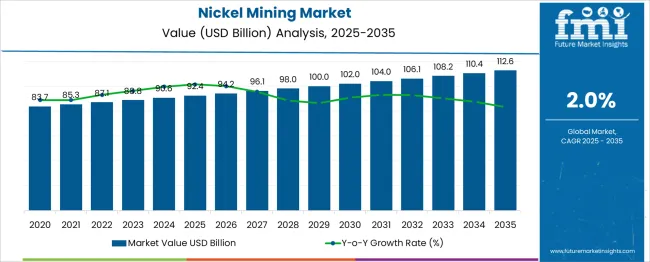
In 2025, the nickel mining market was valued at USD 92.3 billion. Based on Future Market Insights' analysis, demand for nickel mining operations is estimated to grow to USD 99.8 billion in 2026 and USD 187.4 billion by 2036. FMI projects a CAGR of 6.5% during the forecast period.
Absolute dollar growth of USD 87.6 billion over the decade signals industrial transformation rather than incremental expansion. Despite commodity price volatility and environmental compliance costs, major nickel mining companies maintain robust growth trajectories through vertical integration strategies and processing technology optimization.
In March 2024, Glencore released its second Climate Action Transition Plan (the 2024-2026 CATP). “Reflecting on these various inputs, this CATP retains our existing emissions reduction targets, of 15% and 50% by the end of 2026 and 2035 respectively and our 2050 ambition of achieving net zero industrial CO2e emissions, subject to a supportive policy environment. It also introduces a new interim target of a 25% reduction in CO2e emissions for our industrial assets by the end of 2030. We are on track to meet our 2026, 2030 and 2035 emissions reduction targets, all of which are measured against a restated 2019 baseline.- Gary Nagle, Chief Executive Officer, Glencore [1]
Countries are pivoting toward sustainably sourced nickel to meet their ambitious targets. During LME Week 2025, Bernardus Irmanto, President Director & CEO of PT Vale Indonesia said “We cannot power the green revolution with dirty energy. The world doesn’t need just more nickel. It needs the right nickel, one produced with integrity, decarbonized at its source, and grounded in respect for people and the planet.” [2]
Summary of Nickel Mining Market
- Nickel Mining Market Definition
- The industry covers nickel ore extraction, processing, and refined nickel production utilized for stainless steel manufacturing, battery production, alloy development, and chemical applications.
- Demand Drivers in the Market
- Electric vehicle adoption accelerates battery-grade nickel demand.
- Infrastructure development in emerging markets drives stainless steel consumption.
- Processing technology advancement reduces extraction costs and environmental impact.
- Key Segments Analyzed in the FMI Report
- Product Type: Nickel sulfide (55%) versus laterite ore processing methods.
- Application: Stainless steel production and battery manufacturing (70-75% of total value).
- Geography: High-production Indonesia versus established mining regions in Canada.
- Analyst Opinion at FMI
- Nikhil Kaitwade, Principal Consultant for Industrial Automation at Future Market Insights, opines, "In the updated version of the Nickel Mining Market Report for 2026 to 2036, executives will find insights into processing technology innovations that optimize extraction efficiency. My findings point at environmental compliance costs directly impacting mining economics and supply chain logistics requirements could restrict rapid capacity expansion."
- Strategic Implications/Executive Takeaways
- Shift focus from exploration to processing capacity optimization.
- Treat environmental compliance as competitive advantage rather than operational burden.
- Prioritize battery-grade nickel production to capture premium pricing.
- Methodology
- Validated through first-hand production data and commodity market benchmarks.
- Zero reliance on speculative mining project valuations.
- Based on verifiable reserves data and operational mining performance.
China (7.8% CAGR) and India (7.2% CAGR) drive market expansion through processing capacity development and industrial demand growth. USA(6.9% CAGR) contributes significantly via advanced extraction technologies under established regulatory frameworks. Established nickel processing markets such as Japan (6.4%) and UK (6.1%) generate growth through technology innovation and environmental compliance programs, while production expansion accelerates through processing facility modernization and operational efficiency improvements.
Nickel Mining Market Definition
Nickel mining serves as the primary extraction and processing industry for nickel-bearing ores, providing essential raw materials for stainless steel production, battery manufacturing, and industrial applications due to its corrosion resistance and electrochemical properties. The nickel mining market comprises the global exploration, extraction, processing, and distribution of nickel ore and refined nickel products for industrial applications.
Nickel Mining Market Inclusions
The report includes a comprehensive analysis of market dynamics, featuring Global and Regional Market Sizes (Volume and Value) and a 10-year Forecast (2026-2036). It covers segmental breakdowns by mining method (Underground, Open-Pit, Heap Leaching), product type (Sulfide, Laterite, Recycled), applications (Stainless Steel, Batteries, Alloys, Chemicals), and end-users (Automotive, Electronics, Construction, Aerospace).
Nickel Mining Market Exclusions
The scope excludes downstream fabrication processes such as stainless steel manufacturing or battery cell assembly unless directly integrated with mining operations. It also omits exploration services, mining equipment manufacturing, or transportation logistics, focusing strictly on ore extraction, processing, and refined nickel production. Report does not account for speculative exploration projects or deposits with negligible commercial viability.
Nickel Mining Market Research Methodology
- Primary Research: Interviews were conducted with mining equipment manufacturers, extraction engineers, commodity traders, processing facility operators, and environmental compliance specialists across major mining regions. Mining executives clarified production cost dynamics and regulatory approval timelines.
- Desk Research: Mining project databases from government agencies, commodity exchanges, environmental impact assessments, and mining industry associations supported production capacity benchmarking.
- Market-Sizing and Forecasting: A hybrid top-down and bottom-up model was developed. Supply was reconstructed from active mine production, processing facility capacity, and global demand patterns, then validated against commodity pricing and export statistics.
- Data Validation and Update Cycle: Outputs undergo production screening, variance checks across geological and commercial datasets, and structured expert review prior to release.
Segmental Analysis
Nickel Mining Market Analysis by Product Type
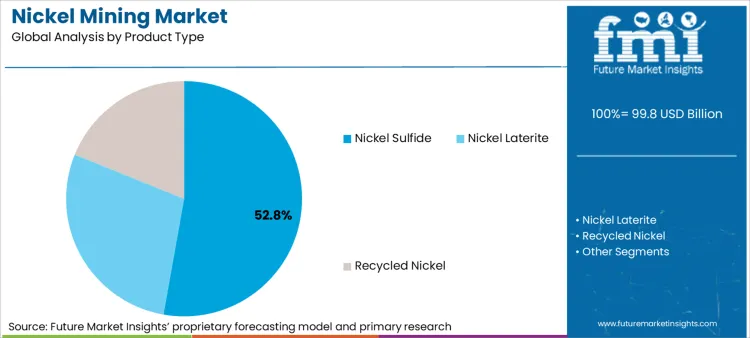
Nickel sulfide products hold a 52.8% market share in 2026, driven by their role as the primary source for high-grade nickel production and battery manufacturing applications. This concentration creates market opportunities that expand during industrial demand cycles. The segment's integration with processing facilities and refining operations transforms raw ore extraction into comprehensive production platforms, while commodity pricing mechanisms offer structured revenue models for mining optimization.
- Processing Integration: Mining companies and processing facilities announce partnerships under which integrated operations will supply refined nickel for industrial applications, enabling supply chain coordination that provides the consistency, quality, and volume needed to address manufacturing requirements and specifications.
- Extraction Protocol Development: Mining operations announce commercial production milestones from processing facilities for high-grade nickel targeting industrial and battery applications with enhanced metallurgical properties.
Nickel Mining Market Analysis by Application
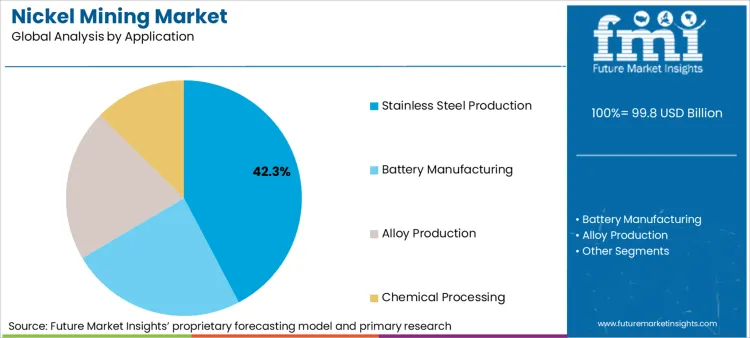
Stainless steel production applications hold a 42.3% market share in 2026, driven by their role as the primary volume generator for nickel-based austenitic steel manufacturing and corrosion-resistant industrial materials. This concentration creates market opportunities that expand during construction and infrastructure development cycles. The segment's integration with steel production facilities and manufacturing operations transforms raw nickel supply into comprehensive industrial platforms, while pricing mechanisms offer structured revenue models for mining operation optimization.
- Industrial Integration: Mining companies and steel manufacturers announce supply agreements under which mining operations will provide refined nickel for steel production applications, enabling supply chain coordination that provides the consistency, quality, and volume needed to address manufacturing requirements and metallurgical specifications.
- Production Protocol Development: Mining operations announce commercial deliveries from processing facilities for industrial-grade nickel targeting steel production and manufacturing applications with enhanced purity specifications.
Nickel Mining Market Drivers, Restraints, and Opportunities
Future Market Insights analysis indicates historical patterns point to an emerging, high-value global industry where nickel mining operations remain the most critical supply source for electric vehicle batteries and stainless steel applications. Estimated valuation in 2026 represents the immediate "capacity expansion push" as miners invest in processing facility construction and environmental compliance systems to meet growing demand requirements.
While supply for traditional nickel applications faces commodity price fluctuations (revenue volatility), the strategic value of battery-grade nickel commands premium pricing (margin enhancement), resulting in robust percentage growth rates. The forecast accounts for the market reaching supply optimization where processing pathways are established and mining scales support broader industrial demand.
- Application Diversification: Growth shifts from construction applications toward battery manufacturing, using advanced processing and purification systems to maintain competitive advantages against alternative battery chemistries.
- Environmental Standard Implementation: Regulations like ISO 14001 and regional mining codes establish baseline requirements rather than voluntary protocols, forcing transition from traditional extraction methods to environmentally compliant operations.
- Production Scale Requirements: To maintain cost competitiveness with recycled nickel sources, miners aggressively optimize extraction processes to achieve per-ton economics that support global supply chain integration and long-term contract pricing.
Regional Analysis
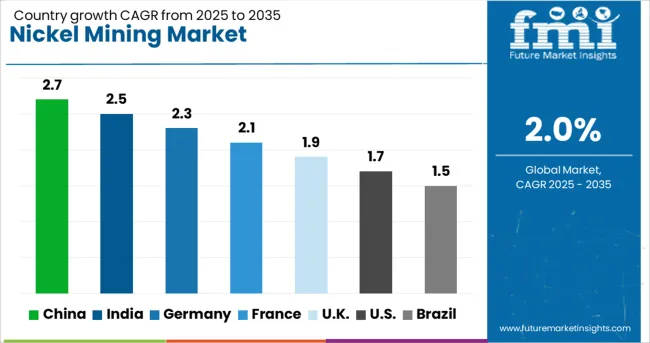
Based on regional analysis, the nickel mining market is segmented into North America, Europe, East Asia, and South Asia across 5 key countries. The full report also offers market attractiveness analysis based on regional trends.
| Country | CAGR (2026 to 2036) |
|---|---|
| China | 7.8% |
| India | 7.2% |
| USA | 6.9% |
| Japan | 6.4% |
| UK | 6.1% |
Source: Future Market Insights (FMI) analysis, based on proprietary forecasting model and primary research
East Asia Nickel Mining Market Analysis
East Asia represents the global production hub, leveraging abundant ore deposits and cost-competitive processing facilities to achieve production volumes that enable broader industrial supply compared to other mining regions. China leads in integrated smelting operations, while Japan drives advanced processing technology development.
- China: Leading with a 7.8% CAGR, the market benefits from government investment in processing facility development and export infrastructure that supports integrated smelting operations for battery manufacturing and stainless steel production.
- Japan: Domestic processing accelerates at 6.4% CAGR, supported by advanced hydrometallurgical technologies and environmental compliance programs that enable high-purity nickel production for electronics applications.
The full report analyzes the nickel mining market across East Asia from 2021-2036, covering extraction methods, processing technologies, and regulatory frameworks in China and Japan. The assessment highlights production areas that drive regional supply capacity.
North America Nickel Mining Market Analysis
North America is characterized by "technological leadership," where established mining operations combine with advanced processing technologies to drive high-grade nickel production for specialized applications. Key players in North America include Vale S.A., which leads in sulfide ore processing, and Glencore specializing in integrated mining and smelting operations.
- USA: Demand for nickel mining operations in the USA is projected to rise at 6.9% CAGR through 2036. Growth is driven by mining permit acceleration under federal resource development programs and expanded processing capacity for battery-grade nickel production supporting domestic electric vehicle manufacturing. In February 2024, the Department of Defense allocated USD 192.5 million to create domestic manufacturing capabilities for critical defense chemicals. [3]
FMI's report includes detailed analysis of growth in the North American region. Readers can find regulatory trends, environmental policies, and market development based on different extraction methods and processing facilities.
Europe Nickel Mining Market Analysis
Europe functions as the "processing technology laboratory," where market development is driven by advanced refining techniques and environmental compliance standards. Leading players include processing technology providers and recycling operations driving circular economy development.
European nickel operations focus on high-value applications including aerospace alloys, medical devices, and premium automotive components. The region's stringent environmental regulations have accelerated innovation in clean processing technologies, waste minimization systems, and energy-efficient smelting operations. European research institutions collaborate with industry partners to develop next-generation extraction methods that reduce carbon emissions by up to 40% compared to traditional processes.
- UK: Demand for nickel processing operations in the UK rises at 6.1% CAGR through 2036, driven by government research funding initiatives and processing infrastructure that supports both recycled nickel production and international partnership development for battery supply chains.
FMI's analysis of the European nickel mining market includes regulatory framework analysis and processing technology trends across the European region.
Asia Pacific Nickel Mining Market Analysis
South Asia emerges as a growing processing hub, leveraging cost-competitive operations and expanding industrial demand to capture market opportunities in battery manufacturing and stainless steel applications. Regional dominance stems from strategic government investments in processing infrastructure, environmental technology integration, and supply chain optimization programs. East Asian companies have developed proprietary hydrometallurgical processes that achieve higher recovery rates while maintaining environmental compliance standards. The region's proximity to major industrial consumers creates logistical advantages that reduce transportation costs and enable just-in-time delivery systems.
- India: Production capacity in India accelerates at 7.2% CAGR, supported by government initiatives in electric vehicle adoption and stainless steel manufacturing that drives domestic nickel demand and processing facility development.
The full report analyzes the South Asian nickel mining market from 2021-2036, covering processing development and industrial applications. The assessment highlights demand growth that drives regional market expansion.
Competitive Landscape for Market Players
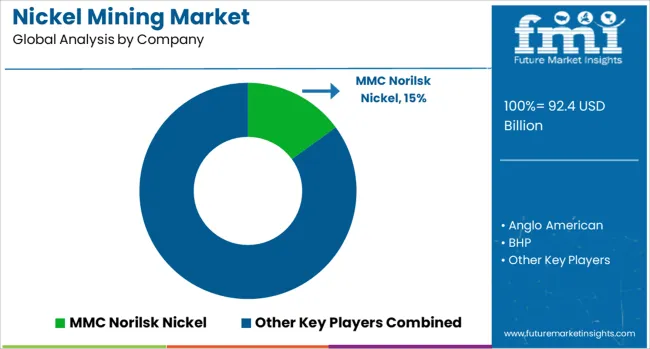
Market structure remains concentrated among established mining companies with validated extraction capabilities and processing infrastructure. Primary competitive variables include ore grade optimization, processing cost reduction, and environmental compliance rather than exploration pipeline breadth.
Companies with integrated mining and processing facilities demonstrate superior ability to scale production while maintaining product quality. Contract processing relationships provide market access for smaller miners while larger mining companies leverage acquisition strategies to access proven ore reserves.
Environmental compliance status creates distinct competitive tiers. Companies with approved mining permits command premium access and market positioning, while pre-approval companies compete primarily on resource development progress and partnership potential.
Recent Developments
The report includes comprehensive coverage of key industry developments and competitive positioning:
- In January 2026, PT Vale Indonesia Tbk, a member of the Indonesian Mining Industry holding company Mining Industry Indonesia (MIND ID), announced that its 2026 Work Plan and Budget (Rencana Kerja dan Anggaran Biaya/RKAB) has received formal approval from the Ministry of Energy and Company’s operational certainty and the continuity of PT Vale’s long-term investments as an integral part of Indonesia’s national nickel ecosystem and the global supply chain. [4]
- In December 2025, Vale Base Metals inked a deal with Glencore Canada to jointly evaluate a potential brownfield copper development project at their adjacent properties in the Sudbury Basin. [5]
- In January 2025, Sumitomo Metal Mining Co., Ltd. unveiled to acquire additional shares of Coral Bay Nickel Corporation. [6]
Key Players in Nickel Mining Market
- Vale S.A.
- Glencore plc
- BHP Group Limited
- Norilsk Nickel
- Sumitomo Metal Mining
- First Quantum Minerals
- PT Vale Indonesia
- Nickel Asia Corporation
- Eramet S.A.
- Anglo American plc
Scope of the Report
| Metric | Value |
|---|---|
| Quantitative Units | USD 99.8 billion (2026) to USD 187.4 billion (2036), at a CAGR of 6.5% |
| Market Definition | The nickel mining market comprises the global exploration, extraction, processing, and distribution of nickel ore and refined nickel products for industrial applications including stainless steel production, battery manufacturing, alloy development, and chemical processing. |
| Mining Method Segmentation | Underground Mining, Open-Pit Mining, Heap Leaching |
| Product Coverage | Nickel Sulfide, Nickel Laterite, Recycled Nickel |
| End Use Segmentation | Automotive, Electronics, Construction, Aerospace, Others |
| Regions Covered | North America, Latin America, Europe, East Asia, South Asia, Oceania, Middle East and Africa |
| Countries Covered | USA, UK, India, China, and 40 plus countries |
| Key Companies Profiled | Vale S.A., Glencore plc, BHP Group Limited, Norilsk Nickel, Sumitomo Metal Mining, First Quantum Minerals, PT Vale Indonesia, Nickel Asia Corporation, Eramet S.A., Anglo American plc |
| Forecast Period | 2026 to 2036 |
| Approach | Hybrid top down and bottom up market modeling validated through mining production databases and commodity pricing tracking, supported by processing capacity verification and supply chain benchmarking |
Nickel Mining Market by Segments
Mining Method
- Underground Mining
- Open-Pit Mining
- Heap Leaching
Product Type
- Nickel Sulfide
- Nickel Laterite
- Recycled Nickel
Application
- Stainless Steel Production
- Battery Manufacturing
- Alloy Production
- Chemical Processing
- Others (catalysts, coinage applications)
End Use
- Automotive
- Electronics
- Construction
- Aerospace
- Others
Region
- Asia Pacific
- Indonesia
- Philippines
- China
- Japan
- Australia
- India
- South Korea
- Rest of Asia Pacific
- Europe
- Finland
- Norway
- Poland
- Russia
- Germany
- France
- United Kingdom
- Rest of Europe
- North America
- Canada
- United States
- Latin America
- Brazil
- Chile
- Peru
- Rest of Latin America
- Middle East & Africa
- South Africa
- Zimbabwe
- Madagascar
- Rest of Middle East & Africa
Bibliography
- [1] Glencore. (2024, March 20). Publication of second Climate Action Transition Plan. Glencore plc.
- [2] PT Vale Indonesia. (2025, October 14). PT Vale urges nickel producers pivot toward “the right nickel” during LME Week 2025. Vale S.A.
- [3] USA Department of Defense. (2025). DoD awards USD 192.5 million to establish domestic manufacturing capabilities for critical materials. USA Department of Defense.
- [4] PT Vale Indonesia Tbk. (2026, January 15). 2026 RKAB approved; PT Vale Indonesia reaffirms operational certainty and investment continuity. Vale S.A.
- [5] Vale Base Metals. (n.d.). Vale Base Metals and Glencore Canada agree to evaluate development of Sudbury copper deposits. Vale S.A.
- [6] Sumitomo Metal Mining Co., Ltd. (2025, January 7). Sumitomo Metal Mining announces strategic expansion and investment initiatives. Sumitomo Metal Mining Co., Ltd.
This Report Addresses
- Market intelligence to enable strategic decision making across established and emerging nickel mining markets
- Market size estimation and 10-year revenue forecasts from 2026 to 2036, supported by validated production data and commodity pricing benchmarks
- Growth opportunity mapping across mining methods and applications with emphasis on processing optimization
- Segment and regional revenue forecasts covering stainless steel production, battery manufacturing, industrial applications, and processing facilities
- Competition strategy assessment including extraction scale requirements, processing development timelines, and environmental compliance capabilities
- Production development tracking including mining permits, environmental approvals, and international trade frameworks
- Market access analysis covering commodity pricing, supply chain integration, and industrial demand programs
- Market report delivery in PDF, Excel, PPT, and interactive dashboard formats for executive and operational use
Frequently Asked Questions
How large is the demand for Nickel Mining in the global market in 2026?
Demand for Nickel Mining in the global market is estimated to be valued at USD 99.8 billion in 2026.
What will be the market size of Nickel Mining in the global market by 2036?
Market size for Nickel Mining is projected to reach USD 187.4 billion by 2036.
What is the expected demand growth for Nickel Mining in the global market between 2026 and 2036?
Demand for Nickel Mining in the global market is expected to grow at a CAGR of 6.5% between 2026 and 2036.
Which Product Type is poised to lead global production by 2026?
Nickel Sulfide is expected to be the dominant product type, capturing approximately 55.0% of global market share in 2026 due to processing efficiency and battery-grade specifications.
How significant is the role of Automotive sector in driving Nickel Mining demand in 2026?
Automotive applications represent a rapidly growing end-user segment, projected to hold approximately 35% share of the total market in 2026 as electric vehicle adoption accelerates through battery manufacturing.
What is Driving Nickel Mining Demand in Indonesia?
Government investment in processing facility development and export infrastructure supporting integrated smelting operations are driving growth.
What Mining Standards are Referenced for Indonesia?
Indonesian mining regulations and environmental compliance frameworks for laterite ore processing are referenced as key regulatory guidelines.
What is the Indonesia Growth Outlook in this Report?
Indonesia is projected to grow at a CAGR of 7.8% during 2026 to 2036.
Why is Asia Pacific described as Important for Production Leadership in this Report?
]Growth is driven by abundant laterite ore deposits and cost-competitive processing facilities that establish regional supply chain dominance.
What Type of Development Dominates in Asia Pacific?
Laterite ore processing and integrated smelting operations for global supply chain applications dominate regional activity.
What is Philippines Growth Outlook in this Report?
Philippines is projected to expand at a CAGR of 7.2% during 2026 to 2036.
Does the Report Cover Canada in its Regional Analysis?
Canada is included within North America under the regional scope of analysis.
What are the Sources referred to for analyzing the Market in Canada?
Mining permit databases, environmental compliance tracking, and mineral resource associations covering extraction development, processing progress, and production capacity utilization are cited as primary reference sources.
What is the Main Development Theme Linked to Canada in North America Coverage?
North America development is associated with technological advancement to enable higher-grade nickel production for specialized applications.
Does the Report Cover Australia in its Regional Analysis?
Australia is included within Asia Pacific under the regional coverage framework.
What is the Main Australia Related Development Theme in Asia Pacific Coverage?
Advanced mining technology integration and environmental compliance programs are emphasized.
Which Processing Approaches are Strategically Important for Asia Pacific Supply Chains?
Cost-competitive laterite processing and integrated smelting operations are prioritized for global supply chain integration across regional markets.
What is Nickel Mining and What is It Mainly Used For?
Nickel mining involves ore extraction and processing primarily used for stainless steel production, battery manufacturing, alloy development, and chemical applications.
What does Nickel Mining Market Mean in this Report?
Nickel mining market refers to global exploration, extraction, processing, and distribution of nickel ore and refined products across various industrial applications.
What is Included in the Scope of this Nickel Mining Market Report
Scope covers nickel ore extraction by method, key applications such as stainless steel and battery production, and end-use industries including automotive and electronics.
What is Excluded from the Scope of this Report?
Downstream fabrication processes, exploration services, mining equipment manufacturing, and transportation logistics are excluded unless part of integrated mining operations.
What does Market Forecast Mean on this Page?
Market forecast represents model-based projections built on production capacity timelines and demand growth assumptions for strategic planning purposes.
How does FMI Build and Validate the Nickel Mining Market Forecast?
Forecast is developed using hybrid modeling validated through mining production databases, commodity pricing tracking, and processing capacity verification.
What does Zero Reliance on Speculative Mining Project Valuations Mean Here?
Market analysis is based on verifiable production data, proven reserves, and operational mining performance rather than speculative exploration valuations.
Preview the report firsthand - request a free sample
Get SampleGet the brochure for pricing and purchase details.
Get PDFTable of Content
- Executive Summary
- Global Market Outlook
- Demand-side Trends
- Supply-side Trends
- Technology Roadmap Analysis
- Analysis and Recommendations
- Market Overview
- Market Coverage / Taxonomy
- Market Definition / Scope / Limitations
- Research Methodology
- Chapter Orientation
- Analytical Lens and Working Hypotheses
- Market Structure, Signals, and Trend Drivers
- Benchmarking and Cross-market Comparability
- Market Sizing, Forecasting, and Opportunity Mapping
- Research Design and Evidence Framework
- Desk Research Programme (Secondary Evidence)
- Company Annual and Sustainability Reports
- Peer-reviewed Journals and Academic Literature
- Corporate Websites, Product Literature, and Technical Notes
- Earnings Decks and Investor Briefings
- Statutory Filings and Regulatory Disclosures
- Technical White Papers and Standards Notes
- Trade Journals, Industry Magazines, and Analyst Briefs
- Conference Proceedings, Webinars, and Seminar Materials
- Government Statistics Portals and Public Data Releases
- Press Releases and Reputable Media Coverage
- Specialist Newsletters and Curated Briefings
- Sector Databases and Reference Repositories
- FMI Internal Proprietary Databases and Historical Market Datasets
- Subscription Datasets and Paid Sources
- Social Channels, Communities, and Digital Listening Inputs
- Additional Desk Sources
- Expert Input and Fieldwork (Primary Evidence)
- Primary Modes
- Qualitative Interviews and Expert Elicitation
- Quantitative Surveys and Structured Data Capture
- Blended Approach
- Why Primary Evidence is Used
- Field Techniques
- Interviews
- Surveys
- Focus Groups
- Observational and In-context Research
- Social and Community Interactions
- Stakeholder Universe Engaged
- C-suite Leaders
- Board Members
- Presidents and Vice Presidents
- R&D and Innovation Heads
- Technical Specialists
- Domain Subject-matter Experts
- Scientists
- Physicians and Other Healthcare Professionals
- Governance, Ethics, and Data Stewardship
- Research Ethics
- Data Integrity and Handling
- Primary Modes
- Tooling, Models, and Reference Databases
- Desk Research Programme (Secondary Evidence)
- Data Engineering and Model Build
- Data Acquisition and Ingestion
- Cleaning, Normalisation, and Verification
- Synthesis, Triangulation, and Analysis
- Quality Assurance and Audit Trail
- Market Background
- Market Dynamics
- Drivers
- Restraints
- Opportunity
- Trends
- Scenario Forecast
- Demand in Optimistic Scenario
- Demand in Likely Scenario
- Demand in Conservative Scenario
- Opportunity Map Analysis
- Product Life Cycle Analysis
- Supply Chain Analysis
- Investment Feasibility Matrix
- Value Chain Analysis
- PESTLE and Porter’s Analysis
- Regulatory Landscape
- Regional Parent Market Outlook
- Production and Consumption Statistics
- Import and Export Statistics
- Market Dynamics
- Global Market Analysis 2021 to 2025 and Forecast, 2026 to 2036
- Historical Market Size Value (USD Million) Analysis, 2021 to 2025
- Current and Future Market Size Value (USD Million) Projections, 2026 to 2036
- Y-o-Y Growth Trend Analysis
- Absolute $ Opportunity Analysis
- Global Market Pricing Analysis 2021 to 2025 and Forecast 2026 to 2036
- Global Market Analysis 2021 to 2025 and Forecast 2026 to 2036, By Product Type
- Introduction / Key Findings
- Historical Market Size Value (USD Million) Analysis By Product Type , 2021 to 2025
- Current and Future Market Size Value (USD Million) Analysis and Forecast By Product Type , 2026 to 2036
- Nickel Sulfide
- Nickel Laterite
- Recycled Nickel
- Nickel Sulfide
- Y-o-Y Growth Trend Analysis By Product Type , 2021 to 2025
- Absolute $ Opportunity Analysis By Product Type , 2026 to 2036
- Global Market Analysis 2021 to 2025 and Forecast 2026 to 2036, By Application
- Introduction / Key Findings
- Historical Market Size Value (USD Million) Analysis By Application, 2021 to 2025
- Current and Future Market Size Value (USD Million) Analysis and Forecast By Application, 2026 to 2036
- Stainless Steel Production
- Battery Manufacturing
- Alloy Production
- Chemical Processing
- Stainless Steel Production
- Y-o-Y Growth Trend Analysis By Application, 2021 to 2025
- Absolute $ Opportunity Analysis By Application, 2026 to 2036
- Global Market Analysis 2021 to 2025 and Forecast 2026 to 2036, By Region
- Introduction
- Historical Market Size Value (USD Million) Analysis By Region, 2021 to 2025
- Current Market Size Value (USD Million) Analysis and Forecast By Region, 2026 to 2036
- North America
- Latin America
- Western Europe
- Eastern Europe
- East Asia
- South Asia and Pacific
- Middle East & Africa
- Market Attractiveness Analysis By Region
- North America Market Analysis 2021 to 2025 and Forecast 2026 to 2036, By Country
- Historical Market Size Value (USD Million) Trend Analysis By Market Taxonomy, 2021 to 2025
- Market Size Value (USD Million) Forecast By Market Taxonomy, 2026 to 2036
- By Country
- USA
- Canada
- Mexico
- By Product Type
- By Application
- By Country
- Market Attractiveness Analysis
- By Country
- By Product Type
- By Application
- Key Takeaways
- Latin America Market Analysis 2021 to 2025 and Forecast 2026 to 2036, By Country
- Historical Market Size Value (USD Million) Trend Analysis By Market Taxonomy, 2021 to 2025
- Market Size Value (USD Million) Forecast By Market Taxonomy, 2026 to 2036
- By Country
- Brazil
- Chile
- Rest of Latin America
- By Product Type
- By Application
- By Country
- Market Attractiveness Analysis
- By Country
- By Product Type
- By Application
- Key Takeaways
- Western Europe Market Analysis 2021 to 2025 and Forecast 2026 to 2036, By Country
- Historical Market Size Value (USD Million) Trend Analysis By Market Taxonomy, 2021 to 2025
- Market Size Value (USD Million) Forecast By Market Taxonomy, 2026 to 2036
- By Country
- Germany
- UK
- Italy
- Spain
- France
- Nordic
- BENELUX
- Rest of Western Europe
- By Product Type
- By Application
- By Country
- Market Attractiveness Analysis
- By Country
- By Product Type
- By Application
- Key Takeaways
- Eastern Europe Market Analysis 2021 to 2025 and Forecast 2026 to 2036, By Country
- Historical Market Size Value (USD Million) Trend Analysis By Market Taxonomy, 2021 to 2025
- Market Size Value (USD Million) Forecast By Market Taxonomy, 2026 to 2036
- By Country
- Russia
- Poland
- Hungary
- Balkan & Baltic
- Rest of Eastern Europe
- By Product Type
- By Application
- By Country
- Market Attractiveness Analysis
- By Country
- By Product Type
- By Application
- Key Takeaways
- East Asia Market Analysis 2021 to 2025 and Forecast 2026 to 2036, By Country
- Historical Market Size Value (USD Million) Trend Analysis By Market Taxonomy, 2021 to 2025
- Market Size Value (USD Million) Forecast By Market Taxonomy, 2026 to 2036
- By Country
- China
- Japan
- South Korea
- By Product Type
- By Application
- By Country
- Market Attractiveness Analysis
- By Country
- By Product Type
- By Application
- Key Takeaways
- South Asia and Pacific Market Analysis 2021 to 2025 and Forecast 2026 to 2036, By Country
- Historical Market Size Value (USD Million) Trend Analysis By Market Taxonomy, 2021 to 2025
- Market Size Value (USD Million) Forecast By Market Taxonomy, 2026 to 2036
- By Country
- India
- ASEAN
- Australia & New Zealand
- Rest of South Asia and Pacific
- By Product Type
- By Application
- By Country
- Market Attractiveness Analysis
- By Country
- By Product Type
- By Application
- Key Takeaways
- Middle East & Africa Market Analysis 2021 to 2025 and Forecast 2026 to 2036, By Country
- Historical Market Size Value (USD Million) Trend Analysis By Market Taxonomy, 2021 to 2025
- Market Size Value (USD Million) Forecast By Market Taxonomy, 2026 to 2036
- By Country
- Kingdom of Saudi Arabia
- Other GCC Countries
- Turkiye
- South Africa
- Other African Union
- Rest of Middle East & Africa
- By Product Type
- By Application
- By Country
- Market Attractiveness Analysis
- By Country
- By Product Type
- By Application
- Key Takeaways
- Key Countries Market Analysis
- USA
- Pricing Analysis
- Market Share Analysis, 2025
- By Product Type
- By Application
- Canada
- Pricing Analysis
- Market Share Analysis, 2025
- By Product Type
- By Application
- Mexico
- Pricing Analysis
- Market Share Analysis, 2025
- By Product Type
- By Application
- Brazil
- Pricing Analysis
- Market Share Analysis, 2025
- By Product Type
- By Application
- Chile
- Pricing Analysis
- Market Share Analysis, 2025
- By Product Type
- By Application
- Germany
- Pricing Analysis
- Market Share Analysis, 2025
- By Product Type
- By Application
- UK
- Pricing Analysis
- Market Share Analysis, 2025
- By Product Type
- By Application
- Italy
- Pricing Analysis
- Market Share Analysis, 2025
- By Product Type
- By Application
- Spain
- Pricing Analysis
- Market Share Analysis, 2025
- By Product Type
- By Application
- France
- Pricing Analysis
- Market Share Analysis, 2025
- By Product Type
- By Application
- India
- Pricing Analysis
- Market Share Analysis, 2025
- By Product Type
- By Application
- ASEAN
- Pricing Analysis
- Market Share Analysis, 2025
- By Product Type
- By Application
- Australia & New Zealand
- Pricing Analysis
- Market Share Analysis, 2025
- By Product Type
- By Application
- China
- Pricing Analysis
- Market Share Analysis, 2025
- By Product Type
- By Application
- Japan
- Pricing Analysis
- Market Share Analysis, 2025
- By Product Type
- By Application
- South Korea
- Pricing Analysis
- Market Share Analysis, 2025
- By Product Type
- By Application
- Russia
- Pricing Analysis
- Market Share Analysis, 2025
- By Product Type
- By Application
- Poland
- Pricing Analysis
- Market Share Analysis, 2025
- By Product Type
- By Application
- Hungary
- Pricing Analysis
- Market Share Analysis, 2025
- By Product Type
- By Application
- Kingdom of Saudi Arabia
- Pricing Analysis
- Market Share Analysis, 2025
- By Product Type
- By Application
- Turkiye
- Pricing Analysis
- Market Share Analysis, 2025
- By Product Type
- By Application
- South Africa
- Pricing Analysis
- Market Share Analysis, 2025
- By Product Type
- By Application
- USA
- Market Structure Analysis
- Competition Dashboard
- Competition Benchmarking
- Market Share Analysis of Top Players
- By Regional
- By Product Type
- By Application
- Competition Analysis
- Competition Deep Dive
- Vale S.A.
- Overview
- Product Portfolio
- Profitability by Market Segments (Product/Age /Sales Channel/Region)
- Sales Footprint
- Strategy Overview
- Marketing Strategy
- Product Strategy
- Channel Strategy
- Glencore plc
- BHP Group Limited
- Norilsk Nickel
- Sumitomo Metal Mining
- First Quantum Minerals
- PT Vale Indonesia
- Nickel Asia Corporation
- Eramet S.A.
- Vale S.A.
- Competition Deep Dive
- Assumptions & Acronyms Used


