

- Market Size (2026)
- USD 235.4 Mn
- Forecast (2036)
- USD 508.2 Mn
- CAGR (2026 to 2036)
- 8.0%
How big is Rotary Ball Splines Market in 2026?
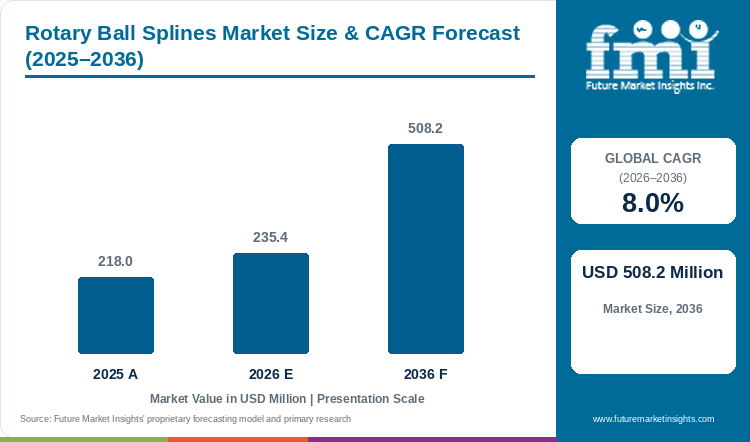
Assessed at USD 218.0 million in 2025 and progressing to USD 235.4 million in 2026, the rotary ball splines market valuation is on course to reach USD 508.2 million by 2036, supported by a forecast-period CAGR of 8.0%.
Compressing assembly cell footprints while speeding up chip and circuit-board placement is prompting electronics manufacturers to replace separate linear slides and rotary tables with single-shaft Z-theta spindles, supported by the September 2025 International Federation of Robotics (IFR) World Robotics report documenting 128,899 annual electrical and electronics robot installations out of 542,076 factory deployments [1]. To cut moving wrist weight on high-speed pick-and-place heads, Integrated Ball-Screw Spline units are projected to account for 53.4% of outer cylinder architecture demand in 2026 as robotics and die-bonder OEMs combine vertical stroke and 360-degree rotation inside one housing. New semiconductor packaging and SMT assembly lines pull Z-theta quill spindles into multi-year OEM build schedules. Per FMI estimates, global rotary ball splines valuation advanced from USD 218.0 million in 2025 to USD 235.4 million in 2026 and is forecast to reach USD 508.2 million by 2036, progressing at an 8.0% CAGR to create USD 272.8 million in incremental market value. Demand growth at an 8.0% CAGR outpaces the 3.7% CAGR seen in general servo drives because multi-head chiplet bonders mount four to twelve hollow spline quills per machine frame, prompting THK to refocus capital toward factory automation in February 2026. However, frictional heat expansion of 20 to 50 degrees Celsius and preload drag during rapid vertical strokes still restrict wider adoption on uncooled high-speed spindles.
Key Market Trends & Insights
- By outer cylinder architecture: Integrated Ball-Screw Spline units are projected to capture 53.4% in 2026 because dual-nut BNS housings deliver independent vertical stroke, rotary indexing, and spiral motion on a single ground shaft.
- By shaft design: Hollow Through-Vacuum Shaft assemblies are estimated to command 59.2% in 2026 as gun-drilled central bores route vacuum suction lines and air tubing directly to pick-and-place nozzles.
- By end-use automation machinery: SCARA Robot Spindles are expected to concentrate 48.6% in 2026 because every 4-axis selective compliance assembly robot relies on a wrist Z-theta rotary ball spline quill.
- By preload grade: Medium-Preload Zero-Backlash nuts are forecast to generate 61.4% in 2026 owing to zero angular play during rapid bidirectional indexing on die-bonder and optical inspection heads.
- By sales channel: Direct OEM Supply is anticipated to account for 63.8% in 2026 through custom shaft end-journal grinding, pulley press-fitting, and cleanroom grease qualification for robotics and semiconductor builders.
Regional Highlights
- Top national expansion: Vietnam is projected to lead country-level growth at a 9.8% CAGR through 2036 under rapid SMT pick-and-place, camera-module assembly, and OSAT semiconductor packaging line installations.
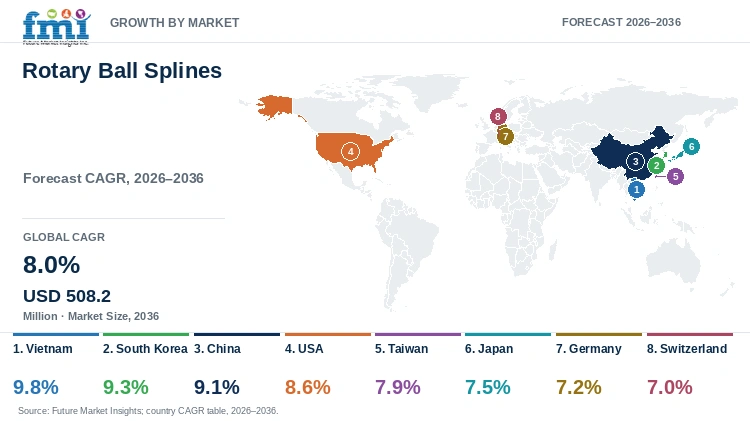
- Broader country progression: South Korea is expected to expand at 9.3% CAGR ahead of China at 9.1%, the USA at 8.6%, Taiwan at 7.9%, Japan at 7.5%, Germany at 7.2%, and Switzerland at 7.0%.
Market Size & Forecast
Table 1: Market Size and Forecast for the Rotary Ball Splines Market (USD million and CAGR percentage), 2025 to 2036
| Metric | Value |
|---|---|
| 2025 Market Size | USD 218.0 million |
| Estimated Market Size in 2026 | USD 235.4 million |
| Projected Market Size by 2036 | USD 508.2 million |
| CAGR, 2026 to 2036 | 8.0% |
| Added Revenue, 2026 to 2036 | USD 272.8 million |
Electronics assembly plants and semiconductor packaging foundries confront tight cycle-time targets and strict placement accuracy rules. Stacking a separate rotary table on top of a linear slide adds moving weight that causes tip vibration during rapid pick-and-place strokes. In September 2025, the International Federation of Robotics World Robotics 2025 Executive Summary reported that global operational industrial robot stock reached 4,663,698 units, with electrical and electronics reclaiming the top customer share at 24% [2]. For this reason, factory automation builders are pairing single-shaft rotary ball splines with modular linear slide units so assembly heads index faster inside narrower cleanroom bays.
Installed SCARA/Bonder Base and Quill-Unit Sizing
Table 2: Installed SCARA/Bonder Base and Quill-Unit Sizing for the Rotary Ball Splines Market (USD million and operational ranges), 2025 to 2036
| Metric | 2025 | 2026 | 2036 |
|---|---|---|---|
| Market size (USD million) | 218.0 | 235.4 | 508.2 |
| Active SCARA, bonder & ATC spindle base (million) | 1.45 to 1.62 | 1.56 to 1.75 | 3.20 to 3.60 |
| Annual rotary ball spline units shipped (thousand) | 520.0 to 580.0 | 560.0 to 625.0 | 1,180.0 to 1,310.0 |
| Average rotary ball spline unit ASP (USD) | 375 to 420 | 377 to 422 | 388 to 430 |
Operational note: Annual unit shipments reflect one primary Z-theta rotary ball spline per new SCARA robot and ATC mechanism plus multi-head arrays (4 to 12 spline spindles per turret) on high-speed SMT mounters and die bonders.
Semiconductor die bonders and industrial robot linear track systems require angular-contact spline grooves that resist twisting loads equally in both rotational directions. Equipment designers pair three-crest or six-row spline nuts with precision linear guide blocks to prevent angular play when vacuum nozzles place micro-LED and high-bandwidth memory chips.
Robot Density & Automation Spindle Spend Sizing
Table 3: Robot Density and Automation Spindle Spend Indicators for the Rotary Ball Splines Market (USD), 2025 to 2036
| Metric | 2025 | 2026 | 2036 |
|---|---|---|---|
| Global annual robot & bonder installations (thousand) | 615.0 | 655.0 | 1,120.0 |
| Spline spend per 1,000 installations (USD thousand) | 354.5 | 359.4 | 453.8 |
| Spline bill-of-materials per SCARA/bonder (USD) | 340 to 460 | 345 to 470 | 365 to 510 |
| Direct OEM factory-fitted spindle share (%) | 62.5% to 65.0% | 63.0% to 65.5% | 66.0% to 69.0% |
Table 4: Automation Machinery & Spindle Spending Indicators for the Rotary Ball Splines Market (USD and percentages), 2026
| Metric | Value | Institutional Reference Basis |
|---|---|---|
| Market size, 2026 | USD 235.4 million | 2026 global valuation baseline |
| Annual robot & bonder installations | 655.0 thousand | Global SCARA, SMT, and wafer equipment builds |
| Market spend per installation | USD 359.4 | Blended OEM and MRO spline quill outlay |
| SCARA Robot Spindles revenue, 2026 | USD 114.4 million | 48.6% end-use automation machinery share |
Grinding helical ball-screw threads and straight spline grooves onto the same hardened steel shaft requires matched support bearings and tight runout control. Automation engineers fit low-torque miniature ball bearings and protective telescopic way covers around exposed spline shafts to keep solder flux and silicon dust out of the ball recirculation tubes.
Analyst Perspective
"Semiconductor back-end packaging and SCARA assembly builders are phasing out stacked linear-plus-rotary wrist housings because moving the Z-axis motor mass degrades settling time. Integrated BNS ball-screw splines with gun-drilled through-vacuum shafts reduce distal wrist inertia by over 40% while holding ±2 micrometer positioning accuracy across millions of pick-and-place cycles."
- Nikhil Kaitwade, Principal Consultant, Future Market Insights.
How is the rotary ball splines market segmented?
The rotary ball splines market is segmented by outer cylinder architecture, shaft design, end-use automation machinery, preload grade, and sales channel. In 2026, Integrated Ball-Screw Spline is projected at 53.4%, Hollow Through-Vacuum Shaft at 59.2%, SCARA Robot Spindles at 48.6%, Medium-Preload Zero-Backlash at 61.4%, and Direct OEM Supply at 63.8%.
By outer cylinder architecture: Integrated Ball-Screw Spline, Gear-Flanged Angular Spline, High-Torque Recirculating Nut, and Compact Keyless Spline Nut.
By shaft design: Hollow Through-Vacuum Shaft, Solid Alloy Steel Shaft, and Stainless Cleanroom Spline Shaft.
By end-use automation machinery: SCARA Robot Spindles, SMT & Die-Bonder Heads, and ATC & Wafer Transfer.
By preload grade: Medium-Preload Zero-Backlash, Heavy-Preload High-Rigidity, Light-Preload High-Speed Nut, and Matched Twin-Nut Preload.
By sales channel: Direct OEM Supply, Authorized Linear Distributors, Cleanroom Subsystem Integrators, Aftermarket Spindle Rebuilders, and Online Motion Catalogs.
Why does Integrated Ball-Screw Spline lead the outer cylinder architecture category?
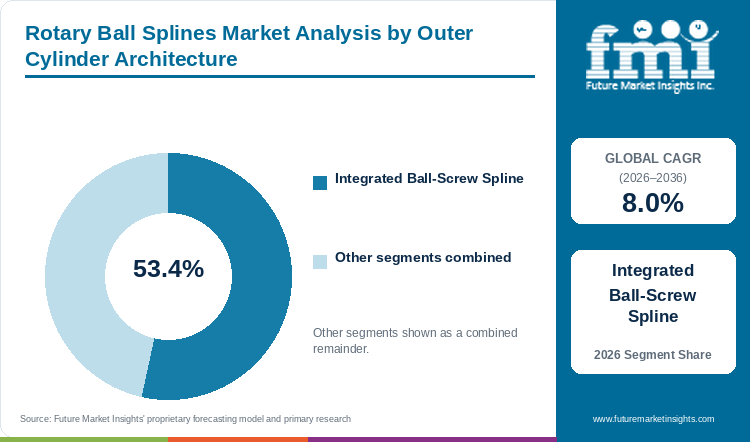
Integrated Ball-Screw Spline assemblies are projected to capture 53.4% of outer cylinder architecture demand in 2026, supported by single-shaft Z-theta motion integration.
Table 5: Outer Cylinder Architecture Share for the Rotary Ball Splines Market (percentage share), 2026
| Outer Cylinder Architecture | Share (2026) |
|---|---|
| Integrated Ball-Screw Spline | 53.4% |
| Other Segments Combined | 46.6%* |
| Total | 100.0% |
*Note: Gear-Flanged Angular Spline (22.6%), High-Torque Recirculating Nut (15.0%), and Compact Keyless Spline Nut (9.0%) sum to 100.0% of 2026 outer cylinder architecture volume.
Table 6: Outer Cylinder Architecture Leadership and Market Growth for the Rotary Ball Splines Market (segment and CAGR percentage), 2026 to 2036
| Metric | Value |
|---|---|
| Global CAGR (2026 to 2036) | 8.0% |
| Leading Segment | Integrated Ball-Screw Spline |
Robotics and semiconductor equipment buyers favor integrated ball-screw spline units because driving an internal ball-screw nut and ball-spline nut with timing belts lets a single shaft move up, down, and around independently. Unlike separate linear and rotary stages that add bulk to glass handling robots and wafer sorters, integrated BNS cartridges cut wrist weight and save assembly time.
- Integrated Ball-Screw Spline units are projected to secure 53.4% of outer cylinder architecture demand in 2026 by removing external anti-rotation guide rods from Z-theta spindles.
- A January 2026 feed-drive study in Science Progress confirmed that nut-rotating dual-drive ball-screw and spline systems hold ±2-micrometer positioning accuracy and boost structural rigidity by 30% to 50% [3], supporting OEM conversion toward integrated BNS housings.
Why does Hollow Through-Vacuum Shaft define the largest shaft design segment?
Hollow Through-Vacuum Shaft configurations are estimated to secure 59.2% of the shaft design category in 2026, driven by internal pneumatic routing and reduced polar inertia.
Routing vacuum suction tubes and sensor wires directly through the center of the spline shaft prevents external air hoses from whipping or snagging when a pick-and-place head spins at 3,000 rpm. While solid steel shafts serve heavy machine tool changers, pairing hollow through-vacuum shafts with robotics actuators lowers moving quill weight on high-speed electronics mounters.
- Hollow Through-Vacuum Shaft assemblies are estimated to command 59.2% of the shaft design segment in 2026 as SMT mounter and SCARA builders cut reciprocating wrist mass.
- Drive-shaft structural testing published in Materials in October 2025 showed that switching from solid steel shafts to hollow 5-to-15-millimeter wall tubing cuts rotating weight while preserving torsional fatigue safety [4].
What keeps SCARA Robot Spindles ahead by end-use automation machinery?
SCARA Robot Spindles are expected to command 48.6% of end-use automation machinery volume in 2026, driven by standard wrist quill architecture across global electronics factories.
Four-axis SCARA assembly robots represent the largest volume customer for rotary ball splines because every robot mounts a vertical Z-theta quill spindle at the end of its forearm. Pairing a wrist ball spline with compact rotary actuators allows electronics and battery assembly lines to press-fit connectors and drive screws with sub-0.01-millimeter repeatability.
- SCARA Robot Spindles are expected to hold 48.6% of end-use automation machinery demand in 2026 because industrial 4-axis assembly arms mount the Z-theta ball spline directly in the wrist.
- Robot kinematics testing published in HardwareX in March 2026 confirmed that mounting the vertical stroke and 360-degree rotation spline at the distal SCARA wrist maximizes horizontal arm speed and smooth stopping [5].
Why does Medium-Preload Zero-Backlash lead the preload grade category?
Medium-Preload Zero-Backlash nuts are forecast to generate 61.4% of preload grade demand in 2026, owing to zero rotational play without excessive frictional heating.
Eliminating rotational play when a vision camera or bonding nozzle stops to place a chip requires preloaded steel or ceramic balls inside the spline nut. While heavy preload grades generate too much friction heat for continuous high-speed strokes, medium-preload zero-backlash nuts prevent angular wobble without overheating the spindle motor.
- Medium-Preload Zero-Backlash units are forecast to account for 61.4% of preload grade demand in 2026 as die-bonder and SCARA engineers stop angular vibration during rapid settling.
- Preload force testing published in Micromachines in November 2025 demonstrated that keeping preload stable across 1.72 to 30 micrometer operating windows prevents backlash and wear-induced stiffness loss [6].
What gives Direct OEM Supply the leading position in sales channel?
Direct OEM Supply channels are anticipated to account for 63.8% of sales channel demand in 2026, reinforced by custom shaft-end machining and matched bearing pre-assembly.
Robotics and semiconductor equipment manufacturers buy factory-matched shaft-and-nut sets directly from linear-motion producers because spline balls are hand-sorted to fit each ground shaft raceway. Unlike standard ball bearings sold through catalog distributors, removing a rotary ball spline nut from its matched shaft alters preload clearance and requires factory re-calibration.
- Direct OEM Supply is anticipated to capture 63.8% of sales channel demand in 2026 because semiconductor and robot builders require cleanroom-greased, runout-certified Z-theta cartridges.
- Precision assembly testing published in Scientific Reports in March 2026 showed that pairing a deep ball spline shaft with a P5-grade THK crossed roller bearing holds radial runout within 0.005 millimeters and cuts assembly time by 35% [7].
What are the drivers, restraints, and opportunities in the rotary ball splines market?
In the rotary ball splines market, AI advanced packaging die-bonder investments and SCARA assembly automation are projected to accelerate Z-theta spline adoption whereas high-speed thermal elongation and preload spalling restrain feed rates and sensorized condition-monitoring spline nuts create predictive maintenance opportunities.
- Driver: Surging CoWoS, HBM, and 3D-IC semiconductor assembly and packaging equipment investments pull multi-head hollow rotary ball splines into advanced die-bonder and flip-chip platforms.
- Restraint: Frictional heat buildup of 20 to 50 degrees Celsius during continuous high-frequency reciprocation causes axial thermal elongation and premature preload loss in uncooled spline nuts.
- Opportunity: Embedding vibration and ball-pass frequency telemetry with low-outgassing cleanroom vacuum seals creates high-margin smart Z-theta modules for sub-nanometer wafer transfer robots.
Growth Analysis and Future Potential: Qualitative Demand Catalysts
Advanced AI chip packaging plants are ordering high-speed flip-chip and hybrid die bonders that place thousands of memory and logic dies per hour with sub-micrometer accuracy. Traditional stacked linear stages and electric linear actuators carry too much moving mass to settle quickly between bonding strokes. Future Market Insights notes that semiconductor equipment builders are mounting four to twelve hollow ball-screw spline quills onto each rotating bonding turret to multiply machine throughput. According to SEMI Market Intelligence data released in September 2025, global semiconductor equipment billings rose 20% year-over-year to USD 75 billion through July 2025, with Assembly and Packaging equipment projected to grow 8% in 2025 and 15% in 2026 to USD 6.3 billion as Wafer Fab Equipment reaches USD 122 billion [8]. Linear motion manufacturers therefore expand cleanroom grinding capacity to fulfill multi-year die-bonder and wafer-sorter schedules.
Risk Assessment of the Rotary Ball Splines Market: Operational and Formulation Friction
Frictional heating during rapid vertical strokes and metal fatigue inside ball recirculation grooves remain the primary operational hurdles limiting spline lifespan. When a preloaded Z-theta spindle cycles several times per second without cooling, heat expansion lengthens the steel shaft by tens of micrometers and throws off vertical bonding depth. In June 2026, a CNC feed-system fault study published in Annals of the New York Academy of Sciences reported that feed-system failures account for 45.38% of total machine tool downtime, with rolling bearings causing 42% and ball screw or spline pairs accounting for 26% [9]. Equipment buyers therefore require thorough thermal-growth testing before qualifying new spline vendors. In addition, solder-flux fumes or silicon dust entering recirculation tubes can jam ball circuits and score hardened spline shafts, forcing costly spindle cartridge replacements.
Commercial Opportunity Analysis: Formulation Differentiation and Value-Add Formats
Semiconductor fab automation directors reward linear-motion suppliers that pair low-outgassing cleanroom ball splines with built-in vibration and preload sensors to prevent unplanned tool stops. An unexpected Z-axis spindle seizure inside a vacuum wafer-transfer robot can scrap an entire batch of high-value silicon wafers. Vendors capturing higher gross margins integrate miniature strain and acoustic sensors onto the spline outer cylinder to flag lubrication drying before metal spalling begins. In April 2026, a wafer transfer robot control study in Scientific Reports demonstrated event-triggered motion control that kept joint position error within 0.0009 rad inside 1.0 second while reducing controller bus traffic by 64.6% [10]. Supplying sensor-ready BNS ball-screw splines with certified ISO Class 3 cleanroom grease allows manufacturers to secure preferred vendor status across leading chipmakers.
Rotary Ball Splines Market by Country (2026 to 2036)
As per FMI, Vietnam is projected to lead rotary ball splines expansion across electronics and automation manufacturing hubs at a 9.8% CAGR through 2036, whereas Switzerland is forecast to progress at a 7.0% CAGR. Commercial performance across semiconductor and SMT assembly corridors in Asia as well as precision machinery markets in North America and Europe depends on annual robot installations and back-end chip packaging capital expenditure.
Table 7: Country CAGR and Primary Growth Levers for the Rotary Ball Splines Market (CAGR percentage and operational drivers), 2026 to 2036
| Country | CAGR (2026 to 2036) | Primary Growth Lever |
|---|---|---|
| Vietnam | 9.8% | SMT pick-and-place, smartphone camera module, and OSAT packaging factory buildouts |
| South Korea | 9.3% | HBM memory die-bonder investments and high-density electronics robot deployments |
| China | 9.1% | Domestic SCARA robot production scale-up across 295,045 annual robot installations |
| USA | 8.6% | Reshored advanced semiconductor packaging fabs and medical diagnostic CNC workstations |
| Taiwan | 7.9% | CoWoS advanced packaging die bonders and domestic HIWIN/TBI ball-spline manufacturing |
| Japan | 7.5% | Global OEM export base for THK, NB, IKO, NSK, and Kuroda precision ball-screw splines |
| Germany | 7.2% | CNC vertical machining center automatic tool changers and automotive assembly cells |
| Switzerland | 7.0% | Ultra-precision micro-machining spindles, watchmaking SCARAs, and medtech pick-and-place |
Source: Future Market Insights analysis
Vietnam Rotary Ball Splines Market Outlook (2026 to 2036)
Unlike mature machinery markets in Japan and Europe centered on domestic OEM design, Vietnam generates rapid growth from multinational electronics assembly and outsourced semiconductor packaging plants expanding across Bac Ninh, Thai Nguyen, and Ho Chi Minh City. An April 2025 electromechanical control study from Hanoi published in PLOS One demonstrated active disturbance rejection control that cut steady-state actuator tracking error to 0.099%–0.127% without high-frequency vibration [11]. Demand for rotary ball splines in Vietnam is projected to climb at a leading 9.8% CAGR through 2036 as smartphone camera-module and circuit-board factories install thousands of SCARA robots and high-speed SMT mounters. Because local factories lack precision shaft-grinding shops, electronics plants rely on stocked replacement BNS cartridges imported from Japan, Taiwan, and South Korea.
Key takeaway: In Vietnam, rapid SMT electronics assembly and semiconductor back-end packaging plant additions are projected to drive a 9.8% CAGR through 2036.
South Korea Rotary Ball Splines Market Outlook (2026 to 2036)
Sales of rotary ball splines in South Korea are expected to expand at a 9.3% CAGR from 2026 to 2036, propelled by high-bandwidth memory (HBM) die-bonder investments in Yongin and Pyeongtaek and domestic spline manufacturing. Whereas Western markets use rotary splines heavily in general packaging, South Korea concentrates demand inside cleanroom semiconductor and display equipment that requires multi-head hollow through-vacuum shafts. In January 2026, a wafer-handling robot study in Sensors limited joint velocity error to 0.1 deg/s and acceleration error to 0.2 deg/s^2 across cleanroom wafer transfers [12]. Tight chipmaker delivery schedules and cleanroom particle standards push equipment builders in South Korea to dual-source precision splines from pioneers in Japan and domestic producer Won ST.
Key takeaway: In South Korea, HBM3e/HBM4 die-bonder investments and high-density electronics automation are forecast to sustain a 9.3% CAGR.
China Rotary Ball Splines Market Outlook (2026 to 2036)
In contrast to import-only electronics hubs, China combines the world's largest industrial robot installation base (295,045 units annually) with fast-growing domestic production of SCARA robots, lithium-battery assembly cells, and semiconductor packaging tools. In April 2026, a compliant robot assembly study in Scientific Reports validated boundary-constrained admittance control for tight peg-in-hole insertion tasks [13]. Because domestic robot builders in Shenzhen, Suzhou, and Shanghai are scaling annual SCARA output, rotary ball splines demand in China is forecast to progress at a 9.1% CAGR through 2036. Fierce price competition in mid-range electronics assembly robots pressures foreign component margins, so suppliers in Japan and Taiwan focus on high-rigidity integrated BNS ball-screw splines that local workshops struggle to grind.
Key takeaway: In China, domestic SCARA robot mass production and wafer-handling equipment localization are estimated to support a 9.1% CAGR through 2036.
USA Rotary Ball Splines Market Outlook (2026 to 2036)
What distinguishes demand in the USA is the simultaneous buildout of CHIPS Act advanced semiconductor packaging facilities in Arizona, Ohio, and Texas and automated medical diagnostic and laboratory workstations. In December 2025, researchers at Purdue University and Indiana University published an open-source 3-axis pick-and-place CNC workstation in HardwareX achieving 0.5 to 0.6 millimeter placement accuracy with a Z-axis vacuum head for diagnostic assay assembly [14]. Commercial rotary ball splines valuation in the USA is anticipated to rise at an 8.6% CAGR over the ten-year horizon to 2036 across cleanroom wafer-transfer arms and medical automation cells. Because domestic machine builders face long lead times on custom metric shaft grinding from Asia, suppliers with U.S. shaft-machining and inventory hubs win rapid-turn OEM programs.
Key takeaway: In the USA, advanced semiconductor packaging fab tool-ins and automated medical device assembly are expected to drive an 8.6% CAGR.
Taiwan Rotary Ball Splines Market Outlook (2026 to 2036)
Taiwan occupies a dual role in the global market as both the premier buyer of CoWoS advanced chip-packaging die bonders in Hsinchu and Tainan and the home manufacturing base for high-volume linear motion exporters HIWIN Technologies and TBI Motion in Taichung. A February 2025 ball-screw control study in Sensors validated feedforward differential input tracking across variable axial loads [15]. Demand for rotary ball splines in Taiwan is estimated to grow at a 7.9% CAGR through 2036 as outsourced semiconductor assembly and test (OSAT) plants expand multi-die bonding capacity. While domestic producers capture broad SCARA and SMT volume across Asia, semiconductor toolmakers in Taiwan still import sub-micrometer ground BNS splines from Japan for flagship chiplet bonders.
Key takeaway: In Taiwan, CoWoS chiplet packaging equipment expansion and domestic linear-motion OEM capacity are forecast to sustain a 7.9% CAGR.
Japan Rotary Ball Splines Market Outlook (2026 to 2036)
Japan is the global engineering and manufacturing center for rotary ball splines, housing the original inventors and flagship exporters THK, Nippon Bearing (NB), IKO (Nippon Thompson), NSK, and Kuroda Precision. According to THK's Integrated Report 2025 published in July 2025, THK invented the original LBS Ball Spline in 1971 and generated JPY 216.6 billion in Industrial Machinery sales (61% of its JPY 352.7 billion total) supplying SCARA robots and semiconductor equipment [16]. Domestic demand in Japan is projected to advance at a 7.5% CAGR between 2026 and 2036 as local robotics and wafer-fab equipment OEMs build next-generation export machines. Rising domestic machinist retirement rates challenge factory staffing, prompting producers in Japan to automate thread-and-spline grinding lines.
Key takeaway: In Japan, flagship precision grinding exports and domestic semiconductor equipment manufacturing are projected to maintain a 7.5% CAGR.
Germany Rotary Ball Splines Market Outlook (2026 to 2036)
Unlike Asian electronics-heavy markets, Germany generates a large share of its rotary ball spline demand from high-torque CNC machining center automatic tool changers (ATCs), automotive battery-module assembly cells, and pharmaceutical packaging lines in Baden-Wuerttemberg and Bavaria. In May 2026, a CNC vertical machining study in Scientific Reports optimized drilling on a 5.5 kW, 8,000-rpm spindle equipped with a 16-tool BT-40 automatic tool changer to hold 2.4-micrometer hole roundness [17]. Market demand in Germany is forecast to expand at a 7.2% CAGR through 2036 as machine tool builders upgrade cam-driven tool changers to servo-driven ball-spline shafts. Cyclical slowdowns in European automotive capex still restrain standard assembly line orders, pushing suppliers to target medical and battery automation.
Key takeaway: In Germany, high-speed CNC machining center ATC arms and precision factory automation retrofits are projected to deliver a 7.2% CAGR.
Switzerland Rotary Ball Splines Market Outlook (2026 to 2036)
Whereas neighboring European markets focus on heavy machine tools, Switzerland specializes in ultra-precision five-axis micro-milling tool changers, watchmaking SCARA assembly cells, and high-speed medical device pick-and-place systems. In May 2026, a five-axis micro-milling study in Materials using an automatic tool changer and laser runout compensation achieved 25-nanometer surface roughness on titanium microgrooves at 20,000 to 34,000 rpm [18]. Sales of rotary ball splines in Switzerland are anticipated to increase at a 7.0% CAGR through 2036 as horological and medtech equipment builders compress machine footprints. Because micro-machining OEMs in Switzerland demand sub-2-micrometer radial runout and zero thermal drift, ultra-precision ground splines from Japan and Europe command strong price premiums.
Key takeaway: In Switzerland, five-axis micro-machining tool changers and watchmaking SCARA assembly cells are anticipated to sustain a 7.0% CAGR.
Full report country CAGRs cover: North America; Latin America; Western Europe; Eastern Europe; East Asia; South Asia and Pacific; and Middle East and Africa.
Who are the notable companies in the rotary ball splines market?
THK Co., Ltd., Nippon Bearing Co., Ltd. (NB Corporation), IKO International (Nippon Thompson Co., Ltd.), HIWIN Technologies Corp., TBI Motion Technology Co., Ltd., NSK Ltd., Kuroda Precision Industries Ltd., and Won ST Co., Ltd. are the notable companies in the rotary ball splines market.
FMI analysis indicates that the competitive arena divides between rolling-element spline inventors in Japan, ultra-precision semiconductor spindle specialists, and high-volume Asian linear-motion challengers. Pioneers in Japan engineer integrated BNS ball-screw splines and caged angular-contact spline nuts for flagship robotics and wafer-fab OEMs. Manufacturers in Taiwan and South Korea supply cost-competitive Z-theta quills and standard hollow spline shafts across high-volume electronics assembly lines.
- Rolling-Spline Inventors & Leaders in Japan: THK Co., Ltd., Nippon Bearing Co., Ltd. (NB Corporation), and IKO International (Nippon Thompson Co., Ltd.) set global benchmarks across BNS ball-screw splines, SSP/SPR rotary ball splines, and LTR angular-contact flanged spline nuts.
- Ultra-Precision Screw & Spindle Specialists: NSK Ltd. and Kuroda Precision Industries Ltd. supply cleanroom-grade hollow shaft ball-screw splines and ultra-precision ground Z-theta actuators for semiconductor wafer transfer and die-bonding machinery.
- High-Volume Challengers in Taiwan & South Korea: HIWIN Technologies Corp., TBI Motion Technology Co., Ltd., and Won ST Co., Ltd. manufacture cost-competitive rotary ball splines and integrated ball-screw splines for SCARA and SMT equipment OEMs across Asia.
Competitive Benchmarking: Rotary Ball Splines Market
Table 8: Competitive Benchmarking for the Rotary Ball Splines Market (qualitative capability ratings), 2026
| Company | Integrated BNS Z-Theta Breadth | Hollow Shaft & Cleanroom Precision | SCARA & Semiconductor OEM Share | Geographic Reach |
|---|---|---|---|---|
| THK Co., Ltd. | High | High | High | High |
| Nippon Bearing Co., Ltd. (NB Corp.) | High | High | High | High |
| IKO International (Nippon Thompson) | High | High | High | High |
| HIWIN Technologies Corp. | High | Medium | High | High |
| TBI Motion Technology Co., Ltd. | Medium | Medium | Medium | High |
| NSK Ltd. | High | High | High | High |
| Kuroda Precision Industries Ltd. | High | High | Medium | Medium |
| Won ST Co., Ltd. | Medium | Medium | High | Medium |
Scoring basis: Capability tiers evaluate integrated ball-screw + ball-spline (BNS) model breadth, hollow through-vacuum shaft grinding accuracy, SCARA and die-bonder OEM design-in share, and global distribution coverage.
Key Developments in the Rotary Ball Splines Market
- THK Co., Ltd. executed a strategic portfolio restructuring in February 2026 by transferring consolidated automotive subsidiary shares to concentrate capital on high-ROE Industrial Machinery linear motion and FA solutions [19].
- NSK Ltd. reported FY2024 consolidated sales of JPY 796.7 billion in its September 2025 Integrated Report, with Industrial Machinery and Precision Machinery & Parts accounting for 45% of revenue as NSK expands semiconductor and robotic ball-screw/spline units under MTP2026 [20].
- Kuroda Precision Industries Ltd. announced in January 2025 the installation of the world's largest class 4,000 kN high-speed precision press machine (MSP-4000-430) at its Nagano Factory to double precision motor-core and actuator component productivity by March 2025 [21].
Key Players in the Rotary Ball Splines Market
Linear Motion & Rotary Ball Spline Pioneers
- THK Co., Ltd.
- Nippon Bearing Co., Ltd. (NB Corporation)
- IKO International (Nippon Thompson Co., Ltd.)
High-Volume Z-Theta & Linear Spline Manufacturers
- HIWIN Technologies Corp.
- TBI Motion Technology Co., Ltd.
- Won ST Co., Ltd.
Semiconductor & Ultra-Precision Spindle Specialists
- NSK Ltd.
- Kuroda Precision Industries Ltd.
Rotary Ball Splines Market - Report Scope
Table 9: Report Scope for the Rotary Ball Splines Market (coverage fields and definitions), 2026 to 2036
| Coverage field | Report scope |
|---|---|
| Market breakdown | Outer Cylinder Architecture; Shaft Design; End-Use Automation Machinery; Preload Grade; Sales Channel |
| Quantitative Units | USD Million |
| Market Definition | Includes commercial supplier valuation from integrated ball-screw + rotary ball-spline Z-theta units (BNS), gear-flanged angular-contact rotary ball splines (LTR), high-torque 3-crest/6-row recirculating spline nuts, and matched ground hollow/solid spline shafts. Category Scope Note: Excludes standard non-rotary linear ball bushings, involute gear splines without recirculating balls, and standalone ball screws. |
| Regions Covered | North America; Latin America; Western Europe; Eastern Europe; East Asia; South Asia and Pacific; Middle East and Africa |
| Countries Covered | Vietnam, South Korea, China, USA, Taiwan, Japan, Germany, Switzerland, and additional countries in the full report |
| Key Companies Covered | THK Co., Ltd., Nippon Bearing Co., Ltd. (NB Corporation), IKO International (Nippon Thompson Co., Ltd.), HIWIN Technologies Corp., TBI Motion Technology Co., Ltd., NSK Ltd., Kuroda Precision Industries Ltd., Won ST Co., Ltd. |
| Forecast Period | 2026 to 2036 |
| Approach | Primary and secondary research combining bottom-up SCARA robot, SMT mounter, die-bonder, and CNC ATC spindle counts with top-down linear-motion OEM revenue triangulation. |
Rotary Ball Splines Market - Research Methodology
Table 10: Research Methodology for the Rotary Ball Splines Market (research methods and approach), 2026 edition
| Method | Approach |
|---|---|
| Primary Research | Structured interviews with SCARA robot mechanical architects, semiconductor die-bonder motion engineers, CNC ATC designers, and authorized linear-motion distributors across Japan, Taiwan, South Korea, Germany, and the USA. |
| Secondary Research | Analysis of IFR World Robotics 2025 statistics, SEMI equipment billing disclosures, THK and NSK Integrated Reports, and peer-reviewed feed-drive and robot kinematics studies in Science Progress, Scientific Reports, and Sensors. |
| Market Sizing and Forecasting | Bottom-up Z-theta spindle requirements per SCARA robot, multi-head SMT/die bonder, and CNC ATC reconciled against top-down precision linear motion component sales from 2026 to 2036. |
| Country Forecasting Model | Country projections weight annual industrial robot installations, OSAT advanced packaging capex, domestic SCARA production share, and machine tool export output across eight manufacturing economies. |
| Operational Benchmark Traceability | Robot installation counts, equipment billings, and spindle ASPs in Tables 2, 3, and 4 trace to IFR World Robotics 2025 (542,076 installations), SEMI EMDS reports, and OEM catalog pricing. |
| Data Triangulation and Validation | Valuations are cross-checked against the parent Linear Slide Units Market (USD 1,522.2 million in 2026) and complementary Servo Drives Market (USD 2,500.0 million in 2026) with strict exclusion of standalone ball screws and profile rail guides. |
Rotary Ball Splines Market by Segments
Rotary Ball Splines Market segmented by Outer Cylinder Architecture:
- Integrated Ball-Screw Spline
- Gear-Flanged Angular Spline
- High-Torque Recirculating Nut
- Compact Keyless Spline Nut
Rotary Ball Splines Market segmented by Shaft Design:
- Hollow Through-Vacuum Shaft
- Solid Alloy Steel Shaft
- Stainless Cleanroom Spline Shaft
Rotary Ball Splines Market segmented by End-Use Automation Machinery:
- SCARA Robot Spindles
- SMT & Die-Bonder Heads
- ATC & Wafer Transfer
Rotary Ball Splines Market segmented by Preload Grade:
- Medium-Preload Zero-Backlash
- Heavy-Preload High-Rigidity
- Light-Preload High-Speed Nut
- Matched Twin-Nut Preload
Rotary Ball Splines Market segmented by Sales Channel:
- Direct OEM Supply
- Authorized Linear Distributors
- Cleanroom Subsystem Integrators
- Aftermarket Spindle Rebuilders
- Online Motion Catalogs
Rotary Ball Splines Market by Region
- North America
- United States
- Canada
- Latin America
- Brazil
- Mexico
- Argentina
- Chile
- Western Europe
- Germany
- France
- United Kingdom
- Italy
- Spain
- Benelux
- Nordics
- Eastern Europe
- Poland
- Czech Republic
- Romania
- Hungary
- East Asia
- China
- Japan
- South Korea
- South Asia and Pacific
- India
- ASEAN
- Australia and New Zealand
- Middle East and Africa
- GCC Countries
- South Africa
- Türkiye
- Israel
Research Sources and Bibliography
- [1] International Federation of Robotics (IFR). (2025, September 25). World Robotics 2025 report – INDUSTRIAL ROBOTS – released by IFR: Global Robot Demand in Factories Doubles Over 10 Years. International Federation of Robotics.
- [2] Müller, C. (2025, September 25). Executive Summary World Robotics 2025 Industrial Robots. IFR Statistical Department / VDMA Services GmbH.
- [3] Zhou, J., Yu, H., He, M., Zhang, Y., Luan, X., & Liu, Y. (2026, January 29). Application-oriented classification and performance analysis of precision linear feed mechanisms for machine tools. Science Progress, 109(1), 00368504251410781 (PubMed PMID 41610186).
- [4] Skotnicki, W., & Jędrzejczyk, D. (2025, October 21). Analysis of the Causes of Damage to the Steel Drive Shaft Used in a Paint Mixer. Materials, 18(20), 4798 (PubMed PMID 41157028).
- [5] Clark, A., Martinez-Hernandez, U., & Assaf, T. (2026, March 17). EduSCARA: An open source RRPR educational SCARA platform. HardwareX, 26, e00761 (PubMed PMID 41890984).
- [6] Saini, H. S., Kilikevičienė, K., & Čeponis, A. (2025, November 26). Investigation of Displacement and Force Characteristics of Piezoelectric Multilayer Actuator for Active Preload Control System in Ultrasonic Motors. Micromachines, 16(12), 1324 (PMCID PMC12734606).
- [7] Liu, Z., Huang, X., & Tan, J. (2026, March 2). Research on intelligent assembly method of aero-engine deep-cavity nuts based on torque-angle control. Scientific Reports, 16, 11569 (PubMed PMID 41772011).
- [8] Tseng, C. (2025, September 25). Building the Future: AI Investment, Equipment & Materials Market Outlook. SEMI Market Intelligence.
- [9] Li, Y., Liang, X., Na, L., Guo, G., & Su, P. (2026, June 24). DARTS‐CNN‐BiLSTM: Intelligent Fault Diagnosis for Computer Numerical Control Machine Tool Feed System. Annals of the New York Academy of Sciences, 1560(1), e70317 (PubMed PMID 42339569).
- [10] Xu, B., Yu, H., Yuan, L., Huang, S., & Zhou, J. (2026, April 18). Prescribed-time prescribed-performance event-triggered control algorithm for wafer transfer robots. Scientific Reports, 16, 18085 (PubMed PMID 42000770).
- [11] Nguyen, T. A., & Nguyen, T. L. (2025, April 11). Nonlinear active disturbance rejection mechanism based sliding mode control for enhancing electric power assisted steering performance. PLOS One, 20(4), e0321664 (PubMed PMID 40215223).
- [12] Ji, Y., & Hu, P. (2026, January 27). Wafer Handing Robotic Arm Vibration Trajectory Planning Based on Graylag Goose Optimization. Sensors, 26(3), 829 (PubMed PMID 41682345).
- [13] Yun, N., Zhou, Z., Wan, J., Wang, K., & Zhang, X. (2026, April 24). Variable admittance control algorithm for robots based on task-space boundary constraints. Scientific Reports, 16, 18888 (PubMed PMID 42032009).
- [14] Tecle, L., Riegle, S., Piepho, A., & Linnes, J. (2025, December 30). Open-source CNC workstation for paper-based diagnostic assay assembly. HardwareX, 25, e00739 (PubMed PMID 41550284).
- [15] Zhang, G., Wang, B., & Lin, Y.-J. (2025, February 7). An Investigation on the Ball Screw-Based Variable Displacement Mechanism for Axial Piston Pumps with Feedforward Differential Input Control. Sensors, 25(4), 994 (PubMed PMID 40006223).
- [16] THK Co., Ltd. (2025, July 15). THK Integrated Report 2025: A Review of the 2024 Fiscal Year. THK Co., Ltd.
- [17] Sivam, S. P. S. S., Kesavan, S., Manikandan, N., Thejasree, P., & Olaiya, B. C. (2026, May 19). A hybrid RSM–Spherical Fuzzy AHP–Fuzzy VIKOR approach for optimizing drilling of AM60 magnesium alloy using biodegradable MQL. Scientific Reports, 16, 22786 (PubMed PMID 42156836).
- [18] Zhang, Y., Wang, C., Bai, Q., Zhang, Q., & He, X. (2026, May 20). Multi-Objective Process Optimization of Micro-Milling Titanium Alloy Ti6Al4V for Microgrooves. Materials, 19(10), 2142 (PubMed PMID 42195783).
- [19] THK Co., Ltd. (2026, February 2). Notice Regarding Transfer of Shares of Consolidated Subsidiaries and Assignment of Receivables. THK Co., Ltd. Investor Relations.
- [20] NSK Ltd. (2025, September 30). NSK Report 2025: Year ended March 31, 2025 Integrated Report. NSK Ltd.
- [21] Kuroda Precision Industries Ltd. (2025, January 17). Installation of the world's largest class high-speed precision press machine. Kuroda Precision Industries Ltd.
- [22] Shi, R., Jian, S., Chen, G., & Yao, P. (2025, November 12). Research on the Design and Control Method of Robotic Flexible Magneto-Rheological Actuator. Sensors, 25(22), 6921 (PubMed PMID 41305129).
- [23] THK Co., Ltd. (2025, February 12). Notice Regarding the Differences Between Financial Forecasts and Actual Operating Results (Non-consolidated). THK Co., Ltd. Investor Relations.
This bibliography is provided for reader reference and is not exhaustive. The full report contains the complete citation list.
This Report Answers
- How large is the rotary ball splines market in 2026 and what is forecast for 2036?
- Which SCARA robotics and semiconductor packaging pressures support demand for rotary ball splines?
- Why does Integrated Ball-Screw Spline lead the outer cylinder architecture category?
- Why does Hollow Through-Vacuum Shaft lead the shaft design category globally?
- How do growth rates differ across Vietnam, South Korea, China, and the USA?
- Which leading companies supply BNS Z-theta units and angular-contact rotary ball splines today?
- What limits adoption or supplier switching in the rotary ball splines market?
- What should buyers evaluate before specifying a rotary ball spline?
Frequently Asked Questions
How big is the rotary ball splines market in 2026, and what is forecast for 2036?
According to FMI, global rotary ball splines valuation is estimated to reach USD 235.4 million in 2026 from USD 218.0 million in 2025 and is projected to climb to USD 508.2 million by 2036.
What is the CAGR for the rotary ball splines market from 2026 to 2036?
Future Market Insights projects an 8.0% compound annual growth rate between 2026 and 2036, generating USD 272.8 million in incremental value over the 10-year forecast period.
Which outer cylinder architecture segment leads the rotary ball splines market?
Integrated Ball-Screw Spline (BNS) assemblies are projected to capture 53.4% of outer cylinder architecture demand in 2026 because coaxial ball-screw and spline grooves enable Z-theta motion on a single shaft.
Which shaft design segment leads the rotary ball splines market?
Hollow Through-Vacuum Shaft designs are estimated to secure 59.2% of the shaft design category in 2026 as internal bores route vacuum suction and air lines directly to pick-and-place nozzles.
Which country has a notable growth outlook during the assessment period?
Vietnam is projected to lead national growth at a 9.8% CAGR through 2036, driven by high-speed SMT assembly, camera-module automation, and OSAT semiconductor packaging line expansions.
Who are the key players in the market?
THK Co., Ltd., Nippon Bearing Co., Ltd. (NB Corporation), IKO International (Nippon Thompson Co., Ltd.), HIWIN Technologies Corp., TBI Motion Technology Co., Ltd., NSK Ltd., Kuroda Precision Industries Ltd., and Won ST Co., Ltd. are key players.
Preview the report firsthand - request a free sample
Get SampleGet the brochure for pricing and purchase details.
Get PDFTable of Content
- Key Takeaways
- Market Size and CAGR
- Top Growth Driver
- Fastest Growing Segment
- Leading Region
- Key Companies
- Emerging Opportunities
- Executive Summary
- Global Market Outlook
- Demand-side Trends
- Supply-side Trends
- Technology Roadmap Analysis
- Analysis and Recommendations
- Analyst Perspective (What is happening? Why now? What should investors know?)
- Key Questions Answered
- How large is the market?
- What is the CAGR?
- What are key trends?
- Which region dominates?
- Who are the leaders?
- Market Overview
- Market Coverage / Taxonomy
- Market Definition / Scope / Limitations
- Research Methodology
- Chapter Orientation
- Analytical Lens and Working Hypotheses
- Market Structure, Signals, and Trend Drivers
- Benchmarking and Cross-market Comparability
- Market Sizing, Forecasting, and Opportunity Mapping
- Research Design and Evidence Framework
- Desk Research Programme (Secondary Evidence)
- Expert Input and Fieldwork (Primary Evidence)
- Tooling, Models, and Reference Databases
- Data Engineering and Model Build
- Quality Assurance and Audit Trail
- Market Background
- Market Dynamics (Drivers, Restraints, Opportunity, Trends)
- Scenario Forecast (Optimistic, Likely, Conservative)
- Impact Analysis
- AI Impact
- Sustainability Impact
- Regulatory Impact
- Technology Impact
- Consumer / Buyer Analysis
- Purchase Drivers
- Adoption Barriers
- Buyer Journey
- Opportunity Map Analysis
- Product Life Cycle Analysis
- Supply Chain Analysis
- Investment Feasibility Matrix
- Value Chain Analysis
- PESTLE and Porter's Analysis
- Regulatory Landscape
- Regional Parent Market Outlook
- Production and Consumption Statistics
- Import and Export Statistics
- Global Market Analysis and Forecast, 2021 to 2036
- Historical Market Size Value (USD Million) Analysis, 2021 to 2025
- Current and Future Market Size Value (USD Million) Projections, 2026 to 2036
- Y-o-Y Growth Trend Analysis
- Absolute $ Opportunity Analysis
- Global Market Pricing Analysis, 2021 to 2036
- Global Market Analysis and Forecast, By Outer Cylinder Architecture, 2021 to 2036
- Introduction / Key Findings
- Historical Market Size Value (USD Million) Analysis By Outer Cylinder Architecture, 2021 to 2025
- Current and Future Market Size Value (USD Million) Analysis and Forecast By Outer Cylinder Architecture, 2026 to 2036
- Integrated Ball-Screw Spline
- Gear-Flanged Angular Spline
- High-Torque Recirculating Nut
- Compact Keyless Spline Nut
- Y-o-Y Growth Trend Analysis By Outer Cylinder Architecture, 2021 to 2025
- Absolute $ Opportunity Analysis By Outer Cylinder Architecture, 2026 to 2036
- Global Market Analysis and Forecast, By Shaft Design, 2021 to 2036
- Introduction / Key Findings
- Historical Market Size Value (USD Million) Analysis By Shaft Design, 2021 to 2025
- Current and Future Market Size Value (USD Million) Analysis and Forecast By Shaft Design, 2026 to 2036
- Hollow Through-Vacuum Shaft
- Solid Alloy Steel Shaft
- Stainless Cleanroom Spline Shaft
- Y-o-Y Growth Trend Analysis By Shaft Design, 2021 to 2025
- Absolute $ Opportunity Analysis By Shaft Design, 2026 to 2036
- Global Market Analysis and Forecast, By End-Use Automation Machinery, 2021 to 2036
- Introduction / Key Findings
- Historical Market Size Value (USD Million) Analysis By End-Use Automation Machinery, 2021 to 2025
- Current and Future Market Size Value (USD Million) Analysis and Forecast By End-Use Automation Machinery, 2026 to 2036
- SCARA Robot Spindles
- SMT & Die-Bonder Heads
- ATC & Wafer Transfer
- Y-o-Y Growth Trend Analysis By End-Use Automation Machinery, 2021 to 2025
- Absolute $ Opportunity Analysis By End-Use Automation Machinery, 2026 to 2036
- Global Market Analysis and Forecast, By Preload Grade, 2021 to 2036
- Introduction / Key Findings
- Historical Market Size Value (USD Million) Analysis By Preload Grade, 2021 to 2025
- Current and Future Market Size Value (USD Million) Analysis and Forecast By Preload Grade, 2026 to 2036
- Medium-Preload Zero-Backlash
- Heavy-Preload High-Rigidity
- Light-Preload High-Speed Nut
- Matched Twin-Nut Preload
- Y-o-Y Growth Trend Analysis By Preload Grade, 2021 to 2025
- Absolute $ Opportunity Analysis By Preload Grade, 2026 to 2036
- Global Market Analysis and Forecast, By Sales Channel, 2021 to 2036
- Introduction / Key Findings
- Historical Market Size Value (USD Million) Analysis By Sales Channel, 2021 to 2025
- Current and Future Market Size Value (USD Million) Analysis and Forecast By Sales Channel, 2026 to 2036
- Direct OEM Supply
- Authorized Linear Distributors
- Cleanroom Subsystem Integrators
- Aftermarket Spindle Rebuilders
- Online Motion Catalogs
- Y-o-Y Growth Trend Analysis By Sales Channel, 2021 to 2025
- Absolute $ Opportunity Analysis By Sales Channel, 2026 to 2036
- Global Market Analysis and Forecast, By Region, 2021 to 2036
- Introduction
- Historical Market Size Value (USD Million) Analysis By Region, 2021 to 2025
- Current Market Size Value (USD Million) Analysis and Forecast By Region, 2026 to 2036
- North America
- Latin America
- Western Europe
- Eastern Europe
- East Asia
- South Asia and Pacific
- Middle East and Africa
- Market Attractiveness Analysis By Region
- North America Market Analysis and Forecast, By Country, 2021 to 2036
- Historical Market Size Value (USD Million) Trend Analysis By Market Taxonomy, 2021 to 2025
- Market Size Value (USD Million) Forecast By Market Taxonomy, 2026 to 2036
- By Country
- United States
- Canada
- By Outer Cylinder Architecture
- By Shaft Design
- By End-Use Automation Machinery
- By Preload Grade
- By Sales Channel
- By Country
- Market Attractiveness Analysis
- By Country
- By Outer Cylinder Architecture
- By Shaft Design
- By End-Use Automation Machinery
- By Preload Grade
- By Sales Channel
- Key Takeaways
- Latin America Market Analysis and Forecast, By Country
- Historical Market Size Value (USD Million) Trend Analysis By Market Taxonomy, 2021 to 2025
- Market Size Value (USD Million) Forecast By Market Taxonomy, 2026 to 2036
- By Country
- Brazil
- Mexico
- Argentina
- Chile
- By Outer Cylinder Architecture
- By Shaft Design
- By End-Use Automation Machinery
- By Preload Grade
- By Sales Channel
- By Country
- Market Attractiveness Analysis
- By Country
- By Outer Cylinder Architecture
- By Shaft Design
- By End-Use Automation Machinery
- By Preload Grade
- By Sales Channel
- Key Takeaways
- Western Europe Market Analysis and Forecast, By Country
- Historical Market Size Value (USD Million) Trend Analysis By Market Taxonomy, 2021 to 2025
- Market Size Value (USD Million) Forecast By Market Taxonomy, 2026 to 2036
- By Country
- Germany
- France
- United Kingdom
- Italy
- Spain
- Benelux
- Nordics
- By Outer Cylinder Architecture
- By Shaft Design
- By End-Use Automation Machinery
- By Preload Grade
- By Sales Channel
- By Country
- Market Attractiveness Analysis
- By Country
- By Outer Cylinder Architecture
- By Shaft Design
- By End-Use Automation Machinery
- By Preload Grade
- By Sales Channel
- Key Takeaways
- Eastern Europe Market Analysis and Forecast, By Country
- Historical Market Size Value (USD Million) Trend Analysis By Market Taxonomy, 2021 to 2025
- Market Size Value (USD Million) Forecast By Market Taxonomy, 2026 to 2036
- By Country
- Poland
- Czech Republic
- Romania
- Hungary
- By Outer Cylinder Architecture
- By Shaft Design
- By End-Use Automation Machinery
- By Preload Grade
- By Sales Channel
- By Country
- Market Attractiveness Analysis
- By Country
- By Outer Cylinder Architecture
- By Shaft Design
- By End-Use Automation Machinery
- By Preload Grade
- By Sales Channel
- Key Takeaways
- East Asia Market Analysis and Forecast, By Country
- Historical Market Size Value (USD Million) Trend Analysis By Market Taxonomy, 2021 to 2025
- Market Size Value (USD Million) Forecast By Market Taxonomy, 2026 to 2036
- By Country
- China
- Japan
- South Korea
- By Outer Cylinder Architecture
- By Shaft Design
- By End-Use Automation Machinery
- By Preload Grade
- By Sales Channel
- By Country
- Market Attractiveness Analysis
- By Country
- By Outer Cylinder Architecture
- By Shaft Design
- By End-Use Automation Machinery
- By Preload Grade
- By Sales Channel
- Key Takeaways
- South Asia and Pacific Market Analysis and Forecast, By Country
- Historical Market Size Value (USD Million) Trend Analysis By Market Taxonomy, 2021 to 2025
- Market Size Value (USD Million) Forecast By Market Taxonomy, 2026 to 2036
- By Country
- India
- ASEAN
- Australia and New Zealand
- By Outer Cylinder Architecture
- By Shaft Design
- By End-Use Automation Machinery
- By Preload Grade
- By Sales Channel
- By Country
- Market Attractiveness Analysis
- By Country
- By Outer Cylinder Architecture
- By Shaft Design
- By End-Use Automation Machinery
- By Preload Grade
- By Sales Channel
- Key Takeaways
- Middle East and Africa Market Analysis and Forecast, By Country
- Historical Market Size Value (USD Million) Trend Analysis By Market Taxonomy, 2021 to 2025
- Market Size Value (USD Million) Forecast By Market Taxonomy, 2026 to 2036
- By Country
- GCC Countries
- South Africa
- Türkiye
- Israel
- By Outer Cylinder Architecture
- By Shaft Design
- By End-Use Automation Machinery
- By Preload Grade
- By Sales Channel
- By Country
- Market Attractiveness Analysis
- By Country
- By Outer Cylinder Architecture
- By Shaft Design
- By End-Use Automation Machinery
- By Preload Grade
- By Sales Channel
- Key Takeaways
- Key Countries Market Analysis
- United States
- Pricing Analysis
- Market Share Analysis, 2025
- By Outer Cylinder Architecture
- By Shaft Design
- By End-Use Automation Machinery
- By Preload Grade
- By Sales Channel
- Canada
- Pricing Analysis
- Market Share Analysis, 2025
- By Outer Cylinder Architecture
- By Shaft Design
- By End-Use Automation Machinery
- By Preload Grade
- By Sales Channel
- Mexico
- Pricing Analysis
- Market Share Analysis, 2025
- By Outer Cylinder Architecture
- By Shaft Design
- By End-Use Automation Machinery
- By Preload Grade
- By Sales Channel
- Brazil
- Pricing Analysis
- Market Share Analysis, 2025
- By Outer Cylinder Architecture
- By Shaft Design
- By End-Use Automation Machinery
- By Preload Grade
- By Sales Channel
- Chile
- Pricing Analysis
- Market Share Analysis, 2025
- By Outer Cylinder Architecture
- By Shaft Design
- By End-Use Automation Machinery
- By Preload Grade
- By Sales Channel
- Germany
- Pricing Analysis
- Market Share Analysis, 2025
- By Outer Cylinder Architecture
- By Shaft Design
- By End-Use Automation Machinery
- By Preload Grade
- By Sales Channel
- United Kingdom
- Pricing Analysis
- Market Share Analysis, 2025
- By Outer Cylinder Architecture
- By Shaft Design
- By End-Use Automation Machinery
- By Preload Grade
- By Sales Channel
- Italy
- Pricing Analysis
- Market Share Analysis, 2025
- By Outer Cylinder Architecture
- By Shaft Design
- By End-Use Automation Machinery
- By Preload Grade
- By Sales Channel
- Spain
- Pricing Analysis
- Market Share Analysis, 2025
- By Outer Cylinder Architecture
- By Shaft Design
- By End-Use Automation Machinery
- By Preload Grade
- By Sales Channel
- France
- Pricing Analysis
- Market Share Analysis, 2025
- By Outer Cylinder Architecture
- By Shaft Design
- By End-Use Automation Machinery
- By Preload Grade
- By Sales Channel
- India
- Pricing Analysis
- Market Share Analysis, 2025
- By Outer Cylinder Architecture
- By Shaft Design
- By End-Use Automation Machinery
- By Preload Grade
- By Sales Channel
- ASEAN
- Pricing Analysis
- Market Share Analysis, 2025
- By Outer Cylinder Architecture
- By Shaft Design
- By End-Use Automation Machinery
- By Preload Grade
- By Sales Channel
- Australia and New Zealand
- Pricing Analysis
- Market Share Analysis, 2025
- By Outer Cylinder Architecture
- By Shaft Design
- By End-Use Automation Machinery
- By Preload Grade
- By Sales Channel
- China
- Pricing Analysis
- Market Share Analysis, 2025
- By Outer Cylinder Architecture
- By Shaft Design
- By End-Use Automation Machinery
- By Preload Grade
- By Sales Channel
- Japan
- Pricing Analysis
- Market Share Analysis, 2025
- By Outer Cylinder Architecture
- By Shaft Design
- By End-Use Automation Machinery
- By Preload Grade
- By Sales Channel
- South Korea
- Pricing Analysis
- Market Share Analysis, 2025
- By Outer Cylinder Architecture
- By Shaft Design
- By End-Use Automation Machinery
- By Preload Grade
- By Sales Channel
- Poland
- Pricing Analysis
- Market Share Analysis, 2025
- By Outer Cylinder Architecture
- By Shaft Design
- By End-Use Automation Machinery
- By Preload Grade
- By Sales Channel
- Hungary
- Pricing Analysis
- Market Share Analysis, 2025
- By Outer Cylinder Architecture
- By Shaft Design
- By End-Use Automation Machinery
- By Preload Grade
- By Sales Channel
- Türkiye
- Pricing Analysis
- Market Share Analysis, 2025
- By Outer Cylinder Architecture
- By Shaft Design
- By End-Use Automation Machinery
- By Preload Grade
- By Sales Channel
- South Africa
- Pricing Analysis
- Market Share Analysis, 2025
- By Outer Cylinder Architecture
- By Shaft Design
- By End-Use Automation Machinery
- By Preload Grade
- By Sales Channel
- Vietnam
- Pricing Analysis
- Market Share Analysis, 2025
- By Outer Cylinder Architecture
- By Shaft Design
- By End-Use Automation Machinery
- By Preload Grade
- By Sales Channel
- Taiwan
- Pricing Analysis
- Market Share Analysis, 2025
- By Outer Cylinder Architecture
- By Shaft Design
- By End-Use Automation Machinery
- By Preload Grade
- By Sales Channel
- Switzerland
- Pricing Analysis
- Market Share Analysis, 2025
- By Outer Cylinder Architecture
- By Shaft Design
- By End-Use Automation Machinery
- By Preload Grade
- By Sales Channel
- United States
- Market Structure Analysis
- Competition Dashboard
- Competition Benchmarking
- Market Share Analysis of Top Players
- By Regional
- By Outer Cylinder Architecture
- By Shaft Design
- By End-Use Automation Machinery
- By Preload Grade
- By Sales Channel
- Emerging Startups
- Innovation Benchmarking
- Competition Analysis
- Competition Deep Dive
- THK Co., Ltd.
- Overview
- Product Portfolio
- Profitability by Market Segments
- Sales Footprint
- Strategy Overview
- Marketing Strategy
- Product Strategy
- Channel Strategy
- Nippon Bearing Co., Ltd. (NB Corp.)
- IKO International (Nippon Thompson)
- HIWIN Technologies Corp.
- TBI Motion Technology Co., Ltd.
- NSK Ltd.
- Kuroda Precision Industries Ltd.
- Won ST Co., Ltd.
- Nippon Bearing Co., Ltd. (NB Corporation)
- IKO International (Nippon Thompson Co., Ltd.)
- THK Co., Ltd.
- Case Studies
- Success Stories
- Recent Developments
- Competition Deep Dive
- Assumptions & Acronyms Used


