


- Probiotic supplements are not priced only by CFU count at manufacturing; the real economics depend on viable CFU at the end of shelf life.
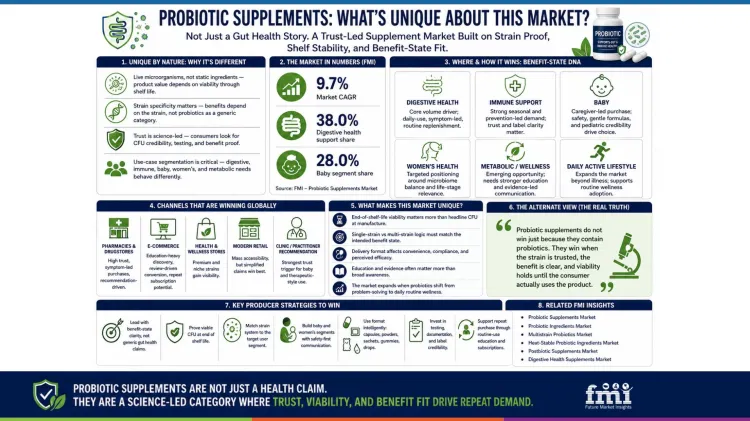
- FMI projects the Probiotic Supplements Market to expand at 9.7% CAGR during 2026 to 2036, with digestive health support leading the functionality segment.
- A low-cost formula can become expensive if it requires high overage, refrigeration, special packaging, or frequent stability failures.
- Shelf-stable strains, spore-forming systems, capsules, powders, sachets, and protected delivery formats can improve cost-in-use when they reduce viability loss.
- Gummies, liquids, drops, and multi-ingredient blends create access and convenience, but they can raise formulation, water activity, and survivability challenges.
- The misconception to avoid is that probiotic value is decided by the highest CFU number on the label. In practice, value is decided by survivability, proof, and consistent delivery.
The Probiotic Supplements Market is often explained through consumer interest in gut health, preventive wellness, and daily supplementation. Those forces matter, but they do not explain the economics of the category. Probiotics are live microorganisms, and that makes them more operationally sensitive than many other supplement categories. A vitamin, mineral, protein powder, or botanical extract may degrade over time, but a probiotic brand faces a more specific burden: it must preserve viable organisms from production through storage, distribution, retail holding, and household use.
This is why the best economic question is not only how much probiotic material a brand buys. The better question is how much live, strain-relevant, functionally meaningful probiotic activity reaches the consumer at the point of use. Many products display CFU counts prominently, but those numbers can be misleading if the count reflects manufacturing overage rather than guaranteed viability at expiry. Buyers, retailers, practitioners, and increasingly informed consumers are becoming more aware of the difference.
FMI identifies digestive health support as the leading functionality in the Probiotic Supplements Market and also shows Baby as the leading customer-orientation segment. These benchmarks are important because they indicate that the market is not only general wellness. It includes sensitive-use cases where consumer trust, dosage consistency, and product integrity are essential. A probiotic positioned for infant, pediatric, digestive, immune, women’s health, or metabolic support cannot rely on a generic value story.
Shelf-stability economics begin with strain selection. Lactobacillus, Bifidobacterium, Bacillus coagulans, Saccharomyces, and other organisms behave differently under oxygen, moisture, heat, acidity, compression, and storage conditions. A strain that performs well in a refrigerated capsule may not survive equally well in a gummy, liquid drop, functional beverage, or powder blend. A supplier may offer an attractive price per kilogram, but if the strain needs heavy overage or strict cold-chain handling, the total economics change quickly.
The Probiotic Ingredients Market is a useful adjacent reference because FMI identifies Lactobacillus as the leading ingredient type and dietary supplements as the leading application demand pool. This reinforces the point that supplement manufacturers are still anchored in known strain families and familiar delivery formats. However, familiar strain names do not remove the need for stability files, strain identity documentation, and end-product testing.
Manufacturers often compensate for viability loss by adding overage. That means they include more live culture at manufacturing than the label requires at expiry. This approach can protect the claim, but it also increases input cost. If the formulation, packaging, humidity control, or distribution environment is weak, the brand may need excessive overage just to meet the final label count. In that case, the visible ingredient cost understates the true cost of the finished product.
Packaging can be just as important as the strain itself. Blister packs, desiccant-lined bottles, high-barrier sachets, moisture-controlled containers, and oxygen-limiting systems can protect viability. However, these packaging choices add cost and must match the product format. A capsule stored in a high-barrier bottle has a different cost profile from a gummy with higher water activity, a liquid drop product, or a ready-to-mix sachet. Shelf-life claims, pack size, serving frequency, and retail channel all affect the economic model.
The Heat-Stable Probiotics Market is relevant because heat-stable systems address a central weakness in conventional probiotics: survivability outside controlled conditions. FMI’s heat-stable probiotic reference highlights shelf-stable supplements as a major application, which reflects why brands are interested in strains and delivery technologies that reduce cold-chain dependence. This does not mean every product should use spore-formers or heat-stable strains, but it shows that stability is becoming a commercial differentiator.
Format choice creates another economic split. Capsules and powders often remain attractive because they can support clearer dosage, lower moisture exposure, and easier strain protection. Gummies can expand consumer access and improve compliance, especially among children and lifestyle users, but they create stability challenges because heat, water activity, sugar systems, acids, and processing conditions can reduce viable counts. Liquid products may be convenient for babies or seniors, but they require careful preservation and shelf-life management.
This is where cost per serving becomes more useful than cost per bottle. A premium probiotic may appear expensive at shelf price, but if it uses a validated strain, lower overage, better stability, and stronger packaging, the cost per effective serving can be attractive. Conversely, a cheaper product with weak survivability may create a lower perceived price but weaker consumer experience, weaker repeat purchase, and higher risk of claim challenge.
Retail and e-commerce add another layer. Products sold through pharmacies, health stores, marketplaces, D2C subscriptions, and mass retail channels face different storage and handling conditions. A product that performs well in pharmacy distribution may face more variable temperatures in last-mile delivery or marketplace fulfillment. Shelf-stable formats can widen channel access, but only if stability is proven under realistic conditions.
For brand owners, the commercial lesson is to evaluate probiotic economics on a risk-adjusted basis. The decision should include strain cost, overage requirement, packaging cost, stability testing, distribution needs, return risk, claim credibility, and expected repeat purchase. A product with stronger stability can support better margins even when its ingredient cost is higher, because it reduces operational risk and strengthens consumer trust.
The misconception to avoid is that the highest CFU number automatically creates the strongest value proposition. High counts can be useful in some products, but the number matters only if the strain remains viable and relevant to the intended benefit. Consumers do not buy a manufacturing number; they buy an expected health-support outcome.
Bottom line: probiotic supplement economics are shaped by viable CFU at end of shelf life, not only by headline dosage. The winners will be brands and ingredient suppliers that combine survivable strains, realistic packaging, defensible claims, and cost-in-use discipline.
Related FMI Reports
- Probiotic Supplements Market: Primary interlink in introduction and conclusion
- Digestive Health Supplements Market: Use when discussing gut-health category context
- Multistrain Probiotics Market: Use when discussing strain combinations and multi-strain product design
- Probiotic for Men Market: Use when discussing gender-specific probiotic positioning
- Probiotic Ingredients Market: Use when discussing strain supply, Lactobacillus, and ingredient documentation
- Dietary Supplements Market: Use when connecting probiotics to broader supplement routines

