


- Pet milk replacer selection should start with species, age, feeding condition, and caregiver skill level rather than only brand familiarity.
- Kittens and puppies have different nutritional tolerances, growth rhythms, and feeding risks, which is why one generalized neonatal claim is not enough.
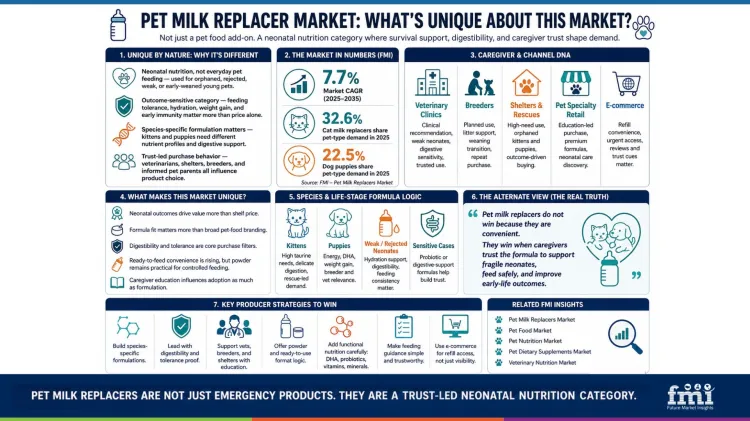
- FMI’s Pet Milk Replacers Market identifies cat milk replacers and dog puppy milk replacers as the core demand segments, confirming the importance of species-specific product architecture.
- The strongest products combine digestibility, fat and protein balance, vitamins and minerals, clear mixing instructions, and practical feeding protocols.
- Shelters, breeders, veterinary clinics, and rescue caregivers need different pack formats and usage guidance than casual pet parents.
- The misconception to avoid is that milk replacers are interchangeable. In practice, formula fit and preparation discipline decide whether the product performs.
Pet milk replacer selection is often simplified as a choice between puppy formula and kitten formula. That is a starting point, but not enough. In the Pet Milk Replacers Market, the more useful commercial question is how well the product fits a specific species, life stage, feeding situation, and caregiver environment.
FMI identifies cat milk replacers as the leading pet-type segment and dog puppy milk replacers as another significant segment. This is more than a product split. It reflects the fact that neonatal care is not one uniform category. Kittens, puppies, and sensitive young animals have different feeding intervals, digestive tolerance, growth expectations, and caregiver needs. A formula that succeeds commercially must fit the biology of the animal and the practical reality of the person feeding it.
The first selection factor is species fit. Kitten milk replacers must be positioned around feline neonatal needs, while puppy milk replacers must reflect canine growth requirements. The buyer may not understand all nutritional details, but they do understand that a newborn kitten is not a small puppy. This makes species-specific communication critical. It also makes generic milk-replacement claims weaker when caregivers are trying to avoid feeding mistakes.
The second factor is life-stage sensitivity. Newborn animals have limited reserves, narrow digestive tolerance, and high vulnerability to dehydration, hypoglycemia, chilling, and underfeeding. A product designed for this stage must support careful preparation and consistent feeding. The formula itself matters, but so does the feeding table, mixing ratio, storage guidance, and transition instruction. In neonatal categories, the label is not only marketing; it is part of the care protocol.
The Pet Care Market is relevant because pet ownership is increasingly linked with health, wellness, and specialized care. Pet parents are more willing to buy products that appear precise and trustworthy. But in pet milk replacers, the user may not be a regular pet parent. The user may be a breeder managing a litter, a shelter volunteer feeding orphaned kittens, a rescuer handling a weak puppy, or a clinic staff member supporting a neonatal case. Each user group needs clarity, not just premium language.
This is why practical product architecture matters. Breeders may prefer larger containers, predictable supply, and repeatable results across multiple animals. Shelters may need economical pack sizes, easy mixing, and instructions that can be followed by volunteers. Veterinary clinics may value professional credibility, emergency usability, and feeding guidance. Pet parents may need smaller packs, simple directions, and reassurance that the product is appropriate for the species. A single product proposition cannot speak to all of these users equally unless the pack architecture and instruction system are carefully built.
Formula format is another selection issue. Powder can be efficient, flexible, and economical for frequent use. It suits breeders and shelters that need to prepare varying quantities. However, powder requires correct mixing. Liquid or ready-to-feed formats may be easier for inexperienced users and urgent situations, but they can carry higher cost and storage limitations. The correct format depends on the care setting. A product that is ideal for a shelter may not be ideal for a first-time pet parent at midnight.
The Functional Milk Replacers Market helps frame the wider shift toward functionality. Milk replacers increasingly compete on more than base nutrition. Digestive support, immune-support cues, probiotics, prebiotics, DHA, vitamins, minerals, and high-quality protein sources can all influence selection. However, functional claims should be used carefully. A neonatal product must be clear and credible. Overloading the pack with claims can confuse buyers if the feeding instructions are not straightforward.
Digestibility is central to formula fit. Newborn pets need a formula that supports intake without creating unnecessary digestive stress. Caregivers quickly notice stool consistency, bloating, feeding refusal, or poor weight progress. These outcomes shape repeat purchase and professional recommendation more than broad brand awareness. In this category, consumer feedback is often based on visible neonatal response, not long-term lifestyle positioning.
The Pet Dietary Supplement Market provides a useful contrast. Supplements often support ongoing wellness, while pet milk replacers address a short but critical early-life window. That difference changes product design. Supplements may build repeat through daily habit. Milk replacers build trust through crisis performance and neonatal outcomes. This is why dosage clarity and preparation discipline matter so much.
Another practical issue is transition. Some young animals may start on milk replacer because maternal feeding is insufficient, then transition toward weaning foods. Others may use replacer temporarily as a supplement. The product should help caregivers understand when and how to use it, how often to feed, when to consult a veterinarian, and how to shift feeding as the animal grows. This is not merely a customer service detail. It influences safety perception and product satisfaction.
The Pet Food Market becomes relevant at the transition stage. Milk replacers are not a permanent feeding format. Their success can influence whether a pet owner, breeder, or shelter trusts the brand in later feeding products. A brand that performs well in neonatal care can build credibility for starter foods, supplements, and broader pet nutrition, but only if the early-use experience is positive.
Manufacturers should therefore build a selection logic around five questions. Which species is the product for? What age and condition is it designed to support? What caregiver environment will use it? What format minimizes preparation error? What proof or guidance gives users confidence? This approach is more useful than simply adding more nutritional claims.
The categories with the strongest fit are species-specific kitten formulas, species-specific puppy formulas, digestive-support replacers, breeder and shelter packs, small emergency packs, and products with clear veterinary-style instructions. The weaker opportunities are broad, one-size-fits-all formulas that do not explain the use case or preparation method clearly.
Accessories and preparation guidance can also influence user success. Feeding bottles, nipples, measuring scoops, reconstitution charts, and storage instructions reduce the gap between product purchase and correct use. These elements may look minor compared with the formula itself, but they are important in households and shelters where feeding is handled by people with different experience levels.
Manufacturers should also consider the post-purchase pathway. A buyer may need help understanding feeding frequency, warming, leftover storage, cleaning, and transition to weaning. Clear educational content can reduce product misuse and strengthen brand trust. For a category used in urgent care situations, after-sale guidance is often as important as pre-sale marketing.
The misconception to avoid is that all pet milk replacers are interchangeable. They are not. Even when the product category looks simple, performance depends on species fit, life-stage fit, formula tolerance, and caregiver compliance.
Bottom line: pet milk replacers win when the product architecture matches the neonatal care situation. The strongest suppliers will design around kittens, puppies, caregiver settings, preparation accuracy, and visible feeding outcomes rather than treating milk replacer as a generic pet nutrition product.

