


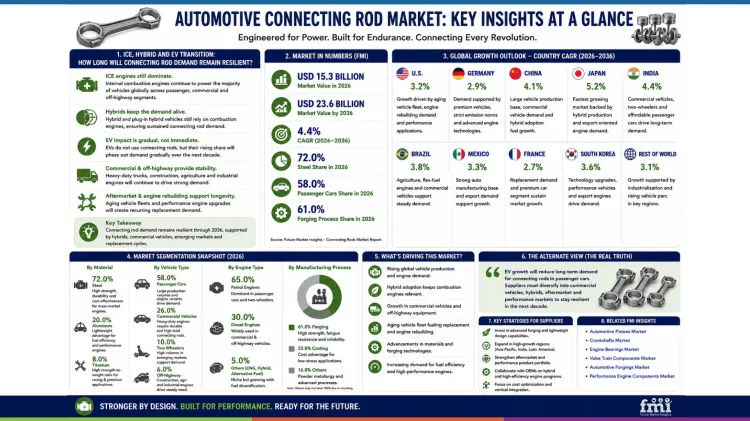
- Steel appears to offer the strongest cost-performance balance for mass-production passenger cars, commercial vehicles, two-wheelers, and off-highway engines.
- FMI expects steel to account for 72.0% of connecting rod material demand in 2026 because it combines strength, fatigue resistance, manufacturing scale, and competitive cost.
- Aluminum offers meaningful rotating-mass reduction, but its lower fatigue strength and higher dimensional sensitivity limit broad adoption in high-load mass-market engines.
- Titanium provides the strongest premium performance proposition through high strength and low weight, but its material, machining, and qualification costs restrict adoption to racing, premium, and high-revolution engines.
- Material selection is becoming more application-specific as turbocharging, hybrid duty cycles, fuel economy requirements, and engine downsizing raise performance demands.
- The key observation is that no material wins every application. Steel wins scale, aluminum wins selected lightweighting cases, and titanium wins where performance matters more than procurement cost.
Connecting rod material selection is a balancing exercise between strength, fatigue life, rotating mass, manufacturability, machining cost, heat resistance, engine speed, and production volume. A material that performs well in motorsport may be commercially unsuitable for a high-volume commuter car. A low-cost material may be unacceptable in a high-output turbocharged engine. This is why the question of steel versus aluminum versus titanium should be answered by application rather than by one universal ranking.
FMI identifies steel as the dominant material in the automotive connecting rod market, with a 72.0% share in 2026. The scale of that share suggests that steel remains the industry’s preferred cost-performance solution. Carbon steel is used widely in mass-production engines, while alloy steel serves turbocharged, commercial vehicle, high-durability, and performance applications.
Steel’s core advantage is not simply low cost. It offers a proven combination of fatigue resistance, stiffness, forgeability, dimensional stability, machinability, supply availability, and OEM qualification history. Connecting rods experience repeated tensile and compressive loading during every engine cycle. A passenger car engine operating at 3,000 revolutions per minute subjects each rod to thousands of load reversals every minute. Commercial and performance engines add higher combustion pressure and longer duty cycles.
Forged steel handles this repeated stress effectively. FMI expects forging to account for 61.0% of manufacturing process demand, which reinforces the relationship between steel and mass-production connecting rods. Hot forging, precision forging, fracture splitting, heat treatment, and machining allow suppliers to produce rods with consistent grain flow, strength, and dimensional accuracy at automotive volumes.
Steel also benefits from a mature industrial ecosystem. Global steel producers offer a wide range of alloy and high-strength grades, while automotive forging companies have decades of process experience. World Steel Association materials describe modern advanced steels as offering high strength with reduced weight and strong recyclability. These attributes allow engineers to optimize steel rods without abandoning the material platform.
The main disadvantage is weight. Steel is denser than aluminum and titanium. Connecting rods are part of the engine’s reciprocating mass, so heavier rods increase inertial loads at higher engine speeds. This can affect crankshaft stress, vibration, fuel efficiency, and engine responsiveness. Engineers address this through optimized I-beam and H-beam profiles, precision forging, hollow designs, material placement, and higher-strength alloys that allow smaller cross-sections.
Aluminum offers a more direct path to reducing reciprocating mass. A lighter connecting rod can improve engine response and reduce some inertial loading. This makes aluminum attractive for performance engines, selected premium vehicles, high-speed applications, and fuel-efficiency programs.
FMI states that aluminum adoption is increasing as OEMs pursue weight reduction and emission compliance. The report links cast aluminum rods with lightweight passenger vehicles and fuel-efficient engines, while forged aluminum rods are associated with motorsport and high-speed engine applications.
The cost-performance case for aluminum is more selective than the lightweighting argument suggests. Aluminum has lower density, but it also has lower stiffness and different fatigue behavior than steel. A connecting rod made from aluminum may require a larger cross-section to achieve the necessary strength. This can offset some packaging and weight benefits. Aluminum also expands more with temperature and may require closer control of clearances and engine operating conditions.
Aluminum connecting rods are often attractive where low rotating mass creates a measurable performance benefit and where replacement intervals or operating conditions are carefully managed. In motorsport, the ability to reduce reciprocating mass can outweigh shorter service life or higher inspection requirements. In mass-market passenger vehicles, OEMs usually need long durability, low warranty risk, high-volume manufacturability, and cost consistency. Steel remains difficult to displace under these conditions.
Titanium occupies the premium end of the material spectrum. It combines high strength with lower density than steel, allowing substantial rotating-mass reduction without accepting all the durability limitations associated with aluminum. This makes titanium attractive for racing engines, premium sports cars, high-revolution motorcycles, aerospace-derived engineering applications, and specialized performance vehicles.
FMI links high-strength titanium rods to performance sports cars and racing engines, while lightweight titanium rods serve premium platforms and high-revolution engines. These uses reflect titanium’s technical strengths, but they also reveal its commercial limitation. Titanium is expensive to produce, forge, machine, finish, and inspect. Tool wear and processing complexity can raise manufacturing costs further.
Titanium therefore offers exceptional performance but a weak mass-market cost case. A high-volume passenger car OEM may not recover the material premium through modest fuel-efficiency improvement. A racing or premium performance buyer may accept the cost because engine response, power-to-weight ratio, and high-rpm reliability have greater value.
The best material also depends on engine type. A small commuter engine prioritizes cost, durability, and high-volume production. Carbon or powder-forged steel is likely to remain suitable. A turbocharged passenger engine faces higher cylinder pressures and may require alloy steel or precision-forged steel. A hybrid engine may benefit from weight reduction but still needs durability under repeated starts, stops, and thermal cycling. Aluminum may be considered in selected cases, but advanced steel can remain more economical.
Commercial vehicle engines favor high-strength forged steel because they operate under high torque and long duty cycles. Off-highway equipment also tends to prioritize durability over low rotating mass. Performance engines and motorsport applications create the clearest business case for titanium and forged aluminum.
Manufacturing process influences the material decision. Forged steel offers mature, scalable production. Cast aluminum may be cheaper than forged aluminum but may not provide the same fatigue performance. Forged aluminum improves strength but raises processing cost. Titanium usually requires advanced forging, precision machining, and strict quality control.
The aftermarket has a different material mix than OEM supply. Engine rebuilders usually replace rods with steel products that match OE specifications. Performance tuners may upgrade to forged steel, aluminum, or titanium depending on engine speed, boost pressure, intended use, and budget. This makes the aftermarket more open to premium material experimentation than high-volume OEM programs.
A lighter connecting rod is not necessarily the better option. Weight reduction must be balanced against fatigue strength, durability, and the required service life. A lightweight design that increases inspection frequency, failure risk, or warranty exposure may ultimately deliver lower overall value.
As per FMI assessment, steel’s 72.0% share appears to reflect the material’s ability to balance weight-reduction potential with cost, durability, and scalable manufacturing. The use of advanced grades and optimized component designs is also supporting further lightweighting without materially compromising service-life requirements. Aluminum continues to address a relatively narrower lightweighting segment, while titanium is largely observed in high-performance applications where customers are prepared to absorb a substantial price premium.
Suppliers should therefore avoid presenting material choice as a linear upgrade from steel to aluminum to titanium. Each material addresses a different commercial problem. Steel addresses scale and durability. Aluminum addresses selected weight-sensitive applications. Titanium addresses extreme performance and low rotating mass.
Bottom line: steel appears to offer the best cost-performance balance for most automotive connecting rod applications. Aluminum becomes attractive when rotating-mass reduction creates enough value to justify its design and durability trade-offs. Titanium offers the strongest performance proposition but remains commercially viable mainly in racing, premium, and high-revolution engines. The market appears likely to remain steel-led while material specialization increases at the edges.

