


- CFU count is only one trust signal in probiotic supplements; strain identity, clinical relevance, viability at expiry, and documentation are becoming stronger differentiators.
- FMI’s Probiotic Supplements Market segmentation includes bacteria type and CFU count, confirming that buyers increasingly compare products by specification, not only brand familiarity.
- Probiotic credibility depends on strain naming, evidence quality, stability data, manufacturing controls, label clarity, and realistic benefit communication.
- Multistrain and high-CFU products need proof that the formulation is coherent, stable, and relevant to the stated benefit area.
- Postbiotics and heat-stable probiotics are gaining attention because they address stability and channel challenges that live-culture products face.
- The misconception to avoid is that bigger numbers automatically mean stronger products. In probiotics, proof of strain relevance matters more than headline CFU inflation.
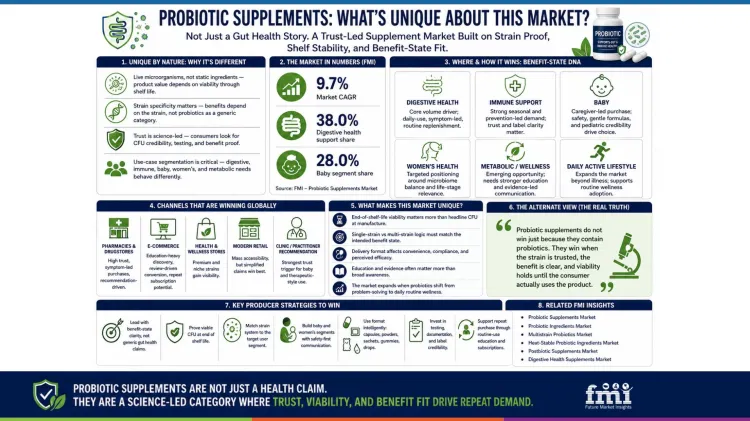
The Probiotic Supplements Market has matured beyond the early stage where consumers accepted broad “good bacteria” claims without much comparison. Today, probiotic products are judged by sharper trust signals: strain identity, CFU level, survivability, evidence, delivery format, shelf-life guarantee, and benefit relevance. This makes strain proof one of the most important evergreen benchmarks for the category.
CFU count remains visible because it is easy to compare. A larger number on the front of pack can create the impression of stronger value. But CFU alone is not enough. The same CFU count can mean very different things depending on the strain, formulation, delivery system, packaging, storage conditions, and whether the number is guaranteed at manufacturing or at expiry. Consumers may see a number; formulators see a viability and evidence problem.
FMI’s Probiotic Supplements Market includes segmentation by bacteria type and CFU count, which shows that specification has become part of the market structure. Digestive health support leads functionality demand, but products within digestive health still compete by how credible their strain story is. A product with a clear strain identity and realistic claim may be more defensible than a high-CFU product with weak documentation.
A strong probiotic benchmark begins with strain naming. Genus and species are not enough. Lactobacillus and Bifidobacterium are broad categories, not complete proof. A finished product should be able to identify the strain, explain its relevance, and maintain traceability from ingredient supplier to finished supplement. Strain-level identity matters because research findings for one strain cannot automatically be transferred to another strain in the same species.
The Probiotic Ingredients Market is relevant here because FMI identifies Lactobacillus as the leading ingredient type and notes dietary supplements as the leading application demand pool. This reinforces the importance of documented strain supply. Supplement brands need ingredient partners that can provide strain files, viable-count data, stability support, regulatory documentation, and formulation guidance.
The second benchmark is viability at end of shelf life. A probiotic product may contain a high number of organisms at production, but the consumer uses the product weeks or months later. If the viable count declines sharply, the label promise becomes weaker. Stronger brands specify counts in a way that reflects end-of-shelf-life integrity and avoid relying only on launch-stage overage as a marketing story.
The third benchmark is benefit relevance. A digestive health product should use strains and evidence linked to digestive comfort or gut balance. A baby product should use age-appropriate logic and conservative communication. A women’s health product should not simply reuse a generic digestive strain without explaining its fit. An immune-support product needs evidence and wording that can survive regulatory and retailer scrutiny. Trust is created when the strain, claim, and consumer group align.
The Multistrain Probiotics Market illustrates the next layer of proof. Multistrain products are attractive because they suggest wider coverage, but they also create a proof burden. Brands must show that the selected strains are compatible, stable together, and relevant to the benefit area. A multistrain formula should be treated as a designed system, not a collection of recognizable names.
The fourth benchmark is delivery format. Capsules, sachets, powders, gummies, liquids, and drops each create different stability and compliance conditions. A capsule may protect cultures better than a gummy in some cases. A drop format may be more practical for infants but may need strict preservation controls. A powder may support flexible dosing but must manage moisture and clumping. Trust depends on matching the delivery format to both the organism and the use case.
The fifth benchmark is label clarity. A probiotic label should help the buyer understand strain identity, CFU level, serving size, storage requirement, expiry basis, target use, and supporting ingredients. Confusing labels weaken trust. If the product uses prebiotics, vitamins, minerals, botanicals, or enzymes, the label should not blur the central probiotic promise. Stronger brands keep the hierarchy clear: what the probiotic is, what it supports, and how the consumer should use it.
Adjacent FMI references also show why the market is evolving beyond conventional live-culture products. The Heat-Stable Probiotics Market highlights the commercial value of survivability in ambient channels, while the Postbiotic Supplements Market reflects interest in microbiome-support formats that do not depend on live-cell viability in the same way. These adjacent categories do not replace probiotics, but they raise the standard for stability and proof.
This creates an important competitive shift. Probiotic supplement brands cannot rely only on brand awareness, high CFU numbers, or broad gut-health language. They need evidence architecture. That includes strain identity, stability data, dosage rationale, manufacturing quality, safety documentation, and benefit-specific communication. In many markets, retailer and pharmacy buyers are also becoming more selective because probiotics sit near health-related claims and consumer safety expectations.
For suppliers, strain proof is also a route to better margins. Commodity-like probiotic blends are easier to replace. Documented strains with stability data, application support, regulatory files, and clinical references are harder to substitute. This is especially true for premium capsules, pediatric products, women’s health products, practitioner-recommended formulas, and products sold through pharmacies or specialty health channels.
For brand owners, the useful internal benchmark is not “highest CFU at lowest cost.” It is “best-supported strain system for the target benefit.” That benchmark should include the strain’s evidence base, viable count at expiry, stability under expected storage, compatibility with other ingredients, dosage fit, consumer format, and channel requirements. A lower-CFU product can be more credible than a high-CFU product if it is better documented and better matched to the use case.
The misconception to avoid is that higher CFU counts automatically build consumer trust. They may attract attention, but attention is not the same as repeat adoption. Repeat adoption depends on whether the consumer believes the product is specific, stable, credible, and relevant to the problem they are trying to solve.
Bottom line: probiotic supplements win when strain proof, viable delivery, and benefit-specific communication work together. CFU count matters, but it is only one part of a broader trust benchmark.
Related FMI Reports
- Probiotic Supplements Market: Primary interlink in introduction and conclusion
- Digestive Health Supplements Market: Use when discussing gut-health category context
- Multistrain Probiotics Market: Use when discussing strain combinations and multi-strain product design
- Probiotic for Men Market: Use when discussing gender-specific probiotic positioning
- Probiotic Ingredients Market: Use when discussing strain supply, Lactobacillus, and ingredient documentation
- Dietary Supplements Market: Use when connecting probiotics to broader supplement routines

