


- Shrimp may benefit from premium pricing on sustainability if and only if other factors like quality, safety, traceability, and supply are well developed.
- Purchasers favor certifications and traceability for their shrimp, but not all sustainability premiums apply to all segments of the global shrimp sector.
- The greatest premiums can be achieved for retail package shrimp, high-quality frozen seafood, exports, and foodservice purchases through sustainability programs.
- Sustainability adds less value where purchasing decisions are price-focused, such as commodity-based wholesale transactions.
- The most dangerous misconception is believing that certification itself generates pricing power. Instead, sustainability is used to protect premium pricing.
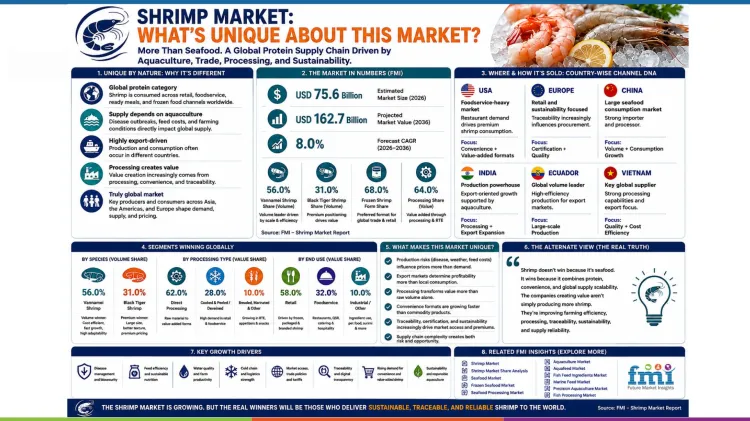
Sustainability is becoming one of the most important competitive differentiators in the global Shrimp Market, but it is also becoming one of the industry's most misunderstood concepts. In this regard, producers are now focusing on certification schemes, traceability solutions, responsible sourcing of feeds, and environmental compliance with the hope that they will automatically fetch premiums. On their part, buyers consider sustainable shrimp to be superior to conventional shrimp products. While there is some truth in both the assertions, they simplify the dynamics of sustainability as creating value.
On its part, sustainability does not fetch a premium. Instead, buyers are willing to pay premiums for sustainable products if it means lower risks, building greater trust, enhancing traceability, improving food safety, and satisfying procurement requirements. In other words, sustainability adds value by solving business problems. The buyer is willing to pay the premium not because of the label but what it means about the product's supply chain.
It is crucial to note that shrimps are produced within some of the world's most complicated supply chains. It can involve production in one country, processing in another, distribution through intermediaries, and consumption in new markets. Therefore, sustainability has come to mean increasing supply chain visibility, regulatory compliance, and procurement confidence. Across the broader Seafood Market, sustainability is evolving from a marketing claim into a sourcing requirement.
Why Sustainability Means Different Things to Different Buyers
Another reason why the sustainability premiums differ from one another is that sustainability has a different meaning for each party making the purchase decision. The retailers, the food service providers, the importers, the regulators, the investors, and the consumers assess sustainability in different ways.
For retailers, sustainability is often related to risk management. Large supermarket companies are under increasing pressure from consumers, investors, and advocacy organizations with regard to their sourcing strategies. Sustainability allows them to mitigate risks, preserve the image of their brands, and prove their responsible approach to procurement. In this respect, certified shrimp producers get ahead as they allow retailers to achieve their corporate goals.
The perspective of food service providers is quite different. Despite the fact that seafood restaurants do not promote aquaculture certificates among their menu items, sustainability is becoming an important criterion when selecting the suppliers. For big hospitality and restaurant companies, it is important that the suppliers can ensure responsible sourcing, traceability, and reliability of supplies.
Consumers are the source of even more uncertainty. The definition of sustainable seafood may refer to environmental responsibility, food safety, ethical production, and high-quality. However, while consumers are unfamiliar with the certification system, sustainability adds some credibility. These perceptions can support premium pricing, particularly in retail environments where packaging serves as the primary communication tool.
Because these motivations differ, there is no single sustainability premium. Instead, premiums vary by geography, distribution channel, customer segment, and procurement objective.
Why Certification Is Becoming a Cost of Entry
Another misunderstanding involves the assumption that once certification takes place, there is an automatic creation of a premium. More often than not, certification simply creates access.
There is no doubt that certifications, including ASC, BAP, GlobalG.A.P., as well as retailer specific sourcing criteria are becoming more and more common within the shrimp industry. Nonetheless, the real power of such certifications can hardly be found in the price premium. For a supplier to become a participant of any foodservice procurement program, it must be certified first.
In other words, although certification does not create a price premium per se, the lack of it can make suppliers unavailable in the market.
One might argue that the process of certification and its effects is not that different from the food safety certification of the past decades. Firms usually do not get a lot of pricing benefits just for meeting basic food safety criteria, while failure to meet such criteria makes the firm unable to compete in major markets. The process of sustainability follows the same path.
Traceability Is Becoming More Valuable Than Sustainability Claims
One of the most important developments across the Seafood Processing Market is the growing importance of traceability. Increasingly, buyers want proof rather than promises.
The questions being asked now include what farms the shrimp came from, how they were harvested, what sort of processing methods were used, how labor conditions were managed, and if environmental commitments were honored. In other words, unsubstantiated assertions about sustainability are losing their credibility.
It is traceability that provides an answer to this challenge, because traceability brings transparency to the whole supply chain. Traceability makes it possible for buyers to check the sustainability claims rather than have to believe them. Traceability, therefore, is becoming more commercially viable than sustainability messages in their own right.
A supplier that can prove its ability to provide full transparency into the supply chain will always be more trusted than one that simply produces certifications. The value added here is in the reliability, rather than in the narrative.
Where the Sustainability Premium Is Strongest
The strongest sustainability premiums tend to appear in premium retail and export markets.
Within the Frozen Seafood Market, sustainability credentials provide visible differentiation. Through packaging, brands are able to signal their certifications, sourcing details, environmental commitment, and traceability efforts. Such signals tend to help premium positioning since they are perceived as indicators of higher quality.
There are also premium food service programs where large restaurants have begun to incorporate sustainability criteria when making purchases. Suppliers who meet such criteria can obtain the preferred status of vendors and enter into long-term agreements.
Export markets tend to offer more compelling motivations to act in a sustainable way. With import requirements, demands of retailers, and sourcing commitments of corporations becoming increasingly stringent, suppliers are motivated not only by access to the market but also by price considerations.
The premium is typically strongest in:
- Premium frozen shrimp
- Branded retail seafood products
- Certified export programs
- Traceable origin offerings
- Foodservice sourcing contracts
- Retail sustainability initiatives
Where the Sustainability Premium Is Weakest
The sustainability premium becomes extremely challenging to realize in commodity channels.
A buyer’s preference might include price, availability, size, and dependability. Although sustainability might matter, it usually becomes less important after the basic criteria are achieved.
In this type of channel setting, certification might become necessary but not enough. Buyers may want a supplier that has sustainability features but does not want to pay a lot more for such benefits.
In effect, this brings out a clear difference between creating and capturing value. Sustainability could help create value by providing access to markets but does not necessarily translate to capturing value in terms of pricing.
As a result, this channel setting presents the most challenging environment for sustainability premiums. In this context, efficient operations take center stage.
The Biggest Misconception
Misunderstandings about sustainability are numerous, but the most serious one is that sustainability will automatically command a premium price.
This is incorrect. Sustainability can increase pricing power only if it increases trust, lowers risks, increases compliance, increases traceability, or increases the credibility of brands. Even with certification, it will take much more value creation to earn justified premium prices.
The most successful companies know that sustainability should be part of a wider value proposition. Trust, consistency, quality, food safety, traceability, and reliability will always be important fundamentals, which sustainability should build on.
Bottom Line
There definitely is a sustainability premium for shrimp, but it is extremely contingent on several factors. Consumers are becoming increasingly inclined to compensate those producers that are able to prove their responsibility, traceability, certification, and transparency along the entire chain. However, sustainability alone is often not a sufficient reason for paying higher prices.
Premium premiums can be found in retail sales, export-oriented buying initiatives, frozen branded seafood, and foodservice purchasing processes. Low premiums can be expected in commodity distribution channels because of the primary importance of price at purchase.
Future market leaders will not be the most sustainable producers but rather those who are capable of making sustainability measurable, verifiable, and commercially viable.
Related FMI Reports
- Shrimp Market
- Seafood Market
- Frozen Seafood Market
- Seafood Processing Market
- Aquaculture Market
- Aquafeed Market
- Marine Feed Market
- Fish Feed Ingredients Market
- Precision Aquaculture Market

