


By Nikhil Kaitwade
Thermal spray equipment is benefiting from a simple industrial reality: operators would rather restore expensive surfaces than replace entire high-value parts. That logic is becoming stronger in aerospace, power generation, and heavy manufacturing.
The market is also being pushed by regulation. As hard-chrome replacement programs, coating qualifications, and high-temperature materials work all move forward, buyers need more capable spray systems, not just more consumables.
Why the market has become harder to ignore
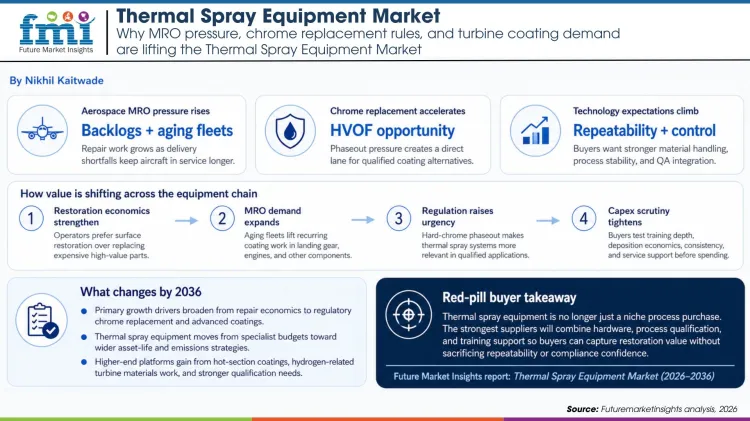
- Aircraft backlogs and aging fleets are sending more repair work into MRO environments that depend on coating restoration.
- Thin operating margins keep operators focused on repair economics and life extension rather than unnecessary replacement.
Aerospace demand matters because delivery shortfalls leave fleets older for longer. When operators cannot replace assets quickly, they lean harder on overhaul work, and that increases the importance of coating systems used on landing gear, engines, and other high-value components.
This is not only an aerospace story. In any sector where asset utilization remains high and replacement is expensive, thermal spray equipment benefits from the economics of restoration. Buyers are therefore evaluating spray capability as part of lifecycle management rather than as a narrow specialty process.
Which demand signals look strongest
- Hard-chrome phaseout and replacement programs are creating a direct growth lane for HVOF and related spray systems.
- New turbine and hot-section materials work is raising the performance expectations placed on coating equipment.
California's chromium rules and broader industry movement away from hexavalent hard chrome have given thermal spray equipment a very practical regulatory tailwind. The opportunity is especially visible where HVOF coatings are already qualified as chrome replacements in demanding applications such as landing gear.
At the same time, gas-turbine materials programs are pushing coating architectures to higher performance levels. That favors buyers who can invest in better process control, more capable plasma or HVOF systems, and stronger integration with post-spray finishing and QA workflows.
| Market dimension | 2015-2025 | 2026-2036 |
|---|---|---|
| Primary growth driver | Repair economics supported steady niche demand. | Regulatory chrome replacement and advanced coatings broaden the market. |
| Aerospace role | High-spec programs anchored premium demand. | Aging fleets and MRO intensity expand recurring equipment needs. |
| Compliance context | Chrome replacement interest was building but uneven. | Phaseout rules make alternatives more urgent. |
| Technology expectation | Established HVOF and plasma capability could satisfy many buyers. | Buyers increasingly want higher repeatability and advanced material handling. |
| Buyer mindset | Thermal spray often sat inside specialist budgets. | It is increasingly tied to wider asset-life and emissions strategies. |
What buyers should test before spending capex
- Workforce capability and integrator support can limit realized value even when end-market demand is strong.
- New-build constraints may support MRO demand, but buyers still need to verify deposition economics and consistency.
Training and process know-how remain gating issues. Thermal spray equipment only performs commercially when shops can run it repeatably, maintain it properly, and qualify outputs under demanding customer requirements. Buyers therefore need to evaluate labor depth and service support alongside machine specifications.
They also need a realistic economics model. MRO demand may be strong, but coating work still depends on turn time, consumable efficiency, and rework rates. A machine that looks technically impressive but cannot hold process stability under throughput pressure will disappoint quickly.
What the next decade may favor
- Advanced hot-section coatings and hydrogen-related turbine materials work should lift the value of higher-end spray platforms.
- Suppliers that can link equipment, process qualification, and training will be better positioned than hardware-only sellers.
Research programs around hotter turbine operation and new barrier coating systems suggest the market will not stay static. Equipment capable of supporting more advanced coating stacks should gain as commercial use cases move from R&D into qualified production and service work.
That means the strongest offerings will likely combine hardware with application support and qualification expertise. For the 2026-2036 forecast and wider segment detail, see the Future Market Insights report: Thermal Spray Equipment Market (2026 - 2036) - https://www.futuremarketinsights.com/reports/thermal-spray-equipment-market
Bibliography
- Boeing Commercial Market Outlook 2024-2043 summary, Aviation Week analysis: https://aviationweek.com/shownews/farnborough-airshow/boeing-forecast-reflects-improving-supply-chain-widebody-prospects
- Boeing CMO overview: https://www.boeing.com/commercial/market/commercial-market-outlook/index.page
- IATA industry financial outlook for 2026: https://www.iata.org/en/pressroom/2025-releases/2025-12-09-01/
- CARB rule to phase out hexavalent chromium plating: https://ww2.arb.ca.gov/news/carb-passes-new-amendments-phase-out-toxic-hexavalent-chromium/printable/print
- CARB board presentation on phase-out milestones: https://ww2.arb.ca.gov/sites/default/files/barcu/board/books/2023/012623/23-1-7pres.pdf
- CARB Final Statement of Reasons: https://ww2.arb.ca.gov/sites/default/files/barcu/regact/2023/chromeatcm2023/chrome_fsor.pdf
- SAE ARP5935, HVOF for chrome replacement on landing gear: https://saemobilus.sae.org/standards/arp5935-use-hvof-thermal-spray-coatings-hard-chrome-replacement-landing-gear-applications
- ASM Digital Library case on HVOF WC-Co-Cr landing gear coating: https://dl.asminternational.org/itsc/article/doi/10.31399/asm.cp.itsc2006p0615/21150/HVOF-Applied-WC-Co-Cr-as-a-Hard-Chrome-Replacement
- NASA NTRS HyTEC coating results: https://ntrs.nasa.gov/citations/20240010950
- US DOE hydrogen-turbine coatings projects: https://www.energy.gov/hgeo/project-selections-foa-2613-advanced-energy-materials-hydrogen-turbines-stationary-power

