


By Sabyasachi Ghosh
Thermodilution catheters remain relevant because certain critical-care decisions still demand invasive hemodynamic precision. In those settings, the debate is not whether the technology is old. It is whether the clinical context still justifies its use.
That makes this a selective but durable market. Demand is concentrated in the highest-acuity cardiac and shock settings, where protocol discipline, training, and risk management matter as much as simple procedure volume.
Why the market has not retreated
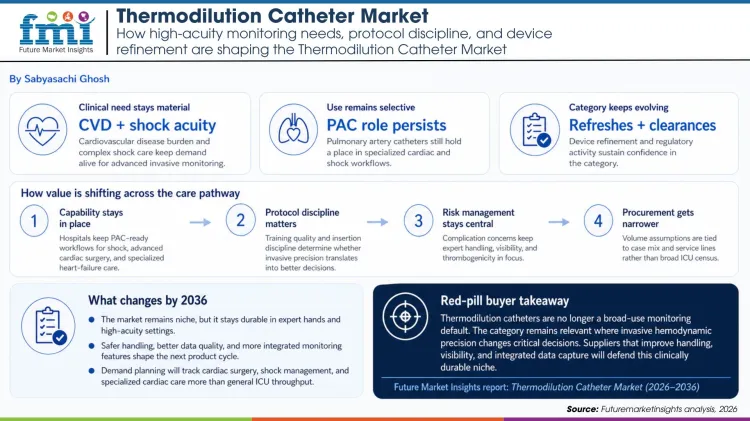
- Cardiovascular disease burden continues to support demand for advanced monitoring in complex cardiac care.
- Registry and review data show that pulmonary artery catheters still hold a place in selected high-acuity workflows.
The global cardiovascular disease burden remains immense, and that keeps pressure on hospitals to maintain tools for complex perioperative and shock management. Thermodilution-based monitoring persists because certain patient groups still require more detailed hemodynamic assessment than noninvasive methods can reliably provide.
Usage is no longer broad by default, but it is still meaningful where acuity is highest. Contemporary CICU data and recent reviews show that PAC use remains concentrated in shock and specialized cardiac populations, which supports ongoing demand even as routine use stays limited.
Where demand continues to build
- Clinical protocols and risk management still support catheter use in selected shock and perioperative cases.
- Product refresh activity and regulatory clearances help sustain confidence in the category.
Guidelines such as the Surviving Sepsis Campaign do not prescribe thermodilution in every case, but they leave room for advanced monitoring where individualized resuscitation and hemodynamic precision are necessary. Hospitals that manage complex cardiac and shock populations therefore keep PAC-ready workflows in place as a hedge against poor decision-making in unstable cases.
The supplier side also remains active. FDA clearances and device refreshes show that manufacturers still see commercial value in improving catheter performance, visibility, and data capture. That ongoing refinement helps prevent the category from slipping into pure legacy status.
| Market dimension | 2015-2025 | 2026-2036 |
|---|---|---|
| Clinical role | Broader use had already narrowed toward higher-acuity cases. | Use remains selective but stays important in shock and complex cardiac care. |
| Buyer rationale | Hospitals bought largely to preserve capability in specialized units. | Procurement focuses more tightly on case mix, protocol fit, and training quality. |
| Technology narrative | The category was often framed as mature and controversial. | Iterative improvements and smarter integration support continued use. |
| Risk lens | Complication concerns constrained broader adoption. | Risk management stays central, with more emphasis on expert handling. |
| Commercial outlook | Demand depended on specialized service lines. | That dependence remains, but high-acuity monitoring needs keep the niche durable. |
What buyers should evaluate most carefully
- Complication risk keeps training quality and insertion discipline central to the value proposition.
- Volume assumptions should be tied to specific service lines, not general ICU throughput.
Pulmonary artery injury and other adverse events remain a serious consideration, which is why buyers cannot evaluate these catheters as simple disposable volume. Training, insertion protocols, thrombogenicity, and visibility features all affect whether the device improves care or introduces avoidable risk.
Commercial planning should be equally selective. The right demand lens is advanced cardiac surgery, shock management, and specialized heart-failure care, not broad ICU census numbers. In this market, a realistic case-mix view is essential to good contracting.
What may define the next product cycle
- Incremental innovation is likely to focus on safer handling, better data quality, and more integrated monitoring features.
- The market should remain niche, but it is a niche with clear clinical staying power in expert hands.
Recent product activity suggests the category will evolve through refinement rather than radical reinvention. Buyers should expect continued work on materials, torque control, and integrated sensing that improves workflow and confidence without changing the core invasive logic of the device.
That should keep the market stable rather than explosive. It remains indication-specific, but the indications that support it are serious and persistent. For deeper segment detail and the 2026-2036 outlook, see the Future Market Insights report: Thermodilution Catheter Market (2026 - 2036) - https://www.futuremarketinsights.com/reports/thermodilution-catheter-market
Bibliography
- WHO Cardiovascular diseases fact page: https://www.who.int/cardiovascular_diseases/en/
- American College of Cardiology press summary of GBD 2023 CVD findings: https://www.acc.org/about-acc/press-releases/2025/09/23/19/19/report-cardiovascular-diseases-caused-1-in-3-global-deaths-in-2023
- ACC Journal Scan of CICU PAC use, JACC: Heart Failure 2023: https://www.acc.org/latest-in-cardiology/journal-scans/2023/06/15/15/15/pulmonary-artery-catheter-use
- PubMed review "The pulmonary artery catheter" 2023: https://pubmed.ncbi.nlm.nih.gov/37078636/
- PubMed meta-analysis on PAC in cardiogenic shock 2023: https://pubmed.ncbi.nlm.nih.gov/37065575/
- Surviving Sepsis Campaign Guidelines 2021: https://www.sccm.org/clinical-resources/guidelines/guidelines/surviving-sepsis-guidelines-2021
- FDA 510(k) database entries, Edwards and related thermodilution devices: https://www.accessdata.fda.gov/scripts/cdrh/cfpmn/pmn.cfm?ID=K233895 and https://www.accessdata.fda.gov/cdrh_docs/pdf19/K193466.pdf
- Liquet Medical catheter clearance for real-time PA pressure, Endovascular Today 2025: https://evtoday.com/news/Liquets-Versus-New-Catheter-Configuration-Cleared-for-PA-Pressure-Measurement
- Japan Council for Quality Health Care, PAC injury risk advisory (English summary PDF): https://www.medsafe.or.jp/uploads/uploads/files/teigen19english.pdf

