


- The market for topical pain relief is becoming more competitive between China and India in the sourcing of APIs to balance cost efficiency, regulatory compliance and quality consistency.
- China’s scale economics, lower manufacturing costs and integrated chemical supply chains give it a leading position in bulk API manufacturing.
- India is tightening its hold on regulated pharma-grade APIs driven by GMP compliance, formulation skills and export-oriented quality standards.
- The total landed cost and not only the price of the raw API including compliance risk, batch consistency and supply continuity is increasingly impacting the selection of suppliers.
- The evolving geopolitical environment and supply chain volatility are transforming the procurement environment, compelling medical facilities and pharma brands to reconsider their sourcing approaches.
- In addition to cost negotiation, quality assurance, regulatory alignment and long-term supplier reliability are increasingly driving strategic sourcing decisions.
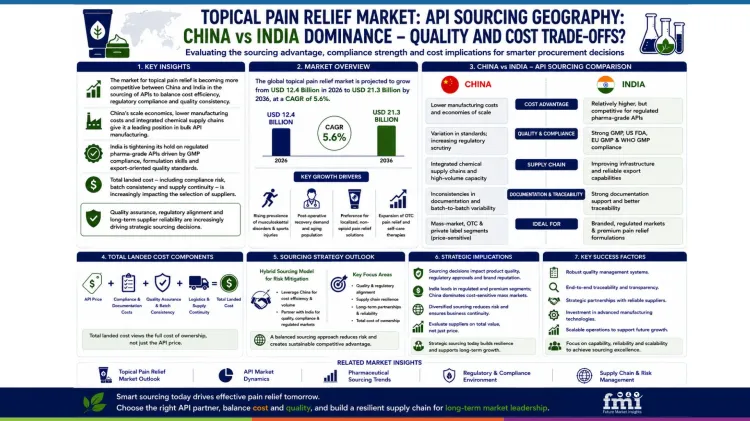
The global topical pain relief market stood at USD 12.4 billion in 2026. The global topical pain relief market is expected to reach USD 21.3 billion by 2036, growing at a CAGR of 5.6 % during the forecast period. The growth is attributed to the growing prevalence of musculoskeletal disorders, sports injuries, post-operative recovery demand, and the increasing preference for localized and non-opioid pain management solutions. As the environment changes, API sourcing has emerged as a major factor in cost structure, product quality and supply chain resilience.
With the increased demand for formulations in topical gels, creams, sprays and patches, the industry is increasingly dependant on active pharmaceutical ingredients (APIs) such as NSAIDs, lidocaine, menthol derivatives, capsaicin and methyl salicylate intermediates. The sourcing geography of these APIs is now a strategic lever which directly impacts margin structures and regulatory positioning in global markets.
China has developed a structural advantage in the global API supply chain with a large-scale chemical manufacturing ecosystem, vertically integrated access to raw materials and cost-efficient production clusters. China is a very competitive place to source topical pain relief APIs, especially for bulk excipient-compatible compounds and high-volume NSAID intermediates. The main benefits for manufacturers, especially in the mass market topical segment, are lower input costs and the ability to ramp up production on a flexible basis when sourcing from China. But this cost advantage is often negated by variations in standards for regulatory documentation, differences in batch-to-batch consistency and increasing scrutiny from international regulators on environmental compliance and quality checks.
Still, India has come up as the high compliance API sourcing hub for pharma. Indian manufacturers are increasingly compliant with US FDA, EU GMP and WHO-GMP standards and are thus preferred partners for regulated markets. Indian API suppliers provide better documentation support, tighter quality control systems and improved traceability frameworks for topical pain relief formulations entering hospital pharmacies and prescription channels. Indian APIs may be more expensive to source than Chinese APIs, but they mitigate the downstream risks of regulatory delays, recalls and formulation instability.
Hence, the procurement strategies in this market are shifting from pure cost comparison to a more complex evaluation of the total landed cost. These include not only API pricing but also compliance validation costs, risks of reformulation, assurance of supply continuity and inventory holding requirements. For multinational pharmaceutical companies, the cost of failure in API sourcing typically exceeds incremental price savings. India is the preferred source for regulated topical pain relief products.
Meanwhile, China continues to dominate the more price sensitive sectors of the market, especially in the area of over-the-counter topical analgesics and private label formulations. Price elasticity is still high in these segments and buyers are looking at affordability and volume scalability. Indian suppliers are more prominent in branded formulations, export-oriented products and clinically positioned pain management solutions where regulatory credibility is important.
Another important dimension for sourcing decisions is supply chain diversification. Pharmaceutical companies are increasing sourcing from China and India to hedge against geopolitical risk, logistics disruptions and raw material shortages. The hybrid sourcing model allows manufacturers to maximize cost benefits while still having regulatory safety nets in place in markets with varying levels of compliance requirements.
API sourcing also influences product differentiation from a formulation point of view. Increasing use of high purity APIs from regulated Indian suppliers in premium transdermal patches and controlled release topical systems. Meanwhile, China-sourced APIs are still the major source for mass-market gels, ointments and sprays, where cost efficiency is the main driving factor.
Formulary standardization and reimbursement structures are indirectly shaping API sourcing decisions via hospital procurement systems and pharmacy chains. ‘The institutional purchasing environment wants products with stable supply chains and consistent clinical performance, which helps drive the trend towards higher quality sourcing even if it costs a little more.’
The competitive implication is clear: API sourcing geography is no longer a back-end procurement decision, but a front-end strategic variable impacting brand positioning, regulatory approval timelines and global market access. Companies risk margin compression and market access restrictions by not aligning sourcing strategy with regulatory and commercial expectations.
Takeaway: The China vs. India API sourcing dynamics in the topical pain relief market is moving from a cost-based competition to a quality-driven strategic equilibrium. China is the undisputed champion of low-cost bulk production, but India is fast becoming the supplier of choice for regulated, high-compliance pharma APIs. Future competitiveness will rely on hybrid sourcing models that optimise both cost efficiency and regulatory reliability.

