


- The topical pain relief market size was valued at USD 12.4 billion in 2026 and is anticipated to reach USD 21.3 billion by 2036, growing at a CAGR of 5.6% during the forecast period.
- With geopolitical uncertainty, logistics disruptions and regulatory scrutiny of pharmaceutical ingredients, topical analgesic manufacturers are increasingly re-evaluating global supply chains.
- While sourcing of APIs for many active ingredients used in topical pain relief products remains concentrated in Asia, formulation and final manufacturing activities are increasingly regionalized closer to end markets.
- The strongest nearshoring efforts are in North America and Europe where supply security, regulatory compliance and shorter lead times are becoming strategic priorities.
- Healthcare buyers are increasingly looking for supply continuity and manufacturing resilience to encourage suppliers to diversify their production footprints.
- Full reshoring is still a major economic challenge, but hybrid manufacturing models are emerging as companies seek to balance cost efficiency with supply chain reliability
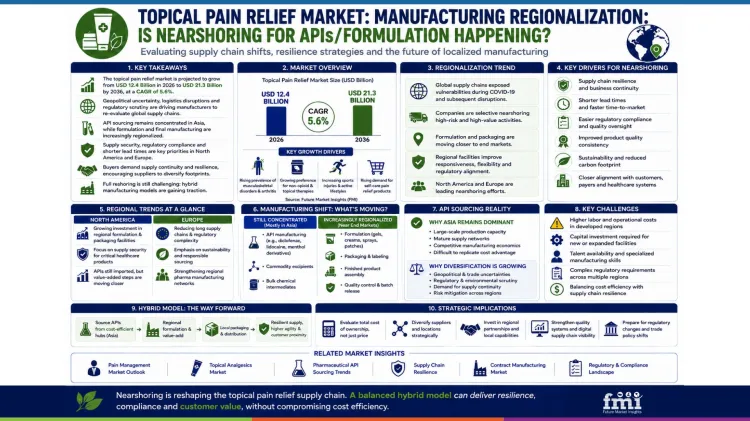
The market for topical pain relief continues to grow as healthcare providers, consumers and payers embrace non-invasive pain management solutions. The market size is expected to grow from USD 12.4 billion in 2026 to USD 21.3 billion by 2036, at a CAGR of 5.6% during the forecast period. The growth is supported by the increasing musculoskeletal disorders, increasing prevalence of arthritis, more adoption of non-opioid therapies, and growing demand for self-care pain control products.
The market's growth makes supply chain strategy a more important competitive variable. One of the most urgent questions for manufacturers today is whether or not manufacturing should still be concentrated in traditional low-cost manufacturing hubs or if regionalized manufacturing models are now a must.
Many topical pain relief products have relied on highly globalized supply chains for years. Active pharmaceutical ingredients, excipients, packaging materials and formulation services were often obtained from multiple countries before the final products reached healthcare providers and consumers.
That model provided us with good cost benefits. But the recent collapses revealed weaknesses that many companies had overlooked.
The COVID-19 pandemic revealed the vulnerability of over-reliance on geographically centralized manufacturing networks. Supply challenges across pharmaceutical and consumer healthcare categories stemmed from shipping bottlenecks, labor shortages, raw material constraints and regulatory interruptions.
Topical pain relief makers were not exempt from these disruptions.
Many organizations discovered that low manufacturing costs could quickly be offset by delayed production schedules, inventory shortages, and reduced product availability. As a result, supply chain resilience has become an executive-level priority throughout the industry.
One of the biggest areas of focus involves active pharmaceutical ingredients.
Many of the key materials used in topical pain relief products are still heavily dependent on Asian manufacturing ecosystems. Ingredients such as diclofenac, lidocaine, menthol derivatives and various excipients are often favoured by the mature supply networks, large scale production infrastructure and competitive manufacturing economics available in countries like China and India.
The economic case remains compelling.
Large scale API facilities profit from established supplier networks, lower operating costs and large production capacity. In many cases, these structural advantages are still difficult for North American or European manufacturers to imitate on a commercial basis.
So the reshoring of API production has been more widespread, but not as fast as many observers expected at the beginning.
Rather, a more complex trend of regionalization is emerging.
Though many manufacturers are not moving entire supply chains, they are selectively nearshoring parts of the value chain that are most exposed to disruption risks.
Formulation procedures are becoming a particularly important area of focus.
Unlike API manufacturing, formulation plants tend to need more direct interaction with regulatory agencies, marketing teams, packaging suppliers and distribution networks. Regional formulation operations can increase responsiveness, and reduce lead times and inventory requirements.
This is particularly true for topical pain relief products, where the quality of the formulation directly impacts product performance, absorption characteristics, texture, stability and patient acceptance.
Many manufacturers increasingly view regional formulation facilities as a way to improve operational flexibility while maintaining access to globally sourced ingredients.
North America provides one of the clearest examples of this shift.
Healthcare companies serving the United States and Canada are increasingly evaluating formulation and packaging operations located closer to final demand centers. International suppliers will continue to supply APIs, but more and more value-added manufacturing activities are being done regionally.
A similar trend is occurring in Europe.
Manufacturers are moving away from long supply chains, with regulatory complexity, sustainability goals and supply security issues at the forefront. Regional production networks may decrease complexity of compliance management and improve responsiveness to changing market requirements.
Nearshoring economics are not always simple.
Production closer to developed markets often increases manufacturing costs. Labor costs, energy costs, environmental compliance requirements and facility investments can be significant cost burdens.
Most companies aren’t looking to nearshoring just to save money as a result.
Instead, buying teams are increasingly looking at the total supply chain cost rather than the factory-gate manufacturing cost.
Strategic decision making, now, takes into account inventory carrying costs, supply disruptions, transportation volatility, regulatory risks and lost sales opportunities.
For many organizations, resilience has evolved into a quantifiable economic advantage.
Manufacturing decisions are also being impacted by buyer behavior.
Big healthcare distributors, pharmacy chains and hospital systems are paying more attention to the reliability of suppliers as well as price. Procurement teams are asking more detailed questions about where you manufacture, your contingency planning, inventory strategies and supply continuity programs.
This shift incentivizes suppliers to show manufacturing flexibility and geographic diversification.
Being able to provide an uninterrupted supply during times of disruption may help companies to reinforce customer connections and improve contract retention rates.
Regionalization trends get more insight from segmentation trends.
Topical creams and gels continue to represent a large share of product demand, being widely used for the management of musculoskeletal pain, arthritis and sports injuries. These high-volume products, which tend to benefit most from manufacturing scale, are less economically attractive for full reshoring.
Specialty patches, premium formulations and differentiated delivery systems may be more suitable for regional manufacturing models, as higher margins can offset higher manufacturing costs.
The focus of hospitals and retail pharmacy chains is increasingly on supplier reliability from an end-user perspective. Procurement decisions are now increasingly based on reliable product availability rather than just the lowest cost sourcing.
Geographically, regionalization efforts are likely to be most pronounced in North America and Europe. Asia is expected to continue to be a key player in API manufacturing due to its well-established pharmaceutical manufacturing infrastructure and cost competitiveness.
The misunderstanding is that nearshoring means completely abandoning global supply chains.
Most topical pain relief manufacturers are, in fact, pursuing hybrid models, mixing globally sourced ingredients with regional formulation, packaging and distribution. This allows companies to keep cost benefits while improving resilience and responsiveness.
In short, the topical pain relief market is undergoing a slow change toward regionalization of manufacturing, but it is a selective shift, not a universal one. APIs continue to use existing Asian supply networks, while formulation and finishing are increasingly being moved closer to end-markets. As healthcare buyers place greater emphasis on supply security and operational resilience, hybrid manufacturing models are likely to become the preferred strategy across much of the industry.

