


- The topical pain relief market is seeing more sensitivity in its supply chain as hospitals and pharmacy chains look to reduce their dependence on single-source suppliers amid ongoing global volatility in raw materials and API disruptions.
- The market size is set to increase from USD 12.4 billion in 2026 to USD 21.3 billion by 2036 at a CAGR of 5.6% owing to the growing number of musculoskeletal disorders, sports injuries, and demand for non-systemic analgesics from the aging population.
- Procurement teams are steadily focusing on supplier diversification to mitigate risks from manufacturing concentration, geo-political trade barriers and logistics bottlenecks in topical formulation inputs.
- Single sourcing is becoming a major risk factor particularly for NSAID gels, lidocaine patches and menthol-based formulations where ingredient sourcing is geographically concentrated.
- Major healthcare distributors are moving to multi-supplier models to assure continuous availability in hospital pharmacies, retail chains and outpatient care settings.
- Supply resilience becomes a key procurement KPI alongside pricing, clinical efficacy and regulatory compliance, repositioning manufacturers competitively.
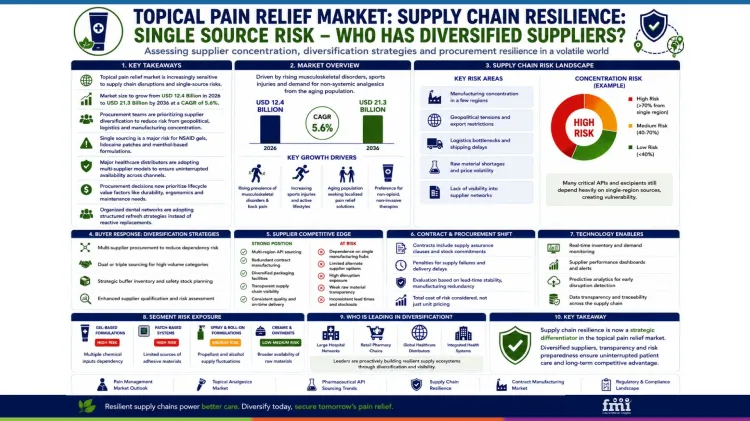
The topical pain relief market is growing steadily, as healthcare systems are increasingly looking at localized, non-invasive therapies for pain management. The market is estimated to reach USD 12.4 Billion by 2026 and USD 21.3 Billion by 2036, growing at a CAGR of 5.6% during the forecast period. Growth is driven primarily by the increasing prevalence of arthritis, lower back pain, sports injuries and post-operative pain conditions, and an increasing preference for opioid-sparing treatment pathways.
Demand fundamentals remain strong, but an often overlooked component is reshaping the competitive environment of the market: supply chain resilience. Unlike previous cycles where the focus was on pricing and formulation effectiveness, procurement conversations are increasingly turning to how vulnerable suppliers are to single source dependencies across raw materials, contract manufacturing and distribution networks.
The supply chain’s concentration is now a real risk in the manufacture of topical analgesics. Manufacturing clusters often produce a handful of active pharmaceutical ingredients such as diclofenac, ibuprofen derivatives, lidocaine and menthol. And the same is true for the adhesive technology in transdermal patches, sophisticated gel delivery technologies, where specific chemical inputs have no easy substitutes. That creates structural vulnerability in case of supply disruptions, particularly in the context of geopolitical tensions, export restrictions or shortages of raw materials.
The pandemic-related disruptions only exacerbated this vulnerability, leading hospital purchasing organizations and big pharmacy chains to review where they do their sourcing. Single-source risk has gone from theoretical supply chain chatter to a real-world procurement constraint. Buyers want to see more of how they are connected to upstream supplier networks, secondary and tertiary sources, in order to ensure supply continuity.
Manufacturers’ strategic edge is in diversified supplier ecosystems. Those companies that continue to multi-region source their APIs, have redundant contract manufacturing organizations, and geographically disperse their packaging facilities are in a better position to win long-term institutional contracts. This is especially important in hospital procurement, where short-term stockouts of pain management products can disrupt post-operative recovery protocols and rehabilitation operations.
At the same time, suppliers that rely heavily on a small number of manufacturing hubs are under the microscope. Institutional buyers are weighing the benefits of concentrated production's cost efficiency against higher risk premia. Supply uncertainty is becoming a more and more important factor in the assessment of bids by procurement departments and the competitive landscape is changing gradually as a result.
Multi-supplier procurement models are also gaining traction on the buyer side. Hospitals and health systems are deliberately splitting volume allocations among several vendors to minimize dependency risk. That way, if one supplier goes down, you still have continuity, and it also gives you more leverage when it comes to contract renewals. Dual- or triple-sourcing strategies are growing in high-volume categories such as topical NSAID gels and analgesic patches.
Contract structures are shifting in line with this. Procurement contracts are no longer limited to price and delivery terms, but include explicit provisions on supply assurance, buffer inventory requirements and penalties for lack of stock. Suppliers are being measured on lead-time stability, manufacturing redundancy and raw material transparency, not just on unit economics.
Another rising dimension is digital supply chain monitoring. The major healthcare distributors are integrating real-time inventory tracking systems to supplier performance dashboards to predict disruptions before they affect clinical availability. This shift is also placing a growing premium on data transparency, as a procurement differentiator.
From a segment perspective, gel-based formulations are most vulnerable to supply chain volatility because of their dependence on multiple chemical inputs and emulsifying agents. Patch-based systems, although more advanced in terms of technology, are also exposed to the same risk due to a shortage of sources of adhesive material. The spray and roll-on formats are somewhat more resilient due to simpler formulation structures, but they are not immune to API scarcity.
From a demand perspective, hospitals are an important part of institutional consumption, especially in areas such as post-surgical recovery and orthopedics. These buyers are explicitly codifying procurement frameworks with an emphasis on supplier redundancy. Retail pharmacy chains are using the same approach, particularly in markets where consumer demand surges can quickly reduce inventory levels.
Strategically, the market is moving toward a two-sided equilibrium. On one side, manufacturers are consolidating operations to get cost efficient. Buyers, nevertheless, are asking for diversification to guarantee continuity and resilience. The resulting tension is creating a procurement environment where supply chain architecture is becoming as important as product formulation itself.
The bottom line is clear: in the topical pain relief market, supply chain resilience is no longer a backend operational concern. In fact, it is a front line procurement metric that drives supplier selection, contract design and long term competitive positioning. Companies that can demonstrate diversified sourcing, redundant manufacturing capacity, and transparent supply networks are increasingly emerging as preferred partners in institutional healthcare procurement.

