


Executive Summary: The verified freshness gap
The fresh food supply chain is shifting from product movement to proof movement. Traceability Arbitrage describes the value gap between suppliers that can prove origin, handling, temperature history, and lot integrity and those that still depend on delayed records. This detailed report examines traceability arbitrage in fresh food supply chains, covering the needs of key B2B decision-makers across CTO, CIO, CEO, and Marketing/Sales roles in this sector. We integrate market figures from Future Market Insights with concrete evidence from TraceGains, Trustwell, IBM Food Trust, and Wiliot to construct detailed customer personas and journey maps.
This report provides a unique perspective, based on vendor developments and market realities, to guide product planning and market positioning for B2B SaaS providers in fresh food supply chains. The central theme, Traceability Arbitrage, shows why B2B SaaS solutions must convert compliance records into commercial proof. Fresh produce, seafood, dairy, meat, and prepared fresh foods now compete on verified condition as much as availability.
Market Overview: The Imperative for Verified Fresh Food Traceability
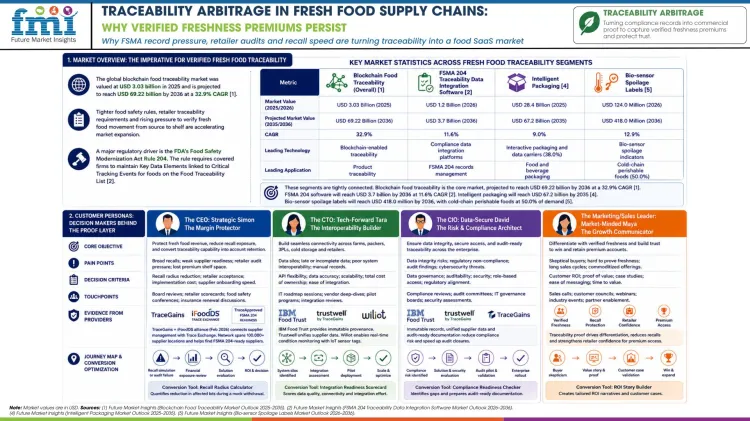
The global blockchain food traceability market was valued at USD 3.03 billion in 2025 and is projected to reach USD 69.22 billion by 2036 at a 32.9% CAGR [1]. This expansion reflects tighter food safety rules, retailer traceability requirements and rising pressure to verify fresh food movement from source to shelf.
A major regulatory driver is the FDA’s Food Safety Modernization Act Rule 204. The rule requires covered firms to maintain Key Data Elements linked to Critical Tracking Events for foods on the Food Traceability List [2]. These records must help firms trace food movement across production, processing and distribution when safety questions arise.
Key Market Statistics Across Fresh Food Traceability Segments:
| Metric | Blockchain Food Traceability (Overall) [1] | FSMA 204 Traceability Data Integration Software [2] | Intelligent Packaging [4] | Bio-sensor Spoilage Labels [5] |
|---|---|---|---|---|
| Market Value (2025/2026) | USD 3.03 Billion (2025) | USD 1.2 Billion (2026) | USD 28.4 Billion (2025) | USD 124.0 Million (2026) |
| Projected Market Value (2035/2036) | USD 69.22 Billion (2036) | USD 3.7 Billion (2036) | USD 67.2 Billion (2035) | USD 418.0 Million (2036) |
| CAGR | 32.9% | 11.6% | 9.0% | 12.9% |
| Leading Technology | Blockchain-enabled traceability | Compliance data integration platforms | Interactive packaging and data carriers (38.0%) | Bio-sensor spoilage indicators |
| Leading Application | Product traceability | FSMA 204 records management | Food and beverage packaging | Cold-chain perishable foods (50.0%) |
These figures show the connected structure of the fresh food traceability market. For example, blockchain food traceability is the core market layer and is projected to reach USD 69.22 billion by 2036 at a 32.9% CAGR [1]. This segment is shaped by the need to verify product origin and handoff records across fresh food networks. FSMA 204 traceability data integration software is projected to reach USD 3.7 billion by 2036 at an 11.6% CAGR [2]. Intelligent packaging was valued at USD 28.4 billion in 2025 and is projected to reach USD 67.2 billion by 2035 [4]. Bio-sensor spoilage labels are projected to reach USD 418.0 million by 2036, with cold-chain perishable foods accounting for 50.0% of demand [5].
Customer Personas: Decision makers behind the proof layer
The CEO: Strategic Simon - The margin protector
Strategic Simon understands that fresh food traceability is no longer only a compliance issue. A recall can erase seasonal margin because retailers may suspend a supplier before root cause is confirmed. He sees Traceability Arbitrage as a way to protect premium accounts. His priority is to turn reliable origin and handling proof into stronger retailer confidence.
- Core Objective: To protect fresh food revenue, reduce recall exposure, and convert traceability capability into account retention.
- Pain Points: broad recalls; weak supplier readiness; retailer audit pressure; lost premium shelf space.
- Decision Criteria: recall radius reduction; retailer acceptance; implementation cost; supplier onboarding speed.
- Touchpoints: board reviews; retailer scorecards; food safety conferences; insurance renewal discussions.
Evidence from Providers: TraceGains and iFoodDS extended their alliance in February 2026 to connect supplier management with iFoodDS Trace Exchange. The integration helps buyers find FSMA 204-ready suppliers and helps suppliers show readiness inside supplier profiles. TraceGains states that its network spans more than 100,000 supplier locations. The alliance also created the TraceApproved FSMA 204 readiness badge for supplier visibility. Gary Iles of Esko and TraceGains said the alliance lets companies "find proven, traceability-ready suppliers" and manage compliance data in one place. (TraceGains)
Journey Map & Conversion Optimization: Simon’s buying journey begins with a recall simulation or retailer audit failure. He looks for financial exposure reduction before reviewing technical architecture. A B2B SaaS provider can convert him through a Recall Radius Calculator. The strongest proof point is a quantified reduction in affected lots during a mock withdrawal.
The CTO: Tech-Forward Tara - The interoperability builder
Tech-Forward Tara is responsible for making traceability work across farms, packers, cold storage providers, carriers, and retailers. She knows that a clean dashboard means little if upstream data arrives late. Traceability Arbitrage depends on her ability to connect fragmented systems. Her challenge is technical execution across many partners.
- Core Objective: To build interoperable traceability infrastructure, automate event capture, and reduce manual reconciliation.
- Pain Points: legacy warehouse systems; disconnected supplier portals; inconsistent lot codes; device data gaps.
- Decision Criteria: API strength; GS1 alignment; sensor integration; data export reliability.
- Touchpoints: solution architecture reviews; ERP partner briefings; GS1 events; pilot vendor demos.
Evidence from Providers: IBM describes Food Trust as a SaaS food safety solution powered by the IBM Blockchain Platform. IBM states that the system enables supply chain participants to collaborate and securely share data to improve traceability and food safety. This matters for Tara because fresh food networks rarely operate on one shared ERP. GS1 US states that Sunrise 2027 marks a retail transition from 1D UPC barcodes to 2D barcodes. The shift supports stronger traceability and richer data across each supply chain link.
Journey Map & Conversion Optimization: Tara’s journey starts with a data architecture review. She wants evidence that a platform can map lot codes, shipment events, and sensor data without replacing every system. A B2B SaaS provider can convert her through a sandbox using live GS1 identifiers. A strong demo shows one fresh product moving from harvest to retail scan with clean event history.
The CIO: Data-Driven David - The governance controller
Data-Driven David treats traceability as an enterprise data governance problem. He must ensure that records are accurate, auditable, secure, and retrievable under time pressure. Traceability Arbitrage depends on trust in the data layer. His main concern is whether records can survive a regulator request or retailer dispute.
- Core Objective: To govern traceability data, protect system integrity, and maintain audit-ready records across partners.
- Pain Points: duplicate master data; poor data ownership; spreadsheet dependency; audit trail weakness.
- Decision Criteria: access controls; data lineage; role-based permissions; FDA-ready export.
- Touchpoints: compliance steering committees; cybersecurity reviews; data governance councils; regulator update briefings.
Evidence from Providers: FDA states that covered firms must provide traceability information within 24 hours after a request. The rule requires Key Data Elements linked to Critical Tracking Events for foods on the Food Traceability List. Trustwell’s FoodLogiQ Traceability page states that its platform captures and organizes Critical Tracking Events and Key Data Elements. The page positions traceability as a business advantage for recall impact reduction and supplier collaboration.
Journey Map & Conversion Optimization: David’s journey begins with a compliance gap assessment. He asks whether the platform can export records in a regulator-ready format. A B2B SaaS provider can convert him through an FSMA 204 Data Readiness Checklist. The checklist should show field ownership, exception handling, retention rules, and export timing.
Marketing & Sales: Growth-Focused Grace - The proof seller
Growth-Focused Grace sees traceability as a market access tool. Retailers, foodservice operators, and consumers ask for proof of origin and handling. She needs traceability data that can become buyer-facing evidence. Traceability Arbitrage becomes useful when verified freshness supports better shelf placement or stronger foodservice contracts.
- Core Objective: To turn verified origin and freshness proof into retailer confidence, sales enablement, and consumer-facing transparency.
- Pain Points: weak product claims; inconsistent pack data; slow retailer onboarding; limited consumer trust proof.
- Decision Criteria: consumer QR experience; claim substantiation; retailer data sharing; account enablement.
- Touchpoints: retailer category reviews; trade shows; sales decks; digital product pages.
Evidence from Providers: Wiliot introduced an ambient Internet of Things food safety initiative for food supply chains ahead of FSMA Rule 204 preparation. The company cited Trustwell’s Julie McGill saying Wiliot data in Trustwell Connect can give brands supply chain visibility through a trusted single source of truth. This supports Grace because consumer and retailer claims require more than product storytelling. FMI’s bio-sensor spoilage labels outlook shows rising interest in condition-linked proof for perishable foods.
Journey Map & Conversion Optimization: Grace’s journey begins with a retailer request for product transparency. She seeks data that can move into sales decks, QR pages, and account portals. A B2B SaaS provider can convert her through a Verified Freshness Claims Toolkit. The toolkit should translate lot-level records into approved claim language.
Key Market Research Pointers: Future Outlook for B2B SaaS in Fresh Food Supply Chain Traceability
To provide a specific perspective beyond standard syndicated research, consider these five evidence-based pointers for the future of the Fresh Food Supply Chain Traceability market, specifically for B2B SaaS providers:
Predictive recall radius engines will become a core SaaS wedge.
Fresh food suppliers will move from post-event tracing to pre-event containment modeling. SaaS platforms can estimate affected lots before a formal recall notice is issued. The mechanism will combine shipment records, transformation events, and temperature exceptions. CEOs will value the tool because it turns traceability into financial risk control. CIOs will require clear data lineage before they approve automated recall recommendations.
FSMA 204 delay will create a preparation window, not a pause.
FDA enforcement will not occur before July 20, 2028. The requirements still define where the market is moving. Suppliers that wait until late 2027 may struggle to coordinate data with trading partners. SaaS providers can sell readiness programs that measure CTE and KDE coverage by product line. This creates near-term demand even before enforcement begins.
Blockchain will become practical only where it solves partner trust.
Blockchain food traceability is expanding fast by FMI estimates. The practical use case is not blockchain as a label claim. The use case is shared proof among parties that do not trust one another’s internal systems. B2B SaaS platforms can use distributed records for lot history and handoff evidence. CTOs will still demand simple integration before accepting blockchain-heavy architecture.
2D barcodes will connect consumer transparency to enterprise traceability.
GS1 Sunrise 2027 is pushing retail systems toward 2D barcode readiness. This creates a packaging-level bridge between consumer engagement and enterprise traceability. Fresh food brands can use one code to support product identity, lot data, freshness proof, and product storytelling. Marketing teams will use this shift to support claims that are backed by operational data. The commercial value rises when every scan links to validated product history.
Supplier readiness scoring will reshape procurement.
Retailers and foodservice operators will increasingly compare suppliers by traceability readiness. This will create a new procurement metric. SaaS platforms can score suppliers on data completeness, response time, FSMA 204 readiness, and cold-chain exception handling. TraceGains and iFoodDS already point toward this model through supplier badges and integrated readiness data. The next stage will be traceability scoring inside procurement workflows.
Uniqueness Explanation: These pointers move beyond basic market size projections. They analyze how regulation, packaging identifiers, sensor data, and supplier readiness reshape the fresh food value chain. Traceability Arbitrage gives B2B SaaS providers a practical way to frame product value for CEOs, CTOs, CIOs, and Marketing/Sales leaders.
Conclusion: The proof layer becomes the market layer
Fresh food supply chains have reached a turning point. B2B SaaS providers that address the core objectives of CEOs, CTOs, CIOs, and Marketing/Sales leaders through Traceability Arbitrage will hold stronger positions. The next phase of fresh food competition will depend on how quickly proof moves from harvest to shelf.
Are you ready to turn fresh food traceability into commercial proof with a Verified Freshness Intelligence Platform that reduces recall exposure, improves supplier readiness, and strengthens retailer confidence?
References
- [1] Future Market Insights. "Blockchain Food Traceability Market | Global Market Analysis Report - 2036."
- [2] Future Market Insights. "FSMA 204 Traceability Data Integration Software Market | Global Market Analysis Report - 2036."
- [3] Future Market Insights. "Food Packaging Market Size, Share & Forecast to 2036."
- [4] Future Market Insights. "Intelligent Packaging Market | Global Market Analysis Report - 2036."
- [5] Future Market Insights. "Bio-sensor Spoilage Labels Market Size and Share Forecast Outlook 2026 to 2036."
- [6] U.S. Food and Drug Administration. "FSMA Final Rule on Requirements for Additional Traceability Records for Certain Foods." Updated May 27, 2026.
- [7] GS1 US. "What is GS1 Sunrise 2027?"
- [8] TraceGains. "TraceGains and iFoodDS Extend Strategic Alliance to Turn FSMA 204 Compliance into a Competitive Advantage." February 19, 2026.
- [9] Trustwell. "Get FSMA 204 Ready with FoodLogiQ Traceability."
- [10] IBM. "Using IBM Food Trust with IBM App Connect Enterprise."

