

- Market Size (2026)
- USD 807.4 Mn
- Forecast (2036)
- USD 2530.1 Mn
- CAGR (2026 to 2036)
- 12.1%
How big is the Titanium Dioxide (TiO2) Alternatives & Natural White Colorants Market in 2026?
USD 807.4 million in 2026 and USD 2,530.1 million by 2036 at a 12.1% CAGR.
Sales are projected to rise from USD 807.4 million in 2026 to USD 2,530.1 million by 2036 at a 12.1% CAGR. The U.S. Food and Drug Administration approved calcium phosphate as a white color additive in May 2025 for four specified food uses. The decision gives confectionery and bakery manufacturers a regulated mineral option for defined products rather than a universal substitute. Commercial trials must test opacity, texture and flavor under normal mixing and storage conditions across full production programs. Reliable application support becomes valuable as manufacturers extend successful recipes across several production sites and retailer brands. Related natural food colors provide wider context for the approved color-additive pathway during strategic planning.
European food manufacturers follow a different regulatory route from companies serving the United States and Great Britain. EFSA concluded in May 2021 that genotoxicity concerns from E171 particles could not be excluded. The assessment supported later European restrictions but did not establish the performance of any replacement ingredient. Formulation teams must qualify each alternative inside the complete recipe and its normal production process. Commercial schedules often lengthen as higher dosages alter texture or reduce appearance consistency during storage. Higher dosage and variable storage performance increase demand for verified clean-label ingredients with practical application support across commercial product portfolios.
-alternatives-&-natural-white-colorants-market-value-analysis.webp "Titanium Dioxide (tio2) Alternatives & Natural White Colorants Market Value Analysis")
Key Takeaways of Titanium Dioxide (TiO2) Alternatives & Natural White Colorants Market
- Demand for titanium dioxide alternatives is driven by regulatory divergence creating separate reformulation programs across major international sales regions, with the commercial task centered on preserving visible whiteness without changing texture or flavor during normal production.
- Calcium carbonate holds the leading share at 38.0% in 2026, owing to established food-grade availability and familiar mineral handling, with rice starch and cellulose routes expanding choice for recipes requiring different texture or label outcomes.
- Bakery icing leads the application category at 38.0% share in 2026, driven by visible whiteness requirements across decorated products where recipe-specific evidence across mixing, heating, and storage conditions is required during commercial qualification.
- The Netherlands and the United States record CAGRs of 11.9% and 11.5% respectively through 2036, shaped by strong import and export documentation needs alongside federal authorization and separate retailer restrictions driving reformulation activity.
- Competition combines application specialists with global color groups, with Corbion targeting water-based bakery icing, Seprify and Oterra connecting cellulose technology with varied food-application testing, and Innophos and Sensient providing FDA-approved mineral routes alongside expanding natural-color manufacturing capacity.
Analyst Perspective
"The titanium dioxide (TiO2) alternatives & natural white colorants market is evolving as food manufacturers prioritize formulation performance alongside clean-label objectives. Commercial success will depend on delivering consistent whiteness, stability, and sensory quality under commercial production conditions. Companies that reduce reformulation complexity, demonstrate reliable processing performance, and support regulatory compliance will be better positioned to expand adoption across food and beverage applications."
- Nandini Roy Choudhury, Principal Analyst at Future Market Insights
Source: FMI's proprietary forecasting model and primary research
How is the Titanium Dioxide (TiO2) Alternatives & Natural White Colorants Market segmented?
The Titanium Dioxide (TiO2) Alternatives & Natural White Colorants Market is segmented by alternative, application, and region.
The alternative framework separates calcium carbonate and rice starch from cellulose-based routes and Seprify’s named technology. Application analysis distinguishes bakery icing from confectionery and dairy products that face different moisture or processing conditions. Coatings remain a separate application; surface coverage and drying behavior determine visible performance during commercial use. Regional analysis compares authorization rules with local technical support across each included geography and application route. Related food color systems help development teams compare natural white solutions with broader color portfolios during formulation planning.
Why is calcium carbonate central to the alternative category?
-alternatives-&-natural-white-colorants-market-analysis-by-alternative.webp "Titanium Dioxide (tio2) Alternatives & Natural White Colorants Market Analysis By Alternative")
Food-grade calcium carbonate offers an established mineral route for opacity inside suitable food matrices and processing conditions. A March 2025 JSFA Reports study tested calcium carbonate beside other inorganic replacements in fortified salt premixes. Researchers found acceptable color masking at a defined concentration and retained fortificant stability through nine months of storage. The results support feasibility within that premix system but do not establish performance across bakery icing or confectionery products.
- Based on alternative type, calcium carbonate is projected to account for 38.9% in 2026 due to established food-grade availability and familiar mineral handling. Existing specifications reduce early material review for laboratories using conventional production systems and ingredient controls. Commercial recipes require dosage testing as higher mineral levels can change opacity and sensory performance during storage.
- Confectionery and bakery laboratories evaluate calcium carbonate for formulas that can tolerate additional mineral solids. Higher addition levels can alter mouthfeel or coating behavior compared with titanium dioxide during regular production. Application teams measure whiteness beside viscosity and surface finish throughout plant trials under standard operating conditions. Flavor checks across the intended shelf life remain necessary for broader commercial approval across multiple product launches.
Why is bakery icing central to the application category?
-alternatives-&-natural-white-colorants-market-analysis-by-application.webp "Titanium Dioxide (tio2) Alternatives & Natural White Colorants Market Analysis By Application")
Bakery icing exposes small color differences across decorated products during retail display and shopper evaluation. Whiteness must remain even through mixing, application and drying without changing surface texture or flavor. Water content and line speed can alter coverage across cakes and pastries during routine commercial decoration. The application therefore favors systems designed for icing behavior rather than general powder replacement across unrelated food categories.
- The application category is forecast to be led by bakery icing at 37.6% share in 2026 due to visible whiteness requirements across decorated products. Producers assess whitening performance beside bakery ingredients that govern application and drying across commercial lines. The segment addresses a defined reformulation need for smooth coverage across cakes and pastries during commercial production.
- Commercial bakers favor icing systems that retain even coverage throughout mixing and application at normal production scale. Corbion launched LUMI Set in June 2026 as a titanium-dioxide-free stabilizer for water-based bakery icings. The launch gives plants an application-specific reformulation route with defined mixing and drying requirements across commercial bakery lines. Extended production trials must confirm surface consistency and flavor across the intended shelf life during final approval.
What are the drivers, restraints, and opportunities in the Titanium Dioxide (TiO2) Alternatives & Natural White Colorants Market?
Regulatory divergence supports reformulation demand but imperfect opacity matching slows commercial adoption across sensitive food applications. Validated cellulose or mineral systems create application-specific expansion routes across commercial food production and retailer portfolios.
- Driver: Food manufacturers need white appearance systems that satisfy local rules and remain stable inside commercial recipes.
- Restraint: Alternative ingredients often require higher dosages that can change texture or processing behavior during production.
- Opportunity: Validated cellulose and mineral systems can expand across additional applications through focused food-grade qualification.
Food producers need white appearance systems that remain stable inside distinct recipes and processing conditions. Döhler presented White Diamond in January 2026 for confectionery products including hard-boiled candies and pan coatings. The release shows that natural white formulation additives require application-specific positioning instead of one universal dosage. Manufacturers invest more readily as ingredient companies document performance under relevant heat and moisture conditions during qualification. Reliable regional technical support can reduce repeat trials across several product lines during commercial conversion programs.
Titanium dioxide delivers strong opacity with limited sensory effect at relatively low dosage across many recipes. The European Commission removed E171 from the authorized food-color list through Regulation 2022/63 in January 2022. The legal change created a replacement requirement without creating a direct technical substitute for each formula. Higher alternative dosages can alter texture or flavor during regular production across sensitive food formulas. Additional process adjustments increase qualification cost across several product lines and regional specifications during commercial launch planning.
Cellulose derivatives could broaden performance beyond established starch and mineral options across several food applications. Aalto University published a July 2025 thesis that used controlled porosity to improve light scattering in microcrystalline cellulose. The research strengthens the technical basis for cellulose opacifiers but does not prove commercial food adoption. Commercial progress requires food-grade validation and repeatable processing inside each intended recipe under plant conditions. Cellulose ingredient producers must provide stable specifications and dependable regional supply during wider commercial qualification programs.
Which country CAGRs are profiled in the Titanium Dioxide (TiO2) Alternatives & Natural White Colorants Market?
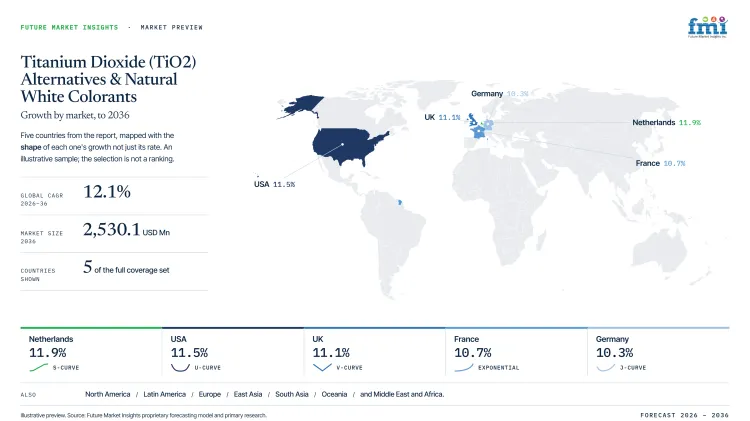
| Country | CAGR |
|---|---|
| USA | 11.5% |
| Germany | 10.3% |
| UK | 11.1% |
| France | 10.7% |
| Netherlands | 11.9% |
How do country-level CAGRs compare in the Titanium Dioxide (TiO2) Alternatives & Natural White Colorants Market?
The country comparison shows a relatively narrow spread in projected growth rates across the Titanium Dioxide (TiO2) Alternatives & Natural White Colorants market. The Netherlands and the USA form a closely aligned upper group with only a limited difference between their forecasts. The UK and France create a middle cluster and remain separated from the upper group by a modest gap. Germany occupies a distinct lower position but remains within a concentrated growth range overall. The total difference between the first and last country is 1.6 percentage points which indicates a fairly consistent growth outlook across the markets profiled. These differences reflect the pace of clean-label reformulation, regulatory developments and the adoption of natural white colorant solutions across food and beverage applications.
- The Netherlands shows a notable position within the comparison as ingredient manufacturers continue to expand innovation in mineral-free and naturally derived white colorant technologies.
- The USA remains close to the Netherlands in CAGR terms but follows a different market path through increasing reformulation activity driven by consumer demand for clean-label products.
- The UK occupies a middle position within the comparison as food producers continue to evaluate and adopt alternatives to titanium dioxide across multiple product categories.
- France remains closely aligned with the UK yet market expansion is supported by manufacturer efforts to replace synthetic and controversial ingredients with naturally sourced alternatives.
- Germany holds a lower position within the group while maintaining steady development through ingredient innovation and gradual adoption of alternative whitening systems.
Comparable CAGRs do not create identical market conditions across countries. Differences in regulatory requirements, reformulation timelines, ingredient availability and end-user preferences can influence how quickly titanium dioxide alternatives are adopted. As a result, suppliers may encounter different commercialization and product development requirements despite relatively similar growth forecasts. The full report provides country-level CAGR analysis across North America, Latin America, Europe, East Asia, South Asia, Oceania and the Middle East and Africa.
Country-wise Analysis
- United States food manufacturers can continue using titanium dioxide under federal rules, but retailer policies create separate commercial limits. Titanium dioxide alternative demand in the USA is forecast to rise at 11.5% CAGR over the forecast period, shaped by federal authorization and varied retailer restrictions. The FDA updated its color-additive record in March 2026 and retained a one-percent food-use limit by weight. Federal authorization lets manufacturers sequence reformulation across product families instead of changing every recipe at the same time. Retailer policies remain the main friction as requirements can exceed federal rules across major national accounts. Commercial programs need clear product specifications that separate legal permission from retailer acceptance across each sales channel.
- German bakery and confectionery producers operate without E171 authorization across regulated food applications inside the European Union. Germany is estimated to post 10.3% CAGR in titanium dioxide alternatives over the forecast period, supported by mandatory reformulation and established food manufacturing. Ingredient laboratories and regional distributors provide a direct enabler for reformulation across established production sites. Germany’s Federal Institute for Risk Assessment confirmed in October 2024 that European food authorization had been withdrawn during 2022. The main friction is recipe-specific validation across products that previously relied on low-dose titanium dioxide. Commercial approval depends on efficient trials that protect texture and appearance across established recipes and product categories.
- Great Britain maintains a separate food-additive register that continues to authorize E171 across England, Scotland and Wales. Titanium dioxide alternative demand in the UK is predicted to advance at 11.1% CAGR through 2036, influenced by a separate authorization route and export-market reformulation needs. The Food Standards Agency updated the titanium dioxide record in April 2025 and retained authorized food use. Domestic manufacturers can delay selected conversions for Great Britain and test alternative formulas for European Union exports. Divergent rules create material friction through recipes that cannot support every intended destination market across Europe. Food manufacturers must separate legal permission from retailer-specific clean-label requirements during product qualification and launch planning.
- French food producers have worked without E171 under the national suspension introduced in January 2020. Adoption of titanium dioxide alternatives in France is estimated to expand at 10.7% CAGR through 2036, reinforced by a longer history of domestic reformulation. Established testing routines support confectionery ingredients and commercial bakery coating programs across established production sites. ANSES confirmed in January 2026 that food use remains unauthorized in France and across the European Union. Recipe-specific texture and flavor testing remains the main friction across wider commercial production programs and retailer launches. Manufacturers gain efficiency through evidence packages that can support several related product lines across multiple facilities.
- Dutch food manufacturers apply European additive rules and manage export programs across several destination markets. The Netherlands’ titanium dioxide alternatives outlook is anticipated to advance at 11.9% CAGR over the assessment period, shaped by European authorization rules and multi-market export requirements. The country’s ingredient distribution network supports imported mineral and cellulose systems for commercial formulation trials. Documentation for several destination markets creates material friction across retailer specifications and product labeling programs. The Netherlands Food and Consumer Product Safety Authority updated its additives handbook in November 2024 with product-level approval guidance. Dutch formulation teams compare dairy ingredients with each white system to protect taste and appearance throughout commercial processing.
Who are the notable companies in the Titanium Dioxide (TiO2) Alternatives & Natural White Colorants Market?
Corbion, Seprify, Oterra, ADM, Sensient Technologies, Innophos, IFC Solutions, and Döhler are the notable companies profiled in this market.
-alternatives-&-natural-white-colorants-market-analysis-by-company.webp "Titanium Dioxide (tio2) Alternatives & Natural White Colorants Market Analysis By Company")
Competition combines application specialists with global color groups that commercialize different whitening technologies for food production. Oterra and Seprify announced a commercial partnership in November 2025 following testing across more than fifteen food categories. The partnership links Seprify’s materials technology with Oterra’s application network and a commercial route across several regions. Corbion focuses on bakery icing, and Innophos supplies a calcium phosphate route for specified food uses. ADM and Sensient Technologies offer broader whitening portfolios across several finished food and beverage products. IFC Solutions and Döhler support mineral or natural-white formulations through responsive application and technical service. Selection within food additive systems depends on documented recipe performance rather than company size across manufacturer programs.
- Corbion and Seprify address different reformulation problems through focused technologies rather than broad color portfolios. Corbion targets water-based bakery icing, whereas Seprify develops cellulose particles for food and coating applications. Their commercial value depends on repeatable plant performance and dependable technical support during food-manufacturer qualification. Application boundaries must remain explicit; each technology serves different moisture and processing conditions during production.
- Oterra and ADM combine color expertise with application laboratories that support reformulation across several food categories. Sensient Technologies adds a broad replacement portfolio plus manufacturing scale for natural colors across several regions. Their wider reach can accelerate regional formulation trials under different regulatory requirements and processing conditions. Global presence does not guarantee equal performance across every recipe, so formulation evidence must remain product-specific.
- Innophos and IFC Solutions provide mineral whitening routes for selected bakery or confectionery applications across North America. Döhler combines natural white systems with formulation support across confectionery and beverage development programs for food manufacturers. Application data and responsive technical service can reduce qualification effort during plant trials across several commercial formulas. Manufacturers must compare dosage and sensory effects across their exact production conditions during broader approval decisions.
Competitive Benchmarking: Titanium Dioxide (TiO2) Alternatives & Natural White Colorants Market
| Company | Dedicated TiO2-Free Formulation | Application Validation | Commercial Scale and Support | Geographic Reach |
|---|---|---|---|---|
| Corbion | High | Low | Medium | North America |
| Seprify | High | High | Medium | Europe with global partner access |
| Oterra | High | High | High | Global |
| ADM | High | Medium | High | Global |
| Sensient Technologies | High | High | High | Global |
| Innophos | High | High | Medium | North America |
| IFC Solutions | Medium | Medium | Low | North America |
| Döhler | High | Medium | High | Global |
Key Developments in the Titanium Dioxide (TiO2) Alternatives & Natural White Colorants Market
- In October 2025, Walmart U.S. announced that titanium dioxide would be removed from all U.S. private-brand food products by January 2027. The commitment creates a defined reformulation deadline across high-volume grocery categories and requires alternative ingredients that preserve appearance and taste. Food manufacturers serving these labels must qualify replacement systems against retailer specifications despite continued federal authorization. The development expands commercial demand without changing the legal status of titanium dioxide under federal food rules.
- In June 2025, Innophos launched VersaCal Bright for doughnut sugar and coated-candy sugar alongside white candy melts and ready-to-eat chicken. The product gives manufacturers a calcium phosphate whitening route with defined U.S. food-use boundaries. Its narrow application list shows why one mineral system cannot replace titanium dioxide across every recipe. Commercial expansion requires separate performance validation for products outside the initial listed categories and regional manufacturer programs.
- In March 2026, Seprify advanced its cellulose platform from pilot validation into commercial supply following a Series A funding round. The company stated that food-grade products were ready for qualification across commercial manufacturing programs and extended supply agreements. The transition supports repeatable sourcing and longer agreements for manufacturers that complete recipe-specific validation across several regional programs. Food manufacturers must test safety and performance under their normal plant conditions during commercial qualification.
- In March 2026, Sensient Technologies began a major expansion of its natural-color manufacturing site in Missouri. The project adds processing space and converts existing areas to support rising natural-color demand across regional markets. The expansion strengthens supply and application support across Sensient’s broader portfolio rather than proving adoption of one titanium-dioxide replacement. Food manufacturers must verify each whitening system inside the intended recipe and processing environment during commercial qualification.
Key Players in the Titanium Dioxide (TiO2) Alternatives & Natural White Colorants Market
Application-Specific Formulation Developers
- Corbion
- Seprify
Global Color and Commercialization Groups
- Oterra
- ADM
- Sensient Technologies
Mineral and Natural White Specialists
- Innophos
- IFC Solutions
- Döhler
Titanium Dioxide (TiO2) Alternatives & Natural White Colorants Market - Report Scope
-alternatives-&-natural-white-colorants-market-breakdown-by-alternative,-application,-and-region.webp "Titanium Dioxide (tio2) Alternatives & Natural White Colorants Market Breakdown By Alternative, Application, And Region")
| Coverage field | Report scope |
|---|---|
| Market breakdown | Alternative, application, and region. |
| Quantitative Units | Revenue in USD Million, CAGR in %. |
| Market Definition | Revenue from ingredients and formulation systems used directly to replace titanium dioxide or provide natural white opacity in food applications. Adjacent pigments and nonfood whitening systems are excluded. |
| Regions Covered | North America, Latin America, Europe, East Asia, South Asia, Oceania, and Middle East and Africa. |
| Countries Covered | USA, Germany, UK, France, Netherlands, and 30+ countries within the regional model. |
| Key Companies Profiled | Corbion, Seprify, Oterra, ADM, Sensient Technologies, Innophos, IFC Solutions, and Döhler. |
| Forecast Period | 2026 to 2036. |
| Approach | Hybrid bottom-up and top-down market sizing supported by primary interviews and official desk research. |
Titanium Dioxide (TiO2) Alternatives & Natural White Colorants Market - Research Methodology
| Method | Approach |
|---|---|
| Primary Research | FMI analysts gathered input from manufacturers, service providers, technology developers, distributors, end users, sourcing teams, and subject-matter experts. Interviews examined purchasing decisions, product or service evaluation, adoption barriers, approval requirements, pricing considerations, and expectations for technical or commercial support. Respondents were also asked what evidence is required before a trial, pilot, or initial order develops into regular purchasing. |
| Desk Research | Desk research covered government statistics, regulatory publications, trade data, industry associations, technical literature, standards, company filings, product information, and official corporate announcements. Sources were reviewed for relevance, publication date, geographic coverage, and consistency with the defined market scope. Claims relating to performance, applications, approvals, capacity, investment, and commercial activity were retained only when supported by credible public evidence. |
| Market Sizing and Forecasting | The market model combined the baseline value with historical performance, segment structure, pricing and volume indicators, adoption levels, company participation, and country-level demand conditions. Forecast assumptions considered economic activity, investment trends, regulatory developments, technology adoption, purchasing cycles, supply availability, and barriers to wider market use. Segment and regional estimates were reconciled before the final market total was calculated. |
| Data Validation | Estimates were checked against multiple independent indicators, including public data, company activity, trade patterns, industry developments, and findings from primary interviews. Validation also tested whether products, services, applications, and company revenues fell within the defined market boundaries. Adjacent categories, unsupported claims, overlapping revenues, and activities without direct market relevance were excluded to reduce double counting and maintain consistency across segments and countries. |
Titanium Dioxide (TiO2) Alternatives & Natural White Colorants Market by Segments
Titanium Dioxide (TiO2) Alternatives & Natural White Colorants Market segmented by Alternative:
- Calcium Carbonate
- Rice Starch
- Cellulose
- Seprify
Titanium Dioxide (TiO2) Alternatives & Natural White Colorants Market segmented by Application:
- Bakery Icing
- Confectionery
- Coatings
- Dairy
Titanium Dioxide (TiO2) Alternatives & Natural White Colorants Market by Region:
- North America
- United States
- Canada
- Latin America
- Brazil
- Mexico
- Argentina
- Chile
- Western Europe
- Germany
- France
- United Kingdom
- Italy
- Spain
- Benelux
- Nordics
- Eastern Europe
- Poland
- Czech Republic
- Romania
- Hungary
- East Asia
- China
- Japan
- South Korea
- South Asia and Pacific
- India
- ASEAN
- Australia and New Zealand
- Middle East and Africa
- GCC Countries
- South Africa
- Türkiye
- Israel
Research Sources and Bibliography
- USA Food and Drug Administration. (2025, May 9). FDA approves three food colors from natural sources.
- European Food Safety Authority. (2021, May 6). Titanium dioxide: E171 no longer considered safe when used as a food additive.
- Teichman, D. L., Siddiqui, J., Chadha, M. K., de Romana, D. L., Arabi, M., & Diosady, L. L. (2025, March 21). Titanium dioxide replacement with inorganic alternatives for color-masking of ferrous fumarate in double fortified salt. JSFA Reports, 5(4), 128–139.
- Corbion. (2026, June 15). Corbion launches LUMI™ Set to help bakers reformulate away from titanium dioxide without sacrificing visual appeal.
- Döhler. (2026, January 21). Natural white colours drive food and beverage innovation in 2026.
- Döhler. (n.d.). Our locations.
- European Commission. (2022, January 14). Commission Regulation (EU) 2022/63 of 14 January 2022 amending Annexes II and III to Regulation (EC) No 1333/2008 as regards the food additive titanium dioxide (E 171).
- Palo, E. (2025, July 11). Developing cellulose-based opacifiers by chemical methods [Master’s thesis, Aalto University]. Aaltodoc.
- USA Food and Drug Administration. (2026, March 26). Regulatory status of color additives: Titanium dioxide.
- German Federal Institute for Risk Assessment. (2024, October 11). Titanium dioxide: Are there health risks?
- Food Standards Agency. (2025, April 1). Authorised regulated food and feed products for Great Britain: Titanium dioxide.
- ANSES. (2026, January 9). Titanium dioxide.
- Netherlands Food and Consumer Product Safety Authority. (2024, November 27). Handboek additieven in levensmiddelen.
- IFC Solutions. (2024, September 4). Titanium dioxide alternatives.
- Oterra. (2025, November 11). Oterra signs partnership with Seprify to bring natural white color replacement for titanium dioxide to food and beverage industry.
- Seprify. (2026, March 10). Seprify rolls out procurement-ready cellulose products enabled by a Series A funding round.
- Morris, S. (2026, March 23). Breaking ground to expand the world’s leading natural color manufacturing network. Sensient Food Colors.
- ADM. (n.d.). Whiteners for foods & beverages.
- Sensient Food Colors. (n.d.). Avalanche: Titanium dioxide alternatives.
- Innophos. (2025, July 2). Innophos launches clean-label whitening alternative to titanium dioxide.
- Walmart Inc. (2025, October 1). Walmart USA moves to eliminate synthetic dyes across all private brand food products.
This bibliography is provided for reader reference and is not exhaustive. The full report contains the complete reference list and detailed citations.
This Report Answers
- How large is the Titanium Dioxide (TiO2) Alternatives & Natural White Colorants Market in 2026 and 2036?
- Which regulatory and formulation pressures support investment in titanium-dioxide alternatives?
- Why is calcium carbonate estimated to account for the largest alternative share in 2026?
- Why is bakery icing projected to capture the largest application share in 2026?
- How do country growth rates differ across USA, Germany, UK, France, and Netherlands?
- Which companies provide white-color technology, formulation support, or commercial application expertise?
- What limits direct substitution across bakery, confectionery, coatings, and dairy products?
- Which evidence should manufacturers require for approving wider commercial production?
- How do local authorization rules affect formulation and market-entry decisions?
Frequently Asked Questions
How big is the Titanium Dioxide (TiO2) Alternatives & Natural White Colorants Market in 2026?
The titanium dioxide (TiO2) alternatives & natural white colorants market is valued at USD 807.4 million in 2026 and is forecast to reach USD 2530.1 million by 2036, reflecting mandatory reformulation programs driven by regulatory restrictions on E171 and growing retailer clean-label commitments across food and beverage applications.
What is the CAGR of the Titanium Dioxide (TiO2) Alternatives & Natural White Colorants Market from 2026 to 2036?
The titanium dioxide (TiO2) alternatives & natural white colorants market is projected to grow at a CAGR of 12.1% between 2026 and 2036, supported by food manufacturers needing white appearance systems that satisfy local authorization rules and remain stable inside commercial recipes across bakery, confectionery, and dairy applications.
Which alternative leads the Titanium Dioxide (TiO2) Alternatives & Natural White Colorants Market?
Calcium carbonate accounts for 38.0% of the titanium dioxide (TiO2) alternatives & natural white colorants market by alternative in 2026, driven by established food-grade availability and familiar mineral handling that reduces early material review for laboratories using conventional production systems and ingredient controls.
Which country segment is growing fastest in the Titanium Dioxide (TiO2) Alternatives & Natural White Colorants Market?
The Netherlands is the fastest-growing country segment in the titanium dioxide (TiO2) alternatives & natural white colorants market, expanding at an 11.9% CAGR through 2036, ahead of the market average of 12.1%, shaped by European authorization rules, multi-market export documentation requirements, and an established ingredient distribution network supporting mineral and cellulose whitening systems.
Who are the leading companies in the Titanium Dioxide (TiO2) Alternatives & Natural White Colorants Market?
Leading companies in the titanium dioxide (TiO2) alternatives & natural white colorants market include Corbion, Seprify, Oterra, ADM, Sensient Technologies, Innophos, IFC Solutions, and Döhler, competing across application-specific formulation platforms, global natural color portfolios, and mineral whitening systems for commercial food production.
Preview the report firsthand - request a free sample
Get SampleGet the brochure for pricing and purchase details.
Get PDFTable of Content
- Key Takeaways
- Market Size and CAGR
- Top Growth Driver
- Fastest Growing Segment
- Leading Region
- Key Companies
- Emerging Opportunities
- Executive Summary
- Global Market Outlook
- Demand-side Trends
- Supply-side Trends
- Technology Roadmap Analysis
- Analysis and Recommendations
- Analyst Perspective (What is happening? Why now? What should investors know?)
- Key Questions Answered
- How large is the market?
- What is the CAGR?
- What are key trends?
- Which region dominates?
- Who are the leaders?
- Market Overview
- Market Coverage / Taxonomy
- Market Definition / Scope / Limitations
- Research Methodology
- Chapter Orientation
- Analytical Lens and Working Hypotheses
- Market Structure, Signals, and Trend Drivers
- Benchmarking and Cross-market Comparability
- Market Sizing, Forecasting, and Opportunity Mapping
- Research Design and Evidence Framework
- Desk Research Programme (Secondary Evidence)
- Expert Input and Fieldwork (Primary Evidence)
- Tooling, Models, and Reference Databases
- Data Engineering and Model Build
- Quality Assurance and Audit Trail
- Market Background
- Market Dynamics (Drivers, Restraints, Opportunity, Trends)
- Scenario Forecast (Optimistic, Likely, Conservative)
- Impact Analysis
- AI Impact
- Sustainability Impact
- Regulatory Impact
- Technology Impact
- Consumer / Buyer Analysis
- Purchase Drivers
- Adoption Barriers
- Buyer Journey
- Opportunity Map Analysis
- Product Life Cycle Analysis
- Supply Chain Analysis
- Investment Feasibility Matrix
- Value Chain Analysis
- PESTLE and Porter's Analysis
- Regulatory Landscape
- Regional Parent Market Outlook
- Production and Consumption Statistics
- Import and Export Statistics
- Global Market Analysis and Forecast, 2021 to 2036
- Historical Market Size Value (USD Million) Analysis, 2021 to 2025
- Current and Future Market Size Value (USD Million) Projections, 2026 to 2036
- Y-o-Y Growth Trend Analysis
- Absolute $ Opportunity Analysis
- Global Market Pricing Analysis, 2021 to 2036
- Global Market Analysis and Forecast, By Alternative, 2021 to 2036
- Introduction / Key Findings
- Historical Market Size Value (USD Million) Analysis By Alternative, 2021 to 2025
- Current and Future Market Size Value (USD Million) Analysis and Forecast By Alternative, 2026 to 2036
- Calcium Carbonate
- Rice Starch
- Cellulose
- Seprify
- Calcium Carbonate
- Y-o-Y Growth Trend Analysis By Alternative, 2021 to 2025
- Absolute $ Opportunity Analysis By Alternative, 2026 to 2036
- Global Market Analysis and Forecast, By Application, 2021 to 2036
- Introduction / Key Findings
- Historical Market Size Value (USD Million) Analysis By Application, 2021 to 2025
- Current and Future Market Size Value (USD Million) Analysis and Forecast By Application, 2026 to 2036
- Bakery Icing
- Confectionery
- Coatings
- Dairy
- Bakery Icing
- Y-o-Y Growth Trend Analysis By Application, 2021 to 2025
- Absolute $ Opportunity Analysis By Application, 2026 to 2036
- Global Market Analysis and Forecast, By Region, 2021 to 2036
- Introduction
- Historical Market Size Value (USD Million) Analysis By Region, 2021 to 2025
- Current Market Size Value (USD Million) Analysis and Forecast By Region, 2026 to 2036
- North America
- Latin America
- Western Europe
- Eastern Europe
- East Asia
- South Asia and Pacific
- Middle East & Africa
- Market Attractiveness Analysis By Region
- North America Market Analysis and Forecast, By Country, 2021 to 2036
- Historical Market Size Value (USD Million) Trend Analysis By Market Taxonomy, 2021 to 2025
- Market Size Value (USD Million) Forecast By Market Taxonomy, 2026 to 2036
- By Country
- USA
- Canada
- By Alternative
- By Application
- By Country
- Market Attractiveness Analysis
- By Country
- By Alternative
- By Application
- Key Takeaways
- Latin America Market Analysis and Forecast, By Country
- Historical Market Size Value (USD Million) Trend Analysis By Market Taxonomy, 2021 to 2025
- Market Size Value (USD Million) Forecast By Market Taxonomy, 2026 to 2036
- By Country
- Brazil
- Mexico
- Chile
- Rest of Latin America
- By Alternative
- By Application
- By Country
- Market Attractiveness Analysis
- By Country
- By Alternative
- By Application
- Key Takeaways
- Western Europe Market Analysis and Forecast, By Country
- Historical Market Size Value (USD Million) Trend Analysis By Market Taxonomy, 2021 to 2025
- Market Size Value (USD Million) Forecast By Market Taxonomy, 2026 to 2036
- By Country
- Germany
- UK
- Italy
- Spain
- France
- Nordic
- BENELUX
- Rest of Western Europe
- By Alternative
- By Application
- By Country
- Market Attractiveness Analysis
- By Country
- By Alternative
- By Application
- Key Takeaways
- Eastern Europe Market Analysis and Forecast, By Country
- Historical Market Size Value (USD Million) Trend Analysis By Market Taxonomy, 2021 to 2025
- Market Size Value (USD Million) Forecast By Market Taxonomy, 2026 to 2036
- By Country
- Russia
- Poland
- Hungary
- Balkan & Baltic
- Rest of Eastern Europe
- By Alternative
- By Application
- By Country
- Market Attractiveness Analysis
- By Country
- By Alternative
- By Application
- Key Takeaways
- East Asia Market Analysis and Forecast, By Country
- Historical Market Size Value (USD Million) Trend Analysis By Market Taxonomy, 2021 to 2025
- Market Size Value (USD Million) Forecast By Market Taxonomy, 2026 to 2036
- By Country
- China
- Japan
- South Korea
- By Alternative
- By Application
- By Country
- Market Attractiveness Analysis
- By Country
- By Alternative
- By Application
- Key Takeaways
- South Asia and Pacific Market Analysis and Forecast, By Country
- Historical Market Size Value (USD Million) Trend Analysis By Market Taxonomy, 2021 to 2025
- Market Size Value (USD Million) Forecast By Market Taxonomy, 2026 to 2036
- By Country
- India
- ASEAN
- Australia & New Zealand
- Rest of South Asia and Pacific
- By Alternative
- By Application
- By Country
- Market Attractiveness Analysis
- By Country
- By Alternative
- By Application
- Key Takeaways
- Middle East & Africa Market Analysis and Forecast, By Country
- Historical Market Size Value (USD Million) Trend Analysis By Market Taxonomy, 2021 to 2025
- Market Size Value (USD Million) Forecast By Market Taxonomy, 2026 to 2036
- By Country
- Kingdom of Saudi Arabia
- Other GCC Countries
- Türkiye
- South Africa
- Other African Union
- Rest of Middle East & Africa
- By Alternative
- By Application
- By Country
- Market Attractiveness Analysis
- By Country
- By Alternative
- By Application
- Key Takeaways
- Key Countries Market Analysis
- USA
- Pricing Analysis
- Market Share Analysis, 2025
- By Alternative
- By Application
- Canada
- Pricing Analysis
- Market Share Analysis, 2025
- By Alternative
- By Application
- Mexico
- Pricing Analysis
- Market Share Analysis, 2025
- By Alternative
- By Application
- Brazil
- Pricing Analysis
- Market Share Analysis, 2025
- By Alternative
- By Application
- Chile
- Pricing Analysis
- Market Share Analysis, 2025
- By Alternative
- By Application
- Germany
- Pricing Analysis
- Market Share Analysis, 2025
- By Alternative
- By Application
- UK
- Pricing Analysis
- Market Share Analysis, 2025
- By Alternative
- By Application
- Italy
- Pricing Analysis
- Market Share Analysis, 2025
- By Alternative
- By Application
- Spain
- Pricing Analysis
- Market Share Analysis, 2025
- By Alternative
- By Application
- France
- Pricing Analysis
- Market Share Analysis, 2025
- By Alternative
- By Application
- India
- Pricing Analysis
- Market Share Analysis, 2025
- By Alternative
- By Application
- ASEAN
- Pricing Analysis
- Market Share Analysis, 2025
- By Alternative
- By Application
- Australia & New Zealand
- Pricing Analysis
- Market Share Analysis, 2025
- By Alternative
- By Application
- China
- Pricing Analysis
- Market Share Analysis, 2025
- By Alternative
- By Application
- Japan
- Pricing Analysis
- Market Share Analysis, 2025
- By Alternative
- By Application
- South Korea
- Pricing Analysis
- Market Share Analysis, 2025
- By Alternative
- By Application
- Russia
- Pricing Analysis
- Market Share Analysis, 2025
- By Alternative
- By Application
- Poland
- Pricing Analysis
- Market Share Analysis, 2025
- By Alternative
- By Application
- Hungary
- Pricing Analysis
- Market Share Analysis, 2025
- By Alternative
- By Application
- Kingdom of Saudi Arabia
- Pricing Analysis
- Market Share Analysis, 2025
- By Alternative
- By Application
- Türkiye
- Pricing Analysis
- Market Share Analysis, 2025
- By Alternative
- By Application
- South Africa
- Pricing Analysis
- Market Share Analysis, 2025
- By Alternative
- By Application
- USA
- Market Structure Analysis
- Competition Dashboard
- Competition Benchmarking
- Market Share Analysis of Top Players
- By Regional
- By Alternative
- By Application
- Emerging Startups
- Innovation Benchmarking
- Competition Analysis
- Competition Deep Dive
- Corbion
- Overview
- Product Portfolio
- Profitability by Market Segments
- Sales Footprint
- Strategy Overview
- Marketing Strategy
- Product Strategy
- Channel Strategy
- IKEA (Seprify)
- Seprify
- GNT
- Sensient
- Ingredion
- ADM
- Corbion
- Case Studies
- Success Stories
- Recent Developments
- Competition Deep Dive
- Assumptions & Acronyms Used


