

- Market Size (2026)
- USD 450.5 Mn
- Forecast (2036)
- USD 1612.3 Mn
- CAGR (2026 to 2036)
- 13.6%
How big is 800VDC Data Center Ground-Fault Location Systems Market in 2026?
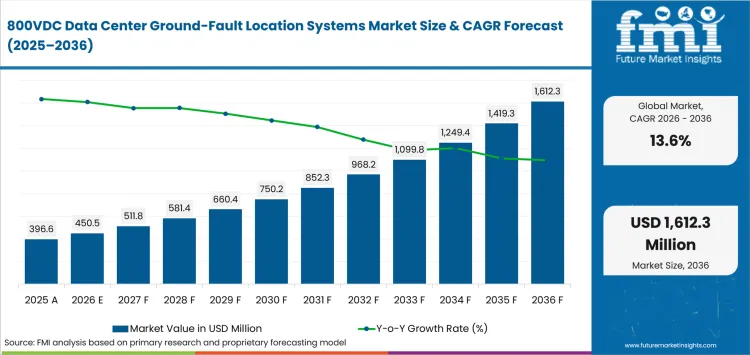
USD 450.5 million in 2026 and USD 1,612.3 million by 2036 at a 13.6% CAGR.
Demand for 800VDC data center ground-fault location systems market is expected to rise at 13.6% CAGR, pushing valuation at USD 450.5 million in 2026 and expected to reach USD 1,612.3 million by 2036. The transition toward higher-voltage power architectures is increasing the importance of fault-detection and isolation capabilities within large-scale data centers. NVIDIA stated in May 2025 that its 800 VDC architecture is intended for racks consuming 1 MW and beyond. Higher power concentrations increase the operational impact of insulation faults because maintenance teams must identify the affected circuit before restoration work can proceed safely. Ground-fault location systems therefore become more valuable as operators seek to shorten fault-isolation time and maintain availability across high-density computing environments.
Existing fleets and new AI campuses enter 800 VDC qualification from different starting points, so power availability changes the purchase path. Lawrence Berkeley National Laboratory estimated in June 2026 that data centers could account for 11.8% of USA electricity use by 2030. Mature fleets favor retrofit compatibility, whereas greenfield projects can specify insulation monitoring earlier in electrical design.
Key Takeaways
- Higher rack power increases demand for selective fault location by making fast electrical troubleshooting necessary ahead of maintenance on energized DC branches.
- By product configuration, rack-integrated assembly is estimated to hold 31.0% in 2026 owing to factory integration that reduces field wiring and branch-mapping work.
- The 750-850 VDC segment is likely to capture 49.0% share in 2026 attributable to direct alignment with the emerging 800 VDC design point.
- In 2026, the 250-500 kW segment is expected to lead rack power density with 36.0% share as protection qualification starts well below megawatt-class rack density.
- Qualification is the main restraint as locating current and insulation thresholds require validation against leakage capacitance plus the selected converter and distribution topology.
- Some of the key players in this market include Bender, Schneider Electric, Eaton, Vertiv, ABB, Delta Electronics, Phoenix Contact, and Socomec.
Analyst Perspective
"Fault-location hardware moves toward adoption only after engineers prove locating current against the selected converter and branch geometry. Commercial advantage shifts to platforms that shorten that proof cycle and return branch identity directly to the maintenance workflow."
- Nikhil Kaitwade, Principal Consultant, Future Market Insights
How is the 800VDC Data Center Ground-Fault Location Systems Market segmented?
The market is segmented by product configuration, nominal DC voltage, rack power density, data center type, route to market, and region.
Product configurations include rack-integrated assembly, standalone device or module, busway or distribution-integrated systems, and prefabricated power cabinets. Nominal DC voltage covers 600-749 VDC, 750-850 VDC, 851-1,000 VDC, and above 1,000 VDC. Rack power density covers below 250 kW, 250-500 kW, 501-750 kW, and above 750 kW. Data center types include hyperscale AI, colocation AI, enterprise or sovereign AI, and HPC or research centers. Routes include power OEM direct, electrical EPC or system integrator, authorized distributor, and retrofit or service channel.
What makes Rack-integrated assembly central to the Product configuration category?
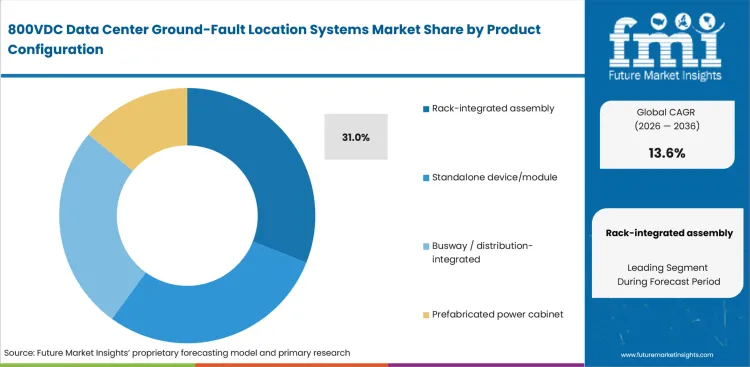
Rack-level placement shortens the diagnostic path beside high-density racks and gives power-platform engineers one boundary for factory validation. In October 2025, Schneider Electric documented an 800 VDC sidecar integrating conversion with protection and metering for racks up to 1.2 MW. The design gives locating logic a defined rack-adjacent integration point during factory testing.
- Rack-integrated assembly is set to lead the product configuration category with 31.0% share in 2026 due to factory coordination that reduces field wiring and branch-mapping work.
- Pre-engineered placement lets electrical commissioning services check locator thresholds against converter behavior at the factory and reduces rework after energization.
Why does 750-850 VDC lead the nominal DC voltage category?
The 750-850 VDC band matches the bus receiving current data center power engineering for accelerated computing. Eaton stated in July 2025 that its NVIDIA work supports 800 V HVDC infrastructure for 1 MW racks and beyond. The company places protection qualification inside the same architecture review as digital power conversion.
- The 750-850 VDC segment is projected to hold 49.0% share in 2026 owing to direct alignment with the emerging AI power architecture.
- Equipment in this band must retain insulation sensitivity under converter switching and system leakage without treating 800 VDC as an exceptional operating class during site review.
How does 250-500 kW hold the lead in Rack power density?
The 250-500 kW band captures facilities that already face concentrated electrical risk well below megawatt-class rack density. Vertiv's May 2025 announcement placed 800 VDC above 300 kW rack requirements. The threshold makes this band an early qualification zone for high-voltage DC protection systems.
- By rack power density, 250-500 kW is forecast to represent 36.0% in 2026 driven by meaningful fault-isolation value at pre-megawatt deployment levels.
- Operators can qualify sensing and communications at this density and then extend the same architecture to megawatt racks with greater outage exposure during onsite service. The staged path preserves earlier qualification records for later rack-platform revisions during deployment.
Why do Hyperscale AI data centers lead the Data center type category?
Hyperscale AI facilities can validate unfamiliar protection behavior beside AI data center cooling and rack-scale power systems. Schneider Electric announced in March 2026 a validated Vera Rubin reference design covering power plus cooling and controls for pre-deployment review. Hyperscalers can use that model to assess protection behavior during design review.
- Based on data center type, hyperscale AI data centers are projected to account for 51.0% in 2026 due to concentrated compute exposure that justifies earlier branch-level diagnostics.
- Hyperscale programs can test fault response inside the electrical model while facility teams are still setting converter and protection parameters.
What are the drivers, restraints and opportunities in the 800VDC Data Center Ground-Fault Location Systems Market?
Higher rack density increases the cost of slow fault isolation, system-specific electrical behavior slows qualification, and integrated diagnostics provide the clearest route to repeatable deployment.
- Driver: Concentrated rack power raises the operational value of locating an insulation fault to a defined branch during maintenance planning for energized DC systems.
- Restraint: Leakage capacitance and converter switching behavior require project-level validation as part of mission-critical 800 VDC fault-locator acceptance.
- Opportunity: Integrated monitoring can place branch location beside power telemetry so operations teams receive one usable electrical event record instead of disconnected alarms.
Higher rack power increases the cost of slow electrical diagnosis
A single fault can expose far more compute capacity, so power management decisions move closer to the rack. In July 2026 Schneider Electric released a validated Helios reference design for 246 kW racks and modular AI clusters up to 10.4 MW IT load. Selective fault location earns budget once technicians can isolate one affected branch quickly enough to preserve service continuity.
Architecture-specific behavior slows protection qualification
Power distribution units and converters change the electrical conditions seen by a locator, which means qualification must follow the chosen architecture. Schneider Electric's August 2026 arc-flash study assessed two representative 800 VDC architectures with time-dependent simulation. Project teams therefore need leakage measurements and fault-current studies to accept thresholds for early deployments.
Integrated fault information expands the serviceable revenue pool
Selective fault status becomes more useful inside data center automation software that already collects modular UPS and electrical alarm data. Bender's March 2025 speedikon partnership paired data-center hardware with a DCIM platform for sensors plus system components and services. Branch identity can then reach maintenance workflows without a separate diagnostic console, which broadens the service value of integrated fault-location packages.
Which country CAGRs are profiled in the 800VDC Data Center Ground-Fault Location Systems Market?
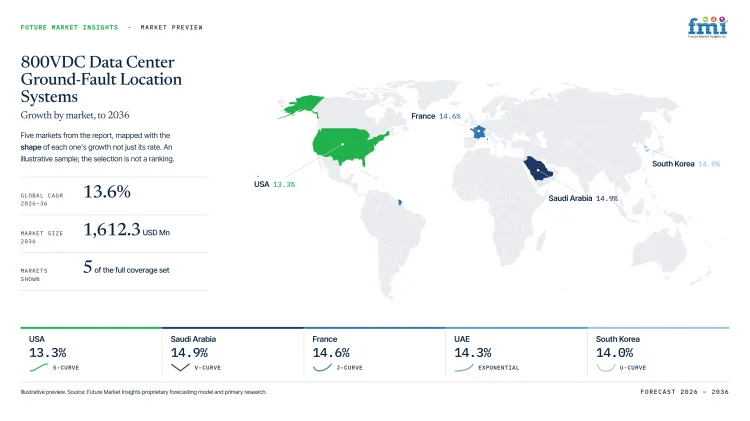
| Country | CAGR |
|---|---|
| Saudi Arabia | 14.9% |
| France | 14.6% |
| UAE | 14.3% |
| South Korea | 14.0% |
| USA | 13.3% |
How do country-level CAGRs compare in the 800VDC Data Center Ground-Fault Location Systems Market?
The country forecasts form a narrow 1.2-point band even though their operating routes differ. Saudi Arabia and France lead through greenfield capacity and large power programs. UAE and South Korea follow as AI projects move electrical decisions earlier. Japan advances more slowly as established facilities keep retrofit qualification commercially relevant.
- Saudi Arabia gains pace from greenfield campus economics and large contiguous development sites.
- France pairs low-carbon electricity with dense industrial power networks near major digital hubs.
- UAE projects favor prefabricated electrical packages that shorten onsite construction schedules.
- South Korea gives non-Seoul liquid-cooled edge projects an advantage under power-impact assessment support.
- USA is supported by continued hyperscale expansion alongside upgrades and retrofits across its mature data center infrastructure.
Similar CAGRs therefore imply different design-in timing and service burdens for protection vendors.The full report provides country-level CAGR analysis across North America, Latin America, Europe, East Asia, South Asia, Oceania and the Middle East and Africa.
Country-wise Analysis
- With utility connection and rack commissioning moving closer together, Saudi data-center developers lock electrical packages early for large AI campuses. Saudi Arabia's 800VDC ground-fault location outlook is anticipated to advance at 14.9% CAGR over the assessment period, driven by greenfield projects that specify protection during early package definition. In August 2026 the Saudi national portal documented 467 MW of operational data-center capacity during the first quarter. That operating base requires local commissioning resources to scale with construction and maintain service coverage during rapid campus turnover. Harsh site conditions favor companies that pair selective fault-location engineering with spare parts and field service.
- Ground-fault location demand in France is forecast to rise at 14.6% CAGR over the forecast period, tied to high-density AI projects that need protection decisions during early electrical design. For French data-center projects, usable power dates determine which electrical architecture reaches construction and turn grid access into an equipment qualification issue. In May 2026, the Élysée identified five large data-center projects expected to receive accelerated grid connections by year-end. RTE's fast-track process now influences the construction date for large electrical packages at qualifying sites. Faster connections do not remove site-readiness risk, so companies with French-language engineering and commissioning support retain an advantage during early 800 VDC adoption.
- In Abu Dhabi, large compute clusters require early power blocks and protection interfaces that fix electrical architecture near the front of campus design. Adoption of 800VDC ground-fault location systems in the UAE is estimated to expand at 14.3% CAGR through 2036, propelled by greenfield campuses that specify locating during equipment tender preparation. The UAE Ministry of Foreign Affairs stated in May 2025 that an initial 1 GW AI data center would anchor a planned 5 GW cluster. Prefabricated power assemblies shorten site work without removing interface checks between protection layers and rack platforms. Accelerated schedules and security requirements keep interface validation as the main constraint on repeatable deployment.
- Scaling national GPU capacity forces South Korean infrastructure planning to account for regional electrical grid constraints and power-system reform. In February 2025 the Ministry of Science and ICT set a goal of securing 18,000 GPUs by mid-2026 and establishing a national AI computing center. Demand for 800VDC ground-fault location systems in South Korea is forecast to rise at 14.0% CAGR through 2036, attributable to denser compute that raises fault-response value. Electricity availability outside Seoul can determine which projects reach final electrical package approval. Korean power-system integrators gain an advantage over hardware-only entrants because early qualification rewards local engineering support.
- New compute loads continue to expand across major U.S. data center hubs, making grid capacity, power availability, and electrical coordination increasingly important. Ground-fault location demand in the USA with 13.3% CAGR is supported by hyperscale and AI data center expansion, as operators prioritize reliable protection for high-density power systems. A large installed base also creates opportunities for upgrades and retrofits, while growing power requirements encourage investment in advanced 800VDC electrical protection and monitoring solutions.
Who are the notable companies in the 800VDC Data Center Ground-Fault Location Systems Market?
Bender, Schneider Electric, Eaton, Vertiv, ABB, Delta Electronics, Phoenix Contact and Socomec are the notable companies serving this market.
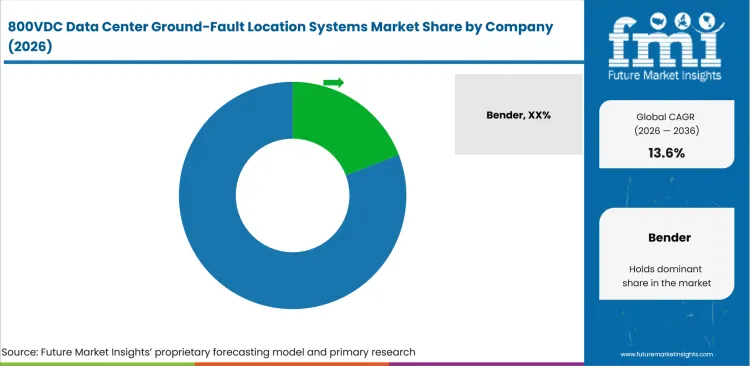
Competition separates fault-location specialists from power-platform companies that shape 800 VDC rack integration. Bender has the closest fit to selective fault location, and Schneider Electric covers broader protection integration. Vertiv and Delta Electronics now package rack power beside liquid cooling systems. Adjacent busbar temperature monitoring requirements also affect package design for Phoenix Contact and Socomec. Verified interfaces and local service support decide early qualification outcomes for new projects.
- Bender and Schneider Electric hold the strongest direct positioning where operators need insulation supervision or fault-location functions tied to an unearthed DC electrical architecture.
- Eaton, Vertiv, ABB and Delta Electronics shape specification using high-density power platforms that place protection requirements inside rack or facility reference designs.
- Phoenix Contact and Socomec participate from protection, monitoring and power-continuity roles that can support integrated electrical packages for data centers.
Competitive Benchmarking: 800VDC Data Center Ground-Fault Location Systems Market
| Company | 800 VDC Architecture Activity | Fault/Insulation Protection Depth | Monitoring Integration | Geographic Reach |
|---|---|---|---|---|
| Bender | Low | High | High | Europe, Americas, Asia-Pacific, Middle East |
| Schneider Electric | High | High | High | Global |
| Eaton | High | Medium | High | Global |
| Vertiv | High | Low | High | Global |
| ABB | High | Medium | High | Global |
| Delta Electronics | High | Medium | High | Global |
| Phoenix Contact | Low | Medium | Low | Global industrial network |
| Socomec | Low | Low | High | Europe, Americas, Asia-Pacific, Middle East |
Scoring basis assigns High 800 VDC activity to a documented data-center platform or reference design with direct market relevance. Medium covers a documented high-voltage DC implementation role and Low identifies a narrower announced role without platform-level evidence. High protection depth requires direct insulation-monitoring or fault-location evidence from documented company programs. Medium covers related DC protection and Low identifies power participation without selective locating evidence. High monitoring integration requires system-level telemetry or management software linked to facility operations. Medium covers device signaling and Low identifies limited monitoring scope within public evidence.
Key Developments in the 800VDC Data Center Ground-Fault Location Systems Market
- In January 2026, Eaton expanded its modular data-center offer with a Flexnode collaboration that integrates Eaton power infrastructure with prefabricated AI compute modules and explicitly includes 800 VDC infrastructure.
- In October 2025, Vertiv advanced its 800 VDC platform designs from concept toward engineering readiness with NVIDIA and detailed centralized rectifiers plus DC busways and rack-level converters.
- In October 2025, ABB began 800 VDC development work with NVIDIA for future 1 MW server racks and linked the program to medium-voltage UPS plus DC distribution architecture.
Key Players in the 800VDC Data Center Ground-Fault Location Systems Market
Insulation monitoring and fault-location specialists
- Bender
- Schneider Electric
Integrated 800 VDC power-system platforms
- Eaton
- Vertiv
- ABB
- Delta Electronics
Protection and power-continuity participants
- Phoenix Contact
- Socomec
800VDC Data Center Ground-Fault Location Systems Market - Report Scope
| Coverage field | Report scope |
|---|---|
| Market breakdown | By product configuration, nominal DC voltage, rack power density, data center type, route to market and region. |
| Quantitative Units | USD Million. |
| Market Definition | Revenue includes dedicated 800 VDC data-center ground-fault location systems and integral locating modules sold within the defined segmentation. Generic protection devices without the locating function and downstream data-center equipment revenue are excluded. |
| Regions Covered | North America, Latin America, Europe, East Asia, South Asia and Pacific, and Middle East and Africa. |
| Countries Covered | Saudi Arabia, France, UAE, South Korea, Japan, and 20+ countries included in the full report. |
| Key Companies Profiled | Bender, Schneider Electric, Eaton, Vertiv, ABB, Delta Electronics, Phoenix Contact, Socomec. |
| Forecast Period | 2026 to 2036. |
| Approach | Primary and secondary research with market triangulation. |
800VDC Data Center Ground-Fault Location Systems Market - Research Methodology
| Method | Approach |
|---|---|
| Primary Research | FMI analysts gathered input from manufacturers, service providers, technology developers, distributors, end users, procurement teams, and subject-matter experts. Interviews examined purchasing decisions, product or service evaluation, adoption barriers, approval requirements, pricing considerations, and expectations for technical or commercial support. Respondents were also asked what evidence is required before a trial, pilot, or initial order develops into regular purchasing. |
| Desk Research | Desk research covered government statistics, regulatory publications, trade data, industry associations, technical literature, standards, company filings, product information, and official corporate announcements. Sources were reviewed for relevance, publication date, geographic coverage, and consistency with the defined market scope. Claims relating to performance, applications, approvals, capacity, investment, and commercial activity were retained only when supported by credible public evidence. |
| Market Sizing and Forecasting | The market model combined the baseline value with historical performance, segment structure, pricing and volume indicators, adoption levels, company participation, and country-level demand conditions. Forecast assumptions considered economic activity, investment trends, regulatory developments, technology adoption, purchasing cycles, supply availability, and barriers to wider market use. Segment and regional estimates were reconciled before the final market total was calculated. |
| Data Validation | Estimates were checked against multiple independent indicators, including public data, company activity, trade patterns, industry developments, and findings from primary interviews. Validation also tested whether products, services, applications, and company revenues fell within the defined market boundaries. Adjacent categories, unsupported claims, overlapping revenues, and activities without direct market relevance were excluded to reduce double counting and maintain consistency across segments and countries. |
800VDC Data Center Ground-Fault Location Systems Market by Segments
800VDC Data Center Ground-Fault Location Systems Market segmented by product configuration:
- Rack-integrated assembly
- Standalone device/module
- Busway / distribution-integrated
- Prefabricated power cabinet
800VDC Data Center Ground-Fault Location Systems Market segmented by nominal DC voltage:
- 750-850 VDC
- 600-749 VDC
- 851-1,000 VDC
- Above 1,000 VDC
800VDC Data Center Ground-Fault Location Systems Market segmented by rack power density:
- 250-500 kW
- Below 250 kW
- 501-750 kW
- Above 750 kW
800VDC Data Center Ground-Fault Location Systems Market segmented by data center type:
- Hyperscale AI data centers
- Colocation AI facilities
- Enterprise / sovereign AI
- HPC & research centers
800VDC Data Center Ground-Fault Location Systems Market segmented by route to market:
- Power OEM direct
- Electrical EPC / system integrator
- Authorized distributor
- Retrofit / service channel
800VDC Data Center Ground-Fault Location Systems Market by Region:
- North America
- United States
- Canada
- Latin America
- Brazil
- Mexico
- Argentina
- Chile
- Western Europe
- Germany
- France
- United Kingdom
- Italy
- Spain
- Benelux
- Nordics
- Eastern Europe
- Poland
- Czech Republic
- Romania
- Hungary
- East Asia
- China
- Japan
- South Korea
- South Asia and Pacific
- India
- ASEAN
- Australia and New Zealand
- Middle East and Africa
- GCC Countries
- South Africa
- Türkiye
- Israel
Research Sources and Bibliography
- NVIDIA. (2025, May 20). NVIDIA 800 VDC Architecture Will Power the Next Generation of AI Factories.
- Lawrence Berkeley National Laboratory. (2026, June). United States Data Center Energy Usage Report: 2025 Update.
- Schneider Electric. (2025, October 13). Schneider Electric Highlights Innovation in 800 VDC Power Systems in Support of NVIDIA’s Next Generation GPUs.
- Eaton. (2025, July 15). Eaton Accelerates the Transformation of Data Center Infrastructure in the AI Era with NVIDIA.
- Vertiv. (2025, May 19). Vertiv Accelerates AI Infrastructure Evolution in Alignment with NVIDIA 800 VDC Power Architecture Announcement.
- Schneider Electric. (2026, March 16). Schneider Electric Teams with NVIDIA to Develop Validated Blueprints for Gigawatt-Scale AI Factories.
- Schneider Electric. (2026, July 23). Schneider Electric and AMD Release First Helios Platform Reference Design to Accelerate AI Factory Deployment.
- Schneider Electric. (2026, August 3). Schneider Electric Releases Pioneering Study Assessing Arc Flash Risk in 800 VDC Data Centers Aligning with World’s Leading Hyperscalers.
- Bender. (2025, March 18). Bender Reveal New DCIM Solution and Partnership with speedikon at Data Centre World 2025.
- National Portal of Saudi Arabia. (2026, August 17). Saudi Arabia Reshapes the Future of the Digital Economy Through Advanced Digital Infrastructure, Global Partnerships.
- Élysée. (2026, May 26). Réunion de l’équipe de France de l’électrification.
- UAE Ministry of Foreign Affairs. (2025, May 16). UAE/US Framework on Advanced Technology Cooperation.
- Ministry of Science and ICT, Republic of Korea. (2025, February 20). Korea to Expand AI Computing Infrastructure to Strengthen National AI Capabilities and Achieve Global Leadership.
- Agency for Natural Resources and Energy, Japan. (2025, June 13). FY2024 Annual Report on Energy (Energy White Paper 2025), Part I Chapter 2 Section 2.
- Eaton. (2026, January 28). Eaton Expands Modular Data Center Offering for Rapid Deployment of AI Factories from Grid to Chip.
- Vertiv. (2025, October 20). From Vision to Readiness: Vertiv Collaborates with NVIDIA to Advance 800 VDC Platform Designs.
- ABB. (2025, October 13). ABB to Develop Next-Generation AI Data Centers with NVIDIA.
- Phoenix Contact. (2026, May 18). Perfect Protection for Insulated Systems.
- Schneider Electric. (2026, June 15). Schneider Electric and Foxconn Announce Strategic Collaboration to Accelerate Next-Generation AI Data Centers.
- ABB. (2026, March 26). ABB and VoltaGrid Extend Collaboration on Data Center Power Infrastructure.
- Vertiv. (2026, July 23). Vertiv Infrastructure Helps Bring NVIDIA AI Computing Capability to the Naval Postgraduate School.
- Socomec. (2026, May 18). Socomec, Daitron Team Up to Meet Japan’s Growing Power Demands.
- Delta Electronics. (2026, June 2). Delta Debuts Prefabricated AI Modular Data Center Solution at COMPUTEX 2026.
- Bender. (2025, August 5). New COMTRAXX EDGE500IP: Gateway and Condition Monitoring in One Device.
- Eaton. (2025, September 9). Eaton Delivers Edge-Based Innovation to Help Mitigate the Impact of AI Power Bursting.
- Socomec. (2025, July 9). Socomec Partners with PowerUp to Provide Advanced AI-Powered Battery Analytics Solutions.
- Schneider Electric. (2025, September 3). AVAIO Digital and Schneider Electric Partner to build new AI-optimized data centers in USA.
- Vertiv. (2026, February 26). NxtGen AI Builds National-Scale Sovereign AI Factory with Vertiv Data Center Infrastructure, Accelerated by NVIDIA Blackwell.
- ABB. (2026, June 1). ABB Expands Collaboration with NVIDIA through Integration of DSX Blueprint for AI Infrastructure.
- Delta Electronics. (2025, October 15). Delta to Demonstrate Seamlessly Integrated High Voltage DC Power, Advanced Cooling, and Networking Solutions to Drive AI Data Center Evolution at OCP Global Summit 2025.
This bibliography is provided for reader reference and is not exhaustive. The full report contains the complete reference list and detailed citations.
This Report Answers
- What is the 800VDC data center ground-fault location systems market size in 2026 and what value is forecast by 2036?
- Which electrical conditions increase demand for selective ground-fault location in high-density AI facilities?
- Why does rack-integrated assembly hold the leading position within the product configuration category?
- Why does the 750-850 VDC range hold the leading position within nominal DC voltage?
- How does the 250-500 kW rack-density segment influence early 800 VDC protection qualification?
- Which five countries record the highest profiled CAGRs and what local conditions separate their adoption paths?
- Which eight companies are profiled and how do their protection or power-platform roles differ?
- Which qualification conditions slow design-in for early 800 VDC fault-location deployments?
- What evidence should operators request before accepting selective fault location inside a new DC power architecture?
Frequently Asked Questions
How big is the 800VDC data center ground-fault location systems market in 2026?
The 800VDC data center ground-fault location systems market is valued at USD 450.5 million in 2026 and is projected to reach USD 1,612.3 million by 2036. Higher rack power increases the value of locating first insulation faults during maintenance planning.
What is the CAGR of the 800VDC data center ground-fault location systems market from 2026 to 2036?
The 800VDC data center ground-fault location systems market is projected to grow at a CAGR of 13.6% between 2026 and 2036. Expansion follows wider 800 VDC qualification and greater electrical exposure from concentrated AI compute loads.
Which product configuration leads the 800VDC data center ground-fault location systems market?
The rack-integrated assembly segment is expected to hold 31.0% of the 800VDC data center ground-fault location systems market in 2026, driven by factory integration that reduces field wiring. Shorter branch mapping also simplifies commissioning and maintenance work near high-density rack branches.
Which nominal DC voltage segment leads the 800VDC data center ground-fault location systems market?
The 750–850 VDC segment is expected to hold 49.0% of the 800VDC data center ground-fault location systems market in 2026, attributable to direct alignment with the 800 VDC architecture. The same voltage band enters qualification with converters and downstream DC distribution.
Which countries are projected to record the highest growth in the 800VDC data center ground-fault location systems market?
Saudi Arabia is projected to grow at 14.9% CAGR, followed by France at 14.6% and the UAE at 14.3% through 2036. Greenfield AI capacity and faster connection programs place protection requirements earlier in electrical design.
Which companies are active in the 800VDC data center ground-fault location systems market?
Key companies operating in the market include Bender, Schneider Electric, Eaton, Vertiv, ABB, Delta Electronics, Phoenix Contact, and Socomec. These companies cover selective fault location plus 800 VDC power design with monitoring integration and commissioning support.
Preview the report firsthand - request a free sample
Get SampleGet the brochure for pricing and purchase details.
Get PDFTable of Content
- Key Takeaways
- Market Size and CAGR
- Top Growth Driver
- Fastest Growing Segment
- Leading Region
- Key Companies
- Emerging Opportunities
- Executive Summary
- Global Market Outlook
- Demand-side Trends
- Supply-side Trends
- Technology Roadmap Analysis
- Analysis and Recommendations
- Analyst Perspective (What is happening? Why now? What should investors know?)
- Key Questions Answered
- How large is the market?
- What is the CAGR?
- What are key trends?
- Which region dominates?
- Who are the leaders?
- Market Overview
- Market Coverage / Taxonomy
- Market Definition / Scope / Limitations
- Research Methodology
- Chapter Orientation
- Analytical Lens and Working Hypotheses
- Market Structure, Signals, and Trend Drivers
- Benchmarking and Cross-market Comparability
- Market Sizing, Forecasting, and Opportunity Mapping
- Research Design and Evidence Framework
- Desk Research Programme (Secondary Evidence)
- Expert Input and Fieldwork (Primary Evidence)
- Tooling, Models, and Reference Databases
- Data Engineering and Model Build
- Quality Assurance and Audit Trail
- Market Background
- Market Dynamics (Drivers, Restraints, Opportunity, Trends)
- Scenario Forecast (Optimistic, Likely, Conservative)
- Impact Analysis
- AI Impact
- Sustainability Impact
- Regulatory Impact
- Technology Impact
- Consumer / Buyer Analysis
- Purchase Drivers
- Adoption Barriers
- Buyer Journey
- Opportunity Map Analysis
- Product Life Cycle Analysis
- Supply Chain Analysis
- Investment Feasibility Matrix
- Value Chain Analysis
- PESTLE and Porter's Analysis
- Regulatory Landscape
- Regional Parent Market Outlook
- Production and Consumption Statistics
- Import and Export Statistics
- Global Market Analysis and Forecast, 2021 to 2036
- Historical Market Size Value (USD Million) Analysis, 2021 to 2025
- Current and Future Market Size Value (USD Million) Projections, 2026 to 2036
- Y-o-Y Growth Trend Analysis
- Absolute $ Opportunity Analysis
- Global Market Pricing Analysis, 2021 to 2036
- Global Market Analysis and Forecast, By Product Configuration, 2021 to 2036
- Introduction / Key Findings
- Historical Market Size Value (USD Million) Analysis By Product Configuration, 2021 to 2025
- Current and Future Market Size Value (USD Million) Analysis and Forecast By Product Configuration, 2026 to 2036
- Rack-integrated assembly
- Standalone device/module
- Busway / distribution-integrated
- Prefabricated power cabinet
- Rack-integrated assembly
- Y-o-Y Growth Trend Analysis By Product Configuration, 2021 to 2025
- Absolute $ Opportunity Analysis By Product Configuration, 2026 to 2036
- Global Market Analysis and Forecast, By Nominal DC Voltage, 2021 to 2036
- Introduction / Key Findings
- Historical Market Size Value (USD Million) Analysis By Nominal DC Voltage, 2021 to 2025
- Current and Future Market Size Value (USD Million) Analysis and Forecast By Nominal DC Voltage, 2026 to 2036
- 750-850 VDC
- 600-749 VDC
- 851-1,000 VDC
- Above 1,000 VDC
- 750-850 VDC
- Y-o-Y Growth Trend Analysis By Nominal DC Voltage, 2021 to 2025
- Absolute $ Opportunity Analysis By Nominal DC Voltage, 2026 to 2036
- Global Market Analysis and Forecast, By Rack Power Density, 2021 to 2036
- Introduction / Key Findings
- Historical Market Size Value (USD Million) Analysis By Rack Power Density, 2021 to 2025
- Current and Future Market Size Value (USD Million) Analysis and Forecast By Rack Power Density, 2026 to 2036
- 250-500 kW
- Below 250 kW
- 501-750 kW
- Above 750 kW
- 250-500 kW
- Y-o-Y Growth Trend Analysis By Rack Power Density, 2021 to 2025
- Absolute $ Opportunity Analysis By Rack Power Density, 2026 to 2036
- Global Market Analysis and Forecast, By Data Center Type, 2021 to 2036
- Introduction / Key Findings
- Historical Market Size Value (USD Million) Analysis By Data Center Type, 2021 to 2025
- Current and Future Market Size Value (USD Million) Analysis and Forecast By Data Center Type, 2026 to 2036
- Hyperscale AI data centers
- Colocation AI facilities
- Enterprise / sovereign AI
- HPC & research centers
- Hyperscale AI data centers
- Y-o-Y Growth Trend Analysis By Data Center Type, 2021 to 2025
- Absolute $ Opportunity Analysis By Data Center Type, 2026 to 2036
- Global Market Analysis and Forecast, By Route to Market, 2021 to 2036
- Introduction / Key Findings
- Historical Market Size Value (USD Million) Analysis By Route to Market, 2021 to 2025
- Current and Future Market Size Value (USD Million) Analysis and Forecast By Route to Market, 2026 to 2036
- Power OEM direct
- Electrical EPC / system integrator
- Authorized distributor
- Retrofit / service channel
- Power OEM direct
- Y-o-Y Growth Trend Analysis By Route to Market, 2021 to 2025
- Absolute $ Opportunity Analysis By Route to Market, 2026 to 2036
- Global Market Analysis and Forecast, By Region, 2021 to 2036
- Introduction
- Historical Market Size Value (USD Million) Analysis By Region, 2021 to 2025
- Current Market Size Value (USD Million) Analysis and Forecast By Region, 2026 to 2036
- North America
- Latin America
- Western Europe
- Eastern Europe
- East Asia
- South Asia and Pacific
- Middle East & Africa
- Market Attractiveness Analysis By Region
- North America Market Analysis and Forecast, By Country, 2021 to 2036
- Historical Market Size Value (USD Million) Trend Analysis By Market Taxonomy, 2021 to 2025
- Market Size Value (USD Million) Forecast By Market Taxonomy, 2026 to 2036
- By Country
- USA
- Canada
- By Product Configuration
- By Nominal DC Voltage
- By Rack Power Density
- By Data Center Type
- By Route to Market
- By Country
- Market Attractiveness Analysis
- By Country
- By Product Configuration
- By Nominal DC Voltage
- By Rack Power Density
- By Data Center Type
- By Route to Market
- Key Takeaways
- Latin America Market Analysis and Forecast, By Country
- Historical Market Size Value (USD Million) Trend Analysis By Market Taxonomy, 2021 to 2025
- Market Size Value (USD Million) Forecast By Market Taxonomy, 2026 to 2036
- By Country
- Brazil
- Mexico
- Chile
- Rest of Latin America
- By Product Configuration
- By Nominal DC Voltage
- By Rack Power Density
- By Data Center Type
- By Route to Market
- By Country
- Market Attractiveness Analysis
- By Country
- By Product Configuration
- By Nominal DC Voltage
- By Rack Power Density
- By Data Center Type
- By Route to Market
- Key Takeaways
- Western Europe Market Analysis and Forecast, By Country
- Historical Market Size Value (USD Million) Trend Analysis By Market Taxonomy, 2021 to 2025
- Market Size Value (USD Million) Forecast By Market Taxonomy, 2026 to 2036
- By Country
- Germany
- UK
- Italy
- Spain
- France
- Nordic
- BENELUX
- Rest of Western Europe
- By Product Configuration
- By Nominal DC Voltage
- By Rack Power Density
- By Data Center Type
- By Route to Market
- By Country
- Market Attractiveness Analysis
- By Country
- By Product Configuration
- By Nominal DC Voltage
- By Rack Power Density
- By Data Center Type
- By Route to Market
- Key Takeaways
- Eastern Europe Market Analysis and Forecast, By Country
- Historical Market Size Value (USD Million) Trend Analysis By Market Taxonomy, 2021 to 2025
- Market Size Value (USD Million) Forecast By Market Taxonomy, 2026 to 2036
- By Country
- Russia
- Poland
- Hungary
- Balkan & Baltic
- Rest of Eastern Europe
- By Product Configuration
- By Nominal DC Voltage
- By Rack Power Density
- By Data Center Type
- By Route to Market
- By Country
- Market Attractiveness Analysis
- By Country
- By Product Configuration
- By Nominal DC Voltage
- By Rack Power Density
- By Data Center Type
- By Route to Market
- Key Takeaways
- East Asia Market Analysis and Forecast, By Country
- Historical Market Size Value (USD Million) Trend Analysis By Market Taxonomy, 2021 to 2025
- Market Size Value (USD Million) Forecast By Market Taxonomy, 2026 to 2036
- By Country
- China
- Japan
- South Korea
- By Product Configuration
- By Nominal DC Voltage
- By Rack Power Density
- By Data Center Type
- By Route to Market
- By Country
- Market Attractiveness Analysis
- By Country
- By Product Configuration
- By Nominal DC Voltage
- By Rack Power Density
- By Data Center Type
- By Route to Market
- Key Takeaways
- South Asia and Pacific Market Analysis and Forecast, By Country
- Historical Market Size Value (USD Million) Trend Analysis By Market Taxonomy, 2021 to 2025
- Market Size Value (USD Million) Forecast By Market Taxonomy, 2026 to 2036
- By Country
- India
- ASEAN
- Australia & New Zealand
- Rest of South Asia and Pacific
- By Product Configuration
- By Nominal DC Voltage
- By Rack Power Density
- By Data Center Type
- By Route to Market
- By Country
- Market Attractiveness Analysis
- By Country
- By Product Configuration
- By Nominal DC Voltage
- By Rack Power Density
- By Data Center Type
- By Route to Market
- Key Takeaways
- Middle East & Africa Market Analysis and Forecast, By Country
- Historical Market Size Value (USD Million) Trend Analysis By Market Taxonomy, 2021 to 2025
- Market Size Value (USD Million) Forecast By Market Taxonomy, 2026 to 2036
- By Country
- Kingdom of Saudi Arabia
- Other GCC Countries
- Türkiye
- South Africa
- Other African Union
- Rest of Middle East & Africa
- By Product Configuration
- By Nominal DC Voltage
- By Rack Power Density
- By Data Center Type
- By Route to Market
- By Country
- Market Attractiveness Analysis
- By Country
- By Product Configuration
- By Nominal DC Voltage
- By Rack Power Density
- By Data Center Type
- By Route to Market
- Key Takeaways
- Key Countries Market Analysis
- USA
- Pricing Analysis
- Market Share Analysis, 2025
- By Product Configuration
- By Nominal DC Voltage
- By Rack Power Density
- By Data Center Type
- By Route to Market
- Canada
- Pricing Analysis
- Market Share Analysis, 2025
- By Product Configuration
- By Nominal DC Voltage
- By Rack Power Density
- By Data Center Type
- By Route to Market
- Mexico
- Pricing Analysis
- Market Share Analysis, 2025
- By Product Configuration
- By Nominal DC Voltage
- By Rack Power Density
- By Data Center Type
- By Route to Market
- Brazil
- Pricing Analysis
- Market Share Analysis, 2025
- By Product Configuration
- By Nominal DC Voltage
- By Rack Power Density
- By Data Center Type
- By Route to Market
- Chile
- Pricing Analysis
- Market Share Analysis, 2025
- By Product Configuration
- By Nominal DC Voltage
- By Rack Power Density
- By Data Center Type
- By Route to Market
- Germany
- Pricing Analysis
- Market Share Analysis, 2025
- By Product Configuration
- By Nominal DC Voltage
- By Rack Power Density
- By Data Center Type
- By Route to Market
- UK
- Pricing Analysis
- Market Share Analysis, 2025
- By Product Configuration
- By Nominal DC Voltage
- By Rack Power Density
- By Data Center Type
- By Route to Market
- Italy
- Pricing Analysis
- Market Share Analysis, 2025
- By Product Configuration
- By Nominal DC Voltage
- By Rack Power Density
- By Data Center Type
- By Route to Market
- Spain
- Pricing Analysis
- Market Share Analysis, 2025
- By Product Configuration
- By Nominal DC Voltage
- By Rack Power Density
- By Data Center Type
- By Route to Market
- France
- Pricing Analysis
- Market Share Analysis, 2025
- By Product Configuration
- By Nominal DC Voltage
- By Rack Power Density
- By Data Center Type
- By Route to Market
- India
- Pricing Analysis
- Market Share Analysis, 2025
- By Product Configuration
- By Nominal DC Voltage
- By Rack Power Density
- By Data Center Type
- By Route to Market
- ASEAN
- Pricing Analysis
- Market Share Analysis, 2025
- By Product Configuration
- By Nominal DC Voltage
- By Rack Power Density
- By Data Center Type
- By Route to Market
- Australia & New Zealand
- Pricing Analysis
- Market Share Analysis, 2025
- By Product Configuration
- By Nominal DC Voltage
- By Rack Power Density
- By Data Center Type
- By Route to Market
- China
- Pricing Analysis
- Market Share Analysis, 2025
- By Product Configuration
- By Nominal DC Voltage
- By Rack Power Density
- By Data Center Type
- By Route to Market
- Japan
- Pricing Analysis
- Market Share Analysis, 2025
- By Product Configuration
- By Nominal DC Voltage
- By Rack Power Density
- By Data Center Type
- By Route to Market
- South Korea
- Pricing Analysis
- Market Share Analysis, 2025
- By Product Configuration
- By Nominal DC Voltage
- By Rack Power Density
- By Data Center Type
- By Route to Market
- Russia
- Pricing Analysis
- Market Share Analysis, 2025
- By Product Configuration
- By Nominal DC Voltage
- By Rack Power Density
- By Data Center Type
- By Route to Market
- Poland
- Pricing Analysis
- Market Share Analysis, 2025
- By Product Configuration
- By Nominal DC Voltage
- By Rack Power Density
- By Data Center Type
- By Route to Market
- Hungary
- Pricing Analysis
- Market Share Analysis, 2025
- By Product Configuration
- By Nominal DC Voltage
- By Rack Power Density
- By Data Center Type
- By Route to Market
- Kingdom of Saudi Arabia
- Pricing Analysis
- Market Share Analysis, 2025
- By Product Configuration
- By Nominal DC Voltage
- By Rack Power Density
- By Data Center Type
- By Route to Market
- Türkiye
- Pricing Analysis
- Market Share Analysis, 2025
- By Product Configuration
- By Nominal DC Voltage
- By Rack Power Density
- By Data Center Type
- By Route to Market
- South Africa
- Pricing Analysis
- Market Share Analysis, 2025
- By Product Configuration
- By Nominal DC Voltage
- By Rack Power Density
- By Data Center Type
- By Route to Market
- USA
- Market Structure Analysis
- Competition Dashboard
- Competition Benchmarking
- Market Share Analysis of Top Players
- By Regional
- By Product Configuration
- By Nominal DC Voltage
- By Rack Power Density
- By Data Center Type
- By Route to Market
- Emerging Startups
- Innovation Benchmarking
- Competition Analysis
- Competition Deep Dive
- Bender
- Overview
- Product Portfolio
- Profitability by Market Segments
- Sales Footprint
- Strategy Overview
- Marketing Strategy
- Product Strategy
- Channel Strategy
- Phoenix Contact
- Eaton
- Schneider Electric
- Bender
- Case Studies
- Success Stories
- Recent Developments
- Competition Deep Dive
- Assumptions & Acronyms Used


