

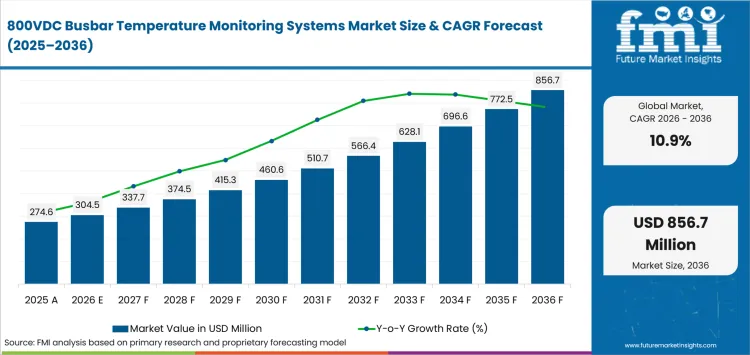
- Market Size (2026)
- USD 304.5 Mn
- Forecast (2036)
- USD 856.7 Mn
- CAGR (2026 to 2036)
- 10.9%
How big is 800VDC Busbar Temperature Monitoring Systems Market in 2026?
USD 304.5 million in 2026 and USD 856.7 million by 2036 at a 10.9% CAGR.
Demand for 800VDC busbar temperature monitoring systems is projected to rise at 10.9% CAGR through 2036, increasing from USD 304.5 million in 2026 to USD 856.7 million. Higher rack densities and growing power requirements are pushing data center operators toward new electrical distribution architectures that require greater visibility into thermal performance. NVIDIA’s May 2025 architecture shifts high-density data center power toward 800 VDC once 54 VDC distribution begins reaching physical limits beyond 200 kW. Permanent joint sensing protects concentrated compute at busbar connections, while busbar systems procurement favors factory installation during assembly and energization.
Country timing differs as greenfield AI campuses qualify new electrical architectures earlier than constrained retrofit sites. The UAE Ministry of Foreign Affairs stated in May 2025 that a planned 5 GW Abu Dhabi technology cluster would begin with a 1 GW AI data center. The project scale favors modular data centers with repeatable power blocks and defined monitoring interfaces during factory commissioning. USA retrofits move more slowly under grid-access limits and established operating standards.
Key Takeaways
- A localized connection fault can interrupt concentrated compute capacity, making continuous joint-temperature visibility more valuable as AI rack density rises.
- By product configuration, rack-integrated assembly is estimated to hold 31.0% in 2026 owing to factory control over sensor placement and alarm routing.
- 750-850 VDC is projected to hold 49.0% share in 2026 owing to emerging AI rack architectures centered on 800 VDC distribution.
- In 2026, 250-500 kW is expected to lead rack power density with 36.0% share because operators are moving current designs toward megawatt-class racks.
- Architecture-specific insulation and fault studies extend approval cycles since monitoring hardware must qualify inside the selected 800 VDC topology.
- Some of the key players in this market include Eaton, Schneider Electric, Vertiv, ABB, Siemens, Delta Electronics, Bender, and Phoenix Contact.
Analyst Perspective
“Unit price says little once a temperature sensor becomes part of an energized 800 VDC busbar assembly. Operators should compare factory qualification and joint-specific alarm logic while confirming that sensor data reaches EPMS or DCIM without separate field engineering.”
- Nikhil Kaitwade, Principal Consultant, Future Market Insights
How is the 800VDC Busbar Temperature Monitoring Systems Market segmented?
The market is segmented by product configuration, nominal DC voltage, rack power density, data center type, and route to market.
Product configuration includes rack-integrated assembly, standalone device/module, busway/distribution-integrated and prefabricated power cabinet. Nominal DC voltage covers 600-749 VDC, 750-850 VDC, 851-1,000 VDC and above 1,000 VDC. Rack power density covers below 250 kW, 250-500 kW, 501-750 kW and above 750 kW. Data center type includes hyperscale AI, colocation AI, enterprise/sovereign AI and HPC/research centers. Route to market includes power OEM direct, electrical EPC/system integrator, authorized distributor and retrofit/service channel.
What supports Hyperscale AI data centers within the Data Center type category?
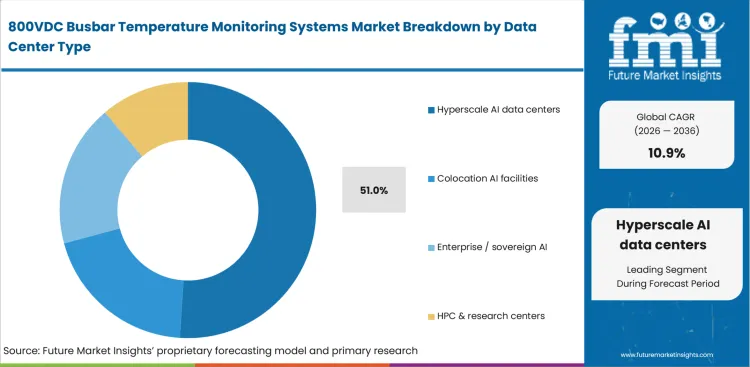
Hyperscale operators qualify new power architectures at campus scale as localized electrical faults threaten large rack fleets. Campus-wide power quality monitoring belongs in the same reliability review as joint-level condition data during repeat-deployment planning and early electrical package design.
- Based on data center type, hyperscale AI data centers are projected to account for 51.0% in 2026 owing to earlier adoption of high-density rack power.
- Hyperscale engineering teams validate protection and monitoring interfaces for repeat deployment. ABB reported in June 2025 that Applied Digital selected a new power architecture for a 400 MW greenfield campus in North Dakota.
What makes Rack-Integrated assembly central to the Product Configuration category?
Rack-integrated sensing is easiest to qualify in factory-built assemblies with fixed busbar geometry and joint locations. Eaton’s October 2025 800 VDC reference architecture places busbar distribution inside a defined AI power design, giving sensor placement a stable electrical boundary. The same factory review also aligns thermal management materials with wiring clearances during assembly testing.
- By product configuration, rack-integrated assembly is estimated to hold 31.0% in 2026 owing to factory control over sensor location and alarm routing.
- Data-center engineers validate insulation clearances against the same drawings used for the power assembly, reducing energized-site intervention during commissioning and later service work.
Why does 750-850 VDC lead the nominal DC Voltage category?
Voltage class sets the insulation envelope for sensors and the communication path leaving an energized conductor. The 750-850 VDC band gives high-voltage DC power designers a defined target for isolation and measurement interfaces during rack-level protection design.
- By nominal DC voltage, the 750-850 VDC segment is forecast to represent 49.0% in 2026 owing to direct alignment with emerging 800 VDC rack architecture.
- Monitoring designers focus early qualification on this voltage band as service spacing and signal isolation change near higher-energy conductors. Schneider Electric announced an 800 VDC program in October 2025 covering conversion, protection and metering for upcoming AI racks.
How does 250-500 kW shape demand within the Rack Power density category?
The 250-500 kW band captures projects beyond conventional rack-power practice without committing every design decision to megawatt-class hardware. Vertiv stated in May 2025 that 800 VDC improves centralized delivery as AI rack requirements move beyond 300 kW. The same transition changes how power distribution units interact with busways and rack converters during design review.
- In 2026, 250-500 kW is expected to lead rack power density with 36.0% share since it covers the active transition toward dedicated 800 VDC delivery.
- Operators in this density band value permanent sensing without a complete facility redesign. Higher connection loading raises outage exposure within otherwise familiar data-hall layouts.
What are the drivers, restraints and opportunities in the 800VDC Busbar Temperature Monitoring Systems Market?
Rising AI rack density increases demand for permanent joint-temperature visibility, while architecture-specific 800 VDC safety studies slow approval and factory-integrated monitoring provides the clearest revenue route.
- Driver: Megawatt-class rack designs concentrate more compute behind each power connection and increase the cost of detecting developing joint heat too late.
- Restraint: Converter-fed 800 VDC systems require topology-specific safety analysis to accept monitoring hardware near energized conductors and protection devices.
- Opportunity: Power-platform manufacturers can qualify sensing and digital alarm interfaces during prefabricated assembly so equipment reaches the data hall with approved interfaces.
Higher Rack Density Raises the Cost of Late Fault Detection
Each increase in rack power concentrates more compute behind fewer high-current joints and raises the operating cost of late fault detection. Vertiv said in October 2025 that its 800 VDC platform had moved from concept to engineering readiness for next-generation AI factories. Permanent joint sensing therefore enters the same design review as rack protection and service access for later deployments.
Architecture-Specific Safety Work Extends Approval Cycles
Electrical approval slows monitoring adoption in converter-fed 800 VDC systems since topology and protection design determine fault behavior. Schneider Electric reported in August 2026 that its arc-flash study compared rack-level and facility-level 800 VDC architectures under different fault conditions. Sensor insulation and communication isolation must therefore fit the chosen protection study and maintenance procedure for equipment installed near energized DC paths.
Factory Integration Provides a Direct Route Into Operating Software
Factory installation gives monitoring firms a direct route into software already used by data-center operations teams. In March 2025, Bender announced a speedikon partnership that links electrical sensors with DCIM software for energy and maintenance functions. The arrangement reduces field integration work and carries a consistent sensor signal from the qualified assembly into infrastructure management platforms without separate site-specific translation work.
Which country CAGRs are profiled in the 800VDC Busbar Temperature Monitoring Systems Market?
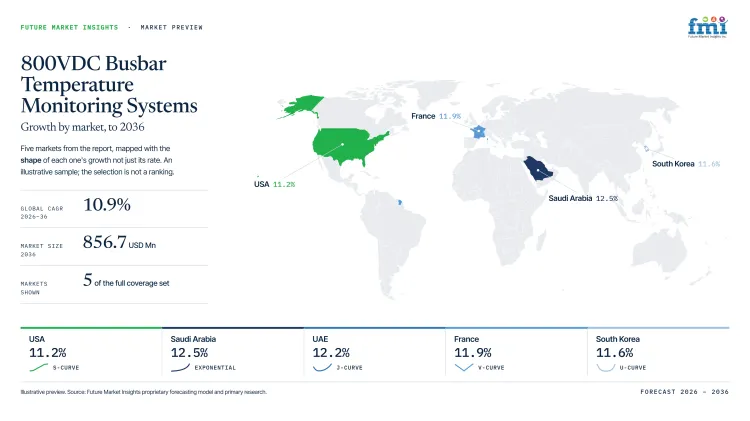
| Country | CAGR |
|---|---|
| Saudi Arabia | 12.5% |
| UAE | 12.2% |
| France | 11.9% |
| South Korea | 11.6% |
| USA | 11.2% |
How do country-level CAGRs compare in the 800VDC Busbar Temperature Monitoring Systems Market?
The 1.3-point spread separates two greenfield-led GCC markets from three engineering environments shaped by slower commercial project sequencing. Saudi Arabia and UAE rank higher because campuses can adopt 800 VDC without displacing much installed rack power. France, South Korea and USA grow quickly but qualification starts from established electrical practices.
- Saudi Arabia greenfield campuses carry less legacy rack-power equipment to preserve.
- UAE service coverage can concentrate on fewer large Abu Dhabi campuses.
- France nuclear-heavy generation improves dense-compute economics during equipment qualification.
- South Korea concentrated technology campuses shorten service routes for local engineers.
- USA purchasing fragments by operator so LV/MV power distribution standards vary.
Comparable growth rates therefore require different qualification budgets and service models directly from monitoring firms.
The full report provides country-level CAGR analysis across North America, Latin America, Europe, East Asia, South Asia, Oceania and the Middle East and Africa.
Country-wise Analysis
- Saudi Arabia channels new AI campuses through centrally backed programs that set electrical architecture early in large equipment procurement and allow approved specifications to repeat between major projects. PIF launched HUMAIN in May 2025 with a mandate covering next-generation data centers and cloud infrastructure, giving project teams a national platform for coordinating hardware procurement and operating requirements. Demand for 800VDC busbar temperature monitoring systems is projected to expand at 12.5% CAGR through 2036 given coordinated greenfield design, while early design freeze leaves little room for unqualified sensing and favors firms that secure power-OEM sponsorship ahead of final busbar factory release.
- UAE data-center sponsors build campuses in phases so an electrical interface approved for one data hall can influence specifications used in later blocks during formal commissioning reviews. Adoption of 800VDC busbar temperature monitoring systems is forecast to rise at 12.2% CAGR by 2036 supported by prefabricated packages, which preserve accepted sensor and alarm interfaces between phases and reduce repeated qualification work. Emirates News Agency reported in October 2025 that Stargate UAE had advanced into construction with the first 200 MW of a planned 1 GW cluster, which means multi-party security reviews on the first phase can set monitoring interfaces reused by later buildings.
- French developers can start electrical planning earlier at designated data-center sites for high-density AI campuses, although unfamiliar 800 VDC equipment requires a detailed formal protection review by engineering consultants. Élysée stated in February 2025 that France had identified 35 available sites for data-center development, giving developers a prepared location base as equipment qualification begins. Sales of 800VDC busbar temperature monitoring systems in France are forecast to expand at 11.9% CAGR through 2036 reflecting the prepared-site pipeline, yet design approval is the main local friction and favors firms that bring documented fault studies plus local lifecycle service into early engineering reviews.
- Adoption of 800VDC busbar temperature monitoring systems in South Korea is estimated to expand at 11.6% CAGR through 2036 driven by denser compute clusters that need compact monitoring interfaces for repeat campus deployment. The Ministry of Science and ICT stated in February 2025 that South Korea targeted 18,000 advanced GPUs by first-half 2026 while government planning addressed power supply and site allocation through coordinated infrastructure programs. Domestic integrators compare imported sensing on protocol interoperability and fit with prefabricated distribution packages, which gives firms with compact documented interfaces an advantage over components that require separate commissioning work during factory acceptance.
- USA data-center operators stage electrical upgrades against utility capacity since most campuses cannot replace every rack-power layer within a single project cycle. Lawrence Berkeley National Laboratory reported in June 2026 that data centers could account for 11.8% of national electricity use by 2030 under its midpoint scenario, which raises pressure to add dense compute without unnecessary facility-wide redesign. Demand for 800VDC busbar temperature monitoring systems in USA is forecast to rise at 11.2% CAGR through 2036 attributable to higher-density additions, but retrofit economics limit adoption to sensing that can enter existing EPMS or BMS workflows without forcing complete conversion of proven distribution assets.
Who are the notable companies in the 800VDC Busbar Temperature Monitoring Systems Market?
Eaton, Schneider Electric, Vertiv, ABB, Siemens, Delta Electronics, Bender, and Phoenix Contact are the notable companies serving this market.
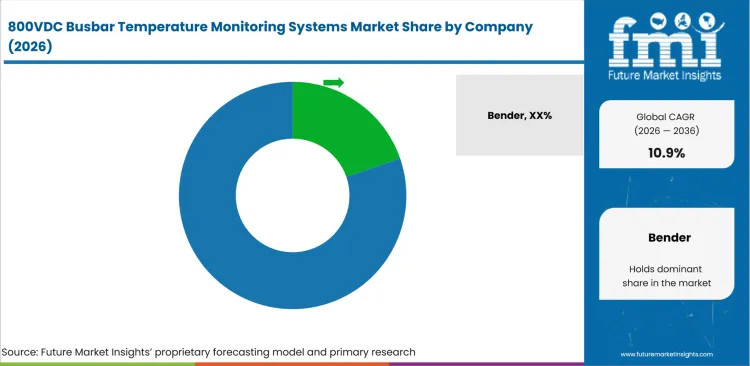
Competition centers on companies that control the electrical boundary at monitored busbar joints and can influence factory qualification. Eaton and Schneider Electric overlap most directly through their pairing of data-center power architectures with electrical condition monitoring. Vertiv, ABB, Siemens, and Delta Electronics shape the surrounding rack and distribution design through broader power-system portfolios. Bender and Phoenix Contact provide narrower monitoring or measurement functions that integrators place beside data center energy storage and other power assets.
- Eaton, Schneider Electric, Vertiv, and ABB compete from integrated power architectures that set monitoring interfaces inside the high-density data-center electrical chain.
- Siemens and Delta Electronics pair distribution hardware with digital monitoring or control functions that support higher-voltage AI rack power and operational visibility.
- Bender and Phoenix Contact serve narrower monitoring and connectivity roles for integrators that need condition data or compact DC measurement inside larger power assemblies.
Competitive Benchmarking: 800VDC Busbar Temperature Monitoring Systems Market
| Company | Thermal or Condition Monitoring Depth | 800 VDC Integration | Data Center Workflow Integration | Geographic Reach |
|---|---|---|---|---|
| Eaton | High | High | High | Global |
| Schneider Electric | Medium | High | High | Global |
| Vertiv | Medium | High | High | Global |
| ABB | Medium | High | Medium | Global |
| Siemens | High | High | High | Global |
| Delta Electronics | Medium | High | Medium | Asia, North America and Europe |
| Bender | Medium | Medium | High | Europe, North America and Asia-Pacific |
| Phoenix Contact | Low | Medium | Medium | Europe, North America and Asia-Pacific |
Scoring basis: High monitoring depth requires documented busbar or multi-function condition monitoring, while Medium marks a narrower electrical condition layer and Low identifies component-level measurement. High 800 VDC integration requires an announced data-center architecture, while Medium reflects compatible high-voltage DC components and Low identifies documented component support without architecture-level integration. High workflow integration requires documented DCIM linkage, while Medium reflects remote data interfaces and Low indicates local indication without system-level integration.
Key Developments in the 800VDC Busbar Temperature Monitoring Systems Market
- In January 2026, Eaton expanded its modular AI data-center offer with Flexnode and integrated 800 VDC power infrastructure into prefabricated compute modules for faster deployment.
- In December 2025, Siemens launched Data Center Solution 5.0 in China and introduced SENTRON 3VA breakers for 800/1000 V DC distribution inside future AI-factory power systems.
- In October 2025, Delta Electronics unveiled an 800 VDC grid-to-chip system at OCP Global Summit 2025 that supports rack power scaling to 1.1 MW.
Key Players in the 800VDC Busbar Temperature Monitoring Systems Market
Integrated 800 VDC Power Platforms
- Eaton
- Schneider Electric
- Vertiv
- ABB
Data Center Power Distribution and Monitoring
- Siemens
- Delta Electronics
Electrical Condition Monitoring and DC Measurement
- Bender
- Phoenix Contact
800VDC Busbar Temperature Monitoring Systems Market - Report Scope
| Coverage field | Report scope |
|---|---|
| Market breakdown | By product configuration, nominal DC voltage, rack power density, data center type, route to market and region. |
| Quantitative Units | USD million. |
| Market Definition | Revenue includes systems, devices, modules and integrated assemblies sold to continuously monitor temperature at busbar joints and comparable connections in 800 V-class DC data-center power distribution. |
| Regions Covered | North America, Latin America, Europe, East Asia, South Asia and Pacific, and Middle East and Africa. |
| Countries Covered | Saudi Arabia, UAE, France, South Korea, USA, and 20+ countries included in the full report. |
| Key Companies Profiled | Eaton, Schneider Electric, Vertiv, ABB, Siemens, Delta Electronics, Bender, and Phoenix Contact. |
| Forecast Period | 2026 to 2036. |
| Approach | Primary and secondary research with market triangulation. |
800VDC Busbar Temperature Monitoring Systems Market - Research Methodology
| Method | Approach |
|---|---|
| Primary Research | FMI analysts gathered input from manufacturers, service providers, technology developers, distributors, end users, procurement teams, and subject-matter experts. Interviews examined purchasing decisions, product or service evaluation, adoption barriers, approval requirements, pricing considerations, and expectations for technical or commercial support. Respondents were also asked what evidence is required before a trial, pilot, or initial order develops into regular purchasing. |
| Desk Research | Desk research covered government statistics, regulatory publications, trade data, industry associations, technical literature, standards, company filings, product information, and official corporate announcements. Sources were reviewed for relevance, publication date, geographic coverage, and consistency with the defined market scope. Claims relating to performance, applications, approvals, capacity, investment, and commercial activity were retained only when supported by credible public evidence. |
| Market Sizing and Forecasting | The market model combined the baseline value with historical performance, segment structure, pricing and volume indicators, adoption levels, company participation, and country-level demand conditions. Forecast assumptions considered economic activity, investment trends, regulatory developments, technology adoption, purchasing cycles, supply availability, and barriers to wider market use. Segment and regional estimates were reconciled before the final market total was calculated. |
| Data Validation | Estimates were checked against multiple independent indicators, including public data, company activity, trade patterns, industry developments, and findings from primary interviews. Validation also tested whether products, services, applications, and company revenues fell within the defined market boundaries. Adjacent categories, unsupported claims, overlapping revenues, and activities without direct market relevance were excluded to reduce double counting and maintain consistency across segments and countries. |
800VDC Busbar Temperature Monitoring Systems Market by Segments
800VDC Busbar Temperature Monitoring Systems Market segmented by Product Configuration:
- Rack-integrated assembly
- Standalone device/module
- Busway / distribution-integrated
- Prefabricated power cabinet
800VDC Busbar Temperature Monitoring Systems Market segmented by Nominal DC Voltage:
- 750-850 VDC
- 600-749 VDC
- 851-1,000 VDC
- Above 1,000 VDC
800VDC Busbar Temperature Monitoring Systems Market segmented by Rack Power Density:
- 250-500 kW
- Below 250 kW
- 501-750 kW
- Above 750 kW
800VDC Busbar Temperature Monitoring Systems Market segmented by Data Center Type:
- Hyperscale AI data centers
- Colocation AI facilities
- Enterprise / sovereign AI
- HPC & research centers
800VDC Busbar Temperature Monitoring Systems Market segmented by Route to Market:
- Power OEM direct
- Electrical EPC / system integrator
- Authorized distributor
- Retrofit / service channel
800VDC Busbar Temperature Monitoring Systems Market by Region:
- North America
- United States
- Canada
- Latin America
- Brazil
- Mexico
- Chile
- Rest of Latin America
- Western Europe
- Germany
- United Kingdom
- Italy
- Spain
- France
- Nordics
- Benelux
- Rest of Western Europe
- Eastern Europe
- Russia
- Poland
- Hungary
- Balkan and Baltic States
- Rest of Eastern Europe
- East Asia
- China
- Japan
- South Korea
- South Asia and Pacific
- India
- ASEAN
- Australia and New Zealand
- Rest of South Asia and Pacific
- Middle East and Africa
- Kingdom of Saudi Arabia
- Other GCC Countries
- Türkiye
- South Africa
- Other African Union Countries
- Rest of Middle East and Africa
Research Sources and Bibliography
- NVIDIA. (2025, May 20). NVIDIA 800 VDC Architecture Will Power the Next Generation of AI Factories
- UAE Ministry of Foreign Affairs. (2025, May 17). UAE-US: A Strategic Partnership Built on Five Decades of Mutual Cooperation and Shared Interests
- Eaton. (2025, October 13). Eaton unveils next-generation architecture to advance 800 VDC power infrastructure for AI factories
- Schneider Electric. (2025, October 13). Schneider Electric Highlights Innovation in 800 VDC Power Systems in support of NVIDIA’s next generation GPUs
- Vertiv. (2025, May 19). Vertiv accelerates AI infrastructure evolution in alignment with NVIDIA 800 VDC power architecture announcement
- ABB. (2025, June 11). ABB and Applied Digital accelerate AI-ready data centers
- Vertiv. (2025, October 13). From Vision to Readiness: Vertiv Collaborates with NVIDIA to Advance 800 VDC Platform Designs to Power the Next Generation of AI Factories
- Schneider Electric. (2026, August 3). Schneider Electric releases pioneering study assessing arc flash risk in 800 VDC data centers aligning with world’s leading hyperscalers
- Bender. (2025, March 18). Bender reveal new DCIM solution and partnership with speedikon at Data Centre World 2025
- Public Investment Fund. (2025, May 12). HRH Crown Prince launches HUMAIN as global AI powerhouse
- Emirates News Agency. (2025, October 16). G42 advances construction of Stargate UAE AI Infrastructure Cluster
- Élysée. (2025, February 10). Clôture de la première journée du Sommet pour l’action sur l’IA
- Ministry of Science and ICT, Republic of Korea. (2025, February 20). Korea to Expand AI Computing Infrastructure to Strengthen National AI Capabilities and Achieve Global Leadership
- Lawrence Berkeley National Laboratory. (2026, June). United States Data Center Energy Usage Report: 2025 Update
- Paananen, J.. (2025, December). Data center as a good grid citizen
- Schneider Electric. (2025, May 29). Transforming data center services: AI-driven condition-based maintenance
- Vertiv. (2025, March 18). New Vertiv software strengthens visibility and control of the complete power train and thermal chain for colocation and hyperscale data centers
- ABB. (2025, June 17). Data centers: always connected
- Delta Electronics. (2026, June 22). DCIM Superpowers Give You Full Visibility and Control-Blog #9 in a Series
- Eaton. (2026, January 28). Eaton expands modular data center offering for rapid deployment of AI factories from grid to chip
- Siemens. (2025, December 11). Siemens launches Data Center Solution 5.0, with debut of innovative DC power distribution products in China
- Delta Electronics. (2025, October 14). Delta’s Groundbreaking 800 VDC Power Solutions Showcased at OCP Global Summit 2025 to Enable Sustainable AI Factories
- Eaton. (2025, September 9). Eaton delivers edge-based innovation to help mitigate the impact of AI power bursting on both data centers and the grid
- Schneider Electric. (2026, March 16). Schneider Electric teams with NVIDIA to develop validated blueprints to design, simulate, build, operate and maintain gigawatt-scale AI Factories
- Vertiv. (2026, March 16). Vertiv brings converged physical infrastructure to NVIDIA Vera Rubin DSX AI factories
- ABB. (2025, October 13). ABB to develop next-generation AI data centers with NVIDIA
- Siemens. (2026, March 18). Siemens expands data center partner ecosystem to scale next-generation AI infrastructure
- Delta Electronics. (2025, October 6). Delta to Demonstrate Seamlessly Integrated High Voltage DC Power, Advanced Cooling, and Networking Solutions to Drive AI Data Center Evolution at OCP Global Summit 2025
- Bender. (2025, August 5). New COMTRAXX® EDGE500IP: Gateway & Condition Monitoring in one device
- Phoenix Contact. (2026, April 20). Current monitoring made easy
- Phoenix Contact. (2026, March 19). Hybrid connector for energy storage
- Eaton. (2026, March 16). Eaton collaborates with NVIDIA to unveil its Beam Rubin DSX platform
- Schneider Electric. (2026, June 15). Schneider Electric and Hon Hai Technology Group (Foxconn) announce strategic collaboration to accelerate next-generation AI data centers
- ABB. (2026, July 2). ABB and Podium partner to bring next-generation technology to early-stage data center development
- Siemens. (2026, August 14). Siemens and Reinhausen develop direct current power solutions for AI data centers
- Delta Electronics. (2026, March 16). Integrated 800 VDC Power Infrastructure: Why This Matters for AI Factories
This bibliography is provided for reader reference and is not exhaustive. The full report contains the complete reference list and detailed citations
This Report Answers
- What is the market size forecast through 2036?
- Why does AI rack density increase monitoring demand?
- Why does rack-integrated assembly lead product configuration?
- Why does 750-850 VDC lead nominal DC voltage?
- Why does 250-500 kW lead rack power density?
- Why do hyperscale AI data centers lead demand?
- How do growth conditions differ among the countries profiled?
Frequently Asked Questions
How big is the 800VDC Busbar Temperature Monitoring Systems Market in 2026?
The 800VDC busbar temperature monitoring systems market is valued at USD 304.5 million in 2026 and is projected to reach USD 856.7 million by 2036. Higher AI rack power raises the value of permanent joint-temperature monitoring at concentrated electrical connection points.
What is the CAGR of the 800VDC Busbar Temperature Monitoring Systems Market from 2026 to 2036?
The 800VDC busbar temperature monitoring systems market is projected to grow at 10.9% CAGR between 2026 and 2036. Expansion follows the shift toward 800 VDC distribution for denser AI rack architectures with higher connection loading.
Which nominal DC voltage segment leads the 800VDC Busbar Temperature Monitoring Systems Market?
The 750-850 VDC segment is expected to hold 49.0% of the 800VDC busbar temperature monitoring systems market in 2026, driven by direct alignment with emerging 800 VDC rack architectures. Factory qualification can then target one voltage band for sensor isolation and alarm interfaces.
Which countries are projected to record the highest growth in the 800VDC Busbar Temperature Monitoring Systems Market?
Saudi Arabia is projected at 12.5% CAGR, followed by UAE at 12.2% and France at 11.9% through 2036 in the 800VDC busbar temperature monitoring systems market. Greenfield AI campuses let these markets qualify rack-power designs before retrofit-heavy sites reach comparable electrical reviews.
Which companies are active in the 800VDC Busbar Temperature Monitoring Systems Market?
Key companies operating in the 800VDC busbar temperature monitoring systems market include Eaton, Schneider Electric, Vertiv, ABB, Siemens, Delta Electronics, Bender, and Phoenix Contact. Their roles span 800 VDC power architecture, electrical condition monitoring and data-center workflow integration.
Preview the report firsthand - request a free sample
Get SampleGet the brochure for pricing and purchase details.
Get PDFTable of Content
- Key Takeaways
- Market Size and CAGR
- Top Growth Driver
- Fastest Growing Segment
- Leading Region
- Key Companies
- Emerging Opportunities
- Executive Summary
- Global Market Outlook
- Demand-side Trends
- Supply-side Trends
- Technology Roadmap Analysis
- Analysis and Recommendations
- Analyst Perspective (What is happening? Why now? What should investors know?)
- Key Questions Answered
- How large is the market?
- What is the CAGR?
- What are key trends?
- Which region dominates?
- Who are the leaders?
- Market Overview
- Market Coverage / Taxonomy
- Market Definition / Scope / Limitations
- Research Methodology
- Chapter Orientation
- Analytical Lens and Working Hypotheses
- Market Structure, Signals, and Trend Drivers
- Benchmarking and Cross-market Comparability
- Market Sizing, Forecasting, and Opportunity Mapping
- Research Design and Evidence Framework
- Desk Research Programme (Secondary Evidence)
- Expert Input and Fieldwork (Primary Evidence)
- Tooling, Models, and Reference Databases
- Data Engineering and Model Build
- Quality Assurance and Audit Trail
- Market Background
- Market Dynamics (Drivers, Restraints, Opportunity, Trends)
- Scenario Forecast (Optimistic, Likely, Conservative)
- Impact Analysis
- AI Impact
- Sustainability Impact
- Regulatory Impact
- Technology Impact
- Consumer / Buyer Analysis
- Purchase Drivers
- Adoption Barriers
- Buyer Journey
- Opportunity Map Analysis
- Product Life Cycle Analysis
- Supply Chain Analysis
- Investment Feasibility Matrix
- Value Chain Analysis
- PESTLE and Porter's Analysis
- Regulatory Landscape
- Regional Parent Market Outlook
- Production and Consumption Statistics
- Import and Export Statistics
- Global Market Analysis and Forecast, 2021 to 2036
- Historical Market Size Value (USD Million) Analysis, 2021 to 2025
- Current and Future Market Size Value (USD Million) Projections, 2026 to 2036
- Y-o-Y Growth Trend Analysis
- Absolute $ Opportunity Analysis
- Global Market Pricing Analysis, 2021 to 2036
- Global Market Analysis and Forecast, By Product Configuration, 2021 to 2036
- Introduction / Key Findings
- Historical Market Size Value (USD Million) Analysis By Product Configuration, 2021 to 2025
- Current and Future Market Size Value (USD Million) Analysis and Forecast By Product Configuration, 2026 to 2036
- Rack-integrated assembly
- Standalone device/module
- Busway / distribution-integrated
- Prefabricated power cabinet
- Rack-integrated assembly
- Y-o-Y Growth Trend Analysis By Product Configuration, 2021 to 2025
- Absolute $ Opportunity Analysis By Product Configuration, 2026 to 2036
- Global Market Analysis and Forecast, By Nominal DC Voltage, 2021 to 2036
- Introduction / Key Findings
- Historical Market Size Value (USD Million) Analysis By Nominal DC Voltage, 2021 to 2025
- Current and Future Market Size Value (USD Million) Analysis and Forecast By Nominal DC Voltage, 2026 to 2036
- 750-850 VDC
- 600-749 VDC
- 851-1,000 VDC
- Above 1,000 VDC
- 750-850 VDC
- Y-o-Y Growth Trend Analysis By Nominal DC Voltage, 2021 to 2025
- Absolute $ Opportunity Analysis By Nominal DC Voltage, 2026 to 2036
- Global Market Analysis and Forecast, By Rack Power Density, 2021 to 2036
- Introduction / Key Findings
- Historical Market Size Value (USD Million) Analysis By Rack Power Density, 2021 to 2025
- Current and Future Market Size Value (USD Million) Analysis and Forecast By Rack Power Density, 2026 to 2036
- 250-500 kW
- Below 250 kW
- 501-750 kW
- Above 750 kW
- 250-500 kW
- Y-o-Y Growth Trend Analysis By Rack Power Density, 2021 to 2025
- Absolute $ Opportunity Analysis By Rack Power Density, 2026 to 2036
- Global Market Analysis and Forecast, By Data Center Type, 2021 to 2036
- Introduction / Key Findings
- Historical Market Size Value (USD Million) Analysis By Data Center Type, 2021 to 2025
- Current and Future Market Size Value (USD Million) Analysis and Forecast By Data Center Type, 2026 to 2036
- Hyperscale AI data centers
- Colocation AI facilities
- Enterprise / sovereign AI
- HPC & research centers
- Hyperscale AI data centers
- Y-o-Y Growth Trend Analysis By Data Center Type, 2021 to 2025
- Absolute $ Opportunity Analysis By Data Center Type, 2026 to 2036
- Global Market Analysis and Forecast, By Route to Market, 2021 to 2036
- Introduction / Key Findings
- Historical Market Size Value (USD Million) Analysis By Route to Market, 2021 to 2025
- Current and Future Market Size Value (USD Million) Analysis and Forecast By Route to Market, 2026 to 2036
- Power OEM direct
- Electrical EPC / system integrator
- Authorized distributor
- Retrofit / service channel
- Power OEM direct
- Y-o-Y Growth Trend Analysis By Route to Market, 2021 to 2025
- Absolute $ Opportunity Analysis By Route to Market, 2026 to 2036
- Global Market Analysis and Forecast, By Region, 2021 to 2036
- Introduction
- Historical Market Size Value (USD Million) Analysis By Region, 2021 to 2025
- Current Market Size Value (USD Million) Analysis and Forecast By Region, 2026 to 2036
- North America
- Latin America
- Western Europe
- Eastern Europe
- East Asia
- South Asia and Pacific
- Middle East & Africa
- Market Attractiveness Analysis By Region
- North America Market Analysis and Forecast, By Country, 2021 to 2036
- Historical Market Size Value (USD Million) Trend Analysis By Market Taxonomy, 2021 to 2025
- Market Size Value (USD Million) Forecast By Market Taxonomy, 2026 to 2036
- By Country
- USA
- Canada
- By Product Configuration
- By Nominal DC Voltage
- By Rack Power Density
- By Data Center Type
- By Route to Market
- By Country
- Market Attractiveness Analysis
- By Country
- By Product Configuration
- By Nominal DC Voltage
- By Rack Power Density
- By Data Center Type
- By Route to Market
- Key Takeaways
- Latin America Market Analysis and Forecast, By Country
- Historical Market Size Value (USD Million) Trend Analysis By Market Taxonomy, 2021 to 2025
- Market Size Value (USD Million) Forecast By Market Taxonomy, 2026 to 2036
- By Country
- Brazil
- Mexico
- Chile
- Rest of Latin America
- By Product Configuration
- By Nominal DC Voltage
- By Rack Power Density
- By Data Center Type
- By Route to Market
- By Country
- Market Attractiveness Analysis
- By Country
- By Product Configuration
- By Nominal DC Voltage
- By Rack Power Density
- By Data Center Type
- By Route to Market
- Key Takeaways
- Western Europe Market Analysis and Forecast, By Country
- Historical Market Size Value (USD Million) Trend Analysis By Market Taxonomy, 2021 to 2025
- Market Size Value (USD Million) Forecast By Market Taxonomy, 2026 to 2036
- By Country
- Germany
- UK
- Italy
- Spain
- France
- Nordic
- BENELUX
- Rest of Western Europe
- By Product Configuration
- By Nominal DC Voltage
- By Rack Power Density
- By Data Center Type
- By Route to Market
- By Country
- Market Attractiveness Analysis
- By Country
- By Product Configuration
- By Nominal DC Voltage
- By Rack Power Density
- By Data Center Type
- By Route to Market
- Key Takeaways
- Eastern Europe Market Analysis and Forecast, By Country
- Historical Market Size Value (USD Million) Trend Analysis By Market Taxonomy, 2021 to 2025
- Market Size Value (USD Million) Forecast By Market Taxonomy, 2026 to 2036
- By Country
- Russia
- Poland
- Hungary
- Balkan & Baltic
- Rest of Eastern Europe
- By Product Configuration
- By Nominal DC Voltage
- By Rack Power Density
- By Data Center Type
- By Route to Market
- By Country
- Market Attractiveness Analysis
- By Country
- By Product Configuration
- By Nominal DC Voltage
- By Rack Power Density
- By Data Center Type
- By Route to Market
- Key Takeaways
- East Asia Market Analysis and Forecast, By Country
- Historical Market Size Value (USD Million) Trend Analysis By Market Taxonomy, 2021 to 2025
- Market Size Value (USD Million) Forecast By Market Taxonomy, 2026 to 2036
- By Country
- China
- Japan
- South Korea
- By Product Configuration
- By Nominal DC Voltage
- By Rack Power Density
- By Data Center Type
- By Route to Market
- By Country
- Market Attractiveness Analysis
- By Country
- By Product Configuration
- By Nominal DC Voltage
- By Rack Power Density
- By Data Center Type
- By Route to Market
- Key Takeaways
- South Asia and Pacific Market Analysis and Forecast, By Country
- Historical Market Size Value (USD Million) Trend Analysis By Market Taxonomy, 2021 to 2025
- Market Size Value (USD Million) Forecast By Market Taxonomy, 2026 to 2036
- By Country
- India
- ASEAN
- Australia & New Zealand
- Rest of South Asia and Pacific
- By Product Configuration
- By Nominal DC Voltage
- By Rack Power Density
- By Data Center Type
- By Route to Market
- By Country
- Market Attractiveness Analysis
- By Country
- By Product Configuration
- By Nominal DC Voltage
- By Rack Power Density
- By Data Center Type
- By Route to Market
- Key Takeaways
- Middle East & Africa Market Analysis and Forecast, By Country
- Historical Market Size Value (USD Million) Trend Analysis By Market Taxonomy, 2021 to 2025
- Market Size Value (USD Million) Forecast By Market Taxonomy, 2026 to 2036
- By Country
- Kingdom of Saudi Arabia
- Other GCC Countries
- Türkiye
- South Africa
- Other African Union
- Rest of Middle East & Africa
- By Product Configuration
- By Nominal DC Voltage
- By Rack Power Density
- By Data Center Type
- By Route to Market
- By Country
- Market Attractiveness Analysis
- By Country
- By Product Configuration
- By Nominal DC Voltage
- By Rack Power Density
- By Data Center Type
- By Route to Market
- Key Takeaways
- Key Countries Market Analysis
- USA
- Pricing Analysis
- Market Share Analysis, 2025
- By Product Configuration
- By Nominal DC Voltage
- By Rack Power Density
- By Data Center Type
- By Route to Market
- Canada
- Pricing Analysis
- Market Share Analysis, 2025
- By Product Configuration
- By Nominal DC Voltage
- By Rack Power Density
- By Data Center Type
- By Route to Market
- Mexico
- Pricing Analysis
- Market Share Analysis, 2025
- By Product Configuration
- By Nominal DC Voltage
- By Rack Power Density
- By Data Center Type
- By Route to Market
- Brazil
- Pricing Analysis
- Market Share Analysis, 2025
- By Product Configuration
- By Nominal DC Voltage
- By Rack Power Density
- By Data Center Type
- By Route to Market
- Chile
- Pricing Analysis
- Market Share Analysis, 2025
- By Product Configuration
- By Nominal DC Voltage
- By Rack Power Density
- By Data Center Type
- By Route to Market
- Germany
- Pricing Analysis
- Market Share Analysis, 2025
- By Product Configuration
- By Nominal DC Voltage
- By Rack Power Density
- By Data Center Type
- By Route to Market
- UK
- Pricing Analysis
- Market Share Analysis, 2025
- By Product Configuration
- By Nominal DC Voltage
- By Rack Power Density
- By Data Center Type
- By Route to Market
- Italy
- Pricing Analysis
- Market Share Analysis, 2025
- By Product Configuration
- By Nominal DC Voltage
- By Rack Power Density
- By Data Center Type
- By Route to Market
- Spain
- Pricing Analysis
- Market Share Analysis, 2025
- By Product Configuration
- By Nominal DC Voltage
- By Rack Power Density
- By Data Center Type
- By Route to Market
- France
- Pricing Analysis
- Market Share Analysis, 2025
- By Product Configuration
- By Nominal DC Voltage
- By Rack Power Density
- By Data Center Type
- By Route to Market
- India
- Pricing Analysis
- Market Share Analysis, 2025
- By Product Configuration
- By Nominal DC Voltage
- By Rack Power Density
- By Data Center Type
- By Route to Market
- ASEAN
- Pricing Analysis
- Market Share Analysis, 2025
- By Product Configuration
- By Nominal DC Voltage
- By Rack Power Density
- By Data Center Type
- By Route to Market
- Australia & New Zealand
- Pricing Analysis
- Market Share Analysis, 2025
- By Product Configuration
- By Nominal DC Voltage
- By Rack Power Density
- By Data Center Type
- By Route to Market
- China
- Pricing Analysis
- Market Share Analysis, 2025
- By Product Configuration
- By Nominal DC Voltage
- By Rack Power Density
- By Data Center Type
- By Route to Market
- Japan
- Pricing Analysis
- Market Share Analysis, 2025
- By Product Configuration
- By Nominal DC Voltage
- By Rack Power Density
- By Data Center Type
- By Route to Market
- South Korea
- Pricing Analysis
- Market Share Analysis, 2025
- By Product Configuration
- By Nominal DC Voltage
- By Rack Power Density
- By Data Center Type
- By Route to Market
- Russia
- Pricing Analysis
- Market Share Analysis, 2025
- By Product Configuration
- By Nominal DC Voltage
- By Rack Power Density
- By Data Center Type
- By Route to Market
- Poland
- Pricing Analysis
- Market Share Analysis, 2025
- By Product Configuration
- By Nominal DC Voltage
- By Rack Power Density
- By Data Center Type
- By Route to Market
- Hungary
- Pricing Analysis
- Market Share Analysis, 2025
- By Product Configuration
- By Nominal DC Voltage
- By Rack Power Density
- By Data Center Type
- By Route to Market
- Kingdom of Saudi Arabia
- Pricing Analysis
- Market Share Analysis, 2025
- By Product Configuration
- By Nominal DC Voltage
- By Rack Power Density
- By Data Center Type
- By Route to Market
- Türkiye
- Pricing Analysis
- Market Share Analysis, 2025
- By Product Configuration
- By Nominal DC Voltage
- By Rack Power Density
- By Data Center Type
- By Route to Market
- South Africa
- Pricing Analysis
- Market Share Analysis, 2025
- By Product Configuration
- By Nominal DC Voltage
- By Rack Power Density
- By Data Center Type
- By Route to Market
- USA
- Market Structure Analysis
- Competition Dashboard
- Competition Benchmarking
- Market Share Analysis of Top Players
- By Regional
- By Product Configuration
- By Nominal DC Voltage
- By Rack Power Density
- By Data Center Type
- By Route to Market
- Emerging Startups
- Innovation Benchmarking
- Competition Analysis
- Competition Deep Dive
- Bender
- Overview
- Product Portfolio
- Profitability by Market Segments
- Sales Footprint
- Strategy Overview
- Marketing Strategy
- Product Strategy
- Channel Strategy
- Phoenix Contact
- Eaton
- Schneider Electric
- Bender
- Case Studies
- Success Stories
- Recent Developments
- Competition Deep Dive
- Assumptions & Acronyms Used


