

- Market Size (2026)
- USD 450.1 Mn
- Forecast (2036)
- USD 980.7 Mn
- CAGR (2026 to 2036)
- 8.1%
How big is AI Data Center Voltage Sag Ride-Through Systems Market in 2026?
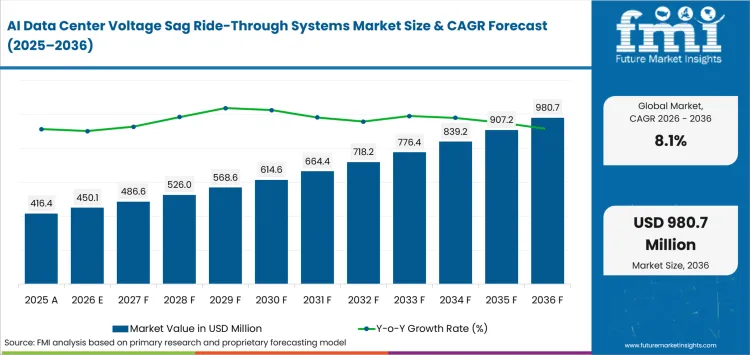
The AI Data Center Voltage Sag Ride-Through Systems Market is valued at USD 450.1 million in 2026 and is forecast to reach USD 980.7 million by 2036, expanding at an 8.1% CAGR from 2026 to 2036.
AI Data Center Voltage Sag Ride-Through Systems revenue is projected to rise from USD 450.1 million in 2026 to USD 980.7 million by 2036 at an 8.1% CAGR. Short voltage disturbances are becoming more consequential as AI racks draw more power and GPU workloads create sharper load changes. The USA Department of Energy reported that data centers consumed about 4.4% of USA electricity in 2023 and could account for 6.7% to 12.0% by 2028. As more compute is concentrated behind dense electrical infrastructure, even a brief sag or transfer event can affect a large block of valuable capacity. Buyers therefore assess how quickly a ride-through system responds, how long it can maintain the required voltage envelope, and how well it coordinates with UPS systems and upstream protection.
The requirement also varies by market. Ireland is considering specific fault ride-through obligations for large transmission-connected demand facilities, while Germany places greater emphasis on energy management and continuous electrical measurement. South Korea is developing 100 MW-class AI capacity in Ulsan, and the UAE is progressing Stargate UAE, where the first 200 MW cluster is expected in 2026. In these environments, ride-through systems need to do more than hold the load through a disturbance. Operators also need predictable recovery and clear event records that facility and grid teams can use after the event.
Key Takeaways
- Demand is moving toward faster power-quality control around AI workloads, where even a short voltage disturbance can interrupt a large block of GPU capacity.
- Transient buffering is projected to account for 25.0% of Solution Function in 2026, supported by the need to bridge short voltage losses without treating every event as a full outage.
- The 1-10 ms band is projected to hold 32.0% of Response Time in 2026, balancing fast correction with coordination across protection and power-conversion systems.
- The 250-500 kW band is projected to account for 34.0% of Rack / Pod Load in 2026, reflecting the use of modular AI power blocks that can be protected and commissioned independently.
- Hyperscale AI is projected to account for 45.0% of Facility Type in 2026, as concentrated compute makes short power-quality events more costly.
- OEM direct is projected to account for 37.0% of Sales Channel in 2026, since response settings, commissioning and system integration often require direct manufacturer involvement.
- Protection coordination and grid-code approval can lengthen deployment, while higher-voltage DC architectures create room for integrated ride-through, monitoring and commissioning solutions.
- ABB, Eaton, Siemens and Janitza are among the notable companies profiled in the market.
Analyst Perspective
"AI data-center ride-through systems will be specified less as generic backup and more as a validated power-quality layer around dense GPU blocks. Suppliers that can prove the required voltage-time behavior and recovery at the commissioning point, then leave operators with a usable event record, will have a clearer route into both greenfield AI campuses and retrofit resilience programs."
- Sudip saha, Principal Consultant, Future Market Insights
How is the AI Data Center Voltage Sag Ride-Through Systems Market segmented?
The market is segmented by Solution Function, Response Time, Rack / Pod Load, Facility Type, Sales Channel and Region.
The market is segmented by Solution Function into Transient Buffering, Harmonic Mitigation, Voltage Ride-Through, Power-Factor Correction, and Event Measurement/Recording; by Response Time into 1-10 ms, Sub-Millisecond, 11-100 ms, and Above 100 ms; by Rack / Pod Load into 250-500 kW, Below 250 kW, 501-750 kW, and Above 750 kW; by Facility Type into Hyperscale AI, Colocation, Enterprise Data Centers, and HPC / Research; and by Sales Channel into OEM Direct, Electrical Integrator / EPC, Power-Quality Specialist, and Distributor / Service Partner.
Why does Hyperscale AI lead the Facility Type category?
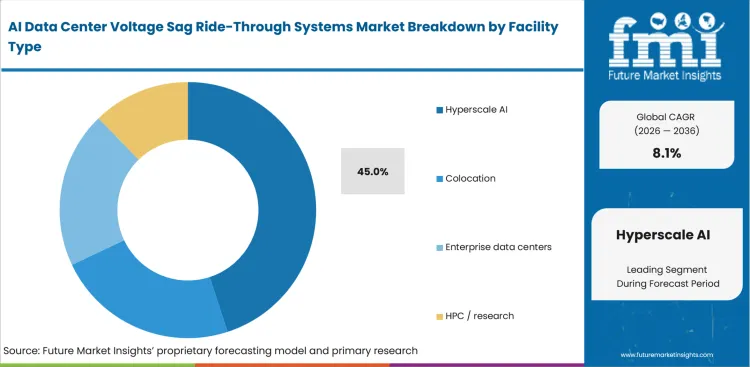
Hyperscale AI sites concentrate compute value and electrical demand in a smaller number of campuses. A shared sag can therefore affect more productive capacity than it would in a lightly loaded enterprise room, and these operators are more likely to define disturbance envelopes during design and commissioning. Abu Dhabi Media Office reported in May 2025 that Stargate UAE will be a 1 GW compute cluster within a 5 GW AI campus and that the first 200 MW cluster is expected to go live in 2026. At that scale, ride-through has to coordinate utility service, on-site generation or storage, power conversion and event monitoring.
- Hyperscale AI is projected to account for 45.0% of Facility Type in 2026 because concentrated compute value raises the business cost of short power-quality events and supports specialized engineering.
- The Stargate UAE announcement illustrates the scale at which selective ride-through and recovery behavior must be integrated with a multi-source power architecture rather than treated as a rack-only feature.
Why does Transient buffering lead the Solution Function category?
Transient buffering leads because many commercially damaging voltage events are shorter than a full utility outage. The buyer wants the AI load to remain inside an acceptable voltage envelope while upstream protection clears the disturbance or another power layer takes control. This requirement sits inside the broader data center power architecture, where ride-through must work with UPS, distribution and protection rather than operate as an isolated device. ABB reported in June 2025 that its HiPerGuard medium-voltage static UPS is part of the electrical infrastructure at Applied Digital’s 400 MW North Dakota AI campus, with the architecture scaling in 25 MW blocks.
- Transient buffering is projected to account for 25.0% of Solution Function in 2026 because it supports continuity through short-duration voltage loss while upstream protection or the next power layer completes its response.
- ABB’s June 2025 Applied Digital announcement shows resilience functions moving into larger modular AI power blocks, reducing the gap between facility distribution and short-event continuity.
Why does 1-10 ms lead the Response Time category?
The 1-10 ms band sits at a practical control point between detection and coordinated correction. Response that is too slow can allow power supplies or protection logic to leave their acceptable operating envelope, while sub-millisecond intervention can require tighter discrimination between a true sag and a disturbance that should be cleared normally. The same issue appears across the wider power quality equipment stack, where monitoring and correction need consistent event definitions. IEC 61000-4-30:2025 covers measurement of supply-voltage dips, interruptions, transients and related power-quality parameters, supporting repeatable event assessment.
- The 1-10 ms band is projected to account for 32.0% of Response Time in 2026 because it offers rapid intervention while preserving practical coordination with protection and power-conversion stages.
- Janitza introduced the UMG 800 energy analyzer at Hannover Messe in April 2025, reinforcing demand for modular event measurement that helps operators determine whether corrective equipment acted at the intended point.
Why does 250-500 kW lead the Rack / Pod Load category?
The 250-500 kW band aligns with the way operators partition high-density AI capacity into manageable electrical blocks. Protecting a pod or power module at this scale can isolate a disturbance without forcing every correction function to operate at whole-campus scale. The design logic also matches the pay-as-you-grow approach used in modular UPS deployments, where capacity and redundancy are added in repeatable increments. Eaton’s SRT3 sag ride-through product family has emphasized fault-clearing capability and protection discrimination, characteristics that become more important as ride-through is applied to larger shared load blocks.
- The 250-500 kW band is projected to account for 34.0% of Rack / Pod Load in 2026 because it fits modular pod design while keeping protection boundaries and commissioning scope manageable.
- Eaton’s SRT3 positioning highlights fault-clearing and protection-discrimination considerations that influence how larger protected blocks are integrated into an existing electrical system.
Why does OEM direct lead the Sales Channel category?
OEM direct leads when the equipment maker must own the voltage-response curve and its interaction with the wider electrical system. AI data-center projects increasingly ask vendors to participate in topology selection, protection studies, controls and commissioning because those decisions influence both performance and warranty accountability. Siemens and Soluna announced a 2 MW Texas pilot in January 2026 to validate electrical infrastructure, controls and monitoring under rapid GPU-driven load swings. The pilot shows why direct engineering support becomes part of the commercial proposition for power-quality systems in AI environments.
- OEM direct is projected to account for 37.0% of Sales Channel in 2026 because response settings, commissioning accountability and firmware behavior favor close manufacturer involvement in critical power design.
- The Siemens and Soluna pilot uses a structured commissioning process to document performance under fast load steps, illustrating how engineering validation can be bundled with the equipment sale.
What are the drivers, restraints and opportunities in the AI Data Center Voltage Sag Ride-Through Systems Market?
Higher AI power density increases the cost of short voltage events, protection and grid-code qualification can extend approval cycles, and new AC/DC architectures create an opening for integrated ride-through plus event intelligence.
- Driver: Higher-density AI loads make short sags and abrupt power transitions more consequential for compute continuity.
- Restraint: Ride-through settings must coordinate with facility protection, UPS behavior and grid requirements before buyers can approve deployment.
- Opportunity: Modular AC and DC solutions can pair fast correction with standardized event records at pod and facility interfaces.
Short voltage disturbances are becoming more expensive as AI facilities concentrate more compute behind dense electrical infrastructure. EirGrid’s July 2026 consultation notes that large data centers can reduce grid consumption rapidly during transmission faults and may not return immediately to pre-fault demand after voltage recovery. Inside the facility, the same disturbance can cause different responses across power supplies, transfer systems and protection devices. This increases the value of selective ride-through alongside conventional data center UPS systems, particularly where operators need a defined load to remain stable until normal power conditions are restored.
Deployment is harder because ride-through equipment has to work with the rest of the electrical system. EirGrid’s MPID 345 process proposes fault ride-through and active-power recovery requirements for transmission-connected demand facilities, which can require changes to protection settings, controls or conditioning equipment. Retrofit projects can be especially difficult because testing and electrical modifications may need to be completed without disrupting live data-center operations.
The opportunity is moving toward systems that combine fast correction with detailed event measurement. IEC 61000-4-29:2026 provides a testing framework for voltage dips, short interruptions and voltage variations at DC input power ports, while Eaton’s July 2025 work with NVIDIA points toward 800 V HVDC infrastructure for 1 MW racks and above. Suppliers that connect ride-through with power quality monitoring can give operators a clearer record of what happened during an event and whether the protection system responded as intended.
Which country CAGRs are profiled in the AI Data Center Voltage Sag Ride-Through Systems Market?
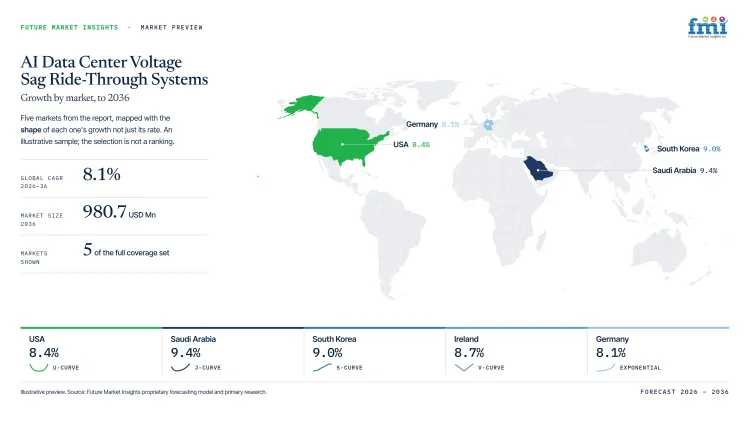
| Country | CAGR, 2026-2036 |
|---|---|
| USA | 8.4% |
| Ireland | 8.7% |
| Germany | 8.1% |
| South Korea | 9.0% |
| Saudi Arabia | 9.4% |
| UAE | 9.7% |
How do country-level CAGRs compare in the AI Data Center Voltage Sag Ride-Through Systems Market?
The six profiled country CAGRs range from 8.1% in Germany to 9.7% in the UAE. Saudi Arabia and South Korea sit at 9.4% and 9.0%, while Ireland is at 8.7%, USA at 8.4% and Germany at 8.1%. The gaps matter for sales timing, but they do not determine absolute revenue opportunity. Gulf markets are being shaped by large new AI campuses, South Korea is more project-led, Ireland has a direct fault ride-through policy signal, and USA and Germany have broader installed infrastructure where retrofit access and qualification discipline influence conversion.
- USA: A large installed data-center base supports demand for resilience systems, but adoption depends on how well ride-through equipment integrates with existing UPS systems, protection schemes and utility connections.
- Ireland: Proposed fault ride-through requirements give voltage recovery a direct grid-security role, increasing the need for tested response curves and documented recovery behavior.
- Germany: Energy-management and continuous electrical-measurement requirements keep power behavior visible in procurement, favoring systems that fit existing monitoring and reporting environments.
- South Korea: New 100 MW-class AI capacity creates an opportunity to specify ride-through and modular power protection during project design instead of adding them later through retrofit.
- Saudi Arabia: Expanding data-center capacity increases demand for scalable critical-power systems, local service capability and staged commissioning as new electrical blocks are brought online.
- UAE: Large AI clusters strengthen the case for ride-through systems that can protect concentrated loads while coordinating with multiple power sources and fast construction schedules.
The report covers North America, Latin America, Western Europe, Eastern Europe, East Asia, South Asia and Pacific, and the Middle East and Africa, with the six profiled countries included in the broader geographic assessment.
Country-wise Analysis
- USA: Demand for AI Data Center Voltage Sag Ride-Through Systems in USA is forecast to expand at 8.4% CAGR from 2026 to 2036. The USA Department of Energy reported that data centers consumed about 4.4% of national electricity in 2023 and could account for approximately 6.7% to 12.0% by 2028. The local buying friction is maintaining coordination across increasingly dense internal power systems while utilities add capacity. Suppliers can improve conversion with modular correction stages, clear protection studies and commissioning records that connect a sag event to compute continuity.
- Ireland: Adoption of AI Data Center Voltage Sag Ride-Through Systems in Ireland is forecast to rise at 8.7% CAGR from 2026 to 2036. In July 2026, the Commission for Regulation of Utilities sought further representations on EirGrid’s MPID 345 proposal after identifying fault ride-through risk from large demand facilities. Existing protection and backup behavior may need modification to match the proposed voltage and active-power recovery profile, making test evidence and event records central to compliance discussions.
- Germany: Demand for AI Data Center Voltage Sag Ride-Through Systems in Germany is forecast to expand at 8.1% CAGR from 2026 to 2036. Germany’s Energy Efficiency Act requires data-center operators to maintain continuous measurements of electrical power and energy use for key components, and qualifying sites face management-system validation or certification duties from January 1, 2026. Ride-through hardware therefore needs to preserve efficiency targets while integrating with monitoring and reporting practices.
- South Korea: Sales of AI Data Center Voltage Sag Ride-Through Systems in South Korea are forecast to rise at 9.0% CAGR from 2026 to 2036. The Ministry of Science and ICT reported in June 2025 that the Ulsan AI Data Center is a 100 MW-class project, with partial operations planned at 41 MW in November 2027 and full capacity of 103 MW by February 2029. Suppliers can improve project fit with pre-engineered power blocks, fast event capture and commissioning support coordinated early with utility and facility protection studies.
- Saudi Arabia: Demand for AI Data Center Voltage Sag Ride-Through Systems in Saudi Arabia is forecast to expand at 9.4% CAGR from 2026 to 2036. The Ministry of Communications and Information Technology reported in May 2026 that operational data-center capacity rose from 440 MW in 2025 to 467 MW in the first quarter of 2026. That pace favors modular conditioned-power packages, regional spares and local commissioning teams that can validate ride-through as each new electrical block is energized.
- UAE: Adoption of AI Data Center Voltage Sag Ride-Through Systems in UAE is forecast to rise at 9.7% CAGR from 2026 to 2036. Abu Dhabi Media Office announced Stargate UAE in May 2025 as a 1 GW compute cluster within a 5 GW AI campus, with the first 200 MW cluster expected to go live in 2026. The local challenge is coordinating concentrated AI load with a multi-source energy system and short delivery schedules, increasing the value of scalable correction stages and common event records for facility and utility teams.
Who are the notable companies in the AI Data Center Voltage Sag Ride-Through Systems Market?
ABB, Eaton, Siemens and Janitza are the notable companies profiled in the market.
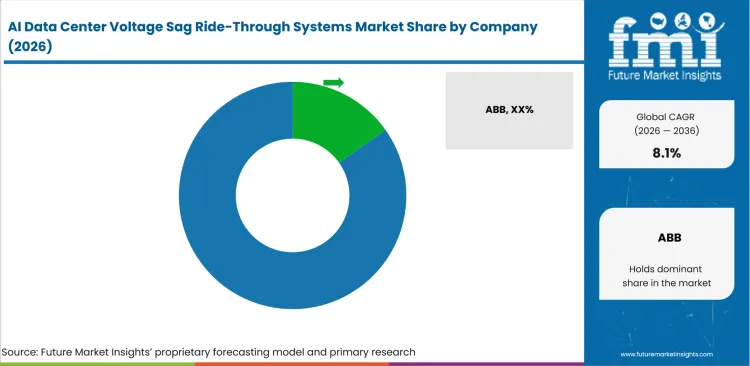
Competition is shaped by where each supplier sits in the disturbance-response chain. ABB and Eaton have direct positions in critical-power conditioning and ride-through and can connect fast correction to wider electrical-distribution portfolios. Siemens is positioned where buyers want source-to-load architecture, controls, commissioning and power-quality monitoring under one engineering framework. Janitza concentrates on measurement and event intelligence, which becomes important when operators need to distinguish a grid sag from an internal equipment or coordination problem.
- Active ride-through and power conditioning: ABB and Eaton combine corrective power technologies with wider critical-power portfolios.
- Integrated AI power architecture and controls: Siemens combines electrical distribution, controls, monitoring and system-level engineering.
- Power-quality measurement and event intelligence: Janitza focuses on high-resolution electrical measurement, event capture and data-center power-quality monitoring.
Competitive Benchmarking: AI Data Center Voltage Sag Ride-Through Systems Market
| Company | Active Sag Correction / Ride-Through | AI Critical-Power Integration | Power-Quality Event Visibility | Geographic Reach |
|---|---|---|---|---|
| ABB | High | High | Medium | Global; direct electrification and service presence across major AI infrastructure regions |
| Eaton | High | High | High | Global; broad data-center power-management portfolio and channel coverage |
| Siemens | Unscored | High | High | Global; electrical infrastructure, controls and monitoring presence across major regions |
| Janitza | Unscored | Medium | High | International; measurement and partner coverage led by Europe with wider global reach |
Scoring basis: High indicates broad commercial capability across the named criterion; Medium indicates a narrower but relevant position; Unscored means the table does not assign a comparative level for that criterion. The table is intended to show functional positioning rather than a company ranking.
Key Developments in the AI Data Center Voltage Sag Ride-Through Systems Market
- In June 2025, ABB and Applied Digital announced an electrical-infrastructure partnership for a 400 MW AI data-center campus in North Dakota. The design uses ABB’s HiPerGuard medium-voltage static UPS and can scale in 25 MW blocks, moving resilience functions into larger AI power modules.
- In July 2025, Eaton announced collaboration with NVIDIA on power infrastructure for high-density GPU systems, including design work supporting a transition to 800 V HVDC for 1 MW racks and beyond. The development expands the disturbance and protection interfaces that ride-through suppliers will need to address.
- In January 2026, Siemens and Soluna announced a 2 MW Texas pilot at Project Grace to manage rapid GPU-driven power swings. The pilot combines Siemens electrical infrastructure, controls and SICAM monitoring within a structured commissioning process to document performance under fast load steps.
- In April 2025, Janitza presented its modular UMG 800 energy analyzer at HANNOVER MESSE 2025. The platform is designed for flexible energy-management and power-quality measurement, strengthening the monitoring layer used to assess electrical-system performance in critical facilities.
Key Players in the AI Data Center Voltage Sag Ride-Through Systems Market
Active Ride-Through and Power Conditioning
- ABB
- Eaton
Integrated AI Power Architecture and Controls
- Siemens
Power-Quality Measurement and Event Intelligence
- Janitza
AI Data Center Voltage Sag Ride-Through Systems Market - Report Scope
| Parameter | Coverage |
|---|---|
| Market breakdown | Solution Function; Response Time; Rack / Pod Load; Facility Type; Sales Channel; Region |
| Quantitative Units | USD Million |
| Market Definition | Revenue includes dedicated voltage sag ride-through and power-quality systems sold for AI data-center critical power paths, including transient buffering, voltage ride-through, harmonic mitigation, power-factor correction and event measurement or recording when sold within the defined system scope. It excludes downstream servers and GPUs, generic utility infrastructure, cooling equipment and unrelated power products. |
| Regions Covered | North America; Latin America; Western Europe; Eastern Europe; East Asia; South Asia and Pacific; Middle East and Africa |
| Countries Covered | USA; Ireland; Germany; South Korea; Saudi Arabia; UAE; and additional countries within the regional coverage |
| Key Companies Profiled | ABB; Eaton; Siemens; Janitza |
| Forecast Period | 2026 to 2036 |
| Approach | Hybrid bottom-up and top-down sizing using product-level revenue boundaries, deployment architecture, buyer adoption conditions and country-level demand indicators. |
AI Data Center Voltage Sag Ride-Through Systems Market - Research Methodology
| Methodology Element | Approach |
|---|---|
| Primary Research | FMI’s primary-research framework covers manufacturers, electrical integrators and EPCs, data-center operators, procurement teams and subject-matter specialists. Discussion topics include response requirements, installation points, qualification frictions, service expectations and pricing behavior. |
| Desk Research | Desk research uses regulator and grid-operator material, government statistics, technical standards, company filings, product documentation and public project announcements to explain buyer mechanisms and current supplier activity. |
| Market Sizing and Forecasting | The sizing framework combines bottom-up product and deployment logic with top-down checks on AI data-center capacity, electrical architecture, facility type, response requirements and country adoption conditions. Forecast assumptions consider new-build deployment, retrofit need, qualification timing and technology migration. |
| Data Validation | Values are reconciled across market scope, segmentation, geography and company roles. Adjacent products are excluded unless sold for the defined ride-through use case, and duplicate revenue is removed across bundled power systems. |
AI Data Center Voltage Sag Ride-Through Systems Market by Segments
AI Data Center Voltage Sag Ride-Through Systems Market segmented by Solution Function:
- Transient buffering
- Harmonic mitigation
- Voltage ride-through
- Power-factor correction
- Event measurement / recording
AI Data Center Voltage Sag Ride-Through Systems Market segmented by Response Time:
- 1-10 ms
- Sub-millisecond
- 11-100 ms
- Above 100 ms
AI Data Center Voltage Sag Ride-Through Systems Market segmented by Rack / Pod Load:
- 250-500 kW
- Below 250 kW
- 501-750 kW
- Above 750 kW
AI Data Center Voltage Sag Ride-Through Systems Market segmented by Facility Type:
- Hyperscale AI
- Colocation
- Enterprise data centers
- HPC / research
AI Data Center Voltage Sag Ride-Through Systems Market segmented by Sales Channel:
- OEM direct
- Electrical integrator / EPC
- Power-quality specialist
- Distributor / service partner
AI Data Center Voltage Sag Ride-Through Systems Market by Region:
- North America
- United States
- Canada
- Latin America
- Brazil
- Mexico
- Argentina
- Chile
- Western Europe
- Germany
- France
- United Kingdom
- Italy
- Spain
- Benelux
- Nordics
- Eastern Europe
- Poland
- Czech Republic
- Romania
- Hungary
- East Asia
- China
- Japan
- South Korea
- South Asia and Pacific
- India
- ASEAN
- Australia and New Zealand
- Middle East and Africa
- GCC Countries
- South Africa
- Türkiye
- Israel
Research Sources and Bibliography
- USA Department of Energy (2024, December 20). DOE Releases New Report Evaluating Increase in Electricity Demand from Data Centers.
- International Electrotechnical Commission (2025, October 24). IEC 61000-4-30:2025, Power quality measurement methods.
- International Electrotechnical Commission (2026, July 30). IEC 61000-4-29:2026, Voltage dips, short interruptions and voltage variations on d.c. input power port immunity tests.
- Commission for Regulation of Utilities (2026, July 8). Grid Code Modification MPID 345 and Compliance and Derogation Framework: Request for further representations.
- Federal Ministry of Justice, Germany (2023, November 13). Energy Efficiency Act (EnEfG), Sections 11-14 on data centres.
- Ministry of Science and ICT, Republic of Korea (2025, June 20). Ulsan AI Data Center Launch Sparks Dialogue on Advancing Korea into a Top-Three Global AI Power.
- Ministry of Communications and Information Technology, Saudi Arabia (2026, May 5). Saudi Arabia Ranks Second Globally in Data Center Market Attractiveness.
- Abu Dhabi Media Office (2025, May 22). Global tech alliance launches Stargate UAE.
- ABB (2025, June 11). ABB and Applied Digital accelerate AI-ready data centers.
- Eaton (2023, October). Sag ride through SRT3 power conditioner product announcement.
- Eaton (2025, July 15). Eaton accelerates the transformation of data center infrastructure in the AI era with NVIDIA.
- Siemens (2026, January 8). Soluna and Siemens Collaborate to Solve GPU Power Swings in Behind-the-Meter AI.
- Siemens (2021). Power Quality in Data Centers.
- Janitza electronics GmbH (2025, April 7). Energy Measurement Technology of the Future - Janitza at the Hannover Messe 2025.
- Janitza electronics GmbH (2026). Data Centers: Efficiency and High Availability for Critical Infrastructure.
This Report Answers
- What operating conditions create demand for voltage sag ride-through systems in AI data centers?
- How do transient buffering and response time affect protection and continuity decisions?
- Why are modular pod load blocks important to ride-through design?
- How does hyperscale AI change the business case for short-event resilience?
- Why does OEM involvement matter during specification and commissioning?
- How do grid-code and energy-management requirements change adoption across countries?
- How do ABB, Eaton, Siemens and Janitza differ by functional role in the competitive landscape?
- What should data-center electrical teams evaluate before approving a ride-through system?
Frequently Asked Questions
What is the AI Data Center Voltage Sag Ride-Through Systems Market size in 2026?
The market is valued at USD 450.1 million in 2026 and is forecast to reach USD 980.7 million by 2036.
What CAGR is forecast for the AI Data Center Voltage Sag Ride-Through Systems Market from 2026 to 2036?
The market is forecast to expand at an 8.1% CAGR from 2026 to 2036.
Which Solution Function category leads in 2026?
Transient buffering leads Solution Function with a 25.0% share in 2026.
What incremental opportunity is forecast between 2026 and 2036?
The market is forecast to add USD 530.6 million in value between 2026 and 2036.
Who are the key players in the AI Data Center Voltage Sag Ride-Through Systems Market?
The profiled companies are ABB, Eaton, Siemens and Janitza, spanning active correction, integrated electrical architecture and power-quality event intelligence.
What is the main adoption restraint?
The main restraint is system-level qualification because a fast correction device must coordinate with protection, UPS behavior and grid requirements, while retrofits may require controlled downtime for testing or electrical changes.
Preview the report firsthand - request a free sample
Get SampleGet the brochure for pricing and purchase details.
Get PDFTable of Content
- Key Takeaways
- Market Size and CAGR
- Top Growth Driver
- Fastest Growing Segment
- Leading Region
- Key Companies
- Emerging Opportunities
- Executive Summary
- Global Market Outlook
- Demand-side Trends
- Supply-side Trends
- Technology Roadmap Analysis
- Analysis and Recommendations
- Analyst Perspective (What is happening? Why now? What should investors know?)
- Key Questions Answered
- How large is the market?
- What is the CAGR?
- What are key trends?
- Which region dominates?
- Who are the leaders?
- Market Overview
- Market Coverage / Taxonomy
- Market Definition / Scope / Limitations
- Research Methodology
- Chapter Orientation
- Analytical Lens and Working Hypotheses
- Market Structure, Signals, and Trend Drivers
- Benchmarking and Cross-market Comparability
- Market Sizing, Forecasting, and Opportunity Mapping
- Research Design and Evidence Framework
- Desk Research Programme (Secondary Evidence)
- Expert Input and Fieldwork (Primary Evidence)
- Tooling, Models, and Reference Databases
- Data Engineering and Model Build
- Quality Assurance and Audit Trail
- Market Background
- Market Dynamics (Drivers, Restraints, Opportunity, Trends)
- Scenario Forecast (Optimistic, Likely, Conservative)
- Impact Analysis
- AI Impact
- Sustainability Impact
- Regulatory Impact
- Technology Impact
- Consumer / Buyer Analysis
- Purchase Drivers
- Adoption Barriers
- Buyer Journey
- Opportunity Map Analysis
- Product Life Cycle Analysis
- Supply Chain Analysis
- Investment Feasibility Matrix
- Value Chain Analysis
- PESTLE and Porter's Analysis
- Regulatory Landscape
- Regional Parent Market Outlook
- Production and Consumption Statistics
- Import and Export Statistics
- Global Market Analysis and Forecast, 2021 to 2036
- Historical Market Size Value (USD Million) Analysis, 2021 to 2025
- Current and Future Market Size Value (USD Million) Projections, 2026 to 2036
- Y-o-Y Growth Trend Analysis
- Absolute $ Opportunity Analysis
- Global Market Pricing Analysis, 2021 to 2036
- Global Market Analysis and Forecast, By Solution Function, 2021 to 2036
- Introduction / Key Findings
- Historical Market Size Value (USD Million) Analysis By Solution Function, 2021 to 2025
- Current and Future Market Size Value (USD Million) Analysis and Forecast By Solution Function, 2026 to 2036
- Transient buffering
- Harmonic mitigation
- Voltage ride-through
- Power-factor correction
- Event measurement / recording
- Transient buffering
- Y-o-Y Growth Trend Analysis By Solution Function, 2021 to 2025
- Absolute $ Opportunity Analysis By Solution Function, 2026 to 2036
- Global Market Analysis and Forecast, By Response Time, 2021 to 2036
- Introduction / Key Findings
- Historical Market Size Value (USD Million) Analysis By Response Time, 2021 to 2025
- Current and Future Market Size Value (USD Million) Analysis and Forecast By Response Time, 2026 to 2036
- 1–10 ms
- Sub-millisecond
- 11–100 ms
- Above 100 ms
- 1–10 ms
- Y-o-Y Growth Trend Analysis By Response Time, 2021 to 2025
- Absolute $ Opportunity Analysis By Response Time, 2026 to 2036
- Global Market Analysis and Forecast, By Rack / Pod Load, 2021 to 2036
- Introduction / Key Findings
- Historical Market Size Value (USD Million) Analysis By Rack / Pod Load, 2021 to 2025
- Current and Future Market Size Value (USD Million) Analysis and Forecast By Rack / Pod Load, 2026 to 2036
- 250–500 kW
- Below 250 kW
- 501–750 kW
- Above 750 kW
- 250–500 kW
- Y-o-Y Growth Trend Analysis By Rack / Pod Load, 2021 to 2025
- Absolute $ Opportunity Analysis By Rack / Pod Load, 2026 to 2036
- Global Market Analysis and Forecast, By Facility Type, 2021 to 2036
- Introduction / Key Findings
- Historical Market Size Value (USD Million) Analysis By Facility Type, 2021 to 2025
- Current and Future Market Size Value (USD Million) Analysis and Forecast By Facility Type, 2026 to 2036
- Hyperscale AI
- Colocation
- Enterprise data centers
- HPC / research
- Hyperscale AI
- Y-o-Y Growth Trend Analysis By Facility Type, 2021 to 2025
- Absolute $ Opportunity Analysis By Facility Type, 2026 to 2036
- Global Market Analysis and Forecast, By Sales Channel, 2021 to 2036
- Introduction / Key Findings
- Historical Market Size Value (USD Million) Analysis By Sales Channel, 2021 to 2025
- Current and Future Market Size Value (USD Million) Analysis and Forecast By Sales Channel, 2026 to 2036
- OEM direct
- Electrical integrator / EPC
- Power-quality specialist
- Distributor / service partner
- OEM direct
- Y-o-Y Growth Trend Analysis By Sales Channel, 2021 to 2025
- Absolute $ Opportunity Analysis By Sales Channel, 2026 to 2036
- Global Market Analysis and Forecast, By Region, 2021 to 2036
- Introduction
- Historical Market Size Value (USD Million) Analysis By Region, 2021 to 2025
- Current Market Size Value (USD Million) Analysis and Forecast By Region, 2026 to 2036
- North America
- Latin America
- Western Europe
- Eastern Europe
- East Asia
- South Asia and Pacific
- Middle East & Africa
- Market Attractiveness Analysis By Region
- North America Market Analysis and Forecast, By Country, 2021 to 2036
- Historical Market Size Value (USD Million) Trend Analysis By Market Taxonomy, 2021 to 2025
- Market Size Value (USD Million) Forecast By Market Taxonomy, 2026 to 2036
- By Country
- USA
- Canada
- By Solution Function
- By Response Time
- By Rack / Pod Load
- By Facility Type
- By Sales Channel
- By Country
- Market Attractiveness Analysis
- By Country
- By Solution Function
- By Response Time
- By Rack / Pod Load
- By Facility Type
- By Sales Channel
- Key Takeaways
- Latin America Market Analysis and Forecast, By Country
- Historical Market Size Value (USD Million) Trend Analysis By Market Taxonomy, 2021 to 2025
- Market Size Value (USD Million) Forecast By Market Taxonomy, 2026 to 2036
- By Country
- Brazil
- Mexico
- Chile
- Rest of Latin America
- By Solution Function
- By Response Time
- By Rack / Pod Load
- By Facility Type
- By Sales Channel
- By Country
- Market Attractiveness Analysis
- By Country
- By Solution Function
- By Response Time
- By Rack / Pod Load
- By Facility Type
- By Sales Channel
- Key Takeaways
- Western Europe Market Analysis and Forecast, By Country
- Historical Market Size Value (USD Million) Trend Analysis By Market Taxonomy, 2021 to 2025
- Market Size Value (USD Million) Forecast By Market Taxonomy, 2026 to 2036
- By Country
- Germany
- UK
- Italy
- Spain
- France
- Nordic
- BENELUX
- Rest of Western Europe
- By Solution Function
- By Response Time
- By Rack / Pod Load
- By Facility Type
- By Sales Channel
- By Country
- Market Attractiveness Analysis
- By Country
- By Solution Function
- By Response Time
- By Rack / Pod Load
- By Facility Type
- By Sales Channel
- Key Takeaways
- Eastern Europe Market Analysis and Forecast, By Country
- Historical Market Size Value (USD Million) Trend Analysis By Market Taxonomy, 2021 to 2025
- Market Size Value (USD Million) Forecast By Market Taxonomy, 2026 to 2036
- By Country
- Russia
- Poland
- Hungary
- Balkan & Baltic
- Rest of Eastern Europe
- By Solution Function
- By Response Time
- By Rack / Pod Load
- By Facility Type
- By Sales Channel
- By Country
- Market Attractiveness Analysis
- By Country
- By Solution Function
- By Response Time
- By Rack / Pod Load
- By Facility Type
- By Sales Channel
- Key Takeaways
- East Asia Market Analysis and Forecast, By Country
- Historical Market Size Value (USD Million) Trend Analysis By Market Taxonomy, 2021 to 2025
- Market Size Value (USD Million) Forecast By Market Taxonomy, 2026 to 2036
- By Country
- China
- Japan
- South Korea
- By Solution Function
- By Response Time
- By Rack / Pod Load
- By Facility Type
- By Sales Channel
- By Country
- Market Attractiveness Analysis
- By Country
- By Solution Function
- By Response Time
- By Rack / Pod Load
- By Facility Type
- By Sales Channel
- Key Takeaways
- South Asia and Pacific Market Analysis and Forecast, By Country
- Historical Market Size Value (USD Million) Trend Analysis By Market Taxonomy, 2021 to 2025
- Market Size Value (USD Million) Forecast By Market Taxonomy, 2026 to 2036
- By Country
- India
- ASEAN
- Australia & New Zealand
- Rest of South Asia and Pacific
- By Solution Function
- By Response Time
- By Rack / Pod Load
- By Facility Type
- By Sales Channel
- By Country
- Market Attractiveness Analysis
- By Country
- By Solution Function
- By Response Time
- By Rack / Pod Load
- By Facility Type
- By Sales Channel
- Key Takeaways
- Middle East & Africa Market Analysis and Forecast, By Country
- Historical Market Size Value (USD Million) Trend Analysis By Market Taxonomy, 2021 to 2025
- Market Size Value (USD Million) Forecast By Market Taxonomy, 2026 to 2036
- By Country
- Kingdom of Saudi Arabia
- Other GCC Countries
- Türkiye
- South Africa
- Other African Union
- Rest of Middle East & Africa
- By Solution Function
- By Response Time
- By Rack / Pod Load
- By Facility Type
- By Sales Channel
- By Country
- Market Attractiveness Analysis
- By Country
- By Solution Function
- By Response Time
- By Rack / Pod Load
- By Facility Type
- By Sales Channel
- Key Takeaways
- Key Countries Market Analysis
- USA
- Pricing Analysis
- Market Share Analysis, 2025
- By Solution Function
- By Response Time
- By Rack / Pod Load
- By Facility Type
- By Sales Channel
- Canada
- Pricing Analysis
- Market Share Analysis, 2025
- By Solution Function
- By Response Time
- By Rack / Pod Load
- By Facility Type
- By Sales Channel
- Mexico
- Pricing Analysis
- Market Share Analysis, 2025
- By Solution Function
- By Response Time
- By Rack / Pod Load
- By Facility Type
- By Sales Channel
- Brazil
- Pricing Analysis
- Market Share Analysis, 2025
- By Solution Function
- By Response Time
- By Rack / Pod Load
- By Facility Type
- By Sales Channel
- Chile
- Pricing Analysis
- Market Share Analysis, 2025
- By Solution Function
- By Response Time
- By Rack / Pod Load
- By Facility Type
- By Sales Channel
- Germany
- Pricing Analysis
- Market Share Analysis, 2025
- By Solution Function
- By Response Time
- By Rack / Pod Load
- By Facility Type
- By Sales Channel
- UK
- Pricing Analysis
- Market Share Analysis, 2025
- By Solution Function
- By Response Time
- By Rack / Pod Load
- By Facility Type
- By Sales Channel
- Italy
- Pricing Analysis
- Market Share Analysis, 2025
- By Solution Function
- By Response Time
- By Rack / Pod Load
- By Facility Type
- By Sales Channel
- Spain
- Pricing Analysis
- Market Share Analysis, 2025
- By Solution Function
- By Response Time
- By Rack / Pod Load
- By Facility Type
- By Sales Channel
- France
- Pricing Analysis
- Market Share Analysis, 2025
- By Solution Function
- By Response Time
- By Rack / Pod Load
- By Facility Type
- By Sales Channel
- India
- Pricing Analysis
- Market Share Analysis, 2025
- By Solution Function
- By Response Time
- By Rack / Pod Load
- By Facility Type
- By Sales Channel
- ASEAN
- Pricing Analysis
- Market Share Analysis, 2025
- By Solution Function
- By Response Time
- By Rack / Pod Load
- By Facility Type
- By Sales Channel
- Australia & New Zealand
- Pricing Analysis
- Market Share Analysis, 2025
- By Solution Function
- By Response Time
- By Rack / Pod Load
- By Facility Type
- By Sales Channel
- China
- Pricing Analysis
- Market Share Analysis, 2025
- By Solution Function
- By Response Time
- By Rack / Pod Load
- By Facility Type
- By Sales Channel
- Japan
- Pricing Analysis
- Market Share Analysis, 2025
- By Solution Function
- By Response Time
- By Rack / Pod Load
- By Facility Type
- By Sales Channel
- South Korea
- Pricing Analysis
- Market Share Analysis, 2025
- By Solution Function
- By Response Time
- By Rack / Pod Load
- By Facility Type
- By Sales Channel
- Russia
- Pricing Analysis
- Market Share Analysis, 2025
- By Solution Function
- By Response Time
- By Rack / Pod Load
- By Facility Type
- By Sales Channel
- Poland
- Pricing Analysis
- Market Share Analysis, 2025
- By Solution Function
- By Response Time
- By Rack / Pod Load
- By Facility Type
- By Sales Channel
- Hungary
- Pricing Analysis
- Market Share Analysis, 2025
- By Solution Function
- By Response Time
- By Rack / Pod Load
- By Facility Type
- By Sales Channel
- Kingdom of Saudi Arabia
- Pricing Analysis
- Market Share Analysis, 2025
- By Solution Function
- By Response Time
- By Rack / Pod Load
- By Facility Type
- By Sales Channel
- Türkiye
- Pricing Analysis
- Market Share Analysis, 2025
- By Solution Function
- By Response Time
- By Rack / Pod Load
- By Facility Type
- By Sales Channel
- South Africa
- Pricing Analysis
- Market Share Analysis, 2025
- By Solution Function
- By Response Time
- By Rack / Pod Load
- By Facility Type
- By Sales Channel
- USA
- Market Structure Analysis
- Competition Dashboard
- Competition Benchmarking
- Market Share Analysis of Top Players
- By Regional
- By Solution Function
- By Response Time
- By Rack / Pod Load
- By Facility Type
- By Sales Channel
- Emerging Startups
- Innovation Benchmarking
- Competition Analysis
- Competition Deep Dive
- ABB
- Overview
- Product Portfolio
- Profitability by Market Segments
- Sales Footprint
- Strategy Overview
- Marketing Strategy
- Product Strategy
- Channel Strategy
- Eaton
- Siemens
- Janitza
- ABB
- Case Studies
- Success Stories
- Recent Developments
- Competition Deep Dive
- Assumptions & Acronyms Used


