

- Market Size (2026)
- USD 4.3 Bn
- Forecast (2036)
- USD 23.0 Bn
- CAGR (2026 to 2036)
- 18.3%
How big is the AI cloud contact centers market in 2026?
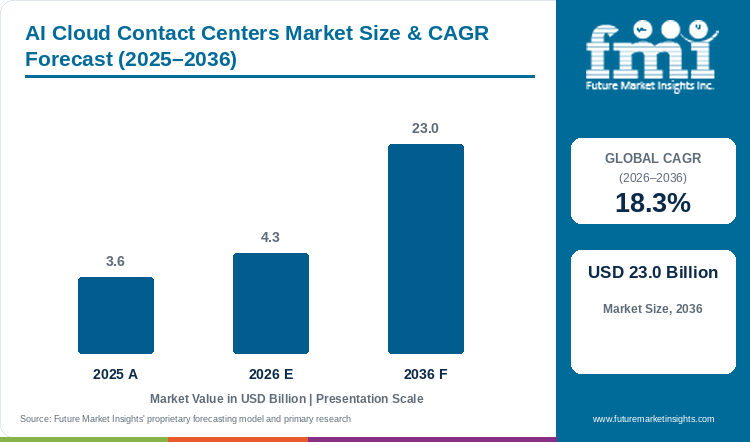
Demand is projected to expand at 18.3% CAGR from 2026 to 2036. Market value rises from USD 3.64 billion in 2025 to USD 4.3 billion in 2026 and USD 23 billion by 2036. [1]
The AI cloud contact centers market is estimated at USD 4.30 billion in 2026 and is projected to reach USD 23.00 billion by 2036, representing a CAGR of 18.3% from 2026 to 2036. [1] The commercial question is whether automation can help complete a customer’s task with the right information and an appropriate escalation route, rather than simply shortening a conversation. A contact center therefore needs reliable access to service records, clear boundaries for automated actions and continuity when an interaction moves between channels or staff. Google Cloud’s platform documentation and Genesys’s virtual-agent offering describe the integration of AI with wider customer engagement, while Amazon Connect documents assistance for email overviews and responses. [3][4][5] These functions can reduce repetitive work, but their usefulness depends on context, permissions and how agents handle exceptions. NIST’s voluntary AI risk framework provides a reference for assessing trustworthiness throughout design and use. [2] As conversational AI becomes part of the operating model, buyers can evaluate resolution quality, staff support and service reliability alongside seat costs, making implementation and ongoing supervision relevant to the forecast. [1]
Key Market Trends and Insights
- Automation moves deeper into customer tasks when platforms can connect the conversation with relevant records and permitted actions, while preserving an appropriate escalation route. [1][4][5]
- Email assistance and interaction summaries support staff work by organizing context, although responses still need to fit the customer’s actual request and service information. [3]
- Cloud contact center platforms bring channels and AI functions into a shared environment, making integration and operational oversight relevant to purchasing decisions. [2][4]
Regional Highlights
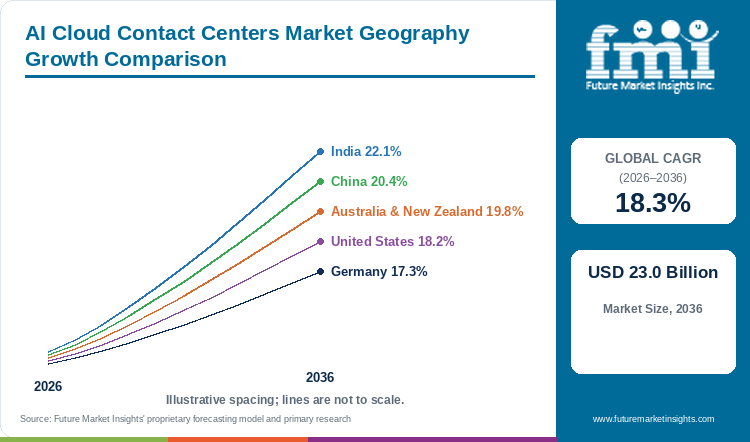
- India and China are projected to record 22.1% and 20.4% CAGR from 2026 to 2036, with service automation and cloud operations supporting demand. [1]
- Germany is projected at 17.3% CAGR, as enterprise buyers assess interaction quality, information access and the operating boundaries of AI-enabled customer service. [1][2]
- Australia & New Zealand is profiled jointly at 19.8% CAGR, while the United States is projected at 18.2% CAGR from 2026 to 2036. [1]
Market Size and Forecast
Table 1: Value outlook for the AI cloud contact centers market
| Metric | Value |
|---|---|
| 2025 market value | USD 3.64 billion [1] |
| 2026 market value | USD 4.3 billion [1] |
| 2036 market value | USD 23 billion [1] |
| CAGR 2026 to 2036 | 18.3% [1] |
| Revenue increase 2026 to 2036 | USD 18.7 billion [1] |
| Market expansion 2026 to 2036 | 5.35 times [1] |
The forecast reflects demand for platforms that connect customer communication to a usable service process, with deployment value extending beyond a new voice interface. Large operations can combine routing, staff assistance and automation, although each function needs a clear relationship with the underlying service records. The link with Microsoft Dynamics is relevant where a customer’s history and case information already sit in an enterprise system, requiring the contact center to maintain context rather than ask the customer to start again. [1][3][4][5]
What operating evidence supports AI-enabled customer service?
AI contact center purchasing depends on the tasks a platform can support within a real service operation, because an accurate response still needs appropriate information and a practical next action. Platform documentation describes channel integration, automated assistance and virtual-agent functions, while the NIST framework helps buyers consider trustworthiness and operating responsibility throughout the use of an AI system. [2][3][4][5]
Table 2: Industry evidence relevant to the AI cloud contact centers market
| Indicator | Data point or observation | Market relevance | Source |
|---|---|---|---|
| AI governance | NIST provides a voluntary risk management framework | Buyers can assess trustworthiness across design and operation | [2] |
| Agent assistance | Amazon Connect documents email overviews and response suggestions | Context can support staff without removing operating responsibility | [3] |
| Platform integration | Google Cloud and Genesys connect AI with contact center functions | Automation needs service information and coordinated channels | [4][5] |
Analyst Perspective
"The AI cloud contact centers market is shifting toward
platforms that can automate outcomes rather than simply manage seats. The implementation needs shared service context and clear handling of exceptions, so that automated interactions can work alongside staff support across the channels that customers use to seek assistance." [1]- Sudip Saha, Co-founder, Future Market Insights
How is the AI cloud contact centers market segmented?
The market is segmented by Component, Organization Size, Industry, and Region.
The market is segmented by Component, Organization Size, Industry, and Region. By component, coverage includes Solution, Services. By organization size, coverage includes Small and Medium-sized Enterprises (SMEs), Large Enterprises. By industry, coverage includes Banking, Financial Services, and Insurance (BFSI), Retail and E-commerce, Healthcare and Life Sciences, Telecom and IT, Government and Public Sector, Travel and Hospitality, Media and Entertainment, Energy and Utilities, Automotive, Education. [1]
Why does the Large Enterprises segment lead demand within the organization size category?
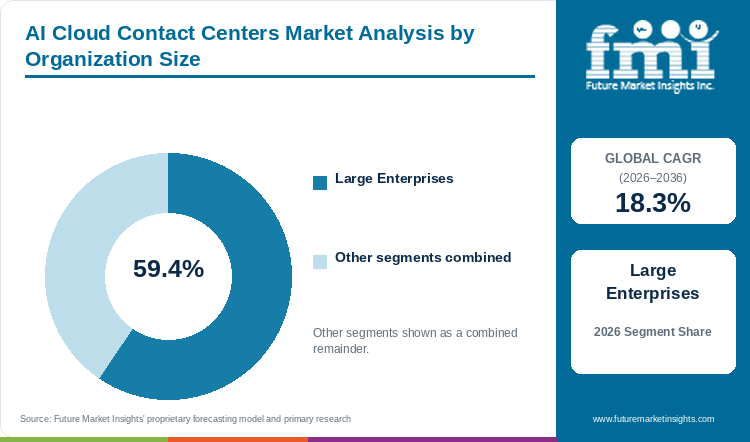
The Large Enterprises segment accounts for 59.4% of organization size demand in 2026. [1]
Large enterprises are estimated to account for 59.4% of organization size demand in 2026 because their customer service operations often span multiple channels, teams and business systems. A shared cloud platform can connect routing, staff support and automated handling within a common operating environment, which is useful when interactions need to carry context between departments rather than remain isolated conversations. [1][4] The scale of the organization also creates implementation work around permissions, service records and exception handling, making an orderly rollout important to the investment. Genesys’s virtual-agent documentation illustrates how automation can be integrated with wider customer experience functions, while the NIST framework supports consideration of responsibility and trustworthiness throughout the system’s use. [2][5]
- The Large Enterprises segment is estimated to represent 59.4% of organization size demand in 2026, because multi-channel service operations need shared context, integrated workflows and coordinated administration. [1][4][5]
- Large deployments need a clear rollout and escalation plan, because adding automation does not remove the service owner’s responsibility for exceptions. [2][5]
Table 3: Leading organization size share in 2026
| Segment | Share of demand |
|---|---|
| Large Enterprises | 59.4% [1] |
| Other organization size segments | 40.6% [1] |
| Total | 100.0% |
Why does the BFSI segment lead demand within the industry category?
The BFSI segment accounts for 29.0% of industry demand in 2026. [1]
The BFSI segment is projected to hold a 29.0% industry share in 2026, reflecting the recurring service tasks created by accounts, payments, product information and customer queries. These interactions can benefit from organized information and staff assistance, but the platform needs clear boundaries around the actions it may take and the circumstances requiring human support. [1][2] An email summary or suggested response can help an agent understand a case, while an automated interaction must access the correct service context rather than offer a plausible answer detached from the customer’s record. Amazon Connect and Google Cloud documentation demonstrate these assistance and platform functions, supporting a purchasing emphasis on dependable resolution and controlled integration alongside the volume of contacts handled. [3][4]
- The BFSI segment is estimated to represent 29.0% of industry demand in 2026, as account and transaction-related service creates recurring customer interactions requiring dependable information and handling. [1][2]
- Financial-service interactions require controlled access to relevant records and an appropriate human route when an automated action cannot safely complete the customer’s task. [2][3][4]
What are the drivers, restraints, and opportunities in the AI cloud contact centers market?
Driver
The need to handle repetitive customer work with consistent access to information supports AI cloud contact center demand, especially where staff must reconstruct context across channels or disconnected systems. Summaries, response assistance and virtual agents can help organize this work, while a cloud platform provides a shared delivery environment. [3][4][5] Demand is therefore tied to useful task completion and staff productivity, with oversight remaining relevant whenever the system interprets a request or performs an action on the customer’s behalf. [1][2]
Restraint
Poor integration can limit the benefit of automation when a platform lacks current service information or cannot pass an unresolved case to a person with enough context. The resulting interaction may appear responsive without actually resolving the customer’s task, creating repeat contacts and additional staff work. NIST’s framework supports assessment of trustworthiness and responsibility, while platform documentation makes clear that AI operates within a wider contact center environment whose records and workflows still need management. [2][3][4][5]
Opportunity
A practical opportunity lies in connecting assistance and automation to complete service workflows, so that an agent or virtual assistant can use relevant information and move the case toward resolution. Genesys and Google Cloud illustrate this broader platform approach, while Amazon Connect documents targeted support for email work. [3][4][5] Connections with contract lifecycle management can be useful where customer queries depend on agreement terms, provided the system retrieves the correct record and preserves a clear route for human interpretation. [1][2]
Which country CAGRs are profiled in the AI cloud contact centers market?
Table 4: Country CAGR comparison for the AI cloud contact centers market
| Country or market | CAGR 2026 to 2036 |
|---|---|
| India | 22.1% [1] |
| China | 20.4% [1] |
| Germany | 17.3% [1] |
| Australia & New Zealand | 19.8% [1] |
| United States | 18.2% [1] |
Country-wise Analysis
India
India’s contact center activity gives buyers a reason to examine how automation supports staff and customer tasks across mobile application store queries and other service workloads, rather than focusing only on the number of seats replaced. A useful deployment needs to connect routing, summaries and service information so that a staff member can pick up an exception with the context already available. The market is projected to expand at a CAGR of 22.1% from 2026 to 2036, reflecting demand for cloud-based service operations and AI-assisted work. [1] Amazon Connect’s email assistance documentation illustrates the value of organizing interaction context, while risk-management guidance reinforces the need to define responsibilities when an automated system participates in customer service. [2][3]
China
China’s service platforms need customer interactions to remain connected to the business information that determines what can actually be resolved, particularly when automation is used across several channels. A virtual response has limited value if it cannot identify the correct task or pass unresolved work to an appropriate team, so integration and permissions shape platform purchasing. China is projected at a CAGR of 20.4% from 2026 to 2036, with demand linked to AI-enabled customer engagement and cloud operations. [1] The platform functions described by Google Cloud and Genesys provide a useful technical reference, while buyers need to assess how those capabilities fit their own service records and operating arrangements. [4][5]
Germany
German enterprise buyers can evaluate AI contact center deployment through the quality of the service process, including whether information is correct, staff can understand the interaction and exceptions have a clear owner. These questions become more important when automation performs tasks across business systems rather than simply responding to a frequently asked question. The projected 17.3% CAGR from 2026 to 2036 reflects continued demand for cloud customer service and assistance functions. [1] NIST’s voluntary risk framework offers a reference for trustworthiness assessment, while platform documentation illustrates the integration required for channel continuity. Purchasing can therefore focus on operating boundaries, resolution quality and orderly deployment rather than assuming that a conversational interface is sufficient. [2][4][5]
Australia & New Zealand
Australia & New Zealand is projected to expand at a CAGR of 19.8% from 2026 to 2036, with cloud platforms supporting a common service environment across distributed operations. [1] Service operations spanning offices, remote staff and different customer channels can benefit from a common cloud environment, provided that the interaction retains useful context when responsibility moves between teams. The purchasing question is therefore how the platform connects information and work, not only where an agent logs in. Google Cloud’s contact center platform describes integrated channel functions, while Amazon Connect’s email assistance documentation shows how summaries and suggestions can support staff. These tools remain dependent on suitable records, permissions and a practical escalation arrangement within the buyer’s service operation. [3][4]
United States
US providers can approach AI cloud contact centers as a combination of customer communication and controlled service work, particularly where the platform is expected to act on an account or move a case between systems. NIST’s framework gives organizations a public reference for assessing trustworthiness and operating responsibility, while vendor documentation describes assistance and virtual-agent functions within the wider contact center environment. [2][3][4][5] The United States market is projected at a CAGR of 18.2% from 2026 to 2036, supporting continued investment in automated service operations. [1] Buyers can compare resolution quality, staff support and integration effort together, because a fast interaction remains commercially useful only when it produces an appropriate outcome for the customer.
Who are the notable companies in the AI cloud contact centers market?
Genesys; NICE; Five9; Amazon Connect; Google Cloud
Competitive Benchmarking
Contact center suppliers combine communication, routing and AI functions in different ways, making integration with the buyer’s service operation a central competitive consideration. Genesys describes an agentic virtual agent within its cloud platform, Amazon Connect provides targeted interaction assistance and Google Cloud offers an AI-enabled contact center platform. [3][4][5] NICE and Five9 bring established enterprise and specialist cloud contact center positions, so purchasing should examine task coverage, information access, staff support and escalation rather than comparing conversational demonstrations alone. [1]
Table 5: Competitive positioning for the AI cloud contact centers market
| Company | Positioning | Evidence or purchasing distinction |
|---|---|---|
| Genesys | Cloud customer-experience orchestration | Agentic virtual-agent integration [5] |
| NICE | Cloud contact center and customer service AI | Enterprise platform participant [1] |
| Five9 | Cloud contact center software | Specialist cloud contact center participant [1] |
| Amazon Connect | Cloud customer engagement | Generative email assistance documentation [3] |
| Google Cloud | AI-enabled contact center platform | Omnichannel cloud platform [4] |
Key Developments in the AI Cloud Contact Centers Market
- Amazon Connect’s current documentation describes generative AI email overviews and suggested responses, illustrating targeted assistance that uses interaction context to support customer service staff. [3]
- Genesys’s agentic virtual-agent offering connects automated execution with its wider cloud customer experience platform, showing how AI functions are incorporated into service workflows. [5]
- Google Cloud documents an AI-enabled omnichannel contact center platform, while NIST’s voluntary framework provides a reference for assessing trustworthiness through the design and use of those systems. [2][4]
Key Players in the AI Cloud Contact Centers Market
- Genesys
- NICE
- Five9
- Amazon Connect
- Google Cloud
AI Cloud Contact Centers Market Report Scope
Table 6: Report coverage for the AI cloud contact centers market
| Attribute | Coverage |
|---|---|
| Market | AI Cloud Contact Centers Market |
| Base year | 2026 |
| Historical reference | 2025 |
| Forecast period | 2026 to 2036 |
| Currency and units | USD billion |
| Segmentation | Component, Organization Size, Industry |
| Geographic coverage | North America, Latin America, Western Europe, Eastern Europe, East Asia, South Asia & Pacific, Middle East & Africa |
| Country and market profiles | India, China, Germany, Australia & New Zealand, United States |
| Competitive coverage | Genesys, NICE, Five9, Amazon Connect, Google Cloud |
AI Cloud Contact Centers Market Research Methodology
Table 7: Research methods for the AI cloud contact centers market
| Method | Approach |
|---|---|
| Market definition | The market covers AI-enabled cloud contact center platforms and associated services, including customer engagement, staff assistance and controlled automation, excluding unrelated standalone software revenue. |
| Desk research | Published market outlooks, official technical documentation, institutional publications and company disclosures inform the assessment. |
| Segment assessment | Product, deployment and buyer categories are distinguished according to the role each plays in the defined market. |
| Country assessment | Local procurement conditions and service requirements are assessed alongside the country and market growth outlook. |
| Competitive comparison | Product portfolios, service roles and operating requirements inform the assessment of representative companies. |
| Forecast assessment | The 2026 base and 2036 outlook reflect demand drivers, adoption constraints and the market coverage specified in this report. |
AI Cloud Contact Centers Market by Segments
AI Cloud Contact Centers Market segmented by Component:
- Solution
- Services
AI Cloud Contact Centers Market segmented by Organization Size:
- Small and Medium-sized Enterprises (SMEs)
- Large Enterprises
AI Cloud Contact Centers Market segmented by Industry:
- Banking, Financial Services, and Insurance (BFSI)
- Retail and E-commerce
- Healthcare and Life Sciences
- Telecom and IT
- Government and Public Sector
- Travel and Hospitality
- Media and Entertainment
- Energy and Utilities
- Automotive
- Education
AI Cloud Contact Centers Market by Region
- North America
- United States
- Canada
- Latin America
- Brazil
- Mexico
- Argentina
- Chile
- Western Europe
- Germany
- France
- United Kingdom
- Italy
- Spain
- Benelux
- Nordics
- Eastern Europe
- Poland
- Czech Republic
- Romania
- Hungary
- East Asia
- China
- Japan
- South Korea
- South Asia and Pacific
- India
- ASEAN
- Australia and New Zealand
- Middle East and Africa
- GCC Countries
- South Africa
- Türkiye
- Israel
Research Sources and Bibliography
- [1] Future Market Insights. Accessed 14 October 2026. AI Cloud Contact Centers Market
- [2] National Institute of Standards and Technology. Accessed 14 October 2026. AI Risk Management Framework
- [3] Amazon Web Services. Accessed 14 October 2026. Generative AI-powered email overviews and suggested responses
- [4] Google Cloud. Accessed 14 October 2026. Contact Center AI Platform
- [5] Genesys. Accessed 14 October 2026. Genesys Cloud Agentic Virtual Agent product overview
This Report Answers
- How big is the AI cloud contact centers market in 2026?
- What is the forecast for the AI cloud contact centers market?
- Which segment has the largest profiled share?
- Which countries and markets are profiled?
- Which companies are covered?
Frequently Asked Questions
How big is the AI cloud contact centers market in 2026?
The market is estimated at USD 4.30 billion in 2026, compared with USD 3.64 billion in 2025. [1]
What is the forecast for the AI cloud contact centers market?
Market value is projected to reach USD 23.00 billion by 2036, with a CAGR of 18.3% from 2026 to 2036. [1]
Which segment has the largest profiled share?
The Large Enterprises segment holds a projected 59.4% share of the organization size segment in 2026, while the BFSI segment represents 29.0% of the industry segment. [1]
Which countries and markets are profiled?
The analysis profiles India, China, Germany, Australia & New Zealand, United States, with each growth rate stated for 2026 to 2036. [1]
Which companies are covered?
Representative participants include Genesys, NICE, Five9, Amazon Connect, Google Cloud, whose differing commercial roles are described in the company comparisons. [1]
Preview the report firsthand - request a free sample
Get SampleGet the brochure for pricing and purchase details.
Get PDFTable of Content
- Key Takeaways
- Market Size and CAGR
- Top Growth Driver
- Fastest Growing Segment
- Leading Region
- Key Companies
- Emerging Opportunities
- Executive Summary
- Global Market Outlook
- Demand-side Trends
- Supply-side Trends
- Technology Roadmap Analysis
- Analysis and Recommendations
- Analyst Perspective (What is happening? Why now? What should investors know?)
- Key Questions Answered
- How large is the market?
- What is the CAGR?
- What are key trends?
- Which region dominates?
- Who are the leaders?
- Market Overview
- Market Coverage / Taxonomy
- Market Definition / Scope / Limitations
- Research Methodology
- Chapter Orientation
- Analytical Lens and Working Hypotheses
- Market Structure, Signals, and Trend Drivers
- Benchmarking and Cross-market Comparability
- Market Sizing, Forecasting, and Opportunity Mapping
- Research Design and Evidence Framework
- Desk Research Programme (Secondary Evidence)
- Expert Input and Fieldwork (Primary Evidence)
- Tooling, Models, and Reference Databases
- Data Engineering and Model Build
- Quality Assurance and Audit Trail
- Market Background
- Market Dynamics (Drivers, Restraints, Opportunity, Trends)
- Scenario Forecast (Optimistic, Likely, Conservative)
- Impact Analysis
- AI Impact
- Sustainability Impact
- Regulatory Impact
- Technology Impact
- Consumer / Buyer Analysis
- Purchase Drivers
- Adoption Barriers
- Buyer Journey
- Opportunity Map Analysis
- Product Life Cycle Analysis
- Supply Chain Analysis
- Investment Feasibility Matrix
- Value Chain Analysis
- PESTLE and Porter's Analysis
- Regulatory Landscape
- Regional Parent Market Outlook
- Production and Consumption Statistics
- Import and Export Statistics
- Global Market Analysis and Forecast, 2021 to 2036
- Historical Market Size Value (USD Billion) Analysis, 2021 to 2025
- Current and Future Market Size Value (USD Billion) Projections, 2026 to 2036
- Y-o-Y Growth Trend Analysis
- Absolute $ Opportunity Analysis
- Global Market Pricing Analysis, 2021 to 2036
- Global Market Analysis and Forecast, By Component, 2021 to 2036
- Introduction / Key Findings
- Historical Market Size Value (USD Billion) Analysis By Component, 2021 to 2025
- Current and Future Market Size Value (USD Billion) Analysis and Forecast By Component, 2026 to 2036
- Solution
- Services
- Y-o-Y Growth Trend Analysis By Component, 2021 to 2025
- Absolute $ Opportunity Analysis By Component, 2026 to 2036
- Global Market Analysis and Forecast, By Organization Size, 2021 to 2036
- Introduction / Key Findings
- Historical Market Size Value (USD Billion) Analysis By Organization Size, 2021 to 2025
- Current and Future Market Size Value (USD Billion) Analysis and Forecast By Organization Size, 2026 to 2036
- Small and Medium-sized Enterprises (SMEs)
- Large Enterprises
- Y-o-Y Growth Trend Analysis By Organization Size, 2021 to 2025
- Absolute $ Opportunity Analysis By Organization Size, 2026 to 2036
- Global Market Analysis and Forecast, By Industry, 2021 to 2036
- Introduction / Key Findings
- Historical Market Size Value (USD Billion) Analysis By Industry, 2021 to 2025
- Current and Future Market Size Value (USD Billion) Analysis and Forecast By Industry, 2026 to 2036
- Banking, Financial Services, and Insurance (BFSI)
- Retail and E-commerce
- Healthcare and Life Sciences
- Telecom and IT
- Government and Public Sector
- Travel and Hospitality
- Media and Entertainment
- Energy and Utilities
- Automotive
- Education
- Y-o-Y Growth Trend Analysis By Industry, 2021 to 2025
- Absolute $ Opportunity Analysis By Industry, 2026 to 2036
- Global Market Analysis and Forecast, By Region, 2021 to 2036
- Introduction
- Historical Market Size Value (USD Billion) Analysis By Region, 2021 to 2025
- Current Market Size Value (USD Billion) Analysis and Forecast By Region, 2026 to 2036
- North America
- Latin America
- Western Europe
- Eastern Europe
- East Asia
- South Asia & Pacific
- Middle East & Africa
- Market Attractiveness Analysis By Region
- North America Market Analysis and Forecast, By Country, 2021 to 2036
- Historical Market Size Value (USD Billion) Trend Analysis By Market Taxonomy, 2021 to 2025
- Market Size Value (USD Billion) Forecast By Market Taxonomy, 2026 to 2036
- By Country
- United States
- Canada
- By Component
- By Organization Size
- By Industry
- By Country
- Market Attractiveness Analysis
- By Country
- By Component
- By Organization Size
- By Industry
- Key Takeaways
- Latin America Market Analysis and Forecast, By Country
- Historical Market Size Value (USD Billion) Trend Analysis By Market Taxonomy, 2021 to 2025
- Market Size Value (USD Billion) Forecast By Market Taxonomy, 2026 to 2036
- By Country
- Brazil
- Mexico
- Argentina
- By Component
- By Organization Size
- By Industry
- By Country
- Market Attractiveness Analysis
- By Country
- By Component
- By Organization Size
- By Industry
- Key Takeaways
- Western Europe Market Analysis and Forecast, By Country
- Historical Market Size Value (USD Billion) Trend Analysis By Market Taxonomy, 2021 to 2025
- Market Size Value (USD Billion) Forecast By Market Taxonomy, 2026 to 2036
- By Country
- Germany
- United Kingdom
- France
- Italy
- Spain
- BENELUX
- Nordics
- By Component
- By Organization Size
- By Industry
- By Country
- Market Attractiveness Analysis
- By Country
- By Component
- By Organization Size
- By Industry
- Key Takeaways
- Eastern Europe Market Analysis and Forecast, By Country
- Historical Market Size Value (USD Billion) Trend Analysis By Market Taxonomy, 2021 to 2025
- Market Size Value (USD Billion) Forecast By Market Taxonomy, 2026 to 2036
- By Country
- Poland
- Russia
- Czech Republic
- Romania
- By Component
- By Organization Size
- By Industry
- By Country
- Market Attractiveness Analysis
- By Country
- By Component
- By Organization Size
- By Industry
- Key Takeaways
- East Asia Market Analysis and Forecast, By Country
- Historical Market Size Value (USD Billion) Trend Analysis By Market Taxonomy, 2021 to 2025
- Market Size Value (USD Billion) Forecast By Market Taxonomy, 2026 to 2036
- By Country
- China
- Japan
- South Korea
- By Component
- By Organization Size
- By Industry
- By Country
- Market Attractiveness Analysis
- By Country
- By Component
- By Organization Size
- By Industry
- Key Takeaways
- South Asia & Pacific Market Analysis and Forecast, By Country
- Historical Market Size Value (USD Billion) Trend Analysis By Market Taxonomy, 2021 to 2025
- Market Size Value (USD Billion) Forecast By Market Taxonomy, 2026 to 2036
- By Country
- India
- ASEAN
- Australia & New Zealand
- By Component
- By Organization Size
- By Industry
- By Country
- Market Attractiveness Analysis
- By Country
- By Component
- By Organization Size
- By Industry
- Key Takeaways
- Middle East & Africa Market Analysis and Forecast, By Country
- Historical Market Size Value (USD Billion) Trend Analysis By Market Taxonomy, 2021 to 2025
- Market Size Value (USD Billion) Forecast By Market Taxonomy, 2026 to 2036
- By Country
- GCC Countries
- South Africa
- Israel
- By Component
- By Organization Size
- By Industry
- By Country
- Market Attractiveness Analysis
- By Country
- By Component
- By Organization Size
- By Industry
- Key Takeaways
- Key Countries Market Analysis
- United States
- Pricing Analysis
- Market Share Analysis, 2025
- By Component
- By Organization Size
- By Industry
- Canada
- Pricing Analysis
- Market Share Analysis, 2025
- By Component
- By Organization Size
- By Industry
- Mexico
- Pricing Analysis
- Market Share Analysis, 2025
- By Component
- By Organization Size
- By Industry
- Brazil
- Pricing Analysis
- Market Share Analysis, 2025
- By Component
- By Organization Size
- By Industry
- Germany
- Pricing Analysis
- Market Share Analysis, 2025
- By Component
- By Organization Size
- By Industry
- United Kingdom
- Pricing Analysis
- Market Share Analysis, 2025
- By Component
- By Organization Size
- By Industry
- Italy
- Pricing Analysis
- Market Share Analysis, 2025
- By Component
- By Organization Size
- By Industry
- Spain
- Pricing Analysis
- Market Share Analysis, 2025
- By Component
- By Organization Size
- By Industry
- France
- Pricing Analysis
- Market Share Analysis, 2025
- By Component
- By Organization Size
- By Industry
- India
- Pricing Analysis
- Market Share Analysis, 2025
- By Component
- By Organization Size
- By Industry
- ASEAN
- Pricing Analysis
- Market Share Analysis, 2025
- By Component
- By Organization Size
- By Industry
- Australia & New Zealand
- Pricing Analysis
- Market Share Analysis, 2025
- By Component
- By Organization Size
- By Industry
- China
- Pricing Analysis
- Market Share Analysis, 2025
- By Component
- By Organization Size
- By Industry
- Japan
- Pricing Analysis
- Market Share Analysis, 2025
- By Component
- By Organization Size
- By Industry
- South Korea
- Pricing Analysis
- Market Share Analysis, 2025
- By Component
- By Organization Size
- By Industry
- Russia
- Pricing Analysis
- Market Share Analysis, 2025
- By Component
- By Organization Size
- By Industry
- Poland
- Pricing Analysis
- Market Share Analysis, 2025
- By Component
- By Organization Size
- By Industry
- South Africa
- Pricing Analysis
- Market Share Analysis, 2025
- By Component
- By Organization Size
- By Industry
- United States
- Market Structure Analysis
- Competition Dashboard
- Competition Benchmarking
- Market Share Analysis of Top Players
- By Regional
- By Component
- By Organization Size
- By Industry
- Emerging Startups
- Innovation Benchmarking
- Competition Analysis
- Competition Deep Dive
- Genesys
- Overview
- Product Portfolio
- Profitability by Market Segments
- Sales Footprint
- Strategy Overview
- Marketing Strategy
- Product Strategy
- Channel Strategy
- NICE
- Five9
- Amazon Connect
- Google Cloud
- Genesys
- Case Studies
- Success Stories
- Recent Developments
- Competition Deep Dive
- Assumptions & Acronyms Used


