

- Market Size (2026)
- USD 387.4 Mn
- Forecast (2036)
- USD 1080.5 Mn
- CAGR (2026 to 2036)
- 10.8%
How big is AI Rack RAS Telemetry Platforms Market in 2026?
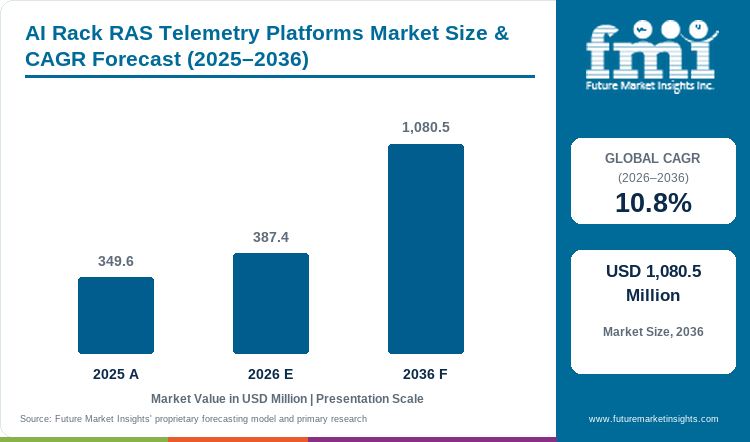
USD 387.4 Million in 2026 and USD 1,080.5 Million by 2036 at a 10.8% CAGR.
The AI Rack RAS Telemetry Platforms Market was valued at USD 349.6 Million in 2025. It is estimated at USD 387.4 Million in 2026 and forecast to reach USD 1,080.5 Million by 2036, expanding at a 10.8% CAGR. Dense accelerator racks can change load faster than room-level measurements reveal. Operators need rack power, cooling conditions and hardware status in the same view before they place equipment or investigate an incident.
Lawrence Berkeley National Laboratory estimated in June 2026 that data centers could account for 11.8% of US electricity use by 2030. Power availability affects where compute capacity can be installed and how fully it can operate. The data center power management market addresses facility electrical capacity; rack telemetry connects those limits to equipment state, temperatures and alarms. Together, these measurements help operators locate the constraint before adding a workload.
Rack telemetry enters a project at different stages. Greenfield AI campuses in the UAE can specify it with the electrical and cooling design. Germany's continuous energy-measurement requirements create demand for traceable operating records. France's site preparation, Japan's Watt-Bit planning and South Korea's proposed 8.4 GW of first-phase regional AI clusters bring power capacity into project decisions before equipment arrives.
Key Takeaways
- Higher AI rack density is turning telemetry into an operating input for commissioning, capacity release and incident response. The platform has to connect rack conditions with the physical infrastructure that supports the workload.
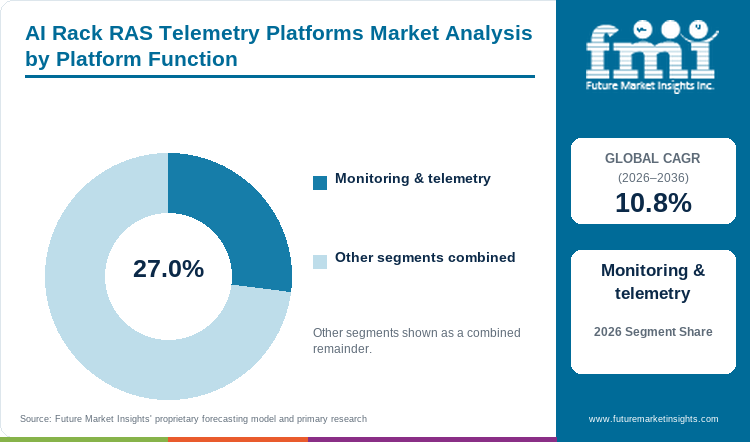
- Monitoring & telemetry accounts for 27.0% of Platform Function demand in 2026. SaaS / public cloud represents 38.0% of Deployment Model demand because centralized administration reduces site-by-site software overhead.
- The 251-500 kW band represents 32.0% of AI Rack Density demand in 2026. Hyperscale AI data centers account for 46.0% of Data Center Type demand, where shared power and cooling dependencies increase the value of fleet-wide visibility.
- Direct enterprise contracts account for 42.0% of Commercial Model demand. Security review, device onboarding and API work often need to be negotiated around the facility rather than purchased as a self-service license.
- Profiled country CAGRs range from 10.6% to 12.2% from 2026 to 2036. UAE is at 12.2%, France at 11.9%, South Korea at 11.5%, USA at 11.2%, Germany at 10.9% and Japan at 10.6%.
- Missing sensors, incompatible protocols and cybersecurity review can delay deployment. Reliable device identification and time-aligned measurements are needed before operators use telemetry to approve capacity changes or diagnose incidents.
Analyst Perspective
A rack record must remain accurate as servers, power feeds and cooling connections change. Otherwise, an alarm can point to the wrong dependency or a capacity model can overstate available headroom. The strongest platforms maintain that record through commissioning and service, giving operators a dependable basis for fault analysis and controlled optimization.
- Sudip Saha, Principal Consultant, Future Market Insights
How is the AI rack RAS telemetry platforms market segmented?
The AI rack RAS telemetry platforms market is segmented by Platform Function, Deployment Model, AI Rack Density, Data Center Type, Commercial Model, and Region.
Platform Function separates monitoring & telemetry from planning & simulation, optimization & control, fault / reliability analytics and reporting & governance. Deployment Model covers SaaS / public cloud, private cloud, on-premise and hybrid deployment. AI Rack Density is grouped into below 100 kW, 100-250 kW, 251-500 kW and above 500 kW. Data Center Type includes hyperscale AI data centers, colocation AI facilities, enterprise private AI and HPC & research centers. Commercial Model covers direct enterprise contract, system integrator / EPC-led, subscription / license and managed-service contract.
A platform's value depends on the decision it supports. Monitoring reveals current conditions; planning models future rack loads; control functions act on the physical environment. Hosting and commercial arrangements determine who maintains the software and connectors. Rack density and facility type determine how much electrical and cooling capacity must be associated with each asset.
What makes Monitoring & telemetry central to the Platform Function category?
Monitoring & telemetry sits closest to the physical event. Operators need a current view of rack power, environmental conditions and device state before a simulation or optimization layer can be trusted. DMTF Redfish supports scalable systems management across multi-vendor environments and includes telemetry services, metric definitions and reports. That gives platform developers a standardized route for collecting machine data from servers and infrastructure components.
The same logic sits inside the broader data center infrastructure management market, where centralized monitoring and capacity planning depend on current infrastructure data. RAS telemetry narrows the job toward reliability, availability and serviceability around AI racks. The platform becomes useful when alarms and historical trends can be resolved to a specific rack, power path or thermal condition instead of remaining at room level.
- Monitoring & telemetry accounts for 27.0% of Platform Function demand in 2026 because later analytics depend on a trusted stream of rack and infrastructure data.
- DMTF published Redfish release 2025.4 in January 2026. The standard supports scalable management across rack-mount systems and data-center environments, including telemetry resources for metric collection and reporting.
Why does SaaS / public cloud lead the Deployment Model category?
SaaS / public cloud deployment reduces the software-maintenance burden for teams that manage several rooms, campuses or colocation sites. Central administrators can use one service layer for software updates and cross-site dashboards instead of maintaining a full management stack at every facility. This matters when AI capacity is distributed across several locations but operators still need common alarm rules and reporting.
The tradeoff is governance. Buyers still examine regional data storage, network access and the security boundary between a hosted platform and local control systems. Schneider Electric describes EcoStruxure IT Expert as a cloud-based vendor-agnostic monitoring platform for distributed IT infrastructure with power, cooling and asset visibility. The commercial appeal is therefore centralized administration, provided the integration and data-residency model fits the operator.
- SaaS / public cloud represents 38.0% of Deployment Model demand in 2026 because a hosted management layer can centralize monitoring across distributed estates.
- Cloud delivery does not remove site integration. Operators still need secure connectors, local device coverage and a clear policy for which operational data can leave the facility network.
How does 251-500 kW shape the AI Rack Density category?
The 251-500 kW band creates a step change in how much power and cooling evidence a rack needs. Room averages become less useful when a single rack can consume a material share of a power block or coolant loop. Placement decisions need rack-specific headroom, infeed status and thermal context before new accelerators are commissioned.
This operating condition also connects with the AI datacenter liquid cooling market, because higher rack power increasingly depends on coolant distribution and thermal instrumentation. Telemetry platforms gain value when liquid-cooling signals can be correlated with IT load instead of being reviewed as a separate facility system. The 251-500 kW band is commercially relevant because it captures high-density deployments without limiting demand to the relatively narrow set of racks above 500 kW.
- The 251-500 kW band accounts for 32.0% of AI Rack Density demand in 2026 because material power and thermal risk make granular monitoring part of rack acceptance and operation.
- At this density, operators need telemetry that follows both the electrical path and the cooling path. A rack can appear healthy from one layer while another layer is approaching its operating limit.
What supports Hyperscale AI data centers within the Data Center Type category?
Hyperscale AI facilities place many accelerator racks behind shared electrical distribution and cooling systems. An incident can therefore propagate through common infrastructure even when individual servers remain healthy. Fleet-scale telemetry helps operators see correlated changes across racks, power paths and environmental conditions before a local event turns into a wider capacity problem.
The UAE framework announced in May 2025 includes a 1 GW AI data center inside a planned 5 GW technology cluster in Abu Dhabi. Projects at that scale make rack records and facility dependencies part of the design process. The adjacent AI rack lifecycle asset intelligence platforms market addresses the asset-identity side of the same operating problem. RAS telemetry adds live condition and reliability evidence to that record.
- Hyperscale AI data centers account for 46.0% of Data Center Type demand in 2026 because fleet scale increases the value of centralized telemetry and correlated event analysis.
- Greenfield campuses can specify telemetry architecture before commissioning. Brownfield hyperscale sites face more connector and data-normalization work because the control estate already exists.
What drives Direct enterprise contract within the Commercial Model category?
Direct enterprise contracts fit deployments where software access is only one part of the work. Buyers may need discovery, data mapping and device onboarding before dashboards become reliable. Security review, API integration and operating support can then become part of the same statement of work. These tasks are difficult to reduce to a self-service subscription when the platform touches critical power or cooling information.
A direct contract also gives operators a defined escalation path when data quality affects capacity decisions or incident response. Hyperscale and colocation buyers can require service-level commitments around integrations, reporting and support. Managed services remain relevant for organizations that want more operational help, while system integrators can carry the platform inside a wider EPC or modernization program.
- Direct enterprise contracts represent 42.0% of Commercial Model demand in 2026 because integration scope and security obligations are commonly negotiated around a specific facility environment.
- Subscription pricing can still sit inside a direct enterprise agreement. The distinguishing feature is the negotiated implementation and support scope rather than the software billing method alone.
What are the drivers, restraints, and opportunities in the AI rack RAS telemetry platforms market?
Higher AI rack density increases the value of continuous operating evidence, mixed IT and facility systems slow integration, and trusted telemetry creates a route into fault analysis and controlled optimization.
- Driver: Dense accelerator racks increase the cost of relying on room-level averages because power and thermal headroom can change quickly at individual racks.
- Restraint: Multi-vendor protocols, incomplete instrumentation and cybersecurity review can extend deployment before the platform is trusted for operational decisions.
- Opportunity: Once data quality is established, the same telemetry can support predictive fault analysis, digital twins and governed optimization instead of stopping at passive monitoring.
Power Concentration Makes Rack-Level Evidence Operationally Valuable
Dense accelerator racks concentrate electrical and cooling demand in a small space. LBNL estimated that U.S. data centers could reach 11.8% of national electricity use by 2030 in its reference case. At rack level, this pressure appears as narrower power and cooling margins around expensive accelerator infrastructure. Operators need to know which rack has headroom before a new workload or hardware change is approved.
Platforms that reconcile rack data with facility metering can also support energy allocation. The AI cluster energy attribution platforms market shows how the same measurement layer can be extended toward workload-level energy accounting. For RAS telemetry, the immediate value is simpler: identify abnormal conditions earlier and preserve evidence that can be used during commissioning or incident review.
Integration Work Delays the Move From Demo to Operating Record
Combining server, rack PDU, cooling and building-system data requires compatible interfaces. Redfish can standardize part of the server-management layer, while SNMP and proprietary interfaces remain common across facility equipment. Naming and time synchronization also matter because an alarm is less useful when the software cannot connect it to the correct rack or dependency.
Cybersecurity adds another gate. A platform may need read access to critical operational technology, while optimization functions can require deeper interaction with controls. Buyers therefore validate connector behavior and credentials before trusting the system. Integration delays conversion, but they also create a defensible role for vendors that can prove multi-vendor coverage and data lineage.
Trusted Telemetry Opens a Path Into Fault Analysis and Optimization
Once a platform has reliable data, it can move from showing conditions to supporting decisions. Schneider Electric reported in February 2026 that its 2025 EcoStruxure IT work expanded liquid-cooling monitoring, APIs and digital-twin capabilities, while its 2026 roadmap includes anomaly detection and deeper root-cause workflows. The shift matters because operators can reuse the same evidence for planning and incident response instead of maintaining separate data models.
Operators need to understand an automated recommendation before acting on it. Operations teams need to see which measurements drove a recommendation and retain the ability to override a control action. Suppliers that preserve auditability while adding predictive analysis can expand contract scope without asking buyers to replace every underlying sensor or facility controller.
Which country CAGRs are profiled in the AI Rack RAS Telemetry Platforms Market?
| Country | CAGR (2026 to 2036) |
|---|---|
| USA | 11.2% |
| South Korea | 11.5% |
| Japan | 10.6% |
| France | 11.9% |
| Germany | 10.9% |
| UAE | 12.2% |
How do country-level CAGRs compare in the AI rack RAS telemetry platforms market?
Country CAGRs span 10.6% to 12.2% from 2026 to 2036, a 1.6 percentage-point spread. UAE leads at 12.2%, followed by France at 11.9%, South Korea at 11.5%, USA at 11.2%, Germany at 10.9% and Japan at 10.6%. Greenfield campus design favors early telemetry specification, while existing facilities require more work to connect equipment installed across different generations.
- UAE is projected at 12.2% CAGR. Greenfield AI campuses can specify telemetry and security requirements during design instead of retrofitting them after rack commissioning.
- France is projected at 11.9% CAGR. Prequalified data-center sites and grid-connection planning create an early point for capacity and telemetry software to enter the project workflow.
- South Korea is projected at 11.5% CAGR. Regional AI data-center clusters increase the need to coordinate compute growth with power and water infrastructure.
- USA is projected at 11.2% CAGR. A varied installed base creates opportunity for telemetry platforms that can handle brownfield controls and mixed device generations.
- Germany is projected at 10.9% CAGR. Continuous power and energy measurement requirements make traceable operational data more relevant to procurement and reporting.
- Japan is projected at 10.6% CAGR. Watt-Bit planning links data-center expansion to both electricity and telecommunications infrastructure, which makes capacity evidence useful before commissioning.
Country-wise Analysis
- USA: Demand for AI Rack RAS Telemetry Platforms is forecast to expand at 11.2% CAGR from 2026 to 2036. LBNL estimated in June 2026 that data centers could account for 11.8% of U.S. electricity use by 2030. The installed base includes facilities built across several technology generations, so the commercial issue is connector breadth rather than greenfield scale alone. Suppliers need secure ingestion across servers and facility devices, then enough historical context to distinguish a real reliability event from normal workload volatility.
- South Korea: Demand is forecast to rise at 11.5% CAGR through 2036. Korea.net reported in June 2026 that the first phase of regional AI data-center clusters is planned at a combined 8.4 GW. The program also references permitting, power and water support. The telemetry opportunity therefore begins before operations, when EPC teams and data-center operators need common records for power allocation and later commissioning. Platforms must scale without losing device identity as clusters are brought online in phases.
- Japan: Demand is forecast to expand at 10.6% CAGR from 2026 to 2036. METI and MIC published Watt-Bit Collaboration Report 1.0 in June 2025 to coordinate electricity and telecommunications infrastructure for future data-center development. The issue for platform vendors is planning discipline. Rack telemetry becomes more valuable when it can be connected with capacity models before expensive AI hardware is placed at a constrained site.
- France: Demand is forecast to rise at 11.9% CAGR through 2036. The Ministry of Economy reported in January 2026 that 63 sites had been identified as suitable for data centers, including five fast-track sites with more than 700 MW of grid-connection potential each. Telemetry requirements can be specified as land, power and facility designs are coordinated. Keeping the same rack and equipment records after handover makes commissioning measurements useful to operations teams.
- Germany: Demand is forecast to expand at 10.9% CAGR from 2026 to 2036. Section 12 of Germany’s Energy Efficiency Act requires data-center operators to establish an energy or environmental management system and continuously measure electrical power and energy demand for essential components. Certification duties also apply to defined capacity thresholds from January 2026. Platforms therefore need traceable metrics and retention workflows that serve operations without separating compliance data from daily facility evidence.
- UAE: Demand is forecast to rise at 12.2% CAGR through 2036. The UAE Ministry of Foreign Affairs stated in May 2025 that a 1 GW AI data center would form part of a planned 5 GW UAE-US AI technology cluster in Abu Dhabi. Greenfield scale allows telemetry architecture to be designed alongside power and cooling systems. Suppliers still need strong security controls and multi-vendor integration because a campus-scale fault can cross several shared infrastructure layers.
Who are the notable companies in the AI rack RAS telemetry platforms market?
Device42, Sunbird Software, Schneider Electric, and Siemens are the notable companies profiled in this market.
Competition is defined by the operating layer each supplier owns most deeply. Device42 starts with automated discovery and rack or dependency context, then adds power and thermal monitoring. Sunbird Software centers its offer on DCIM monitoring and capacity operations through Power IQ and dcTrack. Schneider Electric connects DCIM software with a broad power and cooling portfolio. Siemens approaches the market from building and electrical infrastructure, then adds cloud analytics, digital twins and controls integration.
The overlap matters because buyers rarely purchase telemetry in isolation. A rack operations team may care most about device identity and alarms, while a facilities team may care about electrical distribution or cooling behavior. The useful comparison is therefore whether the platform can ingest the required data, preserve context and support the operating workflow the buyer already uses.
- Device42 emphasizes discovery, rack modeling, real-time power and thermal visibility, plus historical data that can support capacity and incident analysis.
- Sunbird Software emphasizes DCIM monitoring and operations. Power IQ supports power and environmental monitoring, while dcTrack carries asset and capacity workflows.
- Schneider Electric and Siemens connect software with wider facility infrastructure. Their position becomes more relevant when telemetry must interact with electrical systems, cooling or building controls rather than remain at rack level.
Competitive Benchmarking: AI Rack RAS Telemetry Platforms Market
| Company | Rack-level Telemetry Depth | Digital Twin & Optimization | OT / Power Integration | Geographic Reach |
|---|---|---|---|---|
| Device42 | High | Medium | Medium | North America with software availability for international enterprise environments |
| Sunbird Software | High | Medium | High | Worldwide software availability with enterprise data-center deployments |
| Schneider Electric | High | High | High | Global data-center software, power and cooling presence |
| Siemens | Medium | High | High | Global smart-infrastructure and data-center presence |
Scoring basis: Rack-level Telemetry Depth measures documented visibility into rack power, temperature and device state. Digital Twin & Optimization measures capacity modeling, simulation and documented optimization workflows tied to the physical environment. OT / Power Integration measures documented connectivity with electrical distribution, cooling or building-control systems. High indicates broad capability against the criterion. Medium indicates narrower capability.
Key Developments in the AI Rack RAS Telemetry Platforms Market
- In July 2026, Device42 released version 19.10 of its main appliance with reporting and security enhancements. The release added standard-report cloning, AND/OR logic, date-range filters and filter-aware exports. For AI rack operations, the update makes discovered infrastructure context easier to turn into repeatable governance views and operating evidence without rebuilding each report manually.
- In March 2026, Sunbird Software made Power IQ 9.3.3 generally available. The update added custom dynamic plugin mappings for devices whose identifiers vary within a shared device type. The change is relevant to dense AI estates because rack power and environmental platforms often need to ingest heterogeneous equipment while preserving the identity of each monitored device.
- In February 2026, Schneider Electric reviewed EcoStruxure IT enhancements delivered during 2025. Data Center Expert added liquid-cooling monitoring through Motivair integration, while IT Expert expanded API connectivity and supported liquid-cooling monitoring. IT Advisor advanced digital-twin and cooling-optimization capabilities. The direction moves DCIM from basic visibility toward a wider reliability and planning role around AI racks.
Key Players in the AI Rack RAS Telemetry Platforms Market
Rack Discovery and Infrastructure Mapping Platforms
- Device42
DCIM Monitoring and Capacity Operations
- Sunbird Software
Integrated Energy, Building, and AI Infrastructure Control
- Schneider Electric
- Siemens
AI Rack RAS Telemetry Platforms Market - Report Scope
| Coverage field | Report scope |
|---|---|
| Market breakdown | Platform Function; Deployment Model; AI Rack Density; Data Center Type; Commercial Model; Region |
| Quantitative Units | USD Million |
| Market Definition | Revenue includes software subscriptions, software licenses and platform-linked managed services used to monitor, model, analyze, report or control reliability, availability, serviceability, power, thermal and environmental conditions for AI racks within the stated segmentation. Standalone rack hardware, servers, accelerators, PDUs, UPS systems, cooling equipment, independently sold sensors and unrelated general-purpose software are excluded. |
| Regions Covered | North America; Latin America; Western Europe; Eastern Europe; East Asia; South Asia and Pacific; Middle East and Africa |
| Countries Covered | USA, South Korea, Japan, France, Germany, UAE, and more than twenty-five additional countries in the full report |
| Key Companies Profiled | Device42; Sunbird Software; Schneider Electric; Siemens |
| Forecast Period | 2026 to 2036 |
| Approach | Hybrid bottom-up and top-down sizing that reconciles addressable platform revenue across buyer types, deployment models, rack-density bands and commercial routes while excluding adjacent hardware and unrelated software revenue. |
AI Rack RAS Telemetry Platforms Market - Research Methodology
| Method | Approach |
|---|---|
| Primary Research | FMI engages data-center operators, infrastructure software providers, system integrators, engineering teams, procurement teams, facilities specialists and IT operations leaders. Discussions test buying criteria, integration requirements, deployment preferences, contract structures, reliability needs and adoption frictions. |
| Desk Research | Research reviews government and regulator publications, national infrastructure programs, technical standards, company filings, current product documentation and dated first-party announcements that are directly relevant to the market boundary. |
| Market Sizing and Forecasting | The model combines supplier capability mapping with buyer and facility segmentation. Deployment economics, commercial models and country operating conditions are reconciled with the 2025 base and the 2026-2036 forecast. Assumptions consider AI compute expansion, rack density, power and cooling constraints, interoperability and the move from monitoring toward reliability analytics. |
| Data Validation | Findings are cross-checked across independent public sources and first-party technical evidence. Validation removes duplicate revenue, downstream hardware, adjacent software categories and claims that cannot be traced to the defined market boundary. |
AI Rack RAS Telemetry Platforms Market by Segments
AI Rack RAS Telemetry Platforms Market segmented by Platform Function:
- Monitoring & telemetry
- Planning & simulation
- Optimization & control
- Fault / reliability analytics
- Reporting & governance
AI Rack RAS Telemetry Platforms Market segmented by Deployment Model:
- SaaS / public cloud
- Private cloud
- On-premise
- Hybrid deployment
AI Rack RAS Telemetry Platforms Market segmented by AI Rack Density:
- 251-500 kW
- 100-250 kW
- Below 100 kW
- Above 500 kW
AI Rack RAS Telemetry Platforms Market segmented by Data Center Type:
- Hyperscale AI data centers
- Colocation AI facilities
- Enterprise private AI
- HPC & research centers
AI Rack RAS Telemetry Platforms Market segmented by Commercial Model:
- Direct enterprise contract
- System integrator / EPC-led
- Subscription / license
- Managed-service contract
AI Rack RAS Telemetry Platforms Market by Region
- North America
- United States
- Canada
- Latin America
- Brazil
- Mexico
- Argentina
- Chile
- Western Europe
- Germany
- France
- United Kingdom
- Italy
- Spain
- Benelux
- Nordics
- Eastern Europe
- Poland
- Czech Republic
- Romania
- Hungary
- East Asia
- China
- Japan
- South Korea
- South Asia and Pacific
- India
- ASEAN
- Australia and New Zealand
- Middle East and Africa
- GCC Countries
- South Africa
- Türkiye
- Israel
Research Sources and Bibliography
- Lawrence Berkeley National Laboratory. (2026, June). United States Data Center Energy Usage Report: 2025 Update.
- DMTF. (2026, January 16). Redfish Release 2025.4 and Redfish Data Model Specification, Version 2025.4.
- Republic of Korea, Korea.net. (2026, June 30). Mega-project plan envisions Korea as super-gap industrial power.
- Ministry of Economy, Trade and Industry, Japan. (2025, June 12). Report 1.0 of the Public-Private Advisory Council on Watt-Bit Collaboration Published.
- French Ministry of Economy and Finance. (2026, January 30). Rencontres des centres de données: la dynamique des projets d’infrastructures numériques se confirme.
- Federal Ministry of Justice, Germany. Energy Efficiency Act (EnEfG), Section 12: Energy and environmental management systems in data centers.
- UAE Ministry of Foreign Affairs. (2025, May 16). UAE/US Framework on Advanced Technology Cooperation.
- Device42. (2026, July 31). Reporting and Security enhancements - v19.10 MA.
- Device42. Data Center Infrastructure Management software and power/thermal monitoring documentation. Accessed September 2026.
- Sunbird Software. (2026, March 3). Now Available: Power IQ 9.3.3.
- Schneider Electric. (2026, February 18). EcoStruxure IT solutions deliver on vision: Reflecting on 2025 and looking ahead to 2026.
- Schneider Electric. EcoStruxure IT Expert and IT Advisor product documentation. Accessed September 2026.
- Siemens. (2026, June 1). Siemens and partners develop reference architecture purpose-built for NVIDIA AI data centers.
- Siemens. Building X applications and API documentation. Accessed September 2026.
- Future Market Insights. Sudip Saha author profile and technology research coverage.
This bibliography is provided for reader reference and is not exhaustive. The full report contains the complete reference list and detailed research documentation.
This Report Answers
- What is the AI Rack RAS Telemetry Platforms Market size in 2026 and what value is forecast for 2036?
- Which AI infrastructure conditions are increasing demand for continuous rack-level reliability, power and thermal telemetry?
- Why does Monitoring & telemetry account for 27.0% of Platform Function demand in 2026?
- How does SaaS / public cloud influence multi-site operations and software lifecycle management?
- Why does the 251-500 kW band account for the main share within AI Rack Density?
- How do growth rates differ across USA, South Korea, Japan, France, Germany and UAE?
- How do Device42, Sunbird Software, Schneider Electric and Siemens differ in their operating-layer positions?
- Which integration, security and instrumentation issues can slow platform adoption?
- What should data-center infrastructure leaders test before selecting a RAS telemetry platform?
Frequently Asked Questions
How big is the AI Rack RAS Telemetry Platforms Market in 2026?
The market is estimated at USD 387.4 Million in 2026 and is forecast to reach USD 1,080.5 Million by 2036. The market was valued at USD 349.6 Million in 2025.
What is the CAGR of the AI Rack RAS Telemetry Platforms Market from 2026 to 2036?
The market is forecast to expand at a 10.8% CAGR from 2026 to 2036 as higher rack density increases the need for continuous power, thermal and reliability evidence.
Which Platform Function accounts for the main share in 2026?
Monitoring & telemetry accounts for 27.0% of Platform Function demand in 2026 because later planning, fault analysis and optimization depend on a trusted operating data layer.
Which Deployment Model accounts for the main share in 2026?
SaaS / public cloud represents 38.0% of Deployment Model demand in 2026 because centralized software administration supports distributed data-center estates while reducing site-by-site maintenance.
What country growth rates are profiled through 2036?
The profiled CAGRs are 12.2% for UAE, 11.9% for France, 11.5% for South Korea, 11.2% for USA, 10.9% for Germany and 10.6% for Japan from 2026 to 2036.
Which companies are notable in the AI Rack RAS Telemetry Platforms Market?
The profiled companies are Device42, Sunbird Software, Schneider Electric and Siemens. Their positions span rack discovery, DCIM monitoring, capacity operations, digital twins, electrical systems and building controls.
Preview the report firsthand - request a free sample
Get SampleGet the brochure for pricing and purchase details.
Get PDFTable of Content
- Key Takeaways
- Market Size and CAGR
- Top Growth Driver
- Fastest Growing Segment
- Leading Region
- Key Companies
- Emerging Opportunities
- Executive Summary
- Global Market Outlook
- Demand-side Trends
- Supply-side Trends
- Technology Roadmap Analysis
- Analysis and Recommendations
- Analyst Perspective (What is happening? Why now? What should investors know?)
- Key Questions Answered
- How large is the market?
- What is the CAGR?
- What are key trends?
- Which region dominates?
- Who are the leaders?
- Market Overview
- Market Coverage / Taxonomy
- Market Definition / Scope / Limitations
- Research Methodology
- Chapter Orientation
- Analytical Lens and Working Hypotheses
- Market Structure, Signals, and Trend Drivers
- Benchmarking and Cross-market Comparability
- Market Sizing, Forecasting, and Opportunity Mapping
- Research Design and Evidence Framework
- Desk Research Programme (Secondary Evidence)
- Expert Input and Fieldwork (Primary Evidence)
- Tooling, Models, and Reference Databases
- Data Engineering and Model Build
- Quality Assurance and Audit Trail
- Market Background
- Market Dynamics (Drivers, Restraints, Opportunity, Trends)
- Scenario Forecast (Optimistic, Likely, Conservative)
- Impact Analysis
- AI Impact
- Sustainability Impact
- Regulatory Impact
- Technology Impact
- Consumer / Buyer Analysis
- Purchase Drivers
- Adoption Barriers
- Buyer Journey
- Opportunity Map Analysis
- Product Life Cycle Analysis
- Supply Chain Analysis
- Investment Feasibility Matrix
- Value Chain Analysis
- PESTLE and Porter's Analysis
- Regulatory Landscape
- Regional Parent Market Outlook
- Production and Consumption Statistics
- Import and Export Statistics
- Global Market Analysis and Forecast, 2021 to 2036
- Historical Market Size Value (USD Million) Analysis, 2021 to 2025
- Current and Future Market Size Value (USD Million) Projections, 2026 to 2036
- Y-o-Y Growth Trend Analysis
- Absolute $ Opportunity Analysis
- Global Market Pricing Analysis, 2021 to 2036
- Global Market Analysis and Forecast, By Platform Function, 2021 to 2036
- Introduction / Key Findings
- Historical Market Size Value (USD Million) Analysis By Platform Function, 2021 to 2025
- Current and Future Market Size Value (USD Million) Analysis and Forecast By Platform Function, 2026 to 2036
- Monitoring & telemetry
- Planning & simulation
- Optimization & control
- Fault / reliability analytics
- Reporting & governance
- Y-o-Y Growth Trend Analysis By Platform Function, 2021 to 2025
- Absolute $ Opportunity Analysis By Platform Function, 2026 to 2036
- Global Market Analysis and Forecast, By Deployment Model, 2021 to 2036
- Introduction / Key Findings
- Historical Market Size Value (USD Million) Analysis By Deployment Model, 2021 to 2025
- Current and Future Market Size Value (USD Million) Analysis and Forecast By Deployment Model, 2026 to 2036
- SaaS / public cloud
- Private cloud
- On-premise
- Hybrid deployment
- Y-o-Y Growth Trend Analysis By Deployment Model, 2021 to 2025
- Absolute $ Opportunity Analysis By Deployment Model, 2026 to 2036
- Global Market Analysis and Forecast, By AI Rack Density, 2021 to 2036
- Introduction / Key Findings
- Historical Market Size Value (USD Million) Analysis By AI Rack Density, 2021 to 2025
- Current and Future Market Size Value (USD Million) Analysis and Forecast By AI Rack Density, 2026 to 2036
- 251-500 kW
- 100-250 kW
- Below 100 kW
- Above 500 kW
- Y-o-Y Growth Trend Analysis By AI Rack Density, 2021 to 2025
- Absolute $ Opportunity Analysis By AI Rack Density, 2026 to 2036
- Global Market Analysis and Forecast, By Data Center Type, 2021 to 2036
- Introduction / Key Findings
- Historical Market Size Value (USD Million) Analysis By Data Center Type, 2021 to 2025
- Current and Future Market Size Value (USD Million) Analysis and Forecast By Data Center Type, 2026 to 2036
- Hyperscale AI data centers
- Colocation AI facilities
- Enterprise private AI
- HPC & research centers
- Y-o-Y Growth Trend Analysis By Data Center Type, 2021 to 2025
- Absolute $ Opportunity Analysis By Data Center Type, 2026 to 2036
- Global Market Analysis and Forecast, By Commercial Model, 2021 to 2036
- Introduction / Key Findings
- Historical Market Size Value (USD Million) Analysis By Commercial Model, 2021 to 2025
- Current and Future Market Size Value (USD Million) Analysis and Forecast By Commercial Model, 2026 to 2036
- Direct enterprise contract
- System integrator / EPC-led
- Subscription / license
- Managed-service contract
- Y-o-Y Growth Trend Analysis By Commercial Model, 2021 to 2025
- Absolute $ Opportunity Analysis By Commercial Model, 2026 to 2036
- Global Market Analysis and Forecast, By Region, 2021 to 2036
- Introduction
- Historical Market Size Value (USD Million) Analysis By Region, 2021 to 2025
- Current Market Size Value (USD Million) Analysis and Forecast By Region, 2026 to 2036
- North America
- Latin America
- Western Europe
- Eastern Europe
- East Asia
- South Asia and Pacific
- Middle East and Africa
- Market Attractiveness Analysis By Region
- North America Market Analysis and Forecast, By Country, 2021 to 2036
- Historical Market Size Value (USD Million) Trend Analysis By Market Taxonomy, 2021 to 2025
- Market Size Value (USD Million) Forecast By Market Taxonomy, 2026 to 2036
- By Country
- United States
- Canada
- By Platform Function
- By Deployment Model
- By AI Rack Density
- By Data Center Type
- By Commercial Model
- By Country
- Market Attractiveness Analysis
- By Country
- By Platform Function
- By Deployment Model
- By AI Rack Density
- By Data Center Type
- By Commercial Model
- Key Takeaways
- Latin America Market Analysis and Forecast, By Country
- Historical Market Size Value (USD Million) Trend Analysis By Market Taxonomy, 2021 to 2025
- Market Size Value (USD Million) Forecast By Market Taxonomy, 2026 to 2036
- By Country
- Brazil
- Mexico
- Argentina
- Chile
- By Platform Function
- By Deployment Model
- By AI Rack Density
- By Data Center Type
- By Commercial Model
- By Country
- Market Attractiveness Analysis
- By Country
- By Platform Function
- By Deployment Model
- By AI Rack Density
- By Data Center Type
- By Commercial Model
- Key Takeaways
- Western Europe Market Analysis and Forecast, By Country
- Historical Market Size Value (USD Million) Trend Analysis By Market Taxonomy, 2021 to 2025
- Market Size Value (USD Million) Forecast By Market Taxonomy, 2026 to 2036
- By Country
- Germany
- France
- United Kingdom
- Italy
- Spain
- Benelux
- Nordics
- By Platform Function
- By Deployment Model
- By AI Rack Density
- By Data Center Type
- By Commercial Model
- By Country
- Market Attractiveness Analysis
- By Country
- By Platform Function
- By Deployment Model
- By AI Rack Density
- By Data Center Type
- By Commercial Model
- Key Takeaways
- Eastern Europe Market Analysis and Forecast, By Country
- Historical Market Size Value (USD Million) Trend Analysis By Market Taxonomy, 2021 to 2025
- Market Size Value (USD Million) Forecast By Market Taxonomy, 2026 to 2036
- By Country
- Poland
- Czech Republic
- Romania
- Hungary
- By Platform Function
- By Deployment Model
- By AI Rack Density
- By Data Center Type
- By Commercial Model
- By Country
- Market Attractiveness Analysis
- By Country
- By Platform Function
- By Deployment Model
- By AI Rack Density
- By Data Center Type
- By Commercial Model
- Key Takeaways
- East Asia Market Analysis and Forecast, By Country
- Historical Market Size Value (USD Million) Trend Analysis By Market Taxonomy, 2021 to 2025
- Market Size Value (USD Million) Forecast By Market Taxonomy, 2026 to 2036
- By Country
- China
- Japan
- South Korea
- By Platform Function
- By Deployment Model
- By AI Rack Density
- By Data Center Type
- By Commercial Model
- By Country
- Market Attractiveness Analysis
- By Country
- By Platform Function
- By Deployment Model
- By AI Rack Density
- By Data Center Type
- By Commercial Model
- Key Takeaways
- South Asia and Pacific Market Analysis and Forecast, By Country
- Historical Market Size Value (USD Million) Trend Analysis By Market Taxonomy, 2021 to 2025
- Market Size Value (USD Million) Forecast By Market Taxonomy, 2026 to 2036
- By Country
- India
- ASEAN
- Australia and New Zealand
- By Platform Function
- By Deployment Model
- By AI Rack Density
- By Data Center Type
- By Commercial Model
- By Country
- Market Attractiveness Analysis
- By Country
- By Platform Function
- By Deployment Model
- By AI Rack Density
- By Data Center Type
- By Commercial Model
- Key Takeaways
- Middle East and Africa Market Analysis and Forecast, By Country
- Historical Market Size Value (USD Million) Trend Analysis By Market Taxonomy, 2021 to 2025
- Market Size Value (USD Million) Forecast By Market Taxonomy, 2026 to 2036
- By Country
- GCC Countries
- South Africa
- Türkiye
- Israel
- By Platform Function
- By Deployment Model
- By AI Rack Density
- By Data Center Type
- By Commercial Model
- By Country
- Market Attractiveness Analysis
- By Country
- By Platform Function
- By Deployment Model
- By AI Rack Density
- By Data Center Type
- By Commercial Model
- Key Takeaways
- Key Countries Market Analysis
- United States
- Pricing Analysis
- Market Share Analysis, 2025
- By Platform Function
- By Deployment Model
- By AI Rack Density
- By Data Center Type
- By Commercial Model
- Canada
- Pricing Analysis
- Market Share Analysis, 2025
- By Platform Function
- By Deployment Model
- By AI Rack Density
- By Data Center Type
- By Commercial Model
- Mexico
- Pricing Analysis
- Market Share Analysis, 2025
- By Platform Function
- By Deployment Model
- By AI Rack Density
- By Data Center Type
- By Commercial Model
- Brazil
- Pricing Analysis
- Market Share Analysis, 2025
- By Platform Function
- By Deployment Model
- By AI Rack Density
- By Data Center Type
- By Commercial Model
- Chile
- Pricing Analysis
- Market Share Analysis, 2025
- By Platform Function
- By Deployment Model
- By AI Rack Density
- By Data Center Type
- By Commercial Model
- Germany
- Pricing Analysis
- Market Share Analysis, 2025
- By Platform Function
- By Deployment Model
- By AI Rack Density
- By Data Center Type
- By Commercial Model
- United Kingdom
- Pricing Analysis
- Market Share Analysis, 2025
- By Platform Function
- By Deployment Model
- By AI Rack Density
- By Data Center Type
- By Commercial Model
- Italy
- Pricing Analysis
- Market Share Analysis, 2025
- By Platform Function
- By Deployment Model
- By AI Rack Density
- By Data Center Type
- By Commercial Model
- Spain
- Pricing Analysis
- Market Share Analysis, 2025
- By Platform Function
- By Deployment Model
- By AI Rack Density
- By Data Center Type
- By Commercial Model
- France
- Pricing Analysis
- Market Share Analysis, 2025
- By Platform Function
- By Deployment Model
- By AI Rack Density
- By Data Center Type
- By Commercial Model
- India
- Pricing Analysis
- Market Share Analysis, 2025
- By Platform Function
- By Deployment Model
- By AI Rack Density
- By Data Center Type
- By Commercial Model
- ASEAN
- Pricing Analysis
- Market Share Analysis, 2025
- By Platform Function
- By Deployment Model
- By AI Rack Density
- By Data Center Type
- By Commercial Model
- Australia and New Zealand
- Pricing Analysis
- Market Share Analysis, 2025
- By Platform Function
- By Deployment Model
- By AI Rack Density
- By Data Center Type
- By Commercial Model
- China
- Pricing Analysis
- Market Share Analysis, 2025
- By Platform Function
- By Deployment Model
- By AI Rack Density
- By Data Center Type
- By Commercial Model
- Japan
- Pricing Analysis
- Market Share Analysis, 2025
- By Platform Function
- By Deployment Model
- By AI Rack Density
- By Data Center Type
- By Commercial Model
- South Korea
- Pricing Analysis
- Market Share Analysis, 2025
- By Platform Function
- By Deployment Model
- By AI Rack Density
- By Data Center Type
- By Commercial Model
- Poland
- Pricing Analysis
- Market Share Analysis, 2025
- By Platform Function
- By Deployment Model
- By AI Rack Density
- By Data Center Type
- By Commercial Model
- Hungary
- Pricing Analysis
- Market Share Analysis, 2025
- By Platform Function
- By Deployment Model
- By AI Rack Density
- By Data Center Type
- By Commercial Model
- Türkiye
- Pricing Analysis
- Market Share Analysis, 2025
- By Platform Function
- By Deployment Model
- By AI Rack Density
- By Data Center Type
- By Commercial Model
- South Africa
- Pricing Analysis
- Market Share Analysis, 2025
- By Platform Function
- By Deployment Model
- By AI Rack Density
- By Data Center Type
- By Commercial Model
- United States
- Market Structure Analysis
- Competition Dashboard
- Competition Benchmarking
- Market Share Analysis of Top Players
- By Regional
- By Platform Function
- By Deployment Model
- By AI Rack Density
- By Data Center Type
- By Commercial Model
- Emerging Startups
- Innovation Benchmarking
- Competition Analysis
- Competition Deep Dive
- Device42
- Overview
- Product Portfolio
- Profitability by Market Segments
- Sales Footprint
- Strategy Overview
- Marketing Strategy
- Product Strategy
- Channel Strategy
- Sunbird Software
- Schneider Electric
- Siemens
- Device42
- Case Studies
- Success Stories
- Recent Developments
- Competition Deep Dive
- Assumptions & Acronyms Used


