

- Industry Size (2026)
- USD 730.6 Mn
- Forecast (2036)
- USD 1929.8 Mn
- CAGR (2026 to 2036)
- 10.2%
Air-dried Chicken Dog Food Market Size, Market Forecast and Outlook By FMI
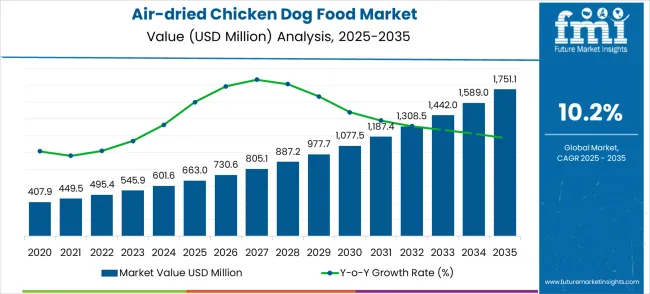
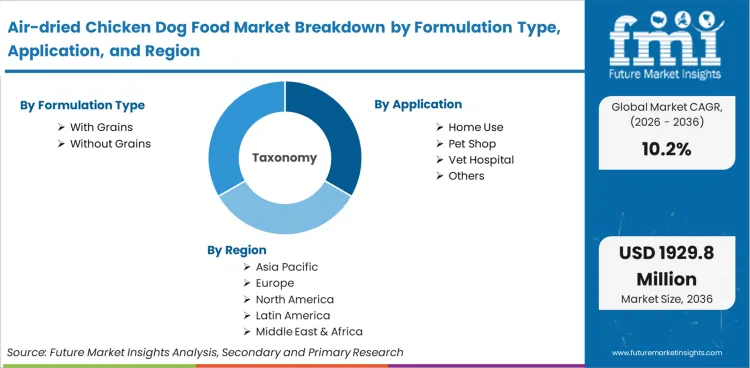
The air-dried chicken dog food market was valued at USD 663.0 million in 2025, projected to reach USD 730.6 million in 2026, and is forecast to expand to USD 1929.8 million by 2036 at a 10.2% CAGR. The air-dried chicken dog food market is one of the fastest-growing segments within premium pet nutrition, driven by pet owners seeking minimally processed, nutrient-dense feeding options for their dogs.
Grain-inclusive formulations hold majority market share as veterinary nutritionists caution against grain-free diets following FDA investigations into potential links between grain-free dog food and dilated cardiomyopathy (DCM) in dogs. Pet specialty retail and veterinary hospital channels serve as important endorsement and distribution points, with veterinary recommendations carrying significant purchase influence for premium pet food products.
Summary of Air-dried Chicken Dog Food Market
- Air-dried Chicken Dog Food Market Definition
- The air-dried chicken dog food market covers commercially manufactured dog food products made from chicken as the primary protein source and preserved through low-temperature air-drying processes. Air drying removes moisture at temperatures typically below 70 degrees Celsius, retaining more native nutrients, enzymes, and flavour compared to conventional kibble extrusion.
- Demand Drivers in the Market
- Pet Humanisation and Premiumisation Trends: Pet owners in the United States, United Kingdom, and Australia increasingly apply human food quality standards to pet nutrition decisions.
- Veterinary Endorsement of Grain-Inclusive Formulations: Following FDA alerts on potential DCM associations with grain-free diets, veterinary professionals are recommending grain-inclusive pet food formulations.
- E-Commerce Subscription Model Expansion: Online pet food subscription platforms in the United States, China, and Europe are lowering the repurchase friction for premium-priced air-dried dog food.
- Key Segments Analyzed in the FMI Report
- With Grains (Formulation Type): 62.1% share in 2026.
- Home Use (Application): 58.3% share in 2026.
- China: 13.8% compound growth, the fastest among tracked countries.
- Analyst Opinion at FMI
- Based on Nandini Roy Choudhury, Principal Consultant for Food & Beverage analysis, the air-dried chicken dog food market is at an early-stage growth inflection where consumer awareness remains low relative to the addressable premium pet food buyer population. Brands that invest in veterinary channel education and in-store sampling programmes are building trial rates that convert into long-term subscription customers, given the high product satisfaction and repeat purchase rates characteristic of air-dried pet food categories.
- Strategic Implications / Executive Takeaways
- Air-dried pet food manufacturers should prioritise veterinary clinic sampling and education programmes to build professional endorsement that drives consumer trial in a product category with low current awareness.
- Brands should develop subscription-based e-commerce models to lock in recurring revenue from premium-price-point consumers and reduce customer acquisition cost over the product lifetime.
- Companies targeting China and India should adapt formulations to local protein preferences and pricing tiers, leveraging the pet humanisation trend that is accelerating in urban centres across both markets.
- Methodology
- Primary Research: FMI conducted technical interviews with production managers, procurement leads, and supply chain directors across 40 countries to validate adoption timelines and market sizing assumptions.
- Desk Research: Analysts aggregated public trade databases, regulatory filings, and production statistics from government and multilateral sources.
- Data Validation and Update Cycle: Segment forecasts undergo cross-validation against trade volumes, production data, and corporate revenue disclosures.
Air-dried Chicken Dog Food Market Key Takeaways
| Metric | Details |
|---|---|
| Industry Size (2026) | USD 730.6 Million |
| Industry Value (2036) | USD 1929.8 Million |
| CAGR (2026-2036) | 10.2% |
Source: Future Market Insights, 2026
Geographic expansion is concentrated in mature pet care markets (United States, United Kingdom, Germany, Australia) while China and India represent emerging growth frontiers where pet humanisation trends are accelerating. All major consumption markets reflect differentiated growth trajectories. China sets a 13.8% CAGR, India sets a 12.8% CAGR, Germany sets a 11.7% CAGR, Brazil sets a 10.7% CAGR, USA sets a 9.7% CAGR, UK sets a 8.7% CAGR, and Japan registers a 7.7% pace through the forecast period.
Air-dried Chicken Dog Food Market Definition
The air-dried chicken dog food market covers commercially manufactured dog food products made from chicken as the primary protein source and preserved through low-temperature air-drying processes. Air drying removes moisture at temperatures typically below 70 degrees Celsius, retaining more native nutrients, enzymes, and flavour compared to conventional kibble extrusion. Products are sold in grain-inclusive and grain-free formulations through home retail, pet shops, veterinary hospitals, and other channels.
Air-dried Chicken Dog Food Market Inclusions
Market scope covers air-dried chicken dog food by formulation type (with grains, without grains) and by application channel (home use, pet shop, vet hospital, others). Global and regional market sizing, premiumisation trend analysis, and distribution channel mapping are included.
Air-dried Chicken Dog Food Market Exclusions
The scope excludes freeze-dried dog food (which uses sublimation rather than air drying), conventional extruded kibble, wet/canned dog food, and raw frozen dog food. Air-dried dog treats and air-dried dog food using protein sources other than chicken (beef, lamb, venison, fish) as the primary ingredient fall outside this specific market boundary.
Air-dried Chicken Dog Food Market Research Methodology
- Primary Research: Analysts engaged with procurement specialists, production managers, and supply chain directors to map decision gates and adoption timelines across key consumption regions.
- Desk Research: Data collection aggregated trade statistics, regulatory filings, production capacity databases, and national standards ratification schedules from government and multilateral sources.
- Market-Sizing and Forecasting: Baseline values derive from a hybrid top-down and bottom-up aggregation of trade volumes, production data, and consumption estimates, applying region-specific growth curves to project forecast-period trajectory.
- Data Validation and Update Cycle: Projections are cross-validated against publicly reported production volumes, trade data, and corporate financial disclosures on an annual update cycle.
Why is the Air-dried Chicken Dog Food Market Growing?
Market expansion is being supported by the increasing demand for premium pet nutrition products and the corresponding need for high-quality protein sources in canine dietary formulations across global pet food manufacturing operations. Modern pet food manufacturers are increasingly focused on specialized protein processing methods that can improve nutritional retention, reduce artificial preservatives, and enhance final product quality while meeting stringent pet health requirements. The proven efficacy of air-dried chicken in various canine dietary applications makes it an essential component of comprehensive pet nutrition strategies and premium pet food production.
The growing focus on natural pet nutrition and advanced pet food processing is driving demand for ultra-pure air-dried chicken that meets stringent quality specifications and regulatory requirements for pet food applications. Pet food manufacturers' preference for reliable, high-quality protein sources that can ensure consistent nutritional outcomes is creating opportunities for innovative processing technologies and customized nutrition solutions. The rising influence of veterinary guidelines and pet health protocols is also contributing to increased adoption of premium-grade air-dried chicken across different pet food applications and dietary requirements for specialized canine nutrition.
Segmental Analysis
The market is segmented by formulation type, application, and region. By formulation type, the market is divided into With Grains and Without Grains. Based on application, the market is categorized into Home Use, Pet Shop, Vet Hospital, and Others. Regionally, the market is divided into Asia Pacific, North America, Europe, Latin America, and the Middle East & Africa.
By Formulation Type, the Grains Segment Accounts for 62.1% Market Share
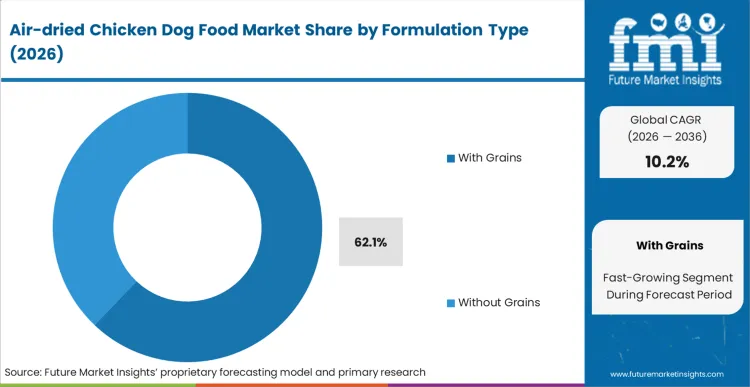
The With Grains segment is projected to account for 62.1% of the air-dried chicken dog food market in 2026, reaffirming its position as the category's dominant formulation type. Pet food manufacturers increasingly recognize the optimal balance of nutrition and cost-effectiveness offered by air-dried chicken dog food with grains for most consumer applications, particularly in home use and commercial pet food manufacturing processes. This formulation type addresses both dietary requirements and economic considerations while providing reliable performance across diverse canine nutrition applications.
This formulation type forms the foundation of most manufacturing protocols for pet food applications, as it represents the most widely accepted and commercially viable level of nutrition in the industry. Quality control standards and extensive feeding testing continue to strengthen confidence in grain formulations among pet food and canine nutrition manufacturers. With increasing recognition of the cost-performance optimization requirements in pet food manufacturing, With Grains air-dried chicken dog food aligns with both production efficiency and nutritional quality goals, making it the central growth driver of comprehensive pet nutrition strategies.
By Application, Home Use Segment Accounts for 58.3% Market Share
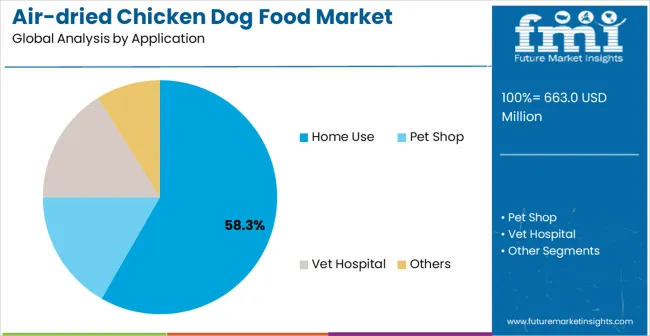
Home Use is projected to represent 58.3% of air-dried chicken dog food demand in 2026, underscoring its role as the primary application driving market adoption and growth. Pet food manufacturers recognize that consumer nutrition requirements, including specialized dietary modifications, premium protein sources, and multi-stage feeding processes, often require specialized chicken products that standard pet foods cannot adequately provide. Air-dried chicken offers enhanced nutritional retention and palatability in home-use pet nutrition applications.
The segment is supported by the growing nature of pet ownership, requiring sophisticated protein sources, and the increasing recognition that specialized processing methods can improve nutritional quality and pet health outcomes. The pet owners are increasingly adopting evidence-based feeding guidelines that recommend specific protein sources for optimal nutrition outcomes. As understanding of canine nutrition complexity advances and veterinary requirements become more stringent, air-dried chicken will continue to play a crucial role in comprehensive nutrition strategies within the premium pet food market.
What are the Drivers, Restraints, and Key Trends of the Air-dried Chicken Dog Food Market?
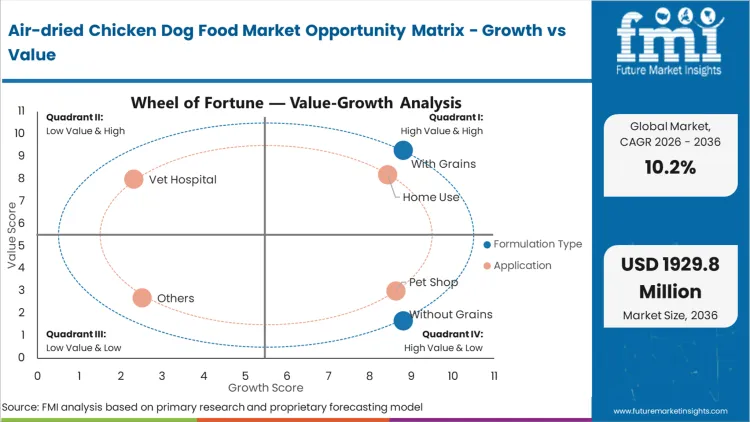
The market is advancing steadily due to increasing recognition of the importance of natural protein processing methods and growing demand for high-quality nutrition sources across the pet food and canine care sectors. The market faces challenges, including complex air-drying processes, potential for quality variations during storage and transportation, and concerns about supply chain consistency for specialized pet food products. Innovation in processing technologies and customized nutrition protocols continues to influence product development and market expansion patterns.
Expansion of Specialized Pet Food Manufacturing and Processing Technologies
The growing adoption of advanced pet food manufacturing facilities is enabling the development of more sophisticated air-dried chicken production and quality control systems that can meet stringent pet nutrition requirements. Specialized manufacturing plants offer comprehensive processing services, including advanced air-drying and preservation processes that are particularly important for achieving high-quality requirements in pet food applications. Advanced processing channels provide access to premium grades that can optimize nutritional performance and reduce artificial preservatives while maintaining cost-effectiveness for large-scale production.
Integration of Digital Quality Control and Manufacturing Management Systems
Modern pet food companies are incorporating digital technologies such as real-time quality monitoring, automated production control systems, and supply chain integration to enhance air-dried chicken manufacturing and distribution processes. These technologies improve product consistency, enable continuous quality assurance, and provide better coordination between manufacturers and customers throughout the supply chain. Advanced digital platforms also enable customized nutritional specifications and early identification of potential quality deviations or supply disruptions, supporting reliable pet nutrition production.
Analysis of the Air-dried Chicken Dog Food Market by Key Country
.webp "Top Country Growth Comparison Air Dried Chicken Dog Food Market Cagr (2026 2036)")
| Country | CAGR |
|---|---|
| China | 13.8% |
| India | 12.8% |
| Germany | 11.7% |
| Brazil | 10.7% |
| USA | 9.7% |
| UK | 8.7% |
| Japan | 7.7% |
Source: FMI analysis based on primary research and proprietary forecasting model
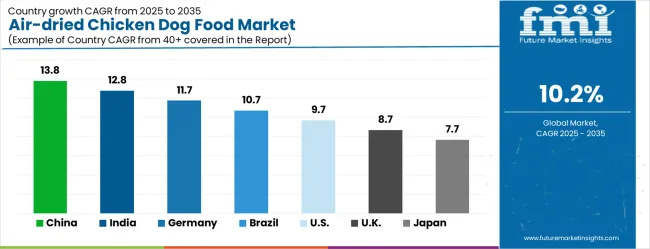
The market is experiencing varied growth globally, with China leading at a 13.8% CAGR through 2036, driven by expanding pet ownership, increasing premium pet food manufacturing infrastructure, and growing domestic demand for high-quality protein sources. India follows at 12.8%, supported by pet industry expansion, increasing recognition of the importance of specialized pet nutrition, and expanding manufacturing capacity. Germany shows growth at 11.7%, prioritizing advanced pet food manufacturing technologies and premium nutrition applications. Brazil records 10.7% growth, with a focus on developing the pet food and nutrition industries. The USA shows 9.7% growth, representing a mature market with established manufacturing patterns and regulatory frameworks. The UK exhibits 8.7% growth, supported by advanced manufacturing frameworks and comprehensive nutrition guidelines. Japan demonstrates 7.7% growth, focusing precision pet food manufacturing infrastructure and systematic quality control approaches.
The report covers an in-depth analysis of 40+ countries; top-performing countries are highlighted below.
Growth Outlook for Air-dried Chicken Dog Food Market in China
China is projected to exhibit robust growth with a CAGR of 13.8% through 2036, driven by ongoing pet ownership expansion and increasing recognition of premium protein sources as essential nutrition components for comprehensive canine care processes. The country's expanding pet food manufacturing infrastructure and growing availability of specialized processing capabilities are creating significant opportunities for air-dried chicken adoption across both domestic and export-oriented production facilities. Major international and domestic pet food companies are establishing comprehensive production and distribution networks to serve the growing population of pet owners and pet care manufacturers requiring high-quality protein sources across consumer and professional applications throughout China's major urban centers.
The Chinese government's strategic focus on pet industry development and food safety standards is driving substantial investments in specialized protein processing capabilities. This policy support, combined with the country's large domestic pet population and expanding middle-class disposable income, creates a favorable environment for air-dried chicken dog food market development. Chinese manufacturers are increasingly focusing on premium pet nutrition products to meet rising consumer expectations, with air-dried chicken representing a key component in this quality transformation.
- Government initiatives supporting pet industry development and food safety modernization are driving demand for high-quality protein sources throughout major urban and suburban centers, including Beijing, Shanghai, and Guangzhou regions.
- Manufacturing capacity expansion and quality control system development are supporting appropriate utilization of air-dried chicken among pet food companies and nutrition manufacturers nationwide, with particular growth in premium pet food production and specialized nutrition services.
Market Potential of Air-dried Chicken Dog Food in India
India is expanding at a CAGR of 12.8%, supported by increasing pet ownership accessibility, growing premium pet nutrition awareness, and developing consumer market presence across the country's major urban centers. The country's large and growing middle class and increasing recognition of specialized pet nutrition are driving demand for effective, high-quality protein solutions in both consumer and professional pet care applications. International pet food companies and domestic manufacturers are establishing comprehensive distribution channels to serve the growing demand for quality pet nutrition products while supporting the country's position as an emerging pet food market.
India's pet industry continues to benefit from urbanization trends, increasing disposable income, and changing lifestyle patterns that favor pet ownership. The country's focus on food safety and quality standards is driving investments in specialized protein processing and quality infrastructure. This development is particularly important for air-dried chicken applications, as pet food manufacturers seek reliable domestic sources for critical protein ingredients to reduce import dependency and improve supply chain security.
- Rising awareness about premium pet nutrition options and improving manufacturing capabilities are creating opportunities for specialized protein sources across pet food and nutrition settings in major cities like Mumbai, Delhi, and Bangalore.
- Growing manufacturing infrastructure development and technology adoption are supporting increased access to high-quality air-dried chicken among companies requiring comprehensive pet nutrition capabilities, particularly in premium pet food production and specialized dietary applications.
Opportunity Analysis of Air-dried Chicken Dog Food Market in Germany
Germany is projected to grow at a CAGR of 11.7%, supported by well-established pet food manufacturing systems and premium nutrition protocols that prioritize quality, consistency, and regulatory compliance. German pet food manufacturers consistently utilize high-quality protein sources for premium nutrition applications and advanced pet food manufacturing, with particular strength in specialty pet foods and high-value nutrition products. The market is characterized by mature manufacturing protocols, comprehensive quality standards, and established relationships between pet food companies and nutrition manufacturers that support long-term supply agreements and technical collaboration.
Germany's pet food industry benefits from advanced research and development capabilities, sophisticated manufacturing infrastructure, and strong regulatory frameworks that support high-quality pet food production. The country's focus on innovation and sustainability is driving the development of more efficient processing methods and cleaner production techniques for specialized proteins like air-dried chicken. This focus on technological advancement and environmental responsibility aligns with global trends toward ecofriendly pet food manufacturing practices.
- Evidence-based nutrition guidelines and pet food research are supporting continued utilization of proven high-quality proteins throughout consumer systems, with particular focus on premium applications requiring stringent quality specifications.
- Specialty pet food networks and manufacturing organizations are facilitating access to air-dried chicken while ensuring appropriate quality control and supply chain management, supported by Germany's strong logistics infrastructure and regulatory expertise.
Sales Evaluation of Air-dried Chicken Dog Food Market in Brazil
Brazil is projected to grow at a CAGR of 10.7% through 2036, driven by pet industry development, increasing access to premium pet nutrition capabilities, and growing recognition of specialized proteins' importance in comprehensive canine care applications. Brazilian pet food manufacturers are increasingly adopting high-quality protein approaches for premium nutrition applications, supported by expanding pet ownership and improved manufacturing accessibility across the country's major urban regions. The market benefits from Brazil's large domestic pet population and growing participation in regional pet food supply chains.
Brazil's pet industry is experiencing modernization and expansion, particularly in premium pet foods and specialty nutrition products. The country's strategic location and trade agreements provide access to both domestic and export markets, creating opportunities for air-dried chicken suppliers. Government support for the pet industry and food safety development, combined with increasing private sector investment, is driving infrastructure improvements and capacity expansion in specialized protein processing.
- Industry development programs and pet food manufacturing access initiatives are supporting increased availability of air-dried chicken across diverse nutrition applications, with particular growth in premium pet food production and specialized dietary services.
- Growing collaboration between international pet food companies and local manufacturers is enhancing nutrition options and technical expertise in high-quality protein management, supported by technology transfer initiatives and joint venture partnerships.
Growth Assessment of Air-dried Chicken Dog Food Market in the United States
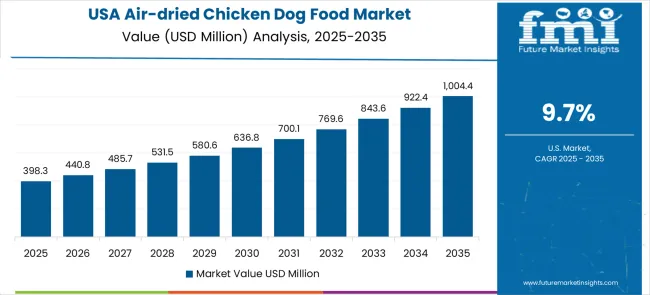
The USA is projected to grow at a CAGR of 9.7% through 2036, supported by established pet food manufacturing systems, evidence-based nutrition protocols, and comprehensive pet care frameworks that prioritize quality, safety, and regulatory compliance. American pet food manufacturers consistently utilize high-quality proteins as part of integrated nutrition approaches, focusing health outcomes and quality optimization in both commercial and premium pet food productions. The market benefits from strong research and development capabilities, advanced manufacturing infrastructure, and well-established regulatory frameworks.
The USA pet food industry's focus on innovation and quality drives demand for specialized proteins that can support premium nutrition processes and meet stringent regulatory requirements. The country's mature market characteristics include established supplier relationships, comprehensive quality standards, and sophisticated logistics networks that support reliable supply chain management for critical pet food ingredients.
- Regulatory frameworks supporting appropriate protein utilization and comprehensive quality coverage are maintaining stable market growth across manufacturing sectors, with particular focus on FDA compliance and Good Manufacturing Practice requirements.
- Pet food research collaboration and evidence-based nutrition guideline development are supporting continued innovation and appropriate utilization of air-dried chicken in premium and specialty pet food applications throughout major manufacturing centers.
In-depth Analysis of Air-dried Chicken Dog Food Market in the United Kingdom
The UK is projected to grow at a CAGR of 8.7% through 2036, supported by advanced manufacturing frameworks and comprehensive evidence-based nutrition guidelines that facilitate the appropriate use of high-quality proteins for premium pet food manufacturing applications. British pet food manufacturers consistently utilize established protocols for protein management, focusing nutrition outcomes and quality optimization within integrated manufacturing systems that support both domestic pet food production and export markets. The country benefits from strong research capabilities, established pet food clusters, and comprehensive regulatory support.
The UK's pet food and nutrition industries are characterized by high levels of innovation, strong academic-industry collaboration, and focus on premium specialty products. The country's regulatory environment has created both challenges and opportunities, with increased focus on domestic supply chain development and quality standards driving investments in specialized protein processing capabilities.
- Manufacturing pathways and nutrition guidelines are supporting systematic adoption of proven high-quality proteins across pet food and nutrition manufacturing services, with particular focus on premium pet foods and specialized dietary operations.
- Manufacturing education programs and nutrition research initiatives are maintaining high standards for protein utilization and quality monitoring, supported by collaborations between industry, academia, and regulatory agencies.
Demand Outlook for Air-dried Chicken Dog Food Market in Japan
Japan is projected to grow at a CAGR of 7.7% through 2036, supported by the country's well-established precision pet food manufacturing infrastructure, comprehensive quality coverage, and systematic approach to pet nutrition that prioritizes consistency, reliability, and technical excellence. Japanese pet food manufacturers prioritize evidence-based protein utilization within structured manufacturing frameworks that prioritize nutrition effectiveness and product quality in both premium and specialty pet food applications. The market is characterized by high technical standards, established quality systems, and long-term supplier relationships.
Japan's pet food industry benefits from advanced technology, sophisticated quality control systems, and a strong focus on continuous improvement. The country's aging population and focus on pet health create steady demand for premium pet nutrition products, while the focus on high-quality manufacturing supports premium pricing for specialized protein products like air-dried chicken.
- Comprehensive manufacturing system coordination and regulatory oversight are supporting stable utilization of high-quality proteins across diverse pet food manufacturing settings and applications, with particular strength in premium and specialty pet food production.
- Academic research centers and manufacturing institutions are maintaining leadership in protein research and nutrition protocol development for optimal health outcomes, supported by strong government funding for pet food research and development programs.
Europe Market Split by Country
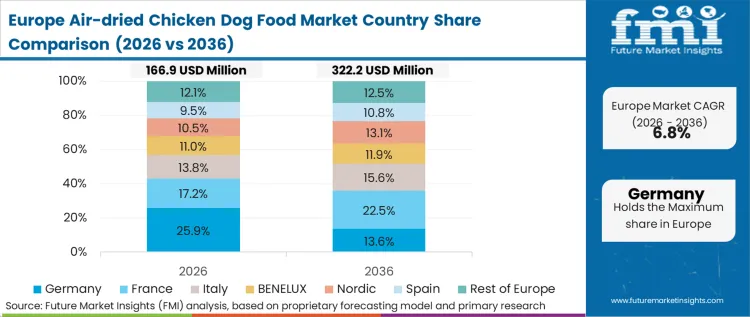
The air-dried chicken dog food market in Europe is projected to grow from USD 142.0 million in 2026 to USD 375.6 million by 2036, registering a CAGR of 10.2% over the forecast period. Germany is expected to maintain its leadership position with a 28.5% market share in 2026, rising to 29.1% by 2036, supported by its advanced pet food manufacturing infrastructure, premium nutrition capabilities, and strong pet industry presence throughout major urban regions.
The United Kingdom follows with a 21.3% share in 2026, projected to reach 21.8% by 2036, driven by advanced manufacturing protocols, pet food innovation integration, and expanding specialty nutrition networks serving both domestic and international markets. France holds an 18.2% share in 2026, expected to increase to 18.6% by 2036, supported by pet industry expansion and growing adoption of premium protein sources. Italy commands a 14.1% share in 2026, projected to reach 14.3% by 2036, while Spain accounts for 9.7% in 2026, expected to reach 9.9% by 2036. The BENELUX region is expected to maintain a 4.8% share in 2026, growing to 5.1% by 2036, supported by innovation-friendly regulatory frameworks and strong academic-industry collaboration. The Rest of Europe region, including Nordic countries, Eastern Europe, and smaller Western European markets, is anticipated to hold 3.4% in 2026, declining slightly to 3.2% by 2036, attributed to market consolidation toward larger core markets with established pet food and nutrition manufacturing capabilities.
Competitive Landscape of the Air-dried Chicken Dog Food Market
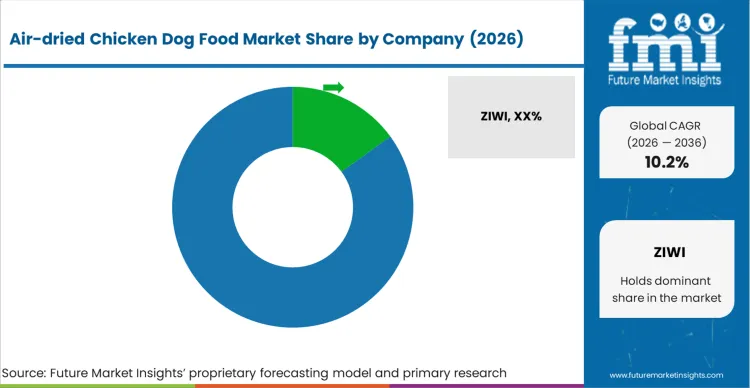
The market is characterized by competition among established pet food manufacturers, specialty nutrition companies, and protein processing suppliers focused on delivering high-quality, consistent, and reliable protein sources. Companies are investing in processing technology advancement, quality control enhancement, strategic partnerships, and customer technical support to deliver effective, pure, and reliable air-dried chicken solutions that meet stringent pet nutrition and food manufacturing requirements. Protein processing optimization, quality validation protocols, and supply chain strategies are central to strengthening product portfolios and market presence.
China Pet Foods (ZEAL) leads the market with comprehensive high-quality protein offerings with a focus on quality, consistency, and manufacturing reliability for pet food applications. Peidi provides specialized air-dried chicken products with focus on premium nutrition applications and comprehensive technical support services. Gambol Pet Group focuses on advanced processing technologies and customized nutrition solutions for protein products serving Asian markets. Jasper delivers established protein products with strong quality control systems and customer service capabilities.
Peptido operates with a focus on bringing innovative protein processing technologies to specialized nutrition applications and emerging markets. Open Farm provides comprehensive pet nutrition portfolios, including air-dried chicken, across multiple consumer applications and premium pet food processes. ZIWI specializes in customized nutrition solutions and quality management systems for protein products with focus on premium compliance. Sundays for Dogs provides reliable supply chain solutions and technical expertise to enhance market accessibility and customer access to essential protein sources.
Air-Dried Chicken Dog Food Market - Stakeholder Contribution Framework
Air-dried chicken dog food represents a premium pet nutrition segment focused on natural protein preservation and enhanced nutritional retention, with the market projected to grow from USD 663.0 million in 2026 to USD 1,751.1 million by 2036 at a 10.2% CAGR. As pet humanization trends accelerate and demand for natural, minimally processed pet foods increases, scaling this market requires coordinated action across pet food manufacturers, veterinary professionals, retail channels, regulatory bodies, ingredient suppliers, and investment partners to address challenges in processing technology, supply chain consistency, nutritional validation, and consumer education.
How Pet Food Manufacturers Could Drive Innovation and Quality?
Advanced Processing Technology: Invest in state-of-the-art air-drying facilities that maintain precise temperature and humidity control, ensuring optimal protein retention while eliminating pathogens. Develop proprietary processing methods that preserve nutritional integrity, enhance palatability, and extend shelf life without artificial preservatives.
Supply Chain Integration: Establish direct relationships with chicken suppliers that meet specific quality standards for air-drying applications, including free-range, organic, and antibiotic-free sources. Implement vertical integration strategies that control the entire process from farm to finished product, ensuring consistent quality and traceability.
Formulation Innovation: Develop specialized air-dried chicken formulations tailored to different life stages, breed sizes, and health conditions. Create grain-inclusive and grain-free options that address diverse dietary needs while maintaining optimal nutritional balance and digestibility.
Quality Assurance Systems: Implement comprehensive testing protocols that verify protein content, moisture levels, microbiological safety, and nutritional consistency across production batches. Establish rigorous supplier qualification and ongoing monitoring programs for all ingredients.
Ecofriendly Initiatives: Develop environmentally responsible processing methods that minimize energy consumption, reduce waste generation, and utilize renewable energy sources. Create packaging solutions that maintain product integrity while lowering environmental impact.
How Veterinary Professionals Could Support Market Education?
Clinical Research Programs: Conduct and support research studies that demonstrate the nutritional benefits, digestibility advantages, and health outcomes associated with air-dried chicken diets compared to traditional pet food processing methods.
Professional Education: Develop continuing education programs for veterinarians on the science behind air-drying technology, nutritional advantages, and appropriate clinical applications for different patient conditions and dietary requirements.
Client Consultation Services: Provide evidence-based guidance to pet owners on selecting appropriate air-dried chicken formulations based on individual pet needs, health status, and life stage requirements, supporting informed decision-making.
Nutritional Assessment Tools: Create standardized protocols for evaluating pet nutritional status and monitoring health outcomes when transitioning to or maintaining air-dried chicken diets, enabling objective assessment of dietary effectiveness.
Industry Collaboration: Partner with manufacturers on product development, nutritional validation, and clinical trials that advance the scientific understanding of air-dried pet nutrition and support evidence-based product claims.
How Retail Partners Could Optimize Market Access?
Premium Positioning Strategies: Develop dedicated premium pet nutrition sections that showcase air-dried chicken products with appropriate educational materials, prioritizing quality differentiation and nutritional advantages over conventional options.
Staff Training Programs: Implement comprehensive training for retail staff on air-dried processing benefits, nutritional advantages, feeding guidelines, and appropriate product recommendations based on pet-specific requirements.
Consumer Education Initiatives: Create in-store educational displays, feeding trials, and consultation services that help pet owners understand the value proposition of air-dried chicken products and proper transition protocols.
Supply Chain Management: Establish inventory management systems that ensure product freshness, proper storage conditions, and adequate stock levels to meet growing consumer demand while minimizing waste and stockouts.
Digital Integration: Develop online platforms and mobile applications that provide product information, feeding calculators, nutritional comparisons, and convenient ordering options for premium pet food customers.
How Regulatory Bodies Could Ensure Market Standards?
Processing Guidelines: Establish specific regulatory standards for air-drying processing parameters, including temperature controls, moisture specifications, and pathogen elimination requirements that ensure product safety while preserving nutritional value.
Nutritional Standards: Develop comprehensive nutritional adequacy standards for air-dried pet foods that account for the unique characteristics of the processing method and ensure complete and balanced nutrition for different life stages.
Labeling Requirements: Create clear labeling standards that accurately communicate processing methods, nutritional claims, and feeding instructions while preventing misleading marketing that could confuse consumers about product benefits.
Safety Monitoring: Implement robust surveillance systems that monitor product safety, track adverse events, and ensure compliance with established processing and nutritional standards across the industry.
International Harmonization: Work toward harmonized international standards for air-dried pet foods that facilitate trade while maintaining high safety and quality standards across different markets and regulatory jurisdictions.
How Ingredient Suppliers Could Strengthen the Supply Chain?
Quality Certification Programs: Develop comprehensive certification systems for chicken sources used in air-dried applications, including animal welfare standards, feed quality requirements, and processing facility audits that ensure consistent raw material quality.
Traceability Systems: Implement end-to-end traceability programs that document the complete supply chain from farm to processing facility, enabling rapid response to quality issues and supporting premium positioning claims.
Specialized Production: Develop dedicated production lines for air-dried applications that optimize chicken characteristics for processing effectiveness, including moisture content, protein quality, and fat distribution, that enhance final product quality.
Technical Support Services: Provide comprehensive technical assistance to manufacturers on raw material handling, processing optimization, and quality troubleshooting that maximizes yield and product consistency.
Innovation Partnerships: Collaborate with manufacturers and research institutions on developing improved chicken strains, feed formulations, and processing methods that enhance the nutritional and functional properties of air-dried products.
How Investment Partners Could Accelerate Market Development?
Manufacturing Infrastructure: Finance, construction, and expansion of specialized air-drying facilities with advanced technology, quality control systems, and capacity to meet projected demand growth in key geographic markets.
Technology Development: Support research and development of breakthrough air-drying technologies, packaging innovations, and quality assurance systems that improve product quality while reducing manufacturing costs and environmental impact.
Market Expansion Capital: Provide funding for manufacturers seeking to enter new geographic markets, establish distribution networks, and build brand recognition in emerging premium pet food segments.
Supply Chain Investment: Back vertical integration initiatives, supplier development programs, and logistics infrastructure that enhance supply chain reliability and quality control throughout the production process.
Consumer Education Funding: Support comprehensive marketing and education campaigns that build consumer awareness of air-dried benefits, address misconceptions, and drive adoption across different consumer segments and geographic markets.
Regional Development Priorities
Asia-Pacific Leadership: Leverage China's 13.8% CAGR and India's 12.8% growth by supporting technology transfer initiatives, quality infrastructure development, and regulatory framework establishment that enables domestic production while meeting international quality standards.
European Premium Focus: Build on Germany's 11.7% growth and established pet food expertise by promoting advanced processing technologies, green initiatives, and premium positioning strategies that set global benchmarks for air-dried pet nutrition.
Americas Market Maturation: Support Brazil's 10.7% growth potential and USA market stability by facilitating technology sharing, regulatory harmonization, and integrated supply chain development that optimizes production efficiency and market accessibility.
Emerging Market Development: Address infrastructure limitations in developing regions through targeted investment in processing facilities, technical training programs, and regulatory capacity building that enables local production while maintaining quality standards.
Cross-Industry Collaboration Initiatives
Research Consortia: Establish collaborative research programs between universities, manufacturers, and veterinary institutions focused on advancing the science of air-dried nutrition, processing optimization, and health outcome validation.
Ecofriendly Partnerships: Create industry-wide initiatives that address environmental impact through improved processing efficiency, green packaging development, and responsible sourcing practices that support long-term market viability.
Quality Standardization: Develop industry associations and standards bodies that establish uniform quality metrics, testing protocols, and certification programs that build consumer confidence and facilitate trade across different markets.
Consumer Advocacy: Support pet owner education initiatives that provide objective information about pet nutrition, processing methods, and product selection criteria that enable informed decision-making and support market growth.
The robust 10.2% CAGR reflects significant growth potential driven by premiumization trends, but success requires stakeholder collaboration to address quality consistency, consumer education, and sustainable scaling challenges while maintaining the nutritional and safety advantages that differentiate air-dried products from conventional alternatives.
Key Players in the Air-dried Chicken Dog Food Market
- ZIWI
- ZEAL / China Pet Foods
- Gambol Pet Group
- Open Farm
- Carna4
- The New Zealand Natural Pet Food
- Sundowns for Dogs (or “Sundays for Dogs”)
- The Real Meat Company
- Redbarn
- Only Natural Pet
- Earth Animal
- A Pup Above
Scope of the Report
| Metric | Value |
|---|---|
| Quantitative Units | USD 730.6 Mn to USD 1929.8 Mn, at a CAGR of 10.2% |
| Market Definition | The air-dried chicken dog food market covers commercially manufactured dog food products made from chicken as the primary protein source and preserved through low-temperature air-drying processes. Air drying removes moisture at temperatures typically below 70 degrees Celsius, retaining more native nutrients, enzymes, and flavour compared to conventional kibble extrusion. |
| Formulation Type Segmentation | With Grains, Without Grains |
| Application Segmentation | Home Use, Pet Shop, Vet Hospital, Others |
| Regions Covered | North America, Latin America, Europe, East Asia, South Asia, Oceania, Middle East & Africa |
| Countries Covered | China, India, Germany, Brazil, USA, UK, Japan, and 40 plus countries |
| Key Companies Profiled | ZIWI, ZEAL / China Pet Foods, Gambol Pet Group, Open Farm, Carna4, The New Zealand Natural Pet Food, Sundowns for Dogs (or “Sundays for Dogs”), The Real Meat Company, Redbarn, Only Natural Pet, Earth Animal, A Pup Above |
| Forecast Period | 2026 to 2036 |
| Approach | Hybrid top-down and bottom-up modelling starting with trade volumes, production data, and consumption estimates, cross-validated against primary interviews and public financial disclosures. |
Air-dried Chicken Dog Food Market by Segments
Formulation Type:
- With Grains
- Without Grains
Application:
- Home Use
- Pet Shop
- Vet Hospital
- Others
Region:
Asia Pacific
- China
- India
- Japan
- South Korea
- ASEAN
- Australia & New Zealand
- Rest of Asia Pacific
North America
- United States
- Canada
- Mexico
Europe
- Germany
- United Kingdom
- France
- Italy
- Spain
- Nordic
- BENELUX
- Rest of Europe
Latin America
- Brazil
- Argentina
- Chile
- Rest of Latin America
Middle East & Africa
- Kingdom of Saudi Arabia
- Other GCC Countries
- Turkey
- South Africa
- Other African Countries
- Rest of Middle East & Africa
Bibliography
- 1. Food and Agriculture Organization of the United Nations. (2024). FAOSTAT Statistical Database. FAO.
- 2. World Health Organization. (2024). Global Health Observatory Data Repository. WHO.
- 3. Organisation for Economic Co-operation and Development. (2024). OECD-FAO Agricultural Outlook 2024-2033. OECD Publishing.
- 4. European Commission, Directorate-General for Health and Food Safety. (2024). EU Animal Feed and Food Safety Regulations. European Commission.
- 5. United States Food and Drug Administration. (2024). Animal Food and Feed Guidance Documents. FDA.
- 6. United States Department of Agriculture. (2024). Livestock, Poultry, and Grain Market News. USDA.
- 7. International Organization for Standardization. (2024). ISO 22000 Food Safety Management Systems. ISO.
This bibliography is provided for reader reference. The full FMI report contains the complete reference list with primary research documentation.
Frequently Asked Questions
How large is the demand for Air-dried Chicken Dog Food in the global market in 2026?
Demand for Air-dried Chicken Dog Food in the global market is estimated to be valued at USD 730.6 million in 2026.
What will be the market size of Air-dried Chicken Dog Food in the global market by 2036?
Market size for Air-dried Chicken Dog Food is projected to reach USD 1929.8 million by 2036.
What is the expected demand growth for Air-dried Chicken Dog Food in the global market between 2026 and 2036?
Demand for Air-dried Chicken Dog Food is expected to grow at a CAGR of 10.2% between 2026 and 2036.
Which Formulation Type is poised to lead global sales by 2026?
With Grains accounts for 62.1% share in 2026 based on FMI analysis.
How is the role of Home Use in driving Air-dried Chicken Dog Food adoption in 2026?
Home Use represents 58.3% of application segment share in 2026.
What is driving demand in China?
China leads with a 13.8% CAGR through 2036, driven by expanding domestic consumption, production capacity additions, and favourable regulatory dynamics.
What is the India growth outlook in this report?
India is projected to grow at a CAGR of 12.8% during 2026 to 2036.
Why is North America described as a priority region in this report?
North American markets are characterized by mature distribution infrastructure, stringent quality and safety requirements, and sustained institutional demand that anchors a stable revenue base for industry participants.
Does the report cover USA in its regional analysis?
Yes, USA is included within North America under the regional scope of analysis.
Does the report cover Germany in its regional analysis?
Yes, Germany is included within Europe under the regional coverage framework.
What is Air-dried Chicken Dog Food and what is it mainly used for?
The air-dried chicken dog food market covers commercially manufactured dog food products made from chicken as the primary protein source and preserved through low-temperature air-drying processes. Air drying removes moisture at temperatures typically below 70 degrees Celsius, retaining more native nutrients, enzymes, and flavour compared to conventional kibble extrusion.
What is included in the scope of this Air-dried Chicken Dog Food Market report?
Market scope covers air-dried chicken dog food by formulation type (with grains, without grains) and by application channel (home use, pet shop, vet hospital, others). Global and regional market sizing, premiumisation trend analysis, and distribution channel mapping are included.
What is excluded from the scope of this report?
The scope excludes freeze-dried dog food (which uses sublimation rather than air drying), conventional extruded kibble, wet/canned dog food, and raw frozen dog food. Air-dried dog treats and air-dried dog food using protein sources other than chicken (beef, lamb, venison, fish) as the primary ingredient fall outside this specific market boundary.
How does FMI build and validate the Air-dried Chicken Dog Food forecast?
Forecasting models apply a hybrid top-down and bottom-up methodology starting with trade data, production volumes, and consumption estimates, cross-validated against primary interviews and publicly reported industry data.
What does zero reliance on speculative third-party market research mean here?
Primary interviews, verified public data sources, and official regulatory and trade registries are used exclusively instead of unverified syndicated estimates.
Preview the report firsthand - request a free sample
Get SampleGet the brochure for pricing and purchase details.
Get PDFTable of Content
- Executive Summary
- Global Market Outlook
- Demand-side Trends
- Supply-side Trends
- Technology Roadmap Analysis
- Analysis and Recommendations
- Market Overview
- Market Coverage / Taxonomy
- Market Definition / Scope / Limitations
- Research Methodology
- Chapter Orientation
- Analytical Lens and Working Hypotheses
- Market Structure, Signals, and Trend Drivers
- Benchmarking and Cross-market Comparability
- Market Sizing, Forecasting, and Opportunity Mapping
- Research Design and Evidence Framework
- Desk Research Programme (Secondary Evidence)
- Company Annual and Sustainability Reports
- Peer-reviewed Journals and Academic Literature
- Corporate Websites, Product Literature, and Technical Notes
- Earnings Decks and Investor Briefings
- Statutory Filings and Regulatory Disclosures
- Technical White Papers and Standards Notes
- Trade Journals, Industry Magazines, and Analyst Briefs
- Conference Proceedings, Webinars, and Seminar Materials
- Government Statistics Portals and Public Data Releases
- Press Releases and Reputable Media Coverage
- Specialist Newsletters and Curated Briefings
- Sector Databases and Reference Repositories
- FMI Internal Proprietary Databases and Historical Market Datasets
- Subscription Datasets and Paid Sources
- Social Channels, Communities, and Digital Listening Inputs
- Additional Desk Sources
- Expert Input and Fieldwork (Primary Evidence)
- Primary Modes
- Qualitative Interviews and Expert Elicitation
- Quantitative Surveys and Structured Data Capture
- Blended Approach
- Why Primary Evidence is Used
- Field Techniques
- Interviews
- Surveys
- Focus Groups
- Observational and In-context Research
- Social and Community Interactions
- Stakeholder Universe Engaged
- C-suite Leaders
- Board Members
- Presidents and Vice Presidents
- R&D and Innovation Heads
- Technical Specialists
- Domain Subject-matter Experts
- Scientists
- Physicians and Other Healthcare Professionals
- Governance, Ethics, and Data Stewardship
- Research Ethics
- Data Integrity and Handling
- Primary Modes
- Tooling, Models, and Reference Databases
- Desk Research Programme (Secondary Evidence)
- Data Engineering and Model Build
- Data Acquisition and Ingestion
- Cleaning, Normalisation, and Verification
- Synthesis, Triangulation, and Analysis
- Quality Assurance and Audit Trail
- Market Background
- Market Dynamics
- Drivers
- Restraints
- Opportunity
- Trends
- Scenario Forecast
- Demand in Optimistic Scenario
- Demand in Likely Scenario
- Demand in Conservative Scenario
- Opportunity Map Analysis
- Product Life Cycle Analysis
- Supply Chain Analysis
- Investment Feasibility Matrix
- Value Chain Analysis
- PESTLE and Porter’s Analysis
- Regulatory Landscape
- Regional Parent Market Outlook
- Production and Consumption Statistics
- Import and Export Statistics
- Market Dynamics
- Global Market Analysis 2021 to 2025 and Forecast, 2026 to 2036
- Historical Market Size Value (USD Million) Analysis, 2021 to 2025
- Current and Future Market Size Value (USD Million) Projections, 2026 to 2036
- Y-o-Y Growth Trend Analysis
- Absolute $ Opportunity Analysis
- Global Market Pricing Analysis 2021 to 2025 and Forecast 2026 to 2036
- Global Market Analysis 2021 to 2025 and Forecast 2026 to 2036, By Formulation Type
- Introduction / Key Findings
- Historical Market Size Value (USD Million) Analysis By Formulation Type , 2021 to 2025
- Current and Future Market Size Value (USD Million) Analysis and Forecast By Formulation Type , 2026 to 2036
- With Grains
- Without Grains
- With Grains
- Y-o-Y Growth Trend Analysis By Formulation Type , 2021 to 2025
- Absolute $ Opportunity Analysis By Formulation Type , 2026 to 2036
- Global Market Analysis 2021 to 2025 and Forecast 2026 to 2036, By Application
- Introduction / Key Findings
- Historical Market Size Value (USD Million) Analysis By Application, 2021 to 2025
- Current and Future Market Size Value (USD Million) Analysis and Forecast By Application, 2026 to 2036
- Home Use
- Pet Shop
- Vet Hospital
- Others
- Home Use
- Y-o-Y Growth Trend Analysis By Application, 2021 to 2025
- Absolute $ Opportunity Analysis By Application, 2026 to 2036
- Global Market Analysis 2021 to 2025 and Forecast 2026 to 2036, By Region
- Introduction
- Historical Market Size Value (USD Million) Analysis By Region, 2021 to 2025
- Current Market Size Value (USD Million) Analysis and Forecast By Region, 2026 to 2036
- North America
- Latin America
- Western Europe
- Eastern Europe
- East Asia
- South Asia and Pacific
- Middle East & Africa
- Market Attractiveness Analysis By Region
- North America Market Analysis 2021 to 2025 and Forecast 2026 to 2036, By Country
- Historical Market Size Value (USD Million) Trend Analysis By Market Taxonomy, 2021 to 2025
- Market Size Value (USD Million) Forecast By Market Taxonomy, 2026 to 2036
- By Country
- USA
- Canada
- Mexico
- By Formulation Type
- By Application
- By Country
- Market Attractiveness Analysis
- By Country
- By Formulation Type
- By Application
- Key Takeaways
- Latin America Market Analysis 2021 to 2025 and Forecast 2026 to 2036, By Country
- Historical Market Size Value (USD Million) Trend Analysis By Market Taxonomy, 2021 to 2025
- Market Size Value (USD Million) Forecast By Market Taxonomy, 2026 to 2036
- By Country
- Brazil
- Chile
- Rest of Latin America
- By Formulation Type
- By Application
- By Country
- Market Attractiveness Analysis
- By Country
- By Formulation Type
- By Application
- Key Takeaways
- Western Europe Market Analysis 2021 to 2025 and Forecast 2026 to 2036, By Country
- Historical Market Size Value (USD Million) Trend Analysis By Market Taxonomy, 2021 to 2025
- Market Size Value (USD Million) Forecast By Market Taxonomy, 2026 to 2036
- By Country
- Germany
- UK
- Italy
- Spain
- France
- Nordic
- BENELUX
- Rest of Western Europe
- By Formulation Type
- By Application
- By Country
- Market Attractiveness Analysis
- By Country
- By Formulation Type
- By Application
- Key Takeaways
- Eastern Europe Market Analysis 2021 to 2025 and Forecast 2026 to 2036, By Country
- Historical Market Size Value (USD Million) Trend Analysis By Market Taxonomy, 2021 to 2025
- Market Size Value (USD Million) Forecast By Market Taxonomy, 2026 to 2036
- By Country
- Russia
- Poland
- Hungary
- Balkan & Baltic
- Rest of Eastern Europe
- By Formulation Type
- By Application
- By Country
- Market Attractiveness Analysis
- By Country
- By Formulation Type
- By Application
- Key Takeaways
- East Asia Market Analysis 2021 to 2025 and Forecast 2026 to 2036, By Country
- Historical Market Size Value (USD Million) Trend Analysis By Market Taxonomy, 2021 to 2025
- Market Size Value (USD Million) Forecast By Market Taxonomy, 2026 to 2036
- By Country
- China
- Japan
- South Korea
- By Formulation Type
- By Application
- By Country
- Market Attractiveness Analysis
- By Country
- By Formulation Type
- By Application
- Key Takeaways
- South Asia and Pacific Market Analysis 2021 to 2025 and Forecast 2026 to 2036, By Country
- Historical Market Size Value (USD Million) Trend Analysis By Market Taxonomy, 2021 to 2025
- Market Size Value (USD Million) Forecast By Market Taxonomy, 2026 to 2036
- By Country
- India
- ASEAN
- Australia & New Zealand
- Rest of South Asia and Pacific
- By Formulation Type
- By Application
- By Country
- Market Attractiveness Analysis
- By Country
- By Formulation Type
- By Application
- Key Takeaways
- Middle East & Africa Market Analysis 2021 to 2025 and Forecast 2026 to 2036, By Country
- Historical Market Size Value (USD Million) Trend Analysis By Market Taxonomy, 2021 to 2025
- Market Size Value (USD Million) Forecast By Market Taxonomy, 2026 to 2036
- By Country
- Kingdom of Saudi Arabia
- Other GCC Countries
- Turkiye
- South Africa
- Other African Union
- Rest of Middle East & Africa
- By Formulation Type
- By Application
- By Country
- Market Attractiveness Analysis
- By Country
- By Formulation Type
- By Application
- Key Takeaways
- Key Countries Market Analysis
- USA
- Pricing Analysis
- Market Share Analysis, 2025
- By Formulation Type
- By Application
- Canada
- Pricing Analysis
- Market Share Analysis, 2025
- By Formulation Type
- By Application
- Mexico
- Pricing Analysis
- Market Share Analysis, 2025
- By Formulation Type
- By Application
- Brazil
- Pricing Analysis
- Market Share Analysis, 2025
- By Formulation Type
- By Application
- Chile
- Pricing Analysis
- Market Share Analysis, 2025
- By Formulation Type
- By Application
- Germany
- Pricing Analysis
- Market Share Analysis, 2025
- By Formulation Type
- By Application
- UK
- Pricing Analysis
- Market Share Analysis, 2025
- By Formulation Type
- By Application
- Italy
- Pricing Analysis
- Market Share Analysis, 2025
- By Formulation Type
- By Application
- Spain
- Pricing Analysis
- Market Share Analysis, 2025
- By Formulation Type
- By Application
- France
- Pricing Analysis
- Market Share Analysis, 2025
- By Formulation Type
- By Application
- India
- Pricing Analysis
- Market Share Analysis, 2025
- By Formulation Type
- By Application
- ASEAN
- Pricing Analysis
- Market Share Analysis, 2025
- By Formulation Type
- By Application
- Australia & New Zealand
- Pricing Analysis
- Market Share Analysis, 2025
- By Formulation Type
- By Application
- China
- Pricing Analysis
- Market Share Analysis, 2025
- By Formulation Type
- By Application
- Japan
- Pricing Analysis
- Market Share Analysis, 2025
- By Formulation Type
- By Application
- South Korea
- Pricing Analysis
- Market Share Analysis, 2025
- By Formulation Type
- By Application
- Russia
- Pricing Analysis
- Market Share Analysis, 2025
- By Formulation Type
- By Application
- Poland
- Pricing Analysis
- Market Share Analysis, 2025
- By Formulation Type
- By Application
- Hungary
- Pricing Analysis
- Market Share Analysis, 2025
- By Formulation Type
- By Application
- Kingdom of Saudi Arabia
- Pricing Analysis
- Market Share Analysis, 2025
- By Formulation Type
- By Application
- Turkiye
- Pricing Analysis
- Market Share Analysis, 2025
- By Formulation Type
- By Application
- South Africa
- Pricing Analysis
- Market Share Analysis, 2025
- By Formulation Type
- By Application
- USA
- Market Structure Analysis
- Competition Dashboard
- Competition Benchmarking
- Market Share Analysis of Top Players
- By Regional
- By Formulation Type
- By Application
- Competition Analysis
- Competition Deep Dive
- ZIWI
- Overview
- Product Portfolio
- Profitability by Market Segments (Product/Age /Sales Channel/Region)
- Sales Footprint
- Strategy Overview
- Marketing Strategy
- Product Strategy
- Channel Strategy
- ZEAL / China Pet Foods
- Gambol Pet Group
- Open Farm
- Carna4
- The New Zealand Natural Pet Food
- Sundowns for Dogs (or “Sundays for Dogs”)
- The Real Meat Company
- Redbarn
- Only Natural Pet
- Earth Animal
- A Pup Above
- ZIWI
- Competition Deep Dive
- Assumptions & Acronyms Used


