

- Market Size (2026)
- USD 277.1 Mn
- Forecast (2036)
- USD 438.6 Mn
- CAGR (2026 to 2036)
- 4.7%
How big is Airbrush Makeup Systems Market in 2026?
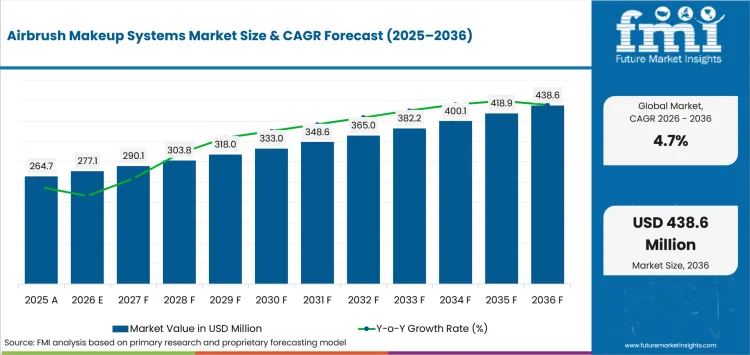
USD 277.1 million in 2026 and USD 438.6 million by 2036 at a 4.7% CAGR.
Demand for airbrush makeup systems is projected to expand at 4.7% CAGR between 2026 and 2036, increasing valuation from USD 277.1 million in 2026 to USD 438.6 million by 2036. Professional bridal workloads create a repeat-use route for airbrush systems that can be cleaned and redeployed across several client applications. TEMPTU documented in April 2026 that Tami Bernard’s bridal team airbrushes brides and bridesmaids during repeat wedding work. Personal adoption still depends on manageable training and cleaning.
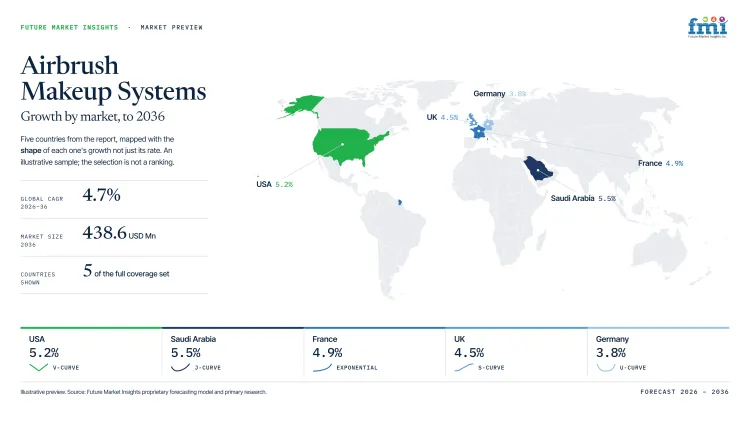
Country growth diverges because digital selling and local operating rules differ. UAE is forecast at 6.1% CAGR versus Germany at 3.8%. Dubai DET documented in November 2025 that Dubai Traders had onboarded more than 2,400 e-commerce sellers within twelve months. That seller base widens discovery for beauty and personal care products, though conversion still depends on local support and compliant bundled formulas.
Key Takeaways
- Portable airbrush equipment gains relevance because direct digital education lets users assess technique before committing to hardware.
- By product type, face brushes are estimated to hold 33.0% in 2026 owing to their broader role in complexion coverage.
- In 2026, at-home use is expected to lead use setting with 58.0% share because individual ownership reaches the larger purchasing base.
- Rechargeable cordless systems are set to lead power source with 59.0% share in 2026 due to mobility during application.
- Cleaning discipline and formula compatibility can reduce repeat use if owners cannot reproduce an even spray after setup.
- Key players in the airbrush makeup systems market include TEMPTU, LUMINESS, KETT Cosmetics, Kryolan, Graftobian, Aeroblend, Iwata-Medea, MAQPRO, Art of Air, and Belloccio.
Analyst Perspective
"Airbrush systems retain users after pressure control, cleaning, and formula replacement become predictable parts of the routine. Product teams comparing at-home beauty devices should assess training depth, refill continuity, service access, and portable power before treating hardware price as the main purchase criterion."
- Rahul Pandita, Principal Consultant, Future Market Insights
How is the airbrush makeup systems market segmented?
The market is segmented by Product Type, Use Setting, Power Source, Price Band, and Sales Channel.
Product type covers face brushes, eye brushes, brush sets, and vegan-fiber lines. Use setting includes at-home, professional & clinic, and hybrid prosumer demand. Power source separates rechargeable cordless, corded, and battery formats. Price band covers mid (USD 100-300), entry (below USD 100), and premium (above USD 300). Sales channel includes e-commerce & DTC, specialty beauty & electronics, professional distribution, and department stores.
What makes Face brushes central to the Product Type category?
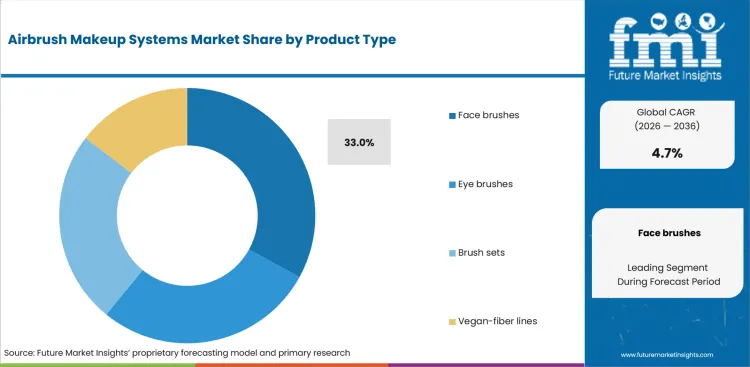
Face brushes cover full-complexion preparation and finishing, so they carry more routine work than eye-focused tools. Kryolan’s August 2025 Airbrush Basics session taught foundation, blush, contour, and highlight as core airbrush tasks. The sequence places broad-face technique at the start of professional qualification before narrower color placement.
- By product type, face brushes are estimated to hold 33.0% in 2026 owing to their wider role in base coverage and finishing.
- Artists qualify the format through even coverage first, then move into detailed placement once spray control is stable.
Why does At-home lead the Use Setting category?
Personal ownership depends on whether a user can set up, spray, clean, and store the system without professional assistance. TEMPTU’s July 2026 comparison placed airbrush makeup inside the at-home foundation conversation while noting a learning curve. Direct education therefore lowers entry friction without removing the need for practice.
- In 2026, at-home use is expected to lead use setting with 58.0% share because personal ownership reaches a broader base.
- Tutorials and clear cleaning steps can turn an unfamiliar device into a repeat personal routine instead of a one-time trial.
How do Rechargeable cordless systems lead the Power Source category?
Cordless power changes the workstation because the compressor no longer has to stay beside a wall outlet. In January 2026, TEMPTU documented professional use of rechargeable equipment during a mobile game-day makeup workflow. Portable power therefore has a direct operating role in bridal, backstage, travel, and home application.
- Rechargeable cordless systems are forecast to represent 59.0% in 2026 driven by mobility during application and client changes.
- Battery condition and cleaning still gate reliability, so portability earns value only after the system survives a complete working routine.
What supports Mid (USD 100-300) in the Price Band category?
The mid price band can package powered spray hardware with starter accessories without reaching premium professional-kit pricing. LUMINESS documented a Try Before You Buy route in September 2025 while explaining airbrush foundation kits. Trial access lowers acquisition hesitation, although shade matching and refill continuity still determine retained use.
- The mid price band is likely to capture 40.0% share in 2026 attributable to a balance between hardware content and acquisition cost.
- A mid-priced kit converts better after guidance and replacement access prove the system can stay usable beyond the first trial.
What are the drivers, restraints and opportunities in the Airbrush Makeup Systems Market?
Portable personal-use routines and digital education support demand, while technique and formula requirements slow conversion, leaving room for brands that pair hardware with training and service.
- Driver: Digital demonstrations and portable power reduce the dependence on an in-store or fixed-studio setup.
- Restraint: Cleaning, spray control, and formula compatibility can interrupt repeat use after the first trial.
- Opportunity: Training, maintenance support, and refill continuity can extend revenue beyond the initial hardware purchase.
Digital discovery gives airbrush brands room to explain technique before a customer owns the equipment. Eurostat’s April 2026 digitalisation edition found that 78% of EU people bought or ordered goods or services online in 2025. That behavior gives cosmetics brands enough reach to place demonstrations beside checkout, but conversion still depends on understandable cleaning and formula guidance.
Routine failure often begins with formula mismatch instead of weak initial interest. Aeroblend’s October 2025 guidance explains that mixing water-based and silicone-heavy layers can cause separation or patchiness. Brands selling beside cosmetic chemicals therefore need explicit compatibility instructions, because a poor layer sequence can turn a functioning system into a support problem.
Training can reduce errors with airflow, layering, and cleaning after purchase. KETT Cosmetics scheduled a full-day virtual airbrush class for June 2026 covering equipment, complexion work, maintenance, and business use. That model gives personalized beauty devices a practical service route because technique education follows the hardware sale and lowers repeat troubleshooting.
Which country CAGRs are profiled in the Airbrush Makeup Systems Market?
| Country | CAGR |
|---|---|
| UAE | 6.1% |
| South Korea | 5.8% |
| Saudi Arabia | 5.5% |
| USA | 5.2% |
| France | 4.9% |
| UK | 4.5% |
| Japan | 4.2% |
| Germany | 3.8% |
How do country-level CAGRs compare in the Airbrush Makeup Systems Market?
The countryrange spans 2.3 percentage points from UAE at 6.1% CAGR to Germany at 3.8%. Gulf markets and South Korea form the upper group, while France, UK, Japan, and Germany sit below the USA. The narrow spread makes channel economics and support cost important differentiators between similar forecast paths.
- The UAE’s premium retail concentration and rapid merchant onboarding accelerate direct-to-consumer device adoption.
- South Korea’s mobile-first beauty ecosystem encourages frequent product comparisons across device formats.
- Saudi Arabia’s expanding digital payment usage reduces purchase friction and supports online device sales.
- The USA’s mature direct-commerce landscape intensifies customer acquisition and brand differentiation efforts.
- France’s preference for familiar card-based checkout experiences influences online purchasing behavior.
- The UK’s strong e-commerce penetration expands the reach of direct-to-consumer beauty device brands.
- Japan’s focus on compact design and detailed product guidance plays a key role in purchase decisions.
- Germany’s research-driven consumers place greater emphasis on technical documentation and product transparency.
Service, compliance and distribution costs decide whether forecast growth becomes profitable. The full report provides country-level CAGR analysis across North America, Latin America, Western Europe, Eastern Europe, East Asia, South Asia and Pacific, and Middle East and Africa.
Country-wise Analysis
- USA direct commerce lets specialist airbrush brands sell without a store demonstration, but bundled makeup enters a formal cosmetic-listing regime. The USA is forecast to grow at 5.2% CAGR through 2036, tied to mature digital purchasing and broad access to beauty hardware. FDA data listed 1,298,361 active cosmetic products under MoCRA as of June 30, 2026, making formulation records a real operating requirement for bundled systems. Digital reach supports customer acquisition, while returns, cleaning support and listing discipline raise the cost of serving first-time owners. Brands with clear separation between hardware service and cosmetic documentation can scale more predictably than sellers treating the kit as one undifferentiated product.
- German shoppers research products deeply before purchase, which raises the value of local-language instructions and transparent service terms for unfamiliar hardware. Destatis data updated in April 2026 show 70% of people aged 16 to 74 bought or ordered online during the previous three months in 2025. Airbrush makeup systems in Germany is forecast to advance at 3.8% CAGR over the forecast period, attributable to mature e-commerce use and interest in powered personal-care formats. Documentation remains the main friction because hardware care, bundled cosmetics, and returns create separate responsibilities. Companies with German support and local fulfillment can reduce those handoffs, while remote sellers face a harder task proving service continuity after purchase.
- French beauty retail blends physical channels with card-led checkout, so airbrush brands can use stores for discovery without losing digital conversion. Insee documented in June 2025 that cards represented 48% of in-store transactions during 2024, overtaking cash at 43%. France is projected to record 4.9% CAGR through 2036, tied to familiar electronic payment and established beauty retail. French-language shade guidance is the direct enabler, while returns and EU cosmetic obligations complicate bundled systems. Brands that explain shade selection before checkout can lower avoidable returns. The remaining test is whether training stays clear after the first application attempt fails.
- Great Britain gives specialist beauty devices a mature online route, reducing dependence on department-store demonstrations for every first purchase. Airbrush makeup systems in the UK is projected to progress at 4.5% CAGR over the assessment period, tied to online comparison and premium-beauty retail. The Office for National Statistics reported in July 2026 that online sales represented 29.4% of retail sales in June, the highest share since April 2021. Channel reach therefore supports discovery, but formula notification and local returns can slow bundled launches. Retailers gain a cleaner proposition from brands that separate cosmetic compliance from hardware service and publish practical cleaning guidance before support requests rise.
- Electronic payment is routine in Saudi retail, lowering checkout friction for higher-value beauty hardware sold through digital and omnichannel routes. The Saudi Central Bank announced in April 2026 that electronic payments accounted for 85% of retail payments in 2025, up from 79% in 2024. Saudi Arabia is anticipated to deliver 5.5% CAGR through 2036, propelled by cash-light retail and premium beauty purchasing. Arabic-language education and responsive regional service remain the main frictions for a technique-led device. Local partners can shorten replacement and support cycles. Remote sellers risk losing repeat formula orders after a minor compressor or cleaning problem interrupts the routine.
- Dubai pairs premium beauty retail with a payment system that makes digital checkout routine for residents and visitors. Al Etihad Payments reported in April 2026 that Aani exceeded 12.5 million registered users and connected 74 licensed financial institutions. Airbrush makeup systems in UAE are forecast to post 6.1% CAGR during the forecast period, driven by digital payment depth and active beauty retail. Product registration and authenticity expectations remain a friction, especially for imported bundles that mix hardware with cosmetics. Regional inventory is the direct enabler because replacement parts and shades can reach users quickly, and brands without local stock may lose repeat purchases despite strong initial visibility.
- Japanese consumers already buy compact personal-care appliances, so airbrush systems must justify storage space through quiet operation and exact care instructions. The cosmetics and pharmaceuticals category reached an 8.82% e-commerce ratio in 2024, according to METI’s August 2025 market survey. Japan is expected to maintain 4.2% CAGR through 2036, reflecting digital buying and familiarity with engineered beauty tools. Local-language maintenance guidance supports adoption, while high service expectations expose any weakness in cleaning or parts access. A technically sound device can still lose formula revenue after the first purchase if replacement needles, seals, or support are difficult to source locally.
- Mobile discovery shapes South Korean beauty purchasing, placing airbrush systems beside fast-moving alternatives in the same shopping session. Airbrush makeup systems in South Korea is expected to outpace most profiled peers with 5.8% CAGR through 2036, aided by high online-shopping intensity and strong beauty experimentation. The Ministry of Data and Statistics reported in August 2026 that June online shopping grew 10.7% year over year while mobile shopping rose 9.8%. Korean-language tutorials are a direct enabler, but rapid comparison makes weak pricing or accessory availability visible immediately. Brands can defend repeat use through fast local fulfillment because broad global awareness does little once shoppers compare service terms side by side.
Who are the notable companies in the Airbrush Makeup Systems Market?
TEMPTU, LUMINESS, KETT Cosmetics, Kryolan, Graftobian, Aeroblend, Iwata-Medea, MAQPRO, Art of Air, and Belloccio are notable companies serving this market.
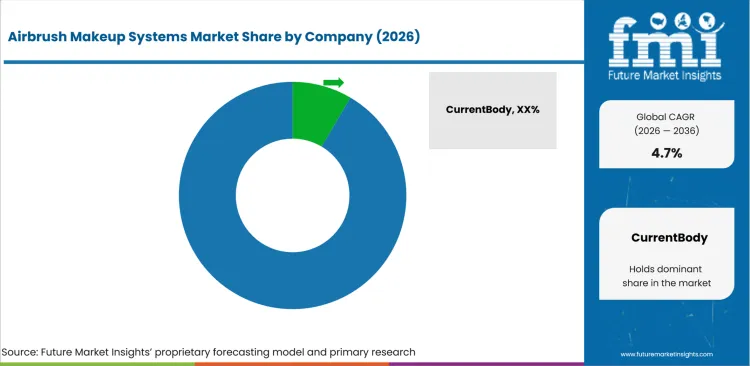
Competition splits between complete-system brands, professional makeup houses, and precision airbrush hardware companies. TEMPTU, LUMINESS, KETT Cosmetics, Aeroblend, Art of Air, and Belloccio sell integrated systems or dedicated refill routes. Kryolan and Graftobian add professional formulation depth, while Iwata-Medea contributes specialist hardware. MAQPRO brings professional color manufacturing and international distribution. The main entry barrier is maintaining technique support and compatible refills after the hardware sale, not compressor access alone. Related natural cosmetic color demand also raises expectations for shade breadth.
- Integrated systems: TEMPTU, LUMINESS, KETT Cosmetics, Aeroblend, Art of Air, and Belloccio compete on kits, education, and refill continuity.
- Professional platforms: Kryolan, Graftobian, and MAQPRO extend airbrush use through shade depth, artist training, and specialist channels.
- Precision hardware: Iwata-Medea supplies airbrush equipment for operators that qualify spray control, maintenance, and replacement fit.
Competitive Benchmarking: Airbrush Makeup Systems Market
| Company | Dedicated Airbrush System Depth | Formula & Accessory Coverage | Education & Support Depth | Geographic Reach |
|---|---|---|---|---|
| TEMPTU | High | High | High | North America with international professional distribution |
| LUMINESS | High | High | High | North America with direct online reach |
| KETT Cosmetics | High | High | High | North America with virtual professional education |
| Kryolan | High | High | High | Global professional makeup distribution |
| Graftobian | High | High | Medium | North America with international professional reach |
| Aeroblend | High | High | High | North America with direct online distribution |
| Iwata-Medea | High | Low | High | Global airbrush distribution |
| MAQPRO | Medium | High | Medium | Europe-led distribution in more than 30 countries |
| Art of Air | High | High | Medium | North America with direct online distribution |
| Belloccio | High | High | High | North America with direct online distribution |
High system depth requires a complete airbrush workflow or several dedicated hardware options. Medium marks a narrower exact-market route and Low a supporting role. High formula coverage requires several airbrush-compatible products, while education depth reflects structured tutorials, classes, or troubleshooting. Geographic reach describes documented availability and does not imply market share.
Key Developments in the Airbrush Makeup Systems Market
- In July 2026, Kryolan ran a Chennai masterclass covering airbrush machine types, pressure control, layering, and maintenance for bridal and high-definition work.
- In June 2026, TEMPTU documented Cristina Cuéllar leading a New York Fashion Week team with TEMPTU PRO airbrush equipment for backstage complexion work.
- In December 2025, KETT Cosmetics scheduled a full-day virtual airbrush class covering equipment, complexion technique, maintenance, and business applications.
Key Players in the Airbrush Makeup Systems Market
Integrated Consumer and Professional Airbrush Systems
- TEMPTU
- LUMINESS
- KETT Cosmetics
- Aeroblend
- Art of Air
- Belloccio
Professional Makeup and Airbrush Formulation Platforms
- Kryolan
- Graftobian
- MAQPRO
Precision Airbrush Hardware
- Iwata-Medea
Airbrush Makeup Systems Market - Report Scope
| Coverage field | Report scope |
|---|---|
| Market breakdown | By product type, use setting, power source, price band, sales channel, and region. |
| Quantitative Units | USD million. |
| Market Definition | Revenue includes powered airbrush makeup systems and dedicated application hardware or accessories sold within the stated taxonomy. Separately sold downstream cosmetics, salon or clinic service revenue, and adjacent beauty devices are excluded. |
| Regions Covered | North America, Latin America, Western Europe, Eastern Europe, East Asia, South Asia and Pacific, and Middle East and Africa. |
| Countries Covered | USA, Germany, France, UK, Saudi Arabia, UAE, Japan, South Korea, and 20+ countries included in the full report. |
| Key Companies Profiled | TEMPTU, LUMINESS, KETT Cosmetics, Kryolan, Graftobian, Aeroblend, Iwata-Medea, MAQPRO, Art of Air, and Belloccio. |
| Forecast Period | 2026 to 2036. |
| Approach | Primary and secondary research with market triangulation. |
Airbrush Makeup Systems Market - Research Methodology
| Method | Approach |
|---|---|
| Primary Research | FMI analysts gathered input from manufacturers, service providers, technology developers, distributors, end users, procurement teams, and subject-matter experts. Interviews examined purchasing decisions, product or service evaluation, adoption barriers, approval requirements, pricing considerations, and expectations for technical or commercial support. Respondents were also asked what evidence is required before a trial, pilot, or initial order develops into regular purchasing. |
| Desk Research | Desk research covered government statistics, regulatory publications, trade data, industry associations, technical literature, standards, company filings, product information, and official corporate announcements. Sources were reviewed for relevance, publication date, geographic coverage, and consistency with the defined market scope. Claims relating to performance, applications, approvals, capacity, investment, and commercial activity were retained only when supported by credible public evidence. |
| Market Sizing and Forecasting | The market model combined the baseline value with historical performance, segment structure, pricing and volume indicators, adoption levels, company participation, and country-level demand conditions. Forecast assumptions considered economic activity, investment trends, regulatory developments, technology adoption, purchasing cycles, supply availability, and barriers to wider market use. Segment and regional estimates were reconciled before the final market total was calculated. |
| Data Validation | Estimates were checked against multiple independent indicators, including public data, company activity, trade patterns, industry developments, and findings from primary interviews. Validation also tested whether products, services, applications, and company revenues fell within the defined market boundaries. Adjacent categories, unsupported claims, overlapping revenues, and activities without direct market relevance were excluded to reduce double counting and maintain consistency across segments and countries. |
Airbrush Makeup Systems Market by Segments
Airbrush Makeup Systems Market segmented by Product Type:
- Face brushes
- Eye brushes
- Brush sets
- Vegan-fiber lines
Airbrush Makeup Systems Market segmented by Use Setting:
- At-home
- Professional & clinic
- Hybrid prosumer
Airbrush Makeup Systems Market segmented by Power Source:
- Rechargeable cordless
- Corded
- Battery
Airbrush Makeup Systems Market segmented by Price Band:
- Mid (USD 100-300)
- Entry (below USD 100)
- Premium (above USD 300)
Airbrush Makeup Systems Market segmented by Sales Channel:
- E-commerce & DTC
- Specialty beauty & electronics
- Professional distribution
- Department stores
Airbrush Makeup Systems Market by Region:
- North America
- United States
- Canada
- Latin America
- Brazil
- Mexico
- Argentina
- Chile
- Western Europe
- Germany
- France
- United Kingdom
- Italy
- Spain
- Benelux
- Nordics
- Eastern Europe
- Poland
- Czech Republic
- Romania
- Hungary
- East Asia
- China
- Japan
- South Korea
- South Asia and Pacific
- India
- ASEAN
- Australia and New Zealand
- Middle East and Africa
- GCC Countries
- South Africa
- Türkiye
- Israel
Research Sources and Bibliography
- TEMPTU. (2026, April 14). BRIDAL BEAUTY PERFECTED WITH TAMI BERNARD
- Dubai Department of Economy and Tourism. (2025, November 4). Dubai Traders accelerates business growth in first year with over 2,400 new e-commerce sellers
- Kryolan. (2025, August 22). Airbrush Basics
- TEMPTU. (2026, July 30). Airbrush Makeup vs Traditional Makeup: What Has Changed in 2026?
- TEMPTU. (2026, January 15). GAME DAY GLAM WITH ALLISON KAYE AND NFL WAGs
- LUMINESS. (2025, September 25). Spray Foundation Myths Busted: What You Need to Know Before You Buy
- Eurostat. (2026, April 23). Digitalisation in Europe - 2026 edition
- Aeroblend. (2025, October 16). How to tell if your makeup is water-based or silicone-based
- KETT Cosmetics. (n.d.). Kett Standard Airbrush. Retrieved September 3, 2026.
- USA Food and Drug Administration. (2026, June 30). Registration & Listing of Cosmetic Product Facilities and Products
- Federal Statistical Office of Germany. (2026, April 20). Personen, die das Internet zu privaten Zwecken nutzen und online einkaufen im Zeitvergleich
- Insee. (2025, June 23). Les données de transactions par carte bancaire CB
- Office for National Statistics. (2026, July 24). Retail sales, Great Britain: June 2026
- Saudi Central Bank. (2026, April 12). SAMA: E-Payments Account for 85% of Total Retail Payments in 2025
- Al Etihad Payments. (2026, April 10). Aani Delivers a Transformational Leap in the UAE’s Digital Payments Landscape: 12.5 Million Users and Instant Transfers in 3 Seconds
- Ministry of Economy, Trade and Industry, Japan. (2025, August 26). Results of FY2024 E-Commerce Market Survey Compiled
- Ministry of Data and Statistics, Republic of Korea. (2026, August 3). 2026년 6월 온라인쇼핑동향 및 2/4분기 온라인 해외 직접 판매 및 구매 동향
- Kryolan. (2026, July 20). Airbrush Makeup - Masterclass
- TEMPTU. (2026, June 14). What It Takes to Create Flawless Skin When the Whole Runway Is Watching
- Iwata-Medea. (2025, April 1). Iwata-Medea Unveils One of the World’s Largest Collections of Airbrushed Art at Portland Open-House Exhibition
- Kryolan. (2026, August 19). Airbrush - Beauty & Creative Make-up
- Kryolan. (2026, May 18). Airbrush Makeup Workshop
- Kryolan. (2026, January 5). Airbrush - Beauty & Creative Make-up
- Graftobian Make-Up Company. (n.d.). GlamAire Airbrush Makeup. Retrieved September 3, 2026.
- MAQPRO. (n.d.). Le maquillage professionnel by Maqpro Paris. Retrieved September 3, 2026.
- Art of Air. (n.d.). About Us. Retrieved September 3, 2026.
- Belloccio. (n.d.). Frequently Asked Questions. Retrieved September 3, 2026.
This bibliography is provided for reader reference and is not exhaustive. The full report contains the complete reference list and detailed citations
This Report Answers
- How large is the airbrush makeup systems market in 2026 and 2036?
- Which operating conditions support airbrush makeup system ownership and repeat use?
- Why do face brushes hold the leading product-type share in 2026?
- Why does at-home use account for the largest use-setting share?
- How does rechargeable cordless power change application and service requirements?
- Why do the eight profiled countries follow different CAGR paths?
- Which companies provide complete systems, professional formulations, or precision airbrush hardware?
- What cleaning, formula, and service frictions can prevent repeat use?
Frequently Asked Questions
How big is the Airbrush Makeup Systems Market in 2026?
The airbrush makeup systems market is valued at USD 277.1 million in 2026 and is projected to reach USD 438.6 million by 2036. Growth follows wider at-home consideration, portable hardware, and stronger digital product education.
What is the CAGR of the Airbrush Makeup Systems Market from 2026 to 2036?
The airbrush makeup systems market is projected to grow at a CAGR of 4.7% between 2026 and 2036. Expansion depends on easier ownership, rechargeable formats, and service that keeps cleaning and formula selection manageable.
Which product type leads the Airbrush Makeup Systems Market?
The face brushes segment is expected to hold 33.0% of the airbrush makeup systems market in 2026, driven by broad-face preparation and finishing work. Professional training also places complexion coverage before narrower eye or creative tasks.
Which use setting leads the Airbrush Makeup Systems Market?
The at-home segment is expected to hold 58.0% of the airbrush makeup systems market in 2026, attributable to the larger personal-ownership base. Direct tutorials and compact equipment reduce dependence on a professional workstation.
Which companies are active in the Airbrush Makeup Systems Market?
Key companies operating in the market include TEMPTU, LUMINESS, KETT Cosmetics, Kryolan, Graftobian, Aeroblend, Iwata-Medea, MAQPRO, Art of Air, and Belloccio. They compete through complete systems, formula breadth, education, maintenance support, and professional application depth.
Preview the report firsthand - request a free sample
Get SampleGet the brochure for pricing and purchase details.
Get PDFTable of Content
- Key Takeaways
- Market Size and CAGR
- Top Growth Driver
- Fastest Growing Segment
- Leading Region
- Key Companies
- Emerging Opportunities
- Executive Summary
- Global Market Outlook
- Demand-side Trends
- Supply-side Trends
- Technology Roadmap Analysis
- Analysis and Recommendations
- Analyst Perspective (What is happening? Why now? What should investors know?)
- Key Questions Answered
- How large is the market?
- What is the CAGR?
- What are key trends?
- Which region dominates?
- Who are the leaders?
- Market Overview
- Market Coverage / Taxonomy
- Market Definition / Scope / Limitations
- Research Methodology
- Chapter Orientation
- Analytical Lens and Working Hypotheses
- Market Structure, Signals, and Trend Drivers
- Benchmarking and Cross-market Comparability
- Market Sizing, Forecasting, and Opportunity Mapping
- Research Design and Evidence Framework
- Desk Research Programme (Secondary Evidence)
- Expert Input and Fieldwork (Primary Evidence)
- Tooling, Models, and Reference Databases
- Data Engineering and Model Build
- Quality Assurance and Audit Trail
- Market Background
- Market Dynamics (Drivers, Restraints, Opportunity, Trends)
- Scenario Forecast (Optimistic, Likely, Conservative)
- Impact Analysis
- AI Impact
- Sustainability Impact
- Regulatory Impact
- Technology Impact
- Consumer / Buyer Analysis
- Purchase Drivers
- Adoption Barriers
- Buyer Journey
- Opportunity Map Analysis
- Product Life Cycle Analysis
- Supply Chain Analysis
- Investment Feasibility Matrix
- Value Chain Analysis
- PESTLE and Porter's Analysis
- Regulatory Landscape
- Regional Parent Market Outlook
- Production and Consumption Statistics
- Import and Export Statistics
- Global Market Analysis and Forecast, 2021 to 2036
- Historical Market Size Value (USD Million) Analysis, 2021 to 2025
- Current and Future Market Size Value (USD Million) Projections, 2026 to 2036
- Y-o-Y Growth Trend Analysis
- Absolute $ Opportunity Analysis
- Global Market Pricing Analysis, 2021 to 2036
- Global Market Analysis and Forecast, By Product Type, 2021 to 2036
- Introduction / Key Findings
- Historical Market Size Value (USD Million) Analysis By Product Type, 2021 to 2025
- Current and Future Market Size Value (USD Million) Analysis and Forecast By Product Type, 2026 to 2036
- Face brushes
- Eye brushes
- Brush sets
- Vegan-fiber lines
- Face brushes
- Y-o-Y Growth Trend Analysis By Product Type, 2021 to 2025
- Absolute $ Opportunity Analysis By Product Type, 2026 to 2036
- Global Market Analysis and Forecast, By Use Setting, 2021 to 2036
- Introduction / Key Findings
- Historical Market Size Value (USD Million) Analysis By Use Setting, 2021 to 2025
- Current and Future Market Size Value (USD Million) Analysis and Forecast By Use Setting, 2026 to 2036
- At-home
- Professional & clinic
- Hybrid prosumer
- At-home
- Y-o-Y Growth Trend Analysis By Use Setting, 2021 to 2025
- Absolute $ Opportunity Analysis By Use Setting, 2026 to 2036
- Global Market Analysis and Forecast, By Power Source, 2021 to 2036
- Introduction / Key Findings
- Historical Market Size Value (USD Million) Analysis By Power Source, 2021 to 2025
- Current and Future Market Size Value (USD Million) Analysis and Forecast By Power Source, 2026 to 2036
- Rechargeable cordless
- Corded
- Battery
- Rechargeable cordless
- Y-o-Y Growth Trend Analysis By Power Source, 2021 to 2025
- Absolute $ Opportunity Analysis By Power Source, 2026 to 2036
- Global Market Analysis and Forecast, By Price Band, 2021 to 2036
- Introduction / Key Findings
- Historical Market Size Value (USD Million) Analysis By Price Band, 2021 to 2025
- Current and Future Market Size Value (USD Million) Analysis and Forecast By Price Band, 2026 to 2036
- Mid (USD 100-300)
- Entry (below USD 100)
- Premium (above USD 300)
- Mid (USD 100-300)
- Y-o-Y Growth Trend Analysis By Price Band, 2021 to 2025
- Absolute $ Opportunity Analysis By Price Band, 2026 to 2036
- Global Market Analysis and Forecast, By Sales Channel, 2021 to 2036
- Introduction / Key Findings
- Historical Market Size Value (USD Million) Analysis By Sales Channel, 2021 to 2025
- Current and Future Market Size Value (USD Million) Analysis and Forecast By Sales Channel, 2026 to 2036
- E-commerce & DTC
- Specialty beauty & electronics
- Professional distribution
- Department stores
- E-commerce & DTC
- Y-o-Y Growth Trend Analysis By Sales Channel, 2021 to 2025
- Absolute $ Opportunity Analysis By Sales Channel, 2026 to 2036
- Global Market Analysis and Forecast, By Region, 2021 to 2036
- Introduction
- Historical Market Size Value (USD Million) Analysis By Region, 2021 to 2025
- Current Market Size Value (USD Million) Analysis and Forecast By Region, 2026 to 2036
- North America
- Latin America
- Western Europe
- Eastern Europe
- East Asia
- South Asia and Pacific
- Middle East & Africa
- Market Attractiveness Analysis By Region
- North America Market Analysis and Forecast, By Country, 2021 to 2036
- Historical Market Size Value (USD Million) Trend Analysis By Market Taxonomy, 2021 to 2025
- Market Size Value (USD Million) Forecast By Market Taxonomy, 2026 to 2036
- By Country
- USA
- Canada
- By Product Type
- By Use Setting
- By Power Source
- By Price Band
- By Sales Channel
- By Country
- Market Attractiveness Analysis
- By Country
- By Product Type
- By Use Setting
- By Power Source
- By Price Band
- By Sales Channel
- Key Takeaways
- Latin America Market Analysis and Forecast, By Country
- Historical Market Size Value (USD Million) Trend Analysis By Market Taxonomy, 2021 to 2025
- Market Size Value (USD Million) Forecast By Market Taxonomy, 2026 to 2036
- By Country
- Brazil
- Mexico
- Chile
- Rest of Latin America
- By Product Type
- By Use Setting
- By Power Source
- By Price Band
- By Sales Channel
- By Country
- Market Attractiveness Analysis
- By Country
- By Product Type
- By Use Setting
- By Power Source
- By Price Band
- By Sales Channel
- Key Takeaways
- Western Europe Market Analysis and Forecast, By Country
- Historical Market Size Value (USD Million) Trend Analysis By Market Taxonomy, 2021 to 2025
- Market Size Value (USD Million) Forecast By Market Taxonomy, 2026 to 2036
- By Country
- Germany
- UK
- Italy
- Spain
- France
- Nordic
- BENELUX
- Rest of Western Europe
- By Product Type
- By Use Setting
- By Power Source
- By Price Band
- By Sales Channel
- By Country
- Market Attractiveness Analysis
- By Country
- By Product Type
- By Use Setting
- By Power Source
- By Price Band
- By Sales Channel
- Key Takeaways
- Eastern Europe Market Analysis and Forecast, By Country
- Historical Market Size Value (USD Million) Trend Analysis By Market Taxonomy, 2021 to 2025
- Market Size Value (USD Million) Forecast By Market Taxonomy, 2026 to 2036
- By Country
- Russia
- Poland
- Hungary
- Balkan & Baltic
- Rest of Eastern Europe
- By Product Type
- By Use Setting
- By Power Source
- By Price Band
- By Sales Channel
- By Country
- Market Attractiveness Analysis
- By Country
- By Product Type
- By Use Setting
- By Power Source
- By Price Band
- By Sales Channel
- Key Takeaways
- East Asia Market Analysis and Forecast, By Country
- Historical Market Size Value (USD Million) Trend Analysis By Market Taxonomy, 2021 to 2025
- Market Size Value (USD Million) Forecast By Market Taxonomy, 2026 to 2036
- By Country
- China
- Japan
- South Korea
- By Product Type
- By Use Setting
- By Power Source
- By Price Band
- By Sales Channel
- By Country
- Market Attractiveness Analysis
- By Country
- By Product Type
- By Use Setting
- By Power Source
- By Price Band
- By Sales Channel
- Key Takeaways
- South Asia and Pacific Market Analysis and Forecast, By Country
- Historical Market Size Value (USD Million) Trend Analysis By Market Taxonomy, 2021 to 2025
- Market Size Value (USD Million) Forecast By Market Taxonomy, 2026 to 2036
- By Country
- India
- ASEAN
- Australia & New Zealand
- Rest of South Asia and Pacific
- By Product Type
- By Use Setting
- By Power Source
- By Price Band
- By Sales Channel
- By Country
- Market Attractiveness Analysis
- By Country
- By Product Type
- By Use Setting
- By Power Source
- By Price Band
- By Sales Channel
- Key Takeaways
- Middle East & Africa Market Analysis and Forecast, By Country
- Historical Market Size Value (USD Million) Trend Analysis By Market Taxonomy, 2021 to 2025
- Market Size Value (USD Million) Forecast By Market Taxonomy, 2026 to 2036
- By Country
- Kingdom of Saudi Arabia
- Other GCC Countries
- Türkiye
- South Africa
- Other African Union
- Rest of Middle East & Africa
- By Product Type
- By Use Setting
- By Power Source
- By Price Band
- By Sales Channel
- By Country
- Market Attractiveness Analysis
- By Country
- By Product Type
- By Use Setting
- By Power Source
- By Price Band
- By Sales Channel
- Key Takeaways
- Key Countries Market Analysis
- USA
- Pricing Analysis
- Market Share Analysis, 2025
- By Product Type
- By Use Setting
- By Power Source
- By Price Band
- By Sales Channel
- Canada
- Pricing Analysis
- Market Share Analysis, 2025
- By Product Type
- By Use Setting
- By Power Source
- By Price Band
- By Sales Channel
- Mexico
- Pricing Analysis
- Market Share Analysis, 2025
- By Product Type
- By Use Setting
- By Power Source
- By Price Band
- By Sales Channel
- Brazil
- Pricing Analysis
- Market Share Analysis, 2025
- By Product Type
- By Use Setting
- By Power Source
- By Price Band
- By Sales Channel
- Chile
- Pricing Analysis
- Market Share Analysis, 2025
- By Product Type
- By Use Setting
- By Power Source
- By Price Band
- By Sales Channel
- Germany
- Pricing Analysis
- Market Share Analysis, 2025
- By Product Type
- By Use Setting
- By Power Source
- By Price Band
- By Sales Channel
- UK
- Pricing Analysis
- Market Share Analysis, 2025
- By Product Type
- By Use Setting
- By Power Source
- By Price Band
- By Sales Channel
- Italy
- Pricing Analysis
- Market Share Analysis, 2025
- By Product Type
- By Use Setting
- By Power Source
- By Price Band
- By Sales Channel
- Spain
- Pricing Analysis
- Market Share Analysis, 2025
- By Product Type
- By Use Setting
- By Power Source
- By Price Band
- By Sales Channel
- France
- Pricing Analysis
- Market Share Analysis, 2025
- By Product Type
- By Use Setting
- By Power Source
- By Price Band
- By Sales Channel
- India
- Pricing Analysis
- Market Share Analysis, 2025
- By Product Type
- By Use Setting
- By Power Source
- By Price Band
- By Sales Channel
- ASEAN
- Pricing Analysis
- Market Share Analysis, 2025
- By Product Type
- By Use Setting
- By Power Source
- By Price Band
- By Sales Channel
- Australia & New Zealand
- Pricing Analysis
- Market Share Analysis, 2025
- By Product Type
- By Use Setting
- By Power Source
- By Price Band
- By Sales Channel
- China
- Pricing Analysis
- Market Share Analysis, 2025
- By Product Type
- By Use Setting
- By Power Source
- By Price Band
- By Sales Channel
- Japan
- Pricing Analysis
- Market Share Analysis, 2025
- By Product Type
- By Use Setting
- By Power Source
- By Price Band
- By Sales Channel
- South Korea
- Pricing Analysis
- Market Share Analysis, 2025
- By Product Type
- By Use Setting
- By Power Source
- By Price Band
- By Sales Channel
- Russia
- Pricing Analysis
- Market Share Analysis, 2025
- By Product Type
- By Use Setting
- By Power Source
- By Price Band
- By Sales Channel
- Poland
- Pricing Analysis
- Market Share Analysis, 2025
- By Product Type
- By Use Setting
- By Power Source
- By Price Band
- By Sales Channel
- Hungary
- Pricing Analysis
- Market Share Analysis, 2025
- By Product Type
- By Use Setting
- By Power Source
- By Price Band
- By Sales Channel
- Kingdom of Saudi Arabia
- Pricing Analysis
- Market Share Analysis, 2025
- By Product Type
- By Use Setting
- By Power Source
- By Price Band
- By Sales Channel
- Türkiye
- Pricing Analysis
- Market Share Analysis, 2025
- By Product Type
- By Use Setting
- By Power Source
- By Price Band
- By Sales Channel
- South Africa
- Pricing Analysis
- Market Share Analysis, 2025
- By Product Type
- By Use Setting
- By Power Source
- By Price Band
- By Sales Channel
- USA
- Market Structure Analysis
- Competition Dashboard
- Competition Benchmarking
- Market Share Analysis of Top Players
- By Regional
- By Product Type
- By Use Setting
- By Power Source
- By Price Band
- By Sales Channel
- Emerging Startups
- Innovation Benchmarking
- Competition Analysis
- Competition Deep Dive
- CurrentBody
- Overview
- Product Portfolio
- Profitability by Market Segments
- Sales Footprint
- Strategy Overview
- Marketing Strategy
- Product Strategy
- Channel Strategy
- Dyson
- FOREO
- Conair
- SharkNinja
- Panasonic
- Ya-Man
- Therabody
- Philips
- NuFACE
- CurrentBody
- Case Studies
- Success Stories
- Recent Developments
- Competition Deep Dive
- Assumptions & Acronyms Used


