
- Market Size (2026)
- USD 5.9 Bn
- Forecast (2036)
- USD 9.0 Bn
- CAGR (2026 to 2036)
- 4.2%
How big is the Alkyd Resin Market in 2026?
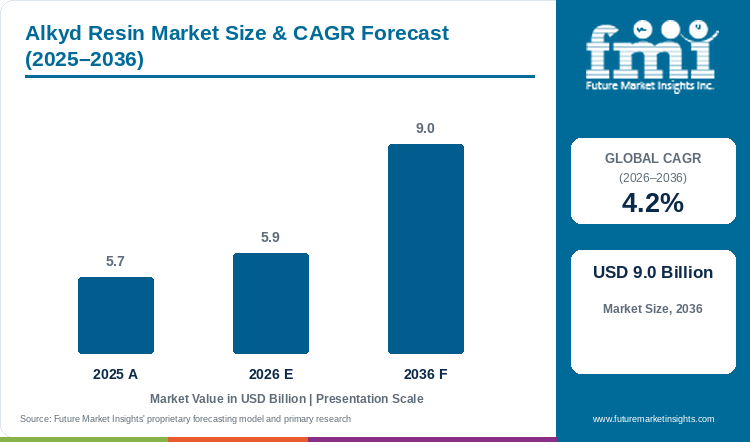
The Alkyd Resin Market is projected to reach USD 9.0 billion by 2036, growing at a 4.2% CAGR from 2026 to 2036. The market is estimated at USD 5.9 billion in 2026. The market was valued at USD 5.7 billion in 2025. Alkyd resins are polyesters modified with vegetable oils [20], and Polynt describes alkyd and modified alkyd resins as suited to paints and coatings [6]. Resin demand follows coatings output. PPG reported on 27 October 2026 that third-quarter net sales rose 7% to USD 4.4 billion [3]. Sherwin-Williams reported the same day that consolidated third-quarter net sales rose 7.9% to USD 6.9 billion [2].
Input cost is the main short-term pressure on pricing. Alkyds are built from a vegetable oil or fatty acid, a polybasic acid such as phthalic anhydride, and a polyol such as glycerol or pentaerythritol [20]. These oil, acid and polyol costs set the resin price. The US Department of Agriculture left its forecast farm price of soybeans for 2026/27 unchanged at USD 12.00 per bushel. The outlook was updated on 15 October 2026 [23]. PPG said cost of goods sold inflation remained high in Industrial Coatings [3]. RPM said raw material inflation offset part of its sales gain in the quarter ended 31 August 2026 [1]. Resin suppliers that price on a formula tied to soybean oil or other oil indices pass these moves through faster than suppliers on fixed annual prices.
Key Market Trends & Insights
- Coatings makers report cost pressure alongside growth. RPM said on 6 October 2026 that fiscal 2027 first-quarter sales rose 4.8% to USD 2.2 billion, while raw material inflation reduced gross margin [1]. Sherwin-Williams reported on 27 October 2026 that its Performance Coatings Group sales rose 8.8% to USD 1.9 billion [2].
- Suppliers are positioning alkyds around lower solvent content. Allnex offers VIALKYD as high-solids, solvent-based alkyds and oil-free polyesters for decorative and industrial uses [10]. Its recent solventborne innovations include high-solids and solvent-free long oil alkyds with very good outdoor durability [10]. US federal limits on architectural coatings are set by category in grams of VOC per litre: 380 for nonflat coatings and 450 for quick-dry enamels [21].
- European building paint demand is weak. The German coatings association VdL reported on 11 February 2026 that sales of paints and plasters for buildings fell 3.5% in 2025 [5]. It forecast a further 3% decline in 2026 [5].
Regional Highlights
- North America: Sherwin-Williams reported third-quarter 2026 Paint Stores Group sales of USD 4.0 billion, up 4.7%, with same-store sales up 3.9% [2]. PPG's global architectural coatings sales were USD 1.1 billion, up 4% [3].
- Europe: German paint, coatings and printing ink sales volume fell 2.8% to 1.4 million tonnes in 2025. Revenue fell nearly 1.2% to EUR 5.8 billion [4]. VdL expects volume to fall another 2% in 2026 [4]. PPG said architectural coatings organic sales in EMEA rose by a low single-digit percentage in the third quarter of 2026 [3]. Higher prices drove the gain, partly offset by lower volumes [3].
- Asia Pacific: PPG said architectural coatings in Latin America and Asia Pacific grew organic sales by a mid-single-digit percentage in the third quarter of 2026 [3]. Asian Paints' investor page shows consolidated net sales of INR 9,953.9 crore for the second quarter of fiscal 2026-27, up 16.9% [17].
Alkyd Resin Market Size and Forecast
Table 1: Alkyd Resin Market Size and Forecast
| Market size and forecast | Value |
|---|---|
| Market size in 2025 | USD 5.7 billion |
| Estimated market size in 2026 | USD 5.9 billion |
| Projected market size by 2036 | USD 9.0 billion |
| CAGR from 2026 to 2036 | 4.2% |
Source: Future Market Insights analysis of the alkyd resin market, 2026.
Analyst Perspective
“Alkyd resin is a cost-pass-through business sitting between vegetable oil markets and the coatings makers. Growth in coatings is real but margins at the customer are under pressure from raw materials, so buyers push back on resin price just as input costs rise. The suppliers that hold position are those with a credible high-solids and waterborne range, because VOC limits and customer reformulation keep moving volume toward those grades. Buyers should ask for oil-index price formulas and a second qualified source for every grade they run at scale.”
- Nikhil Kaitwade, Principal Consultant, FMI
How is the Alkyd Resin Market segmented?
- By product: Short Alkyd Resin, Medium Alkyd Resins and Long Alkyd Resins
- By formulation: High-Solids Solventborne Alkyds, Conventional Solventborne Alkyds, Waterborne Alkyds and Others
- By region: North America, Europe and Asia Pacific
Why does Short Alkyd Resin lead by Product in the Alkyd Resin Market in 2026?
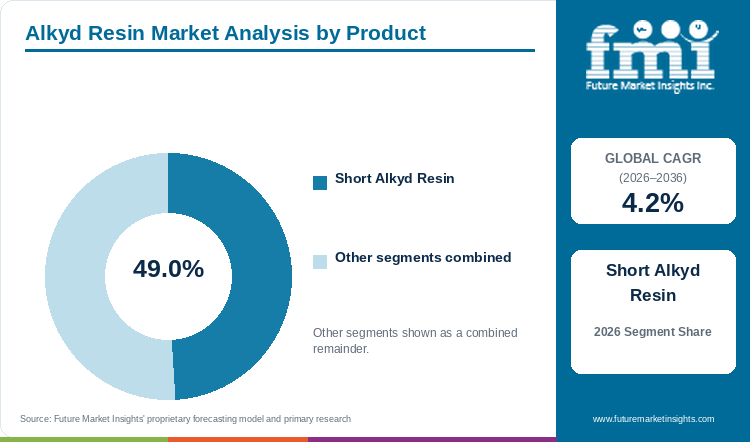
Short Alkyd Resin is estimated to account for 49.0% of the Alkyd Resin Market by product in 2026. Alkyds are classed by oil length: a 2023 study in Polymers places short oil resins below 45% oil, medium between 45% and 55%, and long above 55% [20]. A 2022 review in the Turkish Journal of Chemistry describes short oil alkyds as containing about 30% oil and used for fast-drying products [19]. The same review says they are often cured with isocyanate or melamine [19]. Non-drying oils such as coconut oil go into short oil resins that cure with a separate crosslinker [19]. That cure route points to industrial and factory-applied coatings, not brush-applied decorative paint. Allnex describes its SETAL range as solventborne alkyd and polyester resins for exterior architecture, wood, industrial and automotive refinish [10]. Arkema lists long, medium and short oil alkyds with urethane, silicone, epoxy and other modified types [9]. Short-oil systems serve the industrial segments that are growing. PPG's Industrial Coatings sales rose 5% to USD 1.7 billion in the third quarter of 2026 [3]. RPM's Performance Coatings Group sales rose 10.2% to USD 629.7 million in the quarter ended 31 August 2026 [1].
Table 2: Product, 2026 Share
| Leading Share | 2026 market share |
|---|---|
| Short Alkyd Resin | 49.0% |
| All Other Segments Combined Share | 51.0% |
Source: Future Market Insights analysis of the alkyd resin market, 2026.
Why do High-Solids Solventborne Alkyds lead by Formulation in the Alkyd Resin Market in 2026?
High-Solids Solventborne Alkyds are estimated to account for 40.0% of the Alkyd Resin Market by formulation in 2026. Formulators cut solvent and keep the alkyd chemistry they already know. The US federal rule for architectural coatings, 40 CFR Part 59 Subpart D, sets VOC limits by category. Flat coatings are limited to 250 grams per litre and nonflat coatings to 380 [21]. Primers and undercoaters are limited to 350 grams, rust preventative coatings to 400, and varnishes, quick-dry enamels and industrial maintenance coatings to 450 [21]. Limits are measured with the coating thinned to the maker's maximum recommendation [21]. A resin with more solids needs less thinner to reach application viscosity. Suppliers have built their ranges around this. Allnex offers VIALKYD high-solids, solvent-based alkyds and oil-free polyesters [10]. Synthopol says its development covers high-solids and water-reducible alkyds, as well as low-aromatic and aromatic-free versions [13]. Waterborne alkyds are the alternative route. Polynt offers BECKOSOL AQ alongside its solvent-based alkyd families [6], and Arkema lists water-reducible and waterborne alkyds [9]. High-solids grades lead because they let a formulator cut solvent while keeping existing application equipment. Moving to waterborne generally means reformulating the whole paint.
Table 3: Formulation, 2026 Share
| Leading Share | 2026 market share |
|---|---|
| High-Solids Solventborne Alkyds | 40.0% |
| All Other Segments Combined Share | 60.0% |
Source: Future Market Insights analysis of the alkyd resin market, 2026.
What are the key drivers, restraints and opportunities?
Driver
Industrial coatings demand. Alkyd binders go into industrial and protective systems as well as decorative paint, and those end uses are growing. PPG said third-quarter 2026 Performance Coatings sales rose 10% to USD 1.6 billion [3], and packaging coatings grew by a double-digit percentage [3]. RPM said its Performance Coatings Group sales rose 10.2% in the quarter ended 31 August 2026 [1]. Polynt names architectural, industrial maintenance, industrial and traffic uses for its alkyd and modified alkyd resins [6].
Renewable content and chemical flexibility. According to the Turkish Journal of Chemistry review, conventional alkyds are roughly 50% to 60% renewable by weight [19]. The oil and fatty acid fractions come from plants. Oils such as linseed oil and soybean oil are the usual feedstocks. Linseed-based alkyds dry faster than soybean-based ones [19]. The chemistry also lets suppliers modify the resin. Arkema lists urethane, silicone, epoxy, phenolic, acrylated and styrenated alkyds, and thixotropic types [9].
Restraint
Raw material cost. The three coatings makers cited above all reported input cost pressure in their latest results. Sherwin-Williams attributed lower third-quarter 2026 gross margin to higher raw material and supply chain costs across its segments [2]. PPG called cost of goods sold inflation high in Industrial Coatings [3], and RPM cited raw material inflation [1]. CEPE, the European coatings trade body, carries a press release on its website urging member states to reject antidumping duties on titanium dioxide [24]. The release shows how sensitive European coatings makers are to input cost. Resin suppliers sit between these customers and their own oil, acid and polyol suppliers.
Weak building demand and solvent rules. VdL reported that German building paint volume fell 3.5% in 2025 [5]. It blamed weak residential construction and low construction investment, and said recovery was not expected before 2027 [5]. In the United States, VOC limits of 380 grams per litre for nonflat coatings and 350 for primers [21] constrain conventional solventborne formulations. Buyers move toward high-solids or waterborne grades, which cost more to develop and qualify.
Opportunity
Waterborne and high-solids upgrades. Polynt said in May 2023 that its coatings resin plant at Port Moody, British Columbia, would open in the second half of 2023 [7]. The plant is operated by Polynt Coatings Canada Limited [7]. It was planned to add capacity and flexibility for conventional alkyds, oil-modified urethanes and water-based technologies [7]. Arkema's coating resins range includes aqueous and solvent-based alkyds [8]. Suppliers with capacity for both families can follow customers as they reformulate.
Higher bio-based content. The Turkish Journal of Chemistry review says renewable content above 80% is limited by the lack of bio-based diacid and anhydride substitutes [19]. It also says high-solids, hyperbranched, waterborne and UV-curable alkyd technologies are under research [19]. A supplier that documents a higher plant-derived share gains a selling point with paint makers. So does a lower-solvent grade at the same cost.
Alkyd Resin Market by Country (2026 to 2036)
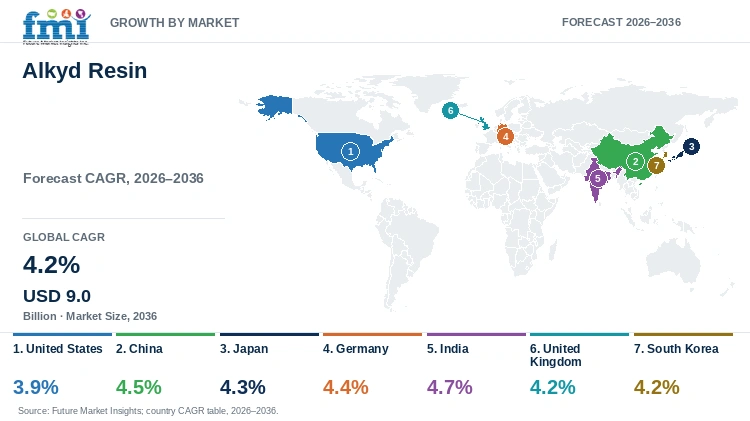
Table 4: Alkyd Resin Market Country Growth Forecast
| Country | CAGR, 2026 to 2036 |
|---|---|
| United States | 3.9% |
| China | 4.5% |
| Japan | 4.3% |
| Germany | 4.4% |
| India | 4.7% |
| United Kingdom | 4.2% |
| South Korea | 4.2% |
Source: Future Market Insights analysis of the alkyd resin market, 2026.
United States
Sherwin-Williams reported third-quarter 2026 results on 27 October 2026. Consolidated net sales were USD 6.9 billion, up 7.9%. Paint Stores Group sales were USD 4.0 billion, up 4.7%. Consumer Brands Group sales rose 21.7% to USD 937.4 million, and Performance Coatings Group sales rose 8.8% to USD 1.9 billion. The company said higher raw material and supply chain costs weighed on gross margin and segment profit in all three segments [2].
PPG reported the same day that global architectural coatings sales were USD 1.1 billion, up 4%. Organic sales rose 2% on higher prices, partly offset by lower volumes [3]. RPM reported on 6 October 2026 that Consumer Group sales for the quarter ended 31 August 2026 rose 5.3% to USD 726.7 million [1]. RPM expects fiscal 2027 consolidated sales to rise in the mid-single-digit range [1]. These customers are growing but protecting margin. Pass-through formulas in resin contracts therefore matter.
Solvent rules shape the grade mix. The federal architectural coatings rule sets 380 grams of VOC per litre for nonflat coatings, 450 for quick-dry enamels and 350 for primers and undercoaters [21]. A quick-dry enamel must be set-to-touch in two hours or less, with a gloss of 70 or above on a 60-degree meter [22].
China
PPG's third-quarter 2026 release, dated 27 October 2026, says architectural coatings in Latin America and Asia Pacific grew organic sales by a mid-single-digit percentage [3]. The same release says protective and marine coatings posted above-market marine volume growth in Asia Pacific [3]. These are regional figures, not a China total.
Polynt posted a news item titled CCE Shanghai 2026 on 1 September 2026 [25]. Its coatings page lists alkyd families including BECKOSOL, DURAMAC, KELSOL, AMBERLAC and BECKOSOL AQ [6].
A forecast rate of 4.5% puts China above the global rate, second only to India among the seven profiled countries. Formulators choosing between solvent-based and low-solvent alkyds can compare Allnex's VIALKYD high-solids range [10], Arkema's waterborne and water-reducible alkyds [9] and Polynt's water-based BECKOSOL AQ [6]. For a supplier, the practical test is holding one grade specification across several coating plants.
Japan
DIC lists polyester and alkyd resins within its synthetic resins and chemicals products. It defines alkyd resins as polyester resins for coatings modified with natural oils or fatty acids [11]. They can be combined with acrylic, urethane, epoxy, phenol and silicone resins to add functionality [11].
Arakawa Chemical Industries offers an alkyd resin, ARAKYD, for paint and printing ink [14].
Corporate calendars give buyers dated checkpoints. Nippon Paint Holdings reported second-quarter FY2026 results on 7 August 2026 [16]. A notice dated 4 November 2026 scheduled its third-quarter announcement for 11 November 2026 at 15:30 JST [15][16]. DIC has scheduled its nine-month results for 12 November 2026 [12].
Germany
VdL, the German coatings association, reported on 11 February 2026 that the market for paints, coatings and printing inks fell in 2025. Sales volume fell 2.8% to 1.4 million tonnes, and revenue fell nearly 1.2% to EUR 5.8 billion [4]. VdL forecast a further 2% fall in volume for 2026 [4].
Building paints are weaker. Volume of paints and plasters for buildings fell 3.5% in 2025. The professional segment fell 4% and do-it-yourself fell 2% [5]. VdL expects a further 3% decline in 2026 [5]. It sees no recovery before 2027, and only if the planned Baubooster stimulus works as hoped [5].
Synthopol's German-language product page covers short, medium and long oil alkyds, acrylated and urethanised types, and water-reducible and high-solids versions [13]. Its uses include decorative and construction paints, wood stains, industrial paints and anti-corrosion primers, as well as low-aromatic and aromatic-free systems [13]. With building paint volume falling, suppliers serving Germany gain more from specialised and industrial grades than from decorative volume. The 4.4% forecast rate should be read with that in mind.
India
Asian Paints' latest reported quarter also showed double-digit sales growth [17].
Kansai Nerolac Paints says it is the second largest coating company in India and a market leader in industrial coatings [18]. It is a subsidiary of Kansai Paints of Japan [18]. Industrial coatings use the modified alkyd grades that Allnex and Arkema offer [9][10].
India has the highest forecast rate of the seven profiled countries at 4.7%, ahead of China at 4.5% and Germany at 4.4%. Germany's coatings sales volume fell in 2025 [4], while Asian Paints reported double-digit sales growth for its latest quarter [17]. For resin suppliers, local supply is the commercial question. Buyers gain from sources that can deliver high-solids and modified grades in-country, without importing every lot.
United Kingdom
Company reporting places the United Kingdom between two European reference points. PPG said architectural coatings organic sales in EMEA rose by a low single-digit percentage in the third quarter of 2026 [3]. Higher prices were partly offset by lower volumes [3]. German building paint volume fell 3.5% in 2025 [5].
UK decorative and wood-coating formulators have grades aimed at that work. Allnex describes SETAL as solventborne alkyd and polyester resins for exterior architecture and wood [10]. Polynt lists architectural uses for its alkyd resins [6], and Synthopol names decorative and construction paints and wood stains as alkyd uses [13].
A forecast rate of 4.2%, level with the global rate, points to steady demand and no major shift in the mix. For buyers, the bigger risk is input cost. The cost pressures reported by PPG and Sherwin-Williams [2][3] reach UK coatings makers through resin prices. Index-linked contracts with a named second source are the safer structure.
South Korea
Automotive refinish is an outlet for conventional solventborne alkyds. PPG reported that its automotive OEM coatings organic sales fell by a low single-digit percentage in the third quarter of 2026 [3]. Its volumes outpaced global automotive production [3]. For coatings makers, automotive therefore offers share gains, not market growth.
Allnex positions SETAL and SETYRENE for automotive refinish and general metal coatings [10]. Arakawa offers its ARAKYD alkyd resin for paint [14]. Korean coatings makers running automotive refinish and industrial lines can qualify these grades against their own specifications.
A forecast rate of 4.2% matches the global rate. PPG's Asia Pacific results show architectural coatings growing at a mid-single-digit rate and marine coatings gaining volume [3]. Korean demand for alkyd binders therefore sits in a region where coatings output is rising.
Who are the notable companies in the Alkyd Resin Market?
Notable companies in the Alkyd Resin Market include Polynt, Arkema, Allnex, DIC Corporation, Arakawa Chemical Industries and Synthopol Chemie.
The clearest difference between suppliers is how they split their ranges between conventional solventborne alkyds and lower-solvent grades. Allnex covers each need with a named family. SETAL serves exterior architecture, wood, industrial and automotive refinish. SETYRENE serves acrylic-modified systems, VIALKYD high solids, and TIRES solventborne alkyds [10]. Polynt groups its alkyd and modified alkyd resins in BECKOSOL, DURAMAC, KELSOL, AMBERLAC, MACOPOL and REZIMAC families and offers BECKOSOL AQ for water-based work [6]. Arkema lists oil-length grades, modified alkyds, thixotropic alkyds and waterborne alkyds [9].
Customers set the price ceiling. PPG, Sherwin-Williams and RPM all reported input cost pressure in their latest quarters [1][2][3]. Paint makers have little room to absorb resin price increases unless they are tied to an index. Suppliers with a regional plant near customers can offer shorter lead times and more flexibility on batch size. Polynt announced its Port Moody plant in 2023 as an example of that model [7].
Smaller specialists compete on technical depth. Synthopol cites more than 60 years of resin development [13]. Its alkyd work covers short, medium and long oil types, acrylated and urethanised types, and water-reducible and high-solids versions [13]. Arakawa Chemical Industries offers ARAKYD alkyd resin for paint and printing ink [14]. DIC groups polyester and alkyd resins in its coatings offer [11].
Key Developments in the Alkyd Resin Market
- On 27 October 2026, PPG reported third-quarter net sales of USD 4.4 billion, up 7%, with Industrial Coatings sales up 5% to USD 1.7 billion. The company said cost of goods sold inflation remained high in that segment [3].
- On 6 October 2026, RPM reported fiscal 2027 first-quarter net sales of USD 2.2 billion, up 4.8%. It said it expects fiscal 2027 consolidated sales to rise in the mid-single-digit range [1].
- On 11 February 2026, VdL reported that German paint, coatings and printing ink sales volume fell 2.8% in 2025 and forecast a further 2% fall in 2026 [4].
- DIC will announce its nine-month 2026 consolidated results on 12 November 2026 [12].
Key Players in the Alkyd Resin Market
- Polynt S.p.A.
- Arkema S.A.
- Allnex
- DIC Corporation
- Arakawa Chemical Industries, Ltd.
- Synthopol Chemie
Alkyd Resin Market Report Scope
Table 5: Alkyd Resin Market Report Scope
| Coverage field | Report scope |
|---|---|
| Market definition | Alkyd resins, polyesters modified with vegetable oils or fatty acids, sold as binders for paints and coatings, measured by value of sales |
| Product | Short Alkyd Resin, Medium Alkyd Resins, Long Alkyd Resins |
| Formulation | High-Solids Solventborne Alkyds, Conventional Solventborne Alkyds, Waterborne Alkyds, Others |
| Regions and profiled countries | North America, Europe and Asia Pacific. Profiled countries: United States, China, Japan, Germany, India, United Kingdom and South Korea |
| Companies covered | Polynt S.p.A., Arkema S.A., Allnex, DIC Corporation, Arakawa Chemical Industries, Ltd., Synthopol Chemie |
| Forecast period | 2026 to 2036, with 2025 as the historical base year |
| Quantitative Units | USD billion |
Source: Future Market Insights analysis of the alkyd resin market, 2026.
Alkyd Resin Market by Segments
Alkyd Resin Market segmented by Product:
- Short Alkyd Resin
- Medium Alkyd Resins
- Long Alkyd Resins
Alkyd Resin Market segmented by Formulation:
- High-Solids Solventborne Alkyds
- Conventional Solventborne Alkyds
- Waterborne Alkyds
- Others
Alkyd Resin Market by Region
- North America
- Europe
- Asia Pacific
- United States
- China
- Japan
- Germany
- India
- United Kingdom
- South Korea
Research Sources and Bibliography
- [1] RPM International Inc. (2026, October 6). Fiscal 2027 first quarter results (Form 8-K, Exhibit 99.1). https://www.sec.gov/Archives/edgar/data/110621/000119312526414916/d80757dex991.htm
- [2] The Sherwin-Williams Company. (2026, October 27). Third quarter 2026 earnings release (Form 8-K, Exhibit 99.1). https://www.sec.gov/Archives/edgar/data/89800/000008980026000054/shwearningsrelease3q2026.htm
- [3] PPG Industries, Inc. (2026, October 27). Third quarter 2026 earnings release (Form 8-K, Exhibit 99). https://www.sec.gov/Archives/edgar/data/79879/000007987926000315/exhibit99-3q2026earningsre.htm
- [4] Verband der deutschen Lack- und Druckfarbenindustrie (VdL). (2026, February 11). Der Markt fuer Lacke, Farben und Druckfarben in 2025. https://www.wirsindfarbe.de/statistiken/der-markt-fuer-lacke-farben-und-druckfarben-in-2025
- [5] Verband der deutschen Lack- und Druckfarbenindustrie (VdL). (2026, February 11). Bautenfarben in 2025. https://www.wirsindfarbe.de/statistiken/bautenfarben-in-2025
- [6] Polynt. (n.d.). Coatings: alkyd resins. https://www.polynt.com/en/products/coatings/
- [7] Polynt. (2023, May 3). Polynt Group Announces Coatings Resin Plant Opening in Canada. https://www.polynt.com/en/news/resine-coatings-in-canada/
- [8] Arkema. (n.d.). Coating resins. https://www.arkema.com/global/en/products/product-families/coating-resins/
- [9] Arkema. (n.d.). Solventborne resins. https://www.arkema.com/global/en/products/product-finder/product-range/coatingresins/solventborneresins/
- [10] Allnex. (n.d.). Solventborne resins. https://allnex.com/en/technologies/solventborne-resins
- [11] DIC Corporation. (n.d.). Polyester / alkyd resins. https://www.dic-global.com/en/products/polyester/
- [12] DIC Corporation. (n.d.). Investor relations and IR calendar. https://www.dic-global.com/en/ir/
- [13] Synthopol Chemie. (n.d.). Produkte: Alkydharze. https://www.synthopol.com/produkte/
- [14] Arakawa Chemical Industries, Ltd. (n.d.). Products. https://www.arakawachem.co.jp/en/products/
- [15] Nippon Paint Holdings Co., Ltd. (2026, November 4). Notice of FY2026 third-quarter financial results announcement. https://www.nipponpaint-holdings.com/en/
- [16] Nippon Paint Holdings Co., Ltd. (n.d.). Investor relations. https://www.nipponpaint-holdings.com/en/ir/
- [17] Asian Paints Limited. (n.d.). Investors: Q2 FY2026-27 performance at a glance. https://www.asianpaints.com/more/investors.html
- [18] Kansai Nerolac Paints Limited. (n.d.). Investors. https://www.nerolac.com/investors.html
- [19] Dizman, C., & Cerrahoglu Kacakgil, E. (2022, October 8). Alkyd resins produced from bio-based resources for more sustainable and environmentally friendly coating applications. Turkish Journal of Chemistry, 47(1), 1-23. https://pmc.ncbi.nlm.nih.gov/articles/PMC10507036/
- [20] Hadzich, A., Flores, S., Masucci, A. E., Gomez, E. D., & Gross, G. A. (2023, April 23). NMR and GPC Analysis of Alkyd Resins: Influence of Synthesis Method, Vegetable Oil and Polyol Content. Polymers, 15(9), 1993. https://pmc.ncbi.nlm.nih.gov/articles/PMC10181308/
- [21] U.S. Environmental Protection Agency. (n.d.). 40 CFR Part 59, Subpart D, Table 1: Volatile organic compound content limits for architectural coatings (text as published by the Legal Information Institute). https://www.law.cornell.edu/cfr/text/40/appendix-Table_1_to_subpart_D_of_part_59
- [22] U.S. Environmental Protection Agency. (n.d.). 40 CFR 59.401, Definitions (text as published by the Legal Information Institute). https://www.law.cornell.edu/cfr/text/40/59.401
- [23] U.S. Department of Agriculture, Economic Research Service. (2026, October 15). Soybeans and Oil Crops: Market Outlook. https://www.ers.usda.gov/topics/crops/soybeans-and-oil-crops/market-outlook
- [24] CEPE, the European Council of the Paint, Printing Ink and Artists' Colours Industry. (n.d.). Home page and press releases. https://www.cepe.org/
- [25] Polynt. (2026, September). CCE Shanghai 2026. https://www.polynt.com/en/news/cce-shanghai-2026/
- [26] DIC Corporation. (n.d.). Products. https://www.dic-global.com/en/products/
Table of Content
Table of Content
- Key Takeaways
- Market Size and CAGR
- Top Growth Driver
- Fastest Growing Segment
- Leading Region
- Key Companies
- Emerging Opportunities
- Executive Summary
- Global Market Outlook
- Demand-side Trends
- Supply-side Trends
- Technology Roadmap Analysis
- Analysis and Recommendations
- Analyst Perspective (What is happening? Why now? What should investors know?)
- Key Questions Answered
- How large is the market?
- What is the CAGR?
- What are key trends?
- Which region dominates?
- Who are the leaders?
Read More...
- Market Overview
- Market Coverage / Taxonomy
- Market Definition / Scope / Limitations
- Research Methodology
- Chapter Orientation
- Analytical Lens and Working Hypotheses
- Market Structure, Signals, and Trend Drivers
- Benchmarking and Cross-market Comparability
- Market Sizing, Forecasting, and Opportunity Mapping
- Research Design and Evidence Framework
- Desk Research Programme (Secondary Evidence)
- Expert Input and Fieldwork (Primary Evidence)
- Tooling, Models, and Reference Databases
- Data Engineering and Model Build
- Quality Assurance and Audit Trail
- Market Background
- Market Dynamics (Drivers, Restraints, Opportunity, Trends)
- Scenario Forecast (Optimistic, Likely, Conservative)
- Impact Analysis
- AI Impact
- Sustainability Impact
- Regulatory Impact
- Technology Impact
- Consumer / Buyer Analysis
- Purchase Drivers
- Adoption Barriers
- Buyer Journey
- Opportunity Map Analysis
- Product Life Cycle Analysis
- Supply Chain Analysis
- Investment Feasibility Matrix
- Value Chain Analysis
- PESTLE and Porter's Analysis
- Regulatory Landscape
- Regional Parent Market Outlook
- Production and Consumption Statistics
- Import and Export Statistics
- Global Market Analysis and Forecast, 2021 to 2036
- Historical Market Size Value (USD Billion) Analysis, 2021 to 2025
- Current and Future Market Size Value (USD Billion) Projections, 2026 to 2036
- Y-o-Y Growth Trend Analysis
- Absolute $ Opportunity Analysis
- Global Market Pricing Analysis, 2021 to 2036
- Global Market Analysis and Forecast, By Product, 2021 to 2036
- Introduction / Key Findings
- Historical Market Size Value (USD Billion) Analysis By Product, 2021 to 2025
- Current and Future Market Size Value (USD Billion) Analysis and Forecast By Product, 2026 to 2036
- Short Alkyd Resin
- Medium Alkyd Resins
- Long Alkyd Resins
- Y-o-Y Growth Trend Analysis By Product, 2021 to 2025
- Absolute $ Opportunity Analysis By Product, 2026 to 2036
- Global Market Analysis and Forecast, By Formulation, 2021 to 2036
- Introduction / Key Findings
- Historical Market Size Value (USD Billion) Analysis By Formulation, 2021 to 2025
- Current and Future Market Size Value (USD Billion) Analysis and Forecast By Formulation, 2026 to 2036
- High-Solids Solventborne Alkyds
- Conventional Solventborne Alkyds
- Waterborne Alkyds
- Others
- Y-o-Y Growth Trend Analysis By Formulation, 2021 to 2025
- Absolute $ Opportunity Analysis By Formulation, 2026 to 2036
- Global Market Analysis and Forecast, By Region, 2021 to 2036
- Introduction
- Historical Market Size Value (USD Billion) Analysis By Region, 2021 to 2025
- Current Market Size Value (USD Billion) Analysis and Forecast By Region, 2026 to 2036
- North America
- Europe
- Asia Pacific
- Market Attractiveness Analysis By Region
- North America Market Analysis and Forecast, By Country, 2021 to 2036
- Historical Market Size Value (USD Billion) Trend Analysis By Market Taxonomy, 2021 to 2025
- Market Size Value (USD Billion) Forecast By Market Taxonomy, 2026 to 2036
- By Country
- By Product
- By Formulation
- Market Attractiveness Analysis
- By Country
- By Product
- By Formulation
- Key Takeaways
- Europe Market Analysis and Forecast, By Country
- Historical Market Size Value (USD Billion) Trend Analysis By Market Taxonomy, 2021 to 2025
- Market Size Value (USD Billion) Forecast By Market Taxonomy, 2026 to 2036
- By Country
- By Product
- By Formulation
- Market Attractiveness Analysis
- By Country
- By Product
- By Formulation
- Key Takeaways
- Asia Pacific Market Analysis and Forecast, By Country
- Historical Market Size Value (USD Billion) Trend Analysis By Market Taxonomy, 2021 to 2025
- Market Size Value (USD Billion) Forecast By Market Taxonomy, 2026 to 2036
- By Country
- United States
- China
- Japan
- Germany
- India
- United Kingdom
- South Korea
- By Product
- By Formulation
- By Country
- Market Attractiveness Analysis
- By Country
- By Product
- By Formulation
- Key Takeaways
- Key Countries Market Analysis
- United States
- Pricing Analysis
- Market Share Analysis, 2025
- By Product
- By Formulation
- Germany
- Pricing Analysis
- Market Share Analysis, 2025
- By Product
- By Formulation
- United Kingdom
- Pricing Analysis
- Market Share Analysis, 2025
- By Product
- By Formulation
- India
- Pricing Analysis
- Market Share Analysis, 2025
- By Product
- By Formulation
- China
- Pricing Analysis
- Market Share Analysis, 2025
- By Product
- By Formulation
- Japan
- Pricing Analysis
- Market Share Analysis, 2025
- By Product
- By Formulation
- South Korea
- Pricing Analysis
- Market Share Analysis, 2025
- By Product
- By Formulation
- United States
- Market Structure Analysis
- Competition Dashboard
- Competition Benchmarking
- Market Share Analysis of Top Players
- By Regional
- By Product
- By Formulation
- Emerging Startups
- Innovation Benchmarking
- Competition Analysis
- Competition Deep Dive
- Polynt S.p.A.
- Overview
- Product Portfolio
- Profitability by Market Segments
- Sales Footprint
- Strategy Overview
- Marketing Strategy
- Product Strategy
- Channel Strategy
- Arkema S.A.
- Allnex
- DIC Corporation
- Arakawa Chemical Industries, Ltd.
- Synthopol Chemie
- Polynt S.p.A.
- Case Studies
- Success Stories
- Recent Developments
- Competition Deep Dive
- Assumptions & Acronyms Used
List of Tables
- Table 1: Global Market Value (USD Billion) Forecast by Region, 2021 to 2036
- Table 2: Global Market Value (USD Billion) Forecast by Product, 2021 to 2036
- Table 3: Global Market Value (USD Billion) Forecast by Formulation, 2021 to 2036
- Table 4: North America Market Value (USD Billion) Forecast by Country, 2021 to 2036
- Table 5: North America Market Value (USD Billion) Forecast by Product, 2021 to 2036
- Table 6: North America Market Value (USD Billion) Forecast by Formulation, 2021 to 2036
- Table 7: Europe Market Value (USD Billion) Forecast by Country, 2021 to 2036
- Table 8: Europe Market Value (USD Billion) Forecast by Product, 2021 to 2036
- Table 9: Europe Market Value (USD Billion) Forecast by Formulation, 2021 to 2036
- Table 10: Asia Pacific Market Value (USD Billion) Forecast by Country, 2021 to 2036
- Table 11: Asia Pacific Market Value (USD Billion) Forecast by Product, 2021 to 2036
- Table 12: Asia Pacific Market Value (USD Billion) Forecast by Formulation, 2021 to 2036
List of Figures
- Figure 1: Global Market Pricing Analysis
- Figure 2: Global Market Value (USD Billion) Forecast 2021-2036
- Figure 3: Global Market Value Share and BPS Analysis by Product, 2026 and 2036
- Figure 4: Global Market Y-o-Y Growth Comparison by Product, 2026-2036
- Figure 5: Global Market Attractiveness Analysis by Product
- Figure 6: Global Market Value Share and BPS Analysis by Formulation, 2026 and 2036
- Figure 7: Global Market Y-o-Y Growth Comparison by Formulation, 2026-2036
- Figure 8: Global Market Attractiveness Analysis by Formulation
- Figure 9: Global Market Value (USD Billion) Share and BPS Analysis by Region, 2026 and 2036
- Figure 10: Global Market Y-o-Y Growth Comparison by Region, 2026-2036
- Figure 11: Global Market Attractiveness Analysis by Region
- Figure 12: North America Market Incremental Dollar Opportunity, 2026-2036
- Figure 13: Europe Market Incremental Dollar Opportunity, 2026-2036
- Figure 14: Asia Pacific Market Incremental Dollar Opportunity, 2026-2036
- Figure 15: North America Market Value Share and BPS Analysis by Country, 2026 and 2036
- Figure 16: North America Market Value Share and BPS Analysis by Product, 2026 and 2036
- Figure 17: North America Market Y-o-Y Growth Comparison by Product, 2026-2036
- Figure 18: North America Market Attractiveness Analysis by Product
- Figure 19: North America Market Value Share and BPS Analysis by Formulation, 2026 and 2036
- Figure 20: North America Market Y-o-Y Growth Comparison by Formulation, 2026-2036
- Figure 21: North America Market Attractiveness Analysis by Formulation
- Figure 22: Europe Market Value Share and BPS Analysis by Country, 2026 and 2036
- Figure 23: Europe Market Value Share and BPS Analysis by Product, 2026 and 2036
- Figure 24: Europe Market Y-o-Y Growth Comparison by Product, 2026-2036
- Figure 25: Europe Market Attractiveness Analysis by Product
- Figure 26: Europe Market Value Share and BPS Analysis by Formulation, 2026 and 2036
- Figure 27: Europe Market Y-o-Y Growth Comparison by Formulation, 2026-2036
- Figure 28: Europe Market Attractiveness Analysis by Formulation
- Figure 29: Asia Pacific Market Value Share and BPS Analysis by Country, 2026 and 2036
- Figure 30: Asia Pacific Market Value Share and BPS Analysis by Product, 2026 and 2036
- Figure 31: Asia Pacific Market Y-o-Y Growth Comparison by Product, 2026-2036
- Figure 32: Asia Pacific Market Attractiveness Analysis by Product
- Figure 33: Asia Pacific Market Value Share and BPS Analysis by Formulation, 2026 and 2036
- Figure 34: Asia Pacific Market Y-o-Y Growth Comparison by Formulation, 2026-2036
- Figure 35: Asia Pacific Market Attractiveness Analysis by Formulation
- Figure 36: Global Market - Tier Structure Analysis
- Figure 37: Global Market - Company Share Analysis
Frequently Asked Questions
How big is the alkyd resin market in 2026?
The Alkyd Resin Market is estimated at USD 5.9 billion in 2026, up from USD 5.7 billion in 2025. It is projected to reach USD 9.0 billion by 2036, a 4.2% CAGR from 2026 to 2036.
Which product leads the alkyd resin market?
Short Alkyd Resin leads with 49.0% of the market in 2026. A 2023 study in Polymers classes short oil alkyds as those below 45% oil [20]. A 2022 review describes them as fast-drying and often cured with isocyanate or melamine [19]. Allnex positions its SETAL range for industrial and automotive refinish, among other uses [10].
Which formulations matter after high-solids alkyds?
High-Solids Solventborne Alkyds hold 40.0%, followed by Conventional Solventborne Alkyds at 24.7%, Waterborne Alkyds at 23.5% and Others at 11.8%. Allnex offers VIALKYD high-solids alkyds [10], Polynt offers BECKOSOL AQ for water-based formulation [6], and Arkema lists waterborne alkyds [9].
Which profiled country is forecast to grow fastest?
India has the highest forecast CAGR of the seven profiled countries at 4.7% from 2026 to 2036, ahead of China at 4.5% and Germany at 4.4%. Germany's coatings volume fell 2.8% in 2025 [4], so its rate depends on specialised grades, not a volume recovery.
What regulation affects alkyd resin formulation in the United States?
The federal architectural coatings rule, 40 CFR Part 59 Subpart D, sets VOC content limits by category. Flat coatings are limited to 250 grams per litre and nonflat coatings to 380 [21]. Primers and undercoaters are limited to 350 and quick-dry enamels to 450 [21]. Limits are measured with the coating thinned to the maker's maximum recommendation [21]. These limits push formulators toward high-solids and waterborne alkyd grades.
What should a buyer check when qualifying an alkyd resin?
Confirm the oil length and oil type, the solids level and solvent system, and whether the resin is modified with urethane, acrylic or silicone. Suppliers offer these options in separate ranges. Arkema offers oil-length and modified grades [9], Allnex offers SETAL, SETYRENE, VIALKYD and TIRES [10], and Synthopol offers water-reducible and low-aromatic versions [13]. Then agree an oil-index price formula, because input costs are rising [2][3].
Preview the report firsthand - request a free sample
Get SampleGet the brochure for pricing and purchase details.
Get PDF
