

- Market Size (2026)
- USD 1460.6 Mn
- Forecast (2036)
- USD 2690.7 Mn
- CAGR (2026 to 2036)
- 6.3%
How big is Crack Repair Resins Market in 2026?
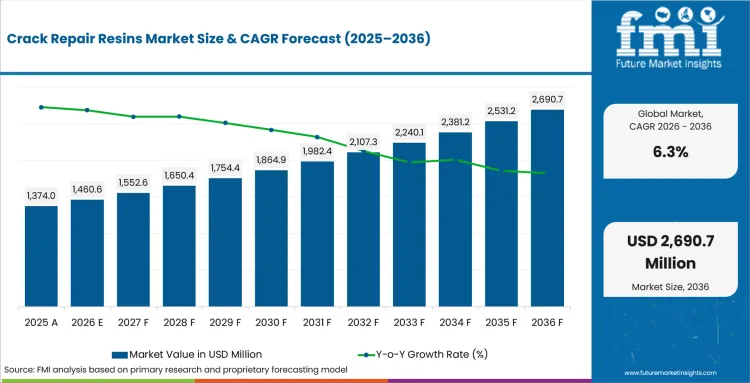
USD 1460.6 million in 2026 and USD 2690.7 million by 2036 at a 6.3% CAGR.
Sales of crack repair resins are estimated to rise at 6.3% CAGR through 2036, increasing valuation from USD 1460.6 million in 2026 to USD 2690.7 million by 2036. Repair specifications must separate stable structural cracks from moving or water-bearing defects prior to selecting resin chemistry and injection equipment for placement. Sika guidance distinguishes rigid epoxy injection from polyurethane and acrylate systems for active leakage, directing viscosity and equipment choices according to crack width and specific site conditions. Construction chemicals combine injection with patching and protection, and epoxy resin formulations address stable load-transfer defects through controlled placement and verified substrate conditions.
Country conversion depends on public specifications and contractor qualification routes rather than uniform purchasing behavior. United States bridge contracts convert diagnosed cracks into resin quantities and application work inside rehabilitation bids. Louisiana DOTD’s August 2025 bid tabulation listed 815 linear feet of epoxy injection for one bridge project. Itemized quantities let contractors price resin use and labor against defined acceptance requirements inside public bids. German motorway programs combine injection with controlled closures, and construction repair composites support strengthening across active corridors through public works. Concrete admixtures shape replacement mortars and technical support needs around repaired defects during wider rehabilitation programs.
Key Takeaways of Crack Repair Resins Market
- Asset owners fund localized resin repairs instead of replacing complete concrete members during rehabilitation programs.
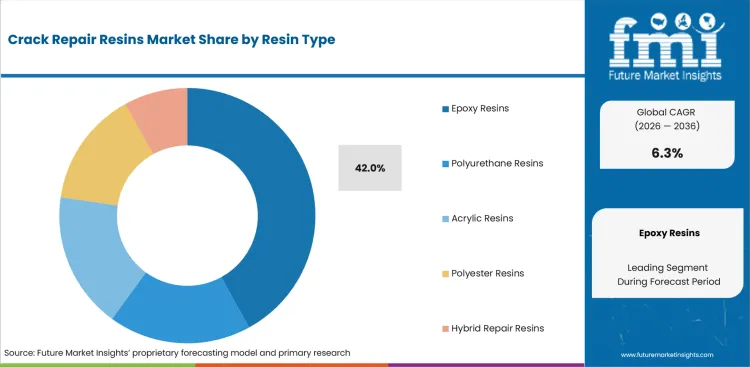
- Epoxy resins are expected to hold 42.0% share in 2026 due to stable load-transfer crack repairs.
- Contractor supply is projected to represent 39.0% share in 2026 owing to stock and accessory availability.
- Injection is anticipated to capture 38.0% share in 2026 driven by placement inside concealed crack paths.
- Incorrect diagnosis and contaminated surfaces can prevent durable bonding across completed repairs under service conditions.
- Integrated manufacturers compete with specialists through broader repair systems and injection support across contractor networks.
Analyst Perspective
“Crack repair resin performance depends more on accurate diagnosis than nominal cured strength across every project. Rigid epoxy suits stable load-transfer defects, whereas active leakage or movement requires chemistry that tolerates changing conditions. Manufacturers earn specifications by linking resin choice with preparation limits and compatible equipment plus responsive field support.”
- Nikhil Kaitwade, Principal Analyst, Future Market Insights
How is the Crack Repair Resins Market segmented?
The crack repair resins industry is segmented by resin type, application method, crack type, end use, sales channel, and region.
The market is segmented by resin type, application method, crack type, end use, sales channel, and region. Resin type separates epoxy from polyurethane, acrylic, polyester, and hybrid systems for moving or wet defects. Application method distinguishes injection, gravity feed, surface sealing, and patch repair according to access and viscosity. Crack type separates structural damage from movement, active leakage, and hairline defects requiring material behavior. End use covers buildings, infrastructure, industrial floors, water-retaining structures, and residential repair with access demands. Sales channels range from contractor supply to direct sales and specialty distribution, and adhesives and sealants frame bonding and movement needs.
What supports demand for epoxy resins within the resin type category?
Stable cracks require rigid resin that reconnects concrete faces without masking continuing movement during service. Engineers confirm crack behavior and substrate condition during assessment, then compare viscosity or cured strength. MAPEI’s current Epojet LV documentation specifies low-viscosity epoxy for dry or damp non-dynamic hairline cracks. Documented limits separate load-transfer injection from flexible sealing; structural adhesives provide benchmarks for prepared-concrete bonding.
- By resin type, epoxy resins are forecast to represent 42.0% in 2026 driven by structural bonding across concrete systems. Engineers compare cured strength and moisture tolerance against prepared substrate conditions during detailed specification review. Flexible chemistries remain necessary for active leakage or movement that would overstress rigid repairs during service.
- Bridge and building contractors adopt epoxy grades through pressure injection or gravity feed across accessible stable defects. Premeasured packaging and compatible ports reduce mixing errors across teams with uneven experience and repeated mobilizations. Technical specialists support repeat purchasing by confirming dryness and temperature limits alongside pressure controls during field placement.
Why does injection shape the application method category?
Injection places resin inside concealed crack paths while contractors document treatment through measured linear footage. A January 2025 Village of Grafton bridge bid included 145 linear feet of epoxy injection. The quantity linked material consumption with equipment and labor inside a broader public rehabilitation contract. Construction adhesives provide an adjacent comparison for bonding across prepared concrete interfaces during complex rehabilitation.
- The injection segment is likely to capture 38.0% share in 2026 attributable to concealed narrow crack paths. Installed ports let crews meter resin and track material travel along each repair line during repeatable controlled injection. Gravity feed remains practical for horizontal hairline defects offering direct access and suitable low-viscosity conditions.
- Infrastructure teams adopt injection across vertical or overhead sections requiring limited concrete removal and controlled resin delivery. Planned venting confirms flow through extended cracks and difficult access points during pressure injection work. Specialist contractors reduce warranty risk by recording pressure and resin travel across port sequences and formal acceptance records.
How are structural cracks positioned within the crack type category?
Engineering assessment precedes resin selection for structural cracks that interrupt load transfer across concrete members. Engineers determine whether rigid rebonding can restore continuity or broader structural strengthening remains technically necessary. ACI CODE-562-25 establishes requirements for evaluating deterioration and designing safe repairs across existing concrete structures. The code connects diagnosis with repair intent; epoxy putty remains an adjacent repair treatment option.
- The crack type is forecast to be led by structural cracks at 31.0% share in 2026 due to load-transfer consequences. Epoxy injection can restore continuity across stable defects with verified conditions and accessible crack paths. Active movement requires flexible treatment that avoids transferring harmful stress into adjacent material during service.
- Asset owners adopt resin repair for localized structural defects identified through inspections and service-risk reviews. Repair scopes combine injection with corrosion treatment or limited concrete replacement inside coordinated rehabilitation programs. Clear acceptance records support repeat purchasing across similar assets governed by engineering standards and scheduled maintenance budgets across regional programs.
What makes buildings central to the end use category?
Buildings contain slabs and walls that impose access or finish constraints across occupied interior spaces. Repair specifications coordinate resin placement with odor limits and surrounding architectural work during scheduled closures. ACI SPEC-563-25 added epoxy and chemical grout injection requirements for building repair in March 2025. Defined preparation and acceptance support later concrete floor coatings and finishing systems across occupied facilities.
- The buildings segment is projected to hold 28.0% share in 2026 owing to basement and parking defects. Contractors reach many repairs without bridge-scale access equipment or prolonged traffic controls during planned maintenance cycles. Occupied properties require predictable curing and controlled handling prior to repaired areas returning safely to regular service.
- Facility managers use crack resins to stop leakage or restore localized concrete prior to finish renewal. Cartridge systems simplify proportioning across smaller teams working during planned maintenance windows inside occupied properties. Service value improves through documented substrate preparation and compatibility with later coatings or waterproofing layers across repeated regional projects.
How do contractors evaluate contractor supply within the sales channel category?
Contractors purchase resin with ports and sealing materials through specialist construction channels serving repair work. Local accessory access prevents delays during shutdown windows and smaller contractor-managed projects across local sites. Fosroc’s current Nitokit LV offering packages epoxy resin with injection nipples for professional crack repair. Packaged kits reduce separate sourcing; regional waterproofing chemicals offer a channel benchmark for repair contractors.
- Based on sales channel, contractor supply is projected to account for 39.0% in 2026 due to local stock and accessories. Installers replace missing components without reopening manufacturer orders during repair schedules or short shutdown windows. Direct channels remain useful for large programs requiring negotiated pricing and consistent lots across assets.
- Specialist distributors support adoption through resin selection and equipment access across differently sized repair projects. Contractors need clear escalation routes for unusual moisture exposure or recurring movement during project planning. Dependable stock and technical guidance reduce repeat mobilization costs and chemistry mismatches during short shutdown windows across dispersed regional sites.
What are the drivers, restraints, and opportunities in the Crack Repair Resins Market?
Condition-based rehabilitation supports demand, but diagnosis and application quality determine whether resin repairs deliver durable performance.
- Driver: Formal bridge inspections convert deterioration into funded scopes specifying resin treatment for diagnosed cracks.
- Restraint: Incorrect diagnosis and contaminated surfaces weaken adhesion across moving or water-bearing cracks during repairs.
- Opportunity: Modular kits and technical service extend injection across smaller buildings and dispersed infrastructure assets.
Public bridge inspections turn documented deterioration into funded programs that can specify localized crack injection rather than broad replacement work. FHWA reported 41,685 poor-condition bridges across United States highway systems in June 2025 through standardized condition reporting. Agencies can translate accepted findings into measured quantities and repair criteria across bridge rehabilitation tenders. Clear technical data helps contractors price resin consumption and acceptance risk across defined project scopes and maintenance budgets.
Application quality remains the central restraint since unsuitable preparation can defeat otherwise compatible resin chemistry across completed repairs. Pressure injection requires dry or properly managed cracks plus sealed surfaces and planned port spacing. Texas DOT specifies these conditions for pressure-injected epoxy repair because incomplete sealing can divert resin from internal voids. Trained crews and documented controls therefore determine whether project owners accept repaired sections during final inspection and later service.
Regional technical support gives contractors a practical route into professional injection work without permanent specialist engineering teams. Product selection must connect resin behavior with pumps and pressure settings across defined site conditions. Master Builders Solutions published its Australian MasterFill Injection Systems guide in June 2026 for professional contractors. Manufacturers can strengthen repeat orders by pairing modular kits with accessible training and responsive field advice across dispersed building and infrastructure projects.
Which country CAGRs are profiled in the Crack Repair Resins Market?
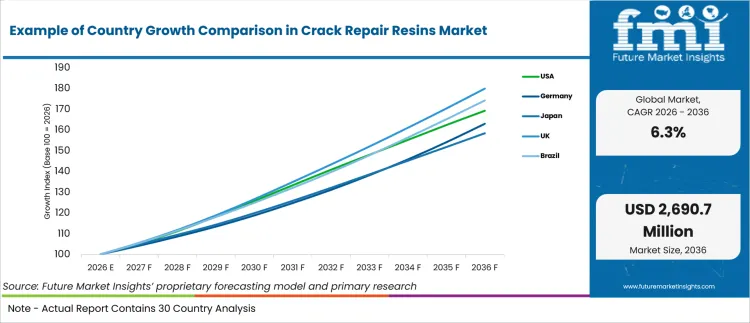
| Country | CAGR |
|---|---|
| United States | 5.4% |
| Germany | 5.0% |
| Japan | 4.7% |
| United Kingdom | 6.0% |
| Brazil | 5.7% |
How do country-level CAGRs compare in the Crack Repair Resins Market?
The five forecasts form a tight 1.3-point band, yet similar growth rates conceal different routes to purchase. United Kingdom and Brazil depend more heavily on dispersed contractor coverage and timely material delivery across rehabilitation programs. United States agencies translate diagnosed defects into itemized bid quantities and acceptance requirements across public bridge contracts. German and Japanese programs rely on formal inspections plus planned closure windows that can delay approved repair work. Manufacturers therefore need country-specific stock plans and application support instead of one uniform regional sales model across these national systems.
- United Kingdom closures bundle concrete repair with waterproofing and joint replacement across scheduled maintenance windows.
- Brazilian programs require regional stock and trained installers across assets separated by long service distances.
- United States contracts itemize epoxy injection beside acceptance requirements and measurable quantities for public bids.
- German motorway programs depend on engineering approval and scheduled traffic closures across federal rehabilitation corridors.
- Japanese bridge programs combine mandatory inspections with municipal repair resources that remain constrained across networks.
The full report provides country-level CAGR analysis across North America, Latin America, Europe, East Asia, South Asia, Oceania and the Middle East and Africa.
Country-wise Analysis
- United States bridge programs separate epoxy injection from overlays and joint work through itemized scopes. The United States is estimated to post 5.4% CAGR over the forecast period, supported by detailed public agency specifications. Public bid schedules convert diagnosed cracking into measurable quantities for qualified contractors and regional distributors. California’s July 2025 bridge preservation notice included epoxy injection at viaduct hinges across eight structures. National distribution supports equipment access across state programs with different approval lists and temperature limits. Seasonal work windows can restrict crew scheduling despite established channels and documented procedures across regional networks during annual rehabilitation planning cycles.
- Germany routes bridge repair through engineering acceptance and planned traffic-management windows across federal motorway corridors. Die Autobahn reported in October 2025 that A65 work repaired concrete bridge abutments and piers. Germany's crack repair resins outlook is anticipated to advance at 5.0% CAGR over the assessment period, underpinned by rehabilitation programs. Scheduled corridor work gives qualified contractors a defined route for material approval and acceptance documentation. Engineering firms support specification review through established construction-chemical channels and technical service during project planning. Restricted closure windows and budget sequencing can delay injection despite verified defects across motorway projects during planned federal corridor rehabilitation.
- Japan manages bridge repair through five-year inspections covering national and municipal road assets across networks. By 2036, Japan is projected to grow at 4.7% CAGR, shaped by targeted preventive maintenance and condition-based planning. Condition classifications direct local authorities toward diagnostic work and defined rehabilitation planning for deteriorated structures. Japan's transport ministry reported in August 2025 that 53,000 bridges required early or urgent action. Chemical distributors support compact equipment and technical training across regional maintenance programs and local districts. Municipal staffing and limited budgets can delay project starts despite documented repair needs across smaller jurisdictions with limited local specialist engineering staff.
- United Kingdom bridge maintenance combines concrete repair with waterproofing and joint replacement during scheduled closures. Crack-repair resin sales in the United Kingdom are forecast to expand at 6.0% CAGR by 2036, aided by transport programs. National Highways described July 2025 M27 work pairing concrete repair with waterproofing and joint replacement. Specialist contractors support complex scopes through established application skills and compatible materials across infrastructure programs. Restricted access hours and fragmented project sizes complicate contractor mobilization across several concurrent maintenance packages. Coordinated material availability remains essential for protecting closure schedules and reopening commitments during rehabilitation work across constrained motorway closure periods.
- Brazilian bridge programs span long distances between federal assets and specialist repair teams across corridors. In Brazil, crack repair resin demand is predicted to advance at 5.7% CAGR through 2036, linked to road rehabilitation. DNIT reported in February 2026 that Riacho do Mel bridge maintenance restored two concrete piers. Federal asset management connects deterioration with funded repair activity and documented contractor scopes inside public contracts. Regional distributors improve access through material delivery and technical guidance across widely dispersed project locations. Long transport distances and uneven installer availability constrain remote execution despite established public maintenance programs across remote federal road corridors.
Who are the notable companies in the Crack Repair Resins Market?
Sika AG, MAPEI S.p.A., Fosroc, a Saint-Gobain company, Master Builders Solutions, Simpson Strong-Tie Company Inc., The Euclid Chemical Company, W. R. Meadows, Inc., and ARDEX Group are the notable companies shaping this market.
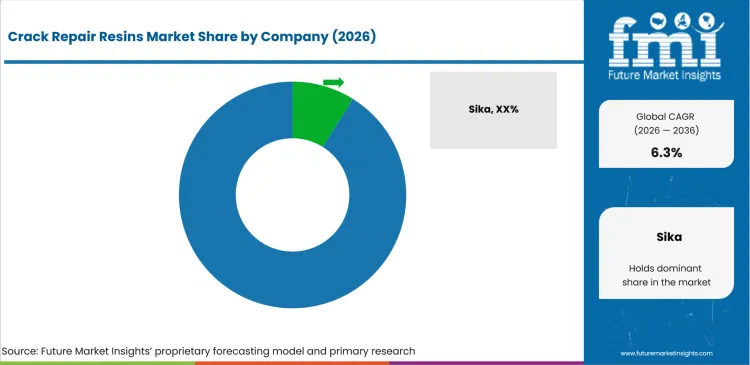
Global construction-chemical groups compete beside specialist repair brands and regional distributors, leaving the field moderately fragmented. Broader groups differentiate through systems combining injection resins with mortars and protective coatings across rehabilitation stages. Specialists compete through packaged kits and deeper application support across narrower crack and moisture conditions. Entry remains possible for manufacturers documenting exact use limits and supporting contractors with compatible accessories. Distribution reach shapes competition across repair sites dispersed through national building and infrastructure maintenance networks and property programs.
- Sika and MAPEI compete beside Fosroc through injection resins embedded within portfolios that combine patching with strengthening and protective treatment. Their multi-region networks help engineering teams coordinate several rehabilitation stages through one technical platform and established technical service networks worldwide.
- Master Builders Solutions and Euclid Chemical cover structural epoxy and water-sealing conditions through documented system ranges and field support. Simpson Strong-Tie differentiates through packaged injection kits and dispensing tools positioned between small cartridges and permanent bulk metering equipment for repairs.
- W. R. Meadows concentrates on low-viscosity epoxy for non-moving structural cracks through North American channels and established distributors. ARDEX addresses rapid rigid crack filling within flooring and building-maintenance workflows that do not require structural load transfer across scheduled property programs.
Competitive Benchmarking: Crack Repair Resins Market
| Company | Structural Epoxy Injection | Water-Bearing Crack Sealing | Repair-System Breadth | Geographic Reach |
|---|---|---|---|---|
| Sika AG | High | High | High | Global or multi-region |
| MAPEI S.p.A. | High | Medium | High | Global or multi-region |
| Fosroc | High | High | High | Global or multi-region |
| Master Builders Solutions | High | High | High | Global or multi-region |
| Simpson Strong-Tie | High | Medium | Medium | North America and selected exports |
| Euclid Chemical | High | High | High | North America and selected exports |
| W. R. Meadows | High | Low | Medium | North America and selected exports |
| ARDEX Group | Low | Low | Medium | Global or multi-region |
Scoring basis: Epoxy injection rates pressure systems High, limited systems Medium, and filler-based portfolios Low across offerings. Water sealing rates active-leak grouts High, limited systems Medium, and rigid products Low; breadth rates three, two, or one functions respectively.
Key Developments in the Crack Repair Resins Market
- In February 2025, Saint-Gobain completed its acquisition of Fosroc and integrated the business within its construction chemicals portfolio across Asia and emerging markets. Fosroc’s injection resins now complement repair mortars and protective systems within wider regional rehabilitation programs. The transaction intensifies competition around coordinated specifications and local technical service instead of standalone resin supply across major infrastructure repair markets worldwide.
- In March 2025, MAPEI renamed its concrete restoration systems line as construction and restoration systems. The broader identity places epoxy adhesives beside repair and strengthening products for buildings and infrastructure. Engineering teams can assess crack treatment through one technical organization across several coordinated rehabilitation stages. The change strengthens competition among manufacturers offering systems for coordinated concrete repair functions across projects.
- In March 2026, Sika issued the Sikadur Crack Repair Kit declaration under EN 1504-5 requirements. The record covers force-transmitting injection in civil works with declared performance for defined narrow cracks. European contractors receive current compliance documentation for comparing packaged injection systems across regulated rehabilitation projects. Declared crack width and durability requirements narrow formal product acceptance across regulated European project reviews.
- In December 2025, Simpson Strong-Tie launched the CI-LVPO-KT kit for larger professional concrete crack repairs. The package combines structural injection epoxy with ports and essential mixing accessories for larger projects. Repair teams gain a practical option between small consumer kits and permanent bulk injection equipment. The launch broadens packaged access for medium-sized commercial repairs across established regional contractor support networks.
Crack Repair Resins Market - Report Scope
| Coverage field | Report scope |
|---|---|
| Market breakdown | Resin type, application method, crack type, end use, sales channel, and region. |
| Market Definition | Resin systems used to fill, bond, seal, or stabilize cracks in concrete and masonry structures. |
| Regions Covered | North America, Latin America, Western Europe, Eastern Europe, East Asia, South Asia and Pacific, and Middle East and Africa. |
| Countries Covered | United States, Germany, Japan, United Kingdom, and Brazil. |
| Key Companies Profiled | Sika AG, MAPEI S.p.A., Fosroc, a Saint-Gobain company, Master Builders Solutions, Simpson Strong-Tie Company Inc., The Euclid Chemical Company, W. R. Meadows, Inc., and ARDEX Group |
| Forecast Period | 2026 to 2036. |
| Approach | Hybrid bottom-up and top-down market sizing supported by primary interviews and authoritative desk research. |
Crack Repair Resins Market - Research Methodology
| Method | Approach |
|---|---|
| Primary Research | FMI analysts gathered input from manufacturers, service providers, technology developers, distributors, end users, procurement teams, and subject-matter experts. Interviews examined purchasing decisions, product or service evaluation, adoption barriers, approval requirements, pricing considerations, and expectations for technical or commercial support. Respondents were also asked what evidence is required before a trial, pilot, or initial order develops into regular purchasing. |
| Desk Research | Desk research covered government statistics, regulatory publications, trade data, industry associations, technical literature, standards, company filings, product information, and official corporate announcements. Sources were reviewed for relevance, publication date, geographic coverage, and consistency with the defined market scope. Claims relating to performance, applications, approvals, capacity, investment, and commercial activity were retained only when supported by credible public evidence. |
| Market Sizing and Forecasting | The market model combined the baseline value with historical performance, segment structure, pricing and volume indicators, adoption levels, company participation, and country-level demand conditions. Forecast assumptions considered economic activity, investment trends, regulatory developments, technology adoption, purchasing cycles, supply availability, and barriers to wider market use. Segment and regional estimates were reconciled before the final market total was calculated. |
| Data Validation | Estimates were checked against multiple independent indicators, including public data, company activity, trade patterns, industry developments, and findings from primary interviews. Validation also tested whether products, services, applications, and company revenues fell within the defined market boundaries. Adjacent categories, unsupported claims, overlapping revenues, and activities without direct market relevance were excluded to reduce double counting and maintain consistency across segments and countries. |
Crack Repair Resins Market by Segments
Crack Repair Resins Market segmented by Resin Type:
- Epoxy Resins
- Polyurethane Resins
- Acrylic Resins
- Polyester Resins
- Hybrid Repair Resins
Crack Repair Resins Market segmented by Application Method:
- Injection
- Gravity Feed
- Surface Sealing
- Patch / Paste Repair
Crack Repair Resins Market segmented by Crack Type:
- Structural Cracks
- Non-structural Cracks
- Active Water-bearing Cracks
- Hairline Cracks
Crack Repair Resins Market segmented by End Use:
- Buildings
- Bridges / Infrastructure
- Industrial Floors
- Water-retaining Structures
- Residential Repair
Crack Repair Resins Market segmented by Sales Channel:
- Contractor Supply
- Direct Chemical Supply
- Retail Repair Kits
- Specialty Distributors
Crack Repair Resins Market by Region:
- North America
- United States
- Canada
- Latin America
- Brazil
- Mexico
- Argentina
- Chile
- Western Europe
- Germany
- France
- United Kingdom
- Italy
- Spain
- Benelux
- Nordics
- Eastern Europe
- Poland
- Czech Republic
- Romania
- Hungary
- East Asia
- China
- Japan
- South Korea
- South Asia and Pacific
- India
- ASEAN
- Australia and New Zealand
- Middle East and Africa
- GCC Countries
- South Africa
- Türkiye
- Israel
Research Sources and Bibliography
- ACI Committee 562. (2025, January 1).
- ACI Committee 563. (2025, March 19)
- Sika AG. (n.d.).
- Louisiana Department of Transportation and Development. (2025, August 13)
- Village of Grafton. (2025, January 9)
- Federal Highway Administration. (2025, June 15)
- Texas Department of Transportation. (n.d.).
- California Department of Transportation. (2025, July 24).
- Die Autobahn GmbH des Bundes. (2025, October 27).
- Ministry of Land, Infrastructure, Transport and Tourism. (2025, August 25).
- National Highways. (2025, July 7).
- Departamento Nacional de Infraestrutura de Transportes. (2026, February 20).
- Master Builders Solutions. (2026, June 2).
- Saint-Gobain. (2025, February 10).
- MAPEI. (2025, March 26)
- Sika Services AG. (2026, March 3).
- Simpson Strong-Tie. (2025, December 17).
- Simpson Strong-Tie. (n.d.).
- The Euclid Chemical Company. (n.d.).
- W. R. Meadows. (n.d.).
- ARDEX Americas. (n.d.).
This bibliography is provided for reader reference and is not exhaustive. The full report contains the complete reference list and detailed citations
This Report Answers
- How large is the global Crack Repair Resins market, and what is its growth outlook?
- What factors support the adoption of resin-based concrete and structural crack repair solutions?
- Why do epoxy-based crack repair resins hold the largest share of the market?
- How do resin injection techniques restore structural integrity and prevent further deterioration?
- How do structural, non-structural, dormant, and active cracks differ in repair requirements?
- Why do market demand, repair practices, and growth opportunities vary across countries?
- Which leading companies provide integrated crack repair resin systems and related solutions?
- What technical, environmental, and application-related factors can limit repair effectiveness?
- How should contractors evaluate and select crack repair resins based on performance, durability, and project requirements?
Frequently Asked Questions
How big is the Crack Repair Resins Market in 2026?
The crack repair resins market is valued at USD 1460.6 million in 2026 and is forecast to reach USD 2690.7 million by 2036. Growth is supported by public bridge and building rehabilitation programs that convert diagnosed cracking into funded, itemized resin repair scopes across contractor-managed projects worldwide.
What is the CAGR of the Crack Repair Resins Market from 2026 to 2036?
The crack repair resins market grows at a CAGR of 6.3% between 2026 and 2036, supported by formal bridge and building inspections that convert diagnosed deterioration into funded rehabilitation scopes specifying resin injection, patching, and sealing across contractor-managed public and private infrastructure programs.
Which resin type leads the Crack Repair Resins Market?
Epoxy resins account for 42.0% of the crack repair resins market by resin type in 2026, driven by demand for stable, load-transfer crack repairs where rigid bonding reconnects concrete faces without masking movement, supported by premeasured packaging that reduces mixing errors across contractor teams.
How much will the Crack Repair Resins Market add between 2026 and 2036?
The crack repair resins market is set to add USD 1,230.1 million between 2026 and 2036, growing from USD 1,460.6 million to USD 2,690.7 million as diagnosed bridge and building deterioration converts into funded, itemized resin repair scopes across expanding contractor and infrastructure rehabilitation networks.
Who are the leading companies in the Crack Repair Resins Market?
Nine companies lead the crack repair resins market, including Sika AG, MAPEI, Fosroc, Master Builders Solutions, Simpson Strong-Tie, Euclid Chemical, W. R. Meadows, and ARDEX Group, competing through structural epoxy injection, water-bearing crack sealing, and broader repair-system portfolios across global and regional contractor networks.
Preview the report firsthand - request a free sample
Get SampleGet the brochure for pricing and purchase details.
Get PDFTable of Content
- Key Takeaways
- Market Size and CAGR
- Top Growth Driver
- Fastest Growing Segment
- Leading Region
- Key Companies
- Emerging Opportunities
- Executive Summary
- Global Market Outlook
- Demand-side Trends
- Supply-side Trends
- Technology Roadmap Analysis
- Analysis and Recommendations
- Analyst Perspective (What is happening? Why now? What should investors know?)
- Key Questions Answered
- How large is the market?
- What is the CAGR?
- What are key trends?
- Which region dominates?
- Who are the leaders?
- Market Overview
- Market Coverage / Taxonomy
- Market Definition / Scope / Limitations
- Research Methodology
- Chapter Orientation
- Analytical Lens and Working Hypotheses
- Market Structure, Signals, and Trend Drivers
- Benchmarking and Cross-market Comparability
- Market Sizing, Forecasting, and Opportunity Mapping
- Research Design and Evidence Framework
- Desk Research Programme (Secondary Evidence)
- Expert Input and Fieldwork (Primary Evidence)
- Tooling, Models, and Reference Databases
- Data Engineering and Model Build
- Quality Assurance and Audit Trail
- Market Background
- Market Dynamics (Drivers, Restraints, Opportunity, Trends)
- Scenario Forecast (Optimistic, Likely, Conservative)
- Impact Analysis
- AI Impact
- Sustainability Impact
- Regulatory Impact
- Technology Impact
- Consumer / Buyer Analysis
- Purchase Drivers
- Adoption Barriers
- Buyer Journey
- Opportunity Map Analysis
- Product Life Cycle Analysis
- Supply Chain Analysis
- Investment Feasibility Matrix
- Value Chain Analysis
- PESTLE and Porter's Analysis
- Regulatory Landscape
- Regional Parent Market Outlook
- Production and Consumption Statistics
- Import and Export Statistics
- Global Market Analysis and Forecast, 2021 to 2036
- Historical Market Size Value (USD Million) Analysis, 2021 to 2025
- Current and Future Market Size Value (USD Million) Projections, 2026 to 2036
- Y-o-Y Growth Trend Analysis
- Absolute $ Opportunity Analysis
- Global Market Pricing Analysis, 2021 to 2036
- Global Market Analysis and Forecast, By Resin Type, 2021 to 2036
- Introduction / Key Findings
- Historical Market Size Value (USD Million) Analysis By Resin Type, 2021 to 2025
- Current and Future Market Size Value (USD Million) Analysis and Forecast By Resin Type, 2026 to 2036
- Epoxy Resins
- Polyurethane Resins
- Acrylic Resins
- Polyester Resins
- Hybrid Repair Resins
- Epoxy Resins
- Y-o-Y Growth Trend Analysis By Resin Type, 2021 to 2025
- Absolute $ Opportunity Analysis By Resin Type, 2026 to 2036
- Global Market Analysis and Forecast, By Application Method, 2021 to 2036
- Introduction / Key Findings
- Historical Market Size Value (USD Million) Analysis By Application Method, 2021 to 2025
- Current and Future Market Size Value (USD Million) Analysis and Forecast By Application Method, 2026 to 2036
- Injection
- Gravity Feed
- Surface Sealing
- Patch / Paste Repair
- Injection
- Y-o-Y Growth Trend Analysis By Application Method, 2021 to 2025
- Absolute $ Opportunity Analysis By Application Method, 2026 to 2036
- Global Market Analysis and Forecast, By Crack Type, 2021 to 2036
- Introduction / Key Findings
- Historical Market Size Value (USD Million) Analysis By Crack Type, 2021 to 2025
- Current and Future Market Size Value (USD Million) Analysis and Forecast By Crack Type, 2026 to 2036
- Structural Cracks
- Non-structural Cracks
- Active Water-bearing Cracks
- Hairline Cracks
- Structural Cracks
- Y-o-Y Growth Trend Analysis By Crack Type, 2021 to 2025
- Absolute $ Opportunity Analysis By Crack Type, 2026 to 2036
- Global Market Analysis and Forecast, By End Use, 2021 to 2036
- Introduction / Key Findings
- Historical Market Size Value (USD Million) Analysis By End Use, 2021 to 2025
- Current and Future Market Size Value (USD Million) Analysis and Forecast By End Use, 2026 to 2036
- Buildings
- Bridges / Infrastructure
- Industrial Floors
- Water-retaining Structures
- Residential Repair
- Buildings
- Y-o-Y Growth Trend Analysis By End Use, 2021 to 2025
- Absolute $ Opportunity Analysis By End Use, 2026 to 2036
- Global Market Analysis and Forecast, By Sales Channel, 2021 to 2036
- Introduction / Key Findings
- Historical Market Size Value (USD Million) Analysis By Sales Channel, 2021 to 2025
- Current and Future Market Size Value (USD Million) Analysis and Forecast By Sales Channel, 2026 to 2036
- Contractor Supply
- Direct Chemical Supply
- Retail Repair Kits
- Specialty Distributors
- Contractor Supply
- Y-o-Y Growth Trend Analysis By Sales Channel, 2021 to 2025
- Absolute $ Opportunity Analysis By Sales Channel, 2026 to 2036
- Global Market Analysis and Forecast, By Region, 2021 to 2036
- Introduction
- Historical Market Size Value (USD Million) Analysis By Region, 2021 to 2025
- Current Market Size Value (USD Million) Analysis and Forecast By Region, 2026 to 2036
- North America
- Latin America
- Western Europe
- Eastern Europe
- East Asia
- South Asia and Pacific
- Middle East & Africa
- Market Attractiveness Analysis By Region
- North America Market Analysis and Forecast, By Country, 2021 to 2036
- Historical Market Size Value (USD Million) Trend Analysis By Market Taxonomy, 2021 to 2025
- Market Size Value (USD Million) Forecast By Market Taxonomy, 2026 to 2036
- By Country
- USA
- Canada
- By Resin Type
- By Application Method
- By Crack Type
- By End Use
- By Sales Channel
- By Country
- Market Attractiveness Analysis
- By Country
- By Resin Type
- By Application Method
- By Crack Type
- By End Use
- By Sales Channel
- Key Takeaways
- Latin America Market Analysis and Forecast, By Country
- Historical Market Size Value (USD Million) Trend Analysis By Market Taxonomy, 2021 to 2025
- Market Size Value (USD Million) Forecast By Market Taxonomy, 2026 to 2036
- By Country
- Brazil
- Mexico
- Chile
- Rest of Latin America
- By Resin Type
- By Application Method
- By Crack Type
- By End Use
- By Sales Channel
- By Country
- Market Attractiveness Analysis
- By Country
- By Resin Type
- By Application Method
- By Crack Type
- By End Use
- By Sales Channel
- Key Takeaways
- Western Europe Market Analysis and Forecast, By Country
- Historical Market Size Value (USD Million) Trend Analysis By Market Taxonomy, 2021 to 2025
- Market Size Value (USD Million) Forecast By Market Taxonomy, 2026 to 2036
- By Country
- Germany
- UK
- Italy
- Spain
- France
- Nordic
- BENELUX
- Rest of Western Europe
- By Resin Type
- By Application Method
- By Crack Type
- By End Use
- By Sales Channel
- By Country
- Market Attractiveness Analysis
- By Country
- By Resin Type
- By Application Method
- By Crack Type
- By End Use
- By Sales Channel
- Key Takeaways
- Eastern Europe Market Analysis and Forecast, By Country
- Historical Market Size Value (USD Million) Trend Analysis By Market Taxonomy, 2021 to 2025
- Market Size Value (USD Million) Forecast By Market Taxonomy, 2026 to 2036
- By Country
- Russia
- Poland
- Hungary
- Balkan & Baltic
- Rest of Eastern Europe
- By Resin Type
- By Application Method
- By Crack Type
- By End Use
- By Sales Channel
- By Country
- Market Attractiveness Analysis
- By Country
- By Resin Type
- By Application Method
- By Crack Type
- By End Use
- By Sales Channel
- Key Takeaways
- East Asia Market Analysis and Forecast, By Country
- Historical Market Size Value (USD Million) Trend Analysis By Market Taxonomy, 2021 to 2025
- Market Size Value (USD Million) Forecast By Market Taxonomy, 2026 to 2036
- By Country
- China
- Japan
- South Korea
- By Resin Type
- By Application Method
- By Crack Type
- By End Use
- By Sales Channel
- By Country
- Market Attractiveness Analysis
- By Country
- By Resin Type
- By Application Method
- By Crack Type
- By End Use
- By Sales Channel
- Key Takeaways
- South Asia and Pacific Market Analysis and Forecast, By Country
- Historical Market Size Value (USD Million) Trend Analysis By Market Taxonomy, 2021 to 2025
- Market Size Value (USD Million) Forecast By Market Taxonomy, 2026 to 2036
- By Country
- India
- ASEAN
- Australia & New Zealand
- Rest of South Asia and Pacific
- By Resin Type
- By Application Method
- By Crack Type
- By End Use
- By Sales Channel
- By Country
- Market Attractiveness Analysis
- By Country
- By Resin Type
- By Application Method
- By Crack Type
- By End Use
- By Sales Channel
- Key Takeaways
- Middle East & Africa Market Analysis and Forecast, By Country
- Historical Market Size Value (USD Million) Trend Analysis By Market Taxonomy, 2021 to 2025
- Market Size Value (USD Million) Forecast By Market Taxonomy, 2026 to 2036
- By Country
- Kingdom of Saudi Arabia
- Other GCC Countries
- Türkiye
- South Africa
- Other African Union
- Rest of Middle East & Africa
- By Resin Type
- By Application Method
- By Crack Type
- By End Use
- By Sales Channel
- By Country
- Market Attractiveness Analysis
- By Country
- By Resin Type
- By Application Method
- By Crack Type
- By End Use
- By Sales Channel
- Key Takeaways
- Key Countries Market Analysis
- USA
- Pricing Analysis
- Market Share Analysis, 2025
- By Resin Type
- By Application Method
- By Crack Type
- By End Use
- By Sales Channel
- Canada
- Pricing Analysis
- Market Share Analysis, 2025
- By Resin Type
- By Application Method
- By Crack Type
- By End Use
- By Sales Channel
- Mexico
- Pricing Analysis
- Market Share Analysis, 2025
- By Resin Type
- By Application Method
- By Crack Type
- By End Use
- By Sales Channel
- Brazil
- Pricing Analysis
- Market Share Analysis, 2025
- By Resin Type
- By Application Method
- By Crack Type
- By End Use
- By Sales Channel
- Chile
- Pricing Analysis
- Market Share Analysis, 2025
- By Resin Type
- By Application Method
- By Crack Type
- By End Use
- By Sales Channel
- Germany
- Pricing Analysis
- Market Share Analysis, 2025
- By Resin Type
- By Application Method
- By Crack Type
- By End Use
- By Sales Channel
- UK
- Pricing Analysis
- Market Share Analysis, 2025
- By Resin Type
- By Application Method
- By Crack Type
- By End Use
- By Sales Channel
- Italy
- Pricing Analysis
- Market Share Analysis, 2025
- By Resin Type
- By Application Method
- By Crack Type
- By End Use
- By Sales Channel
- Spain
- Pricing Analysis
- Market Share Analysis, 2025
- By Resin Type
- By Application Method
- By Crack Type
- By End Use
- By Sales Channel
- France
- Pricing Analysis
- Market Share Analysis, 2025
- By Resin Type
- By Application Method
- By Crack Type
- By End Use
- By Sales Channel
- India
- Pricing Analysis
- Market Share Analysis, 2025
- By Resin Type
- By Application Method
- By Crack Type
- By End Use
- By Sales Channel
- ASEAN
- Pricing Analysis
- Market Share Analysis, 2025
- By Resin Type
- By Application Method
- By Crack Type
- By End Use
- By Sales Channel
- Australia & New Zealand
- Pricing Analysis
- Market Share Analysis, 2025
- By Resin Type
- By Application Method
- By Crack Type
- By End Use
- By Sales Channel
- China
- Pricing Analysis
- Market Share Analysis, 2025
- By Resin Type
- By Application Method
- By Crack Type
- By End Use
- By Sales Channel
- Japan
- Pricing Analysis
- Market Share Analysis, 2025
- By Resin Type
- By Application Method
- By Crack Type
- By End Use
- By Sales Channel
- South Korea
- Pricing Analysis
- Market Share Analysis, 2025
- By Resin Type
- By Application Method
- By Crack Type
- By End Use
- By Sales Channel
- Russia
- Pricing Analysis
- Market Share Analysis, 2025
- By Resin Type
- By Application Method
- By Crack Type
- By End Use
- By Sales Channel
- Poland
- Pricing Analysis
- Market Share Analysis, 2025
- By Resin Type
- By Application Method
- By Crack Type
- By End Use
- By Sales Channel
- Hungary
- Pricing Analysis
- Market Share Analysis, 2025
- By Resin Type
- By Application Method
- By Crack Type
- By End Use
- By Sales Channel
- Kingdom of Saudi Arabia
- Pricing Analysis
- Market Share Analysis, 2025
- By Resin Type
- By Application Method
- By Crack Type
- By End Use
- By Sales Channel
- Türkiye
- Pricing Analysis
- Market Share Analysis, 2025
- By Resin Type
- By Application Method
- By Crack Type
- By End Use
- By Sales Channel
- South Africa
- Pricing Analysis
- Market Share Analysis, 2025
- By Resin Type
- By Application Method
- By Crack Type
- By End Use
- By Sales Channel
- USA
- Market Structure Analysis
- Competition Dashboard
- Competition Benchmarking
- Market Share Analysis of Top Players
- By Regional
- By Resin Type
- By Application Method
- By Crack Type
- By End Use
- By Sales Channel
- Emerging Startups
- Innovation Benchmarking
- Competition Analysis
- Competition Deep Dive
- Sika
- Overview
- Product Portfolio
- Profitability by Market Segments
- Sales Footprint
- Strategy Overview
- Marketing Strategy
- Product Strategy
- Channel Strategy
- Master Builders Solutions
- Mapei
- Fosroc
- Tremco CPG
- Simpson Strong-Tie
- Euclid Chemical
- W. R. Meadows
- Five Star Products
- Ardex
- Sika
- Case Studies
- Success Stories
- Recent Developments
- Competition Deep Dive
- Assumptions & Acronyms Used


