- Market Size (2026)
- USD 6.65 Bn
- Forecast (2036)
- USD 12.84 Bn
- CAGR (2026 to 2036)
- 6.8%
How Big Is the All-Weather Tire Market in 2026?
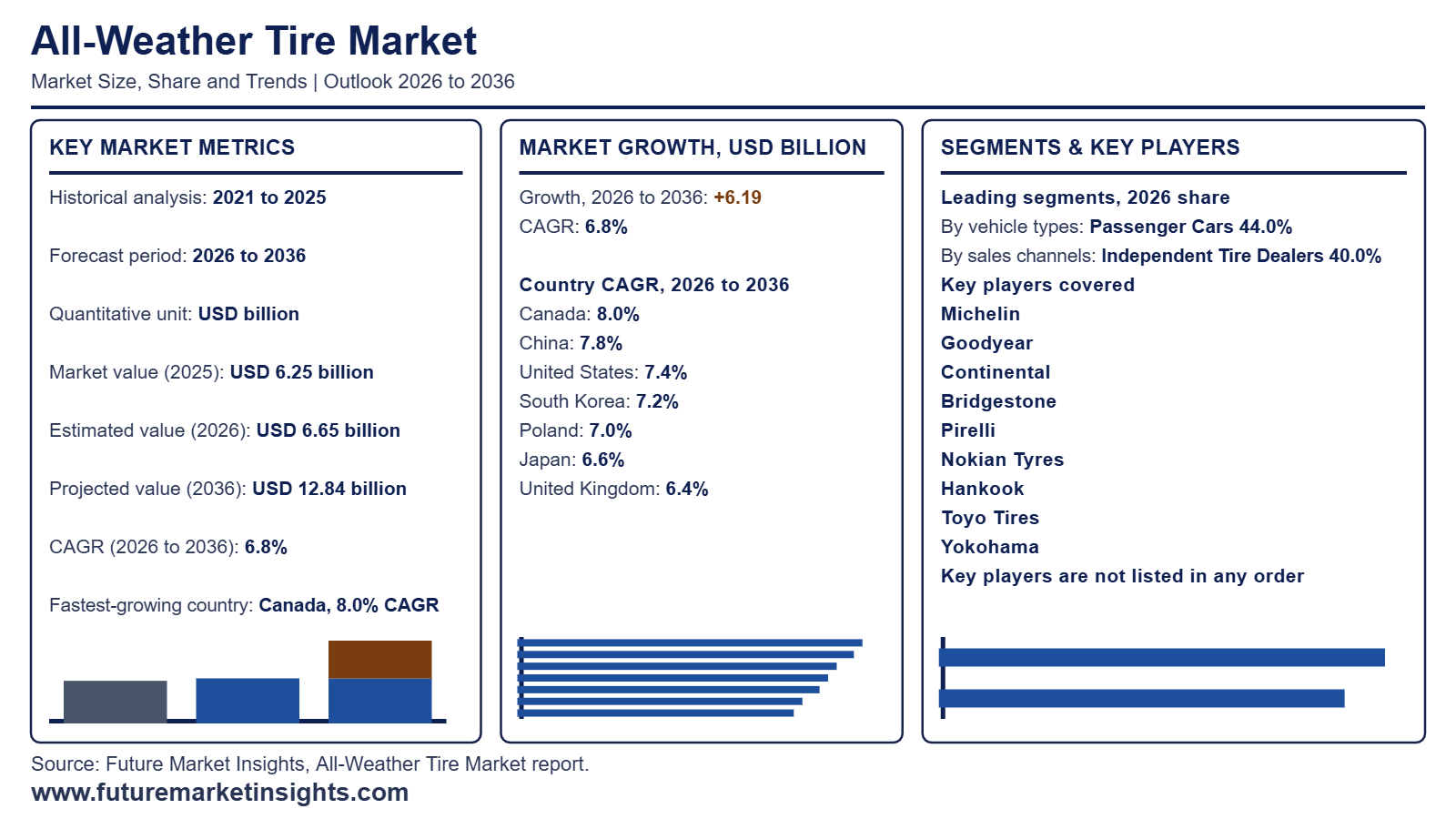
The global all-weather tire market is valued at USD 6.65 billion in 2026, up from USD 6.25 billion in 2025, and is projected by Future Market Insights (FMI) to reach USD 12.84 billion by 2036, expanding at a 6.8% CAGR from 2026 to 2036 and generating USD 6.19 billion in incremental revenue over the 10-year forecast period.
| Market Metric | Valuation / Share / Forecast Benchmark |
|---|---|
| 2025 Market Size (Historical) | USD 6.25 billion |
| 2026 Market Size (Estimated) | USD 6.65 billion |
| 2036 Market Size (Projected) | USD 12.84 billion |
| Compound Annual Growth Rate (2026 to 2036) | 6.8% CAGR |
| Incremental Dollar Opportunity (2026 to 2036) | USD 6.19 billion |
| Leading & Fastest-Growing Vehicle Types | Passenger Cars (44.0% share in 2026; 5.8% CAGR) | Electric Vehicles (fastest, 7.9% CAGR) |
| Leading & Fastest-Growing Sales Channels | Independent Tire Dealers (40.0% share in 2026; 6.0% CAGR) | Online Retail (fastest, 8.9% CAGR) |
| Leading & Fastest-Growing Rim Sizes | 16 to 17 Inch (40.0% share in 2026; 5.0% CAGR) | 20 Inch & Above (fastest, 9.8% CAGR) |
| Largest Country Markets (2026 Global Share) | United States (28.0%), Germany (11.0%), United Kingdom (7.0%) |
| Fastest-Growing Country Markets (2026 to 2036) | Canada (8.0% CAGR), China (7.8% CAGR), United States (7.4% CAGR) |
| Leading Tier-1 Companies | Michelin, Goodyear, Continental, Bridgestone, Pirelli, Nokian Tyres, Hankook, Toyo Tires, Yokohama, Falken (Sumitomo Rubber) |
Source: Future Market Insights analysis of the all-weather tire market, 2026.
Executive Market Overview
Adoption of all-weather tires is rising as drivers drop the twice-yearly swap between summer and winter sets. Milder winters in much of Europe make one set practical for most of the year. Drivers also save on storage fees and fitting appointments. Tire makers, in turn, are adding sizes for SUVs and electric cars. Goodyear, for example, said in April 2026 that sales of 19-inch and larger all-season tires grew over 20% a year. Passenger cars still take about 44% of revenue in 2026. The market is growing at about 6.8% a year, a pace expected to hold through 2036.
Investment in new all-weather ranges is spreading to North America, where most drivers still use all-season tires without winter marks. Continental, for instance, launched the SecureContact AW all-weather touring tire in January 2026. Dealers can therefore offer winter-rated grip to drivers who refuse a second set. SUVs and crossovers are the fastest-growing large vehicle group at about 7.8% a year. Rims of 20 inches and above are growing fastest at about 9.8% a year. Online retail, meanwhile, is growing at about 8.9% a year.
Analyst Perspective
"All-weather tires are replacing the twice-a-year swap between summer and winter sets for many drivers in Europe and North America. Tire makers are launching new ranges in larger rim sizes for SUVs and electric cars. Online ordering with fitting is growing quickly. Over the next decade, North America will add the most new buyers. Strict winter rules in the coldest areas, however, will keep dedicated winter tires in use."Nikhil Kaitwade, Principal Consultant, Future Market Insights (FMI)
Major Market Trends and Insights
- Drivers Are Dropping Seasonal Tire Swaps: Sales of all-weather tires are rising as drivers avoid two sets and storage fees. Milder winters in western Europe make one set practical. Tire makers, in turn, are adding winter safety marks to all-weather ranges. Goodyear, for example, launched Vector All Season 4 in April 2026. As a result, all-weather tires are taking share from summer and winter sets.
- SUV Owners Are Buying Larger Sizes: Demand for all-weather tires in 19-inch and larger sizes is rising quickly. SUVs and electric cars use bigger wheels. Goodyear said sales of 19-inch and above all-season tires rose more than 20% a year from 2022 to 2025. Tire makers are therefore widening size ranges. As a result, larger rims are growing faster than standard sizes.
- Tire Makers Are Launching All-Weather Ranges in North America: Launches of all-weather tires are increasing in the US and Canada. Most North American drivers still buy all-season tires that lack winter safety marks. Continental, for instance, launched the SecureContact AW in January 2026. It also added the TerrainContact A/T2 for SUVs and light trucks in July 2026. As a result, dealers are offering all-weather tires to more drivers.
What Are the Main Drivers, Restraints, and Opportunities?
Milder winters, larger SUV fleets and single-set convenience are driving all-weather tire sales. Winter tire rules and price gaps restrain growth, while larger rim sizes, online sales and North America offer the largest new revenue.
Driver: Milder Winters, SUV Fleets and Single-Set Convenience
Purchases of all-weather tires are supported by drivers who want one set for the whole year. Storage fees and fitting costs for a second set, in turn, push drivers to switch. SUV and crossover fleets are growing, which raises demand for larger sizes. Winter safety marks also let all-weather tires meet rules in many areas. As a result, SUVs and crossovers are set to add about USD 2.68 billion by 2036.
Restraint: Winter Tire Rules and Price Gaps With All-Season Tires
Sales of all-weather tires are limited in areas with long, harsh winters. Drivers in Nordic countries and northern Canada still prefer dedicated winter tires for ice. All-weather tires also cost more than standard all-season tires. Many drivers in the southern US, meanwhile, see no need for winter grip. Tire makers face lower margins when rubber and carbon black costs rise. As a result, adoption stays uneven between regions.
Opportunity: Large Rim Sizes, Online Sales and North America
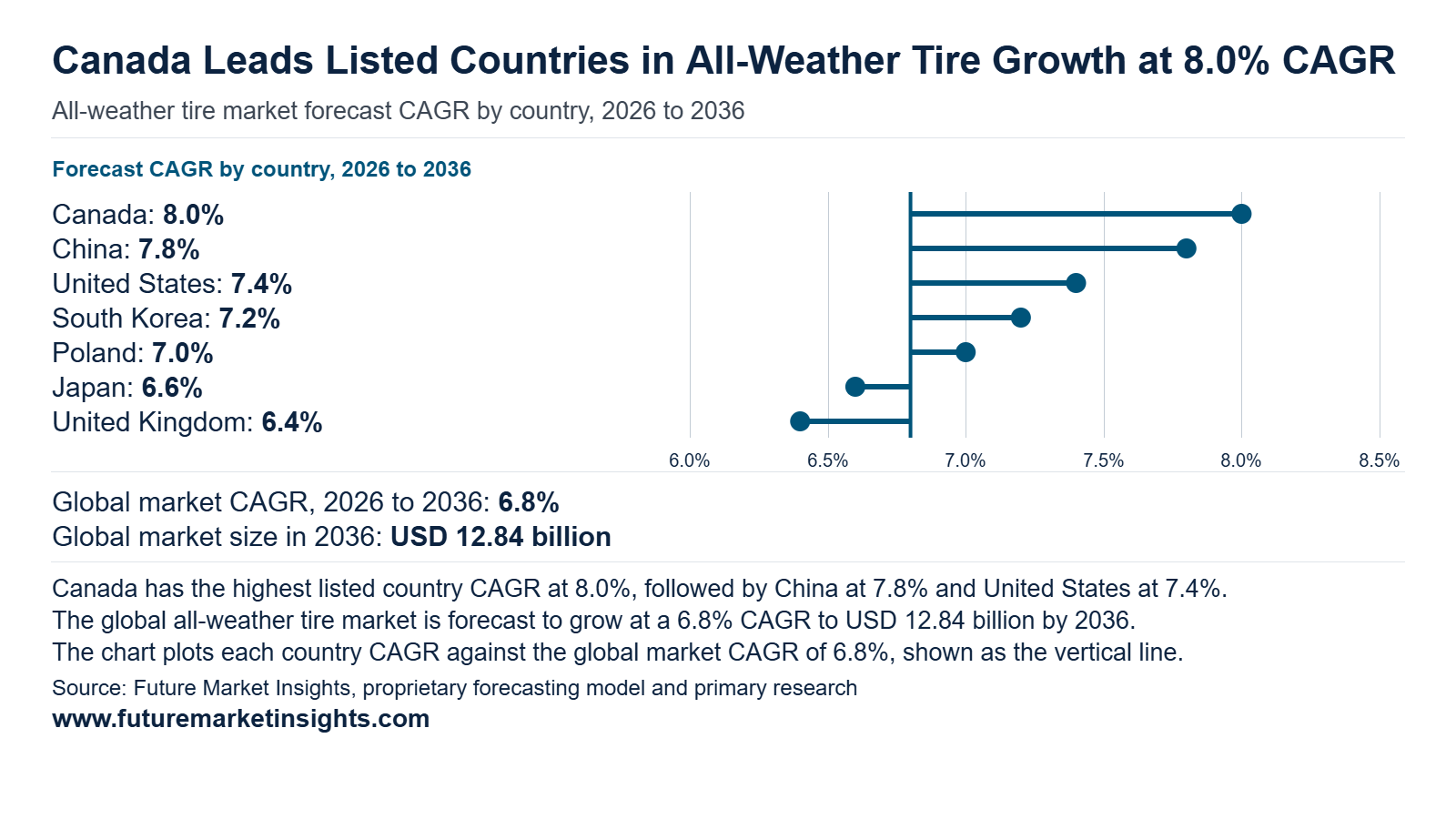
Rims of 18 inches and larger offer the largest investment opportunity, together adding about USD 4.08 billion by 2036. SUVs and electric cars use bigger wheels, which carry higher prices per tire. Online retail, in turn, is growing at about 8.9% a year as drivers book fitting online. SUVs and crossovers are expanding at about 7.8%. Canada, at about 8.0% a year, is the fastest-growing profiled country as winter tire rules favour all-weather sets.
How Is the All-Weather Tire Market Segmented?
The all-weather tire market is segmented into vehicle type, sales channel, rim size and region, with values shown in USD billion.
| Segmentation Axis | Sub-Segments Covered | 2026 Leading Segment & Share | Main Growth Benchmark (2026 to 2036) |
|---|---|---|---|
| Vehicle Type | Passenger Cars, SUVs & Crossovers, Light Commercial Vehicles, Electric Vehicles | Passenger Cars (44.0% revenue share) | Electric Vehicles (7.9% CAGR) vs. Passenger Cars (5.8% CAGR) |
| Sales Channel | Independent Tire Dealers, Chain & Brand-Owned Retail, Original Equipment Fitment, Online Retail | Independent Tire Dealers (40.0% revenue share) | Online Retail (8.9% CAGR) vs. Independent Tire Dealers (6.0% CAGR) |
| Rim Size | 16 to 17 Inch, 18 to 19 Inch, 20 Inch & Above, Up to 15 Inch | 16 to 17 Inch (40.0% revenue share) | 20 Inch & Above (9.8% CAGR) vs. Up to 15 Inch (3.9% CAGR) |
| Region | North America, Europe, East Asia, South Asia & Pacific, Latin America, Middle East & Africa | Europe (44.0% revenue share) | South Asia & Pacific leads regional growth at a 8.6% CAGR; Canada leads national growth at a 8.0% CAGR |
Source: Future Market Insights analysis of the all-weather tire market, 2026.
Why Does the Passenger Car Segment Lead by Vehicle Type?
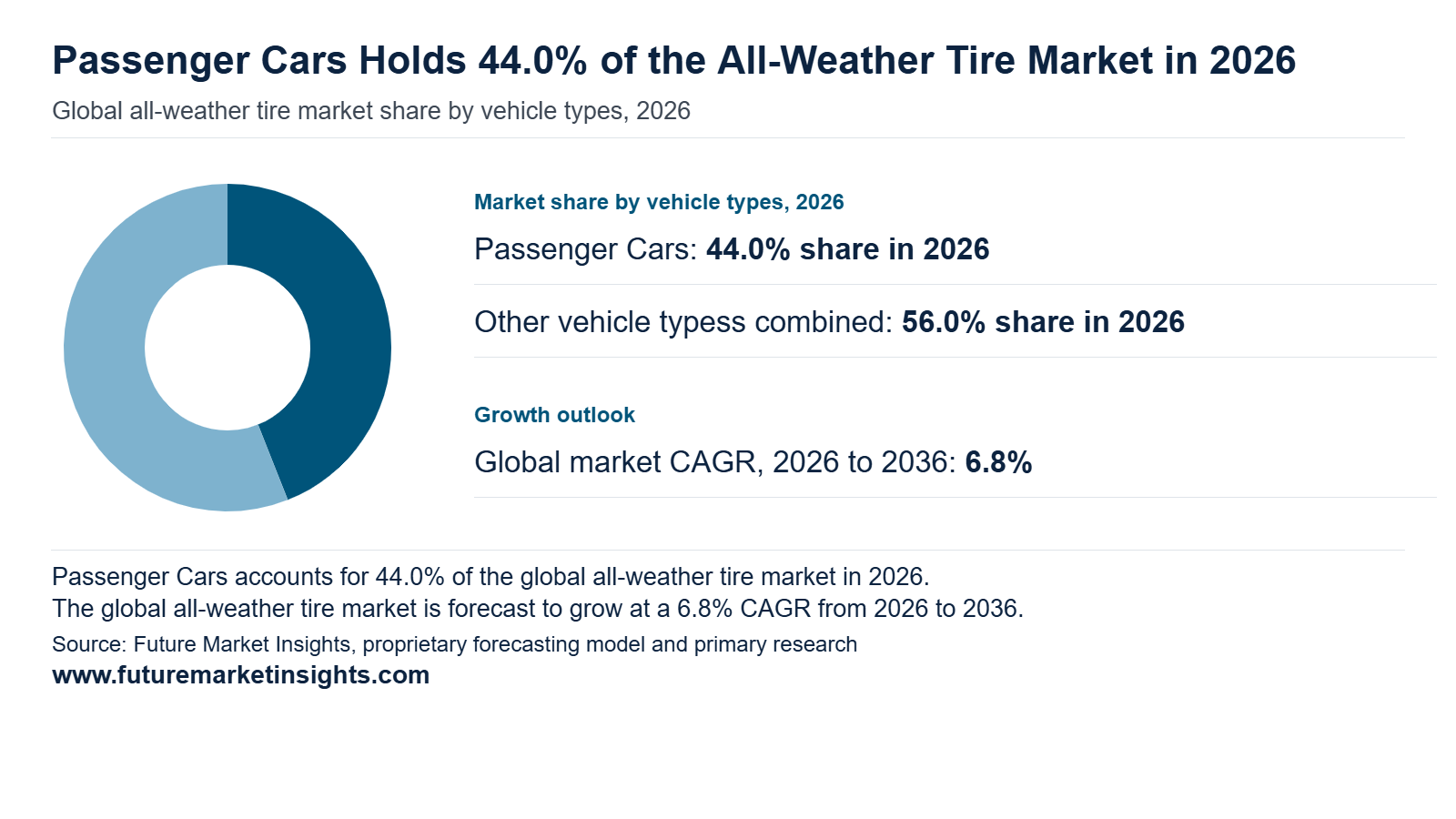
Passenger cars account for about 44% of all-weather tire revenue in 2026, worth USD 2.93 billion. Small and mid-size cars in Europe use all-weather tires most widely. Passenger car sales, however, are growing at only about 5.8% a year, as buyers shift to SUVs. SUVs and crossovers, at about 36%, are growing faster at close to 7.8%. As a result, SUVs and crossovers are set to add the most new revenue, about USD 2.68 billion by 2036. Light commercial vehicles hold about 12%. Electric vehicles hold about 8% and are growing at about 7.9%.
Why Does the Independent Tire Dealer Segment Lead by Sales Channel?
Independent tire dealers sell about 40% of all-weather tires in 2026, worth USD 2.66 billion. Dealers advise drivers on winter rules and fit tires the same day. Growth through dealers is about 6.0% a year. Online retail, however, is growing fastest at close to 8.9%, from about 18% of sales. Many buyers order online and book fitting at a partner garage. Chain and brand-owned stores hold about 30% and are growing at about 6.4%. Original equipment fitment holds about 12% and is growing at around 7.0%.
Why Does the 16 to 17 Inch Segment Lead by Rim Size?
Rims of 16 to 17 inches lead, as most compact and mid-size cars use these sizes. This group holds about 40% of revenue in 2026, worth USD 2.66 billion. Growth in 16 to 17 inch tires, however, is only about 5.0% a year. New SUVs and electric cars come with larger wheels. Rims of 18 to 19 inches are therefore set to add the most revenue, about USD 2.64 billion by 2036. Rims of 20 inches and above are growing fastest at about 9.8% a year. Rims up to 15 inches hold about 14%.
All-Weather Tire Market by Region and Country (2026 to 2036)
Demand for all-weather tires is highest in Europe, where milder winters and winter tire rules favour one-set use. Europe is likely to remain the highest market, holding about 44% of global revenue in 2026. Growth there is about 6.2% a year, since many drivers have already switched. North America holds about 34% and is growing faster at close to 7.4%, as new ranges reach dealers. East Asia, at about 10%, is growing at around 7.2%. South Asia and Pacific is the fastest-growing region at about 8.6% a year, from a small base.
| Country | 2026 Revenue | 2036 Revenue | 10-Year Addition | 2026 to 2036 CAGR | Global Share (2026 → 2036) |
|---|---|---|---|---|---|
| United States | USD 1.86 billion | USD 3.80 billion | +USD 1.94 billion | 7.4% | 28.0% → 29.6% |
| Germany | USD 0.73 billion | USD 1.31 billion | +USD 0.58 billion | 6.0% | 11.0% → 10.2% |
| United Kingdom | USD 0.47 billion | USD 0.87 billion | +USD 0.40 billion | 6.4% | 7.0% → 6.7% |
| France | USD 0.47 billion | USD 0.85 billion | +USD 0.38 billion | 6.2% | 7.0% → 6.6% |
| Canada | USD 0.40 billion | USD 0.86 billion | +USD 0.46 billion | 8.0% | 6.0% → 6.7% |
| Italy | USD 0.27 billion | USD 0.47 billion | +USD 0.20 billion | 5.8% | 4.0% → 3.6% |
| Japan | USD 0.27 billion | USD 0.50 billion | +USD 0.24 billion | 6.6% | 4.0% → 3.9% |
| China | USD 0.27 billion | USD 0.56 billion | +USD 0.30 billion | 7.8% | 4.0% → 4.4% |
| Poland | USD 0.20 billion | USD 0.39 billion | +USD 0.19 billion | 7.0% | 3.0% → 3.1% |
| South Korea | USD 0.13 billion | USD 0.27 billion | +USD 0.13 billion | 7.2% | 2.0% → 2.1% |
Source: Future Market Insights analysis of the all-weather tire market, 2026.
United States
Launches of new all-weather ranges are projected to keep the US the largest all-weather tire market. In 2026, the market in the US is valued at USD 1.86 billion. Through 2036, it is likely to grow to USD 3.80 billion at a CAGR of 7.4%, the third fastest among profiled countries. Key trends to look for include new touring ranges. Continental, for example, brought its SecureContact AW to US dealers in January 2026. Michelin, in turn, sells the CrossClimate 2 and Agilis CrossClimate 2 for light trucks. Drivers in the northeast and Midwest switch to all-weather tires for snow grip. Most US drivers, however, still use standard all-season tires. Discount Tire and Tire Rack sell most replacement tires. Online ordering with home fitting is also growing. SUVs and pickups take a large share of sales. Higher prices than all-season tires slow switching among value buyers.
Germany
Winter tire rules shape tire sales in Germany. Drivers must use winter-marked tires in snow and ice. All-weather tires with the three-peak mountain snowflake mark meet this rule. As a result, many city drivers use one set all year. Continental, based in Hanover, and Goodyear sell many all-weather ranges. Tire dealers and ATU, in turn, fit most replacement tires. Online sellers such as Reifen.com are growing. Drivers in hilly areas, however, still use winter tires. Storage fees for a second set push city drivers to switch. Fleet operators also fit all-weather tires to cut swap costs. Electric car owners choose larger sizes. The market in Germany is valued at USD 0.73 billion in 2026. By 2036, it is projected to reach USD 1.31 billion at a CAGR of 6.0%.
United Kingdom
Mild winters with occasional snow make all-weather tires popular in the United Kingdom. Many drivers want better grip in cold, wet weather without buying winter tires. Michelin CrossClimate and Goodyear Vector ranges, in turn, sell well. Fitting chains such as Kwik Fit and National Tyres lead sales. Online sellers like Blackcircles offer mobile fitting at home. Price, however, slows switching among value buyers. Tests by motoring magazines guide many choices. Insurers and motoring groups advise drivers to fit winter-marked tires. Company car fleets fit all-weather sets to avoid seasonal swaps. Drivers in Scotland and northern England face more snow days. In 2026, the market in the UK stands at USD 0.47 billion. Through 2036, it is likely to grow to USD 0.87 billion at a CAGR of 6.4%.
France
Winter tire rules in mountain areas support all-weather tire sales in France. The Loi Montagne requires winter-marked tires or chains in many mountain areas from November to March. As a result, drivers in the Alps, Pyrenees and Massif Central choose all-weather tires. Michelin, based in Clermont-Ferrand, leads the French market. Norauto and Feu Vert, in turn, fit most replacement tires. Rental car fleets fit all-weather sets to meet the rules. Ski resorts see heavy winter traffic. Online sellers are growing. Insurers encourage winter-marked tires in mountain areas. Budget brands from Asia, however, compete hard on price. In 2026, the market in France is valued at USD 0.47 billion. By 2036, it is projected to reach USD 0.85 billion at a CAGR of 6.2%.
Canada
Quebec's winter tire law and long, cold winters shape tire sales in Canada. Drivers in Quebec must use tires with the three-peak mountain snowflake mark from December to March. All-weather tires carry this mark, so many drivers use one set all year. As a result, Canada is the fastest-growing all-weather tire market among the profiled countries. Nokian Tyres, Michelin and Toyo sell popular all-weather ranges. Canadian Tire and Costco, in turn, sell many replacement sets. Drivers in the far north, however, still prefer winter tires. Rental and fleet operators fit all-weather tires to meet the Quebec rule. Insurers in Ontario offer discounts for winter-rated tires. Worth USD 0.40 billion in 2026, the market in Canada is set to reach USD 0.86 billion by 2036. Growth is at a CAGR of 8.0%.
Italy
Mild winters in most of Italy favour all-weather tires. Winter tire rules apply in northern regions and on some roads from November to April. Drivers in these areas, in turn, choose all-weather tires to avoid two sets. Pirelli, based in Milan, sells the Cinturato All Season range. Tire dealers fit most replacement tires. Rental fleets in the north fit all-weather tires to meet the rules. Online sales are growing among younger drivers. Older drivers, however, often keep summer tires all year. Small cars use smaller, cheaper sizes. Ski resorts in the Alps and Dolomites see heavy winter traffic. In 2026, the market in Italy is valued at USD 0.27 billion. Through 2036, it is likely to grow to USD 0.47 billion at a CAGR of 5.8%, the slowest among the profiled countries.
Japan
Snowy winters in northern Japan support all-weather tire sales. Most Japanese drivers, however, still switch to studless winter tires. Yokohama, Toyo and Sumitomo Rubber, in turn, sell all-weather ranges for city drivers. Drivers in Tokyo and Osaka use all-weather tires for rare snow days. Tire chains such as Autobacs sell most replacement tires. Rental car fleets fit all-weather tires for ski areas in Hokkaido and Nagano. Drivers also save on storage by using one set. Kei cars use smaller sizes. Older drivers keep studless sets for safety. E-commerce sites such as Rakuten list many sizes. In 2026, the market in Japan is worth USD 0.27 billion. By 2036, it is projected to reach USD 0.50 billion at a CAGR of 6.6%.
China
Cold winters in the north support all-weather tire sales in China. Drivers in Beijing and Shenyang face snow and ice for several months. Local tire makers such as Linglong and Sailun, in turn, sell all-weather ranges at lower prices. Global brands sell premium ranges for SUVs and electric cars. Electric car sales are high, which raises demand for larger sizes. Online platforms such as Tmall and Tuhu sell tires with fitting. Most drivers in the south, however, use standard tires. Ride-hailing fleets need durable tires for daily use. Exports of all-weather tires to Europe are rising. Local test reports guide buyers. Valued at USD 0.27 billion in 2026, the market in China is set to reach USD 0.56 billion by 2036. Growth is at a CAGR of 7.8%, the second fastest among profiled countries.
Poland
Cold winters make tire safety a key concern in Poland. Many drivers switch between summer and winter tires each year. All-weather tires, however, are growing in cities with milder winters. Winter tires are not required by law, which makes one-set use an easy choice. Dębica, owned by Goodyear, makes tires in Poland. Michelin and Bridgestone also run factories in the country. Online sellers, in turn, sell many replacement tires. Price-conscious drivers choose budget brands. Fleet operators fit all-weather tires to cut swap costs. Imported used cars arrive on mixed tire sets. Tests by motoring magazines guide choices. In 2026, the market in Poland is valued at USD 0.20 billion. Through 2036, it is likely to grow to USD 0.39 billion at a CAGR of 7.0%.
South Korea
Snowy winters in the north support all-weather tire sales in South Korea. Hankook and Kumho, in turn, sell all-weather ranges at home and abroad. SUVs are popular, which raises demand for larger sizes. Electric car sales are also growing. Tire chains such as T Station sell most replacement tires. Most drivers, however, still use standard all-season tires. Rental fleets on Jeju fit all-weather tires for winter trips. Drivers in apartments have little space to store a second set. Hankook sells online with fitting at partner shops. Taxi fleets in Seoul test all-weather sets. Exports of Korean tires to Europe support makers. Worth USD 0.13 billion in 2026, the market in South Korea is set to reach USD 0.27 billion by 2036. Growth is at a CAGR of 7.2%.
Competitive Environment and Notable Companies
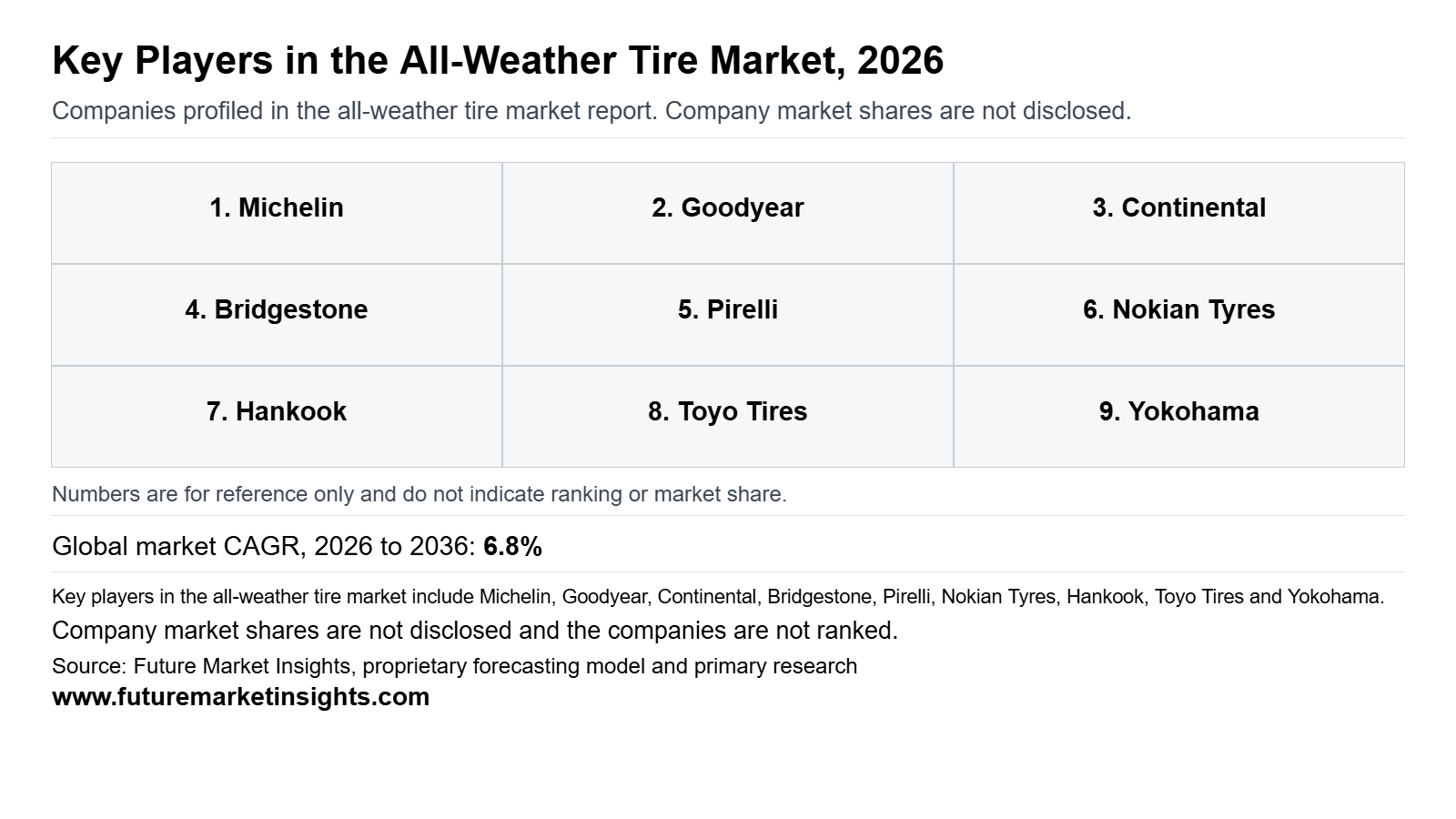
Large global tire makers lead the all-weather tire market, with budget brands competing on price. Notable companies include Michelin, Goodyear, Continental, Bridgestone and Pirelli. Nokian Tyres, Hankook, Toyo Tires, Yokohama and Falken (Sumitomo Rubber) are also active. Premium makers win on safety tests, size range and brand trust. Budget brands, meanwhile, sell to price-conscious drivers through online stores. Winter safety marks open new markets, so most launches carry the three-peak mountain snowflake mark. As a result, competition is shifting toward size range and test results.
How Are Companies Positioned in the All-Weather Tire Market?
Tire makers are launching new all-weather ranges and wider sizes. For example, Continental launched the SecureContact AW in January 2026. Goodyear, in turn, launched Vector All Season 4 in April 2026. Continental also added the TerrainContact A/T2 for SUVs in July 2026. Michelin, meanwhile, is extending CrossClimate ranges to sports and electric cars.
How Do Drivers Choose an All-Weather Tire?
Drivers compare all-weather tires first on wet and snow grip, since safety in bad weather is the main reason to buy. Tread life and road noise come next. Price then shapes the final choice. Test results from motoring magazines and dealer advice also guide buyers.
Which Capabilities Distinguish Tire Maker Offers?
Size coverage is the main point of difference between tire makers, since SUVs and electric cars need new sizes. Strong test results, in turn, support higher prices. Winter safety marks open markets with tire rules. Large dealer networks also help sales.
How Does Geographic Reach Affect Competition?
Global tire makers sell all-weather tires worldwide through dealers and online stores. Winter rules, however, differ by country, so ranges and marketing vary by region. Local brands lead in price-sensitive markets. As a result, global makers focus on premium sizes. Factories in each region shorten delivery times.
| Verified Company Evidence (2026) | Commercial Effect | Buyer Action |
|---|---|---|
| 15 January 2026: Continental launched the SecureContact AW, a premium all-weather touring tire for cars, crossovers and SUVs in North America (Continental Tire, January 2026). | All-weather ranges are reaching North American drivers. | Stock all-weather ranges for northern US and Canadian buyers. |
| 30 April 2026: Goodyear launched Vector All Season 4 and said sales of 19-inch and larger all-season tires rose more than 20% a year from 2022 to 2025 (Goodyear, April 2026). | Larger sizes are growing fastest. | Widen size ranges for SUVs and electric cars. |
| 1 July 2026: Continental introduced the TerrainContact A/T2, an all-season, all-terrain tire for crossovers, SUVs and light trucks (Continental Tire, July 2026). | SUV and light truck owners are getting new options. | Add all-weather and all-terrain sizes for light trucks. |
Source: Verified corporate disclosures and Future Market Insights analysis, 2026.
| Company | Core Positioning | Verified Activity & Source Attribution |
|---|---|---|
| Continental | Global tire maker | Launched SecureContact AW (January 2026) and TerrainContact A/T2 (July 2026). |
| Goodyear | Global tire maker | Launched Vector All Season 4 (April 2026). |
| Michelin | Global tire maker | Sells CrossClimate 2 and CrossClimate 3 ranges (company information). |
| Nokian Tyres | Nordic tire maker | Company information. |
Source: Verified corporate disclosures and Future Market Insights analysis, 2026.
All-Weather Tire Market Report Scope and Research Methodology
All-weather tire sales by country are the foundation of FMI's estimate. These sales are compiled from tire maker reports, dealer surveys and trade records. Sales are then split by vehicle type, sales channel and rim size. Adding the country figures gives regional and global values. The forecast uses vehicle fleets, replacement cycles, winter rules and price trends. Launches reported in 2026, such as Continental's SecureContact AW, are used to confirm current activity. Totals are finally checked against reported sales of leading tire makers, with adjustments where countries differ.
| Coverage Field | Report Scope |
|---|---|
| Market definition | All-weather tires for passenger and light commercial vehicles, carrying winter safety marks for year-round use. |
| Vehicle types | Passenger cars, SUVs and crossovers, light commercial vehicles and electric vehicles. |
| Sales channels | Independent tire dealers, chain and brand-owned retail, original equipment fitment and online retail. |
| Rim sizes | Up to 15 inch, 16 to 17 inch, 18 to 19 inch, and 20 inch and above. |
| Price tiers | Budget, mid-range, premium and performance. |
| Customer types | Private drivers, fleets and car makers. |
| Revenue basis | Sales value of all-weather tires. |
| Exclusions | Standard all-season tires without winter marks, dedicated winter tires and summer tires. |
| Quantitative units | USD billion for value. |
| Volume basis | Units sold, used to check value estimates. |
| Value basis | Sales recognised in the country of the buyer. |
| Regions covered | North America, Europe, East Asia, South Asia & Pacific, Latin America, and Middle East & Africa. |
| National coverage | United States, Germany, United Kingdom, France, Canada, Italy, Japan, China, Poland, South Korea. |
| Companies covered | Michelin, Goodyear, Continental, Bridgestone, Pirelli, Nokian Tyres, Hankook, Toyo Tires, Yokohama and Falken. |
Source: Future Market Insights analysis of the all-weather tire market, 2026.
Research Sources and Bibliography
- Continental Tire. (2026, January 15). Continental Tire announces launch of new SecureContact AW.
- Modern Tire Dealer. (2026, January 27). Continental launches SecureContact AW.
- Goodyear. (2026, April 30). Goodyear redefines the all-season category with Vector All Season 4.
- Tire Technology International. (2026, May 1). Goodyear all-season tire offers broader fitments and year-round performance.
- Continental Tire. (2026, July 1). Continental Tire announces the new TerrainContact A/T2. https://continentaltire.com/learn/continental-tire-announces-new-terraincontact-at2-perfect-balance-adventure-comfort-and-all
Table of Content
- Key Takeaways
- Market Size and CAGR
- Top Growth Driver
- Fastest Growing Segment
- Leading Region
- Key Companies
- Emerging Opportunities
- Executive Summary
- Global Market Outlook
- Demand-side Trends
- Supply-side Trends
- Technology Roadmap Analysis
- Analysis and Recommendations
- Analyst Perspective (What is happening? Why now? What should investors know?)
- Key Questions Answered
- How large is the market?
- What is the CAGR?
- What are key trends?
- Which region dominates?
- Who are the leaders?
Read More...
- Market Overview
- Market Coverage / Taxonomy
- Market Definition / Scope / Limitations
- Research Methodology
- Chapter Orientation
- Analytical Lens and Working Hypotheses
- Market Structure, Signals, and Trend Drivers
- Benchmarking and Cross-market Comparability
- Market Sizing, Forecasting, and Opportunity Mapping
- Research Design and Evidence Framework
- Desk Research Programme (Secondary Evidence)
- Expert Input and Fieldwork (Primary Evidence)
- Tooling, Models, and Reference Databases
- Data Engineering and Model Build
- Quality Assurance and Audit Trail
- Market Background
- Market Dynamics (Drivers, Restraints, Opportunity, Trends)
- Scenario Forecast (Optimistic, Likely, Conservative)
- Impact Analysis
- AI Impact
- Sustainability Impact
- Regulatory Impact
- Technology Impact
- Consumer / Buyer Analysis
- Purchase Drivers
- Adoption Barriers
- Buyer Journey
- Opportunity Map Analysis
- Product Life Cycle Analysis
- Supply Chain Analysis
- Investment Feasibility Matrix
- Value Chain Analysis
- PESTLE and Porter's Analysis
- Regulatory Landscape
- Regional Parent Market Outlook
- Production and Consumption Statistics
- Import and Export Statistics
- Global All-Weather Tire Market Analysis and Forecast, 2021 to 2036
- Historical Market Size Value (USD Billion) Analysis, 2021 to 2025
- Current and Future Market Size Value (USD Billion) Projections, 2026 to 2036
- Y-o-Y Growth Trend Analysis
- Absolute $ Opportunity Analysis
- Global All-Weather Tire Market Pricing Analysis, 2021 to 2036
- Global All-Weather Tire Market Analysis and Forecast, By Vehicle Type, 2021 to 2036
- Introduction / Key Findings
- Historical Market Size Value (USD Billion) Analysis By Vehicle Type, 2021 to 2025
- Current and Future Market Size Value (USD Billion) Analysis and Forecast By Vehicle Type, 2026 to 2036
- Passenger Cars
- SUVs & Crossovers
- Light Commercial Vehicles
- Electric Vehicles
- Y-o-Y Growth Trend Analysis By Vehicle Type, 2021 to 2025
- Absolute $ Opportunity Analysis By Vehicle Type, 2026 to 2036
- Global All-Weather Tire Market Analysis and Forecast, By Sales Channel, 2021 to 2036
- Introduction / Key Findings
- Historical Market Size Value (USD Billion) Analysis By Sales Channel, 2021 to 2025
- Current and Future Market Size Value (USD Billion) Analysis and Forecast By Sales Channel, 2026 to 2036
- Independent Tire Dealers
- Chain & Brand-Owned Retail
- Original Equipment Fitment
- Online Retail
- Y-o-Y Growth Trend Analysis By Sales Channel, 2021 to 2025
- Absolute $ Opportunity Analysis By Sales Channel, 2026 to 2036
- Global All-Weather Tire Market Analysis and Forecast, By Rim Size, 2021 to 2036
- Introduction / Key Findings
- Historical Market Size Value (USD Billion) Analysis By Rim Size, 2021 to 2025
- Current and Future Market Size Value (USD Billion) Analysis and Forecast By Rim Size, 2026 to 2036
- 16 to 17 Inch
- 18 to 19 Inch
- 20 Inch & Above
- Up to 15 Inch
- Y-o-Y Growth Trend Analysis By Rim Size, 2021 to 2025
- Absolute $ Opportunity Analysis By Rim Size, 2026 to 2036
- Global All-Weather Tire Market Analysis and Forecast, By Region, 2021 to 2036
- Introduction
- Historical Market Size Value (USD Billion) Analysis By Region, 2021 to 2025
- Current Market Size Value (USD Billion) Analysis and Forecast By Region, 2026 to 2036
- North America
- Europe
- East Asia
- South Asia & Pacific
- Latin America
- Middle East & Africa
- Market Attractiveness Analysis By Region
- North America All-Weather Tire Market Analysis and Forecast, By Country, 2021 to 2036
- Historical Market Size Value (USD Billion) Trend Analysis By Market Taxonomy, 2021 to 2025
- Market Size Value (USD Billion) Forecast By Market Taxonomy, 2026 to 2036
- By Country
- United States
- Canada
- Rest of North America
- By Vehicle Type
- By Sales Channel
- By Rim Size
- By Country
- Market Attractiveness Analysis
- By Country
- By Vehicle Type
- By Sales Channel
- By Rim Size
- Key Takeaways
- Europe All-Weather Tire Market Analysis and Forecast, By Country, 2021 to 2036
- Historical Market Size Value (USD Billion) Trend Analysis By Market Taxonomy, 2021 to 2025
- Market Size Value (USD Billion) Forecast By Market Taxonomy, 2026 to 2036
- By Country
- Germany
- United Kingdom
- France
- Italy
- Poland
- Rest of Europe
- By Vehicle Type
- By Sales Channel
- By Rim Size
- By Country
- Market Attractiveness Analysis
- By Country
- By Vehicle Type
- By Sales Channel
- By Rim Size
- Key Takeaways
- East Asia All-Weather Tire Market Analysis and Forecast, By Country, 2021 to 2036
- Historical Market Size Value (USD Billion) Trend Analysis By Market Taxonomy, 2021 to 2025
- Market Size Value (USD Billion) Forecast By Market Taxonomy, 2026 to 2036
- By Country
- Japan
- China
- South Korea
- Rest of East Asia
- By Vehicle Type
- By Sales Channel
- By Rim Size
- By Country
- Market Attractiveness Analysis
- By Country
- By Vehicle Type
- By Sales Channel
- By Rim Size
- Key Takeaways
- South Asia & Pacific All-Weather Tire Market Analysis and Forecast, By Country, 2021 to 2036
- Historical Market Size Value (USD Billion) Trend Analysis By Market Taxonomy, 2021 to 2025
- Market Size Value (USD Billion) Forecast By Market Taxonomy, 2026 to 2036
- By Country
- Rest of South Asia & Pacific
- By Vehicle Type
- By Sales Channel
- By Rim Size
- By Country
- Market Attractiveness Analysis
- By Country
- By Vehicle Type
- By Sales Channel
- By Rim Size
- Key Takeaways
- Latin America All-Weather Tire Market Analysis and Forecast, By Country, 2021 to 2036
- Historical Market Size Value (USD Billion) Trend Analysis By Market Taxonomy, 2021 to 2025
- Market Size Value (USD Billion) Forecast By Market Taxonomy, 2026 to 2036
- By Country
- Rest of Latin America
- By Vehicle Type
- By Sales Channel
- By Rim Size
- By Country
- Market Attractiveness Analysis
- By Country
- By Vehicle Type
- By Sales Channel
- By Rim Size
- Key Takeaways
- Middle East & Africa All-Weather Tire Market Analysis and Forecast, By Country, 2021 to 2036
- Historical Market Size Value (USD Billion) Trend Analysis By Market Taxonomy, 2021 to 2025
- Market Size Value (USD Billion) Forecast By Market Taxonomy, 2026 to 2036
- By Country
- Rest of Middle East & Africa
- By Vehicle Type
- By Sales Channel
- By Rim Size
- By Country
- Market Attractiveness Analysis
- By Country
- By Vehicle Type
- By Sales Channel
- By Rim Size
- Key Takeaways
- Key Countries Market Analysis
- United States
- Pricing Analysis
- Market Share Analysis, 2025
- By Vehicle Type
- By Sales Channel
- By Rim Size
- Germany
- Pricing Analysis
- Market Share Analysis, 2025
- By Vehicle Type
- By Sales Channel
- By Rim Size
- United Kingdom
- Pricing Analysis
- Market Share Analysis, 2025
- By Vehicle Type
- By Sales Channel
- By Rim Size
- France
- Pricing Analysis
- Market Share Analysis, 2025
- By Vehicle Type
- By Sales Channel
- By Rim Size
- Canada
- Pricing Analysis
- Market Share Analysis, 2025
- By Vehicle Type
- By Sales Channel
- By Rim Size
- Italy
- Pricing Analysis
- Market Share Analysis, 2025
- By Vehicle Type
- By Sales Channel
- By Rim Size
- Japan
- Pricing Analysis
- Market Share Analysis, 2025
- By Vehicle Type
- By Sales Channel
- By Rim Size
- China
- Pricing Analysis
- Market Share Analysis, 2025
- By Vehicle Type
- By Sales Channel
- By Rim Size
- Poland
- Pricing Analysis
- Market Share Analysis, 2025
- By Vehicle Type
- By Sales Channel
- By Rim Size
- South Korea
- Pricing Analysis
- Market Share Analysis, 2025
- By Vehicle Type
- By Sales Channel
- By Rim Size
- United States
- Market Structure Analysis
- Competition Dashboard
- Competition Benchmarking
- Market Share Analysis of Top Players
- By Regional
- By Vehicle Type
- By Sales Channel
- By Rim Size
- Emerging Startups
- Innovation Benchmarking
- Competition Analysis
- Competition Deep Dive
- Michelin
- Overview
- Product Portfolio
- Profitability by Market Segments
- Sales Footprint
- Strategy Overview
- Marketing Strategy
- Product Strategy
- Channel Strategy
- Goodyear
- Continental
- Bridgestone
- Pirelli
- Nokian Tyres
- Hankook
- Toyo Tires
- Yokohama
- Falken
- Michelin
- Case Studies
- Success Stories
- Recent Developments
- Competition Deep Dive
- Assumptions & Acronyms Used
List of Tables
- Table 1: Global All-Weather Tire Market Value (USD Billion) Forecast by Region, 2021 to 2036
- Table 2: Global All-Weather Tire Market Value (USD Billion) Forecast by Vehicle Type, 2021 to 2036
- Table 3: Global All-Weather Tire Market Value (USD Billion) Forecast by Sales Channel, 2021 to 2036
- Table 4: Global All-Weather Tire Market Value (USD Billion) Forecast by Rim Size, 2021 to 2036
- Table 5: North America All-Weather Tire Market Value (USD Billion) Forecast by Country, 2021 to 2036
- Table 6: North America All-Weather Tire Market Value (USD Billion) Forecast by Vehicle Type, 2021 to 2036
- Table 7: North America All-Weather Tire Market Value (USD Billion) Forecast by Sales Channel, 2021 to 2036
- Table 8: North America All-Weather Tire Market Value (USD Billion) Forecast by Rim Size, 2021 to 2036
- Table 9: Europe All-Weather Tire Market Value (USD Billion) Forecast by Country, 2021 to 2036
- Table 10: Europe All-Weather Tire Market Value (USD Billion) Forecast by Vehicle Type, 2021 to 2036
- Table 11: Europe All-Weather Tire Market Value (USD Billion) Forecast by Sales Channel, 2021 to 2036
- Table 12: Europe All-Weather Tire Market Value (USD Billion) Forecast by Rim Size, 2021 to 2036
- Table 13: East Asia All-Weather Tire Market Value (USD Billion) Forecast by Country, 2021 to 2036
- Table 14: East Asia All-Weather Tire Market Value (USD Billion) Forecast by Vehicle Type, 2021 to 2036
- Table 15: East Asia All-Weather Tire Market Value (USD Billion) Forecast by Sales Channel, 2021 to 2036
- Table 16: East Asia All-Weather Tire Market Value (USD Billion) Forecast by Rim Size, 2021 to 2036
- Table 17: South Asia & Pacific All-Weather Tire Market Value (USD Billion) Forecast by Country, 2021 to 2036
- Table 18: South Asia & Pacific All-Weather Tire Market Value (USD Billion) Forecast by Vehicle Type, 2021 to 2036
- Table 19: South Asia & Pacific All-Weather Tire Market Value (USD Billion) Forecast by Sales Channel, 2021 to 2036
- Table 20: South Asia & Pacific All-Weather Tire Market Value (USD Billion) Forecast by Rim Size, 2021 to 2036
- Table 21: Latin America All-Weather Tire Market Value (USD Billion) Forecast by Country, 2021 to 2036
- Table 22: Latin America All-Weather Tire Market Value (USD Billion) Forecast by Vehicle Type, 2021 to 2036
- Table 23: Latin America All-Weather Tire Market Value (USD Billion) Forecast by Sales Channel, 2021 to 2036
- Table 24: Latin America All-Weather Tire Market Value (USD Billion) Forecast by Rim Size, 2021 to 2036
- Table 25: Middle East & Africa All-Weather Tire Market Value (USD Billion) Forecast by Country, 2021 to 2036
- Table 26: Middle East & Africa All-Weather Tire Market Value (USD Billion) Forecast by Vehicle Type, 2021 to 2036
- Table 27: Middle East & Africa All-Weather Tire Market Value (USD Billion) Forecast by Sales Channel, 2021 to 2036
- Table 28: Middle East & Africa All-Weather Tire Market Value (USD Billion) Forecast by Rim Size, 2021 to 2036
List of Figures
- Figure 1: Global All-Weather Tire Market Pricing Analysis
- Figure 2: Global All-Weather Tire Market Value (USD Billion) Forecast 2021-2036
- Figure 3: Global All-Weather Tire Market Value Share and BPS Analysis by Vehicle Type, 2026 and 2036
- Figure 4: Global All-Weather Tire Market Y-o-Y Growth Comparison by Vehicle Type, 2026-2036
- Figure 5: Global All-Weather Tire Market Attractiveness Analysis by Vehicle Type
- Figure 6: Global All-Weather Tire Market Value Share and BPS Analysis by Sales Channel, 2026 and 2036
- Figure 7: Global All-Weather Tire Market Y-o-Y Growth Comparison by Sales Channel, 2026-2036
- Figure 8: Global All-Weather Tire Market Attractiveness Analysis by Sales Channel
- Figure 9: Global All-Weather Tire Market Value Share and BPS Analysis by Rim Size, 2026 and 2036
- Figure 10: Global All-Weather Tire Market Y-o-Y Growth Comparison by Rim Size, 2026-2036
- Figure 11: Global All-Weather Tire Market Attractiveness Analysis by Rim Size
- Figure 12: Global All-Weather Tire Market Value (USD Billion) Share and BPS Analysis by Region, 2026 and 2036
- Figure 13: Global All-Weather Tire Market Y-o-Y Growth Comparison by Region, 2026-2036
- Figure 14: Global All-Weather Tire Market Attractiveness Analysis by Region
- Figure 15: North America All-Weather Tire Market Incremental Dollar Opportunity, 2026-2036
- Figure 16: Europe All-Weather Tire Market Incremental Dollar Opportunity, 2026-2036
- Figure 17: East Asia All-Weather Tire Market Incremental Dollar Opportunity, 2026-2036
- Figure 18: South Asia & Pacific All-Weather Tire Market Incremental Dollar Opportunity, 2026-2036
- Figure 19: Latin America All-Weather Tire Market Incremental Dollar Opportunity, 2026-2036
- Figure 20: Middle East & Africa All-Weather Tire Market Incremental Dollar Opportunity, 2026-2036
- Figure 21: North America All-Weather Tire Market Value Share and BPS Analysis by Country, 2026 and 2036
- Figure 22: North America All-Weather Tire Market Value Share and BPS Analysis by Vehicle Type, 2026 and 2036
- Figure 23: North America All-Weather Tire Market Y-o-Y Growth Comparison by Vehicle Type, 2026-2036
- Figure 24: North America All-Weather Tire Market Attractiveness Analysis by Vehicle Type
- Figure 25: North America All-Weather Tire Market Value Share and BPS Analysis by Sales Channel, 2026 and 2036
- Figure 26: North America All-Weather Tire Market Y-o-Y Growth Comparison by Sales Channel, 2026-2036
- Figure 27: North America All-Weather Tire Market Attractiveness Analysis by Sales Channel
- Figure 28: North America All-Weather Tire Market Value Share and BPS Analysis by Rim Size, 2026 and 2036
- Figure 29: North America All-Weather Tire Market Y-o-Y Growth Comparison by Rim Size, 2026-2036
- Figure 30: North America All-Weather Tire Market Attractiveness Analysis by Rim Size
- Figure 31: Europe All-Weather Tire Market Value Share and BPS Analysis by Country, 2026 and 2036
- Figure 32: Europe All-Weather Tire Market Value Share and BPS Analysis by Vehicle Type, 2026 and 2036
- Figure 33: Europe All-Weather Tire Market Y-o-Y Growth Comparison by Vehicle Type, 2026-2036
- Figure 34: Europe All-Weather Tire Market Attractiveness Analysis by Vehicle Type
- Figure 35: Europe All-Weather Tire Market Value Share and BPS Analysis by Sales Channel, 2026 and 2036
- Figure 36: Europe All-Weather Tire Market Y-o-Y Growth Comparison by Sales Channel, 2026-2036
- Figure 37: Europe All-Weather Tire Market Attractiveness Analysis by Sales Channel
- Figure 38: Europe All-Weather Tire Market Value Share and BPS Analysis by Rim Size, 2026 and 2036
- Figure 39: Europe All-Weather Tire Market Y-o-Y Growth Comparison by Rim Size, 2026-2036
- Figure 40: Europe All-Weather Tire Market Attractiveness Analysis by Rim Size
- Figure 41: East Asia All-Weather Tire Market Value Share and BPS Analysis by Country, 2026 and 2036
- Figure 42: East Asia All-Weather Tire Market Value Share and BPS Analysis by Vehicle Type, 2026 and 2036
- Figure 43: East Asia All-Weather Tire Market Y-o-Y Growth Comparison by Vehicle Type, 2026-2036
- Figure 44: East Asia All-Weather Tire Market Attractiveness Analysis by Vehicle Type
- Figure 45: East Asia All-Weather Tire Market Value Share and BPS Analysis by Sales Channel, 2026 and 2036
- Figure 46: East Asia All-Weather Tire Market Y-o-Y Growth Comparison by Sales Channel, 2026-2036
- Figure 47: East Asia All-Weather Tire Market Attractiveness Analysis by Sales Channel
- Figure 48: East Asia All-Weather Tire Market Value Share and BPS Analysis by Rim Size, 2026 and 2036
- Figure 49: East Asia All-Weather Tire Market Y-o-Y Growth Comparison by Rim Size, 2026-2036
- Figure 50: East Asia All-Weather Tire Market Attractiveness Analysis by Rim Size
- Figure 51: South Asia & Pacific All-Weather Tire Market Value Share and BPS Analysis by Country, 2026 and 2036
- Figure 52: South Asia & Pacific All-Weather Tire Market Value Share and BPS Analysis by Vehicle Type, 2026 and 2036
- Figure 53: South Asia & Pacific All-Weather Tire Market Y-o-Y Growth Comparison by Vehicle Type, 2026-2036
- Figure 54: South Asia & Pacific All-Weather Tire Market Attractiveness Analysis by Vehicle Type
- Figure 55: South Asia & Pacific All-Weather Tire Market Value Share and BPS Analysis by Sales Channel, 2026 and 2036
- Figure 56: South Asia & Pacific All-Weather Tire Market Y-o-Y Growth Comparison by Sales Channel, 2026-2036
- Figure 57: South Asia & Pacific All-Weather Tire Market Attractiveness Analysis by Sales Channel
- Figure 58: South Asia & Pacific All-Weather Tire Market Value Share and BPS Analysis by Rim Size, 2026 and 2036
- Figure 59: South Asia & Pacific All-Weather Tire Market Y-o-Y Growth Comparison by Rim Size, 2026-2036
- Figure 60: South Asia & Pacific All-Weather Tire Market Attractiveness Analysis by Rim Size
- Figure 61: Latin America All-Weather Tire Market Value Share and BPS Analysis by Country, 2026 and 2036
- Figure 62: Latin America All-Weather Tire Market Value Share and BPS Analysis by Vehicle Type, 2026 and 2036
- Figure 63: Latin America All-Weather Tire Market Y-o-Y Growth Comparison by Vehicle Type, 2026-2036
- Figure 64: Latin America All-Weather Tire Market Attractiveness Analysis by Vehicle Type
- Figure 65: Latin America All-Weather Tire Market Value Share and BPS Analysis by Sales Channel, 2026 and 2036
- Figure 66: Latin America All-Weather Tire Market Y-o-Y Growth Comparison by Sales Channel, 2026-2036
- Figure 67: Latin America All-Weather Tire Market Attractiveness Analysis by Sales Channel
- Figure 68: Latin America All-Weather Tire Market Value Share and BPS Analysis by Rim Size, 2026 and 2036
- Figure 69: Latin America All-Weather Tire Market Y-o-Y Growth Comparison by Rim Size, 2026-2036
- Figure 70: Latin America All-Weather Tire Market Attractiveness Analysis by Rim Size
- Figure 71: Middle East & Africa All-Weather Tire Market Value Share and BPS Analysis by Country, 2026 and 2036
- Figure 72: Middle East & Africa All-Weather Tire Market Value Share and BPS Analysis by Vehicle Type, 2026 and 2036
- Figure 73: Middle East & Africa All-Weather Tire Market Y-o-Y Growth Comparison by Vehicle Type, 2026-2036
- Figure 74: Middle East & Africa All-Weather Tire Market Attractiveness Analysis by Vehicle Type
- Figure 75: Middle East & Africa All-Weather Tire Market Value Share and BPS Analysis by Sales Channel, 2026 and 2036
- Figure 76: Middle East & Africa All-Weather Tire Market Y-o-Y Growth Comparison by Sales Channel, 2026-2036
- Figure 77: Middle East & Africa All-Weather Tire Market Attractiveness Analysis by Sales Channel
- Figure 78: Middle East & Africa All-Weather Tire Market Value Share and BPS Analysis by Rim Size, 2026 and 2036
- Figure 79: Middle East & Africa All-Weather Tire Market Y-o-Y Growth Comparison by Rim Size, 2026-2036
- Figure 80: Middle East & Africa All-Weather Tire Market Attractiveness Analysis by Rim Size
- Figure 81: Global All-Weather Tire Market - Tier Structure Analysis
- Figure 82: Global All-Weather Tire Market - Company Share Analysis
Frequently Asked Questions
How big is the all-weather tire market in 2026?
FMI estimates the global all-weather tire market at USD 6.65 billion in 2026, up from USD 6.25 billion in 2025. Single-set convenience is driving this growth.
How fast is the all-weather tire market expected to grow through 2036?
FMI projects a 6.8% CAGR from 2026 to 2036, taking the market to USD 12.84 billion by 2036. This adds USD 6.19 billion, led by SUVs and larger rim sizes.
Which vehicle type leads the all-weather tire market?
Passenger cars lead with 44.0% of 2026 revenue, as small and mid-size cars use all-weather tires widely. Electric vehicles are growing fastest, at about 7.9% a year.
Which sales channel leads the all-weather tire market?
Independent tire dealers hold 40.0% of 2026 revenue, as drivers seek advice and same-day fitting. Online retail is growing fastest, at about 8.9% a year.
Which rim size leads the all-weather tire market?
Rims of 16 to 17 inches account for 40.0% of 2026 revenue. Rims of 20 inches and above are growing fastest, at about 9.8% a year, as SUVs use bigger wheels.
Which country is the largest all-weather tire market?
The United States is the largest market, with 28.0% of global revenue in 2026, worth USD 1.86 billion. Germany follows at 11.0% and the UK at 7.0%.
Which countries are expected to grow fastest in the all-weather tire market?
Canada is projected to grow fastest, at an 8.0% CAGR from 2026 to 2036, helped by winter tire rules. China follows at 7.8% and the US at 7.4%.
What drives demand for all-weather tires?
Single-set convenience, milder winters and growing SUV fleets are the main drivers. Winter tire rules that accept all-weather tires are also adding demand.
Preview the report firsthand - request a free sample
Get SampleGet the brochure for pricing and purchase details.
Get PDF