

- Market Size (2026)
- USD 140.0 Mn
- Forecast (2036)
- USD 1324.9 Mn
- CAGR (2026 to 2036)
- 25.2%
Amylin Analog Obesity Therapeutics Market Summary
Demand for amylin analog obesity therapeutics will climb at a 25.2% CAGR between 2026 and 2036. From USD 111.8 million in 2025 and USD 140.0 million in 2026, sales are projected to reach USD 1,324.9 million by 2036, as the first amylin-containing medicines move from late-stage trials into approved prescribing.
FMI projects that approvals will turn trial results into paid prescriptions over the decade, which is behind this steep growth curve. The base is small as no amylin obesity medicine has yet reached routine sale, while the first filing is already under review, as Novo Nordisk submitted CagriSema to the U.S. FDA in December 2025 after the REDEFINE 1 trial showed 22.7% weight loss versus 2.3% with placebo at 68 weeks [1]. Competitive pressure is shaping the value that buyers will place on amylin, as CagriSema reached 23.0% weight loss against 25.5% for tirzepatide 15 mg over 84 weeks in REDEFINE 4 and missed its non-inferiority goal [2]. Stand-alone amylin evidence is also building, which widens the future product range; Eli Lilly and Company reported weight loss of up to 20.1% at 48 weeks with eloralintide in a 263-adult Phase 2 study [3]. As a result, sales are expected to scale quickly after 2027, once approved labels and payer decisions are in place.
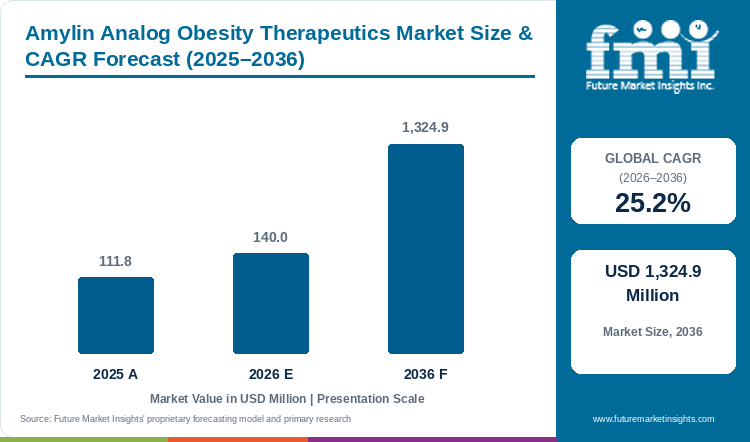
Table 1: Market Size and Forecast for the Amylin Analog Obesity Therapeutics Market (USD million), 2025-2036
| Market size and forecast | Value |
|---|---|
| 2025 market size | USD 111.8 million |
| Estimated market size in 2026 | USD 140.0 million |
| Projected market size by 2036 | USD 1,324.9 million |
| CAGR (2026-2036) | 25.2% |
| Added revenue, 2026 to 2036 | USD 1,184.9 million |
Key Market Trends & Insights
- Selective Amylin Analogs lead molecule type at 42.5% in 2026, as developers are proving the benefit of amylin on its own before pairing it with other drugs.
- Once-Weekly Injection leads dosing frequency at 42.9%, which reflects the weekly obesity shot routine that patients and prescribers already follow.
- Monotherapy leads therapy setting at 56.0% in 2026, well ahead of combination use with GLP-1 medicines and weight maintenance after GLP-1.
- Retail Pharmacies lead the distribution channel mix at 30.8%, with repeat monthly refills moving through local pharmacy counters.
Regional Highlights
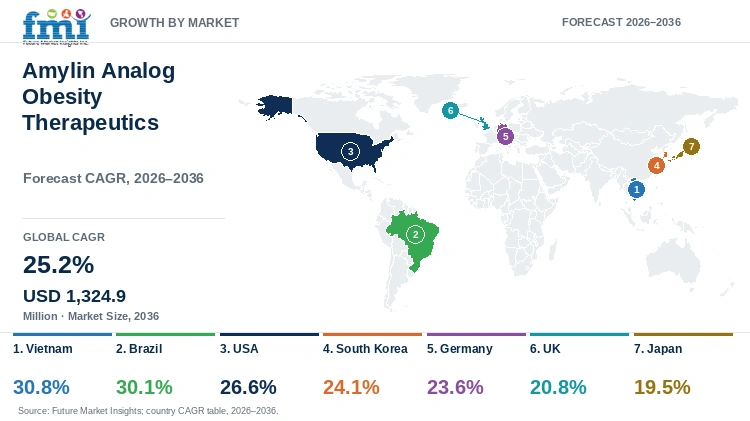
Vietnam at 30.8%, Brazil at 30.1% and the USA at 26.6% will be the three fastest-growing profiled countries between 2026 and 2036. Japan is expected to trail the group at 19.5%, just behind the UK at 20.8%.
Market Evidence
Room for almost tenfold growth from a USD 140.0 million base comes from the very large number of people who could use an amylin medicine. Obesity is spreading in every region, due to which prescribers are looking for more than one type of treatment for weight loss and obesity management. WHO reported that 940 million adults, about 16% of all adults, were living with obesity in 2024, and 2.6 billion were overweight [4]. In the USA alone, CDC measured adult obesity at 40.3% for August 2021 to August 2023 [5]. Demand for amylin analogs will therefore be limited far more by approvals, prices and coverage than by the number of people in need.
Amylin products are being measured against the price and volume levels that incumbent GLP-1 medicines have already set. Buyers are already paying for weekly obesity injections at scale, which gives amylin developers a ready channel and a clear target. Eli Lilly and Company reported 2025 sales of USD 13,542 million for Zepbound and USD 22,965 million for Mounjaro [6], while Novo Nordisk reported Wegovy sales of DKK 79,106 million in 2025, up 41% at constant exchange rates [7]. Sales of amylin medicines are expected to grow first as add-ons or alternatives within this spending, rather than as a separate budget line.
Deal values for amylin assets are reaching billions of dollars, which signals strong confidence in future demand. Big buyers want an amylin option next to their incretin medicines, as combination and switching strategies will decide long-term share. Pfizer completed its Metsera acquisition in November 2025 at USD 65.60 per share plus a contingent value right of up to USD 20.65, an enterprise value of about USD 7.0 billion, gaining the monthly amylin analog MET-233i [8]. In March 2025, Roche agreed to pay Zealand Pharma USD 1.65 billion upfront and up to USD 5.3 billion in total for petrelintide, with a 50/50 profit share in the USA and Europe [9]. This investment is now moving into late-stage trials, as the roughly 7,000-person ZUPREME Phase 3 programme began in September 2026 [10], and more registrational readouts will feed the forecast after 2028.
Coverage decisions, more than trial data alone, will decide which patients can start and stay on an amylin medicine once products are approved. Public payers are opening limited routes for weight-loss drugs while still keeping tight eligibility checks. The Medicare GLP-1 Bridge runs from 1 July 2026 to 31 December 2027 with a USD 50 monthly copay and a USD 245 net monthly price agreed with manufacturers, but it covers only Wegovy, Foundayo and the Zepbound KwikPen and excludes use for type 2 diabetes [11] [12]. Amylin products are not on that list, which means early US sales are expected to depend on commercial plans and self-pay until a coverage route is agreed.
Vietnam and Brazil are pulling ahead as both are adding obesity care from a low base, while mature markets are held back by tighter payer and eligibility rules. Vietnam will lead at a 30.8% CAGR, as overweight and obesity among school-age children more than doubled from 8.5% in 2010 to 19% in 2020, according to the National Institute of Nutrition [13]. Brazil follows at 30.1%, which reflects strong demand under a regulated pharmacy route; Anvisa has required pharmacies to retain GLP-1 prescriptions since 23 June 2025 [14]. However, Japan will grow at 19.5%, as its obesity-disease rules restrict use to patients with a BMI above 35, or above 27 with two or more related conditions [15].
Table 2: Supporting Industry Indicators for the Amylin Analog Obesity Therapeutics Market (mixed units), mixed years
| Indicator | Data point | Why it matters | Source |
|---|---|---|---|
| CagriSema FDA filing (result) | NDA submitted 18 December 2025, after REDEFINE 1 showed 22.7% vs 2.3% placebo at 68 weeks | First amylin-containing obesity product near approval sets the commercial start | [1] |
| REDEFINE 4 head-to-head (result) | 23.0% vs 25.5% for tirzepatide 15 mg at 84 weeks; non-inferiority not achieved | Limits premium pricing claims against the market leader | [2] |
| REIMAGINE 5 in type 2 diabetes (result) | 12.4% vs 9.1% for tirzepatide 5 mg at 60 weeks; FDA decision expected Q4 2026 | Shows a niche where amylin combinations can win on weight loss | [16] |
| Eloralintide Phase 2 (result) | Up to 20.1% weight loss at 48 weeks in 263 adults | Supports the leading Monotherapy and Selective segments | [3] |
| Global adult obesity (statistic) | 940 million adults (about 16%) in 2024; 2.6 billion overweight | Defines the long-term addressable patient pool | [4] |
| US adult obesity (statistic) | 40.3% in August 2021-August 2023 | Explains the USA's large share of early demand | [5] |
| Incumbent spend (result) | Zepbound USD 13,542 million; Mounjaro USD 22,965 million in 2025 | Sets the spending benchmark amylin products compete for | [6] |
| Wegovy sales (result) | DKK 79,106 million in 2025, +41% at CER | Confirms weekly injections as the established buying routine | [7] |
| Medicare GLP-1 Bridge (rule) | 1 Jul 2026-31 Dec 2027; USD 50 copay; USD 245 net monthly price; three named products | Shows the price point public payers will accept | [11] |
| Roche-Zealand deal (target) | USD 1.65 billion upfront, up to USD 5.3 billion total | Signals large-company confidence in amylin monotherapy | [9] |
| Brazil dispensing rule (rule) | GLP-1 prescription retention from 23 June 2025; 90-day validity | Sets pharmacy controls that future amylin products will likely face | [14] |
Market Scale and Implied Patient-Year Analysis
Measured against incumbent obesity medicines, the amylin market remains small even at the end of the forecast. FMI's 2036 value of USD 1,324.9 million equals 9.8% of Zepbound's 2025 sales of USD 13,542 million, and 3.6% of the USD 36,507 million that Zepbound and Mounjaro earned together (calculated) [6]. At the Medicare GLP-1 Bridge net price of USD 245 a month, or USD 2,940 a year [11], the 2026 value matches about 47,600 patient-years of treatment and the 2036 value about 450,600 patient-years (calculated). This volume equals roughly 0.05% of the 940 million adults with obesity worldwide [4], which shows that the forecast rests on early, selective use rather than broad population uptake.
The pipeline timeline supports this shape, as the major readouts and decisions arrive in steps. CagriSema's FDA decision is expected in Q4 2026 [16], Lilly plans to start EloraTZP Phase 3 trials in Q4 2026 [17], and ZUPREME Phase 3 uses a 64-week primary endpoint from its September 2026 start [10]. As a point of comparison for public-health rollouts, NICE expects about 220,000 people in England to receive tirzepatide in the first three years of a rollout lasting up to 12 years [18]. Sales of amylin medicines are therefore expected to remain concentrated in a small number of approved products and paying patients until the late 2020s.
Table 3: Market Scale, Implied Patient-Years and Pipeline Milestones for the Amylin Analog Obesity Therapeutics Market (USD million unless stated), 2025-2036, mixed years
| Metric | Value | Source |
|---|---|---|
| Market value 2026 | USD 140.0 million | FMI |
| Market value 2036 | USD 1,324.9 million | FMI |
| Zepbound sales 2025 | USD 13,542 million | [6] |
| Zepbound + Mounjaro sales 2025 | USD 36,507 million | Calculated from [6] |
| 2036 market as % of Zepbound 2025 sales | 9.8% | Calculated |
| 2036 market as % of Zepbound + Mounjaro 2025 sales | 3.6% | Calculated |
| Medicare Bridge net price | USD 245 per month (USD 2,940 per year) | [11]; annual calculated |
| Implied patient-years 2026 | about 47,600 | Calculated |
| Implied patient-years 2036 | about 450,600 | Calculated |
| 2036 patient-years as % of adults with obesity (940 million) | about 0.05% | Calculated from [4] |
| CagriSema FDA decision | Expected Q4 2026 | [16] |
| EloraTZP Phase 3 start | Q4 2026 | [17] |
| ZUPREME Phase 3 (petrelintide) | Started September 2026; about 7,000 participants; 64-week endpoint | [10] |
Analyst Perspective
“Selective Amylin Analogs will hold 42.5% of the molecule mix in 2026, but the real test will come when the first approved products meet payer price limits set by today's GLP-1 medicines. Companies that pair clear weight-loss results with good tolerability and an affordable monthly price will capture the steepest part of this growth curve.”
- Anurag Sharma, Principal Analyst at Future Market Insights
How is the Amylin Analog Obesity Therapeutics Market Segmented?
The amylin analog obesity therapeutics market is split into molecule type, dosing frequency, therapy setting, distribution channel and region.
By molecule type, the market covers Selective Amylin Analogs, Dual Amylin-Calcitonin Receptor Agonists (medicines that act on both the amylin and the calcitonin signal), Amylin-GLP-1 Co-Formulations and Amylin-Based Unimolecular Multi-Agonists (single molecules that act on several hunger signals). By dosing frequency, it includes Once-Weekly Injection, Daily Injection, Once-Monthly Depot and Oral Daily. By therapy setting, it spans Monotherapy, Combination with GLP-1 and Weight Maintenance After GLP-1. By distribution channel, it covers Retail Pharmacies, Hospital Pharmacies, Online and Telehealth Pharmacies and Specialty Obesity Clinics. Regional coverage includes North America, Latin America, Western Europe, Eastern Europe, East Asia, South Asia and Pacific, and Middle East and Africa.
Why Do Selective Amylin Analogs Lead the Amylin Analog Obesity Therapeutics Market by Molecule Type?
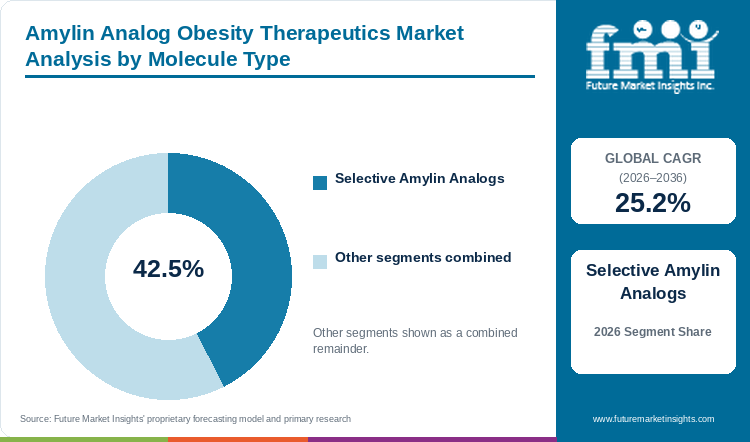
Selective Amylin Analogs are set to hold 42.5% of market share by molecule type in 2026.
Selective Amylin Analogs hold 42.5% of the molecule mix in 2026, as developers are testing amylin on its own to show a clear, separate benefit that payers can judge. This approach lets a company sell the medicine as a stand-alone choice or add it to an existing GLP-1 later, which widens the buyer base for amylin-based peptide therapeutics. AstraZeneca described AZD6234 as a weekly injectable selective amylin receptor agonist in January 2026 [19], while Eli Lilly and Company reported up to 20.1% weight loss with its selective agonist eloralintide [3]. Dual Amylin-Calcitonin Receptor Agonists, Amylin-GLP-1 Co-Formulations and Amylin-Based Unimolecular Multi-Agonists will gain share as combination products such as CagriSema reach approval, while selective agents are expected to keep the largest slice through the early forecast years.
- Selective Amylin Analogs are expected to remain the largest molecule type, starting from a 42.5% share in 2026, as several selective candidates are moving into Phase 3.
- In November 2025, Eli Lilly and Company reported up to 20.1% weight loss at 48 weeks with eloralintide in 263 adults without type 2 diabetes [3].
Why Does Once-Weekly Injection Lead the Amylin Analog Obesity Therapeutics Market by Dosing Frequency?
Once-Weekly Injection is projected to account for 42.9% of the market by dosing frequency in 2026.
Once-Weekly Injection accounts for 42.9% of dosing frequency in 2026, as patients and prescribers are already used to a weekly obesity shot. This routine, typically given with a prefilled injection pen, lowers the effort of switching or adding a medicine, which matters for repeat orders. Novo Nordisk's CagriSema filing covers a once-weekly injection [1], while AbbVie reported a mean half-life of 10.7 to 12.3 days for ABBV-295 and tested weekly, every-other-week and monthly doses [20]. Oral options are also advancing, as Structure Therapeutics reported a half-life of about six days for its oral ACCG-2671 and is testing daily and weekly dosing [21]. Daily Injection, Once-Monthly Depot and Oral Daily formats will gain share later in the decade as longer-acting and oral products move through trials.
- Once-Weekly Injection will keep the lead from a 42.9% share in 2026, while longer-interval injections are expected to take share after 2030.
- In September 2026, AbbVie reported weight reductions of 7.8% to 9.8% at week 12 in weekly cohorts and 7.9% at week 13 in a monthly cohort of ABBV-295 [20].
Why Does Monotherapy Lead the Amylin Analog Obesity Therapeutics Market by Therapy Setting?
Monotherapy is expected to capture 56.0% of the market by therapy setting in 2026.
Monotherapy captures 56.0% of the therapy setting mix in 2026, as a single amylin medicine offers a simpler purchase than adding a second drug to a GLP-1. Many patients are also stopping GLP-1 treatment, which creates a need for other options. The STEP 1 extension found that people regained about two-thirds of their prior weight loss within a year of stopping semaglutide [22]. Combination with GLP-1 is gaining strong support at the same time, as Lilly's EloraTZP delivered up to 23.3% weight loss versus 14.8% for tirzepatide 15 mg at 48 weeks in adults with type 2 diabetes [17]. Weight Maintenance After GLP-1 will remain the smallest setting until trials test switching directly.
- Monotherapy will hold more than half of the market from a 56.0% share in 2026, while Combination with GLP-1 is expected to gain share once combination Phase 3 data arrive.
- In September 2026, Eli Lilly and Company said it will start EloraTZP Phase 3 trials in Q4 2026 after a 367-person Phase 2b study [17].
Why Do Retail Pharmacies Lead the Amylin Analog Obesity Therapeutics Market by Distribution Channel?
Retail Pharmacies are poised to secure 30.8% of the market by distribution channel in 2026.
Retail Pharmacies secure 30.8% of distribution in 2026, as most patients will fill repeat monthly prescriptions close to home. Regulators are also tightening control of obesity drug sales, which steers buyers toward licensed pharmacies. In March 2026, the FDA warned an online seller, Prime Sciences, that its cagrilintide and other peptide products were unapproved new drugs [23], while Brazil now requires pharmacies to retain GLP-1 prescriptions [14]. Hospital Pharmacies, Online and Telehealth Pharmacies and Specialty Obesity Clinics will grow alongside, with telehealth expected to gain share where regulated remote prescribing is allowed.
- Retail Pharmacies are expected to stay the largest channel from a 30.8% share in 2026, as refills will move through local pharmacy counters.
- In March 2026, the FDA issued a warning letter to Prime Sciences over unapproved cagrilintide, semaglutide, tirzepatide and retatrutide products sold online [23].
What are the Drivers, Restraints, and Opportunities in the Amylin Analog Obesity Therapeutics Market?
Strong trial results are driving interest in amylin medicines, while head-to-head results against tirzepatide and payer limits are restraining uptake. Maintenance after GLP-1 treatment offers a clear opportunity.
- Driver: Phase 2 and Phase 3 trials are showing 20% or more weight loss with amylin-based medicines, giving prescribers a credible new treatment option.
- Restraint: Amylin combinations have not beaten tirzepatide 15 mg, and public payers are covering only named GLP-1 products, which limits premium pricing.
- Opportunity: Patients regain most lost weight after stopping GLP-1 treatment, which opens room for tolerable amylin maintenance therapy.
Clinical results are the main force behind demand, as each strong clinical trial readout raises prescriber confidence in a new type of obesity medicine. Eli Lilly and Company reported up to 20.1% weight loss at 48 weeks with eloralintide [3], and Novo Nordisk reported 21.0% weight loss with a lower CagriSema dose in REDEFINE 9 at 68 weeks [16]. Demand for amylin medicines will therefore build as these results move into approved labels from late 2026 onward.
Head-to-head data are restraining pricing power, due to which buyers will compare amylin products directly with tirzepatide. In February 2026, CagriSema reached 23.0% weight loss versus 25.5% with tirzepatide 15 mg and did not show non-inferiority [2]. Novo Nordisk did win in REIMAGINE 5, but only against tirzepatide 5 mg in type 2 diabetes, with 12.4% versus 9.1% weight loss at 60 weeks [16]. Sales of amylin combinations are expected to focus on groups where they show a clear edge, such as specific doses or tolerability needs.
Maintenance after GLP-1 treatment is the clearest opportunity, as many patients cannot stay on high-dose incretins long term. The STEP 1 extension showed that people regained about two-thirds of their prior weight loss within a year of stopping semaglutide [22]. This gap will favour amylin medicines that prove they can hold weight off with fewer side effects, and the Weight Maintenance After GLP-1 setting is projected to gain share once dedicated trials report.
Which Country CAGRs are Profiled in the Amylin Analog Obesity Therapeutics Market?
Table 4: Country CAGRs for the Amylin Analog Obesity Therapeutics Market (%), 2026-2036
| Country | CAGR, 2026 to 2036 |
|---|---|
| Vietnam | 30.8% |
| Brazil | 30.1% |
| USA | 26.6% |
| South Korea | 24.1% |
| Germany | 23.6% |
| UK | 20.8% |
| Japan | 19.5% |
How do Country-level CAGRs Compare in the Amylin Analog Obesity Therapeutics Market?
Vietnam and Brazil form the fastest band above 30%, as both are adding obesity treatment from a lower base and through expanding pharmacy channels. The USA, South Korea and Germany sit in a middle band between 23.6% and 26.6%, which reflects large or growing self-pay demand held back by coverage limits. The UK and Japan are near 20%, as structured public-health rollouts and strict eligibility rules will slow uptake. Vietnam's 30.8% CAGR is 11.3 percentage points above Japan's 19.5%, though this gap describes growth rates and not market size.
- Rising obesity among young people is creating new demand from a very small base in Vietnam, which will grow at a 30.8% CAGR.
- Brazil is set to expand at a 30.1% CAGR, with a large self-pay market buying obesity drugs through regulated retail pharmacies.
- The first amylin approval is expected in the USA, where a 26.6% CAGR will depend on payer decisions on coverage.
- An active self-pay obesity drug market is giving new products a ready channel in South Korea, supporting a 24.1% CAGR.
- Germany will grow at a 23.6% CAGR, as statutory insurance excludes weight-loss drugs and keeps demand mostly self-paid.
- Phased NHS rollouts by clinical priority are spreading uptake over many years in the UK, which is projected to grow at a 20.8% CAGR.
- Strict obesity-disease criteria limit the number of eligible patients in Japan, holding growth to a 19.5% CAGR.
The full report extends amylin analog obesity therapeutics estimates to more than 25 countries and country groups across seven regions.
Country Outlook
- In June 2025, VietNamNet reported National Institute of Nutrition data showing overweight and obesity among Vietnamese children aged 5 to 19 rose from 8.5% in 2010 to 19% in 2020 [13]. This trend will widen the future patient pool, supporting a 30.8% CAGR in Vietnam.
- In Brazil, Anvisa has required pharmacies to retain GLP-1 prescriptions since 23 June 2025, with a 90-day prescription validity [14]. Future amylin products are expected to follow the same controlled pharmacy route, within a 30.1% CAGR.
- The US Medicare GLP-1 Bridge began on 1 July 2026 with a USD 50 copay for Wegovy, Foundayo and Zepbound KwikPen only [11] [12]. Amylin products will need their own coverage route, and the USA is set to grow at a 26.6% CAGR.
- In October 2024, BioWorld reported that Novo Nordisk was preparing to launch Wegovy in South Korea in mid-October [24]. This established weekly-injection market will help amylin products enter later, supporting a 24.1% CAGR for South Korea.
- In March 2024, Germany's G-BA confirmed that Wegovy is excluded from statutory health insurance as a lifestyle drug under the rules in force since 2004 [25]. Amylin obesity medicines are expected to face the same self-pay route, within a 23.6% CAGR.
- In December 2024, NICE said about 220,000 people in England would receive tirzepatide in the first three years of a rollout lasting up to 12 years [18]. This phased model will pace amylin uptake, giving the UK a 20.8% CAGR.
- In November 2023, Reuters reported that Wegovy would launch in Japan in February 2024 for patients with a BMI above 35, or above 27 with two or more obesity-related conditions, with most paying 30% of costs [15]. These narrow criteria will hold Japan at a 19.5% CAGR.
Who are the Leading Companies in the Amylin Analog Obesity Therapeutics Market?
Novo Nordisk, Eli Lilly and Company, AstraZeneca, Roche, Zealand Pharma, AbbVie, Pfizer, Structure Therapeutics and Viking Therapeutics are among the leading developers across integrated amylin and incretin programmes, long-acting peptide partnerships, and oral and early-stage receptor platforms.
Competition is centred on late-stage evidence and deal-making, as no amylin obesity medicine has yet been approved. Novo Nordisk is furthest ahead with a CagriSema decision expected in Q4 2026 [16], while Eli Lilly and Company is building both stand-alone and combination options around eloralintide [17]. Rivals are buying their way in, as Pfizer paid an enterprise value of about USD 7.0 billion for Metsera and its monthly amylin analog MET-233i [8], and Roche and Zealand Pharma are now running a roughly 7,000-person Phase 3 programme for petrelintide [10].
- Novo Nordisk, Eli Lilly and Company and AstraZeneca lead integrated amylin and incretin development, pairing amylin assets with their existing GLP-1 or incretin medicines through fixed combinations, co-formulations or add-on studies.
- Long-acting peptide programmes and partnerships are the focus for Roche, Zealand Pharma, AbbVie and Pfizer, which are developing long-acting injectable amylin analogs, including weekly and monthly formats, through partnerships or acquisitions.
- Oral and early-stage receptor platforms come from Structure Therapeutics, which is testing an oral small-molecule amylin and calcitonin receptor agonist, and Viking Therapeutics, which is in Phase 1 with an injectable dual amylin and calcitonin receptor agonist.
Competitive Benchmarking
Table 5: Competitive Benchmarking for the Amylin Analog Obesity Therapeutics Market (qualitative ratings), 2026
| Company | Amylin Clinical Maturity | Incretin Combination Evidence | Dosing-Format Breadth | Geographic Reach |
|---|---|---|---|---|
| Novo Nordisk | High | High | Medium | USA filing under FDA review; global trials |
| Eli Lilly and Company | High | High | Medium | Global Phase 2/3 programmes; no launch yet |
| AstraZeneca | High | High | Medium | Global Phase 3 study (SELENE 3) |
| Structure Therapeutics | Medium | Medium | High | Clinical development; country reach not established |
| Roche | High | Medium | Medium | USA/Europe co-commercialisation; exclusive rights elsewhere |
| AbbVie | Medium | Unscored | High | Clinical development; availability unverified |
| Pfizer | Medium | Medium | High | Acquired programme rights; availability unverified |
| Viking Therapeutics | Medium | Unscored | Unscored | USA, with FDA IND clearance and no launch |
| Zealand Pharma | High | Medium | Medium | USA/Europe co-commercialisation with Roche |
Amylin Clinical Maturity is rated High for a Phase 3 programme or filing and Medium for Phase 1 or 2 human testing, Incretin Combination Evidence is High for Phase 2, Phase 3 or filed combinations and Medium for early human work or a signed co-development plan, and Dosing-Format Breadth is High where oral or longer-than-weekly dosing has been tested in people and Medium for weekly injection only, with Unscored marking missing public information and every rating describing published evidence rather than sales, approval or company size.
Key Developments
- In September 2026, Novo Nordisk reported that CagriSema delivered 12.4% weight loss versus 9.1% with tirzepatide 5 mg at 60 weeks in REIMAGINE 5, and 21.0% with a lower dose in REDEFINE 9 [16].
- In September 2026, Zealand Pharma and Roche started the ZUPREME Phase 3 programme of petrelintide, with three trials and about 7,000 participants [10].
- In September 2026, Eli Lilly and Company reported up to 23.3% weight loss with EloraTZP versus 14.8% with tirzepatide 15 mg at 48 weeks in adults with type 2 diabetes [17].
- In September 2026, AbbVie presented Phase 1 ABBV-295 data at EASD 2026 showing a mean half-life of 10.7 to 12.3 days [20].
- In June 2026, Viking Therapeutics started a Phase 1 study of VK3019, a dual amylin and calcitonin receptor agonist, after FDA IND clearance [26].
Key Players
Integrated amylin and incretin development
- Novo Nordisk A/S
- Eli Lilly and Company
- AstraZeneca PLC
Long-acting peptide programmes and partnerships
- F. Hoffmann-La Roche Ltd
- Zealand Pharma A/S
- AbbVie Inc.
- Pfizer Inc.
Oral and early-stage receptor platforms
- Structure Therapeutics Inc.
- Viking Therapeutics, Inc.
Report Scope and Methodology
Table 6: Report Scope for the Amylin Analog Obesity Therapeutics Market (descriptive), 2025-2036
| Coverage field | Report scope |
|---|---|
| Market breakdown | Molecule Type; Dosing Frequency; Therapy Setting; Distribution Channel; Region |
| Quantitative units | USD Million |
| Market definition | Revenue from the first commercial sale of named amylin-directed obesity medicines. Downstream resale, separate substitute medicines, diabetes-only use, clinical services and licensing payments are excluded. Co-formulated products are counted once; separately sold combinations contribute only the amylin medicine's revenue. Clinical-trial supply and unapproved research products are excluded. |
| Regions covered | North America; Latin America; Western Europe; Eastern Europe; East Asia; South Asia and Pacific; Middle East and Africa |
| Countries covered | USA; UK; Germany; Japan; South Korea; Vietnam; Brazil |
| Key companies profiled | Novo Nordisk; Eli Lilly and Company; AstraZeneca; Structure Therapeutics; Roche; AbbVie; Pfizer; Viking Therapeutics; Zealand Pharma |
| Forecast period | 2026 to 2036 |
| Approach | Primary and secondary research with market triangulation |
Research Methodology
Table 7: Research Methodology for the Amylin Analog Obesity Therapeutics Market (descriptive), 2025-2036
| Method | Approach |
|---|---|
| Primary research | FMI analysts gathered input from drug developers, distributors, pharmacies, clinicians, payers, procurement teams and subject-matter experts on prescribing decisions, approval needs, pricing, coverage and the evidence needed before trial use becomes regular purchasing. |
| Desk research | Desk research covered regulator and payer publications, government health statistics, company filings and press releases, clinical trial records and peer-reviewed literature, checked for date, scope and consistency with the market definition. |
| Market sizing and forecasting | The model combined the baseline value with pipeline timing, expected approvals, pricing and volume indicators, payer access and country-level demand conditions, and reconciled segment and country estimates before setting the market total. |
| Data validation | Estimates were checked against independent indicators, including company results, trial milestones, payer rules and primary interviews, and adjacent categories and overlapping revenues were excluded to avoid double counting. |
Amylin Analog Obesity Therapeutics Market by Segments
Amylin Analog Obesity Therapeutics Market Segmented by Molecule Type
- Selective Amylin Analogs
- Dual Amylin-Calcitonin Receptor Agonists
- Amylin-GLP-1 Co-Formulations
- Amylin-Based Unimolecular Multi-Agonists
Amylin Analog Obesity Therapeutics Market Segmented by Dosing Frequency
- Once-Weekly Injection
- Daily Injection
- Once-Monthly Depot
- Oral Daily
Amylin Analog Obesity Therapeutics Market Segmented by Therapy Setting
- Monotherapy
- Combination with GLP-1
- Weight Maintenance After GLP-1
Amylin Analog Obesity Therapeutics Market Segmented by Distribution Channel
- Retail Pharmacies
- Hospital Pharmacies
- Online and Telehealth Pharmacies
- Specialty Obesity Clinics
Amylin Analog Obesity Therapeutics Market Segmented by Region
- North America
- Latin America
- Western Europe
- Eastern Europe
- East Asia
- South Asia and Pacific
- Middle East and Africa
Research Sources and Bibliography
- [1] Novo Nordisk (2025, December). Novo Nordisk files for FDA approval of CagriSema, the first once-weekly combination of GLP-1 and amylin analogues for weight management.
- [2] Novo Nordisk (2026, February). CagriSema demonstrated 23% weight loss in an open-label head-to-head REDEFINE 4 trial in people with obesity, the primary endpoint was not achieved (Company announcement No 13/2026).
- [3] Eli Lilly and Company (2025, November). Lilly's selective amylin agonist, eloralintide, demonstrated meaningful weight loss and favorable tolerability in a Phase 2 study of adults with obesity or overweight.
- [4] World Health Organization (2026, October). Obesity and overweight (fact sheet).
- [5] Centers for Disease Control and Prevention, National Center for Health Statistics (2024, September). Obesity and Severe Obesity Prevalence in Adults: United States, August 2021-August 2023 (NCHS Data Brief No. 508).
- [6] Eli Lilly and Company (2026, February). Lilly reports fourth-quarter 2025 financial results and provides 2026 guidance (Form 8-K exhibit).
- [7] Novo Nordisk (2026, February). Financial report for the period 1 January 2025 to 31 December 2025 (Company announcement No 4/2026, Form 6-K).
- [8] Pfizer (2025, November). Pfizer Completes Acquisition of Metsera.
- [9] Roche (2025, March). Roche enters into an exclusive collaboration and licensing agreement with Zealand Pharma to co-develop and co-commercialise petrelintide.
- [10] AllSci (2026, September). Zealand launches Phase III program for amylin analog petrelintide in overweight and obesity.
- [11] KFF (2026, May). What to Know About the BALANCE Model for GLP-1s in Medicare and Medicaid and the Medicare GLP-1 Bridge.
- [12] Centers for Medicare & Medicaid Services (2026, July). Medicare GLP-1 Bridge.
- [13] VietNamNet Global (Vietnam News Agency) (2025, June). Obesity on the rise in Vietnam, outpacing regional countries.
- [14] Agência Nacional de Vigilância Sanitária (Anvisa) (2025, June). Perguntas e respostas: mudanças na comercialização e escrituração de medicamentos agonistas do receptor do GLP-1.
- [15] Reuters (via Malay Mail) (2023, November). Novo to launch Wegovy in Asia with February roll-out in Japan.
- [16] Novo Nordisk (2026, September). Novo's CagriSema delivers superior weight loss versus tirzepatide in REIMAGINE 5 trial.
- [17] Eli Lilly and Company (2026, September). Lilly's EloraTZP (combination of eloralintide and tirzepatide) delivered greater weight loss and A1C reduction vs. tirzepatide 15 mg in adults with obesity and type 2 diabetes.
- [18] National Institute for Health and Care Excellence (2024, December). NICE describes how weight loss drug tirzepatide will be rolled out.
- [19] AstraZeneca (2026, January). AstraZeneca enhances its weight management portfolio through collaboration agreement with CSPC Pharmaceuticals.
- [20] AbbVie (press release republished by Finviz) (2026, September). AbbVie Presents Detailed Phase 1 Data for ABBV-295, a Long-Acting Amylin Analog, Demonstrating Favorable Tolerability and Pharmacokinetic Profile at EASD 2026.
- [21] Nasdaq (2026, September). Structure Therapeutics reports positive data from oral amylin and GLP-1 programs.
- [22] Wilding, J. P. H., et al., Diabetes, Obesity and Metabolism (2022). Weight regain and cardiometabolic effects after withdrawal of semaglutide: The STEP 1 trial extension.
- [23] U.S. Food and Drug Administration (2026, March). Warning Letter: Prime Sciences - 721805 - 03/31/2026.
- [24] BioWorld (2024, October). Novo Nordisk to launch Wegovy in South Korea mid-October.
- [25] Gemeinsamer Bundesausschuss (G-BA) (2024, March). G-BA vollzieht den gesetzlichen Verordnungsausschluss für das Abmagerungsmittel Wegovy® nach.
- [26] Viking Therapeutics (2026, June). Viking Therapeutics Announces Initiation of Phase 1 Study to Evaluate Novel Amylin Receptor Agonist VK3019 in Healthy Adults.
- [27] AstraZeneca (study record, Veeva Clinical Trials, NCT07776509) (2026). A Study to Evaluate Effect of AZD6234 as an Adjunct to Incretin-Based Therapies in Adult Participants with Obesity or Overweight (SELENE 3).
This bibliography is provided for reader reference and is not exhaustive. The full report contains the complete reference list and detailed citations.
This Report Answers
- What is the size of the amylin analog obesity therapeutics market in 2026, and what will it reach by 2036?
- Which clinical results and payer decisions are driving demand for amylin-based obesity medicines?
- Why do Selective Amylin Analogs lead the molecule type mix?
- Why does Once-Weekly Injection lead dosing frequency, and which longer-acting and oral formats are coming?
- Which countries will grow fastest, and what access rules shape each market?
- Which companies are developing amylin medicines, and at what stage are their programmes?
- What limits switching from existing GLP-1 medicines to amylin products?
- What should payers and prescribers check before funding or prescribing an amylin therapy?
Frequently Asked Questions
How Big Is the Amylin Analog Obesity Therapeutics Market Expected to Be in 2026?
The market is estimated at USD 140.0 million in 2026 and will reach USD 1,324.9 million by 2036. The early value reflects the first amylin-containing products nearing approval, such as CagriSema, which was filed with the FDA in December 2025 [1].
What Is the CAGR of the Amylin Analog Obesity Therapeutics Market from 2026 to 2036?
The market is projected to grow at a 25.2% CAGR from 2026 to 2036. Growth will come as approvals turn trial results into paid prescriptions and as more Phase 3 programmes report.
Which Molecule Type Leads the Market?
Selective Amylin Analogs lead with a 42.5% share in 2026. Developers are testing selective agents as stand-alone medicines, such as eloralintide, which showed up to 20.1% weight loss in Phase 2 [3].
Which Dosing Frequency and Therapy Setting Lead the Market?
Once-Weekly Injection leads dosing frequency with 42.9%, and Monotherapy leads therapy setting with 56.0% in 2026. Both reflect the weekly routine that obesity patients already follow and the simpler purchase of a single medicine.
Which Country Is Growing Fastest?
Vietnam has the highest forecast CAGR at 30.8%, followed by Brazil at 30.1%. Japan is the slowest of the profiled countries at 19.5%.
What Is the Key Restraint on the Market?
Head-to-head results and payer limits are the main restraints, as CagriSema did not show non-inferiority to tirzepatide 15 mg in REDEFINE 4 [2]. The Medicare GLP-1 Bridge also covers only three named GLP-1 products [11].
Which Companies Lead the Market?
Novo Nordisk, Eli Lilly and Company, AstraZeneca, Roche, Zealand Pharma, AbbVie, Pfizer, Structure Therapeutics and Viking Therapeutics are the profiled developers. Novo Nordisk is the most advanced, with a CagriSema FDA decision expected in Q4 2026 [16].
Preview the report firsthand - request a free sample
Get SampleGet the brochure for pricing and purchase details.
Get PDFTable of Content
- Key Takeaways
- Market Size and CAGR
- Top Growth Driver
- Fastest Growing Segment
- Leading Region
- Key Companies
- Emerging Opportunities
- Executive Summary
- Global Market Outlook
- Demand-side Trends
- Supply-side Trends
- Technology Roadmap Analysis
- Analysis and Recommendations
- Analyst Perspective (What is happening? Why now? What should investors know?)
- Key Questions Answered
- How large is the market?
- What is the CAGR?
- What are key trends?
- Which region dominates?
- Who are the leaders?
- Market Overview
- Market Coverage / Taxonomy
- Market Definition / Scope / Limitations
- Research Methodology
- Chapter Orientation
- Analytical Lens and Working Hypotheses
- Market Structure, Signals, and Trend Drivers
- Benchmarking and Cross-market Comparability
- Market Sizing, Forecasting, and Opportunity Mapping
- Research Design and Evidence Framework
- Desk Research Programme (Secondary Evidence)
- Expert Input and Fieldwork (Primary Evidence)
- Tooling, Models, and Reference Databases
- Data Engineering and Model Build
- Quality Assurance and Audit Trail
- Market Background
- Market Dynamics (Drivers, Restraints, Opportunity, Trends)
- Scenario Forecast (Optimistic, Likely, Conservative)
- Impact Analysis
- AI Impact
- Sustainability Impact
- Regulatory Impact
- Technology Impact
- Consumer / Buyer Analysis
- Purchase Drivers
- Adoption Barriers
- Buyer Journey
- Opportunity Map Analysis
- Product Life Cycle Analysis
- Supply Chain Analysis
- Investment Feasibility Matrix
- Value Chain Analysis
- PESTLE and Porter's Analysis
- Regulatory Landscape
- Regional Parent Market Outlook
- Production and Consumption Statistics
- Import and Export Statistics
- Global Market Analysis and Forecast, 2021 to 2036
- Historical Market Size Value (USD Million) Analysis, 2021 to 2025
- Current and Future Market Size Value (USD Million) Projections, 2026 to 2036
- Y-o-Y Growth Trend Analysis
- Absolute $ Opportunity Analysis
- Global Market Pricing Analysis, 2021 to 2036
- Global Market Analysis and Forecast, By Molecule Type, 2021 to 2036
- Introduction / Key Findings
- Historical Market Size Value (USD Million) Analysis By Molecule Type, 2021 to 2025
- Current and Future Market Size Value (USD Million) Analysis and Forecast By Molecule Type, 2026 to 2036
- Selective Amylin Analogs
- Dual Amylin-Calcitonin Receptor Agonists
- Amylin-GLP-1 Co-Formulations
- Amylin-Based Unimolecular Multi-Agonists
- Y-o-Y Growth Trend Analysis By Molecule Type, 2021 to 2025
- Absolute $ Opportunity Analysis By Molecule Type, 2026 to 2036
- Global Market Analysis and Forecast, By Dosing Frequency, 2021 to 2036
- Introduction / Key Findings
- Historical Market Size Value (USD Million) Analysis By Dosing Frequency, 2021 to 2025
- Current and Future Market Size Value (USD Million) Analysis and Forecast By Dosing Frequency, 2026 to 2036
- Once-Weekly Injection
- Daily Injection
- Once-Monthly Depot
- Oral Daily
- Y-o-Y Growth Trend Analysis By Dosing Frequency, 2021 to 2025
- Absolute $ Opportunity Analysis By Dosing Frequency, 2026 to 2036
- Global Market Analysis and Forecast, By Therapy Setting, 2021 to 2036
- Introduction / Key Findings
- Historical Market Size Value (USD Million) Analysis By Therapy Setting, 2021 to 2025
- Current and Future Market Size Value (USD Million) Analysis and Forecast By Therapy Setting, 2026 to 2036
- Monotherapy
- Combination with GLP-1
- Weight Maintenance After GLP-1
- Y-o-Y Growth Trend Analysis By Therapy Setting, 2021 to 2025
- Absolute $ Opportunity Analysis By Therapy Setting, 2026 to 2036
- Global Market Analysis and Forecast, By Distribution Channel, 2021 to 2036
- Introduction / Key Findings
- Historical Market Size Value (USD Million) Analysis By Distribution Channel, 2021 to 2025
- Current and Future Market Size Value (USD Million) Analysis and Forecast By Distribution Channel, 2026 to 2036
- Retail Pharmacies
- Hospital Pharmacies
- Online and Telehealth Pharmacies
- Specialty Obesity Clinics
- Y-o-Y Growth Trend Analysis By Distribution Channel, 2021 to 2025
- Absolute $ Opportunity Analysis By Distribution Channel, 2026 to 2036
- Global Market Analysis and Forecast, By Region, 2021 to 2036
- Introduction
- Historical Market Size Value (USD Million) Analysis By Region, 2021 to 2025
- Current Market Size Value (USD Million) Analysis and Forecast By Region, 2026 to 2036
- North America
- Latin America
- Western Europe
- Eastern Europe
- East Asia
- South Asia and Pacific
- Middle East and Africa
- Market Attractiveness Analysis By Region
- North America Market Analysis and Forecast, By Country, 2021 to 2036
- Historical Market Size Value (USD Million) Trend Analysis By Market Taxonomy, 2021 to 2025
- Market Size Value (USD Million) Forecast By Market Taxonomy, 2026 to 2036
- By Country
- By Molecule Type
- By Dosing Frequency
- By Therapy Setting
- By Distribution Channel
- Market Attractiveness Analysis
- By Country
- By Molecule Type
- By Dosing Frequency
- By Therapy Setting
- By Distribution Channel
- Key Takeaways
- Latin America Market Analysis and Forecast, By Country
- Historical Market Size Value (USD Million) Trend Analysis By Market Taxonomy, 2021 to 2025
- Market Size Value (USD Million) Forecast By Market Taxonomy, 2026 to 2036
- By Country
- By Molecule Type
- By Dosing Frequency
- By Therapy Setting
- By Distribution Channel
- Market Attractiveness Analysis
- By Country
- By Molecule Type
- By Dosing Frequency
- By Therapy Setting
- By Distribution Channel
- Key Takeaways
- Western Europe Market Analysis and Forecast, By Country
- Historical Market Size Value (USD Million) Trend Analysis By Market Taxonomy, 2021 to 2025
- Market Size Value (USD Million) Forecast By Market Taxonomy, 2026 to 2036
- By Country
- By Molecule Type
- By Dosing Frequency
- By Therapy Setting
- By Distribution Channel
- Market Attractiveness Analysis
- By Country
- By Molecule Type
- By Dosing Frequency
- By Therapy Setting
- By Distribution Channel
- Key Takeaways
- Eastern Europe Market Analysis and Forecast, By Country
- Historical Market Size Value (USD Million) Trend Analysis By Market Taxonomy, 2021 to 2025
- Market Size Value (USD Million) Forecast By Market Taxonomy, 2026 to 2036
- By Country
- By Molecule Type
- By Dosing Frequency
- By Therapy Setting
- By Distribution Channel
- Market Attractiveness Analysis
- By Country
- By Molecule Type
- By Dosing Frequency
- By Therapy Setting
- By Distribution Channel
- Key Takeaways
- East Asia Market Analysis and Forecast, By Country
- Historical Market Size Value (USD Million) Trend Analysis By Market Taxonomy, 2021 to 2025
- Market Size Value (USD Million) Forecast By Market Taxonomy, 2026 to 2036
- By Country
- By Molecule Type
- By Dosing Frequency
- By Therapy Setting
- By Distribution Channel
- Market Attractiveness Analysis
- By Country
- By Molecule Type
- By Dosing Frequency
- By Therapy Setting
- By Distribution Channel
- Key Takeaways
- South Asia and Pacific Market Analysis and Forecast, By Country
- Historical Market Size Value (USD Million) Trend Analysis By Market Taxonomy, 2021 to 2025
- Market Size Value (USD Million) Forecast By Market Taxonomy, 2026 to 2036
- By Country
- By Molecule Type
- By Dosing Frequency
- By Therapy Setting
- By Distribution Channel
- Market Attractiveness Analysis
- By Country
- By Molecule Type
- By Dosing Frequency
- By Therapy Setting
- By Distribution Channel
- Key Takeaways
- Middle East and Africa Market Analysis and Forecast, By Country
- Historical Market Size Value (USD Million) Trend Analysis By Market Taxonomy, 2021 to 2025
- Market Size Value (USD Million) Forecast By Market Taxonomy, 2026 to 2036
- By Country
- By Molecule Type
- By Dosing Frequency
- By Therapy Setting
- By Distribution Channel
- Market Attractiveness Analysis
- By Country
- By Molecule Type
- By Dosing Frequency
- By Therapy Setting
- By Distribution Channel
- Key Takeaways
- Key Countries Market Analysis
- Vietnam
- Pricing Analysis
- Market Share Analysis, 2025
- By Molecule Type
- By Dosing Frequency
- By Therapy Setting
- By Distribution Channel
- Brazil
- Pricing Analysis
- Market Share Analysis, 2025
- By Molecule Type
- By Dosing Frequency
- By Therapy Setting
- By Distribution Channel
- USA
- Pricing Analysis
- Market Share Analysis, 2025
- By Molecule Type
- By Dosing Frequency
- By Therapy Setting
- By Distribution Channel
- South Korea
- Pricing Analysis
- Market Share Analysis, 2025
- By Molecule Type
- By Dosing Frequency
- By Therapy Setting
- By Distribution Channel
- Germany
- Pricing Analysis
- Market Share Analysis, 2025
- By Molecule Type
- By Dosing Frequency
- By Therapy Setting
- By Distribution Channel
- UK
- Pricing Analysis
- Market Share Analysis, 2025
- By Molecule Type
- By Dosing Frequency
- By Therapy Setting
- By Distribution Channel
- Japan
- Pricing Analysis
- Market Share Analysis, 2025
- By Molecule Type
- By Dosing Frequency
- By Therapy Setting
- By Distribution Channel
- Vietnam
- Market Structure Analysis
- Competition Dashboard
- Competition Benchmarking
- Market Share Analysis of Top Players
- By Regional
- By Molecule Type
- By Dosing Frequency
- By Therapy Setting
- By Distribution Channel
- Emerging Startups
- Innovation Benchmarking
- Competition Analysis
- Competition Deep Dive
- Novo Nordisk
- Overview
- Product Portfolio
- Profitability by Market Segments
- Sales Footprint
- Strategy Overview
- Marketing Strategy
- Product Strategy
- Channel Strategy
- Eli Lilly and Company
- AstraZeneca
- Structure Therapeutics
- Roche
- AbbVie
- Pfizer
- Viking Therapeutics
- Zealand Pharma
- Novo Nordisk A/S
- AstraZeneca PLC
- F. Hoffmann-La Roche Ltd
- Zealand Pharma A/S
- Novo Nordisk
- Case Studies
- Success Stories
- Recent Developments
- Competition Deep Dive
- Assumptions & Acronyms Used


