

- Industry Size (2026)
- USD 260.0 Mn
- Forecast (2036)
- USD 610.0 Mn
- CAGR (2026 to 2036)
- 8.9%
Antibiotic Zone Reader Market Forecast and Outlook 2026 to 2036
The antibiotic zone reader market is valued at USD 260.0 million in 2026 and is projected to reach USD 610 million by 2036 at a CAGR of 8.9%. Value behavior reflects increasing procedural dependence on standardized antimicrobial susceptibility measurement within regulated laboratory environments. Zone readers convert diffusion assay outcomes into quantifiable digital records that reduce operator variability across shifts and sites. Clinical laboratories rely on these systems where treatment decisions depend on narrow interpretive thresholds defined by testing guidelines. Capital allocation favors platforms that deliver measurement consistency traceability and integration with laboratory information systems. Spending intensity aligns with testing volume audit exposure and need for defensible results rather than discretionary automation.
Adoption patterns are constrained by validation workload cost sensitivity and plate level variability inherent in diffusion testing. Readers must demonstrate equivalence with manual measurement under accreditation requirements which lengthens deployment timelines. Performance depends on agar depth disc placement and colony morphology requiring operator oversight despite automation. Budget limitations in low throughput laboratories restrict replacement of manual methods. Procurement prioritizes compatibility with existing media formats software reporting standards and maintenance support. Growth remains tied to laboratory capacity expansion regulatory scrutiny and infection surveillance intensity rather than research driven experimentation globally.
Quick Stats for Antibiotic Zone Reader Market
- Antibiotic Zone Reader Market Value (2026): USD 260.0 million
- Antibiotic Zone Reader Market Forecast Value (2036): USD 610 million
- Antibiotic Zone Reader Market Forecast CAGR 2026 to 2036: 8.9%
- Leading Testing Method by Demand Share: Disk Diffusion (Kirby-Bauer)
- Fastest-Growing Countries: India, Indonesia, Vietnam, Saudi Arabia, United Arab Emirates
- Top Players in Global Demand: i2a (SIRscan), BIOMIC (TRINITY V3), Interscience, bioMérieux, BD (Becton, Dickinson and Company), Thermo Fisher Scientific, Bruker, Merlin Diagnostika, HiMedia Laboratories
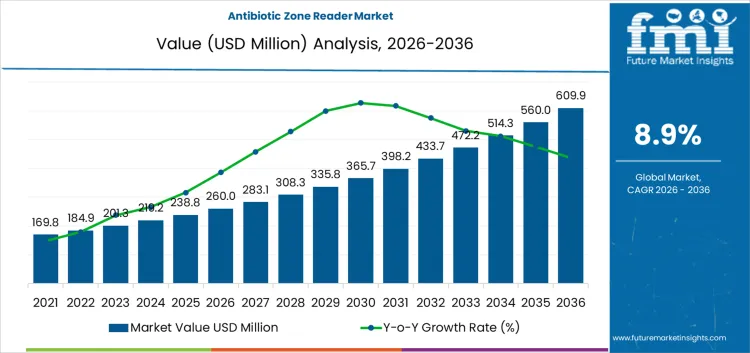
Antibiotic Zone Reader Market Key Takeaways
| Metric | Value |
|---|---|
| Market Value (2026) | USD 260.0 million |
| Market Forecast Value (2036) | USD 610.0 million |
| Forecast CAGR 2026 to 2036 | 8.9% |
Why is the Demand for Antibiotic Zone Reader Growing?
Demand for antibiotic zone readers is increasing as clinical microbiology laboratories and healthcare diagnostics units require precise measurement of inhibition zones to determine antimicrobial susceptibility profiles. Manual measurement methods are labor intensive and subject to interoperator variation, and antibiotic zone readers provide digital imaging and standardized analysis that support consistent interpretation of assay results. Microbiology professionals specify these systems to accelerate turnaround time for susceptibility reports that guide therapeutic decision making in infection management. Procurement teams evaluate resolution, software analytics, workflow integration, and compliance with laboratory quality systems to ensure devices align with throughput expectations and regulatory documentation requirements. Adoption is reinforced by emphasis on documented results that support audit trails and traceability for sterility testing in pharmaceutical quality control and environmental monitoring programs.
Healthcare facilities are reinforcing infection control practices and antimicrobial stewardship initiatives that depend on reliable susceptibility data to limit spread of resistant organisms. Research laboratories engaged in new antibiotic development require accurate zone measurement to validate compound activity across diverse bacterial strains. Advances in digital imaging sensors and pattern recognition software improve differentiation of overlapping zones and support integration with laboratory information management systems. Technical staff benefit from customizable protocols, instrument calibration routines, and vendor support that reduce cycle times and support operational consistency. These application driven needs are contributing to sustained uptake of antibiotic zone readers across clinical and research environments.
How Are the Segments Classified in the Antibiotic Zone Reader Market?
Demand for antibiotic zone readers is shaped by antimicrobial susceptibility testing requirements, diagnostic accuracy expectations, and compliance with laboratory standards. Clinical and quality control laboratories require consistent measurement of inhibition zones to guide treatment decisions and verify antibiotic potency. Adoption aligns with rising antimicrobial resistance monitoring and standardized testing protocols. System selection prioritizes measurement precision, documentation reliability, and workflow efficiency. Segment classification reflects differentiation by testing methodology, system automation level, and laboratory end use. Structure highlights how testing approach, reader capability, and operational setting influence specification priorities and utilization intensity across microbiology laboratories.
Which Testing Method Represents the Largest Share of Demand?
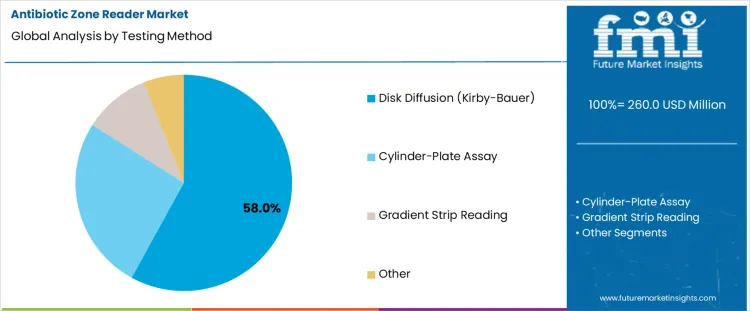
Disk diffusion testing holds 58.0%, representing the largest share among testing methods due to widespread standardization and clinical acceptance. The Kirby-Bauer method is routinely applied in hospital and reference laboratories for antimicrobial susceptibility assessment. Clear interpretive guidelines support consistent result comparison across facilities. Simplicity of setup and low consumable complexity sustain broad adoption. Cylinder-plate assays support antibiotic potency evaluation within quality control environments. Gradient strip reading enables minimum inhibitory concentration estimation with lower testing volume. Testing method segmentation reflects dominance of disk diffusion where regulatory alignment, procedural familiarity, and reproducibility remain essential.
Key Points
- Disk diffusion aligns with standardized clinical protocols.
- Broad guideline support enables result comparability.
- Other methods address potency testing or MIC determination.
Which System Type Accounts for the Highest Share of Demand?
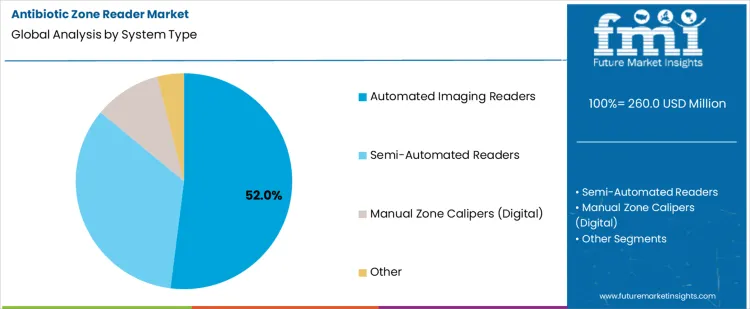
Automated imaging readers hold 52.0%, representing the largest share among system types due to measurement consistency and documentation capability. Automated systems capture high-resolution images and calculate inhibition zones with reduced operator variability. Digital archiving supports audit readiness and traceability requirements. Integration with laboratory information systems improves reporting efficiency. Semi-automated readers balance cost and accuracy through assisted measurement workflows. Manual digital calipers support low-throughput settings with greater operator dependence. System type segmentation reflects preference for automation where accuracy, repeatability, and data integrity are operational priorities.
Key Points
- Automated imaging improves measurement consistency.
- Digital records support traceability and compliance.
- Other systems address cost-sensitive or low-volume needs.
Which End Use Drives the Largest Share of Demand?
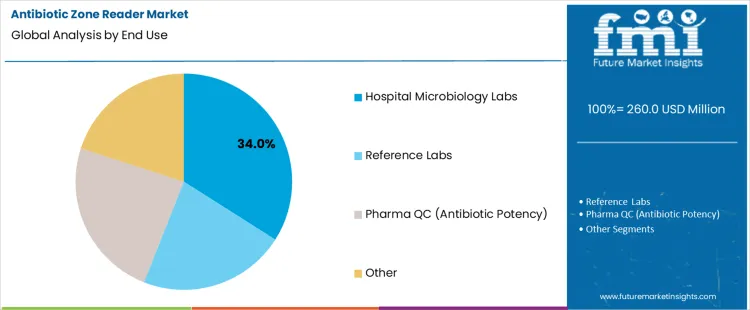
Hospital microbiology labs hold 34.0%, representing the largest share among end-use settings due to routine diagnostic testing volume. These laboratories perform daily susceptibility assessments to support clinical treatment decisions. Rapid and reliable zone measurement directly influences antimicrobial selection accuracy. Integration with diagnostic workflows supports timely reporting. Reference laboratories manage confirmatory testing with lower aggregate volume. Pharmaceutical quality control applies zone readers for antibiotic potency validation. Other users address surveillance and research needs. End-use segmentation reflects concentration of demand where diagnostic frequency and clinical decision support requirements remain highest.
Key Points
- Hospitals conduct frequent susceptibility testing.
- Diagnostic accuracy supports effective treatment decisions.
- Other users apply readers for validation or surveillance.
What are the Key Dynamics in the Antibiotic Zone Reader Market?
Demand for antibiotic zone readers reflects laboratory requirement for objective measurement of inhibition zones in antimicrobial susceptibility testing. Adoption concentrates within clinical microbiology laboratories, hospital diagnostics, pharmaceutical quality control, and public health surveillance units. Global scope aligns with standardized susceptibility testing protocols and rising antimicrobial resistance monitoring. Usage centers on optical and image-based readers integrated with disk diffusion workflows to ensure measurement consistency and auditability.
How do standardization requirements and antimicrobial resistance surveillance shape adoption?
Clinical laboratories require precise zone diameter measurement to classify bacterial susceptibility according to established interpretive criteria. Demand increases as manual ruler-based readings introduce operator variability that affects categorical results. Automated zone readers provide consistent edge detection and calibrated measurement, supporting reproducible outcomes across technicians and shifts. Integration with laboratory information systems improves result traceability and reporting speed. Public health programs rely on standardized readings to track resistance trends across sites. Pharmaceutical laboratories adopt automated readers to support batch release testing and method validation. High sample volumes benefit from faster plate throughput without compromising accuracy. Adoption reflects operational dependence on consistency in susceptibility interpretation rather than workflow automation alone.
How do validation burden, plate variability, and cost pressure influence market scalability?
Zone readers require validation against reference methods to demonstrate measurement equivalence, extending implementation timelines. Demand sensitivity rises where laboratory budgets favor manual methods for low test volumes. Performance depends on agar depth, disk placement accuracy, and colony growth characteristics, affecting edge detection reliability. Irregular inhibition zones challenge algorithm accuracy and require operator review. Training remains necessary to manage exceptions and verify results. Equipment cost and maintenance affect procurement in decentralized laboratories. Software updates and calibration introduce ongoing support requirements. Regulatory documentation expectations increase administrative effort, constraining rapid scaling across fragmented laboratory networks.
How Is Demand for Antibiotic Zone Readers Evolving Globally?
Demand for antibiotic zone readers is expanding globally due to rising antimicrobial resistance surveillance, standardized susceptibility testing, and laboratory automation requirements. Clinical microbiology, pharmaceutical quality control, and academic research drive adoption where repeatable measurement and auditability are required. Transition from manual calipers to digital imaging improves throughput and reduces operator variability. Growth rates in India at 10.8%, Indonesia at 9.7%, Vietnam at 9.3%, Saudi Arabia at 8.9%, and UAE at 8.5% indicate sustained expansion supported by laboratory capacity growth, regulatory scrutiny, and infection control programs across healthcare and public health systems.
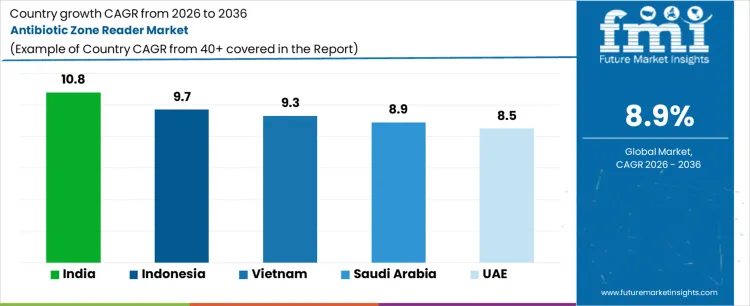
| Country | CAGR (%) |
|---|---|
| India | 10.8% |
| Indonesia | 9.7% |
| Vietnam | 9.3% |
| Saudi Arabia | 8.9% |
| UAE | 8.5% |
What Is Driving Strong Growth of Antibiotic Zone Reader Demand in India?
India is growing at a CAGR of 10.8%, supported by expanding clinical microbiology networks and antimicrobial resistance monitoring. High patient volumes increase routine susceptibility testing across hospitals and diagnostic chains. National surveillance initiatives emphasize standardized reporting and traceable results. Pharmaceutical manufacturing and contract research laboratories require validated zone measurement for quality control. Academic institutions expand microbiology programs, adding instructional laboratories. Demand growth reflects testing volume escalation and compliance-driven accuracy requirements rather than discretionary laboratory upgrades.
- Expansion of hospital microbiology laboratories
- National antimicrobial resistance surveillance programs
- Pharmaceutical quality control testing requirements
- Growth of academic microbiology infrastructure
Why Is Indonesia Experiencing Rapid Adoption of Antibiotic Zone Readers?
Antibiotic zone reader demand in Indonesia is expanding at a CAGR of 9.7%, driven by infection control priorities and laboratory modernization. Public hospitals increase susceptibility testing to guide antibiotic stewardship. Tropical disease prevalence elevates microbiological workload. Automation reduces analyst training burden and improves result consistency across dispersed facilities. Government investment supports upgrading diagnostic equipment. Demand growth reflects public health needs and laboratory standardization rather than expansion of pharmaceutical research activity.
- Increased infection control testing volumes
- Modernization of public hospital laboratories
- Need for consistent results across dispersed facilities
- Government-backed diagnostic infrastructure upgrades
How Is Vietnam Shaping Demand for Antibiotic Zone Readers?
Vietnam is growing at a CAGR of 9.3%, shaped by healthcare system expansion and export-oriented pharmaceutical testing. Hospitals adopt standardized susceptibility testing protocols to improve treatment outcomes. Pharmaceutical packaging and formulation facilities require validated microbiological quality checks. Automation supports growing laboratory networks with limited specialist availability. University laboratories increase applied microbiology research and training. Demand growth reflects healthcare expansion and compliance alignment rather than replacement of legacy automated systems.
- Hospital adoption of standardized susceptibility testing
- Pharmaceutical microbiological quality assurance needs
- Automation addressing specialist workforce constraints
- Expansion of applied microbiology education
What Factors Are Supporting Antibiotic Zone Reader Demand in Saudi Arabia?
Antibiotic zone reader demand in Saudi Arabia is expanding at a CAGR of 8.9%, supported by hospital capacity expansion and infection surveillance initiatives. Centralized laboratories implement digital measurement to standardize results across regions. High healthcare investment supports procurement of automated microbiology equipment. Pharmaceutical and food safety laboratories contribute additional demand. Emphasis on data integrity and reporting accuracy influences adoption. Growth reflects institutional investment and standardization rather than increases in routine diagnostic volumes alone.
- Hospital capacity expansion and consolidation
- Centralized laboratory standardization efforts
- High investment in automated diagnostic equipment
- Data integrity and reporting accuracy requirements
Why Is the UAE Showing Strong Uptake of Antibiotic Zone Readers?
United Arab Emirates is growing at a CAGR of 8.5%, driven by advanced healthcare facilities and regulatory emphasis on quality diagnostics. Hospitals prioritize rapid, standardized susceptibility testing to support antimicrobial stewardship. Medical laboratories serving international patients require audit-ready documentation. Academic and private research centers adopt digital readers for training and applied studies. Strong focus on healthcare quality standards sustains procurement. Growth reflects institutional quality benchmarks and laboratory automation rather than population-driven testing increases.
- Advanced hospital diagnostic capability requirements
- Audit-ready documentation for international healthcare services
- Adoption in academic and private research laboratories
- Emphasis on healthcare quality and accreditation standards
What is the competitive landscape of demand for the antibiotic zone reader market globally?
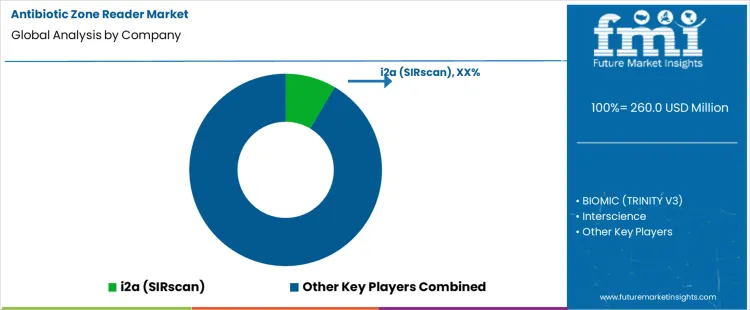
Demand for antibiotic zone readers is driven by clinical microbiology laboratories, hospitals, and diagnostic facilities requiring standardized antimicrobial susceptibility testing to guide appropriate therapy. These systems automate measurement of inhibition zones from disk diffusion assays, improving accuracy, reproducibility, and throughput compared with visual manual reading. Buyers evaluate imaging resolution, software analytics, integration with laboratory information systems, regulatory compliance, and ease of validation and quality control. Procurement teams prioritize suppliers with proven performance records, global service networks, training support, and compatibility with a wide range of culture media and plate formats. Trend in the global market reflects increased emphasis on antimicrobial resistance surveillance, workflow automation, and data traceability to support clinical decision-making and public health reporting.
i2a (SIRscan) holds leading positioning through specialized antibiotic zone readers and imaging software widely adopted by clinical and reference laboratories worldwide. bioMérieux supports demand with integrated susceptibility testing platforms and zone reading solutions aligned with global clinical microbiology workflows. BIOMIC (TRINITY V3) contributes automated zone readers and software analytics for routine and high-throughput testing environments. BD (Becton, Dickinson and Company) participates with imaging and digital analysis tools integrated into broader microbiology systems supporting culturing and susceptibility. Thermo Fisher Scientific supplies digital zone reading systems and laboratory automation technologies integrated with data management solutions. Competitive differentiation depends on imaging accuracy, software analytics sophistication, regulatory readiness, ease of integration, and ability to support diverse laboratory requirements.
Key Players in the Antibiotic Zone Reader Market
- i2a (SIRscan)
- BIOMIC (TRINITY V3)
- Interscience
- bioMérieux
- BD (Becton, Dickinson and Company)
- Thermo Fisher Scientific
- Bruker
- Merlin Diagnostika (Bruker)
- HiMedia Laboratories
Scope of the Report
| Items | Values |
|---|---|
| Quantitative Units | USD million |
| Testing Method | Disk Diffusion (Kirby-Bauer); Cylinder-Plate Assay; Gradient Strip Reading; Other |
| System Type | Automated Imaging Readers; Semi-Automated Readers; Manual Zone Calipers (Digital); Other |
| End Use | Hospital Microbiology Labs; Reference Labs; Pharma QC (Antibiotic Potency); Other |
| Sales Channel | Direct OEM Sales; Clinical Lab Distributors; Microbiology Workflow Integrators; Other |
| Regions Covered | Asia Pacific, Europe, North America, Latin America, Middle East & Africa |
| Countries Covered | India, Indonesia, Vietnam, Saudi Arabia, UAE, and 40+ countries |
| Key Companies Profiled | i2a; BIOMIC; Interscience; bioMérieux; BD; Thermo Fisher Scientific; Bruker; Merlin Diagnostika; HiMedia Laboratories; Regional Suppliers |
| Additional Attributes | Dollar sales by testing method and system type; adoption trends for automated imaging readers to standardize antimicrobial susceptibility interpretation; zone measurement accuracy, repeatability, and edge-detection performance metrics; compatibility with EUCAST and CLSI guidelines and reporting formats; software capabilities for audit trails, LIS connectivity, and result archiving; throughput per shift and operator dependency considerations; maintenance, calibration, and lifecycle cost factors; compliance with laboratory accreditation and validation requirements influencing antibiotic zone reader selection. |
Antibiotic Zone Reader Market by Segment
Testing Method:
- Disk Diffusion (Kirby-Bauer)
- Cylinder-Plate Assay
- Gradient Strip Reading
- Other
System Type:
- Automated Imaging Readers
- Semi-Automated Readers
- Manual Zone Calipers (Digital)
- Other
End Use:
- Hospital Microbiology Labs
- Reference Labs
- Pharma QC (Antibiotic Potency)
- Other
Sales Channel:
- Direct OEM Sales
- Clinical Lab Distributors
- Microbiology Workflow Integrators
- Other
Region:
- Asia Pacific
- China
- Japan
- South Korea
- India
- Australia & New Zealand
- ASEAN
- Rest of Asia Pacific
- Europe
- Germany
- United Kingdom
- France
- Italy
- Spain
- Nordic
- BENELUX
- Rest of Europe
- North America
- United States
- Canada
- Mexico
- Latin America
- Brazil
- Chile
- Rest of Latin America
- Middle East & Africa
- Kingdom of Saudi Arabia
- Other GCC Countries
- Turkey
- South Africa
- Other African Union
- Rest of Middle East & Africa
Bibliography
- Clinical and Laboratory Standards Institute. (2023). Performance standards for antimicrobial susceptibility testing (M100), updated interpretive criteria and disk diffusion measurement guidance. Clinical and Laboratory Standards Institute.
- European Committee on Antimicrobial Susceptibility Testing. (2023). EUCAST disk diffusion method for antimicrobial susceptibility testing, version in force with staged amendments. European Society of Clinical Microbiology and Infectious Diseases.
- World Health Organization. (2023). Global antimicrobial resistance surveillance system (GLASS): Laboratory methods and standardized susceptibility testing requirements. World Health Organization.
- International Organization for Standardization. (2023). ISO 20776-2: Clinical laboratory testing and in vitro diagnostic systems-Susceptibility testing of infectious agents and evaluation of performance of antimicrobial susceptibility test devices. International Organization for Standardization.
- United States Pharmacopeial Convention. (2024). USP <81> Antibiotics-Microbial assays and guidance on zone measurement, digital imaging, and method validation. United States Pharmacopeial Convention.
- European Pharmacopoeia Commission. (2023). European Pharmacopoeia, Chapter 2.7.2 and related chapters: Antibiotic assay methods and inhibition zone measurement requirements. Council of Europe.
Frequently Asked Questions
How big is the antibiotic zone reader market in 2026?
The global antibiotic zone reader market is estimated to be valued at USD 260.0 million in 2026.
What will be the size of antibiotic zone reader market in 2036?
The market size for the antibiotic zone reader market is projected to reach USD 609.9 million by 2036.
How much will be the antibiotic zone reader market growth between 2026 and 2036?
The antibiotic zone reader market is expected to grow at a 8.9% CAGR between 2026 and 2036.
What are the key product types in the antibiotic zone reader market?
The key product types in antibiotic zone reader market are disk diffusion (kirby-bauer), cylinder-plate assay, gradient strip reading and other.
Which system type segment to contribute significant share in the antibiotic zone reader market in 2026?
In terms of system type, automated imaging readers segment to command 52.0% share in the antibiotic zone reader market in 2026.
Preview the report firsthand - request a free sample
Get SampleGet the brochure for pricing and purchase details.
Get PDFTable of Content
- Executive Summary
- Global Market Outlook
- Demand-side Trends
- Supply-side Trends
- Technology Roadmap Analysis
- Analysis and Recommendations
- Market Overview
- Market Coverage / Taxonomy
- Market Definition / Scope / Limitations
- Market Background
- Market Dynamics
- Drivers
- Restraints
- Opportunity
- Trends
- Scenario Forecast
- Demand in Optimistic Scenario
- Demand in Likely Scenario
- Demand in Conservative Scenario
- Opportunity Map Analysis
- Product Life Cycle Analysis
- Supply Chain Analysis
- Investment Feasibility Matrix
- Value Chain Analysis
- PESTLE and Porter’s Analysis
- Regulatory Landscape
- Regional Parent Market Outlook
- Production and Consumption Statistics
- Import and Export Statistics
- Market Dynamics
- Global Market Analysis 2021 to 2025 and Forecast, 2026 to 2036
- Historical Market Size Value (USD Million) Analysis, 2021 to 2025
- Current and Future Market Size Value (USD Million) Projections, 2026 to 2036
- Y-o-Y Growth Trend Analysis
- Absolute $ Opportunity Analysis
- Global Market Pricing Analysis 2021 to 2025 and Forecast 2026 to 2036
- Global Market Analysis 2021 to 2025 and Forecast 2026 to 2036, By Testing Method
- Introduction / Key Findings
- Historical Market Size Value (USD Million) Analysis By Testing Method , 2021 to 2025
- Current and Future Market Size Value (USD Million) Analysis and Forecast By Testing Method , 2026 to 2036
- Disk Diffusion (Kirby-Bauer)
- Cylinder-Plate Assay
- Gradient Strip Reading
- Other
- Disk Diffusion (Kirby-Bauer)
- Y-o-Y Growth Trend Analysis By Testing Method , 2021 to 2025
- Absolute $ Opportunity Analysis By Testing Method , 2026 to 2036
- Global Market Analysis 2021 to 2025 and Forecast 2026 to 2036, By System Type
- Introduction / Key Findings
- Historical Market Size Value (USD Million) Analysis By System Type, 2021 to 2025
- Current and Future Market Size Value (USD Million) Analysis and Forecast By System Type, 2026 to 2036
- Automated Imaging Readers
- Semi-Automated Readers
- Manual Zone Calipers (Digital)
- Other
- Automated Imaging Readers
- Y-o-Y Growth Trend Analysis By System Type, 2021 to 2025
- Absolute $ Opportunity Analysis By System Type, 2026 to 2036
- Global Market Analysis 2021 to 2025 and Forecast 2026 to 2036, By End Use
- Introduction / Key Findings
- Historical Market Size Value (USD Million) Analysis By End Use, 2021 to 2025
- Current and Future Market Size Value (USD Million) Analysis and Forecast By End Use, 2026 to 2036
- Hospital Microbiology Labs
- Reference Labs
- Pharma QC (Antibiotic Potency)
- Other
- Hospital Microbiology Labs
- Y-o-Y Growth Trend Analysis By End Use, 2021 to 2025
- Absolute $ Opportunity Analysis By End Use, 2026 to 2036
- Global Market Analysis 2021 to 2025 and Forecast 2026 to 2036, By Sales Channel
- Introduction / Key Findings
- Historical Market Size Value (USD Million) Analysis By Sales Channel, 2021 to 2025
- Current and Future Market Size Value (USD Million) Analysis and Forecast By Sales Channel, 2026 to 2036
- Direct OEM Sales
- Clinical Lab Distributors
- Microbiology Workflow Integrators
- Other
- Direct OEM Sales
- Y-o-Y Growth Trend Analysis By Sales Channel, 2021 to 2025
- Absolute $ Opportunity Analysis By Sales Channel, 2026 to 2036
- Global Market Analysis 2021 to 2025 and Forecast 2026 to 2036, By Region
- Introduction
- Historical Market Size Value (USD Million) Analysis By Region, 2021 to 2025
- Current Market Size Value (USD Million) Analysis and Forecast By Region, 2026 to 2036
- North America
- Latin America
- Western Europe
- Eastern Europe
- East Asia
- South Asia and Pacific
- Middle East & Africa
- Market Attractiveness Analysis By Region
- North America Market Analysis 2021 to 2025 and Forecast 2026 to 2036, By Country
- Historical Market Size Value (USD Million) Trend Analysis By Market Taxonomy, 2021 to 2025
- Market Size Value (USD Million) Forecast By Market Taxonomy, 2026 to 2036
- By Country
- USA
- Canada
- Mexico
- By Testing Method
- By System Type
- By End Use
- By Sales Channel
- By Country
- Market Attractiveness Analysis
- By Country
- By Testing Method
- By System Type
- By End Use
- By Sales Channel
- Key Takeaways
- Latin America Market Analysis 2021 to 2025 and Forecast 2026 to 2036, By Country
- Historical Market Size Value (USD Million) Trend Analysis By Market Taxonomy, 2021 to 2025
- Market Size Value (USD Million) Forecast By Market Taxonomy, 2026 to 2036
- By Country
- Brazil
- Chile
- Rest of Latin America
- By Testing Method
- By System Type
- By End Use
- By Sales Channel
- By Country
- Market Attractiveness Analysis
- By Country
- By Testing Method
- By System Type
- By End Use
- By Sales Channel
- Key Takeaways
- Western Europe Market Analysis 2021 to 2025 and Forecast 2026 to 2036, By Country
- Historical Market Size Value (USD Million) Trend Analysis By Market Taxonomy, 2021 to 2025
- Market Size Value (USD Million) Forecast By Market Taxonomy, 2026 to 2036
- By Country
- Germany
- UK
- Italy
- Spain
- France
- Nordic
- BENELUX
- Rest of Western Europe
- By Testing Method
- By System Type
- By End Use
- By Sales Channel
- By Country
- Market Attractiveness Analysis
- By Country
- By Testing Method
- By System Type
- By End Use
- By Sales Channel
- Key Takeaways
- Eastern Europe Market Analysis 2021 to 2025 and Forecast 2026 to 2036, By Country
- Historical Market Size Value (USD Million) Trend Analysis By Market Taxonomy, 2021 to 2025
- Market Size Value (USD Million) Forecast By Market Taxonomy, 2026 to 2036
- By Country
- Russia
- Poland
- Hungary
- Balkan & Baltic
- Rest of Eastern Europe
- By Testing Method
- By System Type
- By End Use
- By Sales Channel
- By Country
- Market Attractiveness Analysis
- By Country
- By Testing Method
- By System Type
- By End Use
- By Sales Channel
- Key Takeaways
- East Asia Market Analysis 2021 to 2025 and Forecast 2026 to 2036, By Country
- Historical Market Size Value (USD Million) Trend Analysis By Market Taxonomy, 2021 to 2025
- Market Size Value (USD Million) Forecast By Market Taxonomy, 2026 to 2036
- By Country
- China
- Japan
- South Korea
- By Testing Method
- By System Type
- By End Use
- By Sales Channel
- By Country
- Market Attractiveness Analysis
- By Country
- By Testing Method
- By System Type
- By End Use
- By Sales Channel
- Key Takeaways
- South Asia and Pacific Market Analysis 2021 to 2025 and Forecast 2026 to 2036, By Country
- Historical Market Size Value (USD Million) Trend Analysis By Market Taxonomy, 2021 to 2025
- Market Size Value (USD Million) Forecast By Market Taxonomy, 2026 to 2036
- By Country
- India
- ASEAN
- Australia & New Zealand
- Rest of South Asia and Pacific
- By Testing Method
- By System Type
- By End Use
- By Sales Channel
- By Country
- Market Attractiveness Analysis
- By Country
- By Testing Method
- By System Type
- By End Use
- By Sales Channel
- Key Takeaways
- Middle East & Africa Market Analysis 2021 to 2025 and Forecast 2026 to 2036, By Country
- Historical Market Size Value (USD Million) Trend Analysis By Market Taxonomy, 2021 to 2025
- Market Size Value (USD Million) Forecast By Market Taxonomy, 2026 to 2036
- By Country
- Kingdom of Saudi Arabia
- Other GCC Countries
- Turkiye
- South Africa
- Other African Union
- Rest of Middle East & Africa
- By Testing Method
- By System Type
- By End Use
- By Sales Channel
- By Country
- Market Attractiveness Analysis
- By Country
- By Testing Method
- By System Type
- By End Use
- By Sales Channel
- Key Takeaways
- Key Countries Market Analysis
- USA
- Pricing Analysis
- Market Share Analysis, 2025
- By Testing Method
- By System Type
- By End Use
- By Sales Channel
- Canada
- Pricing Analysis
- Market Share Analysis, 2025
- By Testing Method
- By System Type
- By End Use
- By Sales Channel
- Mexico
- Pricing Analysis
- Market Share Analysis, 2025
- By Testing Method
- By System Type
- By End Use
- By Sales Channel
- Brazil
- Pricing Analysis
- Market Share Analysis, 2025
- By Testing Method
- By System Type
- By End Use
- By Sales Channel
- Chile
- Pricing Analysis
- Market Share Analysis, 2025
- By Testing Method
- By System Type
- By End Use
- By Sales Channel
- Germany
- Pricing Analysis
- Market Share Analysis, 2025
- By Testing Method
- By System Type
- By End Use
- By Sales Channel
- UK
- Pricing Analysis
- Market Share Analysis, 2025
- By Testing Method
- By System Type
- By End Use
- By Sales Channel
- Italy
- Pricing Analysis
- Market Share Analysis, 2025
- By Testing Method
- By System Type
- By End Use
- By Sales Channel
- Spain
- Pricing Analysis
- Market Share Analysis, 2025
- By Testing Method
- By System Type
- By End Use
- By Sales Channel
- France
- Pricing Analysis
- Market Share Analysis, 2025
- By Testing Method
- By System Type
- By End Use
- By Sales Channel
- India
- Pricing Analysis
- Market Share Analysis, 2025
- By Testing Method
- By System Type
- By End Use
- By Sales Channel
- ASEAN
- Pricing Analysis
- Market Share Analysis, 2025
- By Testing Method
- By System Type
- By End Use
- By Sales Channel
- Australia & New Zealand
- Pricing Analysis
- Market Share Analysis, 2025
- By Testing Method
- By System Type
- By End Use
- By Sales Channel
- China
- Pricing Analysis
- Market Share Analysis, 2025
- By Testing Method
- By System Type
- By End Use
- By Sales Channel
- Japan
- Pricing Analysis
- Market Share Analysis, 2025
- By Testing Method
- By System Type
- By End Use
- By Sales Channel
- South Korea
- Pricing Analysis
- Market Share Analysis, 2025
- By Testing Method
- By System Type
- By End Use
- By Sales Channel
- Russia
- Pricing Analysis
- Market Share Analysis, 2025
- By Testing Method
- By System Type
- By End Use
- By Sales Channel
- Poland
- Pricing Analysis
- Market Share Analysis, 2025
- By Testing Method
- By System Type
- By End Use
- By Sales Channel
- Hungary
- Pricing Analysis
- Market Share Analysis, 2025
- By Testing Method
- By System Type
- By End Use
- By Sales Channel
- Kingdom of Saudi Arabia
- Pricing Analysis
- Market Share Analysis, 2025
- By Testing Method
- By System Type
- By End Use
- By Sales Channel
- Turkiye
- Pricing Analysis
- Market Share Analysis, 2025
- By Testing Method
- By System Type
- By End Use
- By Sales Channel
- South Africa
- Pricing Analysis
- Market Share Analysis, 2025
- By Testing Method
- By System Type
- By End Use
- By Sales Channel
- USA
- Market Structure Analysis
- Competition Dashboard
- Competition Benchmarking
- Market Share Analysis of Top Players
- By Regional
- By Testing Method
- By System Type
- By End Use
- By Sales Channel
- Competition Analysis
- Competition Deep Dive
- i2a (SIRscan)
- Overview
- Product Portfolio
- Profitability by Market Segments (Product/Age /Sales Channel/Region)
- Sales Footprint
- Strategy Overview
- Marketing Strategy
- Product Strategy
- Channel Strategy
- BIOMIC (TRINITY V3)
- Interscience
- bioMérieux
- BD (Becton, Dickinson and Company)
- Thermo Fisher Scientific
- Bruker
- Merlin Diagnostika (Bruker)
- HiMedia Laboratories
- Regional Suppliers
- i2a (SIRscan)
- Competition Deep Dive
- Assumptions & Acronyms Used
- Research Methodology


