

- Market Size (2026)
- USD 3.2 Bn
- Forecast (2036)
- USD 6.8 Bn
- CAGR (2026 to 2036)
- 7.8%
How big is Area Scan Cameras Market in 2026?
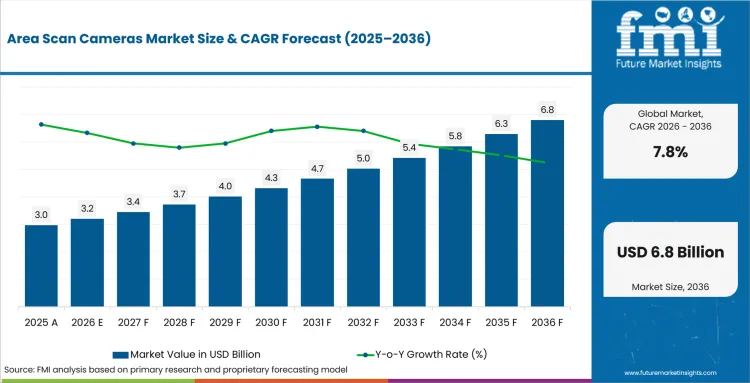
USD 3.2 billion in 2026 and USD 6.8 billion by 2036 at a 7.8% CAGR.
Demand for area scan cameras is projected to expand at 7.8% CAGR between 2026 and 2036, increasing valuation from USD 3.2 billion in 2026 to USD 6.8 billion by 2036. Manufacturers are deploying more vision systems as automation expands across inspection, monitoring, and machine-control applications. IDS Imaging introduced the uEye SLE single-board monitoring camera in May 2025 for machine and device monitoring, reflecting demand for compact imaging systems that can be integrated into automated equipment. The shift toward continuous observation and event-based recording broadens camera use beyond traditional defect inspection.
Country conversion differs as new semiconductor capacity in the USA meets mature installed automation in Germany and Japan. The USA Department of Commerce reported in July 2026 that TSMC’s expanded program would total 12 semiconductor and packaging facilities across the United States. New semiconductor manufacturing equipment adds inspection stations in the USA while mature German and Japanese factories prioritize compatibility with installed optics and software.
Key Takeaways of Area Scan Cameras Market
- Automated inspection raises recurring full-frame acquisition needs as manufacturers add vision checks beside robotics and precision handling.
- Based on sensor type, CMOS area scan cameras are projected to account for 48.0% in 2026 due to broad global-shutter coverage.
- In 2026, GigE Vision is expected to lead interface with 27.0% share as standardized Ethernet simplifies integration.
- By resolution, 5-12 MP is forecast to represent 34.0% in 2026 driven by balanced detail and processing load.
- Camera qualification remains constrained by optics and lighting because image quality must stay stable at production speed.
- Basler, Teledyne FLIR, Omron Sentech, Allied Vision, JAI, IDS Imaging, Daheng Imaging and Hikrobot are some notable players in the sector.
Analyst Perspective
“Area scan camera selection should start with the smallest image specification that resolves the target defect at production speed. Commercial value depends on preserving trigger behavior and SDK compatibility as factories qualify higher resolution or bandwidth without repeating integration work.”
- Nikhil Kaitwade, Principal Consultant, Future Market Insights
How is the Area Scan Cameras Market segmented?
The area scan cameras market is segmented by sensor type, interface, resolution, application, sales channel and region.
By sensor type, the analysis covers CMOS, CCD, SWIR, color and high-speed area scan cameras. The interface category includes GigE Vision, USB3 Vision, Camera Link, CoaXPress and MIPI or embedded links. Resolution spans below 5 MP, 5-12 MP, 12-25 MP and above 25 MP. Application covers machine vision inspection, robotics guidance, electronics inspection, medical or life science imaging and traffic or ITS use. Sales channel includes machine vision distributors, direct OEM sales, system integrators and embedded vision suppliers, with region completing the taxonomy.
What makes CMOS area scan cameras central to the sensor type category?
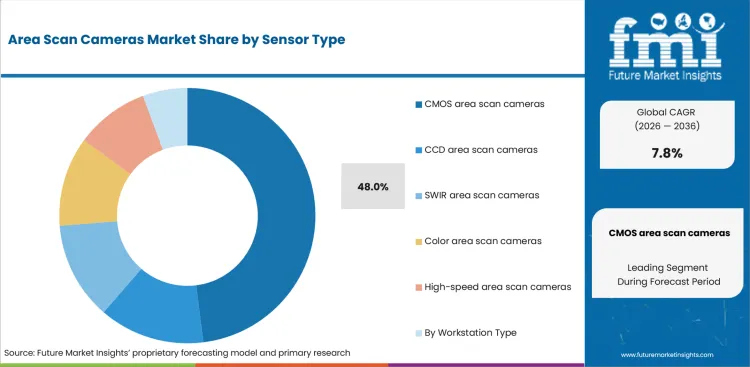
CMOS machine vision camera platforms cover moving-target inspection and high-resolution imaging without forcing manufacturers into one performance tier. Sony Semiconductor Solutions announced the IMX927 industrial global-shutter sensor in September 2025 with approximately 105 effective megapixels and output up to 100 fps.
- CMOS area scan cameras are projected to hold 48.0% share in 2026 owing to broad global-shutter coverage across industrial inspection.
- Camera engineers reuse familiar optics and software across CMOS performance tiers as inspection speed or detail requirements change during qualified line upgrades.
Why does GigE Vision lead the interface category?
Standardized Ethernet lets GigE camera systems sit farther from host computers without adding frame grabbers to ordinary inspection cells, which simplifies machine layout and replacement planning across larger machine footprints.
- By interface, GigE Vision is estimated to hold 27.0% in 2026 owing to standardized networking that reduces cabling and host-integration complexity.
- IDS Imaging introduced a GigE Vision single-board uEye LE revision with Sony STARVIS 2 technology in February 2025. Compact OEM designs can retain standardized camera control while changing enclosure size or sensor sensitivity across embedded inspection systems.
How does the 5-12 MP band fit the resolution category?
The 5-12 MP band gives assembly and surface inspection enough detail without forcing every station into high data rates. Adjacent resolutions let integrators preserve familiar optics and camera control across qualified inspection platforms.
- The 5-12 MP segment is likely to capture 34.0% share in 2026 attributable to balanced detail and manageable processing load. IDS Imaging added 5 MP and 8 MP STARVIS 2 options to its GigE uEye CP series in June 2026.
- Industrial machine vision teams reduce qualification work when the interface and SDK remain stable across adjacent resolution choices.
What supports machine vision inspection in the application category?
Machine vision inspection turns camera performance into a production decision as semiconductor metrology requires stable full-frame acquisition before each process step advances.
- Machine vision inspection is set to lead the application category with 34.0% share in 2026 due to use across presence, alignment and dimensional checks.
- Allied Vision launched four-channel CoaXPress-12 area scan cameras in May 2026 with data rates up to 50 Gbit/s for electronics and semiconductor imaging. Production teams still need optics and host processing that sustain those rates during validated production inspection.
What are the drivers, restraints and opportunities in the Area Scan Cameras Market?
Automation adds inspection points while full-stack qualification slows deployment and specialized spectral or high-bandwidth cameras extend the addressable application set.
- Driver: Automated production adds full-frame image capture wherever inspection or robot guidance requires a two-dimensional decision at line speed.
- Restraint: Higher camera bandwidth increases integration work unless optics and host processing sustain the intended cycle time under production load.
- Opportunity: SWIR-capable area scan cameras can enter inspection tasks where visible imaging cannot separate material or defect contrast reliably.
Factory Automation Adds More Image-Acquisition Points
Robotized manufacturing adds camera demand when inspection and guidance decisions must occur before a part leaves each station. In April 2026 the International Federation of Robotics reported 1,220 industrial robots per 10,000 manufacturing employees in South Korea and 449 in Germany. AI quality inspection becomes easier to repeat when camera families share software and calibration routines across several automated cells.
Integration Load Can Extend Qualification
Higher-speed machine-vision systems can increase integration requirements even when camera performance improves. Allied Vision released a GigE Vision 3.0 FPGA IP core in June 2026 that supports 10 and 25 Gbps interfaces with RDMA transport. Smart factory programs still require optics, network configuration and host processing to maintain cycle time during higher-bandwidth camera qualification.
Non-Visible Imaging Opens Specialized Inspection Routes
Shortwave infrared imaging exposes contrast differences that visible cameras cannot separate under the same illumination at production speed. That capability can extend inspection into materials or defects that standard RGB acquisition misses during routine quality checks. Allied Vision and QDI Systems announced an April 2026 partnership to develop quantum-dot SWIR sensors with lower size and cost targets than conventional InGaAs designs.
Which country CAGRs are profiled in the Area Scan Cameras Market?
| Country | CAGR |
|---|---|
| Taiwan | 8.5% |
| South Korea | 7.9% |
| Germany | 7.4% |
| USA | 7.0% |
| Japan | 6.4% |
How do country-level CAGRs compare in the Area Scan Cameras Market?
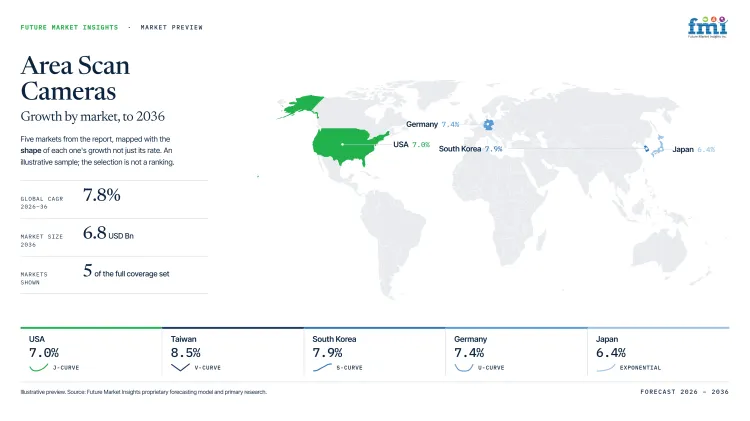
The profiled rates span 2.1 percentage points and form an electronics-intensive upper group around Taiwan and South Korea. Germany and USA occupy a middle band shaped by automation and replacement cycles. Japan remains separate as mature factories emphasize qualification continuity more strongly than rapid camera-platform turnover across installed lines.
- Taiwan semiconductor clusters reward rapid camera qualification for high-throughput inspection and yield control.
- South Korean M.AX programs connect defect data with production decisions across electronics lines.
- German machine builders favor SDK continuity as established automation makes revalidation expensive.
- USA semiconductor expansion must coexist with several generations of installed factory software.
- Japanese factories favor compact replacements that preserve optics and established trigger behavior.
Comparable CAGRs therefore mask entry costs across capacity-building markets and replacement-heavy manufacturing bases. The full report provides country-level CAGR analysis across North America, Latin America, Europe, East Asia, South Asia, Oceania and the Middle East and Africa.
Country-wise Analysis
- Taiwan’s Ministry of Economic Affairs reported in June 2025 that automated fabric inspection reached 120 yards per minute with defect detection up to 99% during continuous production testing. Area scan camera demand in Taiwan is forecast to rise at 8.5% CAGR over the forecast period, reinforced by electronics lines that put high value on defect visibility. Local integrators can test higher-resolution cameras near dense semiconductor and electronics clusters, shortening the path from application trial to production qualification. Production release remains the main friction as camera makers must prove stable bandwidth and lighting on the actual line to secure repeat orders.
- South Korean electronics factories place inspection beside fast assembly steps to catch defects ahead of downstream processing. Area scan camera adoption in South Korea is estimated to expand at 7.9% CAGR through 2036, aided by factory programs connecting defect data with production control. The Ministry of Trade Industry and Resources reported in May 2026 that more than 1,500 organizations joined the M.AX Alliance and AI factory projects reduced defects. Local automation engineering gives camera manufacturers a practical route into electronics lines that use machine-level data. High data loads remain the friction, so camera manufacturers need deterministic acquisition and nearby integration support before high-speed designs earn repeat orders.
- German machine builders qualify cameras inside engineered automation systems in which mechanical fit and software continuity matter during scheduled maintenance. Germany is estimated to post 7.4% CAGR over the forecast period, shaped by replacement demand that must preserve validated production behavior. Local machine-vision integrators support retrofit testing across regional industrial clusters with long equipment lifecycles and several generations of installed factory-control software. The International Federation of Robotics reported 26,982 German industrial robot installations during 2024 in its September 2025 release. Weaker machinery investment can delay discretionary camera upgrades until scheduled maintenance provides a lower-risk validation window for established production lines.
- USA camera demand combines new semiconductor capacity with an installed manufacturing base that spans multiple generations of automation hardware and software. The International Federation of Robotics reported in September 2025 that 393,700 industrial robots operated in American factories during 2024 and system integrators served the installed base. Area scan camera sales in USA are forecast to expand at 7.0% CAGR by 2036, supported by vision additions to new and upgraded production cells. Domestic integrators shorten troubleshooting and qualification across mixed camera interfaces, legacy software and newer high-bandwidth platforms. Fragmented legacy architectures remain the friction as camera replacements can trigger extra validation work across optics, drivers and plant software.
- Japanese manufacturers usually add imaging performance to mature automation during scheduled equipment renewal instead of rebuilding complete inspection cells. Japan’s area scan cameras market outlook is anticipated to advance at 6.4% CAGR over the assessment period, shaped by qualified replacement demand. Local camera and automation expertise helps factories preserve proven lens mounts, trigger paths and software interfaces during incremental upgrades. Qualification continuity remains a material friction because replacements must preserve validated image behavior across long production cycles. The Japan Robot Association reported in June 2026 that 2025 robot orders increased 25.7% and forecast 2026 order value to rise another 16.7%.
Who are the notable companies in the Area Scan Cameras Market?
Basler, Teledyne FLIR, Omron Sentech, Allied Vision, JAI, IDS Imaging, Daheng Imaging and Hikrobot are the notable companies serving this market.
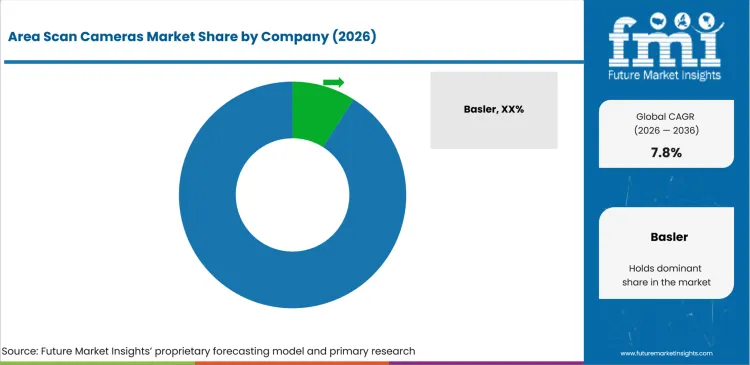
Competition centers on industrial camera makers that differ in sensor breadth and interface speed. Qualification history and local application support raise entry barriers because each camera must perform inside the complete machine vision system. Global camera families compete beside multispectral specialists and high-volume Asian portfolios that target standardized industrial inspection.
- Basler, Teledyne FLIR, Allied Vision and IDS Imaging compete with broad industrial camera portfolios and software environments that support repeated design-in work.
- JAI and Omron Sentech concentrate more heavily on industrial imaging specialization with strong coverage of color, multispectral or standard machine vision interfaces.
- Daheng Imaging and Hikrobot offer area scan portfolios covering mainstream GigE and higher-resolution industrial applications.
Competitive Benchmarking: Area Scan Cameras Market
| Company | Interface and Sensor Breadth | High-Speed Acquisition Depth | Integration and Software Support | Geographic Reach |
|---|---|---|---|---|
| Basler | High | High | High | Global |
| Teledyne FLIR | High | High | High | Global |
| Omron Sentech | Medium | Medium | Medium | Asia, North America and Europe |
| Allied Vision | High | High | High | Global |
| JAI | High | High | Medium | North America, Europe and Asia |
| IDS Imaging | High | Medium | High | Europe, North America and Asia |
| Daheng Imaging | High | Medium | Medium | Asia with international distribution |
| Hikrobot | High | High | Medium | Asia with international distribution |
Key Developments in the Area Scan Cameras Market
- In July 2026, Allied Vision launched FXO 100GigE machine vision cameras using Sony Pregius S sensors and RDMA transport for high-throughput semiconductor and metrology imaging.
- In June 2026, JAI introduced the Wave WAA-1300-GE-TEC area scan camera combining visible and SWIR response from 400 nm to about 1700 nm.
- In October 2025, Basler acquired a 76% stake in Indian distribution partner Alpha TechSys Automation and said the business would operate under the Basler India name.
Key Players in the Area Scan Cameras Market
Broad Industrial Camera Platforms
- Basler
- Teledyne FLIR
- Allied Vision
- IDS Imaging
Specialist Industrial Imaging Suppliers
- Omron Sentech
- JAI
High-Volume Machine Vision Portfolios
- Daheng Imaging
- Hikrobot
Area Scan Cameras Market - Report Scope
| Coverage field | Report scope |
|---|---|
| Market breakdown | By sensor type, interface, resolution, application, sales channel and region. |
| Quantitative Units | Revenue in USD billion and CAGR in %. |
| Market Definition | Commercial standalone and board-level area scan camera hardware that captures complete two-dimensional frames for industrial, scientific, medical, traffic and embedded vision applications. |
| Regions Covered | North America, Latin America, Europe, East Asia, South Asia and Pacific, and Middle East and Africa. |
| Countries Covered | Taiwan, South Korea, Germany, USA, Japan, and 20+ countries included in the full report. |
| Key Companies Profiled | Basler, Teledyne FLIR, Omron Sentech, Allied Vision, JAI, IDS Imaging, Daheng Imaging, Hikrobot. |
| Forecast Period | 2026 to 2036. |
| Approach | Primary and secondary research with market triangulation. |
Area Scan Cameras Market - Research Methodology
| Method | Approach |
|---|---|
| Primary Research | FMI analysts gathered input from manufacturers, service providers, technology developers, distributors, end users, procurement teams, and subject-matter experts. Interviews examined purchasing decisions, product or service evaluation, adoption barriers, approval requirements, pricing considerations, and expectations for technical or commercial support. Respondents were also asked what evidence is required before a trial, pilot, or initial order develops into regular purchasing. |
| Desk Research | Desk research covered government statistics, regulatory publications, trade data, industry associations, technical literature, standards, company filings, product information, and official corporate announcements. Sources were reviewed for relevance, publication date, geographic coverage, and consistency with the defined market scope. Claims relating to performance, applications, approvals, capacity, investment, and commercial activity were retained only when supported by credible public evidence. |
| Market Sizing and Forecasting | The market model combined the baseline value with historical performance, segment structure, pricing and volume indicators, adoption levels, company participation, and country-level demand conditions. Forecast assumptions considered economic activity, investment trends, regulatory developments, technology adoption, purchasing cycles, supply availability, and barriers to wider market use. Segment and regional estimates were reconciled before the final market total was calculated. |
| Data Validation | Estimates were checked against multiple independent indicators, including public data, company activity, trade patterns, industry developments, and findings from primary interviews. Validation also tested whether products, services, applications, and company revenues fell within the defined market boundaries. Adjacent categories, unsupported claims, overlapping revenues, and activities without direct market relevance were excluded to reduce double counting and maintain consistency across segments and countries. |
Area Scan Cameras Market by Segments
Area Scan Cameras Market segmented by Sensor Type:
- CMOS area scan cameras
- CCD area scan cameras
- SWIR area scan cameras
- Color area scan cameras
- High-speed area scan cameras
Area Scan Cameras Market segmented by Interface:
- GigE Vision
- USB3 Vision
- Camera Link
- CoaXPress
- MIPI / embedded
Area Scan Cameras Market segmented by Resolution:
- Below 5 MP
- 5-12 MP
- 12-25 MP
- Above 25 MP
Area Scan Cameras Market segmented by Application:
- Machine vision inspection
- Robotics guidance
- Electronics inspection
- Medical / life science
- Traffic / ITS
Area Scan Cameras Market segmented by Sales Channel:
- Machine vision distributors
- Direct OEM
- System integrators
- Embedded vision suppliers
Area Scan Cameras Market by Region:
- North America
- United States
- Canada
- Latin America
- Brazil
- Mexico
- Chile
- Rest of Latin America
- Western Europe
- Germany
- United Kingdom
- Italy
- Spain
- France
- Nordics
- Benelux
- Rest of Western Europe
- Eastern Europe
- Russia
- Poland
- Hungary
- Balkan and Baltic States
- Rest of Eastern Europe
- East Asia
- China
- Japan
- South Korea
- South Asia and Pacific
- India
- ASEAN
- Australia and New Zealand
- Rest of South Asia and Pacific
- Middle East and Africa
- Kingdom of Saudi Arabia
- Other GCC Countries
- Türkiye
- South Africa
- Other African Union Countries
- Rest of Middle East and Africa
Research Sources and Bibliography
- IDS Imaging Development Systems GmbH. (2025, May 6). IDS launches uEye SLE monitoring cameras.
- USA Department of Commerce. (2026, July 16). Trump Administration Secures an Additional $100 Billion USA Semiconductor Manufacturing Investment for a Total of $265 Billion from TSMC.
- Sony Semiconductor Solutions Corporation. (2025, September 29). Sony Semiconductor Solutions to Release the Industry-Leading*1 Global Shutter CMOS Image Sensor for Industrial Use That Achieves Both Approximately 105-Effective-Megapixels and High-Speed 100 FPS Output.
- IDS Imaging Development Systems GmbH. (2025, February 11). GigE Vision single-board camera with Sony Starvis 2 sensor.
- IDS Imaging Development Systems GmbH. (2026, June 16). Series launch for GigE uEye CP + Sony STARVIS 2.
- Allied Vision Technologies GmbH. (2026, May 7). Allied Vision Launches World’s Smallest 4-Channel CoaXPress-12 Camera Series for High-Speed Imaging.
- International Federation of Robotics. (2026, April 8). Robot Density Surges in Europe, Asia, and Americas.
- Allied Vision Technologies GmbH. (2026, June 10). Allied Vision Launches FPGA IP Core Implementing GigE Vision 3.0 Unlocking Data Rates Beyond 10 Gbps.
- Allied Vision Technologies GmbH. (2026, April 23). Allied Vision and QDI Systems Partner on QD-Based SWIR Sensors.
- Ministry of Economic Affairs, R.O.C. (2025, June 5). TTRI's AI Self-Learning Fabric Inspecting System Wins Gold at the 2025 Edison Awards.
- Ministry of Trade, Industry and Resources, Republic of Korea. (2026, May 20). Experts Discuss M.AX as the Way Forward for Korean Manufacturing.
- International Federation of Robotics. (2025, September 25). World Robotics 2025 report, INDUSTRIAL ROBOTS, released by IFR.
- International Federation of Robotics. (2025, September 25). USA Lags China in Factory Robot Deployment by 5 to 1 Ratio.
- Japan Robot Association. (2026, June 1). マニピュレータ、ロボット統計 受注・生産・出荷実績 2025年 暦年〖会員+非会員〗について.
- Allied Vision Technologies GmbH. (2026, July 6). Allied Vision Among First to Launch 100GigE Machine Vision Cameras.
- JAI. (2026, June 18). Introducing new single-sensor Visible + SWIR area scan camera model.
- Basler AG. (2025, October 14). Basler AG Acquires 76% Stake in Alpha TechSys Automation in India.
This bibliography is provided for reader reference and is not exhaustive. The full report contains the complete reference list and detailed citations.
This Report Answers
- What are the 2026 and 2036 market sizes for area scan cameras?
- Which automation and semiconductor conditions support demand for full-frame industrial imaging?
- Why do CMOS area scan cameras hold the leading position within sensor type?
- How does GigE Vision influence camera integration and downstream machine design?
- Why does the 5-12 MP resolution band balance image detail with processing requirements?
- How do forecast growth rates differ across Taiwan, South Korea, Germany, USA and Japan?
- Which integration constraints delay conversion from camera specification to qualified production use?
- How do profiled suppliers differ in interface breadth, acquisition speed and integration support?
Frequently Asked Questions
How big is the Area Scan Cameras Market in 2026?
The area scan cameras market is expected to be valued at USD 3.2 billion in 2026 and reach USD 6.8 billion by 2036. Automated inspection adds full-frame capture points across factories and raises recurring camera qualification needs.
What is the CAGR of the Area Scan Cameras Market from 2026 to 2036?
The area scan cameras market is projected to grow at a 7.8% CAGR between 2026 and 2036. Expansion follows wider automated inspection and higher-resolution imaging across electronics and semiconductor production.
Which sensor type leads the Area Scan Cameras Market?
CMOS area scan cameras are expected to hold around 48.0% share of sensor type demand in 2026. Global-shutter coverage spans mainstream inspection and higher-speed capture without forcing a separate camera architecture.
How much value will the Area Scan Cameras Market add between 2026 and 2036?
The area scan cameras market is expected to add USD 3.6 billion in value between 2026 and 2036. The increase follows wider automated inspection and higher-throughput imaging across electronics and semiconductor production.
Which companies are active in the Area Scan Cameras Market?
The area scan cameras market includes Basler, Teledyne FLIR, Omron Sentech, Allied Vision, JAI, IDS Imaging, Daheng Imaging and Hikrobot. These companies compete across interface breadth and acquisition speed while differing in software support and regional channel depth.
Preview the report firsthand - request a free sample
Get SampleGet the brochure for pricing and purchase details.
Get PDFTable of Content
- Key Takeaways
- Market Size and CAGR
- Top Growth Driver
- Fastest Growing Segment
- Leading Region
- Key Companies
- Emerging Opportunities
- Executive Summary
- Global Market Outlook
- Demand-side Trends
- Supply-side Trends
- Technology Roadmap Analysis
- Analysis and Recommendations
- Analyst Perspective (What is happening? Why now? What should investors know?)
- Key Questions Answered
- How large is the market?
- What is the CAGR?
- What are key trends?
- Which region dominates?
- Who are the leaders?
- Market Overview
- Market Coverage / Taxonomy
- Market Definition / Scope / Limitations
- Research Methodology
- Chapter Orientation
- Analytical Lens and Working Hypotheses
- Market Structure, Signals, and Trend Drivers
- Benchmarking and Cross-market Comparability
- Market Sizing, Forecasting, and Opportunity Mapping
- Research Design and Evidence Framework
- Desk Research Programme (Secondary Evidence)
- Expert Input and Fieldwork (Primary Evidence)
- Tooling, Models, and Reference Databases
- Data Engineering and Model Build
- Quality Assurance and Audit Trail
- Market Background
- Market Dynamics (Drivers, Restraints, Opportunity, Trends)
- Scenario Forecast (Optimistic, Likely, Conservative)
- Impact Analysis
- AI Impact
- Sustainability Impact
- Regulatory Impact
- Technology Impact
- Consumer / Buyer Analysis
- Purchase Drivers
- Adoption Barriers
- Buyer Journey
- Opportunity Map Analysis
- Product Life Cycle Analysis
- Supply Chain Analysis
- Investment Feasibility Matrix
- Value Chain Analysis
- PESTLE and Porter's Analysis
- Regulatory Landscape
- Regional Parent Market Outlook
- Production and Consumption Statistics
- Import and Export Statistics
- Global Market Analysis and Forecast, 2021 to 2036
- Historical Market Size Value (USD Billion) Analysis, 2021 to 2025
- Current and Future Market Size Value (USD Billion) Projections, 2026 to 2036
- Y-o-Y Growth Trend Analysis
- Absolute $ Opportunity Analysis
- Global Market Pricing Analysis, 2021 to 2036
- Global Market Analysis and Forecast, By Sensor Type, 2021 to 2036
- Introduction / Key Findings
- Historical Market Size Value (USD Billion) Analysis By Sensor Type, 2021 to 2025
- Current and Future Market Size Value (USD Billion) Analysis and Forecast By Sensor Type, 2026 to 2036
- CMOS area scan cameras
- CCD area scan cameras
- SWIR area scan cameras
- Color area scan cameras
- High-speed area scan cameras
- By Workstation Type
- CMOS area scan cameras
- Y-o-Y Growth Trend Analysis By Sensor Type, 2021 to 2025
- Absolute $ Opportunity Analysis By Sensor Type, 2026 to 2036
- Global Market Analysis and Forecast, By Interface, 2021 to 2036
- Introduction / Key Findings
- Historical Market Size Value (USD Billion) Analysis By Interface, 2021 to 2025
- Current and Future Market Size Value (USD Billion) Analysis and Forecast By Interface, 2026 to 2036
- GigE Vision
- USB3 Vision
- Camera Link
- CoaXPress
- MIPI / embedded
- By Material
- GigE Vision
- Y-o-Y Growth Trend Analysis By Interface, 2021 to 2025
- Absolute $ Opportunity Analysis By Interface, 2026 to 2036
- Global Market Analysis and Forecast, By Resolution, 2021 to 2036
- Introduction / Key Findings
- Historical Market Size Value (USD Billion) Analysis By Resolution, 2021 to 2025
- Current and Future Market Size Value (USD Billion) Analysis and Forecast By Resolution, 2026 to 2036
- 5-12 MP
- Below 5 MP
- 12-25 MP
- Above 25 MP
- By Configuration
- 5-12 MP
- Y-o-Y Growth Trend Analysis By Resolution, 2021 to 2025
- Absolute $ Opportunity Analysis By Resolution, 2026 to 2036
- Global Market Analysis and Forecast, By Application, 2021 to 2036
- Introduction / Key Findings
- Historical Market Size Value (USD Billion) Analysis By Application, 2021 to 2025
- Current and Future Market Size Value (USD Billion) Analysis and Forecast By Application, 2026 to 2036
- Machine vision inspection
- Robotics guidance
- Electronics inspection
- Medical / life science
- Traffic / ITS
- By End Use
- Machine vision inspection
- Y-o-Y Growth Trend Analysis By Application, 2021 to 2025
- Absolute $ Opportunity Analysis By Application, 2026 to 2036
- Global Market Analysis and Forecast, By Sales Channel, 2021 to 2036
- Introduction / Key Findings
- Historical Market Size Value (USD Billion) Analysis By Sales Channel, 2021 to 2025
- Current and Future Market Size Value (USD Billion) Analysis and Forecast By Sales Channel, 2026 to 2036
- Machine vision distributors
- Direct OEM
- System integrators
- Embedded vision suppliers
- By Sales Channel
- Machine vision distributors
- Y-o-Y Growth Trend Analysis By Sales Channel, 2021 to 2025
- Absolute $ Opportunity Analysis By Sales Channel, 2026 to 2036
- Global Market Analysis and Forecast, By Region, 2021 to 2036
- Introduction
- Historical Market Size Value (USD Billion) Analysis By Region, 2021 to 2025
- Current Market Size Value (USD Billion) Analysis and Forecast By Region, 2026 to 2036
- North America
- Latin America
- Western Europe
- Eastern Europe
- East Asia
- South Asia and Pacific
- Middle East & Africa
- Market Attractiveness Analysis By Region
- North America Market Analysis and Forecast, By Country, 2021 to 2036
- Historical Market Size Value (USD Billion) Trend Analysis By Market Taxonomy, 2021 to 2025
- Market Size Value (USD Billion) Forecast By Market Taxonomy, 2026 to 2036
- By Country
- USA
- Canada
- By Sensor Type
- By Interface
- By Resolution
- By Application
- By Sales Channel
- By Country
- Market Attractiveness Analysis
- By Country
- By Sensor Type
- By Interface
- By Resolution
- By Application
- By Sales Channel
- Key Takeaways
- Latin America Market Analysis and Forecast, By Country
- Historical Market Size Value (USD Billion) Trend Analysis By Market Taxonomy, 2021 to 2025
- Market Size Value (USD Billion) Forecast By Market Taxonomy, 2026 to 2036
- By Country
- Brazil
- Mexico
- Chile
- Rest of Latin America
- By Sensor Type
- By Interface
- By Resolution
- By Application
- By Sales Channel
- By Country
- Market Attractiveness Analysis
- By Country
- By Sensor Type
- By Interface
- By Resolution
- By Application
- By Sales Channel
- Key Takeaways
- Western Europe Market Analysis and Forecast, By Country
- Historical Market Size Value (USD Billion) Trend Analysis By Market Taxonomy, 2021 to 2025
- Market Size Value (USD Billion) Forecast By Market Taxonomy, 2026 to 2036
- By Country
- Germany
- UK
- Italy
- Spain
- France
- Nordic
- BENELUX
- Rest of Western Europe
- By Sensor Type
- By Interface
- By Resolution
- By Application
- By Sales Channel
- By Country
- Market Attractiveness Analysis
- By Country
- By Sensor Type
- By Interface
- By Resolution
- By Application
- By Sales Channel
- Key Takeaways
- Eastern Europe Market Analysis and Forecast, By Country
- Historical Market Size Value (USD Billion) Trend Analysis By Market Taxonomy, 2021 to 2025
- Market Size Value (USD Billion) Forecast By Market Taxonomy, 2026 to 2036
- By Country
- Russia
- Poland
- Hungary
- Balkan & Baltic
- Rest of Eastern Europe
- By Sensor Type
- By Interface
- By Resolution
- By Application
- By Sales Channel
- By Country
- Market Attractiveness Analysis
- By Country
- By Sensor Type
- By Interface
- By Resolution
- By Application
- By Sales Channel
- Key Takeaways
- East Asia Market Analysis and Forecast, By Country
- Historical Market Size Value (USD Billion) Trend Analysis By Market Taxonomy, 2021 to 2025
- Market Size Value (USD Billion) Forecast By Market Taxonomy, 2026 to 2036
- By Country
- China
- Japan
- South Korea
- By Sensor Type
- By Interface
- By Resolution
- By Application
- By Sales Channel
- By Country
- Market Attractiveness Analysis
- By Country
- By Sensor Type
- By Interface
- By Resolution
- By Application
- By Sales Channel
- Key Takeaways
- South Asia and Pacific Market Analysis and Forecast, By Country
- Historical Market Size Value (USD Billion) Trend Analysis By Market Taxonomy, 2021 to 2025
- Market Size Value (USD Billion) Forecast By Market Taxonomy, 2026 to 2036
- By Country
- India
- ASEAN
- Australia & New Zealand
- Rest of South Asia and Pacific
- By Sensor Type
- By Interface
- By Resolution
- By Application
- By Sales Channel
- By Country
- Market Attractiveness Analysis
- By Country
- By Sensor Type
- By Interface
- By Resolution
- By Application
- By Sales Channel
- Key Takeaways
- Middle East & Africa Market Analysis and Forecast, By Country
- Historical Market Size Value (USD Billion) Trend Analysis By Market Taxonomy, 2021 to 2025
- Market Size Value (USD Billion) Forecast By Market Taxonomy, 2026 to 2036
- By Country
- Kingdom of Saudi Arabia
- Other GCC Countries
- Türkiye
- South Africa
- Other African Union
- Rest of Middle East & Africa
- By Sensor Type
- By Interface
- By Resolution
- By Application
- By Sales Channel
- By Country
- Market Attractiveness Analysis
- By Country
- By Sensor Type
- By Interface
- By Resolution
- By Application
- By Sales Channel
- Key Takeaways
- Key Countries Market Analysis
- USA
- Pricing Analysis
- Market Share Analysis, 2025
- By Sensor Type
- By Interface
- By Resolution
- By Application
- By Sales Channel
- Canada
- Pricing Analysis
- Market Share Analysis, 2025
- By Sensor Type
- By Interface
- By Resolution
- By Application
- By Sales Channel
- Mexico
- Pricing Analysis
- Market Share Analysis, 2025
- By Sensor Type
- By Interface
- By Resolution
- By Application
- By Sales Channel
- Brazil
- Pricing Analysis
- Market Share Analysis, 2025
- By Sensor Type
- By Interface
- By Resolution
- By Application
- By Sales Channel
- Chile
- Pricing Analysis
- Market Share Analysis, 2025
- By Sensor Type
- By Interface
- By Resolution
- By Application
- By Sales Channel
- Germany
- Pricing Analysis
- Market Share Analysis, 2025
- By Sensor Type
- By Interface
- By Resolution
- By Application
- By Sales Channel
- UK
- Pricing Analysis
- Market Share Analysis, 2025
- By Sensor Type
- By Interface
- By Resolution
- By Application
- By Sales Channel
- Italy
- Pricing Analysis
- Market Share Analysis, 2025
- By Sensor Type
- By Interface
- By Resolution
- By Application
- By Sales Channel
- Spain
- Pricing Analysis
- Market Share Analysis, 2025
- By Sensor Type
- By Interface
- By Resolution
- By Application
- By Sales Channel
- France
- Pricing Analysis
- Market Share Analysis, 2025
- By Sensor Type
- By Interface
- By Resolution
- By Application
- By Sales Channel
- India
- Pricing Analysis
- Market Share Analysis, 2025
- By Sensor Type
- By Interface
- By Resolution
- By Application
- By Sales Channel
- ASEAN
- Pricing Analysis
- Market Share Analysis, 2025
- By Sensor Type
- By Interface
- By Resolution
- By Application
- By Sales Channel
- Australia & New Zealand
- Pricing Analysis
- Market Share Analysis, 2025
- By Sensor Type
- By Interface
- By Resolution
- By Application
- By Sales Channel
- China
- Pricing Analysis
- Market Share Analysis, 2025
- By Sensor Type
- By Interface
- By Resolution
- By Application
- By Sales Channel
- Japan
- Pricing Analysis
- Market Share Analysis, 2025
- By Sensor Type
- By Interface
- By Resolution
- By Application
- By Sales Channel
- South Korea
- Pricing Analysis
- Market Share Analysis, 2025
- By Sensor Type
- By Interface
- By Resolution
- By Application
- By Sales Channel
- Russia
- Pricing Analysis
- Market Share Analysis, 2025
- By Sensor Type
- By Interface
- By Resolution
- By Application
- By Sales Channel
- Poland
- Pricing Analysis
- Market Share Analysis, 2025
- By Sensor Type
- By Interface
- By Resolution
- By Application
- By Sales Channel
- Hungary
- Pricing Analysis
- Market Share Analysis, 2025
- By Sensor Type
- By Interface
- By Resolution
- By Application
- By Sales Channel
- Kingdom of Saudi Arabia
- Pricing Analysis
- Market Share Analysis, 2025
- By Sensor Type
- By Interface
- By Resolution
- By Application
- By Sales Channel
- Türkiye
- Pricing Analysis
- Market Share Analysis, 2025
- By Sensor Type
- By Interface
- By Resolution
- By Application
- By Sales Channel
- South Africa
- Pricing Analysis
- Market Share Analysis, 2025
- By Sensor Type
- By Interface
- By Resolution
- By Application
- By Sales Channel
- USA
- Market Structure Analysis
- Competition Dashboard
- Competition Benchmarking
- Market Share Analysis of Top Players
- By Regional
- By Sensor Type
- By Interface
- By Resolution
- By Application
- By Sales Channel
- Emerging Startups
- Innovation Benchmarking
- Competition Analysis
- Competition Deep Dive
- Basler
- Overview
- Product Portfolio
- Profitability by Market Segments
- Sales Footprint
- Strategy Overview
- Marketing Strategy
- Product Strategy
- Channel Strategy
- Teledyne FLIR
- Cognex
- Sony
- Omron Sentech
- Allied Vision
- JAI
- IDS Imaging
- Daheng Imaging
- Hikrobot
- Basler
- Case Studies
- Success Stories
- Recent Developments
- Competition Deep Dive
- Assumptions & Acronyms Used


