

- Market Size (2026)
- USD 205.0 Mn
- Forecast (2036)
- USD 727.3 Mn
- CAGR (2026 to 2036)
- 13.5%
How big is the automated tool path teaching software market in 2026?
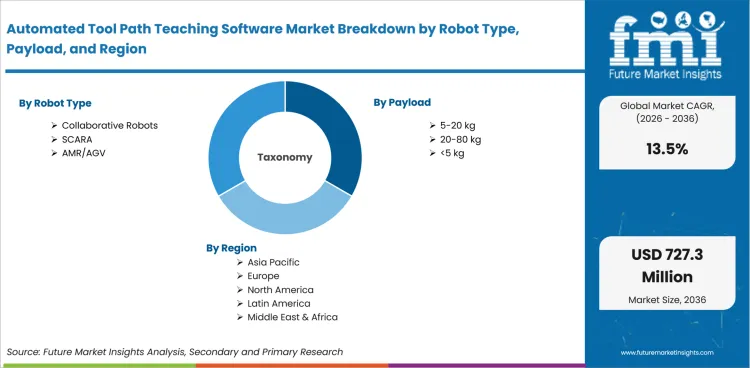
USD 205.0 million in 2026 and USD 727.3 million by 2036 at a 13.5% CAGR.
The automated tool path teaching software industry value is forecast to grow from USD 180.6 million in 2025 to USD 727.3 million by 2036 at a 13.5% CAGR as factories shift robot programming from pendant work to simulation-backed offline workflows. On-premise offline suites are forecast to represent 57.0% share in 2026, led by security review and controller validation needs. The 5-20 kg payload band is expected to secure 42.0% share in 2026, supported by cobot and SCARA cells that handle frequent material movement and assembly changes.
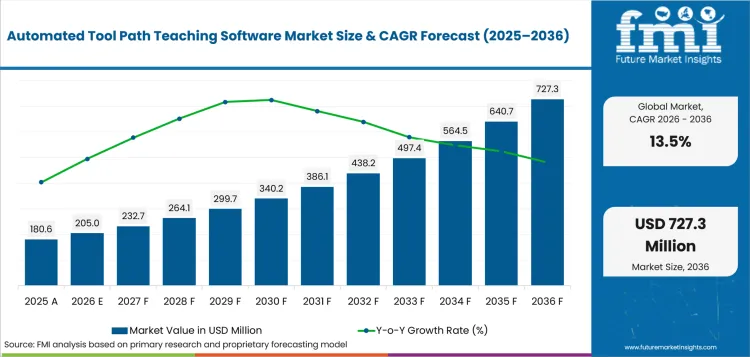
Automated Tool Path Teaching Software Market Overview: Size and Forecast
- 2026 Market Size: USD 205.0 million
- 2036 Market Size: USD 727.3 million
- Forecast CAGR: 13.5% from 2026 to 2036
- Leading Deployment Model: On-premise Offline Suites
- On-premise Offline Suites Share in 2026: 57.0%
- Leading Payload: 5-20 kg
- 5-20 kg Payload Share in 2026: 42.0%
- Fastest-growing Country: China
- China CAGR: 15.1% by 2036
Summary of the Automated Tool Path Teaching Software Market
- Demand and Growth Drivers
- Factory teams are moving robot programming away from live lines to reduce commissioning disruption and production trial risk.
- Simulation-backed workflows support faster changeovers as SKU variety increases across material handling, welding, and assembly cells.
- AI-guided teaching interfaces are helping smaller automation teams reduce reliance on expert pendant programmers.
- Product and Segment View
- On-premise offline suites are forecast to represent 57.0% share in 2026, led by secure deployment and controller validation preferences.
- The 5-20 kg payload segment is projected to hold 42.0% share in 2026, influenced by broad cobot and SCARA use in flexible cells.
- Automotive is expected to secure 35.0% share in 2026, supported by welding, sealing, and assembly programs requiring validated paths.
- Geography and Competitive Outlook
- China is projected to record 15.1% CAGR by 2036, backed by very high robot installation volume and mixed-fleet software demand.
- India is expected to expand at 14.8% CAGR by 2036 through electronics manufacturing automation and integrator-led programming support.
- ABB Robotics and FANUC defend robot-native positions through controller-specific offline programming suites.
- Siemens Digital Industries Software and Visual Components compete through multi-brand simulation and path planning environments.
- Analyst Opinion
- Nikhil Kaitwade, Principal Consultant at Future Market Insights for the industrial domain, observes, “Automated tool path teaching software is moving from an engineering convenience to a production continuity requirement. Buyers want software that prepares robot paths away from the line, checks motion inside a virtual cell, and exports code that works on the controller. Suppliers gain an advantage when they combine collision-free path generation, controller libraries, and easy operator guidance. The strongest vendors will prove that simulation output can reduce handover risk and keep changeovers predictable.”
Outlook is improving as robot fleets expand and software becomes a commissioning control point rather than a support accessory. IFR reported 542,000 industrial robot installations in 2024 and a global operational stock of 4,664,000 units in the same year. IFR also stated that Asia accounted for 74% of new robot deployments in 2024, giving software vendors a large base of factories needing repeatable path updates. Visual Components added OLP 5.0 in March 2026 with built-in post-processors for 22 robot brands, showing how vendor-neutral tools can appraise mixed-fleet software value when plants want controller-specific output without rewriting programs.
The automated tool path teaching software market is expected to witness strong expansion through 2036, driven by offline robot programming, digital workcell validation, and wider use of low-code robot teaching tools.
Which factors support expansion in the automated tool path teaching software market?
Controller-ready path generation and repeatable digital validation support software value across robot OEM and multi-brand programming channels.
- Market value is supported by software licenses, subscriptions, maintenance, and programming modules linked to robot installations.
- Supplier pricing reflects controller coverage and collision-checking capability before AI guidance improves usability.
- Revenue improves as factories standardize offline programming for repeated model and SKU changeovers.
- Buyer trust improves when software can document path changes and reduce physical trial runs before commissioning.
Capital planning also follows the industrial robotics market outlook as software spending rises alongside robot fleet deployment and integration work.
Why is the automated tool path teaching software market growing?
Factories are adopting automated path teaching software as robot fleets need faster program updates and safer virtual validation before production changes.
Robot fleet scale is the central growth mechanism for automated path teaching tools. IFR reported that global robot density increased from 163 to 177 robots per 10,000 manufacturing employees in 2024. That installed-base intensity raises the need for repeatable path validation, collision checking, and controller-ready code across more workcells. Software vendors benefit when each new robot adds recurring tasks for simulation, editing, and commissioning support. Buyers are therefore linking offline programming budgets to uptime, engineering capacity, and safety review rather than treating software as an optional add-on.
How is the automated tool path teaching software market segmented?
The automated tool path teaching software industry is segmented by robot type, payload, application, end-use industry, and deployment model.
- Collaborative Robots are projected to secure 34.0% share in 2026, led by operator-friendly teaching and frequent cell-level edits in smaller automation teams.
- The 5-20 kg payload band is anticipated to hold 42.0% share in 2026 since it covers common cobot, SCARA, and compact articulated robot tasks.
- Material Handling is expected to capture 31.5% share in 2026 due to SKU movement changes, pallet patterns, and line-side transfer updates.
- Automotive is forecast to represent 35.0% share in 2026, guided by welding, sealing, and assembly paths that require simulation sign-off.
- On-premise Offline Suites are projected to account for 57.0% share in 2026, reflected by security requirements and controller-native validation needs.
Why do collaborative robots lead the robot type segment?
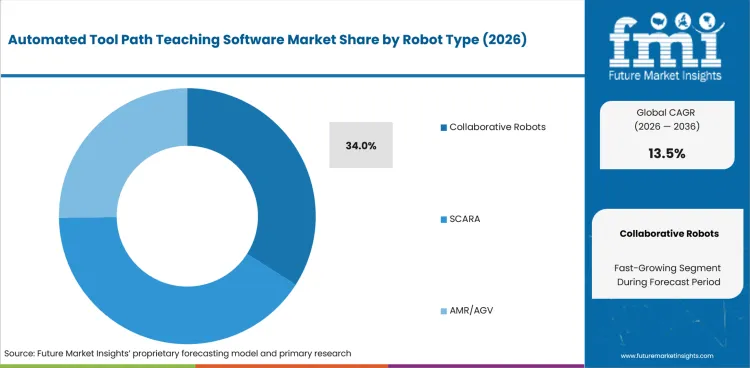
- Collaborative Robots is projected to account for 34.0% share in 2026, influenced by guided interfaces and simpler editing requirements support adoption among small and mid-sized factory teams.
- SCARA and articulated robots gain demand when cycle time and reach make controller-specific programming more important.
Which payload range leads automated tool path teaching software demand?
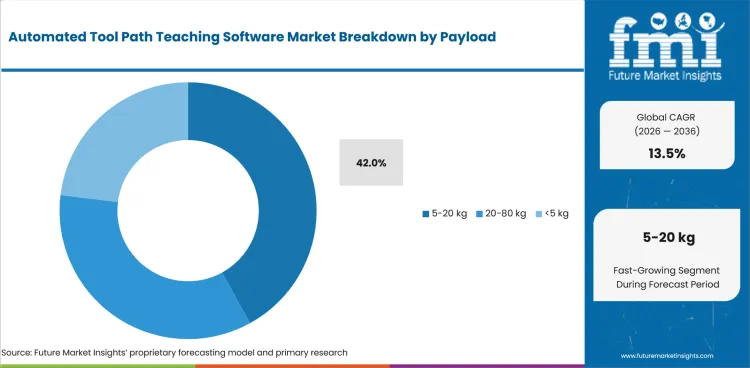
- 5-20 kg is projected to account for 42.0% share in 2026, influenced by mid-payload robots cover handling, inspection, and assembly jobs that change often across flexible production cells.
- <5 kg robots gain use in electronics and laboratory-style cells that need lightweight path changes with tight space limits.
Which application leads the market?
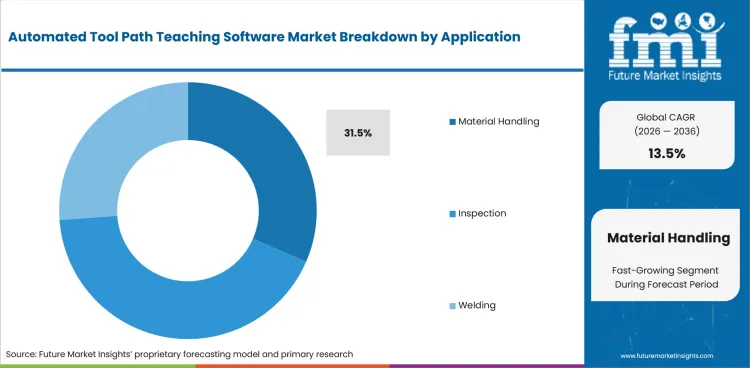
- Material Handling is projected to account for 31.5% share in 2026, influenced by repeatable pick paths, palletizing patterns, and transfer routines require frequent software-supported edits.
- Inspection and welding applications create high-value demand when path accuracy and safety zones need formal validation.
Which end-use industry leads the market?
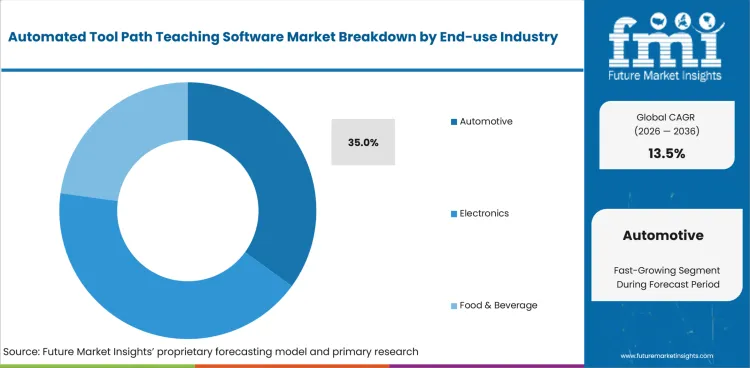
- Automotive is projected to account for 35.0% share in 2026, influenced by model changes, welding cells, and assembly lines require validated robot paths before production trials begin.
- Electronics factories add demand as product refresh cycles and fixture changes create repeated programming tasks.
Which deployment model leads the market?
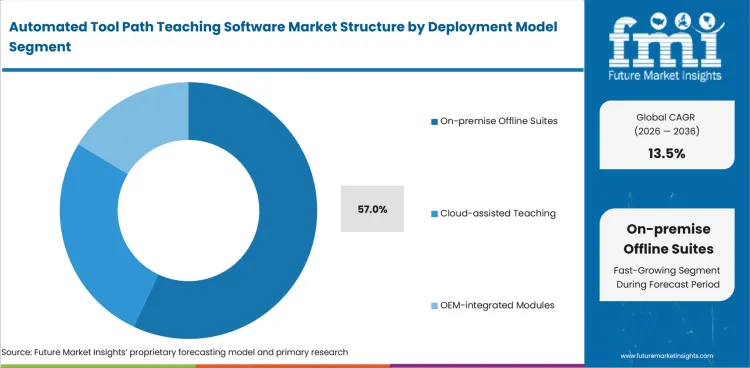
- On-premise Offline Suites is projected to account for 57.0% share in 2026, influenced by buyers prefer secure local validation when controller output and plant OT rules require tighter control.
- Cloud-assisted teaching gains attention when remote experts and AI support help smaller plants resolve programming issues faster.
What are the driver, restraints, and opportunities in the automated tool path teaching software market?
Offline programming and automated path solving support growth while controller lock-in and validation risk limit faster adoption.
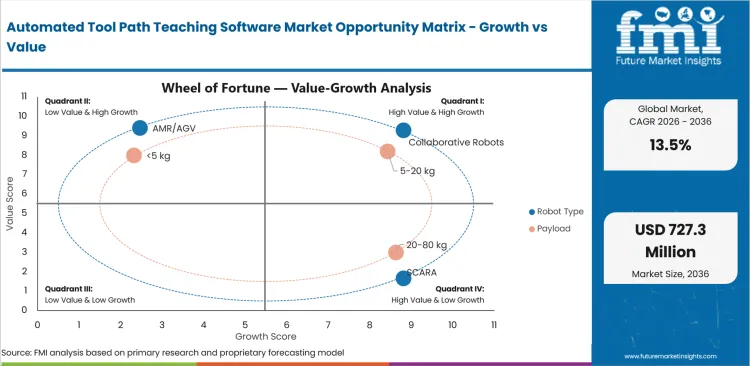
- Driver: CAD-to-path conversion is reducing manual waypoint entry across welding, handling, and surface-treatment cells.
- Restraint: Controller-specific output can increase validation work when post-processors do not match plant safety rules.
- Opportunity: AI-assisted programming can help less experienced operators set up paths and troubleshoot workcell errors.
CAD-to-Path Workflow Shift
CAD geometry is becoming the starting point for robot teaching in machining, welding, and material transfer. IFR reported that electronics became the largest robotics customer industry in 2024 with 128,899 installations. This mix strengthens demand for software that converts part models and fixtures into validated robot motions. Suppliers with reliable CAD import and controller export can help factories reduce live-cell trials and shorten program handover.
Controller Validation and OT Review Pressure
Software adoption can slow when simulated paths need extra proof before controller download. BLS reported 7.6 million USA job openings in April 2026, showing why industrial teams cannot rely only on scarce technical labor to absorb extra validation work. Buyers therefore examine post-processor maturity, audit trails, and local support before wider rollout. Vendors with tested controller libraries can defend pricing better than tools that only deliver visual simulations.
AI-Guided Programming Opportunity
AI assistants create a practical opportunity by guiding users through programming steps and error checks. ABB introduced RobotStudio AI Assistant in September 2025 with real-time step-by-step guidance for robot programming. This development increases software value for plants that need easier commissioning without removing engineering review. Vendors that combine AI guidance with trusted robot physics and controller output are better positioned to win repeat licenses.
The opportunity also connects with the collaborative robots market outlook as cobot buyers place a premium on easy teaching and fast deployment.
Which countries are growing fastest in the automated tool path teaching software market?
China 15.1% CAGR, India 14.8% CAGR, South Korea 13.9% CAGR, Japan 13.2% CAGR, United States 13.0% CAGR, Germany 12.8% CAGR, France 12.1% CAGR, and United Kingdom 11.8% CAGR through 2036.
.webp "Top Country Growth Comparison Automated Tool Path Teaching Software Market Cagr (2026 2036)")
| Country | CAGR |
|---|---|
| United States | 13.0% |
| United Kingdom | 11.8% |
| Germany | 12.8% |
| France | 12.1% |
| Japan | 13.2% |
| China | 15.1% |
| South Korea | 13.9% |
| India | 14.8% |
Source: Future Market Insights, 2026.
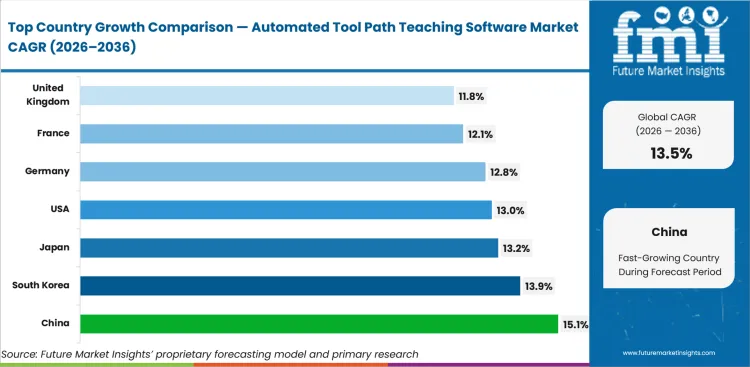
How do country-level CAGRs compare in the automated tool path teaching software market?
China leads country growth while the United Kingdom records the most cautious expansion outlook among profiled markets.
- United States is expected to post 13.0% CAGR by 2036 through its local automation base and software channel maturity.
- United Kingdom is expected to post 11.8% CAGR by 2036 through its local automation base and software channel maturity.
- Germany is expected to post 12.8% CAGR by 2036 through its local automation base and software channel maturity.
- France is expected to post 12.1% CAGR by 2036 through its local automation base and software channel maturity.
- Japan is expected to post 13.2% CAGR by 2036 through its local automation base and software channel maturity.
- China is forecast to record 15.1% CAGR by 2036 through its local automation base and software channel maturity.
- South Korea is projected to expand at 13.9% CAGR by 2036 through its local automation base and software channel maturity.
- India is projected to expand at 14.8% CAGR by 2036 through its local automation base and software channel maturity.
What is the automated tool path teaching software market outlook in the United States?
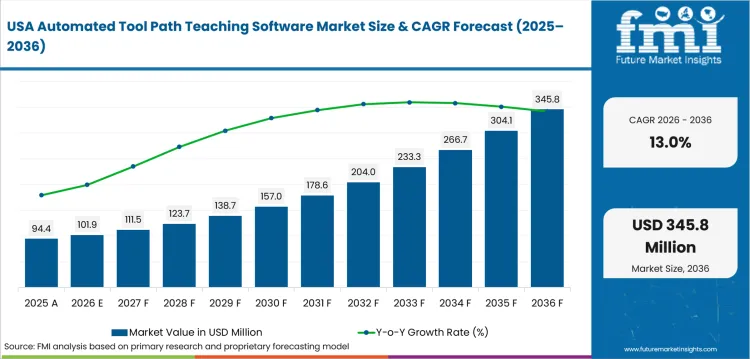
A 13.0% CAGR through 2036 reflects robot fleet depth, integrator channels, and pressure to reduce line trials.
Country Market Snapshot Table
| Parameter | Value |
|---|---|
| Market Size in 2025 (Value) | USD 27.4 million |
| Market Size in 2026 (Value) | USD 31.0 million |
| Market Forecast in 2036 (Value) | USD 105.2 million |
| CAGR (2026 to 2036) | 13.0% |
| Years Considered | 2021 to 2036 |
| Base Year | 2025 |
| Forecast Period | 2026 to 2036 |
| Units Considered | Value (USD million) |
| Leading Sub-Region | Midwest automotive and national integrator networks |
United States Automated Tool Path Teaching Software Market Outlook
- United States demand is shaped by downtime cost and engineering labor pressure. Robot OEMs and system integrators influence software choice in plants that require validated code before cell changes.
- Buyers value offline programming when welding, handling, aerospace, and inspection cells need documented path changes. Security review also keeps on-premise deployment important for many enterprise plants.
Key Growth Drivers
- Robot fleet scale supports a wide software pool. IFR reported 34,200 industrial robot installations in the United States during 2024, keeping offline programming relevant for factories with large installed bases.
- Labor constraints make repeatable programming workflows valuable. BLS reported 7.6 million USA job openings in April 2026, increasing interest in tools that reduce specialist dependency.
- Aerospace and automotive plants favor digital path proof before robot motion enters safety-reviewed production zones.
- Integrator networks help buyers connect programming software with training, commissioning, and controller support.
Key Restraints
- Cyber and OT review can slow cloud-assisted teaching in regulated factories with strict software approval gates.
- Controller-specific validation remains demanding across mixed robot brands and safety-rated workcells.
- Price pressure affects smaller manufacturers as BLS reported total hires fell to 5.1 million in April 2026, making buyers cautious about adding tools without support capacity.
What makes United States unique
The United States is unique due to a deep integrator base and high enterprise scrutiny around OT security.
Key Companies
- ABB Robotics
- FANUC America
- Siemens Digital Industries Software
- RoboDK
- Realtime Robotics
- Universal Robots
Sales & Marketing Channels
- Direct enterprise software sales
- Robot OEM account teams
- Certified system integrators
- Automation distributor networks
- Digital manufacturing consultants
Country Segment Breakdown Table
| Segment | Sub-Segments |
|---|---|
| By Robot Type | Collaborative Robots · SCARA · Articulated · AMR/AGV · Delta Robots |
| By Payload | <5 kg · 5-20 kg · 20-80 kg · >80 kg |
| By Application | Material Handling · Inspection · Assembly · Welding · Packaging · Machine Tending |
| By End-use Industry | Automotive · Electronics · Food & Beverage · Logistics · Pharmaceuticals · Metals |
| By Deployment Model | On-premise Offline Suites · Cloud-assisted Teaching · OEM-integrated Modules · Vendor-neutral Platforms · AI-guided Programming |
| Key Sub-Regions Covered, Industrial Automation Corridors | Midwest · South Atlantic · Texas · California · Pacific Northwest · Northeast |
Frequently Asked Questions
How fast is United States automated tool path teaching software market growing?
Demand in United States is expected to expand at 13.0% CAGR from 2026 to 2036 through automation and offline programming adoption.
Who leads United States automated tool path teaching software market?
ABB Robotics, FANUC America, Siemens Digital Industries Software, RoboDK compete through robot-native suites, integrator coverage, and software support channels.
What is driving adoption in United States automated tool path teaching software market?
Adoption in United States is supported by robot programming needs, validation pressure, and channel support for offline path creation.
How is the automated tool path teaching software market performing in the United Kingdom?
An 11.8% CAGR through 2036 reflects SME digital support and cautious automation budgeting.
Country Market Snapshot Table
| Parameter | Value |
|---|---|
| Market Size in 2025 (Value) | USD 5.8 million |
| Market Size in 2026 (Value) | USD 6.5 million |
| Market Forecast in 2036 (Value) | USD 19.8 million |
| CAGR (2026 to 2036) | 11.8% |
| Years Considered | 2021 to 2036 |
| Base Year | 2025 |
| Forecast Period | 2026 to 2036 |
| Units Considered | Value (USD million) |
| Leading Sub-Region | Midlands and national SME manufacturing corridors |
United Kingdom Automated Tool Path Teaching Software Market Outlook
- United Kingdom demand is more SME-centered than Germany or Japan. Buyers often need easier programming tools that reduce dependence on in-house robot specialists.
- Regional support programs help manufacturers test digital tools before committing to wider automation. Cobot and packaging use cases give software vendors a practical entry point.
Key Growth Drivers
- SME digital support creates a channel for first-time software buyers. UK government reporting said Made Smarter had completed 379 technology projects and upskilled 3,179 roles by 2025.
- Policy funding supports industrial digital adoption. The Advanced Manufacturing Sector Plan cited up to £99 million for Made Smarter support to help more SMEs adopt advanced technologies.
- Food, packaging, and light assembly plants need fast changeovers across short production runs.
- University-linked demonstration centers help factories test path planning before wider site use.
Key Restraints
- Budget fragmentation limits large multi-site software standardization among smaller manufacturers.
- Digital adoption remains uneven across SMEs despite public support and advisory programs.
- UK government evidence stated the Made Smarter FY2025/26 budget was £16 million, indicating meaningful support but limited coverage for all automation needs.
What makes United Kingdom unique
The United Kingdom is unique due to SME advisory channels and regional technology adoption programs.
Key Companies
- Universal Robots
- ABB Robotics
- Visual Components
- RoboDK
- Siemens Digital Industries Software
Sales & Marketing Channels
- Regional digital adoption partners
- System integrator projects
- Cobot distributor channels
- University-linked demo centers
- OEM software bundles
Country Segment Breakdown Table
| Segment | Sub-Segments |
| By Robot Type | Collaborative Robots · SCARA · Articulated · AMR/AGV · Delta Robots |
| By Payload | <5 kg · 5-20 kg · 20-80 kg · >80 kg |
| By Application | Material Handling · Inspection · Assembly · Welding · Packaging · Machine Tending |
| By End-use Industry | Automotive · Electronics · Food & Beverage · Logistics · Pharmaceuticals · Metals |
| By Deployment Model | On-premise Offline Suites · Cloud-assisted Teaching · OEM-integrated Modules · Vendor-neutral Platforms · AI-guided Programmings |
| Key Sub-Regions Covered, Industrial Automation Corridors | Midlands · Northwest England · London · South East · Scotland · Wales |
Frequently Asked Questions
How fast is United Kingdom automated tool path teaching software market growing?
Demand in United Kingdom is expected to expand at 11.8% CAGR from 2026 to 2036 through automation and offline programming adoption.
Who leads United Kingdom automated tool path teaching software market?
Universal Robots, ABB Robotics, Visual Components, RoboDK compete through robot-native suites, integrator coverage, and software support channels.
What is driving adoption in United Kingdom automated tool path teaching software market?
Adoption in United Kingdom is supported by robot programming needs, validation pressure, and channel support for offline path creation.
What supports automated tool path teaching software growth in Germany?
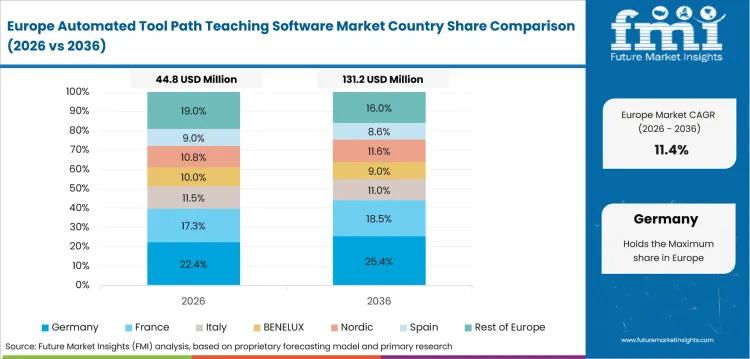
A 12.8% CAGR through 2036 reflects advanced automation, digital twins, and strict validation practices.
Country Market Snapshot Table
| Parameter | Value |
|---|---|
| Market Size in 2025 (Value) | USD 12.9 million |
| Market Size in 2026 (Value) | USD 14.5 million |
| Market Forecast in 2036 (Value) | USD 48.4 million |
| CAGR (2026 to 2036) | 12.8% |
| Years Considered | 2021 to 2036 |
| Base Year | 2025 |
| Forecast Period | 2026 to 2036 |
| Units Considered | Value (USD million) |
| Leading Sub-Region | Bavaria and Baden-Wurttemberg automotive clusters |
Germany Automated Tool Path Teaching Software Market Outlook
- Germany demand is mature and technically strict. Buyers expect software to connect simulation, controller behavior, and formal engineering review.
- Robot-native and PLM-linked suites fit German factories that place strong value on digital twin continuity. Price acceptance improves when software reduces commissioning risk.
Key Growth Drivers
- Robot density supports advanced programming demand. IFR reported Germany at 449 robots per 10,000 manufacturing employees in 2024, placing it among the global leaders.
- Order recovery can support automation renewal. Destatis reported manufacturing orders rose 7.8% month on month in December 2025, with machinery and equipment up 11.5%.
- Automotive model changes raise the need for validated welding and assembly paths.
- Machine builders use offline programming to support customer-specific automation systems.
Key Restraints
- Long validation cycles slow replacement of proven robot tools in conservative factories.
- Brand-specific controller workflows can limit vendor-neutral software adoption.
- Destatis reported manufacturing gross value added fell 1.3% in 2025, keeping capital approvals cautious in some automation budgets.
What makes Germany unique
Germany is unique due to stringent virtual commissioning practice and strong robot OEM software ecosystems.
Key Companies
- KUKA
- Siemens Digital Industries Software
- ABB Robotics
- FANUC
- Visual Components
- RoboDK
Sales & Marketing Channels
- Robot OEM sales teams
- PLM software channels
- Automotive integrators
- Machine-builder partnerships
- Trade fair demonstrations
Country Segment Breakdown Table
| Segment | Sub-Segments |
|---|---|
| By Robot Type | Collaborative Robots · SCARA · Articulated · AMR/AGV · Delta Robots |
| By Payload | <5 kg · 5-20 kg · 20-80 kg · >80 kg |
| By Application | Material Handling · Inspection · Assembly · Welding · Packaging · Machine Tending |
| By End-use Industry | Automotive · Electronics · Food & Beverage · Logistics · Pharmaceuticals · Metals |
| By Deployment Model | On-premise Offline Suites · Cloud-assisted Teaching · OEM-integrated Modules · Vendor-neutral Platforms · AI-guided Programming |
| Key Sub-Regions Covered, Industrial Automation Corridors | Bavaria · Baden-Wurttemberg · North Rhine-Westphalia · Lower Saxony · Hesse · Saxony |
Frequently Asked Questions
How fast is Germany automated tool path teaching software market growing?
Demand in Germany is expected to expand at 12.8% CAGR from 2026 to 2036 through automation and offline programming adoption.
Who leads Germany automated tool path teaching software market?
KUKA, Siemens Digital Industries Software, ABB Robotics, FANUC compete through robot-native suites, integrator coverage, and software support channels.
What is driving adoption in Germany automated tool path teaching software market?
Adoption in Germany is supported by robot programming needs, validation pressure, and channel support for offline path creation.
What is the automated tool path teaching software outlook in France?
A 12.1% CAGR through 2036 reflects aerospace demand, robotics research support, and selective factory digitization.
Country Market Snapshot Table
| Parameter | Value |
|---|---|
| Market Size in 2025 (Value) | USD 6.6 million |
| Market Size in 2026 (Value) | USD 7.4 million |
| Market Forecast in 2036 (Value) | USD 23.2 million |
| CAGR (2026 to 2036) | 12.1% |
| Years Considered | 2021 to 2036 |
| Base Year | 2025 |
| Forecast Period | 2026 to 2036 |
| Units Considered | Value (USD million) |
| Leading Sub-Region | Ile-de-France and aerospace manufacturing corridors |
France Automated Tool Path Teaching Software Market Outlook
- France shows a selective catch-up profile in robot programming software. Aerospace, automotive, metals, and advanced manufacturing sites often ask integrators to prove paths in simulation.
- Vendor-neutral software has room in mixed robot fleets, especially when mid-sized factories need simpler handover and programming support.
Key Growth Drivers
- Robotics research support improves the skills base. France 2030 backed a robotics program with EUR 34 million over eight years for robotics adapted to human needs.
- European automation density supports French supplier benchmarking. IFR stated Western Europe reached 267 robots per 10,000 manufacturing employees in 2024.
- Aerospace production favors simulation before robotic inspection, drilling, and sealing work.
- Metals and automotive suppliers need repeatable paths for welding and handling applications.
Key Restraints
- Smaller factories often delay software spending until robot utilization is proven.
- Limited internal programming teams increase reliance on integrators for training and handover.
- INSEE reported manufacturing output fell back 0.8% in December 2025, showing uneven industrial activity that can slow wider software rollout.
What makes France unique
France is unique due to aerospace precision demand and public research support for human-centered robotics.
Key Companies
- ABB Robotics
- FANUC
- Siemens Digital Industries Software
- Visual Components
- Universal Robots
- RoboDK
Sales & Marketing Channels
- Aerospace integrator accounts
- Robot OEM sales teams
- Regional automation distributors
- Research-to-industry pilots
- PLM and simulation resellers
Country Segment Breakdown Table
| Segment | Sub-Segments |
|---|---|
| By Robot Type | Collaborative Robots · SCARA · Articulated · AMR/AGV · Delta Robots |
| By Payload | <5 kg · 5-20 kg · 20-80 kg · >80 kg |
| By Application | Material Handling · Inspection · Assembly · Welding · Packaging · Machine Tending |
| By End-use Industry | Automotive · Electronics · Food & Beverage · Logistics · Pharmaceuticals · Metals |
| By Deployment Model | On-premise Offline Suites · Cloud-assisted Teaching · OEM-integrated Modules · Vendor-neutral Platforms · AI-guided Programming |
| Key Sub-Regions Covered, Industrial Automation Corridors | Ile-de-France · Auvergne-Rhone-Alpes · Occitanie · Nouvelle-Aquitaine · Hauts-de-France · Grand Est |
Frequently Asked Questions
How fast is France automated tool path teaching software market growing?
Demand in France is expected to expand at 12.1% CAGR from 2026 to 2036 through automation and offline programming adoption.
Who leads France automated tool path teaching software market?
ABB Robotics, FANUC, Siemens Digital Industries Software, Visual Components compete through robot-native suites, integrator coverage, and software support channels.
What is driving adoption in France automated tool path teaching software market?
Adoption in France is supported by robot programming needs, validation pressure, and channel support for offline path creation.
What is the automated tool path teaching software forecast for Japan?
A 13.2% CAGR through 2036 reflects robot OEM strength and high standards for controller-native programming.
Country Market Snapshot Table
| Parameter | Value |
|---|---|
| Market Size in 2025 (Value) | USD 20.3 million |
| Market Size in 2026 (Value) | USD 23.0 million |
| Market Forecast in 2036 (Value) | USD 79.5 million |
| CAGR (2026 to 2036) | 13.2% |
| Years Considered | 2021 to 2036 |
| Base Year | 2025 |
| Forecast Period | 2026 to 2036 |
| Units Considered | Value (USD million) |
| Leading Sub-Region | Tokyo-Nagoya-Osaka industrial corridor |
Japan Automated Tool Path Teaching Software Market Outlook
- Japan demand is linked to domestic robot OEM strength and disciplined factory validation. Users often prefer controller-native tools from established robot suppliers.
- Vendor-neutral platforms win mainly in mixed fleets and export-facing factories that need common programming environments across several robot brands.
Key Growth Drivers
- Domestic robot activity creates a large programming base. IFR reported 44,500 industrial robot installations in Japan during 2024.
- Installed fleet depth supports software renewal. IFR reported Japan had 450,500 operational industrial robots in 2024.
- Electronics production needs frequent path edits as product refresh cycles change fixtures and handling routines.
- Machine tending and automotive cells require stable controller output for long operating shifts.
Key Restraints
- Controller-native software loyalty can slow independent platform gains.
- Conservative validation practice lengthens software replacement cycles.
- METI stated in 2025 that Japan struggles with labor force shortages, increasing the need for easier tools while limiting available implementation staff.
What makes Japan unique
Japan is unique due to its role as both a major robot producer and a demanding software buyer.
Key Companies
- FANUC
- Yaskawa Motoman
- Kawasaki Robotics
- ABB Robotics
- Siemens Digital Industries Software
- KUKA
Sales & Marketing Channels
- Robot OEM software bundles
- Factory automation distributors
- Automotive supplier programs
- Electronics integrator channels
- Training and certification channels
Country Segment Breakdown Table
| Segment | Sub-Segments |
|---|---|
| By Robot Type | Collaborative Robots · SCARA · Articulated · AMR/AGV · Delta Robots |
| By Payload | <5 kg · 5-20 kg · 20-80 kg · >80 kg |
| By Application | Material Handling · Inspection · Assembly · Welding · Packaging · Machine Tending |
| By End-use Industry | Automotive · Electronics · Food & Beverage · Logistics · Pharmaceuticals · Metals |
| By Deployment Model | On-premise Offline Suites · Cloud-assisted Teaching · OEM-integrated Modules · Vendor-neutral Platforms · AI-guided Programming |
| Key Sub-Regions Covered, Industrial Automation Corridors | Tokyo · Aichi · Osaka · Shizuoka · Kanagawa · Fukuoka |
Frequently Asked Questions
How fast is Japan automated tool path teaching software market growing?
Demand in Japan is expected to expand at 13.2% CAGR from 2026 to 2036 through automation and offline programming adoption.
Who leads Japan automated tool path teaching software market?
FANUC, Yaskawa Motoman, Kawasaki Robotics, ABB Robotics compete through robot-native suites, integrator coverage, and software support channels.
What is driving adoption in Japan automated tool path teaching software market?
Adoption in Japan is supported by robot programming needs, validation pressure, and channel support for offline path creation.
How fast is automated tool path teaching software demand growing in China?
A 15.1% CAGR through 2036 reflects unmatched robot installation volume and mixed-brand factory expansion.
Country Market Snapshot Table
| Parameter | Value |
|---|---|
| Market Size in 2025 (Value) | USD 47.8 million |
| Market Size in 2026 (Value) | USD 55.0 million |
| Market Forecast in 2036 (Value) | USD 224.4 million |
| CAGR (2026 to 2036) | 15.1% |
| Years Considered | 2021 to 2036 |
| Base Year | 2025 |
| Forecast Period | 2026 to 2036 |
| Units Considered | Value (USD million) |
| Leading Sub-Region | Yangtze River Delta and Pearl River Delta factory clusters |
China Automated Tool Path Teaching Software Market Outlook
- China is the largest volume opportunity for automated path teaching software. Domestic factories compare paid software against local engineering labor and demand strong proof of cycle-time benefit.
- Software vendors must prove controller support across local and foreign robot brands. Local integrators remain important for deployment into domestic electronics, automotive, and logistics plants.
Key Growth Drivers
- Robot scale is the strongest demand base. IFR reported China installed 295,000 industrial robots in 2024, equal to 54% of global deployments.
- Domestic robot production reinforces software needs. China’s National Bureau of Statistics reported industrial robot output of 62.5 ten thousand sets in 2024.
- Electronics factories need fast programming for product refresh and fixture changes.
- Local integrators can scale software across repeated factory projects and supplier parks.
Key Restraints
- Software price pressure is high in cost-sensitive domestic factories.
- Mixed robot brands require stronger post-processor support than single-brand plants.
- China’s National Bureau of Statistics reported product sales rate for industrial enterprises above designated size at 95.5% in January-February 2025, showing operating pressure that can tighten software payback demands.
What makes China unique
China is unique due to unmatched robot volume and an expanding base of local integrators.
Key Companies
- ABB Robotics
- FANUC
- KUKA
- Siemens Digital Industries Software
- Visual Components
- local robot integrators
Sales & Marketing Channels
- Local robot integrators
- OEM software packages
- Electronics factory accounts
- Automotive supplier channels
- Industrial software resellers
Country Segment Breakdown Table
| Segment | Sub-Segments |
|---|---|
| By Robot Type | Collaborative Robots · SCARA · Articulated · AMR/AGV · Delta Robots |
| By Payload | <5 kg · 5-20 kg · 20-80 kg · >80 kg |
| By Application | Material Handling · Inspection · Assembly · Welding · Packaging · Machine Tending |
| By End-use Industry | Automotive · Electronics · Food & Beverage · Logistics · Pharmaceuticals · Metals |
| By Deployment Model | On-premise Offline Suites · Cloud-assisted Teaching · OEM-integrated Modules · Vendor-neutral Platforms · AI-guided Programming |
| Key Sub-Regions Covered, Industrial Automation Corridors | Yangtze River Delta · Pearl River Delta · Beijing-Tianjin-Hebei · Chongqing · Wuhan · Chengdu |
Frequently Asked Questions
How fast is China automated tool path teaching software market growing?
Demand in China is expected to expand at 15.1% CAGR from 2026 to 2036 through automation and offline programming adoption.
Who leads China automated tool path teaching software market?
ABB Robotics, FANUC, KUKA, Siemens Digital Industries Software compete through robot-native suites, integrator coverage, and software support channels.
What is driving adoption in China automated tool path teaching software market?
Adoption in China is supported by robot programming needs, validation pressure, and channel support for offline path creation.
What is the automated tool path teaching software outlook in South Korea?
A 13.9% CAGR through 2036 reflects dense robot cells and high expectations for quality-controlled automation.
Country Market Snapshot Table
| Parameter | Value |
|---|---|
| Market Size in 2025 (Value) | USD 13.2 million |
| Market Size in 2026 (Value) | USD 15.0 million |
| Market Forecast in 2036 (Value) | USD 55.1 million |
| CAGR (2026 to 2036) | 13.9% |
| Years Considered | 2021 to 2036 |
| Base Year | 2025 |
| Forecast Period | 2026 to 2036 |
| Units Considered | Value (USD million) |
| Leading Sub-Region | Seoul-Gyeonggi and southeast manufacturing corridors |
South Korea Automated Tool Path Teaching Software Market Outlook
- South Korea demand is concentrated among advanced electronics, semiconductor, and automotive manufacturers. Dense cells raise the value of path optimization and collision-free planning.
- Large enterprise accounts often require proven controller integration and local technical support before replacing established software tools.
Key Growth Drivers
- Factory density creates strong software need. IFR reported South Korea at 1,220 robots per 10,000 manufacturing employees in 2024, the highest level worldwide.
- Export production supports automation intensity. MOTIE reported May 2026 automobile exports totaled USD 5.83 billion, keeping automotive programming demand relevant.
- Semiconductor and electronics plants need repeatable paths for inspection and assembly routines.
- Automotive suppliers use software to protect cycle time in high-throughput assembly cells.
Key Restraints
- Large buyer qualification cycles can slow new vendor entry.
- High performance expectations raise support and localization requirements.
- Statistics Korea reported the national unemployment rate at 2.9% in May 2026, keeping skilled technical labor availability tight for implementation projects.
What makes South Korea unique
South Korea is unique due to the world’s highest robot density and demanding enterprise qualification practices.
Key Companies
- ABB Robotics
- FANUC
- Yaskawa Motoman
- Siemens Digital Industries Software
- Visual Components
- KUKA
Sales & Marketing Channels
- Direct enterprise accounts
- Semiconductor automation integrators
- Automotive supplier channels
- Robot OEM bundles
- Local technical support partners
Country Segment Breakdown Table
| Segment | Sub-Segments |
|---|---|
| By Robot Type | Collaborative Robots · SCARA · Articulated · AMR/AGV · Delta Robots |
| By Payload | <5 kg · 5-20 kg · 20-80 kg · >80 kg |
| By Application | Material Handling · Inspection · Assembly · Welding · Packaging · Machine Tending |
| By End-use Industry | Automotive · Electronics · Food & Beverage · Logistics · Pharmaceuticals · Metals |
| By Deployment Model | On-premise Offline Suites · Cloud-assisted Teaching · OEM-integrated Modules · Vendor-neutral Platforms · AI-guided Programming |
| Key Sub-Regions Covered, Industrial Automation Corridors | Seoul Capital Area · Gyeonggi · Ulsan · Busan · Daegu · Gwangju |
Frequently Asked Questions
How fast is South Korea automated tool path teaching software market growing?
Demand in South Korea is expected to expand at 13.9% CAGR from 2026 to 2036 through automation and offline programming adoption.
Who leads South Korea automated tool path teaching software market?
ABB Robotics, FANUC, Yaskawa Motoman, Siemens Digital Industries Software compete through robot-native suites, integrator coverage, and software support channels.
What is driving adoption in South Korea automated tool path teaching software market?
Adoption in South Korea is supported by robot programming needs, validation pressure, and channel support for offline path creation.
What is driving automated tool path teaching software adoption in India?
A 14.8% CAGR through 2036 reflects early robot scale, electronics growth, and integrator-led adoption.
Country Market Snapshot Table
| Parameter | Value |
|---|---|
| Market Size in 2025 (Value) | USD 5.8 million |
| Market Size in 2026 (Value) | USD 6.7 million |
| Market Forecast in 2036 (Value) | USD 26.6 million |
| CAGR (2026 to 2036) | 14.8% |
| Years Considered | 2021 to 2036 |
| Base Year | 2025 |
| Forecast Period | 2026 to 2036 |
| Units Considered | Value (USD million) |
| Leading Sub-Region | Pune-Chennai-Gujarat automotive and electronics corridors |
India Automated Tool Path Teaching Software Market Outlook
- India is an early scale market for automated path teaching software. Buyers often prefer software bundled with robot hardware, training, and integrator services.
- Low-code teaching can win in plants that add robots but lack deep programming teams. Automotive, electronics, and machine tending projects provide the first large adoption pool.
Key Growth Drivers
- Robot installations are building from a smaller base. IFR reported India installed a record 9,100 industrial robots in 2024 with automotive holding 45% share.
- Electronics manufacturing expands the addressable base. PIB reported India’s electronics goods production reached about ₹11.3 lakh crore in 2024-25.
- Integrator-led projects make path teaching software easier for first-time robot buyers.
- Training centers and OEM distributors help buyers connect programming tools with operating support.
Key Restraints
- License price sensitivity reduces standalone software buying in smaller manufacturing plants.
- Training gaps increase support burdens after initial installation and commissioning.
- MoSPI reported industrial output grew by more than 5.80% in 2023-24, which supports demand but also pressures factories to justify software spending against output targets.
What makes India unique
India is unique due to fast percentage growth and high need for bundled software, training, and support.
Key Companies
- FANUC India
- ABB Robotics
- KUKA
- Universal Robots
- RoboDK
- Siemens Digital Industries Software
Sales & Marketing Channels
- Robot OEM distributors
- System integrator projects
- Automotive supplier accounts
- Training center programs
- Industrial software resellers
Country Segment Breakdown Table
| Segment | Sub-Segments |
|---|---|
| By Robot Type | Collaborative Robots · SCARA · Articulated · AMR/AGV · Delta Robots |
| By Payload | <5 kg · 5-20 kg · 20-80 kg · >80 kg |
| By Application | Material Handling · Inspection · Assembly · Welding · Packaging · Machine Tending |
| By End-use Industry | Automotive · Electronics · Food & Beverage · Logistics · Pharmaceuticals · Metals |
| By Deployment Model | On-premise Offline Suites · Cloud-assisted Teaching · OEM-integrated Modules · Vendor-neutral Platforms · AI-guided Programming |
| Key Sub-Regions Covered, Industrial Automation Corridors | Pune · Chennai · Gujarat · Bengaluru · Noida · Hyderabad |
Frequently Asked Questions
How fast is India automated tool path teaching software market growing?
Demand in India is expected to expand at 14.8% CAGR from 2026 to 2036 through automation and offline programming adoption.
Who leads India automated tool path teaching software market?
FANUC India, ABB Robotics, KUKA, Universal Robots compete through robot-native suites, integrator coverage, and software support channels.
What is driving adoption in India automated tool path teaching software market?
Adoption in India is supported by robot programming needs, validation pressure, and channel support for offline path creation.
Who are the leading companies in the automated tool path teaching software market?
ABB Robotics, FANUC, KUKA, Siemens Digital Industries Software, Visual Components, RoboDK, Wandelbots, and Realtime Robotics are among the leading suppliers.
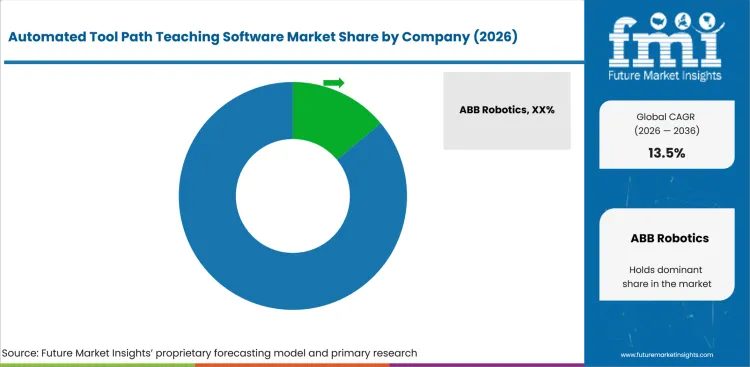
- Robot-native software suppliers hold an advantage when controller behavior and safety sign-off carry high buyer risk.
- Multi-brand simulation platforms gain value in plants that operate mixed robot fleets and need one engineering environment.
- Specialist motion-planning vendors win attention when dense cells require faster collision-free path solving.
- Integrator relationships remain important since buyers often purchase software, training, and commissioning support together.
Robot OEMs compete by turning controller access into software confidence. ABB and FANUC defend strong positions through RobotStudio and ROBOGUIDE. KUKA supports its digital manufacturing position through iiQWorks. These vendors are best placed when factories want a low-risk extension of current robot platforms and direct controller support.
Multi-brand platforms compete through breadth and workflow standardization. Siemens Process Simulate supports robot-specific target locations, motion paths, and controller program work across major robot brands. Visual Components strengthened this position with OLP 5.0 and built-in post-processors for 22 robot brands. RoboDK appeals to integrators and smaller factories that need flexible offline programming without heavy platform commitment.
Specialist vendors compete on speed and ease of use. Wandelbots and Realtime Robotics gain attention in mixed fleets and dense workcells that need vendor-neutral interfaces. Their challenge is proving practical handover to real controllers. Suppliers that combine trusted controller output, documentation, and training should win more durable accounts.
Competitive demand also connects with the machine vision market outlook as inspection-led robot cells need path validation and sensor-aware programming.
How do top automated tool path teaching software companies compare?
ABB and FANUC score strongest on controller-specific output while Siemens and Visual Components lead in multi-brand simulation depth.
| Company | Relevance to Market Title | Controller-Specific Path Output | Multi-Brand Simulation Depth | Collision-Free Automation | Geographic Footprint |
|---|---|---|---|---|---|
| ABB Robotics | Very High | Very Strong | Moderate | Strong | Global |
| FANUC | Very High | Very Strong | Moderate | Strong | Global |
| KUKA | High | Very Strong | Moderate | Strong | Global |
| Siemens Digital Industries Software | Very High | Strong | Very Strong | Strong | Global |
| Visual Components | Very High | Moderate | Very Strong | Very Strong | Global |
| RoboDK | High | Moderate | Strong | Moderate | Global |
| Wandelbots | High | Moderate | Moderate | Strong | Europe and global channels |
| Realtime Robotics | High | Moderate | Strong | Very Strong | United States and global channels |
Source: Future Market Insights competitive analysis, 2026.
Who are the key players in the automated tool path teaching software market?
Key global companies leading the automated tool path teaching software market include:
- ABB Robotics
- FANUC
- KUKA
- Universal Robots
- Yaskawa Motoman
- Kawasaki Robotics
- Siemens Digital Industries Software
- Visual Components
- RoboDK
- Wandelbots
- Realtime Robotics
Key Developments in Automated Tool Path Teaching Software Market
- In September 2025, ABB Robotics added RobotStudio AI Assistant to provide real-time step-by-step robot programming guidance inside its RobotStudio Suite.
- In June 2025, FANUC America introduced ROBOGUIDE V10 for 3D robotic workcell programming and simulation without physical prototypes.
- In March 2026, Visual Components launched Visual Components 5.0 with automatic path solving and post-processors for 22 robot brands.
Key Players in the Automated Tool Path Teaching Software Market
- Robot-Native Suites
- ABB Robotics
- FANUC
- KUKA
- Universal Robots
- Yaskawa Motoman
- Kawasaki Robotics
- Multi-Brand Platforms
- Siemens Digital Industries Software
- Visual Components
- RoboDK
- Specialist Path Planning Vendors
- Wandelbots
- Realtime Robotics
Automated Tool Path Teaching Software Market - Report Scope
| Parameter | Details |
|---|---|
| Forecast period | 2026 to 2036 |
| Historical period | 2021 to 2025 |
| Quantitative unit | Revenue in USD million |
| By robot type | Collaborative Robots, SCARA, Articulated, AMR/AGV, Delta Robots |
| By payload | <5 kg, 5-20 kg, 20-80 kg, >80 kg |
| By application | Material Handling, Inspection, Assembly, Welding, Packaging, Machine Tending |
| By end-use industry | Automotive, Electronics, Food & Beverage, Logistics, Pharmaceuticals, Metals |
| By deployment model | On-premise Offline Suites, Cloud-assisted Teaching, OEM-integrated Modules, Vendor-neutral Platforms, AI-guided Programming |
| Regions covered | North America, Latin America, Europe, East Asia, South Asia and Pacific, Middle East and Africa |
| Countries covered | United States, United Kingdom, Germany, France, Japan, China, South Korea, India |
| Key companies profiled | ABB Robotics, FANUC, KUKA, Universal Robots, Yaskawa Motoman, Kawasaki Robotics, Siemens, Visual Components, RoboDK, Wandelbots, Realtime Robotics |
| Approach | Hybrid bottom-up and top-down methodology using robot fleet signals, software attach rates, application intensity, payload mix, and country-level automation maturity |
Source: Future Market Insights competitive analysis, 2026.
Automated Tool Path Teaching Software Market - Scope & Definition
| Attribute | Detail |
|---|---|
| Market Definition | Software that creates, assists, simulates, validates, or exports robot tool paths for industrial robot applications. |
| Functions Covered | Offline programming, automatic path planning, collision checking, robot simulation, controller-specific code output, AI-guided teaching, and path optimization. |
| Applications Covered | Material handling, inspection, assembly, welding, packaging, and machine tending. |
| End-Use Industries | Automotive, electronics, food and beverage, logistics, pharmaceuticals, and metals. |
| Inclusions | Direct licenses, subscriptions, maintenance, AI modules, OEM-integrated tools, and vendor-neutral offline programming software. |
| Exclusions | Robot arms, end effectors, safety fencing, stand-alone CAD software, general MES software, and manual teach pendant services without a software license. |
Automated Tool Path Teaching Software Market - Research Methodology
| Method | Description |
|---|---|
| Primary Research | FMI analyst interviews with robot integrators, automation engineers, robot OEM channel teams, and software users in discrete manufacturing. |
| Desk Research | Review of robot programming software, controller compatibility, offline simulation tools, OT security guidance, industrial interoperability standards, and official company releases. |
| Market Sizing & Forecasting | Hybrid methodology using robot installation signals, software attach rates, license pricing, application intensity, payload mix, and country-level automation maturity. |
| Data Validation | Cross-verification using robot installation data, company software portfolios, buyer movement toward offline commissioning, and segment-level programming intensity checks. |
Source: Future Market Insights, 2026
Automated Tool Path Teaching Software Market Breakdown by Robot Type, Payload, Application, End-use Industry, Deployment Model, and Region
Automated Tool Path Teaching Software Market Segmented by Robot Type
- Collaborative Robots
- SCARA
- Articulated
- AMR/AGV
- Delta Robots
Automated Tool Path Teaching Software Market Segmented by Payload
- <5 kg
- 5-20 kg
- 20-80 kg
- >80 kg
Automated Tool Path Teaching Software Market Segmented by Application
- Material Handling
- Inspection
- Assembly
- Welding
- Packaging
- Machine Tending
Automated Tool Path Teaching Software Market Segmented by End-use Industry
- Automotive
- Electronics
- Food & Beverage
- Logistics
- Pharmaceuticals
- Metals
Automated Tool Path Teaching Software Market Segmented by Deployment Model
- On-premise Offline Suites
- Cloud-assisted Teaching
- OEM-integrated Modules
- Vendor-neutral Platforms
- AI-guided Programming
Automated Tool Path Teaching Software Market by Region
- North America
- Latin America
- Europe
- East Asia
- South Asia and Pacific
- Middle East and Africa
Research Sources and Bibliography
- ABB Robotics. (2025, September 25). ABB Robotics adds generative AI assistant to RobotStudio.
- Bureau of Labor Statistics. (2026, June 2). Job openings and labor turnover-April 2026.
- CNRS. (2024, March 11). France 2030: The CEA, CNRS, and Inria to lead a major national research programme for robotics adapted to human beings.
- Department for Business and Trade. (2025, July 31). SME Digital Adoption Taskforce: Final report.
- Department for Business and Trade. (2025, June 23). Advanced Manufacturing Sector Plan.
- Destatis. (2026, January 15). Gross domestic product up 0.2% in 2025.
- Destatis. (2026, February 5). New orders in manufacturing in December 2025: +7.8% on the previous month.
- FANUC America. (2025, June 26). FANUC introduces enhanced next-gen ROBOGUIDE robot simulation software.
- Government of China. (2025, October 15). China to continue to share fruits of its sci-tech progress with world.
- INSEE. (2026, February 5). In December 2025, manufacturing output fell back sharply.
- International Federation of Robotics. (2025, September 25). World Robotics 2025 report—Industrial Robots.
- International Federation of Robotics. (2025, October 22). Automation is a cornerstone of modern manufacturing.
- International Federation of Robotics. (2026, April 8). Robot density surges in Europe, Asia, and Americas.
- KUKA. (2025, April 28). All-in-one engineering suite for next-level digital manufacturing.
- Ministry of Economy, Trade and Industry. (2025, June 3). Industrial structure in 2040 led by growth investment.
- Ministry of Electronics and Information Technology. (2026, March 11). Electronics goods production in India reached about INR 11.3 lakh crore in 2024-25.
- Ministry of Trade, Industry and Energy. (2026, June 17). May 2026 automobile exports total USD 5.83 billion.
- National Bureau of Statistics of China. (2024, December 26). Communiqué on the Fifth National Economic Census (No. 3).
- National Bureau of Statistics of China. (2025, March 18). Industrial production operation from January to February 2025.
- Statistics Korea. (2026, June 17). Employment trends in May 2026.
- Visual Components. (2026, March 12). Visual Components 5.0-The fastest way from concept to reality.
This bibliography is provided for reader reference and includes the official sources used to support the report body. It excludes Future Market Insights pages used only as internal interlinks.
This Report Answers
- Market size estimates for 2026 and forecasts through 2036 for the automated tool path teaching software market.
- Insights across more than 30 regional and country-level markets.
- Analysis of offline programming drivers, controller validation pressure, and AI-guided teaching adoption.
- Evaluation of robot type, payload, application, end-use industry, and deployment model dynamics.
- Assessment of country-level demand across the United States, United Kingdom, Germany, France, Japan, China, South Korea, and India.
- Evaluation of competitive positioning across robot-native suites, multi-brand platforms, and specialist motion-planning vendors.
- Identification of growth opportunities across CAD-to-path conversion, multi-robot collision solving, and secure offline suites.
- Delivery of market data, forecasts, and supporting analysis in PDF and Excel formats.
Frequently Asked Questions
What is the growth prospect for automated tool path teaching software?
Demand for automated tool path teaching software is expected to rise at a considerable pace as factories shift robot programming into offline simulation and validation workflows.
Which companies are expected to shape the automated tool path teaching software market?
ABB Robotics, FANUC, KUKA, Siemens Digital Industries Software, Visual Components, RoboDK, Wandelbots, and Realtime Robotics are expected to shape market competition.
Why are robot OEMs investing in automated tool path teaching software?
Robot OEMs are investing in automated tool path teaching software to protect controller relationships and support safer commissioning for customers.
Why is controller compatibility important in this market?
Controller compatibility is important since simulated paths need reliable post-processing before code can be trusted on a physical robot.
Which deployment model is gaining attention in automated tool path teaching software?
On-premise offline suites are gaining attention as factories prioritize secure validation and controller-specific output.
How do AI assistants influence automated tool path teaching software adoption?
AI assistants help less experienced users navigate programming steps and reduce friction during path setup and troubleshooting.
Which applications create the strongest business case?
Material handling, welding, and inspection create strong business cases due to frequent path edits and safety validation needs.
How do integrators influence software buying?
Integrators influence buying by connecting software selection with commissioning, training, controller testing, and workflow design.
What limits faster adoption of automated tool path teaching software?
Adoption is limited by license cost, post-processor quality, controller validation work, and lack of trained programming staff.
What does automated tool path teaching software include?
It includes offline programming, automatic path planning, simulation, collision checking, AI-guided teaching, and controller-specific code generation.
Preview the report firsthand - request a free sample
Get SampleGet the brochure for pricing and purchase details.
Get PDFTable of Content
- Key Takeaways
- Market Size and CAGR
- Top Growth Driver
- Fastest Growing Segment
- Leading Region
- Key Companies
- Emerging Opportunities
- Executive Summary
- Global Market Outlook
- Demand-side Trends
- Supply-side Trends
- Technology Roadmap Analysis
- Analysis and Recommendations
- Analyst Perspective (What is happening? Why now? What should investors know?)
- Key Questions Answered
- How large is the market?
- What is the CAGR?
- What are key trends?
- Which region dominates?
- Who are the leaders?
- Market Overview
- Market Coverage / Taxonomy
- Market Definition / Scope / Limitations
- Research Methodology
- Chapter Orientation
- Analytical Lens and Working Hypotheses
- Market Structure, Signals, and Trend Drivers
- Benchmarking and Cross-market Comparability
- Market Sizing, Forecasting, and Opportunity Mapping
- Research Design and Evidence Framework
- Desk Research Programme (Secondary Evidence)
- Expert Input and Fieldwork (Primary Evidence)
- Tooling, Models, and Reference Databases
- Data Engineering and Model Build
- Quality Assurance and Audit Trail
- Market Background
- Market Dynamics (Drivers, Restraints, Opportunity, Trends)
- Scenario Forecast (Optimistic, Likely, Conservative)
- Impact Analysis
- AI Impact
- Sustainability Impact
- Regulatory Impact
- Technology Impact
- Consumer / Buyer Analysis
- Purchase Drivers
- Adoption Barriers
- Buyer Journey
- Opportunity Map Analysis
- Product Life Cycle Analysis
- Supply Chain Analysis
- Investment Feasibility Matrix
- Value Chain Analysis
- PESTLE and Porter's Analysis
- Regulatory Landscape
- Regional Parent Market Outlook
- Production and Consumption Statistics
- Import and Export Statistics
- Global Market Analysis and Forecast, 2021 to 2036
- Historical Market Size Value (USD Million) Analysis, 2021 to 2025
- Current and Future Market Size Value (USD Million) Projections, 2026 to 2036
- Y-o-Y Growth Trend Analysis
- Absolute $ Opportunity Analysis
- Global Market Pricing Analysis, 2021 to 2036
- Global Market Analysis and Forecast, By Robot Type, 2021 to 2036
- Introduction / Key Findings
- Historical Market Size Value (USD Million) Analysis By Robot Type, 2021 to 2025
- Current and Future Market Size Value (USD Million) Analysis and Forecast By Robot Type, 2026 to 2036
- Collaborative Robots
- SCARA
- AMR/AGV
- Collaborative Robots
- Y-o-Y Growth Trend Analysis By Robot Type, 2021 to 2025
- Absolute $ Opportunity Analysis By Robot Type, 2026 to 2036
- Global Market Analysis and Forecast, By Payload, 2021 to 2036
- Introduction / Key Findings
- Historical Market Size Value (USD Million) Analysis By Payload, 2021 to 2025
- Current and Future Market Size Value (USD Million) Analysis and Forecast By Payload, 2026 to 2036
- 5-20 kg
- 20-80 kg
- <5 kg
- 5-20 kg
- Y-o-Y Growth Trend Analysis By Payload, 2021 to 2025
- Absolute $ Opportunity Analysis By Payload, 2026 to 2036
- Global Market Analysis and Forecast, By Application, 2021 to 2036
- Introduction / Key Findings
- Historical Market Size Value (USD Million) Analysis By Application, 2021 to 2025
- Current and Future Market Size Value (USD Million) Analysis and Forecast By Application, 2026 to 2036
- Material Handling
- Inspection
- Welding
- Material Handling
- Y-o-Y Growth Trend Analysis By Application, 2021 to 2025
- Absolute $ Opportunity Analysis By Application, 2026 to 2036
- Global Market Analysis and Forecast, By End-use Industry, 2021 to 2036
- Introduction / Key Findings
- Historical Market Size Value (USD Million) Analysis By End-use Industry, 2021 to 2025
- Current and Future Market Size Value (USD Million) Analysis and Forecast By End-use Industry, 2026 to 2036
- Automotive
- Electronics
- Food & Beverage
- Automotive
- Y-o-Y Growth Trend Analysis By End-use Industry, 2021 to 2025
- Absolute $ Opportunity Analysis By End-use Industry, 2026 to 2036
- Global Market Analysis and Forecast, By Deployment Model, 2021 to 2036
- Introduction / Key Findings
- Historical Market Size Value (USD Million) Analysis By Deployment Model, 2021 to 2025
- Current and Future Market Size Value (USD Million) Analysis and Forecast By Deployment Model, 2026 to 2036
- On-premise Offline Suites
- Cloud-assisted Teaching
- OEM-integrated Modules
- On-premise Offline Suites
- Y-o-Y Growth Trend Analysis By Deployment Model, 2021 to 2025
- Absolute $ Opportunity Analysis By Deployment Model, 2026 to 2036
- Global Market Analysis and Forecast, By Region, 2021 to 2036
- Introduction
- Historical Market Size Value (USD Million) Analysis By Region, 2021 to 2025
- Current Market Size Value (USD Million) Analysis and Forecast By Region, 2026 to 2036
- North America
- Latin America
- Western Europe
- Eastern Europe
- East Asia
- South Asia and Pacific
- Middle East & Africa
- Market Attractiveness Analysis By Region
- North America Market Analysis and Forecast, By Country, 2021 to 2036
- Historical Market Size Value (USD Million) Trend Analysis By Market Taxonomy, 2021 to 2025
- Market Size Value (USD Million) Forecast By Market Taxonomy, 2026 to 2036
- By Country
- USA
- Canada
- Mexico
- By Robot Type
- By Payload
- By Application
- By End-use Industry
- By Deployment Model
- By Country
- Market Attractiveness Analysis
- By Country
- By Robot Type
- By Payload
- By Application
- By End-use Industry
- By Deployment Model
- Key Takeaways
- Latin America Market Analysis and Forecast, By Country
- Historical Market Size Value (USD Million) Trend Analysis By Market Taxonomy, 2021 to 2025
- Market Size Value (USD Million) Forecast By Market Taxonomy, 2026 to 2036
- By Country
- Brazil
- Chile
- Rest of Latin America
- By Robot Type
- By Payload
- By Application
- By End-use Industry
- By Deployment Model
- By Country
- Market Attractiveness Analysis
- By Country
- By Robot Type
- By Payload
- By Application
- By End-use Industry
- By Deployment Model
- Key Takeaways
- Western Europe Market Analysis and Forecast, By Country
- Historical Market Size Value (USD Million) Trend Analysis By Market Taxonomy, 2021 to 2025
- Market Size Value (USD Million) Forecast By Market Taxonomy, 2026 to 2036
- By Country
- Germany
- UK
- Italy
- Spain
- France
- Nordic
- BENELUX
- Rest of Western Europe
- By Robot Type
- By Payload
- By Application
- By End-use Industry
- By Deployment Model
- By Country
- Market Attractiveness Analysis
- By Country
- By Robot Type
- By Payload
- By Application
- By End-use Industry
- By Deployment Model
- Key Takeaways
- Eastern Europe Market Analysis and Forecast, By Country
- Historical Market Size Value (USD Million) Trend Analysis By Market Taxonomy, 2021 to 2025
- Market Size Value (USD Million) Forecast By Market Taxonomy, 2026 to 2036
- By Country
- Russia
- Poland
- Hungary
- Balkan & Baltic
- Rest of Eastern Europe
- By Robot Type
- By Payload
- By Application
- By End-use Industry
- By Deployment Model
- By Country
- Market Attractiveness Analysis
- By Country
- By Robot Type
- By Payload
- By Application
- By End-use Industry
- By Deployment Model
- Key Takeaways
- East Asia Market Analysis and Forecast, By Country
- Historical Market Size Value (USD Million) Trend Analysis By Market Taxonomy, 2021 to 2025
- Market Size Value (USD Million) Forecast By Market Taxonomy, 2026 to 2036
- By Country
- China
- Japan
- South Korea
- By Robot Type
- By Payload
- By Application
- By End-use Industry
- By Deployment Model
- By Country
- Market Attractiveness Analysis
- By Country
- By Robot Type
- By Payload
- By Application
- By End-use Industry
- By Deployment Model
- Key Takeaways
- South Asia and Pacific Market Analysis and Forecast, By Country
- Historical Market Size Value (USD Million) Trend Analysis By Market Taxonomy, 2021 to 2025
- Market Size Value (USD Million) Forecast By Market Taxonomy, 2026 to 2036
- By Country
- India
- ASEAN
- Australia & New Zealand
- Rest of South Asia and Pacific
- By Robot Type
- By Payload
- By Application
- By End-use Industry
- By Deployment Model
- By Country
- Market Attractiveness Analysis
- By Country
- By Robot Type
- By Payload
- By Application
- By End-use Industry
- By Deployment Model
- Key Takeaways
- Middle East & Africa Market Analysis and Forecast, By Country
- Historical Market Size Value (USD Million) Trend Analysis By Market Taxonomy, 2021 to 2025
- Market Size Value (USD Million) Forecast By Market Taxonomy, 2026 to 2036
- By Country
- Kingdom of Saudi Arabia
- Other GCC Countries
- Türkiye
- South Africa
- Other African Union
- Rest of Middle East & Africa
- By Robot Type
- By Payload
- By Application
- By End-use Industry
- By Deployment Model
- By Country
- Market Attractiveness Analysis
- By Country
- By Robot Type
- By Payload
- By Application
- By End-use Industry
- By Deployment Model
- Key Takeaways
- Key Countries Market Analysis
- USA
- Pricing Analysis
- Market Share Analysis, 2025
- By Robot Type
- By Payload
- By Application
- By End-use Industry
- By Deployment Model
- Canada
- Pricing Analysis
- Market Share Analysis, 2025
- By Robot Type
- By Payload
- By Application
- By End-use Industry
- By Deployment Model
- Mexico
- Pricing Analysis
- Market Share Analysis, 2025
- By Robot Type
- By Payload
- By Application
- By End-use Industry
- By Deployment Model
- Brazil
- Pricing Analysis
- Market Share Analysis, 2025
- By Robot Type
- By Payload
- By Application
- By End-use Industry
- By Deployment Model
- Chile
- Pricing Analysis
- Market Share Analysis, 2025
- By Robot Type
- By Payload
- By Application
- By End-use Industry
- By Deployment Model
- Germany
- Pricing Analysis
- Market Share Analysis, 2025
- By Robot Type
- By Payload
- By Application
- By End-use Industry
- By Deployment Model
- UK
- Pricing Analysis
- Market Share Analysis, 2025
- By Robot Type
- By Payload
- By Application
- By End-use Industry
- By Deployment Model
- Italy
- Pricing Analysis
- Market Share Analysis, 2025
- By Robot Type
- By Payload
- By Application
- By End-use Industry
- By Deployment Model
- Spain
- Pricing Analysis
- Market Share Analysis, 2025
- By Robot Type
- By Payload
- By Application
- By End-use Industry
- By Deployment Model
- France
- Pricing Analysis
- Market Share Analysis, 2025
- By Robot Type
- By Payload
- By Application
- By End-use Industry
- By Deployment Model
- India
- Pricing Analysis
- Market Share Analysis, 2025
- By Robot Type
- By Payload
- By Application
- By End-use Industry
- By Deployment Model
- ASEAN
- Pricing Analysis
- Market Share Analysis, 2025
- By Robot Type
- By Payload
- By Application
- By End-use Industry
- By Deployment Model
- Australia & New Zealand
- Pricing Analysis
- Market Share Analysis, 2025
- By Robot Type
- By Payload
- By Application
- By End-use Industry
- By Deployment Model
- China
- Pricing Analysis
- Market Share Analysis, 2025
- By Robot Type
- By Payload
- By Application
- By End-use Industry
- By Deployment Model
- Japan
- Pricing Analysis
- Market Share Analysis, 2025
- By Robot Type
- By Payload
- By Application
- By End-use Industry
- By Deployment Model
- South Korea
- Pricing Analysis
- Market Share Analysis, 2025
- By Robot Type
- By Payload
- By Application
- By End-use Industry
- By Deployment Model
- Russia
- Pricing Analysis
- Market Share Analysis, 2025
- By Robot Type
- By Payload
- By Application
- By End-use Industry
- By Deployment Model
- Poland
- Pricing Analysis
- Market Share Analysis, 2025
- By Robot Type
- By Payload
- By Application
- By End-use Industry
- By Deployment Model
- Hungary
- Pricing Analysis
- Market Share Analysis, 2025
- By Robot Type
- By Payload
- By Application
- By End-use Industry
- By Deployment Model
- Kingdom of Saudi Arabia
- Pricing Analysis
- Market Share Analysis, 2025
- By Robot Type
- By Payload
- By Application
- By End-use Industry
- By Deployment Model
- Türkiye
- Pricing Analysis
- Market Share Analysis, 2025
- By Robot Type
- By Payload
- By Application
- By End-use Industry
- By Deployment Model
- South Africa
- Pricing Analysis
- Market Share Analysis, 2025
- By Robot Type
- By Payload
- By Application
- By End-use Industry
- By Deployment Model
- USA
- Market Structure Analysis
- Competition Dashboard
- Competition Benchmarking
- Market Share Analysis of Top Players
- By Regional
- By Robot Type
- By Payload
- By Application
- By End-use Industry
- By Deployment Model
- Emerging Startups
- Innovation Benchmarking
- Competition Analysis
- Competition Deep Dive
- ABB Robotics
- Overview
- Product Portfolio
- Profitability by Market Segments (Product/Region/Sales Channel)
- Sales Footprint
- Strategy Overview
- Marketing Strategy
- Product Strategy
- Channel Strategy
- FANUC
- KUKA
- Universal Robots
- Yaskawa Motoman
- Kawasaki Robotics
- ABB Robotics
- Case Studies
- Success Stories
- Recent Developments
- Competition Deep Dive
- Assumptions & Acronyms Used


