

- Market Size (2026)
- USD 351.0 Mn
- Forecast (2036)
- USD 808.4 Mn
- CAGR (2026 to 2036)
- 8.7%
How Big is the Bake-Stable Caramel Fillings Market in 2026?
The bake-stable caramel fillings market is estimated at USD 351.0 million in 2026.
The global bake-stable caramel fillings market was valued at USD 322.9 million in 2025 and is estimated to reach USD 351.0 million in 2026. The market is projected to reach USD 808.4 million by 2036, expanding at a compound annual growth rate (CAGR) of 8.7% between 2026 and 2036. Fruit fillings accounted for the largest share of the Product Type breakdown, contributing 32.0% of total revenue in 2026. Demand is supported by bakeries that need a caramel centre able to survive dough expansion, oven heat and subsequent storage. Conditions in the chocolate market are also relevant. Barry Callebaut, a leading supplier of chocolate and fillings to the bakery industry, reported a 6.8% decline in sales volume in its 2024/25 financial year, while revenue rose by 49.0% to CHF 14.8 billion as a result of higher cocoa prices[5]. Such price increases can encourage bakeries to extend caramel-based indulgent products. Suppliers are responding with new ranges. For instance, British Bakels launched two ambient-stable Billionaire's Caramels in December 2025, citing demand for "affordable indulgence"[7].
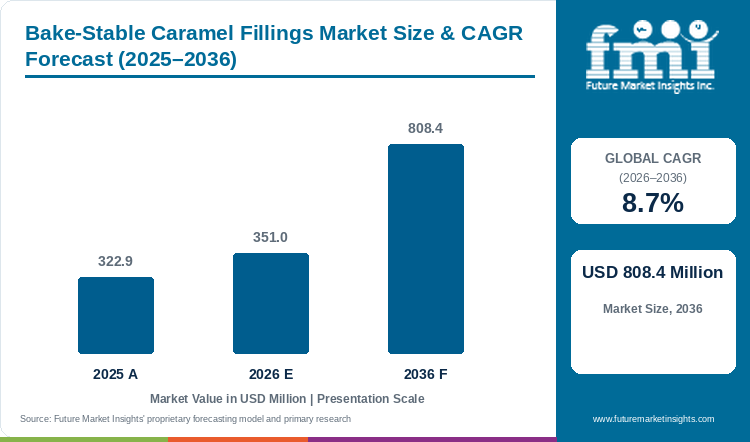
Table 1: Bake-Stable Caramel Fillings Market Size and Forecast (USD million), 2025 to 2036
| Market size and forecast | Value |
|---|---|
| 2025 market size | USD 322.9 million |
| Estimated market size in 2026 | USD 351.0 million |
| Projected market size by 2036 | USD 808.4 million |
| CAGR (2026-2036) | 8.7% |
| Added revenue, 2026 to 2036 | USD 457.4 million |
Key Market Trends & Insights
- By product type: The Fruit fillings segment accounted for the largest share of the Product Type breakdown in 2026, representing 32.0% of total market revenue.
- By form: Powder / dry preparations held the leading market position with a share of 48.0% in 2026, as bakeries control the final water addition and viscosity.
- By application: Bread & rolls remained the largest application segment, accounting for 32.0% of the market in 2026.
Regional Highlights
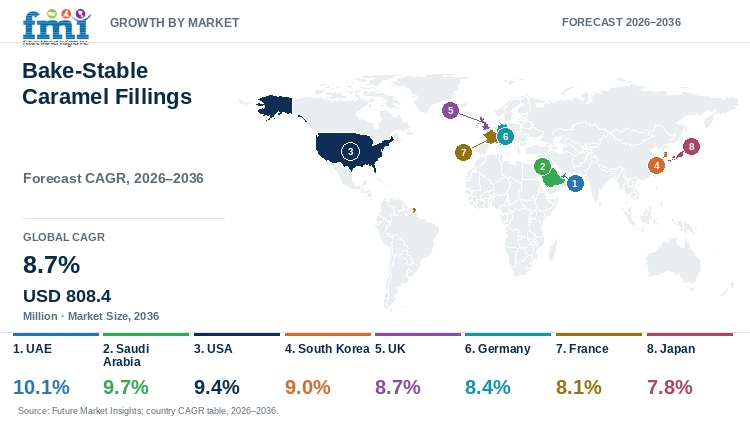
- Fastest-growing country: The UAE is expected to record the highest growth rate among the eight profiled countries, with a projected CAGR of 10.1% between 2026 and 2036.
- Growth across other countries: Saudi Arabia is projected to expand at a CAGR of 9.7%, followed by the USA at 9.4% and South Korea at 9.0%. Japan is expected to register comparatively slower growth, with a CAGR of 7.8% during the forecast period.
Sugar is the main raw material in caramel, and its availability remains an important factor influencing the cost of fillings. According to UkrAgroConsult, the International Sugar Organization (ISO) cut its forecast for the 2025/26 global sugar surplus to 1.1 million tonnes, down from 2.2 million tonnes in May 2026, in what was the fourth downward revision of the season[6]. For 2026/27, the ISO expects a small global deficit of 0.2 million tonnes, with El Niño identified as the main risk to its forecast. Raw sugar prices rallied in August 2026, with the ISA daily price averaging 17.4 cents per pound[6]. A tighter sugar balance can raise the cost of confectionery fillings, although caramel remains less exposed to price changes than cocoa-based fillings.
Suppliers are developing caramel formulations adapted to particular bakery applications. Barry Callebaut lists a water-based bake-stable caramel for muffins, pies and viennoiserie[2]. Bakels' June 2025 review of the IBA trade fair discussed high-temperature caramel production and differentiated flavour options[3], and in December 2025 British Bakels added Sea Salted and Real Chocolate Billionaire's Caramels to its True Caramel range, which is designed for bake stability across high- and low-volume production[7]. In 2026, Ingredients UK introduced Nigay's FG BS AF caramel for pre-bake use in viennoiserie and biscuits[4]. Adoption still depends on the portion, dough and bake schedule used by each customer.
Ingredient composition also affects production records and labelling. European Union food-information legislation sets requirements for ingredient and allergen information[1]. Caramel formulations containing milk require accurate information throughout bakery handling and label review, and a flavour variation can change that information even when it uses the same depositing equipment. This adds a documentation requirement to the technical assessment, particularly where a bakery produces several recipes for different retail customers.
Table 2: Supporting Industry Indicators for the Bake-Stable Caramel Fillings Market, 2025 to 2026
| Indicator | Data point | Why it matters | Source |
|---|---|---|---|
| Sugar balance | The ISO cut its 2025/26 global sugar surplus forecast to 1.1 million tonnes, from 2.2 million tonnes in May 2026. | A smaller surplus can raise the cost of the main caramel raw material. | [6] |
| Sugar outlook | The ISO forecasts a global sugar deficit of 0.2 million tonnes in 2026/27. | A move into deficit increases the risk of higher sugar prices. | [6] |
| Sugar price | The ISA daily raw sugar price averaged 17.4 cents per pound in August 2026. | Sugar prices feed directly into caramel production costs. | [6] |
| Chocolate volumes | Barry Callebaut's sales volume fell by 6.8% in 2024/25, with Global Chocolate down 5.3%. | Weaker chocolate demand may encourage bakeries to use alternative indulgent fillings. | [5] |
| Cocoa pricing | Barry Callebaut's revenue rose by 49.0% to CHF 14.8 billion, driven by higher cocoa-related pricing. | Higher chocolate costs improve the relative value of caramel fillings. | [5] |
| Product launch | British Bakels launched two ambient-stable Billionaire's Caramels in December 2025. | New products extend caramel use in indulgent bakery. | [7] |
| Pre-bake launch | Ingredients UK introduced Nigay FG BS AF in 2026 for pre-bake use in biscuits and viennoiserie. | A named grade gives developers a defined formulation for trials. | [4] |
| Caramel development | Bakels' June 2025 IBA review described application-tailored caramel production. | Different profiles can extend product ranges when baking performance is maintained. | [3] |
| Defined applications | Barry Callebaut lists water-based bake-stable caramel for muffins, pies and viennoiserie. | Application-specific formulations link thermal behaviour with the intended product. | [2] |
| Ingredient information | EU food-information legislation governs ingredient and allergen information for finished foods. | Milk-based caramel requires accurate allergen records. | [1] |
Demand Intensity Analysis
A comparison of FMI's market estimate with world sugar consumption provides a measure of the value added by caramel processing. According to the ISO, global sugar consumption is approximately 179.6 million tonnes in 2025/26[6]. FMI estimated the bake-stable caramel fillings market at USD 322.9 million in 2025, which is equivalent to approximately USD 1.8 for every tonne of sugar consumed worldwide. At the August 2026 average raw sugar price of 17.4 cents per pound, or approximately USD 384.0 per tonne[6], the market value corresponds to the cost of approximately 0.84 million tonnes of raw sugar, although caramel fillings also contain dairy, fat and processing costs.
The chocolate market provides another reference point. Barry Callebaut's revenue rose by 49.0% in 2024/25, while its sales volume fell by 6.8%[5]. These figures imply an increase of approximately 60.0% in average revenue per tonne, reflecting the pass-through of cocoa prices. In comparison, FMI expects the caramel fillings market to grow at a CAGR of 8.7% between 2026 and 2036, which indicates that caramel is expected to grow through volume and product extension rather than raw material price inflation.
A similar comparison can be made with the sugar balance. The ISO's 2025/26 surplus of 1.1 million tonnes represents only 0.6% of global consumption[6], which leaves little buffer against crop shortfalls. If the forecast 2026/27 deficit materialises, caramel manufacturers may face higher sugar costs at a time when chocolate costs remain elevated.
Segment values show where demand is concentrated. Powder / dry represented USD 168.5 million of Form revenue in 2026, while Bread & rolls accounted for USD 112.3 million in the separate Application breakdown. Direct to industrial bakeries accounted for USD 179.0 million, and Conventional represented USD 175.5 million within the Claim breakdown. The market is projected to reach 2.3 times its 2026 value by 2036.
Table 3: Demand Intensity Metrics for the Bake-Stable Caramel Fillings Market, 2025/26 Commodity Data Against 2025 and 2026 Market Values
| Demand intensity metric | Value | Basis |
|---|---|---|
| FMI market value, 2025 | USD 322.9 million | FMI estimate of bake-stable caramel filling revenue. |
| Global sugar consumption, 2025/26 | 179.6 million tonnes | ISO estimate. |
| FMI value per tonne of sugar consumed | USD 1.8 | The calculation divides USD 322.9 million by 179.6 million tonnes. |
| Raw sugar price, August 2026 | Approximately USD 384.0 per tonne | 17.4 cents per pound multiplied by 2,204.6 pounds per tonne. |
| Sugar surplus as a share of consumption, 2025/26 | 0.6% | 1.1 million tonnes divided by 179.6 million tonnes. |
| Barry Callebaut revenue growth, 2024/25 | 49.0% | Driven by higher cocoa-related pricing. |
| Barry Callebaut volume change, 2024/25 | -6.8% | Group sales volume. |
| Implied change in chocolate revenue per tonne | Approximately +60.0% | 1.49 divided by 0.932. |
| FMI value CAGR, 2026 to 2036 | 8.7% | FMI market forecast. |
| Powder / dry revenue, 2026 | USD 168.5 million | 48.0% of the market. |
| Direct industrial channel revenue, 2026 | USD 179.0 million | 51.0% of the market. |
| Market expansion multiple | 2.3 times | Projected 2036 market value relative to 2026. |
Analyst Perspective
"High cocoa prices have made caramel a practical indulgent filling, but it only wins repeat orders when the centre stays in place through the oven and the product still looks right after cooling."
- Nandini Roy Choudhury, Principal Analyst at Future Market Insights
How is the bake-stable caramel fillings market segmented?
The bake-stable caramel fillings market is segmented by product type, form, application, claim and sales channel. Product Type comprises Fruit fillings, Cream & custard, Chocolate & praline and Savory fillings. Form covers Powder / dry, Liquid, Paste / semi-solid and Granules / pieces. Application includes Bread & rolls, Cakes & muffins, Biscuits & cookies, Viennoiserie & pastry and Other bakery & snacks. Claim comprises Conventional, Clean label, Organic and Non-GMO / identity preserved. Sales Channel comprises Direct to industrial bakeries, Ingredient distributors, Foodservice & artisan supply and Online B2B.
How are Fruit fillings assessed within Product Type?
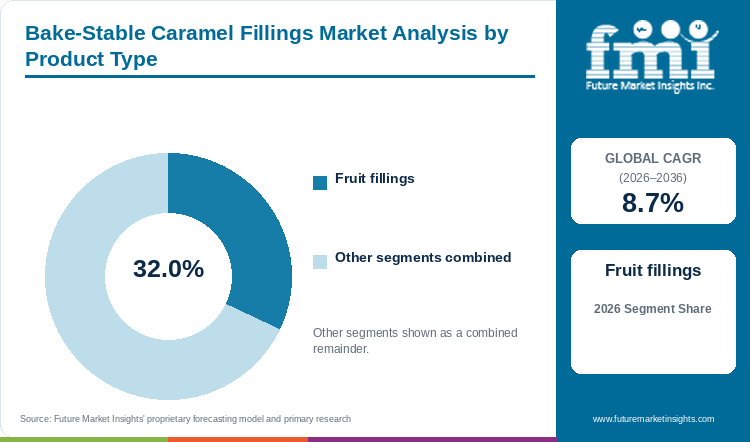
Fruit fillings, 32.0% in 2026.
Fruit-flavoured caramel centres, such as apple caramel, allow bakeries to combine a familiar fruit profile with the richness of caramel, and the Fruit fillings segment generated approximately USD 112.3 million in 2026. For bake-stable preparations, selection depends on how the complete filling behaves within the intended product. Barry Callebaut identifies specific pre-bake applications for its caramel, including muffins, pies and viennoiserie[2]. The assessment should follow the filling through depositing, baking and cooling at the intended portion size. Moisture movement and texture during storage also influence suitability, so the purchasing specification needs to describe the preparation and its operating conditions clearly.
- Fruit fillings, 32.0% in 2026.
- The completed filling must retain its intended texture through baking, cooling and storage.
What supports Powder / dry as the leading Form?
Powder / dry, 48.0% in 2026.
With dry preparations, the bakery controls the final water addition, which explains why the Powder / dry format generated approximately USD 168.5 million in 2026. Ingredients can be measured by weight before mixing, but the preparation step must be consistent. Too little dispersion or a different mixing time can leave the depositor working with a filling unlike the one accepted in trials. A practical procedure sets the water quantity, mixing sequence and the point at which the caramel is ready to use. Savings from not transporting water must be weighed against this work, as the oven receives the reconstituted filling rather than the dry material.
- Powder / dry, 48.0% in 2026.
- Mixing time and water addition determine the consistency that reaches the depositor.
How do Bread & rolls set the Application benchmark?
Bread & rolls, 32.0% in 2026.
Sweet rolls expose a caramel centre to steam, dough expansion and changing temperature during baking, and Bread & rolls accounted for approximately USD 112.3 million of filling revenue in 2026. A centre that moves too freely can collect at the seam or soak the adjacent crumb, while one that is too firm can be difficult to portion. Bakels describes caramel production tailored to different applications[3]. For bread and rolls, a useful test combines the filling weight with the dough and bake schedule the plant intends to use. Inspection after cooling shows whether the centre remains distinct, and storage checks reveal whether moisture continues to move into the crumb.
- Bread & rolls, 32.0% in 2026.
- A wet seam after cooling can indicate that the centre and surrounding crumb need further adjustment.
Why do Conventional claims retain the largest share?
Conventional, 50.0% in 2026.
Half of the Claim segment, or approximately USD 175.5 million in 2026, is held by Conventional formulations. These give developers freedom to select sweeteners, fats, dairy ingredients and hydrocolloids for the required balance of stability and mouthfeel, which helps when a caramel must both pass through a depositor and remain enclosed during baking. Other claims add ingredient or sourcing conditions without removing these technical demands. European food-information requirements apply to ingredient and allergen information in the finished product[1], so records for the actual caramel must follow it into the bakery's label review.
- Conventional, 50.0% in 2026.
- Ingredient and allergen information must describe the formulation actually supplied[1].
Why are industrial bakeries the principal Sales Channel?
Direct to industrial bakeries, 51.0% in 2026.
On an industrial line, the filling specification extends beyond flavour to pumping pressure, deposit weight and product shape. Direct supply to industrial bakeries generated approximately USD 179.0 million in 2026, as direct discussions allow the bakery to connect these settings with viscosity and moisture requirements. Container handling also affects the result. Residual caramel left in a pack reduces usable yield, while a difficult changeover adds work between recipes. Ambient-stable products that can be used straight from the pail, such as British Bakels' Billionaire's Caramels[7], reduce some of this handling. Distributors supply smaller quantities and mixed orders to other customers.
- Direct to industrial bakeries, 51.0% in 2026.
- Residual filling, container handling and changeover time affect the cost of a production run.
What are the drivers, restraints and opportunities in the bake-stable caramel fillings market?
High cocoa prices support demand for caramel-based indulgence, although rising sugar costs and substitution risks restrain the market, leaving room for flavour variations when the process remains manageable.
High cocoa prices support demand for caramel-based indulgence
The rise in cocoa prices is an important driver of caramel filling demand. Barry Callebaut reported that its revenue rose by 49.0% in 2024/25 because of higher cocoa-related pricing, while sales volume fell by 6.8% as a result of customer behaviour shifts and consumption softness[5]. Bakeries facing higher chocolate costs can use caramel to maintain indulgent products at a lower cost. Suppliers are positioning their ranges accordingly. British Bakels linked its December 2025 caramel launches to demand for "affordable indulgence"[7]. Thermal stability remains essential, as pre-bake filling exposes caramel to conditions that a topping never encounters. Compared with other bakery ingredients, a filling that stays in place through baking reduces losses and simplifies cooling and packing.
Rising sugar costs and substitution risks restrain the market
Sugar supply is tightening. The ISO has reduced its 2025/26 global surplus forecast four times, to 1.1 million tonnes, and expects a deficit of 0.2 million tonnes in 2026/27[6]. Higher sugar costs would reduce part of caramel's cost advantage over chocolate. Substitution between caramel grades is also difficult. A more fluid centre may escape during baking, while a thicker preparation may slow depositing or alter the portion. Moisture can also move into the crumb after cooling, and changes in milk or sugar ingredients can require a label review[1]. Where an existing recipe already gives an acceptable result, a proposed replacement needs a clear advantage to justify another round of line trials.
Flavour variations create opportunities when the process remains manageable
An established caramel-filled product gives a bakery a starting point for new flavours. A salted or fruit variation can refresh the range while using the same shaping and baking route. Bakels discussed application-tailored caramels and different flavour profiles in its June 2025 review of IBA[3], and its later Sea Salted and Real Chocolate variants[7] show how suppliers extend an accepted caramel into related products. The development task goes beyond selecting food flavors, as the changed recipe must still deposit, bake and store within a workable range. A useful trial compares the new version with the existing one at the same portion and bake schedule, which makes the production cost of the variation visible before launch.
Which country CAGRs are profiled in the bake-stable caramel fillings market?
Table 4: Country growth outlook for the bake-stable caramel fillings market
| Country | CAGR |
|---|---|
| UAE | 10.1% |
| Saudi Arabia | 9.7% |
| USA | 9.4% |
| South Korea | 9.0% |
| UK | 8.7% |
| Germany | 8.4% |
| France | 8.1% |
| Japan | 7.8% |
UAE
- The UAE is the fastest-growing market among the profiled countries, with a forecast CAGR of 10.1% from 2026 to 2036. Central production and distribution require UAE bakeries to assess caramel texture across several stages, as a product may be deposited in a central kitchen, baked, transported and displayed before it is eaten. Hotel kitchens and larger central bakeries may use the same flavour family in different pack sizes. Stockholding by distributors is useful for shorter menu programmes, and clear pre-bake instructions help bakeries keep the product consistent across their range.
Saudi Arabia
- In Saudi bakeries, dairy character, salt and texture give caramel different roles across the product range, but a filling for a roll must still stay enclosed during baking. Saudi Arabia is projected to grow at a CAGR of 9.7% during 2026 to 2036. Qualification needs to connect the selected recipe with accurate depositing and the actual bake cycle. Larger accounts can agree the formulation and replenishment quantities around their production schedule, while for smaller bakeries the availability of a suitable pack may determine whether the approved grade is practical.
USA
- With a forecast CAGR of 9.4% for 2026 to 2036, the USA ranks third among the profiled countries. Depositing conditions and portion weight are central to qualifying caramel fillings on US production lines, as a caramel handled successfully by hand may require different viscosity or temperature control on a faster line. Evaluating leakage, filling position and output together shows whether the preparation suits production. Procurement can compare the delivered price with the quantity of filling actually used, including material left in containers, which favours grades with predictable portioning.
South Korea
- Small caramel-centred buns and cookies leave little room for variation in the deposited amount. For a South Korean bakery, a change in filling weight can shift both sweetness and the balance between centre and dough. South Korea is forecast to grow at a CAGR of 9.0% over 2026 to 2036. Trials need to follow that balance through oven expansion and the texture after cooling. A different caramel intensity can provide variety within a familiar product, and early launches benefit from pack sizes that prevent opened containers from sitting too long.
UK
- UK bakeries have access to several new caramel options. Ingredients UK introduced Nigay's FG BS AF in 2026 for pre-bake use in cookies and viennoiserie[4], and British Bakels launched two Billionaire's Caramels in December 2025[7]. The UK market is projected to grow at a CAGR of 8.7% from 2026 to 2036. Selection still depends on each customer's portion, dough and heat exposure. A wholesaler serving several bakery formats needs to communicate application limits clearly, while a larger plant will also examine how the filling pumps and deposits over a run.
Germany
- Germany's forecast CAGR is 8.4% over 2026 to 2036. Pre-bake filling, post-bake injection and surface finishing expose caramel to different conditions, so German buyers comparing similar flavour descriptions first need to establish which operation each grade is designed for. For a filled biscuit or pastry, the test then follows leakage, centre texture and moisture movement during storage. Escaped filling increases product losses and cleaning work, so those costs belong beside the ingredient price. When a recipe moves between sites, instructions for temperature, mixing and holding help reproduce the filling at the depositor.
France
- In French pastry, caramel has to complement the dough, chocolate or fruit around it, which gives flavour and sweetness a central role in selection. France is forecast to grow at a CAGR of 8.1% from 2026 to 2036. An artisan may work with small quantities, while an industrial producer needs the filling to remain within a defined depositing range. Ingredient records also feed into the European framework for finished-product information[1]. Tasting after cooling and again during storage shows whether the declared formulation delivers the expected eating quality.
Japan
- Japan is expected to register the slowest growth among the profiled countries, with a forecast CAGR of 7.8% for 2026 to 2036. Caramel intensity after baking determines whether smaller portions deliver the intended flavour in Japanese bakery products, so portion and sweetness targets must be considered together. Small product dimensions also make leakage conspicuous. Initial import quantities and pack sizes should fit the launch volume, so that the bakery can assess demand using a stable recipe before planning regular replenishment.
Who are the notable companies in the bake-stable caramel fillings market?
Barry Callebaut; Bakels; Zeelandia; IRCA Group; Nigay
The supplier field includes caramel specialists and companies with wider bakery ranges. Barry Callebaut and Nigay offer identified bake-stable formulations[2][4], while Bakels, Zeelandia and IRCA supply caramel products for different applications. Barry Callebaut's scale in chocolate also gives it exposure to the cocoa price changes that affect filling choices, with 2024/25 revenue of CHF 14.8 billion[5]. Bakels has extended its True Caramel range with new Billionaire's Caramels[7].
Buying several confectionery ingredients from one company may simplify ordering, but the caramel still requires a working specification of its own. The bakery needs to know how it should be prepared, where it can be used and how consistently it will behave once regular deliveries begin.
Competitive Benchmarking: Bake-Stable Caramel Fillings Market
Table 5: Company capabilities in the bake-stable caramel fillings market
| Company | Relevant offering | Purchasing consideration |
|---|---|---|
| Barry Callebaut | Water-based bake-stable caramel filling | Match depositing and bake conditions |
| Bakels | Caramel fillings and tailored caramel production | Select flavor and application specification |
| Zeelandia | Bakery caramels with adjustable viscosity and bake stability | Agree the required working consistency |
| IRCA Group | Caramel filling solutions | Distinguish pre-bake from post-bake use |
| Nigay | FG BS AF bake-stable caramel | Confirm the pre-bake operating range |
Key Developments in the Bake-Stable Caramel Fillings Market
- In June 2025, Bakels' review of IBA described high-temperature caramel production and flavour options tailored to different bakery applications[3].
- In November 2025, Barry Callebaut reported a 6.8% decline in sales volume and a 49.0% increase in revenue for 2024/25, driven by higher cocoa-related pricing[5].
- In December 2025, British Bakels launched Sea Salted and Real Chocolate Billionaire's Caramels, which are ambient-stable and can be piped, injected, layered or drizzled[7].
- In 2026, Ingredients UK introduced Nigay's FG BS AF bake-stable caramel for pre-bake applications including viennoiserie and biscuits[4].
- In September 2026, the ISO's revised forecast cut the 2025/26 global sugar surplus to 1.1 million tonnes and projected a deficit of 0.2 million tonnes for 2026/27[6].
Key Players in the Bake-Stable Caramel Fillings Market
- Barry Callebaut
- Bakels
- Zeelandia
- IRCA Group
- Nigay
Bake-Stable Caramel Fillings Market - Report Scope
Table 6: Report scope for the bake-stable caramel fillings market
| Coverage field | Report scope |
|---|---|
| Market breakdown | Product Type; Form; Application; Claim; Sales Channel |
| Quantitative Units | USD Million |
| Market Definition | Includes ingredient-level revenue from caramel-containing fillings sold for pre-bake use within the stated segment taxonomy. Excludes downstream finished baked-goods revenue, post-bake-only caramel sauces, standalone non-caramel fruit or cream fillings, decorative caramel chips sold solely as inclusions, and unrelated coatings or equipment; bundled ingredient systems count only the separable qualifying filling value. |
| Regions Covered | North America; Latin America; Western Europe; Eastern Europe; East Asia; South Asia and Pacific; Middle East and Africa |
| Countries Covered | UAE; Saudi Arabia; USA; South Korea; UK; Germany; France; Japan |
| Key Companies Profiled | Barry Callebaut; Bakels; Zeelandia; IRCA Group; Nigay |
| Forecast Period | 2026 to 2036 |
| Approach | Market assessment supported by official technical and regulatory publications, company product information and country operating conditions. |
Bake-Stable Caramel Fillings Market - Research Methodology
Table 7: Research approach for the bake-stable caramel fillings market
| Method | Approach |
|---|---|
| Market definition | The assessment separates qualifying ingredient revenue from finished bakery products and unrelated formulation inputs. |
| Secondary evidence | Government publications, regulatory material, technical literature and first-party product documentation establish the operating context. |
| Commercial assessment | Product performance, supply continuity and customer qualification requirements are considered within each segment and country profile. |
| Comparability | Market values, segment shares and country forecasts use the stated revenue boundary, units and forecast period. |
Bake-Stable Caramel Fillings Market by Segments
Product Type
- Fruit fillings
- Cream & custard
- Chocolate & praline
- Savory fillings
Form
- Powder / dry
- Liquid
- Paste / semi-solid
- Granules / pieces
Application
- Bread & rolls
- Cakes & muffins
- Biscuits & cookies
- Viennoiserie & pastry
- Other bakery & snacks
Claim
- Conventional
- Clean label
- Organic
- Non-GMO / identity preserved
Sales Channel
- Direct to industrial bakeries
- Ingredient distributors
- Foodservice & artisan supply
- Online B2B
Bake-Stable Caramel Fillings Market by Region
- North America
- United States
- Canada
- Latin America
- Brazil
- Mexico
- Argentina
- Chile
- Western Europe
- Germany
- France
- United Kingdom
- Italy
- Spain
- Benelux
- Nordics
- Eastern Europe
- Poland
- Czech Republic
- Romania
- Hungary
- East Asia
- China
- Japan
- South Korea
- South Asia and Pacific
- India
- ASEAN
- Australia and New Zealand
- Middle East and Africa
- GCC Countries
- South Africa
- Türkiye
- Israel
Research Sources and Bibliography
- [1] European Commission. (n.d.). Food information to consumers: Legislation.
- [2] Barry Callebaut. (n.d.). Bake stable caramel filling.
- [3] Bakels. (2025, June 2). Top 5 takeaways from IBA 2025.
- [4] Ingredients UK. (2026). New product launch: Bake-stable caramel filling.
- [5] Eastlake, D. (2025, November 5). ConfectioneryNews. Barry Callebaut revenue up 49% but sales down, as cocoa price hikes hit industry leader.
- [6] UkrAgroConsult. (2026, September 3). ISO halves global sugar surplus estimate.
- [7] Briggs, F. (2025, December 4). Retail Times. British Bakels launches two new Billionaire's Caramels to meet growing demand for indulgent sweet bakery.
Future Market Insights. (2026). Bake-Stable Caramel Fillings Market: Global Industry Analysis and Opportunity Assessment 2036.
This Report Answers
- What is the value of the bake-stable caramel fillings market in 2026 and its forecast value in 2036?
- Which bakery processing pressures support demand for heat-stable caramel centers?
- Why do Fruit fillings lead the Product Type classification?
- What explains Powder / dry leadership within the Form classification?
- How do CAGRs vary across the eight profiled countries?
- Which profiled companies have documented caramel or bakery filling capabilities?
Frequently Asked Questions
How big is the bake-stable caramel fillings market in 2026, and what is forecast for 2036?
The market is valued at USD 351.0 million in 2026 and is forecast to reach USD 808.4 million by 2036. The figures refer to ingredient revenue rather than retail sales of filled bakery products.
What is the CAGR for the bake-stable caramel fillings market from 2026 to 2036?
The market is forecast to grow at a CAGR of 8.7% from 2026 to 2036, supported by bakeries extending caramel-based indulgent products.
Which Product Type segment leads bake-stable caramel fillings in 2026?
Fruit fillings lead with 32.0% of Product Type revenue in 2026.
Which Form segment leads bake-stable caramel fillings in 2026?
Powder / dry leads with 48.0% of Form revenue in 2026, although buyers must still verify reconstitution and pre-bake behaviour on their own lines.
Which profiled countries have the highest projected CAGRs?
The UAE leads at 10.1%, followed by Saudi Arabia at 9.7% and the USA at 9.4% from 2026 to 2036.
Which companies are active in the bake-stable caramel fillings market?
The report profiles Barry Callebaut, Bakels, Zeelandia, IRCA Group and Nigay.
Preview the report firsthand - request a free sample
Get SampleGet the brochure for pricing and purchase details.
Get PDFTable of Content
- Key Takeaways
- Market Size and CAGR
- Top Growth Driver
- Fastest Growing Segment
- Leading Region
- Key Companies
- Emerging Opportunities
- Executive Summary
- Global Market Outlook
- Demand-side Trends
- Supply-side Trends
- Technology Roadmap Analysis
- Analysis and Recommendations
- Analyst Perspective (What is happening? Why now? What should investors know?)
- Key Questions Answered
- How large is the market?
- What is the CAGR?
- What are key trends?
- Which region dominates?
- Who are the leaders?
- Market Overview
- Market Coverage / Taxonomy
- Market Definition / Scope / Limitations
- Research Methodology
- Chapter Orientation
- Analytical Lens and Working Hypotheses
- Market Structure, Signals, and Trend Drivers
- Benchmarking and Cross-market Comparability
- Market Sizing, Forecasting, and Opportunity Mapping
- Research Design and Evidence Framework
- Desk Research Programme (Secondary Evidence)
- Expert Input and Fieldwork (Primary Evidence)
- Tooling, Models, and Reference Databases
- Data Engineering and Model Build
- Quality Assurance and Audit Trail
- Market Background
- Market Dynamics (Drivers, Restraints, Opportunity, Trends)
- Scenario Forecast (Optimistic, Likely, Conservative)
- Impact Analysis
- AI Impact
- Sustainability Impact
- Regulatory Impact
- Technology Impact
- Consumer / Buyer Analysis
- Purchase Drivers
- Adoption Barriers
- Buyer Journey
- Opportunity Map Analysis
- Product Life Cycle Analysis
- Supply Chain Analysis
- Investment Feasibility Matrix
- Value Chain Analysis
- PESTLE and Porter's Analysis
- Regulatory Landscape
- Regional Parent Market Outlook
- Production and Consumption Statistics
- Import and Export Statistics
- Global Market Analysis and Forecast, 2021 to 2036
- Historical Market Size Value (USD Million) Analysis, 2021 to 2025
- Current and Future Market Size Value (USD Million) Projections, 2026 to 2036
- Y-o-Y Growth Trend Analysis
- Absolute $ Opportunity Analysis
- Global Market Pricing Analysis, 2021 to 2036
- Global Market Analysis and Forecast, By Product Type, 2021 to 2036
- Introduction / Key Findings
- Historical Market Size Value (USD Million) Analysis By Product Type, 2021 to 2025
- Current and Future Market Size Value (USD Million) Analysis and Forecast By Product Type, 2026 to 2036
- Fruit fillings
- Cream & custard
- Chocolate & praline
- Savory fillings
- Y-o-Y Growth Trend Analysis By Product Type, 2021 to 2025
- Absolute $ Opportunity Analysis By Product Type, 2026 to 2036
- Global Market Analysis and Forecast, By Form, 2021 to 2036
- Introduction / Key Findings
- Historical Market Size Value (USD Million) Analysis By Form, 2021 to 2025
- Current and Future Market Size Value (USD Million) Analysis and Forecast By Form, 2026 to 2036
- Powder / dry
- Liquid
- Paste / semi-solid
- Granules / pieces
- Y-o-Y Growth Trend Analysis By Form, 2021 to 2025
- Absolute $ Opportunity Analysis By Form, 2026 to 2036
- Global Market Analysis and Forecast, By Application, 2021 to 2036
- Introduction / Key Findings
- Historical Market Size Value (USD Million) Analysis By Application, 2021 to 2025
- Current and Future Market Size Value (USD Million) Analysis and Forecast By Application, 2026 to 2036
- Bread & rolls
- Cakes & muffins
- Biscuits & cookies
- Viennoiserie & pastry
- Other bakery & snacks
- Y-o-Y Growth Trend Analysis By Application, 2021 to 2025
- Absolute $ Opportunity Analysis By Application, 2026 to 2036
- Global Market Analysis and Forecast, By Claim, 2021 to 2036
- Introduction / Key Findings
- Historical Market Size Value (USD Million) Analysis By Claim, 2021 to 2025
- Current and Future Market Size Value (USD Million) Analysis and Forecast By Claim, 2026 to 2036
- Conventional
- Clean label
- Organic
- Non-GMO / identity preserved
- Y-o-Y Growth Trend Analysis By Claim, 2021 to 2025
- Absolute $ Opportunity Analysis By Claim, 2026 to 2036
- Global Market Analysis and Forecast, By Sales Channel, 2021 to 2036
- Introduction / Key Findings
- Historical Market Size Value (USD Million) Analysis By Sales Channel, 2021 to 2025
- Current and Future Market Size Value (USD Million) Analysis and Forecast By Sales Channel, 2026 to 2036
- Direct to industrial bakeries
- Ingredient distributors
- Foodservice & artisan supply
- Online B2B
- Y-o-Y Growth Trend Analysis By Sales Channel, 2021 to 2025
- Absolute $ Opportunity Analysis By Sales Channel, 2026 to 2036
- Global Market Analysis and Forecast, By Region, 2021 to 2036
- Introduction
- Historical Market Size Value (USD Million) Analysis By Region, 2021 to 2025
- Current Market Size Value (USD Million) Analysis and Forecast By Region, 2026 to 2036
- North America
- Latin America
- Western Europe
- Eastern Europe
- East Asia
- South Asia and Pacific
- Middle East and Africa
- Market Attractiveness Analysis By Region
- North America Market Analysis and Forecast, By Country, 2021 to 2036
- Historical Market Size Value (USD Million) Trend Analysis By Market Taxonomy, 2021 to 2025
- Market Size Value (USD Million) Forecast By Market Taxonomy, 2026 to 2036
- By Country
- United States
- Canada
- By Product Type
- By Form
- By Application
- By Claim
- By Sales Channel
- By Country
- Market Attractiveness Analysis
- By Country
- By Product Type
- By Form
- By Application
- By Claim
- By Sales Channel
- Key Takeaways
- Latin America Market Analysis and Forecast, By Country
- Historical Market Size Value (USD Million) Trend Analysis By Market Taxonomy, 2021 to 2025
- Market Size Value (USD Million) Forecast By Market Taxonomy, 2026 to 2036
- By Country
- Brazil
- Mexico
- Argentina
- Chile
- By Product Type
- By Form
- By Application
- By Claim
- By Sales Channel
- By Country
- Market Attractiveness Analysis
- By Country
- By Product Type
- By Form
- By Application
- By Claim
- By Sales Channel
- Key Takeaways
- Western Europe Market Analysis and Forecast, By Country
- Historical Market Size Value (USD Million) Trend Analysis By Market Taxonomy, 2021 to 2025
- Market Size Value (USD Million) Forecast By Market Taxonomy, 2026 to 2036
- By Country
- Germany
- France
- United Kingdom
- Italy
- Spain
- Benelux
- Nordics
- By Product Type
- By Form
- By Application
- By Claim
- By Sales Channel
- By Country
- Market Attractiveness Analysis
- By Country
- By Product Type
- By Form
- By Application
- By Claim
- By Sales Channel
- Key Takeaways
- Eastern Europe Market Analysis and Forecast, By Country
- Historical Market Size Value (USD Million) Trend Analysis By Market Taxonomy, 2021 to 2025
- Market Size Value (USD Million) Forecast By Market Taxonomy, 2026 to 2036
- By Country
- Poland
- Czech Republic
- Romania
- Hungary
- By Product Type
- By Form
- By Application
- By Claim
- By Sales Channel
- By Country
- Market Attractiveness Analysis
- By Country
- By Product Type
- By Form
- By Application
- By Claim
- By Sales Channel
- Key Takeaways
- East Asia Market Analysis and Forecast, By Country
- Historical Market Size Value (USD Million) Trend Analysis By Market Taxonomy, 2021 to 2025
- Market Size Value (USD Million) Forecast By Market Taxonomy, 2026 to 2036
- By Country
- China
- Japan
- South Korea
- By Product Type
- By Form
- By Application
- By Claim
- By Sales Channel
- By Country
- Market Attractiveness Analysis
- By Country
- By Product Type
- By Form
- By Application
- By Claim
- By Sales Channel
- Key Takeaways
- South Asia and Pacific Market Analysis and Forecast, By Country
- Historical Market Size Value (USD Million) Trend Analysis By Market Taxonomy, 2021 to 2025
- Market Size Value (USD Million) Forecast By Market Taxonomy, 2026 to 2036
- By Country
- India
- ASEAN
- Australia and New Zealand
- By Product Type
- By Form
- By Application
- By Claim
- By Sales Channel
- By Country
- Market Attractiveness Analysis
- By Country
- By Product Type
- By Form
- By Application
- By Claim
- By Sales Channel
- Key Takeaways
- Middle East and Africa Market Analysis and Forecast, By Country
- Historical Market Size Value (USD Million) Trend Analysis By Market Taxonomy, 2021 to 2025
- Market Size Value (USD Million) Forecast By Market Taxonomy, 2026 to 2036
- By Country
- GCC Countries
- South Africa
- Türkiye
- Israel
- By Product Type
- By Form
- By Application
- By Claim
- By Sales Channel
- By Country
- Market Attractiveness Analysis
- By Country
- By Product Type
- By Form
- By Application
- By Claim
- By Sales Channel
- Key Takeaways
- Key Countries Market Analysis
- United States
- Pricing Analysis
- Market Share Analysis, 2025
- By Product Type
- By Form
- By Application
- By Claim
- By Sales Channel
- Canada
- Pricing Analysis
- Market Share Analysis, 2025
- By Product Type
- By Form
- By Application
- By Claim
- By Sales Channel
- Mexico
- Pricing Analysis
- Market Share Analysis, 2025
- By Product Type
- By Form
- By Application
- By Claim
- By Sales Channel
- Brazil
- Pricing Analysis
- Market Share Analysis, 2025
- By Product Type
- By Form
- By Application
- By Claim
- By Sales Channel
- Chile
- Pricing Analysis
- Market Share Analysis, 2025
- By Product Type
- By Form
- By Application
- By Claim
- By Sales Channel
- Germany
- Pricing Analysis
- Market Share Analysis, 2025
- By Product Type
- By Form
- By Application
- By Claim
- By Sales Channel
- United Kingdom
- Pricing Analysis
- Market Share Analysis, 2025
- By Product Type
- By Form
- By Application
- By Claim
- By Sales Channel
- Italy
- Pricing Analysis
- Market Share Analysis, 2025
- By Product Type
- By Form
- By Application
- By Claim
- By Sales Channel
- Spain
- Pricing Analysis
- Market Share Analysis, 2025
- By Product Type
- By Form
- By Application
- By Claim
- By Sales Channel
- France
- Pricing Analysis
- Market Share Analysis, 2025
- By Product Type
- By Form
- By Application
- By Claim
- By Sales Channel
- India
- Pricing Analysis
- Market Share Analysis, 2025
- By Product Type
- By Form
- By Application
- By Claim
- By Sales Channel
- ASEAN
- Pricing Analysis
- Market Share Analysis, 2025
- By Product Type
- By Form
- By Application
- By Claim
- By Sales Channel
- Australia and New Zealand
- Pricing Analysis
- Market Share Analysis, 2025
- By Product Type
- By Form
- By Application
- By Claim
- By Sales Channel
- China
- Pricing Analysis
- Market Share Analysis, 2025
- By Product Type
- By Form
- By Application
- By Claim
- By Sales Channel
- Japan
- Pricing Analysis
- Market Share Analysis, 2025
- By Product Type
- By Form
- By Application
- By Claim
- By Sales Channel
- South Korea
- Pricing Analysis
- Market Share Analysis, 2025
- By Product Type
- By Form
- By Application
- By Claim
- By Sales Channel
- Poland
- Pricing Analysis
- Market Share Analysis, 2025
- By Product Type
- By Form
- By Application
- By Claim
- By Sales Channel
- Hungary
- Pricing Analysis
- Market Share Analysis, 2025
- By Product Type
- By Form
- By Application
- By Claim
- By Sales Channel
- Türkiye
- Pricing Analysis
- Market Share Analysis, 2025
- By Product Type
- By Form
- By Application
- By Claim
- By Sales Channel
- South Africa
- Pricing Analysis
- Market Share Analysis, 2025
- By Product Type
- By Form
- By Application
- By Claim
- By Sales Channel
- UAE
- Pricing Analysis
- Market Share Analysis, 2025
- By Product Type
- By Form
- By Application
- By Claim
- By Sales Channel
- Saudi Arabia
- Pricing Analysis
- Market Share Analysis, 2025
- By Product Type
- By Form
- By Application
- By Claim
- By Sales Channel
- United States
- Market Structure Analysis
- Competition Dashboard
- Competition Benchmarking
- Market Share Analysis of Top Players
- By Regional
- By Product Type
- By Form
- By Application
- By Claim
- By Sales Channel
- Emerging Startups
- Innovation Benchmarking
- Competition Analysis
- Competition Deep Dive
- Barry Callebaut
- Overview
- Product Portfolio
- Profitability by Market Segments
- Sales Footprint
- Strategy Overview
- Marketing Strategy
- Product Strategy
- Channel Strategy
- Bakels
- Zeelandia
- IRCA Group
- Nigay
- Barry Callebaut
- Case Studies
- Success Stories
- Recent Developments
- Competition Deep Dive
- Assumptions & Acronyms Used


