
- Market Size (2026)
- USD 3.30 Bn
- Forecast (2036)
- USD 5.08 Bn
- CAGR (2026 to 2036)
- 4.4%
How Big Is the Bakelite Market in 2026?
The global bakelite market is valued at USD 3.30 billion in 2026, up from USD 3.18 billion in 2025, and is projected by Future Market Insights (FMI) to reach USD 5.08 billion by 2036, expanding at a 4.4% CAGR from 2026 to 2036 and generating USD 1.78 billion in incremental revenue over the 10-year forecast period.
| Market Metric | Valuation / Share / Forecast Benchmark |
|---|---|
| 2025 Market Size (Historical) | USD 3.18 billion |
| 2026 Market Size (Estimated) | USD 3.30 billion |
| 2036 Market Size (Projected) | USD 5.08 billion |
| Compound Annual Growth Rate (2026 to 2036) | 4.4% CAGR |
| Incremental Dollar Opportunity (2026 to 2036) | USD 1.78 billion |
| Leading & Fastest-Growing Products | Moulding Compounds (30.0% share in 2026; 4.0% CAGR) | Friction Material Binders (fastest, 4.8% CAGR) |
| Leading & Fastest-Growing End Uses | Electrical & Electronics (34.0% share in 2026; 4.6% CAGR) | Aerospace & Defence (fastest, 5.3% CAGR) |
| Leading & Fastest-Growing Forms | Moulding Powder (38.0% share in 2026; 4.0% CAGR) | Liquid Resin (fastest, 4.8% CAGR) |
| Largest Country Markets (2026 Global Share) | China (34.0%), United States (15.0%), Japan (7.0%) |
| Fastest-Growing Country Markets (2026 to 2036) | India (6.4% CAGR), China (4.8% CAGR), South Korea (4.4% CAGR) |
| Leading Tier-1 Companies | Sumitomo Bakelite (Durez, Vyncolit), Bakelite Synthetics, Hexion, SI Group, Prefere Resins, Kolon Industries, Chang Chun Group, Jinan Shengquan Group, Momentive, Hitachi Chemical (Resonac) |
Source: Future Market Insights analysis of the bakelite market, 2026.
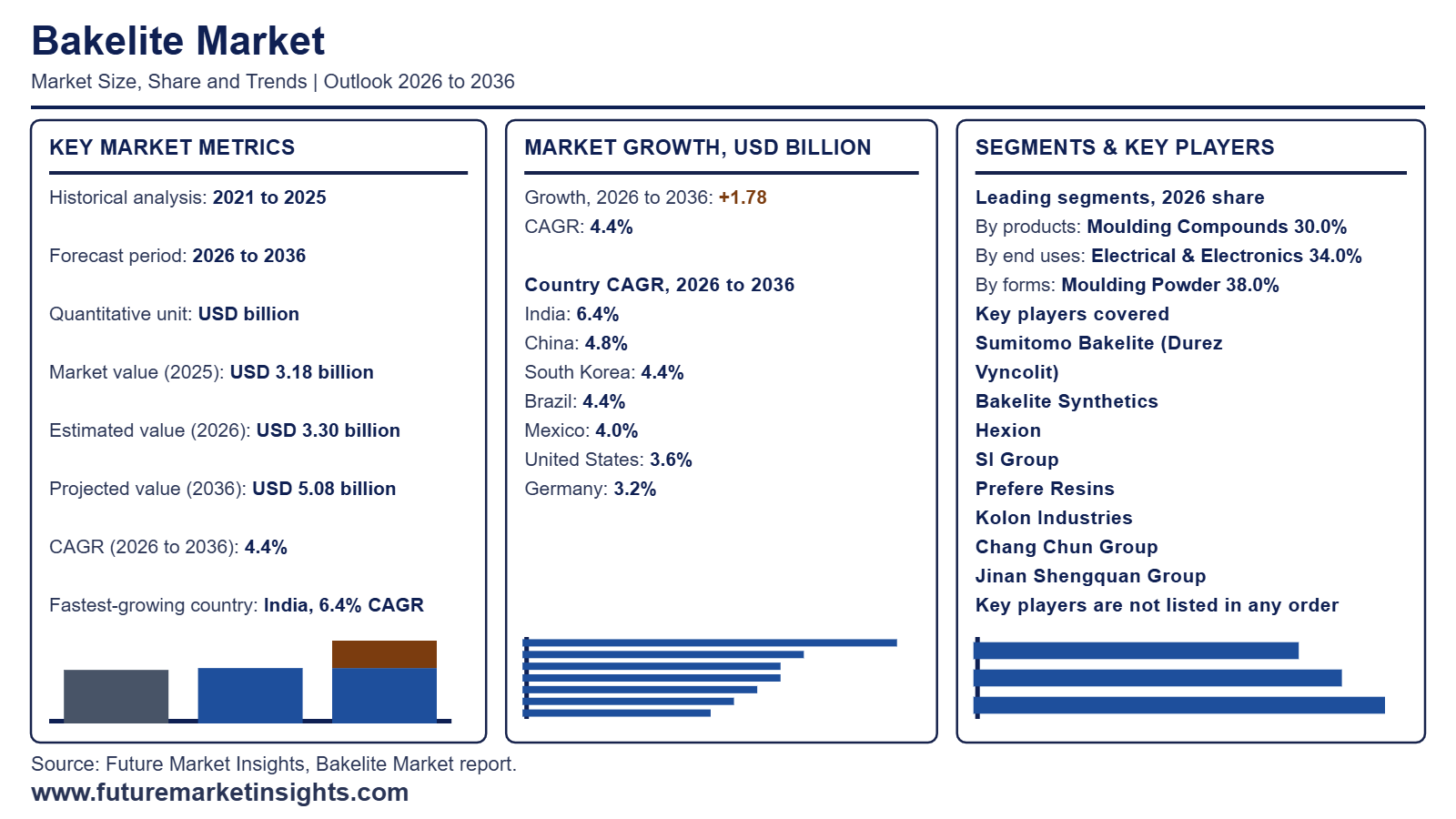
Executive Market Overview
Demand for bakelite is holding steady in electrical, brake and heat-resistant parts, where few plastics can match its heat and flame resistance. Production, however, is shifting toward Asia as Western plants consolidate. For example, Sumitomo Bakelite said in September 2026 that it plans to close its Durez plant in Kenton, Ohio. Buyers in North America therefore rely more on imports. Moulding compounds take about 30% of revenue in 2026, the largest product group. Grid upgrades and electric cars add steady demand for heat-resistant parts. The market as a whole is growing at about 4.4% a year, a pace expected to hold through 2036.
Prices for bakelite resins moved with phenol costs through 2026. Phenolic resin prices rose in the first quarter on higher phenol, then weakened in the second quarter as feedstock costs fell. Buyers, in turn, are signing shorter contracts to follow these swings. Friction material binders, meanwhile, are growing fastest at about 4.8% a year, as brake pads for heavier electric cars need more binder. Liquid resin is the fastest-growing form at about 4.8%. Electrical and electronics uses take about 34% of revenue in 2026.
Analyst Perspective
"Bakelite and other phenolic moulding materials are holding a steady place in electrical, brake and heat-resistant parts. Demand is shifting toward Asia, where most electrical and car parts are made, while North American and European plants consolidate. Phenol prices swung through 2026, squeezing moulders. Over the next decade, friction binders and electric vehicle parts will add the most new demand."
- Nikhil Kaitwade, Principal Consultant, Future Market Insights (FMI)
Major Market Trends and Insights
- Western Producers Are Consolidating Plants: Production of phenolic resins is shifting from older Western plants to newer Asian sites. Ageing plants need costly upgrades. Sumitomo Bakelite, for example, announced plans in September 2026 to close its Durez plant in Ohio. The company cited the plant's age and future investment needs. As a result, more supply is coming from fewer, larger sites.
- Resin Prices Are Following Phenol Costs: Prices for bakelite resins rose in early 2026 and eased by mid-year. Phenol and formaldehyde costs move with benzene and methanol prices. Procurement Resource reported higher phenolic resin prices in the first quarter of 2026. Prices then weakened in the second quarter as feedstock costs fell. As a result, moulders face changing input costs.
- Brake Makers Are Using More Phenolic Binders: Demand for phenolic binders in brake pads and clutches is rising. Heavier electric cars need strong, heat-resistant brake parts. Brake makers, in turn, are testing low-copper and low-dust formulas that rely on phenolic binders. Friction material binders are growing at about 4.8% a year. As a result, friction uses are adding steady new demand.
What Are the Main Drivers, Restraints, and Opportunities?
Electrical insulation, brake parts and heat-resistant components are driving bakelite demand. Phenol costs and emission rules restrain growth, while electric vehicle parts, friction binders and South Asia offer the largest new revenue.
Driver: Electrical Insulation, Brake Parts and Heat-Resistant Components
Purchases of bakelite are supported by electrical, automotive and machinery makers. Bakelite parts resist heat, flame and electrical current. Switchgear and circuit breaker makers, in turn, use moulding compounds. Brake and clutch makers use phenolic binders. As a result, industrial laminates and composites are set to add about USD 0.49 billion by 2036.
Restraint: Phenol and Formaldehyde Costs and Emission Rules
Sales of bakelite are slowed by swings in phenol and formaldehyde prices. Emission rules on formaldehyde, meanwhile, raise costs for producers. Newer plastics such as nylon and PPS replace bakelite in some parts. Ageing plants in the West also need costly upgrades. Weak housing activity cuts demand for laminates. As a result, Western producers are closing sites rather than investing.
Opportunity: Electric Vehicle Parts, Friction Binders and South Asia
Industrial laminates and composites offer the largest investment opportunity in bakelite, adding about USD 0.49 billion by 2036. Aircraft, rail and electrical makers need fire-safe panels and boards. Friction material binders, in turn, are growing at about 4.8% a year as vehicle fleets expand. Liquid resin is expanding at about 4.8%. India, at about 6.4% a year, is the fastest-growing profiled country as electrical and car parts output rises.
How Is the Bakelite Market Segmented?
The bakelite market is segmented into product, end use, form and region, with values shown in USD billion.
| Segmentation Axis | Sub-Segments Covered | 2026 Leading Segment & Share | Main Growth Benchmark (2026 to 2036) |
|---|---|---|---|
| Product | Moulding Compounds, Industrial Laminates & Composites, Friction Material Binders, Abrasive & Refractory Binders, Electrical Insulation Components | Moulding Compounds (30.0% revenue share) | Friction Material Binders (4.8% CAGR) vs. Moulding Compounds (4.0% CAGR) |
| End Use | Electrical & Electronics, Automotive, Industrial Machinery & Tooling, Appliances & Cookware, Aerospace & Defence | Electrical & Electronics (34.0% revenue share) | Aerospace & Defence (5.3% CAGR) vs. Appliances & Cookware (3.8% CAGR) |
| Form | Moulding Powder, Liquid Resin, Impregnated Sheet & Prepreg, Solid & Flake | Moulding Powder (38.0% revenue share) | Liquid Resin (4.8% CAGR) vs. Moulding Powder (4.0% CAGR) |
| Region | North America, Europe, East Asia, South Asia & Pacific, Latin America, Middle East & Africa | East Asia (46.0% revenue share) | South Asia & Pacific leads regional growth at a 5.8% CAGR; India leads national growth at a 6.4% CAGR |
Source: Future Market Insights analysis of the bakelite market, 2026.
Why Does the Moulding Compound Segment Lead by Product?
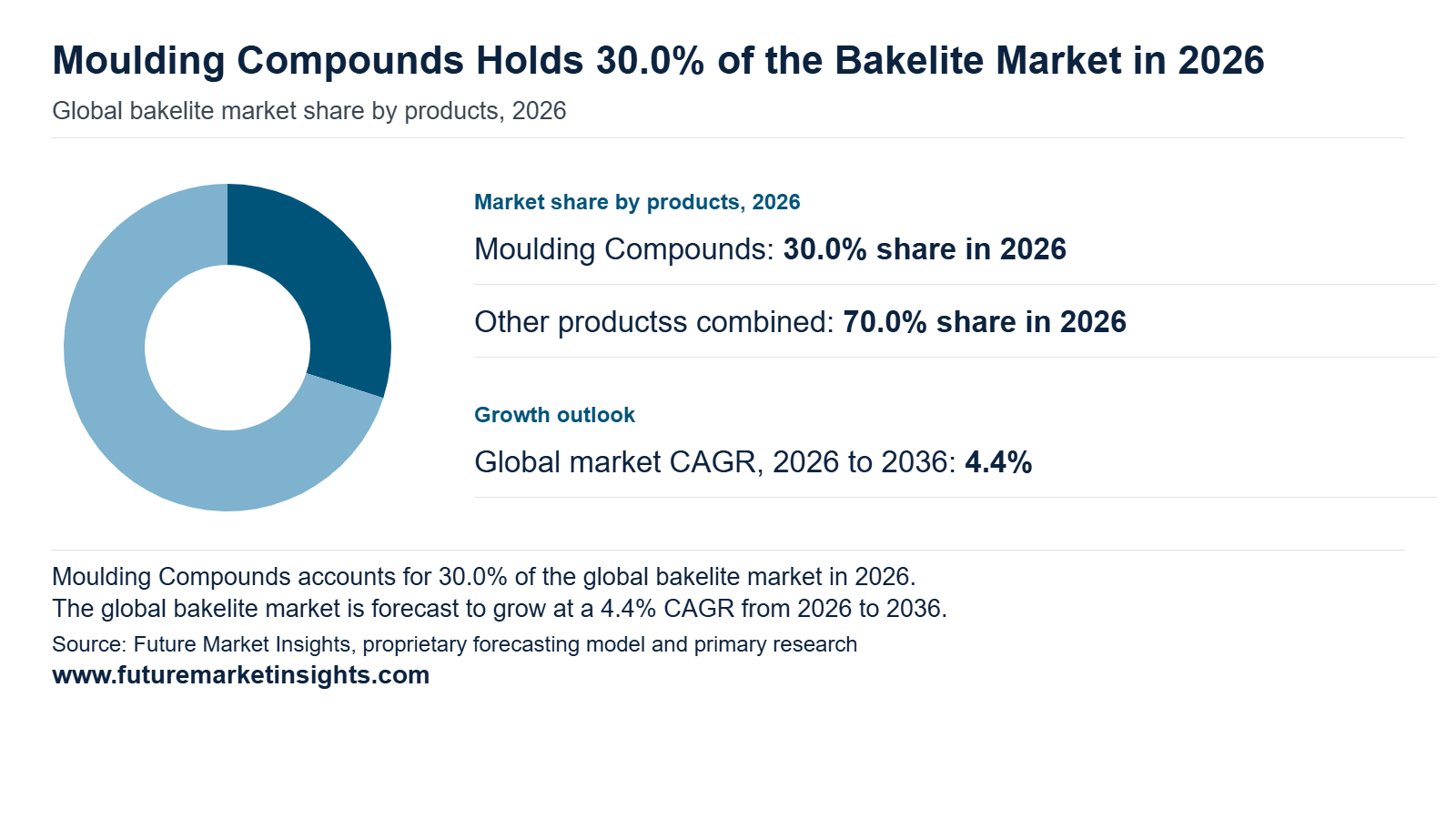
Moulding compounds account for about 30% of bakelite revenue in 2026, worth USD 0.99 billion. Makers of switches, sockets and pot handles use these compounds. Growth in moulding compounds is about 4.0% a year. Friction material binders, however, are growing fastest at about 4.8%. Brake pads for trucks and electric cars need more binder per part. Industrial laminates and composites hold about 26% and will add the most revenue. Abrasive binders and electrical insulation parts each hold about 12%.
Why Does the Electrical and Electronics Segment Lead by End Use?
Electrical and electronics lead at about 34% of bakelite revenue in 2026, worth USD 1.12 billion. Switchgear, breakers and connectors need heat and flame resistance. This end use is growing at about 4.6% a year as grids expand. Automotive holds about 28% and is growing at about 4.4%. Aerospace and defence, however, is growing fastest at about 5.3%, from about 8% of revenue. Industrial machinery holds about 18%. Appliances and cookware hold about 12% and grow slowest.
Why Does the Moulding Powder Segment Lead by Form?
Moulding powder makes up about 38% of bakelite revenue in 2026, worth USD 1.25 billion. Moulders press the powder into parts under heat. Growth in moulding powder is about 4.0% a year. Liquid resin, at about 30%, is growing fastest at close to 4.8%. Brake, abrasive and laminate makers use liquid resin to bind fibres and grains. Impregnated sheet and prepreg hold about 20% and serve aircraft interiors. Solid and flake forms hold about 12%.
Bakelite Market by Region and Country (2026 to 2036)
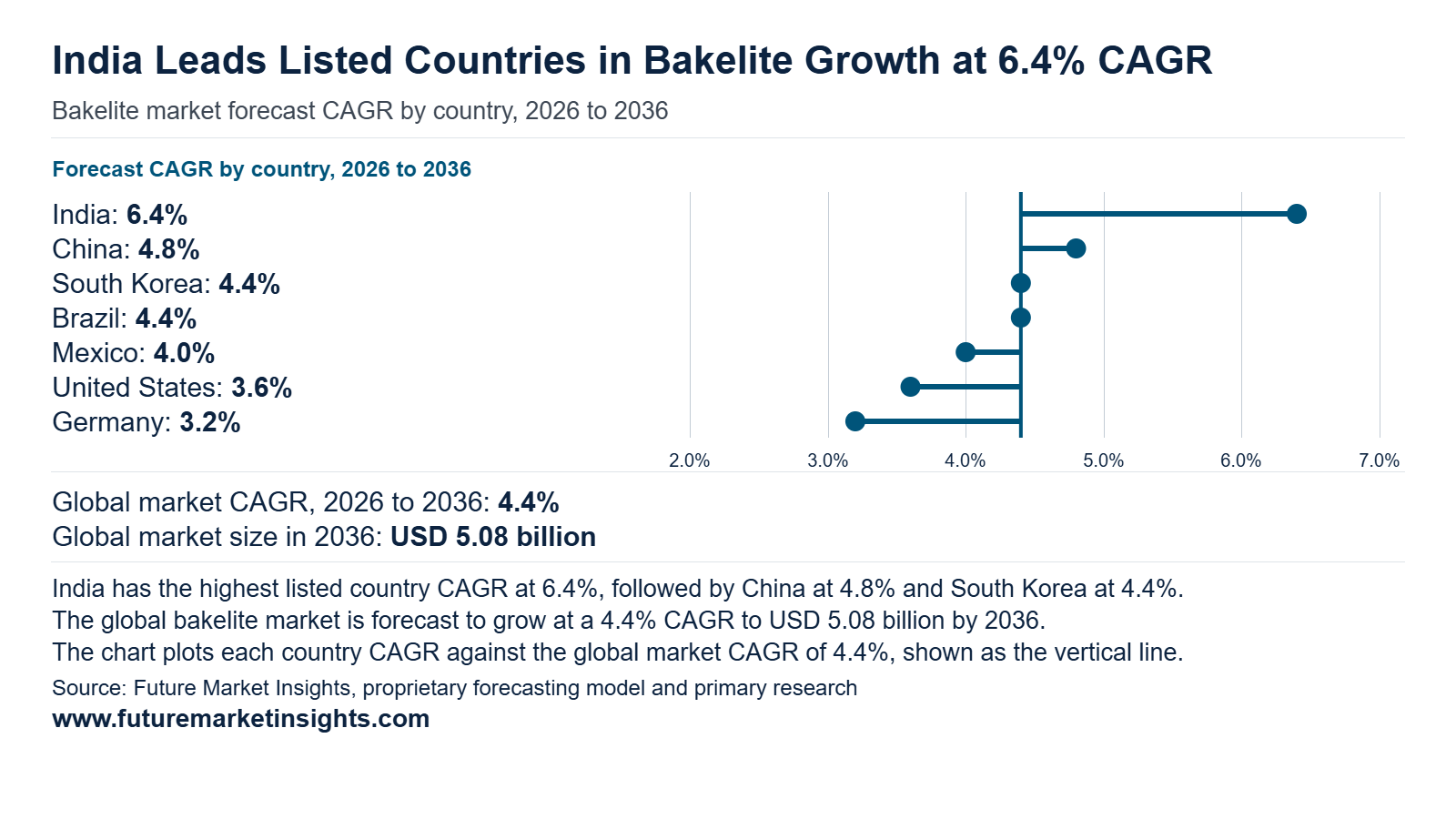
Demand for bakelite is highest in East Asia, where most electrical and car parts are made. East Asia is likely to remain the highest market, holding about 46% of global revenue in 2026. Growth there is about 4.8% a year, supported by new resin capacity. Europe holds about 20% and is growing at close to 3.4%, slowed by high energy costs. North America, at about 18%, is growing at around 3.6% as local plants close. South Asia and Pacific is the fastest-growing region at about 5.8% a year, led by India. Latin America holds about 4%, and the Middle East and Africa about 2%.
| Country | 2026 Revenue | 2036 Revenue | 10-Year Addition | 2026 to 2036 CAGR | Global Share (2026 → 2036) |
|---|---|---|---|---|---|
| China | USD 1.12 billion | USD 1.79 billion | +USD 0.67 billion | 4.8% | 34.0% → 35.3% |
| United States | USD 0.49 billion | USD 0.71 billion | +USD 0.21 billion | 3.6% | 15.0% → 13.9% |
| Japan | USD 0.23 billion | USD 0.31 billion | +USD 0.08 billion | 3.0% | 7.0% → 6.1% |
| Germany | USD 0.20 billion | USD 0.27 billion | +USD 0.07 billion | 3.2% | 6.0% → 5.3% |
| India | USD 0.20 billion | USD 0.37 billion | +USD 0.17 billion | 6.4% | 6.0% → 7.3% |
| South Korea | USD 0.13 billion | USD 0.20 billion | +USD 0.07 billion | 4.4% | 4.0% → 4.0% |
| Brazil | USD 0.08 billion | USD 0.13 billion | +USD 0.04 billion | 4.4% | 2.5% → 2.5% |
| Italy | USD 0.07 billion | USD 0.09 billion | +USD 0.02 billion | 3.0% | 2.0% → 1.7% |
| France | USD 0.07 billion | USD 0.09 billion | +USD 0.02 billion | 3.2% | 2.0% → 1.8% |
| Mexico | USD 0.07 billion | USD 0.10 billion | +USD 0.03 billion | 4.0% | 2.0% → 1.9% |
Source: Future Market Insights analysis of the bakelite market, 2026.
China
Large electrical and car parts industries are projected to keep China the largest bakelite market. In 2026, the market in China is valued at USD 1.12 billion. Through 2036, it is likely to grow to USD 1.79 billion at a CAGR of 4.8%, the second fastest among profiled countries. Key trends to look for include new capacity at large sites. Jinan Shengquan and Chang Chun Group, in turn, produce large volumes of phenolic resins. Switchgear and appliance makers use moulding compounds. Brake makers use phenolic binders for cars and trucks. Price competition, however, keeps margins thin. Exports of moulded parts go worldwide. Emission rules are tightening for formaldehyde. Electric vehicle makers, meanwhile, use phenolic parts in motors and battery packs. Abrasive makers in Henan use phenolic binders for cutting discs. Kitchenware exporters use bakelite handles.
United States
Consolidation of older plants is reshaping bakelite supply in the United States. Sumitomo Bakelite plans to close its Durez plant in Kenton, Ohio, as announced in September 2026. Bakelite Synthetics and Hexion, in turn, run other phenolic resin plants. Brake makers and electrical firms are the main buyers. Housing starts fell 15.4% in May 2026, which cut demand for laminates. Emission rules on formaldehyde raise costs. Aerospace firms, meanwhile, use phenolic composites in aircraft cabins. Foundries use phenolic resins to bind sand moulds. Imports from Asia are rising as local plants close. Utilities buy switchgear with phenolic parts for grid upgrades. Defence makers use phenolic parts in rocket nozzles. In 2026, the market in the US is valued at USD 0.49 billion. Through 2036, it is likely to grow to USD 0.71 billion at a CAGR of 3.6%.
Japan
Sumitomo Bakelite is based in Japan and leads local supply. Electrical and car makers use moulding compounds. Akebono and other brake makers, in turn, buy phenolic binders. Demand is steady but not growing. Strict quality standards favour premium grades. Chip makers, meanwhile, use phenolic materials in semiconductor packaging. Hybrid car motors use phenolic commutators. Printed circuit boards use paper-phenolic laminates. Rice cooker and pan makers use heat-proof handles. Ageing staff make it hard to run older plants. Japanese firms are moving some output to Southeast Asia. Bullet trains use fire-safe interior panels. In 2026, the market in Japan is worth USD 0.23 billion. By 2036, it is projected to reach USD 0.31 billion at a CAGR of 3.0%, the joint slowest among profiled countries.
Germany
Car, electrical and machinery makers drive bakelite demand in Germany. Prefere Resins and Hexion run local plants. Bosch and Continental, in turn, buy phenolic parts for brakes and electronics. Formaldehyde limits under REACH raise costs. Weak car output slowed demand in 2025. Electric motor makers, meanwhile, use phenolic insulation. Switchgear makers such as Siemens use moulding compounds. Grinding disc makers serve the metal trades. Airbus suppliers use phenolic honeycomb in cabins. Rail makers use fire-safe interior panels. Wind turbine makers use phenolic electrical parts. Producers are developing low-emission resins. Tool makers in Baden-Württemberg buy laminate sheets for jigs. The market in Germany stands at USD 0.20 billion in 2026. By 2036, it is projected to reach USD 0.27 billion at a CAGR of 3.2%.
India
Rising electrical and car parts output is making India the fastest-growing bakelite market among the profiled countries. Switch and socket makers use large volumes of moulding powder. Two-wheeler brake makers, in turn, use phenolic binders. Pressure cooker makers use bakelite for handles and knobs. Local makers supply most resin. Electric scooter makers, meanwhile, use phenolic parts in motors. Abrasive firms in Gujarat use phenolic bonds. Grid upgrades raise demand for breakers. Housing growth lifts demand for switches. Pollution boards are tightening rules on small resin plants. Railway coach factories use fire-safe panels. In 2026, the market in India is valued at USD 0.20 billion. By 2036, it is projected to reach USD 0.37 billion, growing at a CAGR of 6.4%.
South Korea
Kolon Industries leads phenolic resin supply in South Korea. Electronics makers, in turn, use phenolic laminates in circuit boards. Hyundai and Kia buy brake pads with phenolic binders. Samsung and LG use moulded parts in appliances. Battery makers, meanwhile, use phenolic materials for heat shields. Electric car output adds demand for motor insulation. Shipyards use phenolic panels for fire safety. Defence firms use phenolic composites in vehicles. Exports to Southeast Asia support producers. Chinese imports pressure local prices. Rail cars for export use fire-safe interior panels. Phenol supply from local refineries keeps feedstock costs stable. Worth USD 0.13 billion in 2026, the market in South Korea is set to reach USD 0.20 billion by 2036. Growth is at a CAGR of 4.4%, tied for third fastest among profiled countries.
Brazil
Car and truck parts makers drive bakelite demand in Brazil. Fras-le and other brake makers, in turn, buy phenolic binders. Truck and bus fleets need frequent brake replacement. Electrical makers use moulding compounds in switches. Local resin makers supply most demand. Sugar and mining equipment, meanwhile, uses phenolic laminates. Formaldehyde rules are tightening. Grid upgrades raise switchgear demand. Abrasive makers serve metal workshops. Imports from China fill gaps in supply. Pan makers use heat-proof handles. Farm machinery makers in Rio Grande do Sul buy friction parts. Wind farms in the northeast need electrical insulation. Valued at USD 0.08 billion in 2026, the market in Brazil is set to reach USD 0.13 billion by 2036. Growth is at a CAGR of 4.4%, tied for third fastest among profiled countries.
Italy
Brake and appliance makers support bakelite demand in Italy. Brembo, in turn, uses phenolic binders in brake pads. Cookware makers use bakelite handles. Electrical firms such as Bticino use moulding compounds. High power costs squeeze resin makers. Grinding wheel makers, meanwhile, serve local machine shops. Coffee machine makers use heat-proof parts. Car output is falling. Asian imports are taking share in basic grades. Luxury pan makers use premium heat-resistant handles. Train makers use fire-safe panels. Machinery exports support laminate demand. Motorcycle makers buy friction parts for brakes. Producers near Milan supply moulding powder across southern Europe. In 2026, the market in Italy is valued at USD 0.07 billion. Through 2036, it is likely to grow to USD 0.09 billion at a CAGR of 3.0%, the joint slowest among profiled countries.
France
Aerospace, rail and brake makers support bakelite demand in France. Safran and Airbus suppliers, in turn, use phenolic composites. Alstom uses fire-safe phenolic panels in trains. Brake makers use phenolic binders. Strict emission rules raise costs. Schneider Electric, meanwhile, uses moulded parts in switches. Electric car motors add insulation demand. Imported resins are gaining share. Producers face high energy costs. Defence firms use phenolic parts in missiles. Tefal and other cookware makers use heat-proof handles. Nuclear plants need fire-safe electrical parts. Rail upgrades across France add panel demand. Small moulders serve local electrical brands. The market in France is valued at USD 0.07 billion in 2026. By 2036, it is projected to reach USD 0.09 billion at a CAGR of 3.2%.
Mexico
Car parts and appliance plants drive bakelite demand in Mexico. Brake makers, in turn, supply plants serving the US market. Electrical makers use moulding compounds in switches and breakers. Appliance makers in Monterrey use moulded parts. Nearshoring is bringing new factories from Asia. Truck makers, meanwhile, use phenolic brake parts. Electric car plants add demand for motor insulation. Imports supply most resin. USMCA rules favour local parts content. Data centre construction raises demand for switchgear. Bus makers use fire-safe interior panels. Cookware plants export pans with bakelite handles to the US. Mining firms buy friction parts for haul trucks. Valued at USD 0.07 billion in 2026, the market in Mexico is set to reach USD 0.10 billion by 2036. Growth is at a CAGR of 4.0%.
Competitive Environment and Notable Companies
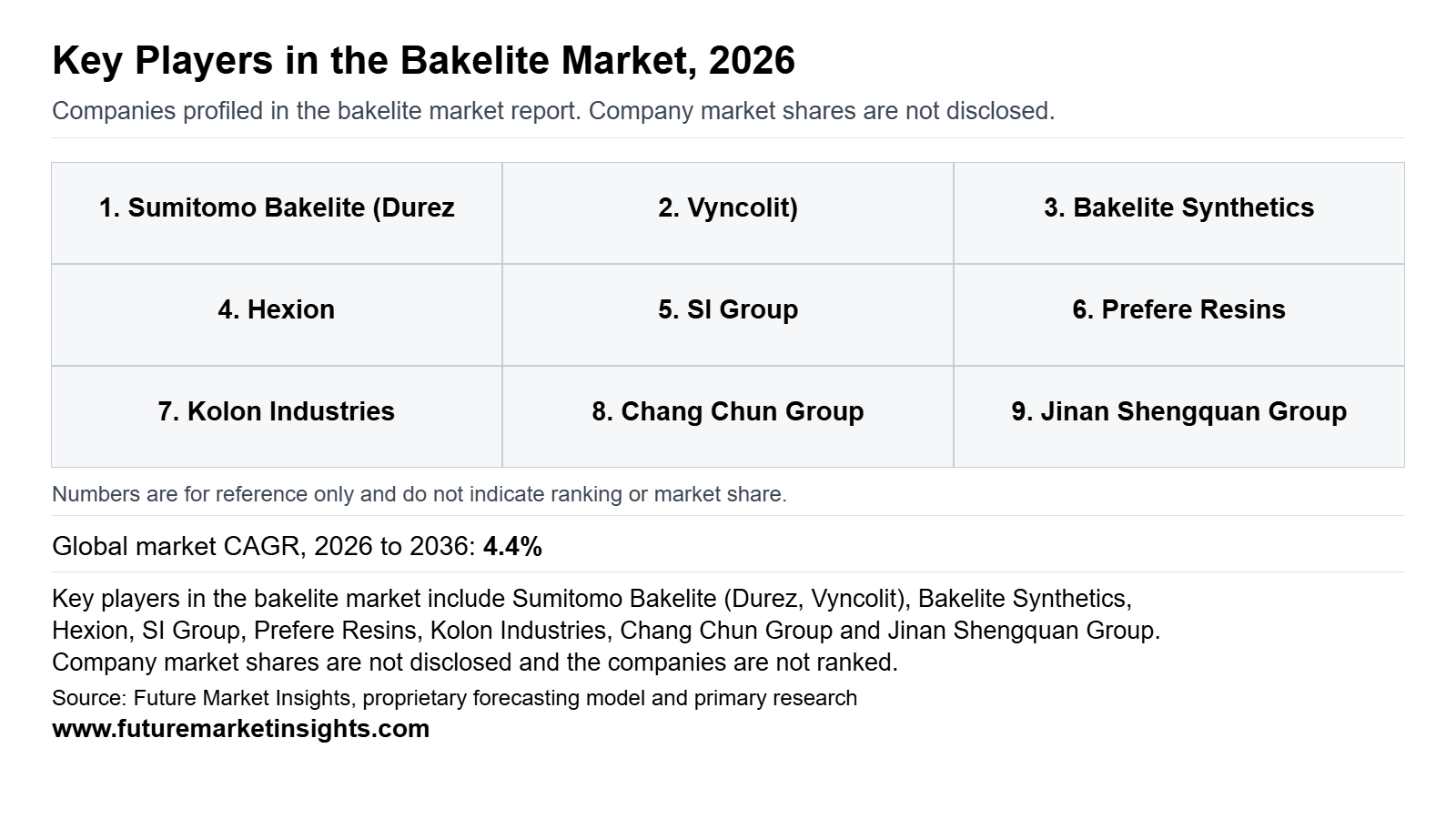
Large phenolic resin groups and many local moulders make up the bakelite market. Notable companies include Sumitomo Bakelite, Bakelite Synthetics, Hexion, SI Group and Prefere Resins. Kolon Industries, Chang Chun Group, Jinan Shengquan, Momentive and Resonac are also active. Large groups compete on technical service and global supply. Local makers, meanwhile, compete on price. Since Western plants are ageing, supply is shifting to Asia. As a result, competition is shifting toward cost and plant scale.
How Are Companies Positioned in the Bakelite Market?
Resin makers are restructuring plants. For example, Sumitomo Bakelite announced plans in September 2026 to close its Durez plant in Ohio. Asian makers, in turn, are adding capacity for moulding and friction resins. Producers are developing low-formaldehyde grades to meet new rules. Several firms are also buying smaller moulders to secure demand.
How Do Manufacturers Choose a Bakelite Supplier?
Parts makers compare bakelite suppliers first on heat and flame performance. Consistent quality between batches comes next, since parts must pass safety tests. Price then shapes the choice. Technical support and local stock also matter.
Which Capabilities Distinguish Supplier Offers?
Grade range and technical support are the main points of difference between resin makers. Low-emission grades, in turn, win buyers in Europe. Large plants lower costs. Close work with brake and electrical makers also builds long contracts.
How Does Geographic Reach Affect Competition?
Large resin groups sell worldwide from plants in Asia, Europe and North America. Local makers, however, lead in China and India. As a result, global groups focus on premium grades. Shipping costs favour local supply. Formaldehyde rules differ by region, which shapes product ranges.
| Verified Company Evidence (2026) | Commercial Effect | Buyer Action |
|---|---|---|
| 28 September 2026: Sumitomo Bakelite announced plans to close its Durez plant in Kenton, Ohio, citing its age and future investment needs (PCI Magazine, September 2026). | North American supply is consolidating. | Secure alternative supply before the closure. |
| Q1 2026: Phenolic resin prices rose on higher phenol costs and tight supply (Procurement Resource, 2026). | Input costs rose early in the year. | Use price-linked contracts. |
| Q2 2026: Phenolic resin prices weakened as feedstock costs fell and US housing starts dropped 15.4% in May (Procurement Resource, 2026). | Demand from laminates softened. | Review stock levels and pricing. |
Source: Verified corporate disclosures and Future Market Insights analysis, 2026.
| Company | Core Positioning | Verified Activity & Source Attribution |
|---|---|---|
| Sumitomo Bakelite | Japanese phenolic resin leader | Plans to close Durez Kenton plant (September 2026). |
| Bakelite Synthetics | US phenolic resin maker | Company information. |
| Hexion | US resin maker | Company information. |
| Prefere Resins | European phenolic resin maker | Company information. |
Source: Verified corporate disclosures and Future Market Insights analysis, 2026.
Bakelite Market Report Scope and Research Methodology
Bakelite sales by country form the base of FMI's estimate. These sales are taken from producer reports, moulder data and trade records. Sales are split by product, end use and form. Country totals are then added to give regional and global values. Forecasts are built on electrical and car output, brake demand, phenol prices and plant capacity. Producer news from 2026, such as Sumitomo Bakelite's plant plans, is used to check trends. As a final step, FMI checks the results against reported sales of leading producers. Any country where figures do not match is adjusted.
| Coverage Field | Report Scope |
|---|---|
| Market definition | Bakelite and phenol-formaldehyde thermoset resins and compounds for moulded parts, laminates and binders. |
| Products | Moulding compounds, industrial laminates and composites, friction material binders, abrasive and refractory binders, and electrical insulation components. |
| End uses | Electrical and electronics, automotive, industrial machinery and tooling, appliances and cookware, and aerospace and defence. |
| Forms | Moulding powder, liquid resin, impregnated sheet and prepreg, and solid and flake. |
| Grades | General purpose, heat-resistant, flame-retardant and low-emission grades. |
| Customer types | Moulders, brake makers, laminate makers and electrical firms. |
| Revenue basis | Sales value of bakelite resins and compounds. |
| Exclusions | Wood adhesives, foundry resins and finished moulded products. |
| Quantitative units | USD billion for value. |
| Volume basis | Tonnes sold, used to check value estimates. |
| Value basis | Sales recognised in the country of the buyer. |
| Regions covered | North America, Europe, East Asia, South Asia & Pacific, Latin America, and Middle East & Africa. |
| National coverage | China, United States, Japan, Germany, India, South Korea, Brazil, Italy, France, Mexico. |
| Companies covered | Sumitomo Bakelite, Bakelite Synthetics, Hexion, SI Group, Prefere Resins, Kolon Industries, Chang Chun Group, Jinan Shengquan, Momentive and Resonac. |
Source: Future Market Insights analysis of the bakelite market, 2026.
Research Sources and Bibliography
- PCI Magazine. (2026, September 28). Sumitomo Bakelite plans Ohio phenolic resin plant closure.
- Procurement Resource. (2026). Phenol formaldehyde resins price trends.
- Procurement Resource. (2026). Phenolic resin price trends.
- MarketResearch.com. (2026). Bakelite market size, share and industry outlook, 2026.
Table of Content
- Key Takeaways
- Market Size and CAGR
- Top Growth Driver
- Fastest Growing Segment
- Leading Region
- Key Companies
- Emerging Opportunities
- Executive Summary
- Global Market Outlook
- Demand-side Trends
- Supply-side Trends
- Technology Roadmap Analysis
- Analysis and Recommendations
- Analyst Perspective (What is happening? Why now? What should investors know?)
- Key Questions Answered
- How large is the market?
- What is the CAGR?
- What are key trends?
- Which region dominates?
- Who are the leaders?
Read More...
- Market Overview
- Market Coverage / Taxonomy
- Market Definition / Scope / Limitations
- Research Methodology
- Chapter Orientation
- Analytical Lens and Working Hypotheses
- Market Structure, Signals, and Trend Drivers
- Benchmarking and Cross-market Comparability
- Market Sizing, Forecasting, and Opportunity Mapping
- Research Design and Evidence Framework
- Desk Research Programme (Secondary Evidence)
- Expert Input and Fieldwork (Primary Evidence)
- Tooling, Models, and Reference Databases
- Data Engineering and Model Build
- Quality Assurance and Audit Trail
- Market Background
- Market Dynamics (Drivers, Restraints, Opportunity, Trends)
- Scenario Forecast (Optimistic, Likely, Conservative)
- Impact Analysis
- AI Impact
- Sustainability Impact
- Regulatory Impact
- Technology Impact
- Consumer / Buyer Analysis
- Purchase Drivers
- Adoption Barriers
- Buyer Journey
- Opportunity Map Analysis
- Product Life Cycle Analysis
- Supply Chain Analysis
- Investment Feasibility Matrix
- Value Chain Analysis
- PESTLE and Porter's Analysis
- Regulatory Landscape
- Regional Parent Market Outlook
- Production and Consumption Statistics
- Import and Export Statistics
- Global Bakelite Market Analysis and Forecast, 2021 to 2036
- Historical Market Size Value (USD Billion) Analysis, 2021 to 2025
- Current and Future Market Size Value (USD Billion) Projections, 2026 to 2036
- Y-o-Y Growth Trend Analysis
- Absolute $ Opportunity Analysis
- Global Bakelite Market Pricing Analysis, 2021 to 2036
- Global Bakelite Market Analysis and Forecast, By Product, 2021 to 2036
- Introduction / Key Findings
- Historical Market Size Value (USD Billion) Analysis By Product, 2021 to 2025
- Current and Future Market Size Value (USD Billion) Analysis and Forecast By Product, 2026 to 2036
- Moulding Compounds
- Industrial Laminates & Composites
- Friction Material Binders
- Abrasive & Refractory Binders
- Electrical Insulation Components
- Y-o-Y Growth Trend Analysis By Product, 2021 to 2025
- Absolute $ Opportunity Analysis By Product, 2026 to 2036
- Global Bakelite Market Analysis and Forecast, By End Use, 2021 to 2036
- Introduction / Key Findings
- Historical Market Size Value (USD Billion) Analysis By End Use, 2021 to 2025
- Current and Future Market Size Value (USD Billion) Analysis and Forecast By End Use, 2026 to 2036
- Electrical & Electronics
- Automotive
- Industrial Machinery & Tooling
- Appliances & Cookware
- Aerospace & Defence
- Y-o-Y Growth Trend Analysis By End Use, 2021 to 2025
- Absolute $ Opportunity Analysis By End Use, 2026 to 2036
- Global Bakelite Market Analysis and Forecast, By Form, 2021 to 2036
- Introduction / Key Findings
- Historical Market Size Value (USD Billion) Analysis By Form, 2021 to 2025
- Current and Future Market Size Value (USD Billion) Analysis and Forecast By Form, 2026 to 2036
- Moulding Powder
- Liquid Resin
- Impregnated Sheet & Prepreg
- Solid & Flake
- Y-o-Y Growth Trend Analysis By Form, 2021 to 2025
- Absolute $ Opportunity Analysis By Form, 2026 to 2036
- Global Bakelite Market Analysis and Forecast, By Region, 2021 to 2036
- Introduction
- Historical Market Size Value (USD Billion) Analysis By Region, 2021 to 2025
- Current Market Size Value (USD Billion) Analysis and Forecast By Region, 2026 to 2036
- North America
- Europe
- East Asia
- South Asia & Pacific
- Latin America
- Middle East & Africa
- Market Attractiveness Analysis By Region
- North America Bakelite Market Analysis and Forecast, By Country, 2021 to 2036
- Historical Market Size Value (USD Billion) Trend Analysis By Market Taxonomy, 2021 to 2025
- Market Size Value (USD Billion) Forecast By Market Taxonomy, 2026 to 2036
- By Country
- United States
- Rest of North America
- By Product
- By End Use
- By Form
- By Country
- Market Attractiveness Analysis
- By Country
- By Product
- By End Use
- By Form
- Key Takeaways
- Europe Bakelite Market Analysis and Forecast, By Country, 2021 to 2036
- Historical Market Size Value (USD Billion) Trend Analysis By Market Taxonomy, 2021 to 2025
- Market Size Value (USD Billion) Forecast By Market Taxonomy, 2026 to 2036
- By Country
- Germany
- Italy
- France
- Rest of Europe
- By Product
- By End Use
- By Form
- By Country
- Market Attractiveness Analysis
- By Country
- By Product
- By End Use
- By Form
- Key Takeaways
- East Asia Bakelite Market Analysis and Forecast, By Country, 2021 to 2036
- Historical Market Size Value (USD Billion) Trend Analysis By Market Taxonomy, 2021 to 2025
- Market Size Value (USD Billion) Forecast By Market Taxonomy, 2026 to 2036
- By Country
- China
- Japan
- South Korea
- Rest of East Asia
- By Product
- By End Use
- By Form
- By Country
- Market Attractiveness Analysis
- By Country
- By Product
- By End Use
- By Form
- Key Takeaways
- South Asia & Pacific Bakelite Market Analysis and Forecast, By Country, 2021 to 2036
- Historical Market Size Value (USD Billion) Trend Analysis By Market Taxonomy, 2021 to 2025
- Market Size Value (USD Billion) Forecast By Market Taxonomy, 2026 to 2036
- By Country
- India
- Rest of South Asia & Pacific
- By Product
- By End Use
- By Form
- By Country
- Market Attractiveness Analysis
- By Country
- By Product
- By End Use
- By Form
- Key Takeaways
- Latin America Bakelite Market Analysis and Forecast, By Country, 2021 to 2036
- Historical Market Size Value (USD Billion) Trend Analysis By Market Taxonomy, 2021 to 2025
- Market Size Value (USD Billion) Forecast By Market Taxonomy, 2026 to 2036
- By Country
- Brazil
- Mexico
- Rest of Latin America
- By Product
- By End Use
- By Form
- By Country
- Market Attractiveness Analysis
- By Country
- By Product
- By End Use
- By Form
- Key Takeaways
- Middle East & Africa Bakelite Market Analysis and Forecast, By Country, 2021 to 2036
- Historical Market Size Value (USD Billion) Trend Analysis By Market Taxonomy, 2021 to 2025
- Market Size Value (USD Billion) Forecast By Market Taxonomy, 2026 to 2036
- By Country
- Rest of Middle East & Africa
- By Product
- By End Use
- By Form
- By Country
- Market Attractiveness Analysis
- By Country
- By Product
- By End Use
- By Form
- Key Takeaways
- Key Countries Market Analysis
- China
- Pricing Analysis
- Market Share Analysis, 2025
- By Product
- By End Use
- By Form
- United States
- Pricing Analysis
- Market Share Analysis, 2025
- By Product
- By End Use
- By Form
- Japan
- Pricing Analysis
- Market Share Analysis, 2025
- By Product
- By End Use
- By Form
- Germany
- Pricing Analysis
- Market Share Analysis, 2025
- By Product
- By End Use
- By Form
- India
- Pricing Analysis
- Market Share Analysis, 2025
- By Product
- By End Use
- By Form
- South Korea
- Pricing Analysis
- Market Share Analysis, 2025
- By Product
- By End Use
- By Form
- Brazil
- Pricing Analysis
- Market Share Analysis, 2025
- By Product
- By End Use
- By Form
- Italy
- Pricing Analysis
- Market Share Analysis, 2025
- By Product
- By End Use
- By Form
- France
- Pricing Analysis
- Market Share Analysis, 2025
- By Product
- By End Use
- By Form
- Mexico
- Pricing Analysis
- Market Share Analysis, 2025
- By Product
- By End Use
- By Form
- China
- Market Structure Analysis
- Competition Dashboard
- Competition Benchmarking
- Market Share Analysis of Top Players
- By Regional
- By Product
- By End Use
- By Form
- Emerging Startups
- Innovation Benchmarking
- Competition Analysis
- Competition Deep Dive
- Sumitomo Bakelite
- Overview
- Product Portfolio
- Profitability by Market Segments
- Sales Footprint
- Strategy Overview
- Marketing Strategy
- Product Strategy
- Channel Strategy
- Bakelite Synthetics
- Hexion
- SI Group
- Prefere Resins
- Kolon Industries
- Chang Chun Group
- Jinan Shengquan
- Momentive
- Resonac
- Sumitomo Bakelite
- Case Studies
- Success Stories
- Recent Developments
- Competition Deep Dive
- Assumptions & Acronyms Used
List of Tables
- Table 1: Global Bakelite Market Value (USD Billion) Forecast by Region, 2021 to 2036
- Table 2: Global Bakelite Market Value (USD Billion) Forecast by Product, 2021 to 2036
- Table 3: Global Bakelite Market Value (USD Billion) Forecast by End Use, 2021 to 2036
- Table 4: Global Bakelite Market Value (USD Billion) Forecast by Form, 2021 to 2036
- Table 5: North America Bakelite Market Value (USD Billion) Forecast by Country, 2021 to 2036
- Table 6: North America Bakelite Market Value (USD Billion) Forecast by Product, 2021 to 2036
- Table 7: North America Bakelite Market Value (USD Billion) Forecast by End Use, 2021 to 2036
- Table 8: North America Bakelite Market Value (USD Billion) Forecast by Form, 2021 to 2036
- Table 9: Europe Bakelite Market Value (USD Billion) Forecast by Country, 2021 to 2036
- Table 10: Europe Bakelite Market Value (USD Billion) Forecast by Product, 2021 to 2036
- Table 11: Europe Bakelite Market Value (USD Billion) Forecast by End Use, 2021 to 2036
- Table 12: Europe Bakelite Market Value (USD Billion) Forecast by Form, 2021 to 2036
- Table 13: East Asia Bakelite Market Value (USD Billion) Forecast by Country, 2021 to 2036
- Table 14: East Asia Bakelite Market Value (USD Billion) Forecast by Product, 2021 to 2036
- Table 15: East Asia Bakelite Market Value (USD Billion) Forecast by End Use, 2021 to 2036
- Table 16: East Asia Bakelite Market Value (USD Billion) Forecast by Form, 2021 to 2036
- Table 17: South Asia & Pacific Bakelite Market Value (USD Billion) Forecast by Country, 2021 to 2036
- Table 18: South Asia & Pacific Bakelite Market Value (USD Billion) Forecast by Product, 2021 to 2036
- Table 19: South Asia & Pacific Bakelite Market Value (USD Billion) Forecast by End Use, 2021 to 2036
- Table 20: South Asia & Pacific Bakelite Market Value (USD Billion) Forecast by Form, 2021 to 2036
- Table 21: Latin America Bakelite Market Value (USD Billion) Forecast by Country, 2021 to 2036
- Table 22: Latin America Bakelite Market Value (USD Billion) Forecast by Product, 2021 to 2036
- Table 23: Latin America Bakelite Market Value (USD Billion) Forecast by End Use, 2021 to 2036
- Table 24: Latin America Bakelite Market Value (USD Billion) Forecast by Form, 2021 to 2036
- Table 25: Middle East & Africa Bakelite Market Value (USD Billion) Forecast by Country, 2021 to 2036
- Table 26: Middle East & Africa Bakelite Market Value (USD Billion) Forecast by Product, 2021 to 2036
- Table 27: Middle East & Africa Bakelite Market Value (USD Billion) Forecast by End Use, 2021 to 2036
- Table 28: Middle East & Africa Bakelite Market Value (USD Billion) Forecast by Form, 2021 to 2036
List of Figures
- Figure 1: Global Bakelite Market Pricing Analysis
- Figure 2: Global Bakelite Market Value (USD Billion) Forecast 2021-2036
- Figure 3: Global Bakelite Market Value Share and BPS Analysis by Product, 2026 and 2036
- Figure 4: Global Bakelite Market Y-o-Y Growth Comparison by Product, 2026-2036
- Figure 5: Global Bakelite Market Attractiveness Analysis by Product
- Figure 6: Global Bakelite Market Value Share and BPS Analysis by End Use, 2026 and 2036
- Figure 7: Global Bakelite Market Y-o-Y Growth Comparison by End Use, 2026-2036
- Figure 8: Global Bakelite Market Attractiveness Analysis by End Use
- Figure 9: Global Bakelite Market Value Share and BPS Analysis by Form, 2026 and 2036
- Figure 10: Global Bakelite Market Y-o-Y Growth Comparison by Form, 2026-2036
- Figure 11: Global Bakelite Market Attractiveness Analysis by Form
- Figure 12: Global Bakelite Market Value (USD Billion) Share and BPS Analysis by Region, 2026 and 2036
- Figure 13: Global Bakelite Market Y-o-Y Growth Comparison by Region, 2026-2036
- Figure 14: Global Bakelite Market Attractiveness Analysis by Region
- Figure 15: North America Bakelite Market Incremental Dollar Opportunity, 2026-2036
- Figure 16: Europe Bakelite Market Incremental Dollar Opportunity, 2026-2036
- Figure 17: East Asia Bakelite Market Incremental Dollar Opportunity, 2026-2036
- Figure 18: South Asia & Pacific Bakelite Market Incremental Dollar Opportunity, 2026-2036
- Figure 19: Latin America Bakelite Market Incremental Dollar Opportunity, 2026-2036
- Figure 20: Middle East & Africa Bakelite Market Incremental Dollar Opportunity, 2026-2036
- Figure 21: North America Bakelite Market Value Share and BPS Analysis by Country, 2026 and 2036
- Figure 22: North America Bakelite Market Value Share and BPS Analysis by Product, 2026 and 2036
- Figure 23: North America Bakelite Market Y-o-Y Growth Comparison by Product, 2026-2036
- Figure 24: North America Bakelite Market Attractiveness Analysis by Product
- Figure 25: North America Bakelite Market Value Share and BPS Analysis by End Use, 2026 and 2036
- Figure 26: North America Bakelite Market Y-o-Y Growth Comparison by End Use, 2026-2036
- Figure 27: North America Bakelite Market Attractiveness Analysis by End Use
- Figure 28: North America Bakelite Market Value Share and BPS Analysis by Form, 2026 and 2036
- Figure 29: North America Bakelite Market Y-o-Y Growth Comparison by Form, 2026-2036
- Figure 30: North America Bakelite Market Attractiveness Analysis by Form
- Figure 31: Europe Bakelite Market Value Share and BPS Analysis by Country, 2026 and 2036
- Figure 32: Europe Bakelite Market Value Share and BPS Analysis by Product, 2026 and 2036
- Figure 33: Europe Bakelite Market Y-o-Y Growth Comparison by Product, 2026-2036
- Figure 34: Europe Bakelite Market Attractiveness Analysis by Product
- Figure 35: Europe Bakelite Market Value Share and BPS Analysis by End Use, 2026 and 2036
- Figure 36: Europe Bakelite Market Y-o-Y Growth Comparison by End Use, 2026-2036
- Figure 37: Europe Bakelite Market Attractiveness Analysis by End Use
- Figure 38: Europe Bakelite Market Value Share and BPS Analysis by Form, 2026 and 2036
- Figure 39: Europe Bakelite Market Y-o-Y Growth Comparison by Form, 2026-2036
- Figure 40: Europe Bakelite Market Attractiveness Analysis by Form
- Figure 41: East Asia Bakelite Market Value Share and BPS Analysis by Country, 2026 and 2036
- Figure 42: East Asia Bakelite Market Value Share and BPS Analysis by Product, 2026 and 2036
- Figure 43: East Asia Bakelite Market Y-o-Y Growth Comparison by Product, 2026-2036
- Figure 44: East Asia Bakelite Market Attractiveness Analysis by Product
- Figure 45: East Asia Bakelite Market Value Share and BPS Analysis by End Use, 2026 and 2036
- Figure 46: East Asia Bakelite Market Y-o-Y Growth Comparison by End Use, 2026-2036
- Figure 47: East Asia Bakelite Market Attractiveness Analysis by End Use
- Figure 48: East Asia Bakelite Market Value Share and BPS Analysis by Form, 2026 and 2036
- Figure 49: East Asia Bakelite Market Y-o-Y Growth Comparison by Form, 2026-2036
- Figure 50: East Asia Bakelite Market Attractiveness Analysis by Form
- Figure 51: South Asia & Pacific Bakelite Market Value Share and BPS Analysis by Country, 2026 and 2036
- Figure 52: South Asia & Pacific Bakelite Market Value Share and BPS Analysis by Product, 2026 and 2036
- Figure 53: South Asia & Pacific Bakelite Market Y-o-Y Growth Comparison by Product, 2026-2036
- Figure 54: South Asia & Pacific Bakelite Market Attractiveness Analysis by Product
- Figure 55: South Asia & Pacific Bakelite Market Value Share and BPS Analysis by End Use, 2026 and 2036
- Figure 56: South Asia & Pacific Bakelite Market Y-o-Y Growth Comparison by End Use, 2026-2036
- Figure 57: South Asia & Pacific Bakelite Market Attractiveness Analysis by End Use
- Figure 58: South Asia & Pacific Bakelite Market Value Share and BPS Analysis by Form, 2026 and 2036
- Figure 59: South Asia & Pacific Bakelite Market Y-o-Y Growth Comparison by Form, 2026-2036
- Figure 60: South Asia & Pacific Bakelite Market Attractiveness Analysis by Form
- Figure 61: Latin America Bakelite Market Value Share and BPS Analysis by Country, 2026 and 2036
- Figure 62: Latin America Bakelite Market Value Share and BPS Analysis by Product, 2026 and 2036
- Figure 63: Latin America Bakelite Market Y-o-Y Growth Comparison by Product, 2026-2036
- Figure 64: Latin America Bakelite Market Attractiveness Analysis by Product
- Figure 65: Latin America Bakelite Market Value Share and BPS Analysis by End Use, 2026 and 2036
- Figure 66: Latin America Bakelite Market Y-o-Y Growth Comparison by End Use, 2026-2036
- Figure 67: Latin America Bakelite Market Attractiveness Analysis by End Use
- Figure 68: Latin America Bakelite Market Value Share and BPS Analysis by Form, 2026 and 2036
- Figure 69: Latin America Bakelite Market Y-o-Y Growth Comparison by Form, 2026-2036
- Figure 70: Latin America Bakelite Market Attractiveness Analysis by Form
- Figure 71: Middle East & Africa Bakelite Market Value Share and BPS Analysis by Country, 2026 and 2036
- Figure 72: Middle East & Africa Bakelite Market Value Share and BPS Analysis by Product, 2026 and 2036
- Figure 73: Middle East & Africa Bakelite Market Y-o-Y Growth Comparison by Product, 2026-2036
- Figure 74: Middle East & Africa Bakelite Market Attractiveness Analysis by Product
- Figure 75: Middle East & Africa Bakelite Market Value Share and BPS Analysis by End Use, 2026 and 2036
- Figure 76: Middle East & Africa Bakelite Market Y-o-Y Growth Comparison by End Use, 2026-2036
- Figure 77: Middle East & Africa Bakelite Market Attractiveness Analysis by End Use
- Figure 78: Middle East & Africa Bakelite Market Value Share and BPS Analysis by Form, 2026 and 2036
- Figure 79: Middle East & Africa Bakelite Market Y-o-Y Growth Comparison by Form, 2026-2036
- Figure 80: Middle East & Africa Bakelite Market Attractiveness Analysis by Form
- Figure 81: Global Bakelite Market - Tier Structure Analysis
- Figure 82: Global Bakelite Market - Company Share Analysis
Frequently Asked Questions
How big is the bakelite market in 2026?
FMI estimates the global bakelite market at USD 3.30 billion in 2026, up from USD 3.18 billion in 2025. Electrical and brake demand is driving this growth.
How fast is the bakelite market expected to grow through 2036?
FMI projects a 4.4% CAGR from 2026 to 2036, taking the market to USD 5.08 billion by 2036. This adds USD 1.78 billion, led by laminates and friction binders.
Which product leads the bakelite market?
Moulding compounds lead with 30.0% of 2026 revenue, as switch and handle makers rely on these compounds. Friction material binders are growing fastest, at about 4.8%.
Which end use leads the bakelite market?
Electrical and electronics hold 34.0% of 2026 revenue. Aerospace and defence is growing fastest, at about 5.3% a year, from a small base.
Which form leads the bakelite market?
Moulding powder accounts for 38.0% of 2026 revenue. Liquid resin is growing fastest, at about 4.8% a year from 2026 to 2036.
Which country is the largest bakelite market?
China is the largest market, with 34.0% of global revenue in 2026, worth USD 1.12 billion. The United States follows at 15.0% and Japan at 7.0%.
Which countries are expected to grow fastest in the bakelite market?
India is projected to grow fastest, at a 6.4% CAGR from 2026 to 2036, as parts output rises. China follows at 4.8% and South Korea at 4.4%.
What drives demand for bakelite?
Electrical, brake and heat-resistant parts are the main drivers. Grid upgrades and electric cars are also adding demand for phenolic parts.
Preview the report firsthand - request a free sample
Get SampleGet the brochure for pricing and purchase details.
Get PDF
