
- Market Size (2026)
- USD 2.3 Bn
- Forecast (2036)
- USD 3.9 Bn
- CAGR (2026 to 2036)
- 5.5%
How big is the Cable Ties Market in 2026?
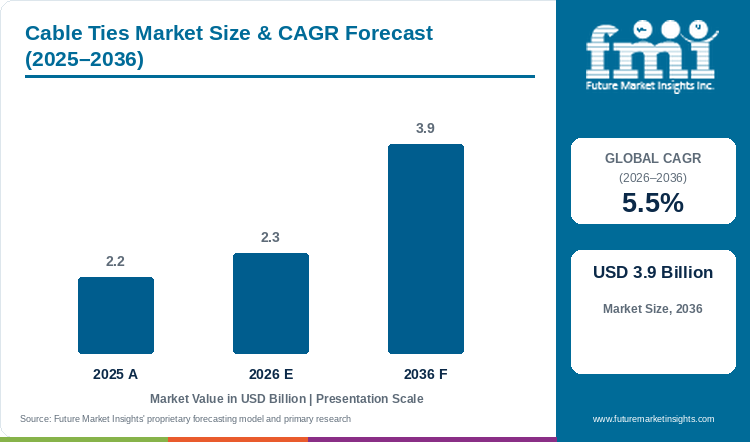
The Cable Ties Market is projected to reach USD 3.9 billion by 2036, growing at a 5.5% CAGR from 2026 to 2036. The market stands at USD 2.3 billion in 2026.
Cable Ties Market Size and Forecast
Table 1: Cable Ties Market Size and Forecast
| Market size and forecast | Value |
|---|---|
| Market size in 2025 | USD 2.2 billion |
| Estimated market size in 2026 | USD 2.3 billion |
| Projected market size by 2036 | USD 3.9 billion |
| CAGR from 2026 to 2036 | 5.5% |
Source: Future Market Insights analysis of the cable ties market, 2026.
The market was valued at USD 2.2 billion in 2025. Demand follows vehicle output, electrical installation and building work, and the latest readings point in different directions. US construction spending for September 2026 was USD 2,186.1 billion at a seasonally adjusted annual rate, 2.7% below September 2025. UK car output for the first nine months of 2026 was 543,682 units, against 543,083. The VDA series for Germany shows 326,300 vehicles in October 2026, 7% below October 2025.
Standards shape what a supplier can sell more than price does. The fourth edition of IEC 62275 was published on 22 November 2022 as a technical revision of the 2018 edition. It covers metallic, non-metallic and composite ties and their fixing devices. UL 62275 is the US adoption of IEC 62275, and it adds Types 11, 2S, 21 and 21S, which are not recognised outside Canada and the United States. It also replaced the cable tie requirements of UL 1565. Material choice then sets cost and performance. Panduit lists post-industrial recycled nylon 6.6, nylon 6/12 and 304, 316 and 316L stainless steel in its ranges. The choice between nylon and stainless steel follows the corrosion, heat and fire conditions of the installation.
Key Market Trends & Insights
- Recycled content is entering mainstream ranges. Panduit lists post-industrial recycled nylon 6.6 ties made from up to 100% recycled nylon. The resin is certified to the SCS Recycled Content Standard. The ties carry a Type 2S and 21S classification under UL 62275, and a stated carbon footprint up to 36% lower than standard plastic ties.
- Weather-resistant chemistry is being matched to solar and outdoor work. In a post dated 25 April 2024, Panduit described a nylon 6/12 tie. It says the tie withstands UV exposure up to 10 times longer than standard black ties, with an expected outdoor lifespan of over 20 years.
- Biodegradable options are appearing. HellermannTyton states that its new microplastic-free ties are designed to fully biodegrade at the end of their useful life. Its range also covers releasable, stainless steel and fixing-element ties.
Regional Highlights
- North America: UL 62275 and its harmonised Canadian and Mexican versions, CSA C22.2 No. 62275 and NMX-J-623-ANCE, give suppliers one test base across three countries. Advanced Cable Ties manufactures in Gardner, Massachusetts.
- Continental Europe: SapiSelco in Saonara, Italy, declares CE marking under the Low Voltage Directive 2014/35/EU and holds a TUV certificate against EN 62275.
- United Kingdom: ties are sold with UKCA marking alongside CE marking, and Unex lists the Electrical Equipment (Safety) Regulations 2016 for its black UV-resistant tie.
Analyst Perspective
“A cable tie looks like a commodity, but the purchase is decided by the test certificate behind it. Nylon carries the volume, yet the buyer who matters most is the one with a vibration, heat or salt-spray problem that nylon cannot solve. Suppliers that hold Type 2S or 21S listings, marine approvals and a stainless steel range can serve an automotive plant, a shipyard and an electrical contractor from one catalogue. Buyers should specify the Type designation and temperature rating in the purchase order, along with the length and width.”
- Nikhil Kaitwade, Principal Consultant, FMI
How is the Cable Ties Market segmented?
- By material type: Nylon, Stainless Steel and Others
- By product type: Plastic Pawl Cable Ties, Ball Lock Cable Ties and Ladder Cable Ties
- By end use: Automotive, Consumer Goods, Marine, Electronics and Electrical and Building and Construction
- By region: Worldwide, with North America and Europe as profiled regions
Why does Nylon lead by Material Type in the Cable Ties Market in 2026?
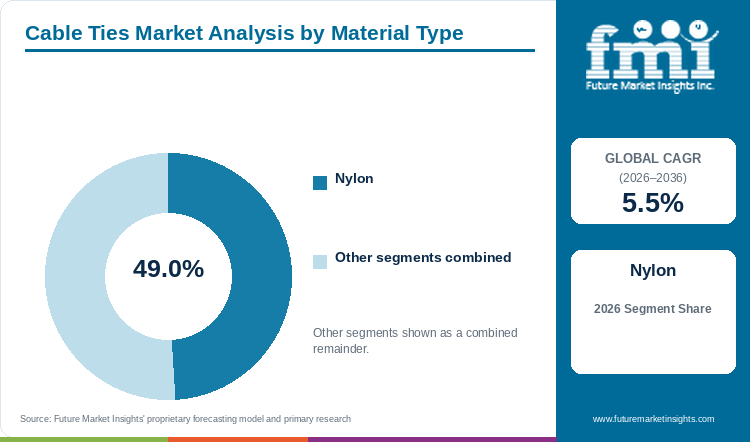
Nylon accounts for 49.0% of the Cable Ties Market by material type in 2026. IEC 62275 and UL 62275 allow Type 1 and Type 2 ties to be molded from any non-metallic material, so the standard does not restrict the polymer. Suppliers have still concentrated on polyamide 6.6 [1]. SapiSelco makes its ME-T and re-openable ties in self-extinguishing polyamide 6.6 rated UL 94 V2 [6][7]. Unex specifies weather-resistant polyamide 6.6 with UL 94 class V2 for its black UV-resistant tie [16], and Panduit's recycled range is nylon 6.6 [12]. Nylon also covers the widest set of conditions through additives and grades. Panduit explains that outdoor-rated nylon 6.6 contains more carbon atoms to block most UV radiation. Panduit describes Nylon 612 (PA612) as combining performance characteristics of nylon 6 and nylon 12 [14]. Unex gives an operating range of minus 40 to plus 105 degrees Celsius for its black tie. The tie is halogen-free to EN 50642:2018 and suitable for outdoor use to ASTM D 6779-07 [16]. SapiSelco offers colored, metal-detectable and UV-stabilized versions, and a low-temperature material [6]. Grade variety inside one polymer family keeps nylon at the front of the material split. Other materials fill niches without challenging that lead. SapiSelco's Click Tie is made of LDPE polyethylene with resistance to chemical aggression and a tensile strength of 70 N and 275 N [7]. HellermannTyton's releasable listings include TPU and TPE soft-grip designs [11]. Stainless steel serves the harsher cases. Panduit's comparison chart rates 304 and 316 stainless steel best for loop tensile strength, UV and extreme temperatures [13]. Vehicle assembly buyers that follow the fasteners market see both materials in use.
Table 2: Material Type, 2026 Share
| Leading Share | 2026 market share |
|---|---|
| Nylon | 49.0% |
| All Other Segments Combined Share | 51.0% |
Source: Future Market Insights analysis of the cable ties market, 2026.
Why do Plastic Pawl Cable Ties lead by Product Type in the Cable Ties Market in 2026?
Plastic Pawl Cable Ties account for 49.0% of the Cable Ties Market by product type in 2026. The segment covers standard single-use ties and releasable ties, since both lock with a moulded plastic pawl. Standard ties carry the volume, and releasable designs add reuse. HellermannTyton states that some releasable cable ties are designed to be used more than once [11]. SapiSelco calls its RIA and RID ties reusable and applied by hand, with 280 N and 180 N tensile strength respectively [7]. A tie that can be opened lets an installer correct a harness, add a cable or inspect a bundle without cutting it. Range depth supports the lead. HellermannTyton's releasable range runs from 57 N for soft-grip designs to 1115 N for the RT250I, in polyamide 66 variants, PA12, TPU and TPE [11]. One of its releasable ties has a bundle diameter of 16.0 to 68.0 millimetres at 200 N [8].
Table 3: Product Type, 2026 Share
| Leading Share | 2026 market share |
|---|---|
| Plastic Pawl Cable Ties | 49.0% |
| All Other Segments Combined Share | 51.0% |
Source: Future Market Insights analysis of the cable ties market, 2026.
Why does Automotive lead by End use in the Cable Ties Market in 2026?
Automotive accounts for 38.0% of the Cable Ties Market by end use in 2026. HellermannTyton lists automotive among the sectors it serves, alongside aviation and aerospace, food and beverage, rail, shipbuilding, solar, telecommunications and wind power [9]. SapiSelco holds IATF 16949 certification for automotive quality management [5]. IDEX says BAND-IT products primarily serve the automotive, aerospace, energy, utility, municipal, cable management and general industrial markets [18]. Vehicle volumes decide how far that lead grows. UK car output for the first nine months of 2026 was 543,682 units, up 0.1% on a year earlier, with September up 38.6% [20]. Germany's VDA series recorded 326,300 vehicles in October 2026, 7% below October 2025 [21]. SapiSelco's ME-T tie pairs a stainless steel locking tooth with a polyamide 6.6 body for vibration-prone installations [6], the condition this end use presents.
Table 4: End use, 2026 Share
| Leading Share | 2026 market share |
|---|---|
| Automotive | 38.0% |
| All Other Segments Combined Share | 62.0% |
Source: Future Market Insights analysis of the cable ties market, 2026.
What are the key drivers, restraints and opportunities?
Driver
Certification-led specification. UL 62275 and IEC 62275 define ties by Type designation. Type 2 ties keep 100% of declared loop tensile strength after heat aging, temperature cycling and UV exposure. Type 1 ties need to retain only 50% [1]. Type 2S and 21S add a minimum declaration of 220 N and a five-minute load hold for supporting flexible conduit and cables [1]. A supplier with those listings can sell into regulated installations that a plain tie cannot enter.
Wide product reach across sectors. SapiSelco lists standard, steel-tooth, high-tensile, collar, identification, releasable and tamper-evident ties, plus fixing systems and tools [4]. HellermannTyton reports 18 manufacturing facilities, product development in 13 countries and more than 7,000 employees in 40 countries [9]. Breadth of that kind suits buyers who also source wire and cable accessories and want fewer suppliers.
Restraint
Weak building activity. US construction spending in September 2026 was 2.7% below a year earlier, and residential spending of USD 848.8 billion was down 5.5% from August [19]. Nonresidential work rose 1.1% over the month to USD 790.6 billion [19]. Ties used in building and construction follow that mix, so the segment gains less in a soft housing year.
Uneven vehicle output. Germany's October 2026 figure was 7% below a year earlier [21], and the UK nine-month total was almost flat at 0.1% growth [20]. Because automotive carries the largest share of cable tie demand, a weak production quarter shows up quickly in distributor orders. Suppliers also carry the cost of parallel certification, since Types 11, 2S, 21 and 21S are recognised only in Canada and the United States [1].
Opportunity
Recycled and biodegradable formats. Panduit offers nylon 6.6 ties and mounts made from up to 100% recycled nylon, validated to UL 2809 for recycled content and carrying needle flame testing per IEC 62275 [12]. HellermannTyton markets microplastic-free ties designed to biodegrade [8]. Early suppliers can charge for documented recycled content in tenders that score sustainability.
Stainless steel for harsh sites. Panduit describes its Pan-Steel system as stainless steel ties, banding, mounts and tools, with 304, 316 and 316L grades and a useable life it puts above 30 years [13]. Its ball lock head is credited with high tensile strength and low thread force [15]. Offshore, solar and heat-exposed installations are the natural growth areas. The conduit market shows a similar pull toward corrosion-resistant materials at the same sites.
Cable Ties Market by Country (2026 to 2036)
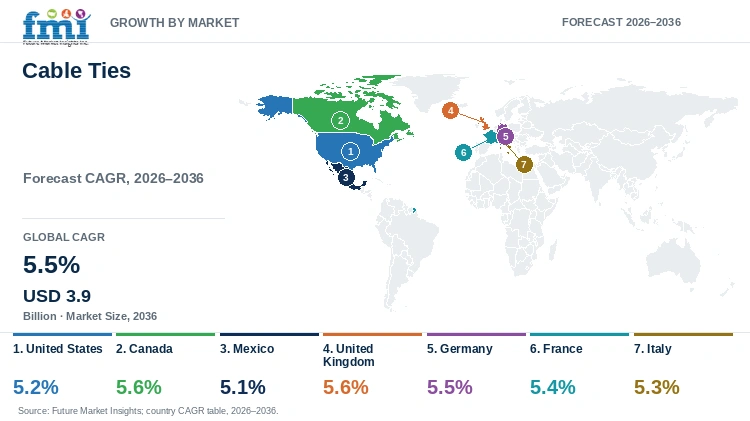
Table 5: Cable Ties Market Country Growth Forecast
| Country | CAGR, 2026 to 2036 |
|---|---|
| United States | 5.2% |
| Canada | 5.6% |
| Mexico | 5.1% |
| United Kingdom | 5.6% |
| Germany | 5.5% |
| France | 5.4% |
| Italy | 5.3% |
Source: Future Market Insights analysis of the cable ties market, 2026.
United States
The United States sets the reference test base for the North American market. UL 62275 is the adoption of IEC 62275 and replaced the cable tie rules in UL 1565 [1]. Advanced Cable Ties, based at 245 Suffolk Lane in Gardner, Massachusetts, says its products meet UL Type 21S and CSA Type 21S and the military standard AS33671, and that it is ISO 9001:2015 registered [3].
Building demand is soft. The Census Bureau reported on 2 November 2026 that construction spending in September was USD 2,186.1 billion, 2.7% below September 2025, with residential at USD 848.8 billion and nonresidential at USD 790.6 billion [19]. Contractors who buy ties for electrical rough-in will find volumes tied to nonresidential work, which rose 1.1% from August.
Supply links across the southern border are deep. Census data show US goods imports from Mexico of USD 481.6 billion and exports of USD 297.6 billion for January to September 2026 [24]. Ties that cross the border inside vehicles and equipment are covered by the same UL 62275 family of tests [1].
Canada
Canada shares the UL 62275 text through CSA C22.2 No. 62275, and Types 11, 2S, 21 and 21S are recognised in Canada and the United States only [1]. Advanced Cable Ties lists CSA Type 21S [3], and SapiSelco's UL file E160935 covers Types 21, 21S, 2 and 2S with the CSA C22.2 No. 62275 reference [5].
Statistics Canada reported on 5 November 2026 that Canada's gross domestic product rose 1.9% in 2025 after 2.1% in 2024 [25]. Steady growth suits a market where cable ties follow replacement and maintenance work as much as new building.
A supplier that holds both the UL and CSA listings can offer the same tie on both sides of the border. Canada's 5.6% forecast rate is among the highest of the profiled countries, and buyers should confirm the CSA listing on every Type 21S specification.
Mexico
Mexico applies NMX-J-623-ANCE, which is harmonised with UL 62275 and CSA C22.2 No. 62275, so the three North American texts rest on one test base [1]. Types 11, 2S, 21 and 21S are not recognised outside Canada and the United States, which matters for exporters supplying plants in Mexico [1].
The trade volume behind the country is large. The Census Bureau lists US goods exports to Mexico at USD 34.1 billion in September 2026 and USD 297.6 billion for January to September, with imports at USD 62.2 billion and USD 481.6 billion [24]. Vehicles and electrical goods built in Mexico use cable ties within harnesses and panels, and each product that crosses the border carries supplier approvals.
SapiSelco's file for Type 11 products refers to UL 62275 and CSA C22.2 No. 62275 [5]. Type 11 ties correspond to Type 1 and so need to retain only 50% of declared strength after aging, but their polymers must be separately evaluated for long-term properties [1]. Buyers in Mexico should check which Type a plant specification actually names.
United Kingdom
The UK requires ties to be sold with UKCA or CE marking depending on the route. Panduit lists UKCA and CE marking for its recycled nylon ties [12], and Unex cites the Electrical Equipment (Safety) Regulations 2016 for its black UV-resistant tie, which is rated minus 40 to plus 105 degrees Celsius [16].
SMMT figures show over 717,000 cars built in the UK in 2025, with exports down 7.9% to 555,826 [20]. Output for the first nine months of 2026 was 543,682 against 543,083, with September at 70,831 against 51,090 [20]. The September jump compares against a weak month a year earlier, so the nine-month total is the better read.
HellermannTyton's UK site lists inside serrated, outside serrated and non-serrated ties, releasable and stainless steel ties and cable tie mounts [8]. Exports took 76.7% of UK car output in the first nine months of 2026 [20], so UK tie demand moves with overseas orders, and the 5.6% forecast rate is among the highest of the profiled countries.
Germany
The VDA series shows 326,300 vehicles in October 2026, 7% below the 352,502 recorded in October 2025, after 390,658 in September 2026 [21].
TUV certificate Z1 095068 0002 Rev. 01 covers SapiSelco ties against EN 62275, the European text of the IEC standard [5]. The Low Voltage Directive 2014/35/EU is the basis of the CE mark that SapiSelco declares [5]. HellermannTyton lists automotive, shipbuilding, wind power and solar among the sectors it serves [9].
Germany's 5.5% forecast rate matches the global rate, so the market is expected to grow with its end uses, not ahead of them. Suppliers that sell to those sectors can pair a stainless steel range for wind and marine with a polyamide range for vehicles, and add recycled-content documentation for buyers that ask for it.
France
France reported on 5 November 2026 that manufacturing output rose by 0.5% in September 2026, according to the national statistics institute INSEE [23]. Factory output sets the pace for ties used in machine building, panels and vehicles. A modest monthly gain supports steady, not sharp, replenishment.
Marine and offshore work depends on class approvals. SapiSelco holds a Bureau Veritas type approval certificate against IEC 62275 [5], and Panduit lists Bureau Veritas and DNV product certification after its UL 62275 approval [12]. A shipyard or offshore contractor in France can therefore specify ties from either supplier with a classification-society certificate in hand.
France's forecast rate is 5.4%. Certificate depth matters most here. SapiSelco declares CE marking under Directive 2014/35/EU, and class-society type approval separates suppliers for marine jobs [5].
Italy
Italy is the home of SapiSelco, which says it has designed and made cable ties since 1950 at Via Irpinia in Saonara [4]. Its range covers standard, steel-tooth, high-tensile, releasable and tamper-evident ties, with accessories, tools and expansion fixing systems [4].
SapiSelco holds IATF 16949 for automotive quality, ISO 14001 for the environment, and type approvals from RINA, Bureau Veritas, DNV and LR [5]. ANFIA reported on 2 November 2026 that Italian car registrations rose 4.8% in October, after a 9.9% rise in September, and on 9 October 2026 that the automotive production index rose 1.2% in August [22].
Italy is therefore a supplier country as well as a buyer, with a forecast rate of 5.3%. Buyers sourcing from Italian makers can check the certificate list directly against the UL, TUV and class-society numbers before approving a vendor.
Who are the notable companies in the Cable Ties Market?
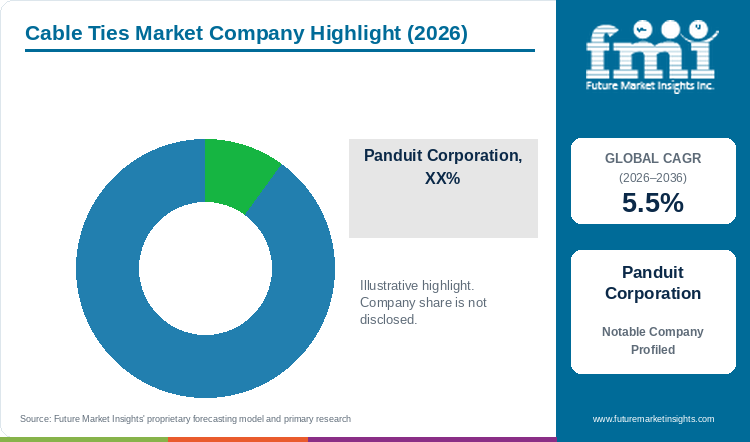
Notable companies in the Cable Ties Market include Panduit Corporation, HellermannTyton, SapiSelco, Advanced Cable Ties, Inc., Unex, 3M Company and BAND-IT (IDEX Corporation).
Certification depth separates suppliers more than catalogue length. SapiSelco publishes UL file E160935 for Types 21, 21S, 2 and 2S and Type 11, a TUV certificate against EN 62275, and type approvals from RINA, Bureau Veritas, DNV and LR [5]. Panduit lists Type 2S and 21S classification with Bureau Veritas and DNV certification after UL 62275 approval [12]. Advanced Cable Ties states UL and CSA Type 21S and AS33671 compliance with ISO 9001:2015 registration [3].
Material breadth is the second lever. Panduit sells nylon 6.6, a nylon 6/12 grade and 304, 316 and 316L stainless steel, including coated 316 [12][13][14]. HellermannTyton lists 316L and 304 stainless steel with a ball bearing lock and polyester or polyolefin coatings [10], plus polyamide, TPU and TPE designs [11]. SapiSelco adds LDPE and steel-tooth versions [6][7]. A buyer with both heat and chemical exposure can find all of this at a few suppliers.
Channels and scale differ by supplier. HellermannTyton reports 18 manufacturing facilities [9]. SapiSelco sells retail display units and buckets for distributors [4], and a distributor listing shows 3M offering a nylon 6/6 tie rated under UL 62275 [26]. BAND-IT, part of IDEX, makes stainless steel banding, buckles and clamping systems for identification and bundling [18]. Its revenue was USD 34.7 million in the third quarter of 2026, against USD 30.3 million a year earlier [17].
Key Developments in the Cable Ties Market
- On 28 October 2026, IDEX reported that Fire & Safety/Diversified Products net sales rose 5% to USD 191.5 million in the third quarter, with organic sales up 6% on higher volumes in BAND-IT and Fire & Safety [17].
- On 2 November 2026, the US Census Bureau reported September construction spending of USD 2,186.1 billion, 2.7% below a year earlier, a softer setting for building-related cable tie demand [19].
- On 5 November 2026, INSEE reported a 0.5% rise in French manufacturing output for September 2026, and on 2 November 2026 ANFIA reported a 4.8% rise in Italian car registrations for October [22][23].
- Panduit's recycled nylon 6.6 range carries UL 2809 recycled content validation and a Type 2S and 21S classification. Its product page documents the range with customer drawings dated August 2025 [12].
Key Players in the Cable Ties Market
- Panduit Corporation
- HellermannTyton
- SapiSelco
- Advanced Cable Ties, Inc.
- Unex
- 3M Company
- BAND-IT (IDEX Corporation)
Cable Ties Market Report Scope
Table 6: Cable Ties Market Report Scope
| Coverage field | Report scope |
|---|---|
| Market definition | Cable ties and their locking heads in nylon, stainless steel and other materials, measured by value of sales to end-use industries |
| Material Type | Nylon, Stainless Steel, Others |
| Product Type | Plastic Pawl Cable Ties, Ball Lock Cable Ties, Ladder Cable Ties |
| End use | Automotive, Consumer Goods, Marine, Electronics and Electrical, Building and Construction |
| Regions and profiled countries | Worldwide market value. Profiled regions: North America and Europe. Profiled countries: United States, Canada, Mexico, United Kingdom, Germany, France, Italy. |
| Companies covered | Panduit Corporation, HellermannTyton, SapiSelco, Advanced Cable Ties, Inc., Unex, 3M Company, BAND-IT (IDEX Corporation) |
| Forecast period | 2026 to 2036, with 2025 as the historical base year |
| Quantitative Units | USD billion |
Source: Future Market Insights analysis of the cable ties market, 2026.
Cable Ties Market by Segments
Cable Ties Market segmented by Material Type:
- Nylon
- Stainless Steel
- Others
Cable Ties Market segmented by Product Type:
- Plastic Pawl Cable Ties
- Ball Lock Cable Ties
- Ladder Cable Ties
Cable Ties Market segmented by End use:
- Automotive
- Consumer Goods
- Marine
- Electronics and Electrical
- Building and Construction
Cable Ties Market by Region
- North America
- Europe
- United States
- Canada
- Mexico
- United Kingdom
- Germany
- France
- Italy
Research Sources and Bibliography
- [1] National Electrical Manufacturers Association (NEMA). (2015). UL 62275, Cable Ties for electrical installations: New Type Designators Simplified. https://nema.org/docs/default-source/products-document-library/ul-62275-cable-tie-types-simplified-2015-04-29.pdf
- [2] International Electrotechnical Commission. (2022, November 22). IEC 62275:2022 ED4, Cable management systems - Cable ties for electrical installations (standards listing by Genorma). https://genorma.com/en/standards/iec-62275-2022-ed4/amp
- [3] Advanced Cable Ties, Inc. (2026). Cable ties and cable management solutions (company website). https://advancedcableties.com/
- [4] SapiSelco. (n.d.). Cable ties and fixing systems (company website). https://www.sapiselco.com/en/
- [5] SapiSelco. (n.d.). Certifications. https://www.sapiselco.com/en/certifications/
- [6] SapiSelco. (n.d.). ME-T cable ties with steel teeth. https://www.sapiselco.com/en/me-t-cable-ties/
- [7] SapiSelco. (n.d.). Re-openable cable ties. https://www.sapiselco.com/en/re-openable-cable-ties/
- [8] HellermannTyton. (2026). Cable ties (company website, UK). https://www.hellermanntyton.co.uk/
- [9] HellermannTyton. (n.d.). About us. https://www.hellermanntyton.co.uk/company/about-us
- [10] HellermannTyton. (n.d.). Cable ties, stainless steel. https://www.hellermanntyton.co.uk/products/cable-ties-stainless-steel
- [11] HellermannTyton. (n.d.). Cable ties, releasable. https://www.hellermanntyton.co.uk/products/cable-ties-releasable
- [12] Panduit. (n.d.). Post-Industrial Recycled Nylon 6.6 Cable Ties and Mounts. https://www.panduit.com/en/products/featured-products/post-industrial-recycled-cable-ties.html
- [13] Panduit. (n.d.). Stainless steel cable ties (Pan-Steel system). https://www.panduit.com/en/landing-pages/stainless-steel-cable-ties.html
- [14] Panduit Renewable Energy Team. (2024, April 25). The perfect cable tie for solar: nylon 612. https://www.panduit.com/en/about/blog/the-perfect-cable-tie-for-solar-nylon-612.html
- [15] Hamdan, A. (2023, June 7). Why Pan-Steel stainless steel ties are superior in strength. Panduit. https://www.panduit.com/en/about/blog/why-pan-steel-stainless-steel-ties-are-superior-in-strength.html
- [16] Unex. (n.d.). Technical specification: UV-resistant halogen-free cable tie, black, material 22 U61X. https://docs.unex.net/tech/NL/bundelband-22-in-u61x-kleur-zwart
- [17] IDEX Corporation. (2026, October 28). Third quarter 2026 results (Form 8-K, Exhibit 99.1). https://www.sec.gov/Archives/edgar/data/832101/000083210126000026/iex-20260930xex991.htm
- [18] IDEX Corporation. (2026, February 19). Annual report on Form 10-K for the year ended 31 December 2025. https://www.sec.gov/Archives/edgar/data/832101/000083210126000003/iex-20251231.htm
- [19] U.S. Census Bureau. (2026, November 2). Monthly Construction Spending, September 2026. https://www.census.gov/construction/c30/current/index.html
- [20] Society of Motor Manufacturers and Traders. (2026). UK car manufacturing. https://www.smmt.co.uk/vehicle-data/car-manufacturing/
- [21] Verband der Automobilindustrie (VDA). (2026). Production figures. https://www.vda.de/en
- [22] ANFIA. (2026, November 2). Italian car market, October 2026. https://www.anfia.it/en/
- [23] INSEE. (2026, November 5). In September 2026, manufacturing output increased by 0.5%. https://www.insee.fr/en/accueil
- [24] U.S. Census Bureau. (2026). U.S. trade in goods with Mexico, January to September 2026. https://www.census.gov/foreign-trade/balance/c2010.html
- [25] Statistics Canada. (2026, November 5). Provincial and territorial economic accounts, 2025. https://www150.statcan.gc.ca/n1/dai-quo/index-eng.htm
- [26] Dale Electric Supply. (n.d.). 3M CT15NT120-C standard nylon cable tie (distributor listing). https://dale-electric.com/index.php/products/CT15NT120-C
Table of Content
- Key Takeaways
- Market Size and CAGR
- Top Growth Driver
- Fastest Growing Segment
- Leading Region
- Key Companies
- Emerging Opportunities
- Executive Summary
- Global Market Outlook
- Demand-side Trends
- Supply-side Trends
- Technology Roadmap Analysis
- Analysis and Recommendations
- Analyst Perspective (What is happening? Why now? What should investors know?)
- Key Questions Answered
- How large is the market?
- What is the CAGR?
- What are key trends?
- Which region dominates?
- Who are the leaders?
Read More...
- Market Overview
- Market Coverage / Taxonomy
- Market Definition / Scope / Limitations
- Research Methodology
- Chapter Orientation
- Analytical Lens and Working Hypotheses
- Market Structure, Signals, and Trend Drivers
- Benchmarking and Cross-market Comparability
- Market Sizing, Forecasting, and Opportunity Mapping
- Research Design and Evidence Framework
- Desk Research Programme (Secondary Evidence)
- Expert Input and Fieldwork (Primary Evidence)
- Tooling, Models, and Reference Databases
- Data Engineering and Model Build
- Quality Assurance and Audit Trail
- Market Background
- Market Dynamics (Drivers, Restraints, Opportunity, Trends)
- Scenario Forecast (Optimistic, Likely, Conservative)
- Impact Analysis
- AI Impact
- Sustainability Impact
- Regulatory Impact
- Technology Impact
- Consumer / Buyer Analysis
- Purchase Drivers
- Adoption Barriers
- Buyer Journey
- Opportunity Map Analysis
- Product Life Cycle Analysis
- Supply Chain Analysis
- Investment Feasibility Matrix
- Value Chain Analysis
- PESTLE and Porter's Analysis
- Regulatory Landscape
- Regional Parent Market Outlook
- Production and Consumption Statistics
- Import and Export Statistics
- Global Market Analysis and Forecast, 2021 to 2036
- Historical Market Size Value (USD Billion) Analysis, 2021 to 2025
- Current and Future Market Size Value (USD Billion) Projections, 2026 to 2036
- Y-o-Y Growth Trend Analysis
- Absolute $ Opportunity Analysis
- Global Market Pricing Analysis, 2021 to 2036
- Global Market Analysis and Forecast, By Material Type, 2021 to 2036
- Introduction / Key Findings
- Historical Market Size Value (USD Billion) Analysis By Material Type, 2021 to 2025
- Current and Future Market Size Value (USD Billion) Analysis and Forecast By Material Type, 2026 to 2036
- Nylon
- Stainless Steel
- Others
- Y-o-Y Growth Trend Analysis By Material Type, 2021 to 2025
- Absolute $ Opportunity Analysis By Material Type, 2026 to 2036
- Global Market Analysis and Forecast, By Product Type, 2021 to 2036
- Introduction / Key Findings
- Historical Market Size Value (USD Billion) Analysis By Product Type, 2021 to 2025
- Current and Future Market Size Value (USD Billion) Analysis and Forecast By Product Type, 2026 to 2036
- Plastic Pawl Cable Ties
- Ball Lock Cable Ties
- Ladder Cable Ties
- Y-o-Y Growth Trend Analysis By Product Type, 2021 to 2025
- Absolute $ Opportunity Analysis By Product Type, 2026 to 2036
- Global Market Analysis and Forecast, By End use, 2021 to 2036
- Introduction / Key Findings
- Historical Market Size Value (USD Billion) Analysis By End use, 2021 to 2025
- Current and Future Market Size Value (USD Billion) Analysis and Forecast By End use, 2026 to 2036
- Automotive
- Consumer Goods
- Marine
- Electronics and Electrical
- Building and Construction
- Y-o-Y Growth Trend Analysis By End use, 2021 to 2025
- Absolute $ Opportunity Analysis By End use, 2026 to 2036
- Global Market Analysis and Forecast, By Region, 2021 to 2036
- Introduction
- Historical Market Size Value (USD Billion) Analysis By Region, 2021 to 2025
- Current Market Size Value (USD Billion) Analysis and Forecast By Region, 2026 to 2036
- North America
- Europe
- Market Attractiveness Analysis By Region
- North America Market Analysis and Forecast, By Country, 2021 to 2036
- Historical Market Size Value (USD Billion) Trend Analysis By Market Taxonomy, 2021 to 2025
- Market Size Value (USD Billion) Forecast By Market Taxonomy, 2026 to 2036
- By Country
- By Material Type
- By Product Type
- By End use
- Market Attractiveness Analysis
- By Country
- By Material Type
- By Product Type
- By End use
- Key Takeaways
- Europe Market Analysis and Forecast, By Country
- Historical Market Size Value (USD Billion) Trend Analysis By Market Taxonomy, 2021 to 2025
- Market Size Value (USD Billion) Forecast By Market Taxonomy, 2026 to 2036
- By Country
- United States
- Canada
- Mexico
- United Kingdom
- Germany
- France
- Italy
- By Material Type
- By Product Type
- By End use
- By Country
- Market Attractiveness Analysis
- By Country
- By Material Type
- By Product Type
- By End use
- Key Takeaways
- Key Countries Market Analysis
- United States
- Pricing Analysis
- Market Share Analysis, 2025
- By Material Type
- By Product Type
- By End use
- Canada
- Pricing Analysis
- Market Share Analysis, 2025
- By Material Type
- By Product Type
- By End use
- Mexico
- Pricing Analysis
- Market Share Analysis, 2025
- By Material Type
- By Product Type
- By End use
- Germany
- Pricing Analysis
- Market Share Analysis, 2025
- By Material Type
- By Product Type
- By End use
- United Kingdom
- Pricing Analysis
- Market Share Analysis, 2025
- By Material Type
- By Product Type
- By End use
- Italy
- Pricing Analysis
- Market Share Analysis, 2025
- By Material Type
- By Product Type
- By End use
- France
- Pricing Analysis
- Market Share Analysis, 2025
- By Material Type
- By Product Type
- By End use
- United States
- Market Structure Analysis
- Competition Dashboard
- Competition Benchmarking
- Market Share Analysis of Top Players
- By Regional
- By Material Type
- By Product Type
- By End use
- Emerging Startups
- Innovation Benchmarking
- Competition Analysis
- Competition Deep Dive
- Panduit Corporation
- Overview
- Product Portfolio
- Profitability by Market Segments
- Sales Footprint
- Strategy Overview
- Marketing Strategy
- Product Strategy
- Channel Strategy
- HellermannTyton
- SapiSelco
- Advanced Cable Ties, Inc.
- Unex
- 3M Company
- BAND-IT (IDEX Corporation)
- Panduit Corporation
- Case Studies
- Success Stories
- Recent Developments
- Competition Deep Dive
- Assumptions & Acronyms Used
List of Tables
- Table 1: Global Market Value (USD Billion) Forecast by Region, 2021 to 2036
- Table 2: Global Market Value (USD Billion) Forecast by Material Type, 2021 to 2036
- Table 3: Global Market Value (USD Billion) Forecast by Product Type, 2021 to 2036
- Table 4: Global Market Value (USD Billion) Forecast by End use, 2021 to 2036
- Table 5: North America Market Value (USD Billion) Forecast by Country, 2021 to 2036
- Table 6: North America Market Value (USD Billion) Forecast by Material Type, 2021 to 2036
- Table 7: North America Market Value (USD Billion) Forecast by Product Type, 2021 to 2036
- Table 8: North America Market Value (USD Billion) Forecast by End use, 2021 to 2036
- Table 9: Europe Market Value (USD Billion) Forecast by Country, 2021 to 2036
- Table 10: Europe Market Value (USD Billion) Forecast by Material Type, 2021 to 2036
- Table 11: Europe Market Value (USD Billion) Forecast by Product Type, 2021 to 2036
- Table 12: Europe Market Value (USD Billion) Forecast by End use, 2021 to 2036
List of Figures
- Figure 1: Global Market Pricing Analysis
- Figure 2: Global Market Value (USD Billion) Forecast 2021-2036
- Figure 3: Global Market Value Share and BPS Analysis by Material Type, 2026 and 2036
- Figure 4: Global Market Y-o-Y Growth Comparison by Material Type, 2026-2036
- Figure 5: Global Market Attractiveness Analysis by Material Type
- Figure 6: Global Market Value Share and BPS Analysis by Product Type, 2026 and 2036
- Figure 7: Global Market Y-o-Y Growth Comparison by Product Type, 2026-2036
- Figure 8: Global Market Attractiveness Analysis by Product Type
- Figure 9: Global Market Value Share and BPS Analysis by End use, 2026 and 2036
- Figure 10: Global Market Y-o-Y Growth Comparison by End use, 2026-2036
- Figure 11: Global Market Attractiveness Analysis by End use
- Figure 12: Global Market Value (USD Billion) Share and BPS Analysis by Region, 2026 and 2036
- Figure 13: Global Market Y-o-Y Growth Comparison by Region, 2026-2036
- Figure 14: Global Market Attractiveness Analysis by Region
- Figure 15: North America Market Incremental Dollar Opportunity, 2026-2036
- Figure 16: Europe Market Incremental Dollar Opportunity, 2026-2036
- Figure 17: North America Market Value Share and BPS Analysis by Country, 2026 and 2036
- Figure 18: North America Market Value Share and BPS Analysis by Material Type, 2026 and 2036
- Figure 19: North America Market Y-o-Y Growth Comparison by Material Type, 2026-2036
- Figure 20: North America Market Attractiveness Analysis by Material Type
- Figure 21: North America Market Value Share and BPS Analysis by Product Type, 2026 and 2036
- Figure 22: North America Market Y-o-Y Growth Comparison by Product Type, 2026-2036
- Figure 23: North America Market Attractiveness Analysis by Product Type
- Figure 24: North America Market Value Share and BPS Analysis by End use, 2026 and 2036
- Figure 25: North America Market Y-o-Y Growth Comparison by End use, 2026-2036
- Figure 26: North America Market Attractiveness Analysis by End use
- Figure 27: Europe Market Value Share and BPS Analysis by Country, 2026 and 2036
- Figure 28: Europe Market Value Share and BPS Analysis by Material Type, 2026 and 2036
- Figure 29: Europe Market Y-o-Y Growth Comparison by Material Type, 2026-2036
- Figure 30: Europe Market Attractiveness Analysis by Material Type
- Figure 31: Europe Market Value Share and BPS Analysis by Product Type, 2026 and 2036
- Figure 32: Europe Market Y-o-Y Growth Comparison by Product Type, 2026-2036
- Figure 33: Europe Market Attractiveness Analysis by Product Type
- Figure 34: Europe Market Value Share and BPS Analysis by End use, 2026 and 2036
- Figure 35: Europe Market Y-o-Y Growth Comparison by End use, 2026-2036
- Figure 36: Europe Market Attractiveness Analysis by End use
- Figure 37: Global Market - Tier Structure Analysis
- Figure 38: Global Market - Company Share Analysis
Frequently Asked Questions
How big is the cable ties market in 2026?
The Cable Ties Market stands at USD 2.3 billion in 2026, up from USD 2.2 billion in 2025. It is projected to reach USD 3.9 billion by 2036, a 5.5% CAGR from 2026 to 2036.
Which segments lead the cable ties market?
Nylon leads by material type with 49.0%, Plastic Pawl Cable Ties lead by product type with 49.0%, and Automotive leads by end use with 38.0% in 2026. UL 62275 allows Type 1 and Type 2 ties to be molded from any non-metallic material [1], and HellermannTyton lists automotive among the sectors it serves [9].
Which other segments matter?
Stainless Steel holds 29.0% by material type and Others 22.0%. Ball Lock Cable Ties hold 29.0% by product type and Ladder Cable Ties 22.0%. By end use, Consumer Goods account for 22.0%, Marine 16.0%, Electronics and Electrical 13.0% and Building and Construction 11.0%. Panduit's Pan-Steel system uses 304, 316 and 316L stainless steel [13].
Which profiled country is forecast to grow fastest?
Canada and the United Kingdom share the highest forecast CAGR at 5.6% from 2026 to 2036, ahead of Germany at 5.5%, France at 5.4%, Italy at 5.3%, the United States at 5.2% and Mexico at 5.1%. Canada and the United States share UL 62275 and CSA C22.2 No. 62275 [1].
What standards govern cable ties?
IEC 62275, whose fourth edition was published on 22 November 2022, is the international text [2]. UL 62275 adopts it in the United States, with CSA C22.2 No. 62275 in Canada and NMX-J-623-ANCE in Mexico [1]. In the European Union, suppliers such as SapiSelco declare conformity under the Low Voltage Directive 2014/35/EU [5].
What should a buyer check when choosing a cable tie?
Check the Type designation, loop tensile strength, temperature range and flammability class first. Type 2 ties keep 100% of declared tensile strength after aging, while Type 1 ties need to keep 50% [1]. Unex, for example, gives a range of minus 40 to plus 105 degrees Celsius and UL 94 class V2 for its black tie [16]. Then confirm marine or vehicle approvals, such as the DNV and Bureau Veritas certificates that SapiSelco lists [5].
Preview the report firsthand - request a free sample
Get SampleGet the brochure for pricing and purchase details.
Get PDF
