

- Market Size (2026)
- USD 87.1 Bn
- Forecast (2036)
- USD 150.4 Bn
- CAGR (2026 to 2036)
- 5.6%
How big is the bamboo products market in 2026?
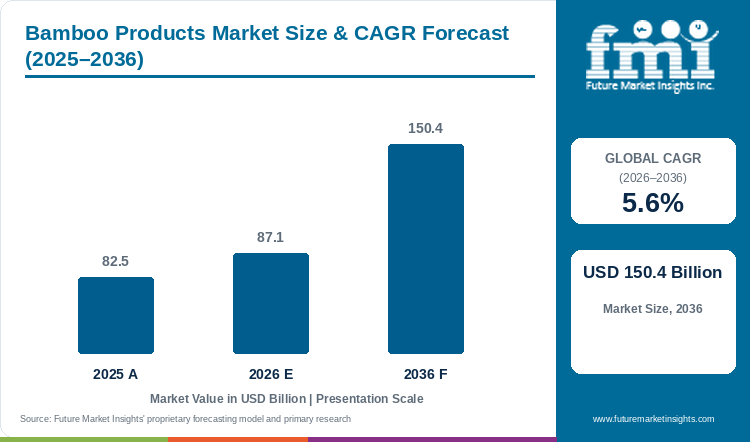
Demand is projected to expand at 5.6% CAGR from 2026 to 2036. Market value rises from USD 82.5 billion in 2025 to USD 87.12 billion in 2026 and USD 150.36 billion by 2036. [1]
FMI estimates the bamboo products market at USD 87.12 billion in 2026 and projects revenue to reach USD 150.36 billion by 2036, expanding at a 5.6% CAGR from a 2025 baseline of USD 82.5 billion. Market demand spans a highly diverse range of categories, including furniture, household articles, textiles, and construction products. Consequently, buyers must thoroughly understand the finished composition and intended use of an item before evaluating its performance or selecting a supplier.
In 2026, furniture is expected to account for 29.4% of product demand, while personal and residential users will represent 52.6% of end-user demand. Furthermore, online retail will capture 36.8% of sales-channel demand. These metrics place assembled-product durability and highly clear digital listings at the absolute center of the market's leading commercial categories. For furniture manufacturers, maintaining stable panels, reliable joints, secure bonding, and suitable finishes is critical when carrying an agreed specification through repeat orders. Additionally, the material's moisture response heavily dictates the specific environments in which an assembled article can be safely and effectively used.
Regulatory compliance also plays a vital role in material description and product safety. FTC guidance strictly distinguishes directly extracted bamboo fiber from rayon manufactured using bamboo as a source material, providing textile sellers with a clear, legally sound basis for describing the exact materials present in a finished product. Similarly, European Commission enforcement actions regarding unauthorized bamboo additives in plastic food-contact articles highlight a separate, critical composition issue. Suppliers must rigorously assess these regulations against the actual articles being offered to ensure full market compliance.
Maintaining application-specific testing records allows buyers to accurately compare engineered materials, household goods, and textiles without mistakenly transferring a performance claim from one use case to another. Ultimately, the core commercial opportunity lies in pairing an accurately described material with rigorous evidence relevant to its intended application. This operational discipline supports more dependable purchasing decisions and provides clearer care information across a highly varied product assortment.
Key Market Trends and Insights
- Furniture accounts for 29.4% of product demand; finished construction determines durability [1].
- Personal and residential users hold 52.6%; application-specific care matters across the assortment [1].
- Online retail represents 36.8%; listings need to identify the finished material accurately [1].
Regional Highlights
- Fastest-growing profiled market: South Korea at 5.8% CAGR from 2026 to 2036 [1].
- EU controls concern plastics containing unauthorized bamboo additives, with requirements specific to these food-contact materials [3].
Market Size and Forecast
Table 1: Market size and forecast for the bamboo products market in USD billion and percentage
| Metric | Value |
|---|---|
| 2025 market size | USD 82.5 billion |
| Estimated market size in 2026 | USD 87.12 billion |
| Projected market size by 2036 | USD 150.36 billion |
| CAGR 2026 to 2036 | 5.6% |
| Added revenue 2026 to 2036 | USD 63.24 billion |
| Market expansion multiple | 1.7x |
Bamboo furniture performance depends on stable panels, reliable joints and suitable bonding; moisture response also influences the use of assembled articles in home decor. Construction applications place further demands on engineered materials, linking bamboo products with purchasing considerations in green building materials.
Material Identity and Product Boundary Evidence
Textile labeling and plastic food-contact requirements address different product compositions and intended uses [2][3].
Table 2: Evidence and adoption indicators for the bamboo products market
| Indicator | Data point or finding | Commercial relevance | Source |
|---|---|---|---|
| Textile identity | Rayon made from bamboo needs accurate fiber labeling | Prevents misleading material descriptions | [2] |
| EU plastic food contact | Bamboo powder is an unauthorized additive in the described plastics | Defines a product-specific restriction | [3] |
| EU coordinated action | 21 countries participated in enforcement | Shows cross-border relevance | [3] |
Analyst Perspective
"Bamboo describes the source material, while a buyer's practical requirements depend on the finished article and its intended application. A furniture manufacturer needs stable panels and reliable bonding, whereas a household customer needs accurate composition and suitable care information. Suppliers can support repeat purchasing by making those details clear and consistent, particularly when engineered products, solid bamboo items and regenerated textiles appear within the same broad assortment."
- Rahul Pandita, Principal Consultant, FMI
How is the bamboo products market segmented?
The market covers 3 commercial axes and region: product type; end user; sales channel.
By product type: Furniture; Home decor; Kitchenware; Personal accessories; Yarn and textiles; Construction products; Packaging and storage; Other products. By end user: Personal and residential; Commercial; Industrial and infrastructure. By sales channel: Online retail; Offline retail; Project and institutional procurement.
Why does furniture lead demand within the product type category?
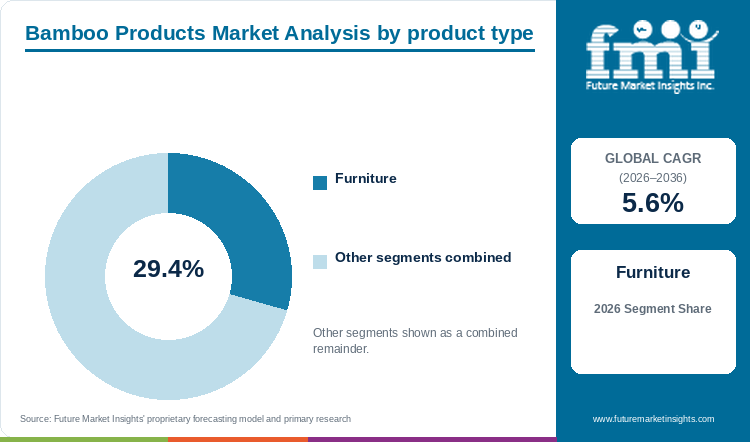
The furniture segment accounts for 29.4% of product type demand in 2026. [1]
Furniture leads product demand because bamboo can be supplied in finished chairs and cabinets or engineered components that manufacturers select against repeatable specifications. Stable panels, suitable adhesives and reliable finishes influence how those products perform after assembly, linking the material purchase with durability and care in the intended setting. Agreed dimensions and moisture response are especially relevant when a buyer repeats an order. Crafted handicrafts provide a related context in which workmanship and finishing shape the value of a household article, while furniture adds the requirements of joints and assembled construction.
- Furniture accounts for 29.4% of product demand in 2026, making stable panels, reliable joints and suitable finishes important to the performance of bamboo articles selected for repeated household or manufacturing use. [1]
- Manufacturers comparing engineered bamboo components need records relevant to bonding, dimensions and the intended application, while clear care information helps the purchaser understand how the finished furniture can be maintained after delivery.
Table 3: Leading product type share for the bamboo products market
| Product type | Share in 2026 |
|---|---|
| Furniture | 29.4% |
| Other segments combined | 70.6% |
| Total | 100.0% |
Why does personal and residential lead demand within the end user category?
The personal and residential segment accounts for 52.6% of end user demand in 2026. [1]
Personal and residential users lead because households encounter bamboo in several familiar product categories, including furniture, kitchenware and textiles selected for their practical role within the home. Each article has its own composition and care requirements, making accurate descriptions useful when a customer compares items remotely or moves between product types. Bamboo apparel illustrates the need to distinguish regenerated rayon from directly extracted bamboo fiber in textile labeling. [2] For residential suppliers, the opportunity is to connect the material description with the performance and handling relevant to the particular article being purchased.
- Personal and residential users account for 52.6% of end-user demand in 2026, with household purchases spanning furniture, kitchenware and textiles that require clear descriptions of composition, intended application and suitable care. [1]
- Accurate textile labeling helps customers distinguish bamboo-source rayon from directly extracted fiber, while application-specific records for other household articles allow buyers to assess the finished product against its particular use and maintenance needs. [2]
What are the drivers restraints and opportunities in the bamboo products market?
- Driver: Repeatable engineered bamboo materials support manufacturing purchases when boards and parts meet agreed dimensions and perform reliably after treatment and bonding, giving furniture buyers a practical basis for placing later orders to the same specification.
- Restraint: Misleading composition claims can create market-access problems, with FTC textile guidance and European Commission action on bamboo additives in plastic food-contact articles making the actual material in the finished product a central compliance consideration. [2][3]
- Opportunity: Application-specific composition and performance records can improve buyer confidence by helping manufacturers compare engineered products and households understand intended use, while accurate descriptions keep distinct solid, composite and regenerated materials clear across the assortment.
Repeatable engineered materials support purchasing
Furniture manufacturers need boards and parts that meet agreed dimensions and perform reliably after assembly, linking a material order with treatment, bonding and the intended application. Suppliers that can maintain those specifications give buyers a practical basis for repeating the purchase, while useful product records help explain the finished performance expected from the engineered bamboo components.
Misleading material claims create market-access risk
FTC guidance calls for accurate descriptions of bamboo-source rayon, while European Commission action identifies unauthorized bamboo additives in plastic food-contact articles. [2][3] These are composition issues with different product contexts, making it necessary for sellers to understand the material present in the finished article and provide the information relevant to its particular use and destination.
Application-specific records improve buyer confidence
Composition records and performance assessment suited to the intended application help furniture buyers compare engineered materials and households understand the article they are selecting. Clear descriptions can also distinguish solid bamboo products from plastic composites and regenerated textiles, giving retailers a more useful basis for explaining care and allowing customers to assess the actual finished material.
Which country CAGRs are profiled in the bamboo products market?
Table 5: Country CAGR comparison for the bamboo products market
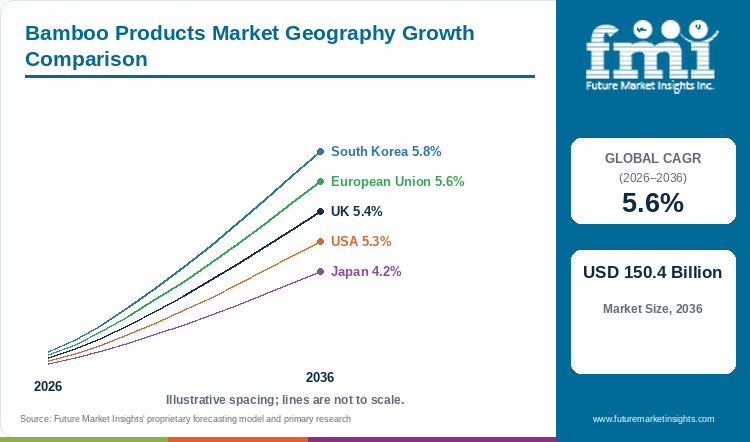
| Country or regional market | CAGR 2026 to 2036 |
|---|---|
| South Korea | 5.8% |
| European Union | 5.6% |
| UK | 5.4% |
| USA | 5.3% |
| Japan | 4.2% |
Country and Regional Analysis
South Korea
Furniture buyers need to rigorously compare joint strength and moisture behavior; a supplier can vastly improve repeat orders by maintaining consistent board dimensions and finish quality across production batches. Furthermore, the Korea Forest Service actively promotes the sustainable utilization of bamboo as a vital eco-friendly material and carbon sink, while Korean Industrial Standards (KS) enforce strict regulations on formaldehyde emissions and moisture content for bamboo furniture and building materials. The South Korea bamboo products market is projected to expand at a 5.8% CAGR from 2026 to 2036.
European Union
The European Commission's stringent enforcement actions regarding food-contact materials specifically target plastic articles containing unauthorized bamboo additives or powders, while solid bamboo articles must be rigorously assessed against the requirements relevant to their own finished composition and intended application. Beyond food safety, the EU’s broader regulatory framework, including the Ecodesign for Sustainable Products Regulation (ESPR) and strict scrutiny on greenwashing, demands transparent lifecycle assessments and sustainable sourcing documentation for all imported bamboo goods. FMI projects the European Union bamboo products market to expand at a 5.6% CAGR from 2026 to 2036, presenting a regional benchmark alongside the complex, product-specific composition considerations that suppliers must navigate when preparing offers for European buyers.
UK
Homewares sold online must state their exact composition and care instructions with absolute clarity; a buyer needs to easily distinguish a solid bamboo article from a laminated or regenerated material before comparing product claims. To support this transparency, the UK’s Competition and Markets Authority (CMA) actively enforces the Green Claims Code to prevent misleading environmental marketing, while industry bodies and recognized eco-labels guide retailers on compliant timber and bamboo sourcing. The UK bamboo products market is projected to expand at a 5.4% CAGR from 2026 to 2036.
USA
FTC textile guidance strictly requires accurate descriptions of bamboo-source rayon in the United States, making the precise finished fiber identity critically important when sellers explain a plant-source statement or environmental claim to consumers. In addition to textile labeling, bamboo-based composite boards and furniture must comply with stringent formaldehyde emission standards set by the EPA’s TSCA Title VI and the California Air Resources Board (CARB). FMI forecasts the United States bamboo products market to grow at a 5.3% CAGR from 2026 to 2036, with clear, verifiable material records helping buyers assess the actual article and allowing suppliers to confidently substantiate the claims used within their product descriptions.
Japan
Residential products can vastly benefit from a highly consistent finish and a manageable care routine; buyers must carefully assess storage conditions and moisture exposure for the finished product rather than assuming all bamboo goods behave identically. Domestically, the Japanese Ministry of Agriculture, Forestry and Fisheries (MAFF) and the Japanese Industrial Standards (JIS) enforce rigorous norms for bamboo mold prevention, anti-corrosion treatments, and the adhesives used in laminated bamboo, while national forestry initiatives actively encourage the commercial utilization of abandoned bamboo forests to maintain local ecological balance. The Japan bamboo products market is projected to expand at a 4.2% CAGR from 2026 to 2036.
Who are the notable companies in the bamboo products market?
MOSO International; Smith and Fong; EcoPlanet Bamboo; Dasso Group; Bamboo Australia
Competitive Benchmarking
Table 6: Competitive positioning for the bamboo products market
| Company or institution | Positioning | Evidence or purchasing distinction |
|---|---|---|
| MOSO International | Engineered bamboo products | Application-specific material supplier [1] |
| Smith and Fong | Engineered interior products | Engineered interior-product offerings. [1] |
| EcoPlanet Bamboo | Plantation-linked supply | Plantation-linked bamboo supply. [1] |
| Dasso Group | Engineered bamboo building products | Offers exterior bamboo decking and other engineered material products. [4] |
| Bamboo Australia | Bamboo household and material supplies | Offers bamboo poles, screens, woven ply and other bamboo products. [5] |
Key Developments in the Bamboo Products Market
- FTC bamboo-textile guidance distinguishes directly extracted bamboo fiber from rayon made with bamboo as its source, providing sellers with a defined basis for material descriptions and helping consumers compare the composition of finished textile products. [2]
- The European Commission's coordinated action addresses unauthorized bamboo additives in plastic food-contact articles, illustrating how product composition can affect market access and why suppliers need to assess the finished article before offering it to buyers. [3]
Key Players in the Bamboo Products Market
MOSO International; Smith and Fong; EcoPlanet Bamboo; Dasso Group; Bamboo Village; Anji Tianzhen Bamboo Flooring; Bamboo Australia.
Bamboo Products Market Report Scope
Table 7: Report coverage for the bamboo products market
| Coverage field | Report scope |
|---|---|
| Market breakdown | Product type; End user; Sales channel; region |
| Quantitative units | USD billion |
| Market definition | Finished bamboo-based products by application. Bamboo-source rayon is identified as a processed textile. Raw crop value is not added to the finished-product receipt. |
| Regions covered | North America; Latin America; Western Europe; Eastern Europe; East Asia; South Asia and Pacific; Middle East and Africa |
| Countries profiled | South Korea; European Union; UK; USA; Japan |
| Key companies profiled | MOSO International; Smith and Fong; EcoPlanet Bamboo; Dasso Group; Bamboo Village; Anji Tianzhen Bamboo Flooring; Bamboo Australia |
| Forecast period | 2026 to 2036 |
Bamboo Products Market Research Methodology
Table 8: Research methods for the bamboo products market
| Method | Approach |
|---|---|
| Published market outlook | FMI's published outlook supplies the market values, forecast period, country CAGRs and segment shares presented in the report. [1] |
| Market definition review | The product, customer and sales-channel categories are reviewed against the report's scope and monetary units. |
| Public evidence review | FTC textile guidance and European Commission coordinated-action material inform the discussion of finished composition, labeling and food-contact applications. [2][3] |
| Country conditions review | Country discussion considers the local purchasing, service or product requirements documented in the cited public sources. |
| Company disclosure review | Public company pages support the descriptions of documented offerings and operating roles in the competitive tables. [4][5] |
| Commercial interpretation | The evidence is interpreted through the purchasing conditions, delivery requirements and repeat-use decisions described in the article. |
| Evidence reconciliation | Market research, public statistics, policy material and company disclosures are examined for their relevance to the defined product scope and commercial conditions. |
Bamboo Products Market by Segments
By product type
- Furniture
- Home decor
- Kitchenware
- Personal accessories
- Yarn and textiles
- Construction products
- Packaging and storage
- Other products
By end user
- Personal and residential
- Commercial
- Industrial and infrastructure
By sales channel
- Online retail
- Offline retail
- Project and institutional procurement
Bamboo Products Market by Region
- North America
- USA
- Canada
- Latin America
- Brazil
- Mexico
- Argentina
- Chile
- Western Europe
- Germany
- France
- UK
- Italy
- Spain
- Benelux
- Nordics
- Eastern Europe
- Poland
- Czech Republic
- Romania
- Hungary
- East Asia
- China
- Japan
- South Korea
- South Asia and Pacific
- India
- ASEAN
- Australia and New Zealand
- Middle East and Africa
- GCC countries
- South Africa
- Türkiye
- Israel
Research Sources and Bibliography
- [1] Future Market Insights. Published outlook accessed 12 October 2026. Bamboo Products Market.
- [2] Federal Trade Commission. Accessed October 2026. Bamboo Textiles.
- [3] European Commission. Accessed October 2026. Bamboo-zling EU coordinated action.
- [4] Dasso Group. Accessed October 2026. Dasso Group company and product information.
- [5] Bamboo Australia. Accessed October 2026. Bamboo Australia company and product information.
This Report Answers
- How big is the bamboo products market in 2026?
- What market value is projected by 2036?
- Which product type segment leads demand?
- Which other commercial categories shape the market?
- Which countries have the fastest profiled growth?
- Which companies and institutions participate in the market?
Frequently Asked Questions
How large is the bamboo products market in 2026?
FMI estimates market value at USD 87.12 billion in 2026; the estimated 2025 value is USD 82.5 billion [1].
What value and CAGR are projected through 2036?
Market value is projected to reach USD 150.36 billion by 2036 at a 5.6% CAGR from 2026 to 2036 [1].
Which product type segment leads in 2026?
Furniture accounts for 29.4% of this category [1].
What is the report segmentation?
Product type; End user; Sales channel, and region.
Which profiled market records the highest CAGR?
South Korea has the highest profiled rate at 5.8% from 2026 to 2036 [1].
Who are the key participants?
MOSO International; Smith and Fong; EcoPlanet Bamboo; Dasso Group; Bamboo Village; Anji Tianzhen Bamboo Flooring; Bamboo Australia.
Preview the report firsthand - request a free sample
Get SampleGet the brochure for pricing and purchase details.
Get PDFTable of Content
- Key Takeaways
- Market Size and CAGR
- Top Growth Driver
- Fastest Growing Segment
- Leading Region
- Key Companies
- Emerging Opportunities
- Executive Summary
- Global Market Outlook
- Demand-side Trends
- Supply-side Trends
- Technology Roadmap Analysis
- Analysis and Recommendations
- Analyst Perspective (What is happening? Why now? What should investors know?)
- Key Questions Answered
- How large is the market?
- What is the CAGR?
- What are key trends?
- Which region dominates?
- Who are the leaders?
- Market Overview
- Market Coverage / Taxonomy
- Market Definition / Scope / Limitations
- Research Methodology
- Chapter Orientation
- Analytical Lens and Working Hypotheses
- Market Structure, Signals, and Trend Drivers
- Benchmarking and Cross-market Comparability
- Market Sizing, Forecasting, and Opportunity Mapping
- Research Design and Evidence Framework
- Desk Research Programme (Secondary Evidence)
- Expert Input and Fieldwork (Primary Evidence)
- Tooling, Models, and Reference Databases
- Data Engineering and Model Build
- Quality Assurance and Audit Trail
- Market Background
- Market Dynamics (Drivers, Restraints, Opportunity, Trends)
- Scenario Forecast (Optimistic, Likely, Conservative)
- Impact Analysis
- AI Impact
- Sustainability Impact
- Regulatory Impact
- Technology Impact
- Consumer / Buyer Analysis
- Purchase Drivers
- Adoption Barriers
- Buyer Journey
- Opportunity Map Analysis
- Product Life Cycle Analysis
- Supply Chain Analysis
- Investment Feasibility Matrix
- Value Chain Analysis
- PESTLE and Porter's Analysis
- Regulatory Landscape
- Regional Parent Market Outlook
- Production and Consumption Statistics
- Import and Export Statistics
- Global Market Analysis and Forecast, 2021 to 2036
- Historical Market Size Value (USD Billion) Analysis, 2021 to 2025
- Current and Future Market Size Value (USD Billion) Projections, 2026 to 2036
- Y-o-Y Growth Trend Analysis
- Absolute $ Opportunity Analysis
- Global Market Pricing Analysis, 2021 to 2036
- Global Market Analysis and Forecast, By product type, 2021 to 2036
- Introduction / Key Findings
- Historical Market Size Value (USD Billion) Analysis By product type, 2021 to 2025
- Current and Future Market Size Value (USD Billion) Analysis and Forecast By product type, 2026 to 2036
- Furniture
- Home decor
- Kitchenware
- Personal accessories
- Yarn and textiles
- Construction products
- Packaging and storage
- Other products
- Y-o-Y Growth Trend Analysis By product type, 2021 to 2025
- Absolute $ Opportunity Analysis By product type, 2026 to 2036
- Global Market Analysis and Forecast, By end user, 2021 to 2036
- Introduction / Key Findings
- Historical Market Size Value (USD Billion) Analysis By end user, 2021 to 2025
- Current and Future Market Size Value (USD Billion) Analysis and Forecast By end user, 2026 to 2036
- Personal and residential
- Commercial
- Industrial and infrastructure
- Y-o-Y Growth Trend Analysis By end user, 2021 to 2025
- Absolute $ Opportunity Analysis By end user, 2026 to 2036
- Global Market Analysis and Forecast, By sales channel, 2021 to 2036
- Introduction / Key Findings
- Historical Market Size Value (USD Billion) Analysis By sales channel, 2021 to 2025
- Current and Future Market Size Value (USD Billion) Analysis and Forecast By sales channel, 2026 to 2036
- Online retail
- Offline retail
- Project and institutional procurement
- Y-o-Y Growth Trend Analysis By sales channel, 2021 to 2025
- Absolute $ Opportunity Analysis By sales channel, 2026 to 2036
- Global Market Analysis and Forecast, By Region, 2021 to 2036
- Introduction
- Historical Market Size Value (USD Billion) Analysis By Region, 2021 to 2025
- Current Market Size Value (USD Billion) Analysis and Forecast By Region, 2026 to 2036
- North America
- Latin America
- Western Europe
- Eastern Europe
- East Asia
- South Asia and Pacific
- Middle East and Africa
- Market Attractiveness Analysis By Region
- North America Market Analysis and Forecast, By Country, 2021 to 2036
- Historical Market Size Value (USD Billion) Trend Analysis By Market Taxonomy, 2021 to 2025
- Market Size Value (USD Billion) Forecast By Market Taxonomy, 2026 to 2036
- By Country
- USA
- Canada
- By product type
- By end user
- By sales channel
- By Country
- Market Attractiveness Analysis
- By Country
- By product type
- By end user
- By sales channel
- Key Takeaways
- Latin America Market Analysis and Forecast, By Country
- Historical Market Size Value (USD Billion) Trend Analysis By Market Taxonomy, 2021 to 2025
- Market Size Value (USD Billion) Forecast By Market Taxonomy, 2026 to 2036
- By Country
- Brazil
- Mexico
- Argentina
- Chile
- By product type
- By end user
- By sales channel
- By Country
- Market Attractiveness Analysis
- By Country
- By product type
- By end user
- By sales channel
- Key Takeaways
- Western Europe Market Analysis and Forecast, By Country
- Historical Market Size Value (USD Billion) Trend Analysis By Market Taxonomy, 2021 to 2025
- Market Size Value (USD Billion) Forecast By Market Taxonomy, 2026 to 2036
- By Country
- Germany
- France
- UK
- Italy
- Spain
- Benelux
- Nordics
- By product type
- By end user
- By sales channel
- By Country
- Market Attractiveness Analysis
- By Country
- By product type
- By end user
- By sales channel
- Key Takeaways
- Eastern Europe Market Analysis and Forecast, By Country
- Historical Market Size Value (USD Billion) Trend Analysis By Market Taxonomy, 2021 to 2025
- Market Size Value (USD Billion) Forecast By Market Taxonomy, 2026 to 2036
- By Country
- Poland
- Czech Republic
- Romania
- Hungary
- By product type
- By end user
- By sales channel
- By Country
- Market Attractiveness Analysis
- By Country
- By product type
- By end user
- By sales channel
- Key Takeaways
- East Asia Market Analysis and Forecast, By Country
- Historical Market Size Value (USD Billion) Trend Analysis By Market Taxonomy, 2021 to 2025
- Market Size Value (USD Billion) Forecast By Market Taxonomy, 2026 to 2036
- By Country
- China
- Japan
- South Korea
- By product type
- By end user
- By sales channel
- By Country
- Market Attractiveness Analysis
- By Country
- By product type
- By end user
- By sales channel
- Key Takeaways
- South Asia and Pacific Market Analysis and Forecast, By Country
- Historical Market Size Value (USD Billion) Trend Analysis By Market Taxonomy, 2021 to 2025
- Market Size Value (USD Billion) Forecast By Market Taxonomy, 2026 to 2036
- By Country
- India
- ASEAN
- Australia and New Zealand
- By product type
- By end user
- By sales channel
- By Country
- Market Attractiveness Analysis
- By Country
- By product type
- By end user
- By sales channel
- Key Takeaways
- Middle East and Africa Market Analysis and Forecast, By Country
- Historical Market Size Value (USD Billion) Trend Analysis By Market Taxonomy, 2021 to 2025
- Market Size Value (USD Billion) Forecast By Market Taxonomy, 2026 to 2036
- By Country
- GCC countries
- South Africa
- Türkiye
- Israel
- By product type
- By end user
- By sales channel
- By Country
- Market Attractiveness Analysis
- By Country
- By product type
- By end user
- By sales channel
- Key Takeaways
- Key Countries Market Analysis
- USA
- Pricing Analysis
- Market Share Analysis, 2025
- By product type
- By end user
- By sales channel
- Canada
- Pricing Analysis
- Market Share Analysis, 2025
- By product type
- By end user
- By sales channel
- Mexico
- Pricing Analysis
- Market Share Analysis, 2025
- By product type
- By end user
- By sales channel
- Brazil
- Pricing Analysis
- Market Share Analysis, 2025
- By product type
- By end user
- By sales channel
- Chile
- Pricing Analysis
- Market Share Analysis, 2025
- By product type
- By end user
- By sales channel
- Germany
- Pricing Analysis
- Market Share Analysis, 2025
- By product type
- By end user
- By sales channel
- UK
- Pricing Analysis
- Market Share Analysis, 2025
- By product type
- By end user
- By sales channel
- Italy
- Pricing Analysis
- Market Share Analysis, 2025
- By product type
- By end user
- By sales channel
- Spain
- Pricing Analysis
- Market Share Analysis, 2025
- By product type
- By end user
- By sales channel
- France
- Pricing Analysis
- Market Share Analysis, 2025
- By product type
- By end user
- By sales channel
- India
- Pricing Analysis
- Market Share Analysis, 2025
- By product type
- By end user
- By sales channel
- ASEAN
- Pricing Analysis
- Market Share Analysis, 2025
- By product type
- By end user
- By sales channel
- Australia and New Zealand
- Pricing Analysis
- Market Share Analysis, 2025
- By product type
- By end user
- By sales channel
- China
- Pricing Analysis
- Market Share Analysis, 2025
- By product type
- By end user
- By sales channel
- Japan
- Pricing Analysis
- Market Share Analysis, 2025
- By product type
- By end user
- By sales channel
- South Korea
- Pricing Analysis
- Market Share Analysis, 2025
- By product type
- By end user
- By sales channel
- Poland
- Pricing Analysis
- Market Share Analysis, 2025
- By product type
- By end user
- By sales channel
- Hungary
- Pricing Analysis
- Market Share Analysis, 2025
- By product type
- By end user
- By sales channel
- Türkiye
- Pricing Analysis
- Market Share Analysis, 2025
- By product type
- By end user
- By sales channel
- South Africa
- Pricing Analysis
- Market Share Analysis, 2025
- By product type
- By end user
- By sales channel
- European Union
- Pricing Analysis
- Market Share Analysis, 2025
- By product type
- By end user
- By sales channel
- USA
- Market Structure Analysis
- Competition Dashboard
- Competition Benchmarking
- Market Share Analysis of Top Players
- By Regional
- By product type
- By end user
- By sales channel
- Emerging Startups
- Innovation Benchmarking
- Competition Analysis
- Competition Deep Dive
- MOSO International
- Overview
- Product Portfolio
- Profitability by Market Segments
- Sales Footprint
- Strategy Overview
- Marketing Strategy
- Product Strategy
- Channel Strategy
- Smith and Fong
- EcoPlanet Bamboo
- Dasso Group
- Bamboo Australia
- MOSO International
- Case Studies
- Success Stories
- Recent Developments
- Competition Deep Dive
- Assumptions & Acronyms Used


