

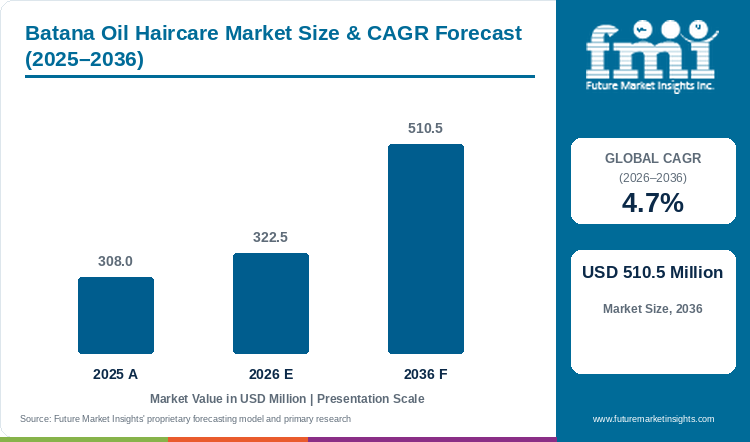
- Market Size (2026)
- USD 322.5 Mn
- Forecast (2036)
- USD 510.5 Mn
- CAGR (2026 to 2036)
- 4.7%
How big is Batana Oil Haircare Market in 2026?
USD 322.5 Million in 2026 and USD 510.5 Million by 2036 at a 4.7% CAGR.
According to FMI's report, sales of batana oil haircare are valued at USD 322.5 Million in 2026. Demand is forecast to reach USD 510.5 Million by 2036, representing a 4.7% CAGR. Adoption of batana oil in shampoos and treatment products will add more opportunities for volume sales during the forecast period. The market was valued at USD 308.0 Million in 2025.
Retail access and cosmetic rules will govern sales of batana oil haircare across key countries. For instance, e-commerce accounted for 17.1% of total U.S. retail sales in the second quarter of 2026. Saudi Arabia and the UAE require product notification or other approval steps before sale. Japan and South Korea apply stricter rules when products carry hair-growth or hair-loss claims. As a result, market-specific claims and compliance will remain important during the forecast period.
Key Takeaways
- Batana oil is being used in everyday haircare, including conditioning and scalp-care products. It is also becoming easier to find through large retailers and online stores.
- Core / classic lines hold a 33.0% share of Product Type in 2026. Oils, shampoos and conditioners are already part of normal haircare routines, which makes batana easier to try.
- Conventional products account for 52.0% of Nature in 2026. Brands can mix batana with other conditioning ingredients and make the product easier to use in terms of texture, scent and rinse feel.
- Liquid & serum holds a 27.0% share of Format in 2026. These products allow users to apply small amounts directly to the scalp or hair.
- Evidence is still a concern. Retailers and buyers need to know that the ingredient is genuine, the formula is consistent and the claims can be supported.
- Profiled companies include Unilever, Church & Dwight, Olaplex, Shiseido, Wella Company, Kao Corporation, L'Oreal, Amorepacific, Henkel and Procter & Gamble.
Analyst Perspective
“Batana oil is easier to sell when it stays within a clear haircare use, such as conditioning or scalp care. The risk starts when brands move into hair-growth claims without enough evidence. Suppliers that can prove ingredient identity and keep the formula consistent will have a better chance of repeat sales.”
- Rahul Pandita, Principal Consultant, Future Market Insights.
How is the batana oil haircare market segmented?
The market is segmented by Product Type, Nature, Format, Price Positioning and Sales Channel.
By Product Type, the market includes Core / classic lines, Targeted treatment lines, Sensitive & gentle lines, Premium & clinical lines and Kits & sets. By Nature, it covers Conventional, Vegan & cruelty-free, Natural & organic, Dermocosmetic / clinical and Fragrance-free & sensitive products.
By Format, the market includes Liquid & serum, Cream & balm, Stick & solid, Spray & mist, Sheet & patch and Powder. Price Positioning covers Mass, Masstige, Premium and Professional products. Sales Channel includes E-commerce & DTC, Specialty beauty retail, Pharmacies & drugstores, Supermarkets & hypermarkets and Salons & spas.
Why do Core / classic lines anchor the Product Type category?
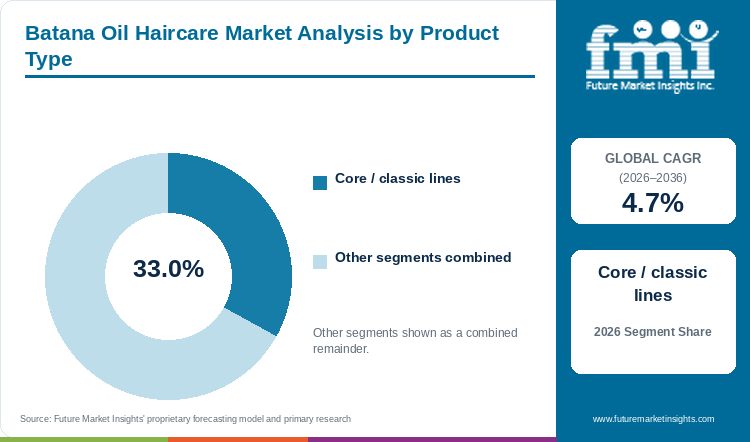
Core / classic lines hold a 33.0% share in 2026
Batana oil is being added to hair oils, shampoos and conditioners already used in regular haircare routines. Buyers therefore do not need a separate product format to use the ingredient. For instance, in 2025, Taliah Waajid Brand sold Batana Oil Gro Drops with shampoo and conditioner in the same range.
- Core / classic lines hold a 33.0% share in 2026. Familiar products make batana easier to try.
Why does Conventional remain the leading Nature?
Conventional holds a 52.0% share in 2026
Conventional formulas make it easier to use batana in shampoos, conditioners and treatment products. Pure oils can feel heavy or have a strong smell. Blending batana with other ingredients can improve the texture, scent and rinse feel while keeping it as part of the formula.
- Conventional holds a 52.0% share in 2026. Brands can use batana with familiar ingredients and make the product easier to use.
- Hollywood Beauty launched a batana oil blend in September 2025 through mass retail and e-commerce. The product showed how batana can be sold as part of a blended haircare formula, not only as a pure oil.
Why is Liquid & serum the leading Format?
Liquid & serum holds a 27.0% share in 2026
Liquid and serum formats are likely to account for higher demand, as batana is already used and recognized in oil form. Scalp applicators will support controlled use by helping buyers apply the product directly where needed. A 2024 study found that some plant oils can enter the hair fiber and support conditioning, although batana oil was not tested in the study.
- Liquid & serum holds a 27.0% share in 2026. The format works well for direct use on the scalp or hair.
- Moe's Group launched a 100% pure Batana Oil in July 2026 for direct sale and as a formulation ingredient. This allows liquid batana to be sold as a finished product or supplied to other brands.
Why does Mass lead Price Positioning?
Mass leads Price Positioning with a 37.0% share in 2026
Many buyers are still unfamiliar with batana oil. A lower price makes it easier to try the product without spending much on the first purchase.
- Mass leads Price Positioning with a 37.0% share in 2026. The lower price makes first-time purchase easier.
Why does E-commerce & DTC lead Sales Channel?
E-commerce & DTC leads Sales Channel with a 34.0% share in 2026
Online stores give brands more space to explain batana oil and show how the product should be used. Smaller brands can also sell directly to buyers without first getting space in large retail stores. In the second quarter of 2026, e-commerce accounted for 17.1% of U.S. retail sales.
- E-commerce & DTC leads Sales Channel with a 34.0% share in 2026. Online selling helps brands explain the ingredient and reach buyers without depending only on physical stores.
- The U.S. Census Bureau reported USD 340.2 billion in retail e-commerce sales in the second quarter of 2026. This gives newer haircare products a large channel for first purchase and repeat orders.
What are the drivers, restraints and opportunities in the batana oil haircare market?
Batana oil fits into hair oil and scalp-care routines that buyers already know. Growth may slow when product claims are too strong or the quality of the oil is not consistent. The main opportunity is to use batana in simple products with clear ingredient information across more haircare formats.
- Driver: Batana fits into hair oil, conditioning and scalp-care routines that buyers already use.
- Restraint: Hair-growth claims can bring stricter rules. Changes in oil quality can also make retailers and buyers less confident.
- Opportunity: Brands can use tested batana oil in simple products such as shampoos, conditioners, masks and serums.
Use of batana oil in products for dryness and conditioning will support demand during the forecast period. However, hair-growth and hair-loss claims will bring stricter regulatory requirements. In the USA, such claims can move a product into drug regulation. South Korea has separate rules for functional cosmetics linked to hair-loss symptoms, while Japan can treat hair-growth products as quasi-drugs. Product claims and advertising will therefore need to follow country-specific rules. Consistent oil quality will also remain important for retail acceptance.
More opportunities will emerge from adding batana oil to everyday haircare products. For instance, Moe's Group launched single-ingredient Batana Oil in July 2026 for direct sale and private-label use. Haircare brands can also use batana oil in shampoos, conditioners, masks and serums focused on conditioning and manageability. Country-specific claims will remain important as suppliers expand into more markets.
Which country CAGRs are profiled in the batana oil haircare market?
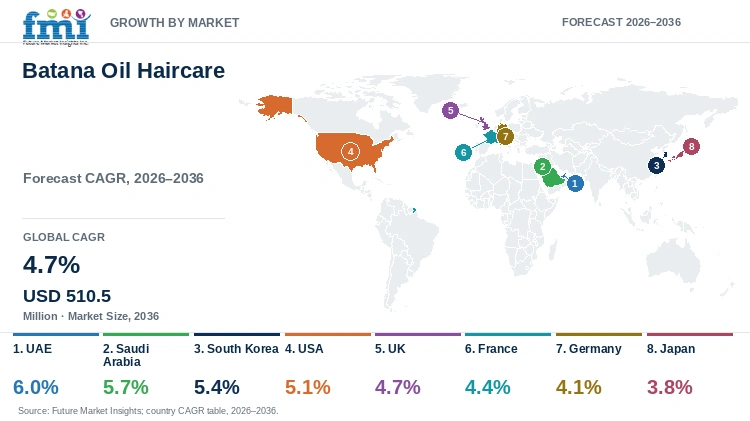
| Country | CAGR |
|---|---|
| UAE | 6.0% |
| Saudi Arabia | 5.7% |
| South Korea | 5.4% |
| USA | 5.1% |
| UK | 4.7% |
| France | 4.4% |
| Germany | 4.1% |
| Japan | 3.8% |
How do country-level CAGRs compare in the batana oil haircare market?
The country growth rates are relatively close. UAE and Saudi Arabia are expected to grow above 5.5%. South Korea and the USA are also above 5.0%, while the UK, France, Germany and Japan range from 3.8% to 4.7%. UAE has the highest rate at 6.0% and Japan the lowest at 3.8%. The difference is 2.2 percentage points. These rates show expected growth only, not the size of each market.
- UAE: Beauty trade is expanding in the UAE. Imported cosmetic products require registration and compliance with local import requirements before sale.
- Saudi Arabia: Cosmetic products require notification before sale in Saudi Arabia. Product information and labels have to meet the required conditions before market entry.
- South Korea: Hair-loss claims are subject to stricter rules in South Korea. Products positioned for conditioning or scalp care follow the cosmetic route.
- USA: E-commerce and large retailers give new haircare ingredients broad access to buyers in the USA. Hair-growth claims remain subject to FDA requirements.
- UK: Online sales support access for smaller haircare brands in the UK. Cosmetic products require a Responsible Person, safety records and notification before sale.
- France: Online channels and established beauty stores both support haircare sales in France. Cosmetic claims remain subject to EU rules.
- Germany: Online shopping is widely used in Germany. Haircare claims need supporting evidence, particularly for stronger performance claims.
- Japan: Hair-growth products can fall under quasi-drug rules in Japan. Products sold for conditioning follow the cosmetic route.
The country sections below look at the main factors affecting demand in each market. The CAGR figures should not be treated as a ranking of market size.
Country-wise Analysis
- The UAE is expected to grow at a 6.0% CAGR from 2026 to 2036, the highest rate among the eight countries. Dubai Municipality requires consumer products to be registered through Montaji and also controls advertising and imports. In October 2025, the municipality said Dubai had nearly 13,000 establishments in cosmetics and consumer-product trade. For batana suppliers, the market offers strong beauty-channel activity, but local registration and distributor support need to be in place before sales can scale.
- Saudi Arabia is projected to grow at a 5.7% CAGR from 2026 to 2036. Cosmetic products have to go through the Saudi Food and Drug Authority's notification process, and hair and scalp products appear in its searchable product list. A brand therefore needs the right label and product classification before expanding distribution. Interest in botanical haircare can help batana products, but local partners still need a product file they can use during import and retail onboarding.
- South Korea is expected to expand at a 5.4% CAGR from 2026 to 2036. The main issue is how the product is described. The Ministry of Food and Drug Safety treats products that help with hair-loss symptoms as functional cosmetics. A batana oil or serum sold for conditioning, scalp feel or manageability has a simpler position. Stronger hair-loss claims need more supporting documentation and can change the regulatory route.
- The USA is projected to grow at a 5.1% CAGR from 2026 to 2036. E-commerce accounted for 17.1% of total U.S. retail sales in the second quarter of 2026, giving batana products a large discovery channel. Taliah Waajid Brand and Hollywood Beauty have also brought batana products into consumer retail. The main limit is claim language. FDA rules draw a line between cosmetic benefits and claims that imply drug action, so brands need clear ingredient information and sensible benefit wording.
- The UK is expected to grow at a 4.7% CAGR from 2026 to 2036. Internet sales represented 27.4% of total retail sales in 2025, giving niche haircare ingredients a strong online route. Products sold in Great Britain still need a Responsible Person, a product information file and notification to the Office for Product Safety and Standards. Brands can build awareness online, but complete safety and claims records are still needed before the product reaches the market.
- France is projected to grow at a 4.4% CAGR from 2026 to 2036. Insee reported that 63.6% of people aged 15 or older made an online purchase in the previous three months in 2025. Beauty and personal-care stores also recorded growth during the year. Batana brands can therefore use online content for education and physical retail for discovery. Claims still have to follow EU cosmetic rules, so simple language and clear ingredient information matter.
- Germany is expected to grow at a 4.1% CAGR from 2026 to 2036. Destatis reported that 85% of internet users aged 16 to 74 had shopped online in 2025. This makes it easy for buyers to compare products, ingredients and reviews. It also makes weak claims easier to spot. Batana brands can reach consumers online, but the benefit wording needs to stand up to EU cosmetic-claims rules.
- Japan is projected to grow at a 3.8% CAGR from 2026 to 2036, the lowest rate in the country set. Hair-growth agents can fall under quasi-drug rules, and commercial imports of cosmetics or quasi-drugs need the right permissions. A batana oil or conditioner sold for cosmetic care therefore has a simpler route than a product promoted for hair growth. Brands should settle the claim language and importer requirements before launch.
Who are the notable companies in the batana oil haircare market?
Unilever, Church & Dwight, Olaplex, Shiseido, Wella Company, Kao Corporation, L'Oreal, Amorepacific, Henkel and Procter & Gamble are the notable companies profiled in this market.
The profiled companies bring different strengths rather than one common batana product line. Unilever, Kao Corporation, L'Oreal and Procter & Gamble have large consumer haircare businesses and broad distribution. Olaplex, Wella Company and Henkel are stronger in professional, repair or treatment-led haircare. Church & Dwight has hair and scalp brands such as Viviscal and Toppik, while Amorepacific has serum and scalp-care products through brands including Mise-en-Scène and LABO-H. Shiseido remains a large beauty group, although its professional hair business moved to Henkel in 2022. A batana-specific product was not verified for every company by the publication cutoff.
- Scaled consumer and professional haircare platforms: Unilever, Kao Corporation, L'Oreal and Procter & Gamble have broad haircare ranges and reach across several markets.
- Professional and treatment-led specialists: Olaplex, Wella Company and Henkel are stronger in repair, salon, scalp-care and premium treatment products.
- Targeted hair and beauty portfolio participants: Church & Dwight and Amorepacific have specific hair or scalp brands. Shiseido remains relevant as a large beauty company, although its directly evidenced current haircare role is narrower.
Competitive Benchmarking: Batana Oil Haircare Market
| Company | Oil & Serum Haircare Capability | Scalp / Damage Treatment Capability | Omnichannel / Professional Reach | Geographic Reach |
|---|---|---|---|---|
| Unilever | Unscored | High | High | Global consumer beauty reach across major regions |
| Church & Dwight | Medium | Medium | Medium | United States plus consumer operations in Canada, France, Australia, UK, Mexico and China |
| Olaplex | High | High | High | United States and international markets through professional, specialty retail and e-commerce |
| Shiseido | Unscored | Low | Medium | Japan and global beauty markets; professional hair business transferred to Henkel |
| Wella Company | High | High | High | Global professional and consumer haircare channels |
| Kao Corporation | Medium | High | High | Asia, Europe and the Americas with salon and consumer hair brands |
| L'Oreal | High | High | High | Global salon, selective retail and e-commerce networks |
| Amorepacific | High | High | High | South Korea, North America, Greater China, Japan and wider international channels |
| Henkel | High | High | High | Global consumer and professional haircare, strengthened by Olaplex ownership |
| Procter & Gamble | Medium | High | High | Global mass retail and e-commerce haircare distribution |
Scoring basis: Oil & Serum Haircare Capability looks at documented oils, serums or similar conditioning products. Scalp / Damage Treatment Capability looks at products for scalp care, thinning or damage repair. Omnichannel / Professional Reach looks at evidence of retail, e-commerce or salon distribution. High means broad documented capability. Medium means narrower capability. Low is used only for a documented limitation. Where public information is not enough, the company is left Unscored.
Key Developments in the Batana Oil Haircare Market
- In August 2025, Taliah Waajid Brand launched Love My Natural Hair with Batana Oil Gro Drops, honey and hibiscus across a textured-hair range. Batana was sold alongside familiar wash and treatment products rather than only as a standalone oil.
- In September 2025, Hollywood Beauty introduced a Batana Oil blend through Walmart, Target, CVS, Walgreens and e-commerce. The launch put batana into mainstream U.S. retail at an accessible price. The distribution is clear evidence of wider availability, but it does not by itself prove stronger hair-growth claims.
- In July 2026, Moe's Group launched 100% pure Batana Oil under the INCI name Elaeis Oleifera Kernel Oil. The company offered it for direct sale and for private-label or custom formulation. This gives the ingredient a B2B route as well as a consumer product route.
Key Players in the Batana Oil Haircare Market
Scaled Consumer and Professional Haircare Platforms
- Unilever
- Kao Corporation
- L'Oreal
- Procter & Gamble
Professional and Treatment-Led Haircare Specialists
- Olaplex
- Wella Company
- Henkel
Targeted Hair and Beauty Portfolio Participants
- Church & Dwight
- Amorepacific
- Shiseido
Batana Oil Haircare Market - Report Scope
| Coverage field | Report scope |
|---|---|
| Market breakdown | Product Type; Nature; Format; Price Positioning; Sales Channel |
| Quantitative Units | USD Million |
| Market Definition | Includes manufacturer- or brand-level revenue from products sold as batana oil haircare within the stated segmentation, including pure batana hair oils and formulations in which batana is a named haircare ingredient. Excludes non-hair batana uses, products without batana, drugs or supplements, salon service fees, downstream reseller markups and adjacent substitute products. |
| Regions Covered | North America; Latin America; Western Europe; Eastern Europe; East Asia; South Asia and Pacific; Middle East and Africa |
| Countries Covered | USA, Germany, France, UK, Saudi Arabia, UAE, Japan, South Korea |
| Key Companies Profiled | Unilever, Church & Dwight, Olaplex, Shiseido, Wella Company, Kao Corporation, L'Oreal, Amorepacific, Henkel, Procter & Gamble |
| Forecast Period | 2026 to 2036 |
| Approach | Primary and secondary research with market triangulation. |
Batana Oil Haircare Market - Research Methodology
| Method | Approach |
|---|---|
| Primary Research | FMI analysts gathered input from manufacturers, service providers, technology developers, distributors, end users, procurement teams and subject-matter experts. Interviews examined purchasing decisions, product or service evaluation, adoption barriers, approval requirements, pricing considerations and expectations for technical or commercial support. Respondents were also asked what evidence is required before a trial, pilot, or initial order develops into regular purchasing. |
| Desk Research | Desk research covered government statistics, regulatory publications, trade data, industry associations, technical literature, standards, company filings, product information and official corporate announcements. Sources were reviewed for relevance, publication date, geographic coverage and consistency with the defined market scope. Claims relating to performance, applications, approvals, capacity, investment and commercial activity were retained only when supported by credible public evidence. |
| Market Sizing and Forecasting | The market model combined the baseline value with historical performance, segment structure, pricing and volume indicators, adoption levels, company participation and country-level demand conditions. Forecast assumptions considered economic activity, investment trends, regulatory developments, technology adoption, purchasing cycles, supply availability and barriers to wider market use. Segment and regional estimates were reconciled before the final market total was calculated. |
| Data Validation | Estimates were checked against multiple independent indicators, including public data, company activity, trade patterns, industry developments and findings from primary interviews. Validation also tested whether products, services, applications and company revenues fell within the defined market boundaries. Adjacent categories, unsupported claims, overlapping revenues and activities without direct market relevance were excluded to reduce double counting and maintain consistency across segments and countries. |
Batana Oil Haircare Market by Segments
Batana Oil Haircare Market segmented by Product Type:
- Core / classic lines
- Targeted treatment lines
- Sensitive & gentle lines
- Premium & clinical lines
- Kits & sets
Batana Oil Haircare Market segmented by Nature:
- Conventional
- Vegan & cruelty-free
- Natural & organic
- Dermocosmetic / clinical
- Fragrance-free & sensitive
Batana Oil Haircare Market segmented by Format:
- Liquid & serum
- Cream & balm
- Stick & solid
- Spray & mist
- Sheet & patch
- Powder
Batana Oil Haircare Market segmented by Price Positioning:
- Mass
- Masstige
- Premium
- Professional
Batana Oil Haircare Market segmented by Sales Channel:
- E-commerce & DTC
- Specialty beauty retail
- Pharmacies & drugstores
- Supermarkets & hypermarkets
- Salons & spas
Batana Oil Haircare Market by Region:
- North America
- United States
- Canada
- Latin America
- Brazil
- Mexico
- Argentina
- Chile
- Western Europe
- Germany
- France
- United Kingdom
- Italy
- Spain
- Benelux
- Nordics
- Eastern Europe
- Poland
- Czech Republic
- Romania
- Hungary
- East Asia
- China
- Japan
- South Korea
- South Asia and Pacific
- India
- ASEAN
- Australia and New Zealand
- Middle East and Africa
- GCC Countries
- South Africa
- Türkiye
- Israel
Research Sources and Bibliography
- Cosmetic Ingredient Review (n.d.). Elaeis Oleifera Kernel Oil.
- Journal of Agricultural and Food Chemistry (2017, May 10). Characterization of Mesocarp and Kernel Lipids from Elaeis guineensis Jacq., Elaeis oleifera [Kunth] Cortés, and Their Interspecific Hybrids.
- International Journal of Cosmetic Science (2024, June 24). Penetration of oils into hair.
- Taliah Waajid Brand (2025, August 28). Taliah Waajid Launches Love My Natural Hair Collection for Textured Hair Care.
- Taliah Waajid Brand (n.d.). Batana Oil Gro Drops.
- Hollywood Beauty (2025, September 16). Hollywood Beauty Unveils Batana Oil.
- Hollywood Beauty (n.d.). Batana 100% Natural Oil Blend.
- Moe's Group (2026, July 15). Pure Batana Oil: Private Label and Single-Ingredient Launch.
- U.S. Census Bureau (2026, August 18). Quarterly Retail E-Commerce Sales.
- U.S. Food and Drug Administration (n.d.). Cosmetics Labeling Claims.
- U.S. Food and Drug Administration (2026, September 9). Registration & Listing of Cosmetic Product Facilities and Products.
- Destatis (2026, August 25). Online shopping in the EU: Germany above EU average.
- European Commission (2013, July 10). Commission Regulation (EU) No 655/2013 on common criteria for cosmetic claims.
- Office for National Statistics (2026, August 21). Internet sales as a percentage of total retail sales.
- UK Government (2025, July 10). Consumer products: cosmetics.
- UK Government (n.d.). Making cosmetic products available to consumers in Great Britain.
- Insee (2025, December 2). Online purchases by individuals.
- Insee (2026, July). Retail trade activity in 2025.
- Saudi Food and Drug Authority (2025, March 11). Guidance and Requirements for Cosmetic Product Notification.
- Saudi Food and Drug Authority (2026, April 28). Listed cosmetic products.
- Dubai Municipality (2025, October 27). Product Safety at Beautyworld Middle East 2025.
- Dubai Municipality (n.d.). Dubai Municipality Services.
- Japan Customs (n.d.). Importation of pharmaceutical products for business.
- Japan Customs (n.d.). Import procedures for drugs, quasi-drugs and cosmetics.
- Ministry of Food and Drug Safety, Republic of Korea (n.d.). Functional Cosmetics.
- Unilever (n.d.). At a glance.
- Church & Dwight (n.d.). Consumer Brands.
- Church & Dwight (n.d.). Viviscal Professional Thin to Thick Shampoo Ingredient Disclosure.
- Olaplex (2026, January 2). New Year, New Hair Goals.
- Wella Company (n.d.). About Us.
- Wella Company (2025, February 7). New Wella Professionals Ultimate Smooth.
- Kao Corporation (n.d.). Brands.
- Kao Corporation (2026, July 13). Liese H-Linx expands hair care rollout across Asia.
- L'Oreal (2025). Professional Products Division - 2025 Annual Report.
- L'Oreal (2025, June 30). L'Oreal signs agreement to acquire Color Wow.
- Amorepacific (2026, February 6). Amorepacific Group 2025 Earnings Summary.
- Amorepacific (2026, August 19). Mise-en-Scène and LABO-H Deliver K-Haircare Experiences at Olive Young Festa LA 2026.
- Henkel (2026, July 7). Henkel successfully closes acquisition of premium hair care brand Olaplex.
- Shiseido (2022, February 9). Shiseido transfers Professional Hair business to Henkel.
- Procter & Gamble (2026, February 25). Pantene Abundant & Strong Haircare.
This bibliography is provided for reader reference and is not exhaustive. The full report contains the complete reference list and detailed citations.
This Report Answers
- How large is the Batana Oil Haircare Market in 2026, and what value is forecast for 2036?
- Which industry pressures are supporting demand for batana oil haircare products?
- Why do Core / classic lines hold the leading position within Product Type?
- Why does Conventional hold the leading position within Nature?
- How do growth rates differ across the eight profiled countries?
- Which companies supply relevant haircare, scalp-care or treatment capabilities in the competitive set?
- What limits adoption, stronger efficacy claims or supplier switching in batana oil haircare?
- What should buyers evaluate before purchasing a batana oil haircare product or formulation input?
Frequently Asked Questions
How big is the Batana Oil Haircare Market in 2026, and what is forecast for 2036?
The market is valued at USD 322.5 Million in 2026 and is forecast to reach USD 510.5 Million by 2036. Growth comes from batana moving into oils, shampoos, conditioners, serums and scalp-care products.
What is the CAGR for the Batana Oil Haircare Market from 2026 to 2036?
The market is forecast to grow at a 4.7% CAGR from 2026 to 2036. The rate reflects wider use of batana across everyday haircare and treatment-oriented products.
Which Product Type segment leads the Batana Oil Haircare Market?
Core / classic lines lead Product Type with a 33.0% share in 2026. Oils, shampoos and conditioners are familiar formats, making batana easier to try for the first time.
Which Nature segment leads the Batana Oil Haircare Market?
Conventional leads Nature with a 52.0% share in 2026. Brands can combine batana with familiar conditioning ingredients and adjust the texture and feel of the finished product.
Which profiled countries have the highest growth rates in the Batana Oil Haircare Market?
UAE has the highest profiled CAGR at 6.0%, followed by Saudi Arabia at 5.7% and South Korea at 5.4% from 2026 to 2036. These are growth rates and do not show which country has the largest market.
Which companies are active in the Batana Oil Haircare Market competitive set?
Profiled companies are Unilever, Church & Dwight, Olaplex, Shiseido, Wella Company, Kao Corporation, L'Oreal, Amorepacific, Henkel and Procter & Gamble. Their roles differ across consumer haircare, salon products, scalp care and treatment. A batana-specific product was not verified for every company by the publication cutoff.
Preview the report firsthand - request a free sample
Get SampleGet the brochure for pricing and purchase details.
Get PDFTable of Content
- Key Takeaways
- Market Size and CAGR
- Top Growth Driver
- Fastest Growing Segment
- Leading Region
- Key Companies
- Emerging Opportunities
- Executive Summary
- Global Market Outlook
- Demand-side Trends
- Supply-side Trends
- Technology Roadmap Analysis
- Analysis and Recommendations
- Analyst Perspective (What is happening? Why now? What should investors know?)
- Key Questions Answered
- How large is the market?
- What is the CAGR?
- What are key trends?
- Which region dominates?
- Who are the leaders?
- Market Overview
- Market Coverage / Taxonomy
- Market Definition / Scope / Limitations
- Research Methodology
- Chapter Orientation
- Analytical Lens and Working Hypotheses
- Market Structure, Signals, and Trend Drivers
- Benchmarking and Cross-market Comparability
- Market Sizing, Forecasting, and Opportunity Mapping
- Research Design and Evidence Framework
- Desk Research Programme (Secondary Evidence)
- Expert Input and Fieldwork (Primary Evidence)
- Tooling, Models, and Reference Databases
- Data Engineering and Model Build
- Quality Assurance and Audit Trail
- Market Background
- Market Dynamics (Drivers, Restraints, Opportunity, Trends)
- Scenario Forecast (Optimistic, Likely, Conservative)
- Impact Analysis
- AI Impact
- Sustainability Impact
- Regulatory Impact
- Technology Impact
- Consumer / Buyer Analysis
- Purchase Drivers
- Adoption Barriers
- Buyer Journey
- Opportunity Map Analysis
- Product Life Cycle Analysis
- Supply Chain Analysis
- Investment Feasibility Matrix
- Value Chain Analysis
- PESTLE and Porter's Analysis
- Regulatory Landscape
- Regional Parent Market Outlook
- Production and Consumption Statistics
- Import and Export Statistics
- Global Market Analysis and Forecast, 2021 to 2036
- Historical Market Size Value (USD Million) Analysis, 2021 to 2025
- Current and Future Market Size Value (USD Million) Projections, 2026 to 2036
- Y-o-Y Growth Trend Analysis
- Absolute $ Opportunity Analysis
- Global Market Pricing Analysis, 2021 to 2036
- Global Market Analysis and Forecast, By Product Type, 2021 to 2036
- Introduction / Key Findings
- Historical Market Size Value (USD Million) Analysis By Product Type, 2021 to 2025
- Current and Future Market Size Value (USD Million) Analysis and Forecast By Product Type, 2026 to 2036
- Core / classic lines
- Targeted treatment lines
- Sensitive & gentle lines
- Premium & clinical lines
- Kits & sets
- Y-o-Y Growth Trend Analysis By Product Type, 2021 to 2025
- Absolute $ Opportunity Analysis By Product Type, 2026 to 2036
- Global Market Analysis and Forecast, By Nature, 2021 to 2036
- Introduction / Key Findings
- Historical Market Size Value (USD Million) Analysis By Nature, 2021 to 2025
- Current and Future Market Size Value (USD Million) Analysis and Forecast By Nature, 2026 to 2036
- Conventional
- Vegan & cruelty-free
- Natural & organic
- Dermocosmetic / clinical
- Fragrance-free & sensitive
- Y-o-Y Growth Trend Analysis By Nature, 2021 to 2025
- Absolute $ Opportunity Analysis By Nature, 2026 to 2036
- Global Market Analysis and Forecast, By Format, 2021 to 2036
- Introduction / Key Findings
- Historical Market Size Value (USD Million) Analysis By Format, 2021 to 2025
- Current and Future Market Size Value (USD Million) Analysis and Forecast By Format, 2026 to 2036
- Liquid & serum
- Cream & balm
- Stick & solid
- Spray & mist
- Sheet & patch
- Powder
- Y-o-Y Growth Trend Analysis By Format, 2021 to 2025
- Absolute $ Opportunity Analysis By Format, 2026 to 2036
- Global Market Analysis and Forecast, By Price Positioning, 2021 to 2036
- Introduction / Key Findings
- Historical Market Size Value (USD Million) Analysis By Price Positioning, 2021 to 2025
- Current and Future Market Size Value (USD Million) Analysis and Forecast By Price Positioning, 2026 to 2036
- Mass
- Masstige
- Premium
- Professional
- Y-o-Y Growth Trend Analysis By Price Positioning, 2021 to 2025
- Absolute $ Opportunity Analysis By Price Positioning, 2026 to 2036
- Global Market Analysis and Forecast, By Sales Channel, 2021 to 2036
- Introduction / Key Findings
- Historical Market Size Value (USD Million) Analysis By Sales Channel, 2021 to 2025
- Current and Future Market Size Value (USD Million) Analysis and Forecast By Sales Channel, 2026 to 2036
- E-commerce & DTC
- Specialty beauty retail
- Pharmacies & drugstores
- Supermarkets & hypermarkets
- Salons & spas
- Y-o-Y Growth Trend Analysis By Sales Channel, 2021 to 2025
- Absolute $ Opportunity Analysis By Sales Channel, 2026 to 2036
- Global Market Analysis and Forecast, By Region, 2021 to 2036
- Introduction
- Historical Market Size Value (USD Million) Analysis By Region, 2021 to 2025
- Current Market Size Value (USD Million) Analysis and Forecast By Region, 2026 to 2036
- North America
- Latin America
- Western Europe
- Eastern Europe
- East Asia
- South Asia and Pacific
- Middle East and Africa
- Market Attractiveness Analysis By Region
- North America Market Analysis and Forecast, By Country, 2021 to 2036
- Historical Market Size Value (USD Million) Trend Analysis By Market Taxonomy, 2021 to 2025
- Market Size Value (USD Million) Forecast By Market Taxonomy, 2026 to 2036
- By Country
- United States
- Canada
- By Product Type
- By Nature
- By Format
- By Price Positioning
- By Sales Channel
- By Country
- Market Attractiveness Analysis
- By Country
- By Product Type
- By Nature
- By Format
- By Price Positioning
- By Sales Channel
- Key Takeaways
- Latin America Market Analysis and Forecast, By Country
- Historical Market Size Value (USD Million) Trend Analysis By Market Taxonomy, 2021 to 2025
- Market Size Value (USD Million) Forecast By Market Taxonomy, 2026 to 2036
- By Country
- Brazil
- Mexico
- Argentina
- Chile
- By Product Type
- By Nature
- By Format
- By Price Positioning
- By Sales Channel
- By Country
- Market Attractiveness Analysis
- By Country
- By Product Type
- By Nature
- By Format
- By Price Positioning
- By Sales Channel
- Key Takeaways
- Western Europe Market Analysis and Forecast, By Country
- Historical Market Size Value (USD Million) Trend Analysis By Market Taxonomy, 2021 to 2025
- Market Size Value (USD Million) Forecast By Market Taxonomy, 2026 to 2036
- By Country
- Germany
- France
- United Kingdom
- Italy
- Spain
- Benelux
- Nordics
- By Product Type
- By Nature
- By Format
- By Price Positioning
- By Sales Channel
- By Country
- Market Attractiveness Analysis
- By Country
- By Product Type
- By Nature
- By Format
- By Price Positioning
- By Sales Channel
- Key Takeaways
- Eastern Europe Market Analysis and Forecast, By Country
- Historical Market Size Value (USD Million) Trend Analysis By Market Taxonomy, 2021 to 2025
- Market Size Value (USD Million) Forecast By Market Taxonomy, 2026 to 2036
- By Country
- Poland
- Czech Republic
- Romania
- Hungary
- By Product Type
- By Nature
- By Format
- By Price Positioning
- By Sales Channel
- By Country
- Market Attractiveness Analysis
- By Country
- By Product Type
- By Nature
- By Format
- By Price Positioning
- By Sales Channel
- Key Takeaways
- East Asia Market Analysis and Forecast, By Country
- Historical Market Size Value (USD Million) Trend Analysis By Market Taxonomy, 2021 to 2025
- Market Size Value (USD Million) Forecast By Market Taxonomy, 2026 to 2036
- By Country
- China
- Japan
- South Korea
- By Product Type
- By Nature
- By Format
- By Price Positioning
- By Sales Channel
- By Country
- Market Attractiveness Analysis
- By Country
- By Product Type
- By Nature
- By Format
- By Price Positioning
- By Sales Channel
- Key Takeaways
- South Asia and Pacific Market Analysis and Forecast, By Country
- Historical Market Size Value (USD Million) Trend Analysis By Market Taxonomy, 2021 to 2025
- Market Size Value (USD Million) Forecast By Market Taxonomy, 2026 to 2036
- By Country
- India
- ASEAN
- Australia and New Zealand
- By Product Type
- By Nature
- By Format
- By Price Positioning
- By Sales Channel
- By Country
- Market Attractiveness Analysis
- By Country
- By Product Type
- By Nature
- By Format
- By Price Positioning
- By Sales Channel
- Key Takeaways
- Middle East and Africa Market Analysis and Forecast, By Country
- Historical Market Size Value (USD Million) Trend Analysis By Market Taxonomy, 2021 to 2025
- Market Size Value (USD Million) Forecast By Market Taxonomy, 2026 to 2036
- By Country
- GCC Countries
- South Africa
- Türkiye
- Israel
- By Product Type
- By Nature
- By Format
- By Price Positioning
- By Sales Channel
- By Country
- Market Attractiveness Analysis
- By Country
- By Product Type
- By Nature
- By Format
- By Price Positioning
- By Sales Channel
- Key Takeaways
- Key Countries Market Analysis
- United States
- Pricing Analysis
- Market Share Analysis, 2025
- By Product Type
- By Nature
- By Format
- By Price Positioning
- By Sales Channel
- Canada
- Pricing Analysis
- Market Share Analysis, 2025
- By Product Type
- By Nature
- By Format
- By Price Positioning
- By Sales Channel
- Mexico
- Pricing Analysis
- Market Share Analysis, 2025
- By Product Type
- By Nature
- By Format
- By Price Positioning
- By Sales Channel
- Brazil
- Pricing Analysis
- Market Share Analysis, 2025
- By Product Type
- By Nature
- By Format
- By Price Positioning
- By Sales Channel
- Chile
- Pricing Analysis
- Market Share Analysis, 2025
- By Product Type
- By Nature
- By Format
- By Price Positioning
- By Sales Channel
- Germany
- Pricing Analysis
- Market Share Analysis, 2025
- By Product Type
- By Nature
- By Format
- By Price Positioning
- By Sales Channel
- United Kingdom
- Pricing Analysis
- Market Share Analysis, 2025
- By Product Type
- By Nature
- By Format
- By Price Positioning
- By Sales Channel
- Italy
- Pricing Analysis
- Market Share Analysis, 2025
- By Product Type
- By Nature
- By Format
- By Price Positioning
- By Sales Channel
- Spain
- Pricing Analysis
- Market Share Analysis, 2025
- By Product Type
- By Nature
- By Format
- By Price Positioning
- By Sales Channel
- France
- Pricing Analysis
- Market Share Analysis, 2025
- By Product Type
- By Nature
- By Format
- By Price Positioning
- By Sales Channel
- India
- Pricing Analysis
- Market Share Analysis, 2025
- By Product Type
- By Nature
- By Format
- By Price Positioning
- By Sales Channel
- ASEAN
- Pricing Analysis
- Market Share Analysis, 2025
- By Product Type
- By Nature
- By Format
- By Price Positioning
- By Sales Channel
- Australia and New Zealand
- Pricing Analysis
- Market Share Analysis, 2025
- By Product Type
- By Nature
- By Format
- By Price Positioning
- By Sales Channel
- China
- Pricing Analysis
- Market Share Analysis, 2025
- By Product Type
- By Nature
- By Format
- By Price Positioning
- By Sales Channel
- Japan
- Pricing Analysis
- Market Share Analysis, 2025
- By Product Type
- By Nature
- By Format
- By Price Positioning
- By Sales Channel
- South Korea
- Pricing Analysis
- Market Share Analysis, 2025
- By Product Type
- By Nature
- By Format
- By Price Positioning
- By Sales Channel
- Poland
- Pricing Analysis
- Market Share Analysis, 2025
- By Product Type
- By Nature
- By Format
- By Price Positioning
- By Sales Channel
- Hungary
- Pricing Analysis
- Market Share Analysis, 2025
- By Product Type
- By Nature
- By Format
- By Price Positioning
- By Sales Channel
- Türkiye
- Pricing Analysis
- Market Share Analysis, 2025
- By Product Type
- By Nature
- By Format
- By Price Positioning
- By Sales Channel
- South Africa
- Pricing Analysis
- Market Share Analysis, 2025
- By Product Type
- By Nature
- By Format
- By Price Positioning
- By Sales Channel
- UAE
- Pricing Analysis
- Market Share Analysis, 2025
- By Product Type
- By Nature
- By Format
- By Price Positioning
- By Sales Channel
- Saudi Arabia
- Pricing Analysis
- Market Share Analysis, 2025
- By Product Type
- By Nature
- By Format
- By Price Positioning
- By Sales Channel
- United States
- Market Structure Analysis
- Competition Dashboard
- Competition Benchmarking
- Market Share Analysis of Top Players
- By Regional
- By Product Type
- By Nature
- By Format
- By Price Positioning
- By Sales Channel
- Emerging Startups
- Innovation Benchmarking
- Competition Analysis
- Competition Deep Dive
- Unilever
- Overview
- Product Portfolio
- Profitability by Market Segments
- Sales Footprint
- Strategy Overview
- Marketing Strategy
- Product Strategy
- Channel Strategy
- Church & Dwight
- Olaplex
- Shiseido
- Wella Company
- Kao Corporation
- L'Oreal
- Amorepacific
- Henkel
- Procter & Gamble
- Unilever
- Case Studies
- Success Stories
- Recent Developments
- Competition Deep Dive
- Assumptions & Acronyms Used


