

- Market Size (2026)
- USD 920.7 Mn
- Forecast (2036)
- USD 1572.7 Mn
- CAGR (2026 to 2036)
- 5.5%
How big is Oil Mist Separators Market in 2026?
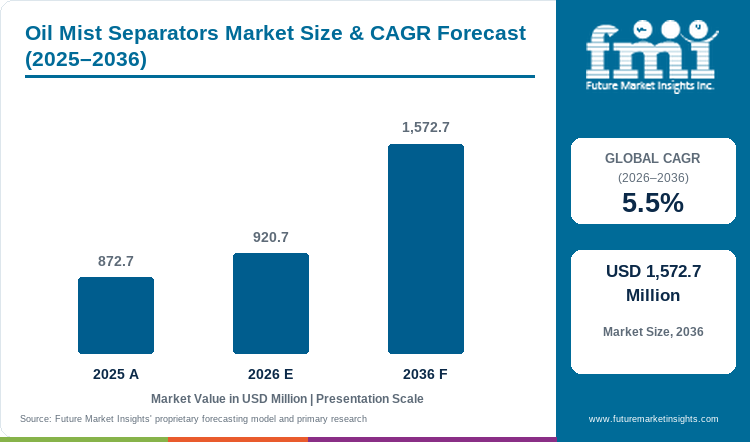
USD 920.7 million in 2026 and USD 1,572.7 million by 2036 at a 5.5% CAGR.
Sales of oil mist separators are estimated to rise at 5.5% CAGR through 2036, increasing valuation from USD 872.7 million in 2025 to USD 920.7 million in 2026, and reaching USD 1,572.7 million by 2036. Machine-level capture becomes part of equipment specification as faster machining and higher coolant pressure concentrate aerosol inside enclosed work zones. Absolent Air Care Group reported in June 2025 that Filtermist secured its largest unit order for a single oil mist project. The order covered centrifugal extraction equipment for a major Asian manufacturer and documented repeat specification at project scale.
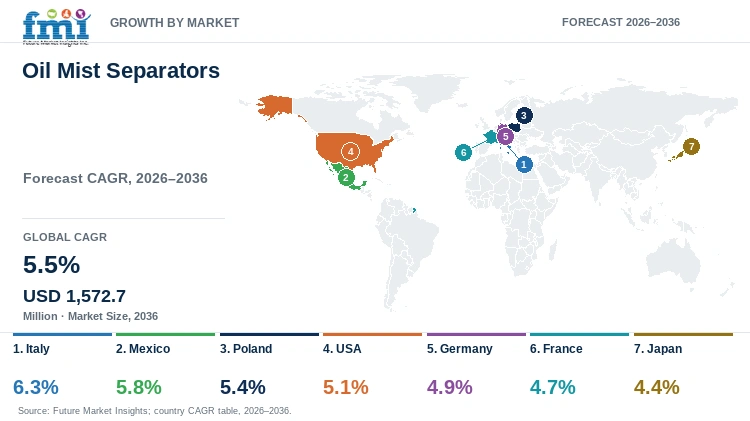
Country investment cycles change how quickly the same control need becomes an equipment order. As per FMI analysis, Italy is expected to rise at a 6.3% CAGR while France is projected at 4.7% CAGR through 2036. INSEE reported in February 2026 that French machinery-and-equipment output stood at an index of 103.53 in December 2025. Mature plants can postpone nonessential extraction replacement even when machining activity continues at stable production rates.
Key Takeaways
- New machining installations and higher coolant intensity increase demand for source capture that can be sized before equipment enters production.
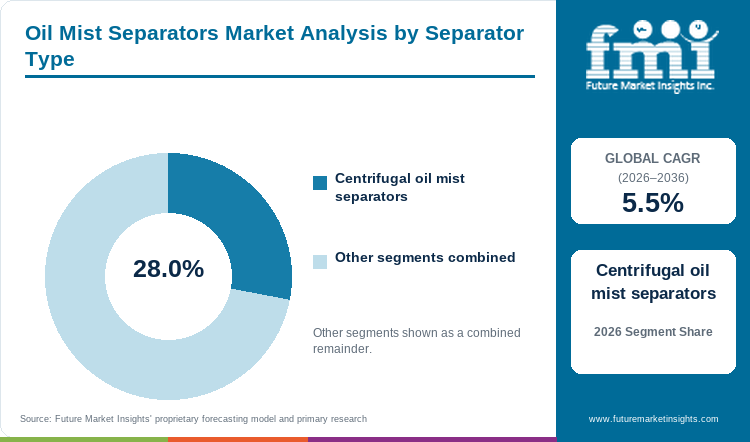
- Based on separator type, centrifugal oil mist separators are projected to account for 28.0% in 2026, supported by liquid recovery during repeated wet-machining duty.
- By airflow capacity, below 500 m³/h units are estimated to hold 22.0% in 2026, driven by compact machines that favor dedicated source capture.
- In 2026, CNC machining is expected to lead the application category with 36.0% share, attributable to enclosed wet cutting that produces repeatable machine-level aerosol loads.
- Poor airflow matching and difficult service access can delay adoption when the operating-cost case remains unclear before installation approval.
- Some of the key players in this market include Filtermist, Donaldson, Nederman, Plymovent, Losma, Absolent Air Care Group, 3nine, Camfil APC, Keller Lufttechnik, and Air Quality Engineering.
Analyst Perspective
"Plant engineers increasingly judge oil mist separators as part of the machine package because enclosure airflow determines whether rated filtration translates into source control. Suppliers gain repeat business when mounting access and service intervals remain predictable under the customer’s actual coolant and duty cycle."
- Nikhil Kaitwade, Principal Consultant, Future Market Insights
How is the oil mist separators market segmented?
The oil mist separators market is segmented by separator type, airflow capacity, application, end use, sales channel and region.
The oil mist separators market is segmented by separator type, airflow capacity, application, end use and sales channel. Separator type covers centrifugal, electrostatic, coalescing, HEPA-assisted and compact machine-mounted units while airflow capacity runs from below 500 m³/h to above 5,000 m³/h. Applications include CNC machining, grinding, cold heading, die casting and metal forming while end use and sales channel separate production settings from specification and replacement routes.
What supports centrifugal oil mist separators within the separator type category?
Centrifugal separation suits wet machining where recoverable droplets dominate the contaminant load and liquid return reduces disposable-media demand. Plants compare this architecture with other metalworking fluids because straight oils and emulsions create different aerosol behavior. Filtermist reported in April 2026 that F Save controls cut oil mist extraction energy by an average 55% at a UK aerospace manufacturer. That operating result strengthens the case for machine-level centrifugal units where production cycles include frequent idle periods. Buyers still add polishing stages where smoke or submicron particles require finer capture than primary centrifugal separation provides.
- By separator type, centrifugal oil mist separators are forecast to represent 28.0% in 2026, supported by recoverable coolant mist that reduces primary-media demand.
- Plant engineers add polishing stages where smoke or submicron aerosol extends beyond the practical capture range of primary centrifugal separation equipment.
How do compact airflow requirements shape the below 500 m³/h category?
Small enclosed machines need enough negative pressure to contain mist without paying for unused airflow or long duct runs. Compact collectors also simplify layouts near machine tool spindles where service space and coolant hardware compete for enclosure access. Filtermist announced its AW Series in December 2025 with 250 m³/h and 500 m³/h machine-mounted models beside an 800 m³/h version. The launch addresses high-pressure neat-oil and precision machining where limited floor space constrains collector placement near smaller machines. Buyers can match a smaller collector to the process before considering larger cellular or centralized extraction.
- Below 500 m³/h units are likely to capture 22.0% share in 2026, driven by compact machine installations that avoid unnecessary centralized airflow.
- Under-sizing can limit enclosure control because inadequate extraction defeats the benefit of a smaller collector footprint during active machining duty.
Why does CNC machining account for a large share of application demand?
CNC turning and milling combine enclosed work zones with continuous coolant delivery that atomizes into fine aerosol at higher speeds. The separator must handle the actual cutting fluid regime without pulling excessive air from the enclosure. In May 2026 3nine presented its APEX series at GrindingHub Stuttgart for CNC and grinding oil mist applications. Machine specification remains an efficient purchase point because mounting and controls can be settled before production starts on each production cell.
- CNC machining is set to lead the application category with 36.0% share in 2026, attributable to enclosed wet cutting that generates recurring aerosol loads.
- Machining cells with smoke or mixed particulate require additional filtration stages because buyers cannot select collectors from nominal airflow alone.
What keeps automotive machining important within the end use category?
Automotive plants and tier suppliers run dense machining cells where repeatable extraction specifications simplify maintenance over multiple production lines. Their industrial air filtration choices must also survive line changes without forcing every machine into a central-system redesign. AMT reported in February 2026 that US manufacturing-technology orders increased 22.5% during 2025. That capital activity expands the equipment base where machining mist control can be specified during installation. Automotive buyers still require modular collector formats because model changes can alter machine layouts before the separator reaches the end of its service life.
- Automotive machining is projected to hold 30.0% share in 2026, supported by repeated wet-machining cells that accept standardized extraction packages.
- Model changes can interrupt replacement timing because suppliers must prove that separator mounting and service access remain practical after production layouts change.
How does direct equipment OEM specification influence the sales channel category?
Machine builders can define mounting points and electrical interfaces before shipment instead of leaving extraction ownership to the receiving plant. That route reduces sizing disputes and aligns oil mist collectors with adjacent air filters already specified for the facility. Donaldson’s April 2026 Stratos documentation shows machine-mounted and floor-supported configurations with digital airflow controls for metalworking mist. The format gives machine builders a current example of extraction designed for individual equipment installation. Direct OEM sales become commercially attractive when a builder can repeat one validated configuration on similar machines without reopening installation ownership for every equipment program.
- The sales channel category is forecast to be led by direct equipment OEM at 35.0% share in 2026, driven by integration decisions settled before commissioning.
- Distributors and service providers serve mixed installed fleets where replacement timing does not coincide with a new machine purchase or OEM specification.
What are the drivers, restraints and opportunities in the Oil Mist Separators Market?
Machine-level aerosol control expands purchases, capital and lifecycle checks can delay approval, and smarter compact controls widen retrofit and OEM routes.
- Driver: New machining capacity expands purchases when plant engineers attach source-level mist control to an active machine enclosure.
- Restraint: Capital approval slows when airflow sizing, energy demand and maintenance work cannot be justified before equipment installation.
- Opportunity: Demand-based controls can improve retrofit payback by reducing idle extraction energy on compatible installed oil mist collectors.
Machine Investment Pulls Mist Control Into New Equipment
New machining capacity expands separator purchases when plant engineers connect the machine enclosure with a defined mist-control requirement. Filtermist documented in January 2026 that Factory 33 used oil mist collectors on active machining equipment to eliminate visible fog inside the workshop. The purchase links productive equipment directly to source capture instead of treating extraction as a general building-air project. Grinding machinery can produce the same decision point where coolant aerosol rises inside enclosed processes.
Sizing and Service Economics Delay Capital Approval
Capital approval slows when a separator must be added during a weak machine-investment cycle and the operating savings remain unclear. UCIMU said in December 2025 that Italian machine-tool production had been nearly stagnant during 2025 and manufacturers expected only moderate growth in 2026. Plants under tighter capital review can postpone ancillary extraction even when source control remains technically justified. Emulsifiable metalworking fluid can also change drainage and filter-loading behavior as operating conditions shift. Vendors reduce this restraint by providing pressure-loss data and realistic service intervals before purchase. A technically suitable collector can still lose budget priority when maintenance work cannot fit scheduled production downtime.
Demand-Based Controls Improve Retrofit Payback
Retrofit economics improve when extraction follows coolant use instead of running continuously during idle periods. Filtermist launched F Save in October 2025 with sensors that read coolant-pump activity and switch compatible oil mist collectors with the machine cycle. The control is designed for Filtermist FX and S Series units and can be retrofitted without accessing machine electronics. Suppliers can secure retrofit orders by documenting the customer’s actual machine duty cycle before installation and quantifying avoidable idle runtime. Facilities that also manage coolant filtration skids can treat liquid cleanliness separately from mist-collector runtime. Plants gain a practical route to lower extraction energy without replacing serviceable collection hardware before the end of its normal operating life.
Which country CAGRs are profiled in the Oil Mist Separators Market?
| Country | CAGR |
|---|---|
| Italy | 6.3% |
| Mexico | 5.8% |
| Poland | 5.4% |
| USA | 5.1% |
| Germany | 4.9% |
| France | 4.7% |
| Japan | 4.4% |
How do country-level CAGRs compare in the Oil Mist Separators Market?
Italy and Mexico form the upper end of the selected-country CAGR range while France and Japan occupy the lower end. Poland, the USA and Germany form a closely grouped middle set where forecast differences are comparatively narrow. The 1.9 percentage-point spread measures forecast pace rather than current market size and does not establish one uniform buying pattern.
- Italy’s established equipment base, combined with ongoing machinery investment, creates demand for oil mist separators that can support both retrofit projects and new-machine installations.
- In Mexico, changing automotive production programs encourage the adoption of modular collection systems that can be reconfigured alongside machining cells.
- Poland’s manufacturing sector often upgrades extraction equipment in phases, making service-led replacement strategies more practical than full-system overhauls.
- The USA continues to generate demand through new metalworking equipment purchases across a wide range of shop sizes and production environments.
- Germany’s export-oriented machine-building industry places strong emphasis on application engineering and equipment optimization, even during softer domestic investment cycles.
- In France, process modifications frequently drive retrofit activity, as existing extraction systems can remain operational for extended periods before replacement becomes necessary.
- Japan’s mature manufacturing facilities prioritize compact interfaces, efficient floor-space utilization, and disciplined commissioning during equipment upgrades.
Comparable CAGRs can still produce different entry conditions because OEM access, installed equipment age and local service economics vary by country. The full report provides country-level CAGR analysis across North America, Latin America, Western Europe, Eastern Europe, East Asia, South Asia and Pacific, and the Middle East and Africa.
Country-wise Analysis
- Machine builders give Italian plants a direct route to specify mist control during new equipment purchases and line modernization. By 2036, Italy is projected to grow at 6.3% CAGR, supported by renewed machine investment that provides fresh separator specification points. UCIMU reported that Italian machine-tool consumption rose 22.3% in 2025 and domestic deliveries increased 28.1%. Those gains enlarge the flow of machines where extraction can be mounted before commissioning. Capacity utilization still averaged 76.5% during 2025, so retrofit spending can remain selective outside active replacement programs. Suppliers need compact units and repeatable mounting packages that machine builders can carry between similar CNC installations without reopening airflow design for every order.
- Automotive plants concentrate machining demand in Mexican production corridors where equipment uptime makes local service response commercially important. Mexico's oil mist separators outlook is anticipated to advance at 5.8% CAGR over the assessment period, driven by a large national vehicle-production base that sustains wet-machining demand. INEGI reported that Mexico produced 3,953,494 light vehicles nationwide during the full 2025 calendar year. Output declined 0.9% from 2024, which keeps separator demand exposed to vehicle production cycles instead of a straight expansion path. Plants also operate mixed machine brands that can change mounting geometry between successive vehicle programs. Suppliers need modular collectors and nearby service coverage that can support repeat installations without extending maintenance downtime.
- Polish component plants provide a broad machining base where separator replacement often follows staged equipment modernization instead of greenfield expansion. Oil mist separator demand in Poland is forecast to rise at 5.4% CAGR over the forecast period, supported by metalworking-machine output that keeps source-capture requirements active. Statistics Poland reported that production of machine tools for machining metals increased 21.2% year over year during January through September 2025. Modernization timing still differs between large export-oriented plants and smaller domestic manufacturers with tighter capital budgets. Suppliers need serviceable retrofit formats that can move with incremental cell upgrades without forcing major duct changes during each equipment replacement.
- Contract machine shops and large manufacturers evaluate industrial filtration differently because facility scale changes installation and service needs for mist control. Adoption of oil mist separators in the USA is estimated to expand at 5.1% CAGR through 2036, reinforced by current metalworking machinery orders and a broad installed machining base. AMT reported that January 2026 metalworking-machinery orders were 24.4% above January 2025 after the record December period. Wide variation in shop scale makes standardized service coverage difficult for national separator suppliers outside large production sites. Vendors need lifecycle data and regional support that fit smaller facilities while preserving engineered options for plants operating several connected machining cells.
- German machining plants involve application engineers early because coolant behavior and enclosure geometry determine extraction sizing. The German oil mist separators sector is projected to record 4.9% CAGR during the assessment period, shaped by a mature installed base and cautious domestic equipment investment. VDW reported that first-half 2025 machine-tool orders fell 5% while domestic demand dropped 22% and foreign orders rose 4%. Capital hesitation can postpone retrofits even where existing collectors no longer fit changed processes. Suppliers improve order conversion by documenting pressure loss and service access before approval without requiring a complete central-system redesign or extended production shutdown.
- French plants combine mature machining capacity with capital decisions that favor upgrades showing measurable operating improvement. In France, oil mist separator demand is predicted to advance at 4.7% CAGR through 2036, influenced by replacement activity within established machinery and equipment fleets. INSEE reported that the machinery-and-equipment turnover index reached 119.64 in March 2026 after 118.94 in February. Serviceable legacy extraction can delay replacement when production changes remain within existing airflow capacity. Suppliers need flexible machine-level collectors and clear maintenance data so local buyers can justify replacement when revised coolant loads or metalworking fluid additives alter service requirements.
- Japanese manufacturers protect compact layouts and predictable machine performance because mature plants add controls without disrupting tightly planned production. Oil mist separator sales in Japan are forecast to expand at 4.4% CAGR by 2036, attributable to selective replacement within a mature machine-tool installed base. JMTBA reported that 2025 machine-tool orders increased 8.0% while domestic orders slipped 0.2% and foreign orders rose 11.5%. The domestic result confirms a selective replacement setting rather than broad local machine investment. Vendors need quiet compact systems and clear maintenance records before buyers retire functioning collectors or alter approved machine interfaces during planned equipment upgrades.
Who are the notable companies in the Oil Mist Separators Market?
Filtermist, Donaldson, Nederman, Plymovent, Losma, Absolent Air Care Group, 3nine, Camfil APC, Keller Lufttechnik, and Air Quality Engineering serve the defined oil mist separator market.
Competition is fragmented between compact machine-mounted specialists and groups that engineer wider airflow systems for machining plants. Separation performance must match the actual coolant load before a supplier can reduce installation risk at commissioning. Current supplier portfolios cover direct-mounted units and larger cellular or central configurations for different machine and plant requirements. Buyers compare maintenance access and local service coverage beside filtration architecture when one vendor must support several machine types.
- Filtermist, 3nine and Losma emphasize compact mechanical or hybrid separation for individual machine tools and precision-machining environments.
- Donaldson, Absolent Air Care Group, Camfil APC and Keller Lufttechnik cover broader filtration architectures or engineered system scales for heavier loads.
- Nederman, Plymovent and Air Quality Engineering provide configurable mist-control platforms that extend from individual machines toward wider workplace-air programs.
Competitive Benchmarking: Oil Mist Separators Market
| Company | Machine-Mounted Fit | Mist Technology Breadth | System Scale & Integration | Geographic Reach |
|---|---|---|---|---|
| Filtermist | High | High | Medium | Europe, North America, Asia and distributor markets |
| Donaldson | High | High | High | North America, Europe, Asia-Pacific and global industrial markets |
| Nederman | Medium | High | High | Europe, North America, Asia and global industrial markets |
| Plymovent | High | Medium | High | Europe, North America and international distributor markets |
| Losma | High | High | High | Europe, North America, Asia and international industrial markets |
| Absolent Air Care Group | High | High | High | Europe, North America, Asia and global OEM channels |
| 3nine | High | Medium | Medium | Europe, North America, Asia and distributor-led international markets |
| Camfil APC | Medium | High | High | Americas, Europe and Asia-Pacific |
| Keller Lufttechnik | Medium | High | High | Europe with international engineered-project reach |
| Air Quality Engineering | High | High | High | North America with selected international distribution |
Scoring basis: High machine-mounted fit requires documentation of direct individual-machine mounting while Medium requires machine-tool use without the same mounting breadth. High technology breadth requires at least three documented mist-control stages or architectures and Medium requires two. High system integration covers stand-alone plus cellular or centralized configurations while Medium documents a narrower system range.
Key Developments in the Oil Mist Separators Market
- In February 2026, Plymovent announced plans to consolidate its two German locations and combine industrial filtration expertise under one operating team that explicitly covers oil mist separation.
- In November 2025, Absolent Air Care Group disclosed that its Industrial business had launched a completely new compact machine-mounted oil mist filter series during the third quarter.
- In September 2025, 3nine introduced the APEX Series as its latest oil mist separator generation before the platform’s launch event at EMO Hannover.
Key Players in the Oil Mist Separators Market
Compact Machine-Level Separation Specialists
- Filtermist
- 3nine
- Losma
Engineered Multi-Stage Mist Filtration Platforms
- Donaldson
- Absolent Air Care Group
- Camfil APC
- Keller Lufttechnik
Integrated Extraction and Workplace-Air Providers
- Nederman
- Plymovent
- Air Quality Engineering
Oil Mist Separators Market - Report Scope
| Coverage field | Report scope |
|---|---|
| Market breakdown | By separator type, airflow capacity, application, end use, sales channel and region. |
| Quantitative Units | USD million. |
| Market Definition | Revenue from oil mist separator and collector equipment used to capture coolant and oil aerosol from machining and related metalworking processes. |
| Regions Covered | North America, Latin America, Western Europe, Eastern Europe, East Asia, South Asia and Pacific and Middle East and Africa. |
| Countries Covered | Italy, Mexico, Poland, USA, Germany, France, Japan, and 20+ countries included in the full report. |
| Key Companies Profiled | Filtermist, Donaldson, Nederman, Plymovent, Losma, Absolent Air Care Group, 3nine, Camfil APC, Keller Lufttechnik, Air Quality Engineering. |
| Forecast Period | 2026 to 2036. |
| Approach | Primary and secondary research with market triangulation. |
Oil Mist Separators Market - Research Methodology
| Method | Approach |
|---|---|
| Primary Research | FMI analysts gathered input from manufacturers, service providers, technology developers, distributors, end users, procurement teams, and subject-matter experts. Interviews examined purchasing decisions, product or service evaluation, adoption barriers, approval requirements, pricing considerations, and expectations for technical or commercial support. Respondents were also asked what evidence is required before a trial, pilot, or initial order develops into regular purchasing. |
| Desk Research | Desk research covered government statistics, regulatory publications, trade data, industry associations, technical literature, standards, company filings, product information, and official corporate announcements. Sources were reviewed for relevance, publication date, geographic coverage, and consistency with the defined market scope. Claims relating to performance, applications, approvals, capacity, investment, and commercial activity were retained only when supported by credible public evidence. |
| Market Sizing and Forecasting | The market model combined the baseline value with historical performance, segment structure, pricing and volume indicators, adoption levels, company participation, and country-level demand conditions. Forecast assumptions considered economic activity, investment trends, regulatory developments, technology adoption, purchasing cycles, supply availability, and barriers to wider market use. Segment and regional estimates were reconciled before the final market total was calculated. |
| Data Validation | Estimates were checked against multiple independent indicators, including public data, company activity, trade patterns, industry developments, and findings from primary interviews. Validation also tested whether products, services, applications, and company revenues fell within the defined market boundaries. Adjacent categories, unsupported claims, overlapping revenues, and activities without direct market relevance were excluded to reduce double counting and maintain consistency across segments and countries. |
Oil Mist Separators Market by Segments
Oil Mist Separators Market segmented by Separator Type:
- Centrifugal oil mist separators
- Electrostatic precipitators
- Coalescing filter separators
- HEPA-assisted mist collectors
- Compact machine-mounted units
Oil Mist Separators Market segmented by Airflow Capacity:
- Below 500 m³/h
- 500-2,000 m³/h
- 2,000-5,000 m³/h
- Above 5,000 m³/h
Oil Mist Separators Market segmented by Application:
- CNC machining
- Grinding
- Cold heading
- Die casting
- Metal forming
Oil Mist Separators Market segmented by End Use:
- Automotive machining
- Machine shops
- Aerospace machining
- Bearing/fastener plants
- General manufacturing
Oil Mist Separators Market segmented by Sales Channel:
- Direct equipment OEM
- Industrial air filtration distributors
- Machine tool dealers
- MRO/service providers
Oil Mist Separators Market by Region:
- North America
- United States
- Canada
- Latin America
- Brazil
- Mexico
- Argentina
- Chile
- Western Europe
- Germany
- France
- United Kingdom
- Italy
- Spain
- Benelux
- Nordics
- Eastern Europe
- Poland
- Czech Republic
- Romania
- Hungary
- East Asia
- China
- Japan
- South Korea
- South Asia and Pacific
- India
- ASEAN
- Australia and New Zealand
- Middle East and Africa
- GCC Countries
- South Africa
- Türkiye
- Israel
Research Sources and Bibliography
- Absolent Air Care Group AB. (2025, June 16). Filtermist reports largest ever unit orders for a single project.
- INSEE. (2026, February 5). In December 2025, manufacturing output fell back sharply (-0.8%).
- Filtermist Limited. (2026, April 27). UK Aerospace manufacturer achieves an average of 55% energy reduction on its oil mist extraction thanks to F Save.
- Filtermist Limited. (2025, December 3). Welcome to a new era in oil mist filtration.
- 3nine AB. (2026, May 12). 3nine’s APEX series at GrindingHub Stuttgart.
- AMT - The Association For Manufacturing Technology. (2026, February 9). Manufacturing Technology Orders set record in December 2025.
- Donaldson Company, Inc. (2026, April). Stratos Mist Collector.
- Filtermist Limited. (2026, January 9). Fog-free Factory 33 Ltd thanks to Filtermist oil mist collectors.
- UCIMU-SISTEMI PER PRODURRE. (2025, December 16). The Italian machine tool industry to close a rather stagnant 2025. Manufacturers expect moderate growth for 2026.
- Filtermist Limited. (2025, October 2). Filtermist launches new smart energy-saving device - F Save.
- UCIMU-SISTEMI PER PRODURRE. (2026). Italian Machines Tool Industry in 2025.
- Instituto Nacional de Estadística y Geografía. (2026, January 9). Registro administrativo de la industria automotriz de vehículos ligeros. Diciembre de 2025.
- Statistics Poland. (2025, October 23). Production of major industrial products in September 2025.
- AMT - The Association For Manufacturing Technology. (2026, March 9). MT orders predictably decline in January after historic December.
- VDW - German Machine Tool Builders’ Association. (2025, August 12). Machine tool industry expecting no upturn until next year.
- INSEE. (2026, May 29). In March 2026, manufacturing turnover bounced back (+2.2%).
- Japan Machine Tool Builders’ Association. (2026, February 3). The Current Condition of the Japanese Machine Tool Industry: Monthly Machine Tool Orders (December 2025).
- Plymovent. (2026, February 25). Plymovent investiert weiter in Deutschland.
- Absolent Air Care Group AB. (2025, November 4). Interim report January-September 2025.
- 3nine AB. (2025, September 2). The APEX Series - Smarter Oil Mist Separation.
- Filtermist Limited. (2026). Oil Mist Collectors.
- Donaldson Company, Inc. (2026). WSO Mist Collector.
- Nederman. (2026). Oil Mist Collection | Metalworking | FibreDrain.
- Plymovent. (2026). Oil mist removal.
- Losma S.p.A. (2026). Products.
- Absolent Air Care Group AB. (2026). Oil mist collectors.
- 3nine AB. (2026). 3nine oil mist eliminators - The smartest solution for problems with oil mist.
- Camfil APC. (2026). Oil Mist Collector for Machining.
- Keller Lufttechnik GmbH + Co. KG. (2026). Downloads: coolant and oil mist separators.
- Air Quality Engineering, Inc. (2026). MistBuster: efficient compact industrial mist collectors for metalworking applications.
- Losma S.p.A. (2026). Icarus, oily mist filter unit.
- Plymovent. (2026). MistEliminator-4 series.
- Filtermist Limited. (2026, August 10). F Save helps specialist IS variable equipment supplier minimise environmental impact.
- Filtermist Limited. (2026, August 19). Majorlift Highlights the Benefits of F Save in New Customer Case Study.
- 3nine AB. (2026, May 26). Strong interest in the APEX series at Elmia Machine Tools 2026.
- Absolent Air Care Group AB. (2025, July 18). Interim report January-June 2025.
- 3nine AB. (2026, April 7). Strong interest in the APEX series at Global Industrie Paris.
This bibliography is provided for reader reference and is not exhaustive. The full report contains the complete reference list and detailed citations.
This Report Answers
- How large is the oil mist separators market in 2026 and 2036?
- Which machining conditions turn airborne mist control into equipment purchases?
- Why do centrifugal separators account for 28.0% of separator type demand?
- How do compact airflow requirements influence machine-mounted separator selection decisions?
- Why does CNC machining represent 36.0% of application demand in 2026?
- How do country growth rates differ among the seven selected national markets?
- Which companies serve compact machine-level and engineered mist-control requirements worldwide?
- What limits purchase approval when airflow and lifecycle economics remain uncertain?
- How can OEM integration shorten the path from specification to installation?
Frequently Asked Questions
How big is the oil mist separators market in 2026?
The oil mist separators market is valued at USD 920.7 million in 2026 and is projected to reach USD 1,572.7 million by 2036. Machine-level aerosol control converts into orders when suppliers resolve airflow sizing and mounting before commissioning.
What is the CAGR of the oil mist separators market from 2026 to 2036?
The oil mist separators market is projected to grow at a 5.5% CAGR between 2026 and 2036. Growth is tied to new machining installations and replacement projects that need effective source capture without excessive lifecycle cost.
Which separator type accounts for 28.0% of demand in 2026?
The centrifugal oil mist separator segment is projected to account for 28.0% of separator type demand in 2026. The format suits recoverable coolant mist and compact machine integration where operators want lower primary-media consumption.
Which airflow capacity category accounts for 22.0% of demand in 2026?
The below 500 m³/h segment is estimated to hold 22.0% of airflow capacity demand in 2026. Compact enclosed machines often need dedicated extraction that avoids long duct runs and unnecessary fan capacity.
Which countries record higher growth rates in the oil mist separators market?
Italy is projected to grow at 6.3% CAGR followed by Mexico at 5.8% and Poland at 5.4% through 2036. Their growth routes differ because machine investment and local service conditions shape separator purchasing differently.
Which companies are active in the oil mist separators market?
Key companies operating in the oil mist separators market include Filtermist, Donaldson, Nederman, Plymovent, Losma, Absolent Air Care Group, 3nine, Camfil APC, Keller Lufttechnik, and Air Quality Engineering. Their positions differ by mounting format and filtration architecture while service reach separates machine-level specialists from broader engineered-system providers.
Preview the report firsthand - request a free sample
Get SampleGet the brochure for pricing and purchase details.
Get PDFTable of Content
- Key Takeaways
- Market Size and CAGR
- Top Growth Driver
- Fastest Growing Segment
- Leading Region
- Key Companies
- Emerging Opportunities
- Executive Summary
- Global Market Outlook
- Demand-side Trends
- Supply-side Trends
- Technology Roadmap Analysis
- Analysis and Recommendations
- Analyst Perspective (What is happening? Why now? What should investors know?)
- Key Questions Answered
- How large is the market?
- What is the CAGR?
- What are key trends?
- Which region dominates?
- Who are the leaders?
- Market Overview
- Market Coverage / Taxonomy
- Market Definition / Scope / Limitations
- Research Methodology
- Chapter Orientation
- Analytical Lens and Working Hypotheses
- Market Structure, Signals, and Trend Drivers
- Benchmarking and Cross-market Comparability
- Market Sizing, Forecasting, and Opportunity Mapping
- Research Design and Evidence Framework
- Desk Research Programme (Secondary Evidence)
- Expert Input and Fieldwork (Primary Evidence)
- Tooling, Models, and Reference Databases
- Data Engineering and Model Build
- Quality Assurance and Audit Trail
- Market Background
- Market Dynamics (Drivers, Restraints, Opportunity, Trends)
- Scenario Forecast (Optimistic, Likely, Conservative)
- Impact Analysis
- AI Impact
- Sustainability Impact
- Regulatory Impact
- Technology Impact
- Consumer / Buyer Analysis
- Purchase Drivers
- Adoption Barriers
- Buyer Journey
- Opportunity Map Analysis
- Product Life Cycle Analysis
- Supply Chain Analysis
- Investment Feasibility Matrix
- Value Chain Analysis
- PESTLE and Porter's Analysis
- Regulatory Landscape
- Regional Parent Market Outlook
- Production and Consumption Statistics
- Import and Export Statistics
- Global Market Analysis and Forecast, 2021 to 2036
- Historical Market Size Value (USD Million) Analysis, 2021 to 2025
- Current and Future Market Size Value (USD Million) Projections, 2026 to 2036
- Y-o-Y Growth Trend Analysis
- Absolute $ Opportunity Analysis
- Global Market Pricing Analysis, 2021 to 2036
- Global Market Analysis and Forecast, By Separator Type, 2021 to 2036
- Introduction / Key Findings
- Historical Market Size Value (USD Million) Analysis By Separator Type, 2021 to 2025
- Current and Future Market Size Value (USD Million) Analysis and Forecast By Separator Type, 2026 to 2036
- Centrifugal oil mist separators
- Electrostatic precipitators
- Coalescing filter separators
- HEPA-assisted mist collectors
- Compact machine-mounted units
- Y-o-Y Growth Trend Analysis By Separator Type, 2021 to 2025
- Absolute $ Opportunity Analysis By Separator Type, 2026 to 2036
- Global Market Analysis and Forecast, By Airflow Capacity, 2021 to 2036
- Introduction / Key Findings
- Historical Market Size Value (USD Million) Analysis By Airflow Capacity, 2021 to 2025
- Current and Future Market Size Value (USD Million) Analysis and Forecast By Airflow Capacity, 2026 to 2036
- Below 500 m³/h
- 500-2,000 m³/h
- 2,000-5,000 m³/h
- Above 5,000 m³/h
- Y-o-Y Growth Trend Analysis By Airflow Capacity, 2021 to 2025
- Absolute $ Opportunity Analysis By Airflow Capacity, 2026 to 2036
- Global Market Analysis and Forecast, By Application, 2021 to 2036
- Introduction / Key Findings
- Historical Market Size Value (USD Million) Analysis By Application, 2021 to 2025
- Current and Future Market Size Value (USD Million) Analysis and Forecast By Application, 2026 to 2036
- CNC machining
- Grinding
- Cold heading
- Die casting
- Metal forming
- Y-o-Y Growth Trend Analysis By Application, 2021 to 2025
- Absolute $ Opportunity Analysis By Application, 2026 to 2036
- Global Market Analysis and Forecast, By End Use, 2021 to 2036
- Introduction / Key Findings
- Historical Market Size Value (USD Million) Analysis By End Use, 2021 to 2025
- Current and Future Market Size Value (USD Million) Analysis and Forecast By End Use, 2026 to 2036
- Automotive machining
- Machine shops
- Aerospace machining
- Bearing/fastener plants
- General manufacturing
- Y-o-Y Growth Trend Analysis By End Use, 2021 to 2025
- Absolute $ Opportunity Analysis By End Use, 2026 to 2036
- Global Market Analysis and Forecast, By Sales Channel, 2021 to 2036
- Introduction / Key Findings
- Historical Market Size Value (USD Million) Analysis By Sales Channel, 2021 to 2025
- Current and Future Market Size Value (USD Million) Analysis and Forecast By Sales Channel, 2026 to 2036
- Direct equipment OEM
- Industrial air filtration distributors
- Machine tool dealers
- MRO/service providers
- Y-o-Y Growth Trend Analysis By Sales Channel, 2021 to 2025
- Absolute $ Opportunity Analysis By Sales Channel, 2026 to 2036
- Global Market Analysis and Forecast, By Region, 2021 to 2036
- Introduction
- Historical Market Size Value (USD Million) Analysis By Region, 2021 to 2025
- Current Market Size Value (USD Million) Analysis and Forecast By Region, 2026 to 2036
- North America
- Latin America
- Western Europe
- Eastern Europe
- East Asia
- South Asia and Pacific
- Middle East and Africa
- Market Attractiveness Analysis By Region
- North America Market Analysis and Forecast, By Country, 2021 to 2036
- Historical Market Size Value (USD Million) Trend Analysis By Market Taxonomy, 2021 to 2025
- Market Size Value (USD Million) Forecast By Market Taxonomy, 2026 to 2036
- By Country
- United States
- Canada
- By Separator Type
- By Airflow Capacity
- By Application
- By End Use
- By Sales Channel
- By Country
- Market Attractiveness Analysis
- By Country
- By Separator Type
- By Airflow Capacity
- By Application
- By End Use
- By Sales Channel
- Key Takeaways
- Latin America Market Analysis and Forecast, By Country
- Historical Market Size Value (USD Million) Trend Analysis By Market Taxonomy, 2021 to 2025
- Market Size Value (USD Million) Forecast By Market Taxonomy, 2026 to 2036
- By Country
- Brazil
- Mexico
- Argentina
- Chile
- By Separator Type
- By Airflow Capacity
- By Application
- By End Use
- By Sales Channel
- By Country
- Market Attractiveness Analysis
- By Country
- By Separator Type
- By Airflow Capacity
- By Application
- By End Use
- By Sales Channel
- Key Takeaways
- Western Europe Market Analysis and Forecast, By Country
- Historical Market Size Value (USD Million) Trend Analysis By Market Taxonomy, 2021 to 2025
- Market Size Value (USD Million) Forecast By Market Taxonomy, 2026 to 2036
- By Country
- Germany
- France
- United Kingdom
- Italy
- Spain
- Benelux
- Nordics
- By Separator Type
- By Airflow Capacity
- By Application
- By End Use
- By Sales Channel
- By Country
- Market Attractiveness Analysis
- By Country
- By Separator Type
- By Airflow Capacity
- By Application
- By End Use
- By Sales Channel
- Key Takeaways
- Eastern Europe Market Analysis and Forecast, By Country
- Historical Market Size Value (USD Million) Trend Analysis By Market Taxonomy, 2021 to 2025
- Market Size Value (USD Million) Forecast By Market Taxonomy, 2026 to 2036
- By Country
- Poland
- Czech Republic
- Romania
- Hungary
- By Separator Type
- By Airflow Capacity
- By Application
- By End Use
- By Sales Channel
- By Country
- Market Attractiveness Analysis
- By Country
- By Separator Type
- By Airflow Capacity
- By Application
- By End Use
- By Sales Channel
- Key Takeaways
- East Asia Market Analysis and Forecast, By Country
- Historical Market Size Value (USD Million) Trend Analysis By Market Taxonomy, 2021 to 2025
- Market Size Value (USD Million) Forecast By Market Taxonomy, 2026 to 2036
- By Country
- China
- Japan
- South Korea
- By Separator Type
- By Airflow Capacity
- By Application
- By End Use
- By Sales Channel
- By Country
- Market Attractiveness Analysis
- By Country
- By Separator Type
- By Airflow Capacity
- By Application
- By End Use
- By Sales Channel
- Key Takeaways
- South Asia and Pacific Market Analysis and Forecast, By Country
- Historical Market Size Value (USD Million) Trend Analysis By Market Taxonomy, 2021 to 2025
- Market Size Value (USD Million) Forecast By Market Taxonomy, 2026 to 2036
- By Country
- India
- ASEAN
- Australia and New Zealand
- By Separator Type
- By Airflow Capacity
- By Application
- By End Use
- By Sales Channel
- By Country
- Market Attractiveness Analysis
- By Country
- By Separator Type
- By Airflow Capacity
- By Application
- By End Use
- By Sales Channel
- Key Takeaways
- Middle East and Africa Market Analysis and Forecast, By Country
- Historical Market Size Value (USD Million) Trend Analysis By Market Taxonomy, 2021 to 2025
- Market Size Value (USD Million) Forecast By Market Taxonomy, 2026 to 2036
- By Country
- GCC Countries
- South Africa
- Türkiye
- Israel
- By Separator Type
- By Airflow Capacity
- By Application
- By End Use
- By Sales Channel
- By Country
- Market Attractiveness Analysis
- By Country
- By Separator Type
- By Airflow Capacity
- By Application
- By End Use
- By Sales Channel
- Key Takeaways
- Key Countries Market Analysis
- United States
- Pricing Analysis
- Market Share Analysis, 2025
- By Separator Type
- By Airflow Capacity
- By Application
- By End Use
- By Sales Channel
- Canada
- Pricing Analysis
- Market Share Analysis, 2025
- By Separator Type
- By Airflow Capacity
- By Application
- By End Use
- By Sales Channel
- Mexico
- Pricing Analysis
- Market Share Analysis, 2025
- By Separator Type
- By Airflow Capacity
- By Application
- By End Use
- By Sales Channel
- Brazil
- Pricing Analysis
- Market Share Analysis, 2025
- By Separator Type
- By Airflow Capacity
- By Application
- By End Use
- By Sales Channel
- Chile
- Pricing Analysis
- Market Share Analysis, 2025
- By Separator Type
- By Airflow Capacity
- By Application
- By End Use
- By Sales Channel
- Germany
- Pricing Analysis
- Market Share Analysis, 2025
- By Separator Type
- By Airflow Capacity
- By Application
- By End Use
- By Sales Channel
- United Kingdom
- Pricing Analysis
- Market Share Analysis, 2025
- By Separator Type
- By Airflow Capacity
- By Application
- By End Use
- By Sales Channel
- Italy
- Pricing Analysis
- Market Share Analysis, 2025
- By Separator Type
- By Airflow Capacity
- By Application
- By End Use
- By Sales Channel
- Spain
- Pricing Analysis
- Market Share Analysis, 2025
- By Separator Type
- By Airflow Capacity
- By Application
- By End Use
- By Sales Channel
- France
- Pricing Analysis
- Market Share Analysis, 2025
- By Separator Type
- By Airflow Capacity
- By Application
- By End Use
- By Sales Channel
- India
- Pricing Analysis
- Market Share Analysis, 2025
- By Separator Type
- By Airflow Capacity
- By Application
- By End Use
- By Sales Channel
- ASEAN
- Pricing Analysis
- Market Share Analysis, 2025
- By Separator Type
- By Airflow Capacity
- By Application
- By End Use
- By Sales Channel
- Australia and New Zealand
- Pricing Analysis
- Market Share Analysis, 2025
- By Separator Type
- By Airflow Capacity
- By Application
- By End Use
- By Sales Channel
- China
- Pricing Analysis
- Market Share Analysis, 2025
- By Separator Type
- By Airflow Capacity
- By Application
- By End Use
- By Sales Channel
- Japan
- Pricing Analysis
- Market Share Analysis, 2025
- By Separator Type
- By Airflow Capacity
- By Application
- By End Use
- By Sales Channel
- South Korea
- Pricing Analysis
- Market Share Analysis, 2025
- By Separator Type
- By Airflow Capacity
- By Application
- By End Use
- By Sales Channel
- Poland
- Pricing Analysis
- Market Share Analysis, 2025
- By Separator Type
- By Airflow Capacity
- By Application
- By End Use
- By Sales Channel
- Hungary
- Pricing Analysis
- Market Share Analysis, 2025
- By Separator Type
- By Airflow Capacity
- By Application
- By End Use
- By Sales Channel
- Türkiye
- Pricing Analysis
- Market Share Analysis, 2025
- By Separator Type
- By Airflow Capacity
- By Application
- By End Use
- By Sales Channel
- South Africa
- Pricing Analysis
- Market Share Analysis, 2025
- By Separator Type
- By Airflow Capacity
- By Application
- By End Use
- By Sales Channel
- United States
- Market Structure Analysis
- Competition Dashboard
- Competition Benchmarking
- Market Share Analysis of Top Players
- By Regional
- By Separator Type
- By Airflow Capacity
- By Application
- By End Use
- By Sales Channel
- Emerging Startups
- Innovation Benchmarking
- Competition Analysis
- Competition Deep Dive
- Filtermist
- Overview
- Product Portfolio
- Profitability by Market Segments
- Sales Footprint
- Strategy Overview
- Marketing Strategy
- Product Strategy
- Channel Strategy
- Donaldson
- Nederman
- Plymovent
- Losma
- Absolent Air Care Group
- 3nine
- Camfil APC
- Keller Lufttechnik
- Air Quality Engineering
- Filtermist
- Case Studies
- Success Stories
- Recent Developments
- Competition Deep Dive
- Assumptions & Acronyms Used


