

- Market Size (2026)
- USD 620.7 Mn
- Forecast (2036)
- USD 1001.5 Mn
- CAGR (2026 to 2036)
- 4.9%
How big is Oil Pump Drive Chain Market in 2026?
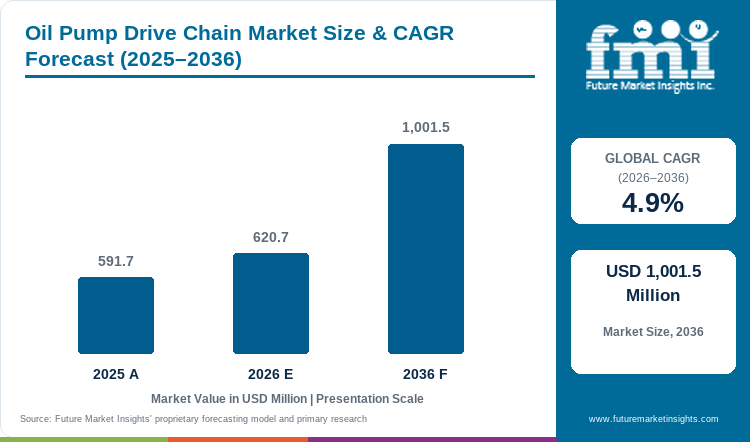
USD 620.7 million in 2026 and USD 1,001.5 million by 2036, expanding at 4.9% CAGR.
Sales of oil pump drive chains are estimated to rise at 4.9% CAGR through 2036, increasing valuation from USD 591.7 million in 2025 to USD 620.7 million in 2026, and reaching USD 1,001.5 million by 2036. Tsubakimoto Chain's 2025 integrated report describes continued timing-chain development for hybrid and plug-in hybrid engines. Oil pump drive chains enter the same engine-program validation cycle before series production because chain geometry and wear behavior must match the assigned lubrication system. Revenue therefore follows awarded engine programs and their production life rather than discretionary accessory purchasing.
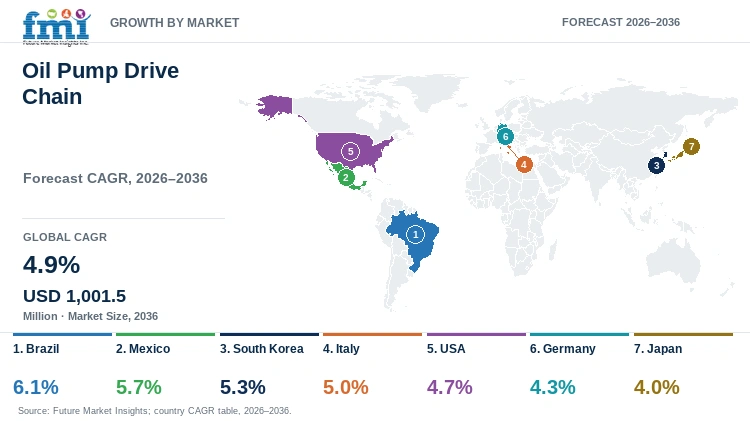
Brazil's projected 6.1% CAGR exceeds Germany's 4.3% CAGR over the forecast period, but the difference reflects powertrain mix instead of present market size. VDA reported in February 2026 that Germany produced 1.67 million electric passenger cars during 2025 and electric models represented 40% of domestic passenger-car production. Battery-electric vehicles remove the combustion engine oil-pump drive from the bill of materials on each platform. Companies therefore need to weigh eligible engine-platform volume against headline vehicle output before committing qualification resources in each country.
Key Takeaways
- Combustion and hybrid engine programs sustain demand because mechanically driven lubrication systems require qualified chain hardware during platform development.
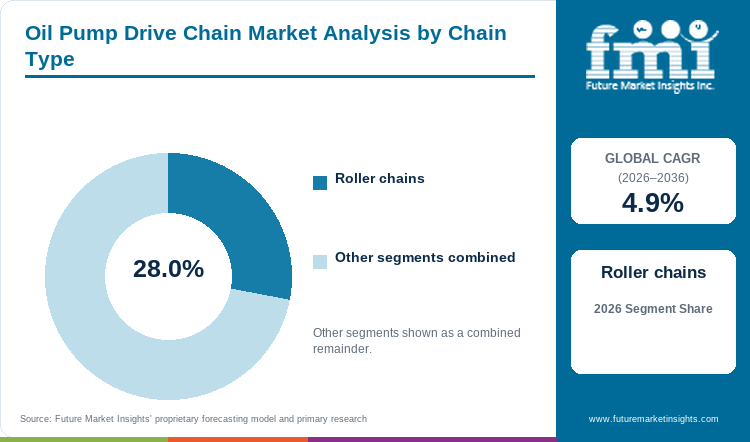
- Based on chain type, roller chains are projected to account for 28.0% in 2026, supported by compact geometry that fits validated oil-pump drives.
- By engine type, gasoline engines are estimated to hold 38.0% in 2026, owing to high-volume petrol platforms that retain mechanical lubrication hardware.
- In 2026, passenger cars are expected to lead vehicle type with 47.0% share, driven by shared engine families that repeat approved chain specifications.
- Battery-electric platforms remove the combustion-engine oil pump and can reduce factory-fit chain applications at the vehicle architecture level.
- Some of the key players in this market include Tsubakimoto Chain Co., DAIDO KOGYO CO., LTD., BorgWarner Inc., Schaeffler AG, Cloyes Gear & Products, Inc., Melling Tool Company, CRP Industries Inc. (Rein Automotive), Dayco, Gates Corporation, and VIEROL AG (VAICO).
Analyst Perspective
"Oil pump drive chain revenue follows engine-platform decisions well before series production, so suppliers must clear wear and friction validation early. Hybrid programs extend that qualification runway, but battery-electric substitutions can strand tooling unless suppliers keep platform exposure selective."
- Nikhil Kaitwade, Principal Consultant, Future Market Insights
How is the oil pump drive chain market segmented?
The oil pump drive chain market is segmented by Chain Type, Engine Type, Vehicle Type, Sales Channel, Material - Coating and Region.
The oil pump drive chain market is segmented by chain type, engine type, vehicle type, sales channel and material - coating. Chain type covers roller, silent, inverted-tooth, timing-drive integrated and low-friction chains while engine type includes gasoline, diesel, hybrid and turbocharged engines. Vehicle type separates passenger cars, light commercial vehicles, heavy-duty vehicles and performance vehicles within the supplied taxonomy. Sales channel covers OEM direct, powertrain suppliers, aftermarket replacement and service kits while material - coating includes standard alloy steel, low-friction coated steel, shot-peened chains and high-fatigue chains.
What supports roller chain demand within the chain type category?
Roller chains suit compact oil-pump layouts because they transfer crankshaft power without a separate actuator. Melling's May 2026 timing set for Lexus and Toyota 2.4-liter engines uses a single roller chain and includes oil-pump-drive components, confirming a direct repair route for the same chain geometry used inside lubrication systems. Engineers still qualify wear behavior, tension control and sprocket fit before a design enters repeat production. Same demands apply to automotive timing chains operating in the lubricated engine environment, where manufacturers must prove fatigue performance before a validated architecture can support multiple applications.
- Based on chain type, roller chains are projected to account for 28.0% in 2026, supported by compact geometry that fits validated oil-pump drives.
- Engine teams select roller-chain layouts after load paths and lubrication conditions satisfy durability requirements for the assigned oil-pump drive.
How do gasoline engines shape demand within the engine type category?
Gasoline engines keep oil-pump chains relevant because every operating combustion engine requires controlled lubricant circulation under changing speed and temperature. BorgWarner announced in May 2026 that a Japanese automaker selected its variable cam timing system for a next-generation hybrid engine scheduled for 2028 production. Since that program retains combustion hardware within an electrified powertrain, both the lubrication system and its timing chain and belt systems must complete the same engine-platform qualification cycle before launch and serial production. Chain suppliers gain repeat volume only after the engine family reaches production with a mechanically driven oil pump.
- By engine type, gasoline engines are estimated to hold 38.0% in 2026, owing to high-volume petrol platforms that retain mechanical lubrication hardware.
- Hybrid gasoline programs can extend component life cycles because electric traction reduces fuel use without removing the combustion engine from every operating mode.
What makes passenger cars important within the vehicle type category?
Passenger-car programs spread one validated oil-pump-chain design over several models when those vehicles share an engine family. Melling released a timing chain set with an oil pump for Ford, Lincoln and Mercury 3.5-liter and 3.7-liter engines in December 2025, showing how shared architectures support repeatable repair content after the original production cycle. The same engine-family duty cycles and long service exposure also shape automotive piston systems, allowing repeated applications to lower tooling and stocking costs without removing the need for exact fitment by engine code.
- In 2026, passenger cars are expected to lead vehicle type with 47.0% share, driven by shared engine families that repeat approved chain specifications.
- Aftermarket coverage becomes more economical when one engine family supports several vehicles that use identical oil-pump-chain service content.
Why does OEM direct purchasing matter within the sales channel category?
Oil pump drive chains enter factory programs during engine design because chain pitch and sprocket geometry must be validated before production release. Tsubakimoto Chain describes timing-chain systems as a core mobility business serving automobile engines and continuing development for hybrid powertrains. That engineering model also governs internal oil-pump drives and automotive camshaft systems, since late changes to buried engine hardware can trigger renewed durability and noise testing. Distributors gain importance during repair cycles, but original chain content depends on early access to the engine program and repeatable serial delivery.
- By sales channel, OEM direct is forecast to represent 55.0% in 2026, attributable to engine-level qualification before series production begins.
- Factory suppliers must support design validation and serial delivery before a selected oil-pump-chain specification becomes repeatable production content.
How does standard alloy steel support the material - coating category?
Standard alloy steel forms the structural chain body because fatigue strength and repeatable forming remain basic requirements for high-cycle engine service. DAIDO KOGYO documents VCN surface treatment on engine-chain pins to increase abrasion resistance and support smaller chain designs. The treatment modifies the pin contact surface without replacing the underlying steel architecture that carries chain load, so engineers add it only where wear or packaging limits justify the processing cost. Chain durability is also conditioned by the automotive engine oils specified for each engine, because surface behavior changes with the fluid and load environment. Baseline steel remains the cost reference when additional treatment does not solve a measured wear problem.
- The material - coating category is forecast to be led by standard alloy steel at 41.0% share in 2026, supported by repeatable fatigue performance in mass production.
- Coated variants receive consideration where wear targets or packaging limits justify added processing cost beyond the baseline steel chain.
What are the drivers, restraints and opportunities in the Oil Pump Drive Chain Market?
Hybrid engine activity sustains chain applications while battery-electric substitution removes them, and integrated repair packages can widen lifecycle revenue.
- Driver: Hybrid and combustion engine programs preserve mechanical lubrication hardware that requires chain qualification before factory production.
- Restraint: Battery-electric platforms eliminate the combustion-engine oil-pump drive and reduce the chain content available per new vehicle.
- Opportunity: Vehicle-specific repair packages can combine oil-pump-drive content with timing service to simplify complete engine repairs.
Hybrid Programs Preserve Engine-Chain Qualification
Hybrid powertrains preserve combustion-engine lubrication hardware because the engine still needs controlled oil flow whenever it operates. The USA Environmental Protection Agency reported that hybrids reached 15% of model-year 2024 new-vehicle production and projected 19% for model year 2025. That production mix keeps internal-combustion development active inside electrified programs that still require complete engine lubrication hardware. Oil pump drive chain suppliers can convert those programs into orders only after meeting platform-specific friction, noise and durability targets before production release.
Battery-Electric Architecture Removes the Oil-Pump Drive
Battery-electric vehicles remove the combustion engine and therefore eliminate the conventional engine oil-pump-chain application from the vehicle bill of materials. The USA Energy Information Administration reported in July 2026 that battery-electric vehicles represented 6% of new light-duty vehicle sales during the second quarter of 2026. Each battery-electric platform narrows the factory-fit chain pool even if overall vehicle sales remain stable. Modern chain durability also makes replacement demand event-driven because surviving combustion vehicles may run many years before chain service.
Integrated Repair Packages Extend Lifecycle Revenue
Workshops create an aftermarket opportunity when one repair package reduces the number of separate engine parts that technicians must identify and source. Melling released a Ford and Lincoln timing chain set with a high-volume oil pump in May 2026 for 3.5-liter and 3.7-liter engines. By combining timing and lubrication service content for a specific engine, the package addresses the same fitment coordination required across automotive pump systems, where the oil pump and chain must match the engine configuration.
Which country CAGRs are profiled in the Oil Pump Drive Chain Market?
| Country | CAGR |
|---|---|
| Brazil | 6.1% |
| Mexico | 5.7% |
| South Korea | 5.3% |
| Italy | 5.0% |
| USA | 4.7% |
| Germany | 4.3% |
| Japan | 4.0% |
How do country-level CAGRs compare in the Oil Pump Drive Chain Market?
Brazil and Mexico form the upper forecast group, while Germany and Japan occupy the lower end of the seven-country range. The 2.1 percentage-point spread reflects different production mixes and powertrain transitions rather than a ranking of present market size.
- Brazil combines vehicle production growth with export programs that can widen the number of locally qualified engine applications.
- Mexico carries unusually heavy light-truck production, which raises exposure to turbocharged and higher-load combustion-engine applications.
- South Korea combines concentrated vehicle engineering with a large hybrid share that preserves combustion hardware inside electrified models.
- Italy relies more heavily on selective component and export programs because domestic vehicle output contracted materially during 2025.
- The USA combines new engine programs with an unusually large installed vehicle base that sustains long-tail repair activity.
- Germany faces stronger component substitution as battery-electric models account for a growing share of domestic passenger-car production.
- Japan combines mature engine engineering with long vehicle ownership, which rewards exact fitment and durable aftermarket coverage.
Similar CAGRs can still produce different supplier economics because platform access and repair coverage vary by country. The full report provides country-level CAGR analysis across North America, Latin America, Western Europe, Eastern Europe, East Asia, South Asia and Pacific, and the Middle East and Africa.
Country-wise Analysis
- Brazil's vehicle plants support locally assembled combustion and hybrid programs that can carry oil-pump-chain content into serial production. By 2036, Brazil is projected to grow at 6.1% CAGR, with engine-component demand tied to local platform awards and export production. ANFAVEA reported in January 2026 that Brazil produced 2.644 million vehicles during 2025 and increased output by 3.5% from 2024. That factory base gives chain suppliers more engine programs to qualify before powertrain mix determines actual component content. Local cost targets and early engineering access still decide whether a qualified chain converts into a production order for domestic or export vehicle programs.
- Mexico's export-oriented plants produce a light-truck-heavy vehicle mix that exposes suppliers to turbocharged and higher-load engine applications. Oil pump drive chain demand in Mexico is forecast to rise at 5.7% CAGR over the forecast period, supported by its large light-truck manufacturing base. INEGI reported in January 2026 that Mexico produced 3,953,494 light vehicles during 2025 and light trucks represented 77.2% of output. This production mix sustains demand for variable oil pump systems on turbocharged engines, where lubrication output must adjust to changing loads. Cross-border platform decisions remain the main sourcing constraint, so suppliers need local delivery plus North American engineering support before serial awards become durable revenue.
- South Korea's concentrated automotive sector combines domestic engineering capacity with a large hybrid vehicle share that preserves combustion hardware. Adoption of oil pump drive chains in South Korea is estimated to expand at 5.3% CAGR through 2036, supported by the country's hybrid-heavy sales mix. The Ministry of Trade, Industry and Resources reported that eco-friendly vehicles represented 47.7% of domestic sales in January 2026. Hybrid growth preserves an engine lubrication system inside electrified models and keeps mechanical oil-pump drives relevant to platform qualification. Rapid model changes still require local engineering support before a chain design can remain on repeat production programs.
- Italy retains vehicle and engine-component manufacturing capacity even after a sharp contraction in domestic automotive production during 2025. The Italy oil pump drive chain sector is projected to record 5.0% CAGR during the assessment period, influenced by selective engine-component and export programs. ANFIA reported in February 2026 that Italy produced about 474,000 vehicles during 2025 and output fell 19.8% from 2024. The contraction narrows domestic program volume and makes export-linked component business more important for chain suppliers. Companies need targeted OEM relationships and disciplined capacity commitments because broad domestic volume cannot support every engine-chain investment without export demand.
- The United States combines a very large installed vehicle base with continuing gasoline and hybrid vehicle programs that support both factory and repair demand. In the USA, oil pump drive chain demand is predicted to advance at 4.7% CAGR through 2036, supported by the scale of vehicles already in service. Federal Highway Administration data show 298 million registered motor vehicles nationwide in the United States during 2024. That installed fleet supports long-tail repair demand for chain systems on older combustion vehicles after original production ends, while hybrid vehicle programs continue to retain combustion hardware within newer electrified platforms. Suppliers still need selective exposure because powertrain strategies differ by manufacturer and battery-electric models remove the oil-pump-chain application.
- Germany remains a major passenger-car production center, but battery-electric output is removing engine-specific chain content from a growing share of domestic manufacturing. Germany is estimated to post 4.3% CAGR over the forecast period, with electrification reducing the eligible combustion-engine production pool. VDA reported in February 2026 that Germany produced 1.67 million electric passenger cars during 2025 and those models represented 40% of domestic passenger-car production. That powertrain shift removes oil-pump-chain content from many new vehicles even where total factory activity remains substantial. Suppliers need selective exposure to combustion and hybrid engine families with production lives long enough to recover qualification costs.
- Japan's mature passenger-car base combines long vehicle ownership with disciplined engine development and demanding application-specific validation. Oil pump drive chain sales in Japan are forecast to expand at 4.0% CAGR by 2036, supported by a broad household passenger-car ownership base. JAMA reported in April 2026 that 71.9% of surveyed households owned passenger cars and multiple-vehicle ownership reached 30.5%. These long service lives sustain demand for oil pump chains, engine oil filtration and other maintenance parts across aging combustion vehicles. New suppliers still need proven wear performance and precise application fit before established Japanese engineering and service networks will support repeat business.
Who are the notable companies in the Oil Pump Drive Chain Market?
Tsubakimoto Chain Co., DAIDO KOGYO CO., LTD., BorgWarner Inc., Schaeffler AG, Cloyes Gear & Products, Inc., Melling Tool Company, CRP Industries Inc. (Rein Automotive), Dayco, Gates Corporation, and VIEROL AG (VAICO) serve this market through OE engine-chain systems or vehicle-specific oil-pump-drive repair content.
Competition is divided between OE engine-chain groups and repair specialists that publish vehicle-specific oil-pump-drive content. Tsubakimoto Chain is the current parent of DAIDO KOGYO, so the two names should not be treated as unrelated corporate parents. BorgWarner serves engine timing and combustion programs, while Schaeffler, Cloyes and Melling publish direct repair content. CRP, Dayco, Gates and VAICO reach the automotive component aftermarket through timing systems, power-transmission components and oil-pump-drive applications. Entry depends on documented engine fitment and technical support rather than company scale alone.
- OE engine-chain groups include Tsubakimoto Chain, DAIDO KOGYO and BorgWarner because each documents automotive engine-chain or timing-system engineering.
- Direct repair specialists include Schaeffler, Cloyes and Melling because their published service coverage names oil-pump-chain or oil-pump-drive content.
- Broader repair-channel companies include CRP, Dayco, Gates and VAICO where timing-system coverage extends into connected engine-service applications.
Competitive Benchmarking: Oil Pump Drive Chain Market
| Company | Oil-Pump Chain Specificity | Engine-System Integration | Aftermarket Service Coverage | Geographic Reach |
|---|---|---|---|---|
| Tsubakimoto Chain Co. | Medium | High | Low | Global |
| DAIDO KOGYO CO., LTD. | Medium | High | Low | Japan with overseas engine-chain operations |
| BorgWarner Inc. | Medium | High | Medium | Americas, Europe and Asia |
| Schaeffler AG | High | High | High | Global |
| Cloyes Gear & Products, Inc. | High | High | High | North America with international distribution |
| Melling Tool Company | High | High | High | North America with international distribution |
| CRP Industries Inc. (Rein Automotive) | Medium | High | High | North America |
| Dayco | Low | High | High | Global |
| Gates Corporation | Low | Medium | High | Global |
| VIEROL AG (VAICO) | High | Medium | High | Europe with international aftermarket sales |
Scoring basis: High oil-pump-chain specificity requires direct oil-pump-chain or oil-pump-drive coverage across several applications. Medium reflects narrower direct coverage where the oil-pump chain appears inside a documented timing-chain system. Low identifies documented timing-system participation where current public evidence does not show direct oil-pump-chain coverage. High engine-system integration requires multi-component chain-system evidence, while Medium and Low reflect progressively narrower breadth. Aftermarket service coverage applies comparable thresholds to the breadth of documented vehicle-specific repair applications and kit content.
Key Developments in the Oil Pump Drive Chain Market
- In April 2026, Melling Tool Company released oil pump chain 1110 for Lexus and Toyota 2.4-liter DOHC engines. The release added a vehicle-specific replacement component for the exact oil-pump-chain application covered by this market.
- In March 2026, Cloyes Gear & Products, Inc. added more than 70 timing-system SKUs including engine oil pump sprockets and chains. The release expanded direct aftermarket coverage for oil-pump-drive service components on several import applications.
- In May 2025, Dayco North America added eight timing-chain kits covering 11.6 million vehicles in operation. The expansion widened closely related engine-chain service coverage through the North American aftermarket for repair shops serving established vehicle populations.
Key Players in the Oil Pump Drive Chain Market
OE Engine-Chain and Powertrain Systems
- Tsubakimoto Chain Co.
- DAIDO KOGYO CO., LTD.
- BorgWarner Inc.
- Schaeffler AG
Direct Oil-Pump-Chain and Engine-Service Specialists
- Cloyes Gear & Products, Inc.
- Melling Tool Company
Aftermarket Timing and Repair Platforms
- CRP Industries Inc. (Rein Automotive)
- Dayco
- Gates Corporation
- VIEROL AG (VAICO)
Oil Pump Drive Chain Market - Report Scope
| Coverage field | Report scope |
|---|---|
| Market breakdown | By Chain Type, Engine Type, Vehicle Type, Sales Channel, Material - Coating and Region. |
| Quantitative Units | USD million. |
| Market Definition | Revenue from engine oil pump drive chains and chain-centered service content within the defined segmentation. |
| Regions Covered | North America, Latin America, Western Europe, Eastern Europe, East Asia, South Asia and Pacific and Middle East and Africa. |
| Countries Covered | Brazil, Mexico, South Korea, Italy, USA, Germany, Japan, and 20+ countries included in the full report. |
| Key Companies Profiled | Tsubakimoto Chain Co., DAIDO KOGYO CO., LTD., BorgWarner Inc., Schaeffler AG, Cloyes Gear & Products, Inc., Melling Tool Company, CRP Industries Inc. (Rein Automotive), Dayco, Gates Corporation, and VIEROL AG (VAICO). |
| Forecast Period | 2026 to 2036. |
| Approach | Primary and secondary research with market triangulation. |
Oil Pump Drive Chain Market - Research Methodology
| Method | Approach |
|---|---|
| Primary Research | FMI analysts gathered input from manufacturers, service providers, technology developers, distributors, end users, procurement teams, and subject-matter experts. Interviews examined purchasing decisions, product or service evaluation, adoption barriers, approval requirements, pricing considerations, and expectations for technical or commercial support. Respondents were also asked what evidence is required before a trial, pilot, or initial order develops into regular purchasing. |
| Desk Research | Desk research covered government statistics, regulatory publications, trade data, industry associations, technical literature, standards, company filings, product information, and official corporate announcements. Sources were reviewed for relevance, publication date, geographic coverage, and consistency with the defined market scope. Claims relating to performance, applications, approvals, capacity, investment, and commercial activity were retained only when supported by credible public evidence. |
| Market Sizing and Forecasting | The market model combined the baseline value with historical performance, segment structure, pricing and volume indicators, adoption levels, company participation, and country-level demand conditions. Forecast assumptions considered economic activity, investment trends, regulatory developments, technology adoption, purchasing cycles, supply availability, and barriers to wider market use. Segment and regional estimates were reconciled before the final market total was calculated. |
| Data Validation | Estimates were checked against multiple independent indicators, including public data, company activity, trade patterns, industry developments, and findings from primary interviews. Validation also tested whether products, services, applications, and company revenues fell within the defined market boundaries. Adjacent categories, unsupported claims, overlapping revenues, and activities without direct market relevance were excluded to reduce double counting and maintain consistency across segments and countries. |
Oil Pump Drive Chain Market by Segments
Oil Pump Drive Chain Market segmented by Chain Type:
- Roller chains
- Silent chains
- Inverted-tooth chains
- Timing-drive integrated chains
- Low-friction chains
Oil Pump Drive Chain Market segmented by Engine Type:
- Gasoline engines
- Diesel engines
- Hybrid engines
- Turbocharged engines
Oil Pump Drive Chain Market segmented by Vehicle Type:
- Passenger cars
- Light commercial vehicles
- Heavy-duty vehicles
- Performance vehicles
Oil Pump Drive Chain Market segmented by Sales Channel:
- OEM direct
- Powertrain suppliers
- Aftermarket replacement
- Service kits
Oil Pump Drive Chain Market segmented by Material - Coating:
- Standard alloy steel
- Low-friction coated steel
- Shot-peened chains
- High-fatigue chains
Oil Pump Drive Chain Market by Region:
- North America
- United States
- Canada
- Latin America
- Brazil
- Mexico
- Chile
- Rest of Latin America
- Western Europe
- Germany
- United Kingdom
- Italy
- Spain
- France
- Nordics
- Benelux
- Rest of Western Europe
- Eastern Europe
- Russia
- Poland
- Hungary
- Balkan and Baltic States
- Rest of Eastern Europe
- East Asia
- China
- Japan
- South Korea
- South Asia and Pacific
- India
- ASEAN
- Australia and New Zealand
- Rest of South Asia and Pacific
- Middle East and Africa
- Kingdom of Saudi Arabia
- Other GCC Countries
- Türkiye
- South Africa
- Other African Union Countries
- Rest of Middle East and Africa
Research Sources and Bibliography
- Tsubakimoto Chain Co. (2025). 2025 Integrated Report (Annual Report).
- German Association of the Automotive Industry. (2026, February 3). New record: 40% electric share of passenger car production in 2025.
- Melling Tool Company. (2026, May 7). Timing Set for Lexus/Toyota 2.4L DOHC - # 3-1109SX.
- BorgWarner Inc. (2026, May 6). BorgWarner Wins Two Conquest Awards in Asia for Combustion and Hybrid Powertrain Programs.
- Melling Tool Company. (2025, December 29). Timing Chain Set with Oil Pump for Ford/Lincoln/Mercury 3.5L & 3.7L DOHC - # TOPK-1024.
- DAIDO KOGYO CO., LTD. (n.d.). Surface treatment (metal coating). Retrieved September 16, 2026.
- USA Environmental Protection Agency. (2026). 2025 EPA Automotive Trends Report: Fuel Economy, and Technology since 1975.
- USA Energy Information Administration. (2026, July 27). Hybrid sales rise while battery electric sales remain lower after tax credit expiration.
- Melling Tool Company. (2026, May 22). Timing Chain Set with Oil Pump for Ford/Lincoln/Mercury 3.5L & 3.7L DOHC - # TOPK-1024HV.
- Associação Nacional dos Fabricantes de Veículos Automotores. (2026, January 15). Produção e venda de autoveículos crescem em 2025 e Anfavea projeta nova alta em 2026.
- Instituto Nacional de Estadística y Geografía. (2026, January 9). Registro administrativo de la industria automotriz de vehículos ligeros. Diciembre de 2025.
- Ministry of Trade, Industry and Resources, Republic of Korea. (2026, February 19). January 2026 Automobile Exports Reach $6.1 Billion, Second-Highest January on Record.
- Associazione Nazionale Filiera Industria Automobilistica. (2026, February 11). L’indice della produzione dell’industria automotive italiana riporta una crescita a dicembre (+13,5%), ma il 2025 si chiude in flessione a doppia cifra (-10,3%).
- Federal Highway Administration. (2026). Our Nation’s Highways 2026: Vehicles.
- Japan Automobile Manufacturers Association. (2026, April 14). 2025年度乗用車市場動向調査について.
- Melling Tool Company. (2026, April 13). Oil Pump Chain for Lexus/Toyota 2.4L DOHC - # 1110.
- Cloyes Gear & Products, Inc. (2026, March 23). Precision in Every Way: Our New Product Wave is Here!
- Dayco. (2025, May 15). Dayco North America Adds 30 Part Numbers to Timing Chain Kit, Tensioner and Hose Lines.
- Dayco. (2026, February 10). Timing Chain Kit Installation - GM 1.4L Engine.
- Tsubakimoto Chain Co. (2026, January 1). Notice Regarding Completion of Making Daido Kogyo Co., Ltd. a Wholly Owned Subsidiary Through a Simplified Share Exchange.
- BorgWarner Inc. (2026, September 10). BorgWarner to Showcase Expanded Aftermarket Portfolio and Unified Customer Offering at Automechanika Frankfurt 2026.
- Schaeffler Vehicle Lifetime Solutions. (2026, July 8). Integrated Portfolio and Smart Solutions: Schaeffler Vehicle Lifetime Solutions Paves the Way for Greater Efficiency and Reduced Complexity.
- Cloyes Gear & Products, Inc. (2026, July 27). Revitalize Your Engine: New Cloyes Arrivals for June 2026.
- Melling Tool Company. (2026, June 4). Timing Chain Set with High Volume Oil Pump for Ford 3.5L DOHC - # TOPK-1023HV.
- Tsubakimoto Chain Co. (2025, May 14). Notice Regarding Execution of Business Integration Agreement and Share Exchange Agreement for Business Integration of Tsubakimoto Chain Co. and Daido Kogyo Co., Ltd.
- DAIDO KOGYO CO., LTD. (2026, January 1). つばきグループの一員となりました。
- BorgWarner Inc. (2026, August 5). BorgWarner Secures New Variable Cam Timing Program Awards in Europe and China.
- Schaeffler Vehicle Lifetime Solutions. (2025, September). INA Service Info: Timing Chain Kit 559 1807 40.
- Cloyes Gear & Products, Inc. (2026, June 1). Now Available: Cloyes New Product Announcement.
- CRP Automotive. (2025, April 2). New Rein Timing Chain Solutions for MINI N-Series Engines.
- Gates Corporation. (2026, September 8). Gates Introduces Smart Kit™ to Simplify Complex Vehicle Repairs.
- VAICO. (2026, April 20). Timing Belt in Oil Bath: A Permanent Solution by Converting the Oil Pump Drive to a Chain.
This bibliography is provided for reader reference and is not exhaustive. The full report contains the complete reference list and detailed citations.
This Report Answers
- How large is the oil pump drive chain market by 2036?
- Which engine conditions keep mechanical oil-pump-chain demand commercially relevant?
- What share do roller chains hold within the chain type category?
- How do hybrid programs change the addressable oil-pump-chain supplier base?
- Which country conditions explain differences among the supplied CAGR forecasts?
- How does battery-electric substitution reduce eligible factory-fit chain applications?
- Which companies provide direct oil-pump-chain and related engine-chain capabilities?
- What qualification factors matter before an oil-pump-chain supplier wins production?
Frequently Asked Questions
How big is the Oil Pump Drive Chain Market in 2026?
The oil pump drive chain market is valued at USD 620.7 million in 2026 and is projected to reach USD 1,001.5 million by 2036. Engine-platform awards and hybrid powertrains preserve qualified mechanical lubrication content within continuing combustion-engine programs.
What CAGR is forecast for the Oil Pump Drive Chain Market?
The oil pump drive chain market is projected to expand at 4.9% CAGR from 2026 to 2036. Growth depends on combustion and hybrid engine programs that continue using mechanically driven oil pumps inside qualified lubrication systems.
What share do roller chains hold within chain type?
Roller chains are projected to account for 28.0% of chain type demand during 2026. Their compact geometry fits oil-pump drives where engineers require repeatable mechanical transfer within restricted engine packaging.
How important are gasoline engines within engine type demand?
Gasoline engines are estimated to represent 38.0% of engine type demand during 2026. Petrol and hybrid platforms retain lubrication hardware that keeps chain qualification tied to combustion-engine program life.
Which countries have the upper supplied CAGR forecasts?
Brazil is forecast at 6.1% CAGR and Mexico at 5.7% from 2026 to 2036. Their outlooks reflect different production mixes and vehicle-program conditions rather than equal present market scale.
Which companies are active in the Oil Pump Drive Chain Market?
Active companies include Tsubakimoto Chain Co., DAIDO KOGYO CO., LTD., BorgWarner Inc., Schaeffler AG, Cloyes Gear & Products, Inc., Melling Tool Company, CRP Industries Inc. (Rein Automotive), Dayco, Gates Corporation, and VIEROL AG (VAICO). Their roles span OE engine-chain engineering, aftermarket timing systems and vehicle-specific oil-pump-drive repair coverage for workshops.
Preview the report firsthand - request a free sample
Get SampleGet the brochure for pricing and purchase details.
Get PDFTable of Content
- Key Takeaways
- Market Size and CAGR
- Top Growth Driver
- Fastest Growing Segment
- Leading Region
- Key Companies
- Emerging Opportunities
- Executive Summary
- Global Market Outlook
- Demand-side Trends
- Supply-side Trends
- Technology Roadmap Analysis
- Analysis and Recommendations
- Analyst Perspective (What is happening? Why now? What should investors know?)
- Key Questions Answered
- How large is the market?
- What is the CAGR?
- What are key trends?
- Which region dominates?
- Who are the leaders?
- Market Overview
- Market Coverage / Taxonomy
- Market Definition / Scope / Limitations
- Research Methodology
- Chapter Orientation
- Analytical Lens and Working Hypotheses
- Market Structure, Signals, and Trend Drivers
- Benchmarking and Cross-market Comparability
- Market Sizing, Forecasting, and Opportunity Mapping
- Research Design and Evidence Framework
- Desk Research Programme (Secondary Evidence)
- Expert Input and Fieldwork (Primary Evidence)
- Tooling, Models, and Reference Databases
- Data Engineering and Model Build
- Quality Assurance and Audit Trail
- Market Background
- Market Dynamics (Drivers, Restraints, Opportunity, Trends)
- Scenario Forecast (Optimistic, Likely, Conservative)
- Impact Analysis
- AI Impact
- Sustainability Impact
- Regulatory Impact
- Technology Impact
- Consumer / Buyer Analysis
- Purchase Drivers
- Adoption Barriers
- Buyer Journey
- Opportunity Map Analysis
- Product Life Cycle Analysis
- Supply Chain Analysis
- Investment Feasibility Matrix
- Value Chain Analysis
- PESTLE and Porter's Analysis
- Regulatory Landscape
- Regional Parent Market Outlook
- Production and Consumption Statistics
- Import and Export Statistics
- Global Market Analysis and Forecast, 2021 to 2036
- Historical Market Size Value (USD Million) Analysis, 2021 to 2025
- Current and Future Market Size Value (USD Million) Projections, 2026 to 2036
- Y-o-Y Growth Trend Analysis
- Absolute $ Opportunity Analysis
- Global Market Pricing Analysis, 2021 to 2036
- Global Market Analysis and Forecast, By Chain Type, 2021 to 2036
- Introduction / Key Findings
- Historical Market Size Value (USD Million) Analysis By Chain Type, 2021 to 2025
- Current and Future Market Size Value (USD Million) Analysis and Forecast By Chain Type, 2026 to 2036
- Roller chains
- Silent chains
- Inverted-tooth chains
- Timing-drive integrated chains
- Low-friction chains
- Y-o-Y Growth Trend Analysis By Chain Type, 2021 to 2025
- Absolute $ Opportunity Analysis By Chain Type, 2026 to 2036
- Global Market Analysis and Forecast, By Engine Type, 2021 to 2036
- Introduction / Key Findings
- Historical Market Size Value (USD Million) Analysis By Engine Type, 2021 to 2025
- Current and Future Market Size Value (USD Million) Analysis and Forecast By Engine Type, 2026 to 2036
- Gasoline engines
- Diesel engines
- Hybrid engines
- Turbocharged engines
- Y-o-Y Growth Trend Analysis By Engine Type, 2021 to 2025
- Absolute $ Opportunity Analysis By Engine Type, 2026 to 2036
- Global Market Analysis and Forecast, By Vehicle Type, 2021 to 2036
- Introduction / Key Findings
- Historical Market Size Value (USD Million) Analysis By Vehicle Type, 2021 to 2025
- Current and Future Market Size Value (USD Million) Analysis and Forecast By Vehicle Type, 2026 to 2036
- Passenger cars
- Light commercial vehicles
- Heavy-duty vehicles
- Performance vehicles
- Y-o-Y Growth Trend Analysis By Vehicle Type, 2021 to 2025
- Absolute $ Opportunity Analysis By Vehicle Type, 2026 to 2036
- Global Market Analysis and Forecast, By Sales Channel, 2021 to 2036
- Introduction / Key Findings
- Historical Market Size Value (USD Million) Analysis By Sales Channel, 2021 to 2025
- Current and Future Market Size Value (USD Million) Analysis and Forecast By Sales Channel, 2026 to 2036
- OEM direct
- Powertrain suppliers
- Aftermarket replacement
- Service kits
- Y-o-Y Growth Trend Analysis By Sales Channel, 2021 to 2025
- Absolute $ Opportunity Analysis By Sales Channel, 2026 to 2036
- Global Market Analysis and Forecast, By Material - Coating, 2021 to 2036
- Introduction / Key Findings
- Historical Market Size Value (USD Million) Analysis By Material - Coating, 2021 to 2025
- Current and Future Market Size Value (USD Million) Analysis and Forecast By Material - Coating, 2026 to 2036
- Standard alloy steel
- Low-friction coated steel
- Shot-peened chains
- High-fatigue chains
- Y-o-Y Growth Trend Analysis By Material - Coating, 2021 to 2025
- Absolute $ Opportunity Analysis By Material - Coating, 2026 to 2036
- Global Market Analysis and Forecast, By Region, 2021 to 2036
- Introduction
- Historical Market Size Value (USD Million) Analysis By Region, 2021 to 2025
- Current Market Size Value (USD Million) Analysis and Forecast By Region, 2026 to 2036
- North America
- Latin America
- Western Europe
- Eastern Europe
- East Asia
- South Asia and Pacific
- Middle East and Africa
- Market Attractiveness Analysis By Region
- North America Market Analysis and Forecast, By Country, 2021 to 2036
- Historical Market Size Value (USD Million) Trend Analysis By Market Taxonomy, 2021 to 2025
- Market Size Value (USD Million) Forecast By Market Taxonomy, 2026 to 2036
- By Country
- United States
- Canada
- By Chain Type
- By Engine Type
- By Vehicle Type
- By Sales Channel
- By Material - Coating
- By Country
- Market Attractiveness Analysis
- By Country
- By Chain Type
- By Engine Type
- By Vehicle Type
- By Sales Channel
- By Material - Coating
- Key Takeaways
- Latin America Market Analysis and Forecast, By Country
- Historical Market Size Value (USD Million) Trend Analysis By Market Taxonomy, 2021 to 2025
- Market Size Value (USD Million) Forecast By Market Taxonomy, 2026 to 2036
- By Country
- Brazil
- Mexico
- Chile
- Rest of Latin America
- By Chain Type
- By Engine Type
- By Vehicle Type
- By Sales Channel
- By Material - Coating
- By Country
- Market Attractiveness Analysis
- By Country
- By Chain Type
- By Engine Type
- By Vehicle Type
- By Sales Channel
- By Material - Coating
- Key Takeaways
- Western Europe Market Analysis and Forecast, By Country
- Historical Market Size Value (USD Million) Trend Analysis By Market Taxonomy, 2021 to 2025
- Market Size Value (USD Million) Forecast By Market Taxonomy, 2026 to 2036
- By Country
- Germany
- United Kingdom
- Italy
- Spain
- France
- Nordics
- Benelux
- Rest of Western Europe
- By Chain Type
- By Engine Type
- By Vehicle Type
- By Sales Channel
- By Material - Coating
- By Country
- Market Attractiveness Analysis
- By Country
- By Chain Type
- By Engine Type
- By Vehicle Type
- By Sales Channel
- By Material - Coating
- Key Takeaways
- Eastern Europe Market Analysis and Forecast, By Country
- Historical Market Size Value (USD Million) Trend Analysis By Market Taxonomy, 2021 to 2025
- Market Size Value (USD Million) Forecast By Market Taxonomy, 2026 to 2036
- By Country
- Russia
- Poland
- Hungary
- Balkan and Baltic States
- Rest of Eastern Europe
- By Chain Type
- By Engine Type
- By Vehicle Type
- By Sales Channel
- By Material - Coating
- By Country
- Market Attractiveness Analysis
- By Country
- By Chain Type
- By Engine Type
- By Vehicle Type
- By Sales Channel
- By Material - Coating
- Key Takeaways
- East Asia Market Analysis and Forecast, By Country
- Historical Market Size Value (USD Million) Trend Analysis By Market Taxonomy, 2021 to 2025
- Market Size Value (USD Million) Forecast By Market Taxonomy, 2026 to 2036
- By Country
- China
- Japan
- South Korea
- By Chain Type
- By Engine Type
- By Vehicle Type
- By Sales Channel
- By Material - Coating
- By Country
- Market Attractiveness Analysis
- By Country
- By Chain Type
- By Engine Type
- By Vehicle Type
- By Sales Channel
- By Material - Coating
- Key Takeaways
- South Asia and Pacific Market Analysis and Forecast, By Country
- Historical Market Size Value (USD Million) Trend Analysis By Market Taxonomy, 2021 to 2025
- Market Size Value (USD Million) Forecast By Market Taxonomy, 2026 to 2036
- By Country
- India
- ASEAN
- Australia and New Zealand
- Rest of South Asia and Pacific
- By Chain Type
- By Engine Type
- By Vehicle Type
- By Sales Channel
- By Material - Coating
- By Country
- Market Attractiveness Analysis
- By Country
- By Chain Type
- By Engine Type
- By Vehicle Type
- By Sales Channel
- By Material - Coating
- Key Takeaways
- Middle East and Africa Market Analysis and Forecast, By Country
- Historical Market Size Value (USD Million) Trend Analysis By Market Taxonomy, 2021 to 2025
- Market Size Value (USD Million) Forecast By Market Taxonomy, 2026 to 2036
- By Country
- Kingdom of Saudi Arabia
- Other GCC Countries
- Türkiye
- South Africa
- Other African Union Countries
- Rest of Middle East and Africa
- By Chain Type
- By Engine Type
- By Vehicle Type
- By Sales Channel
- By Material - Coating
- By Country
- Market Attractiveness Analysis
- By Country
- By Chain Type
- By Engine Type
- By Vehicle Type
- By Sales Channel
- By Material - Coating
- Key Takeaways
- Key Countries Market Analysis
- United States
- Pricing Analysis
- Market Share Analysis, 2025
- By Chain Type
- By Engine Type
- By Vehicle Type
- By Sales Channel
- By Material - Coating
- Canada
- Pricing Analysis
- Market Share Analysis, 2025
- By Chain Type
- By Engine Type
- By Vehicle Type
- By Sales Channel
- By Material - Coating
- Mexico
- Pricing Analysis
- Market Share Analysis, 2025
- By Chain Type
- By Engine Type
- By Vehicle Type
- By Sales Channel
- By Material - Coating
- Brazil
- Pricing Analysis
- Market Share Analysis, 2025
- By Chain Type
- By Engine Type
- By Vehicle Type
- By Sales Channel
- By Material - Coating
- Chile
- Pricing Analysis
- Market Share Analysis, 2025
- By Chain Type
- By Engine Type
- By Vehicle Type
- By Sales Channel
- By Material - Coating
- Germany
- Pricing Analysis
- Market Share Analysis, 2025
- By Chain Type
- By Engine Type
- By Vehicle Type
- By Sales Channel
- By Material - Coating
- United Kingdom
- Pricing Analysis
- Market Share Analysis, 2025
- By Chain Type
- By Engine Type
- By Vehicle Type
- By Sales Channel
- By Material - Coating
- Italy
- Pricing Analysis
- Market Share Analysis, 2025
- By Chain Type
- By Engine Type
- By Vehicle Type
- By Sales Channel
- By Material - Coating
- Spain
- Pricing Analysis
- Market Share Analysis, 2025
- By Chain Type
- By Engine Type
- By Vehicle Type
- By Sales Channel
- By Material - Coating
- France
- Pricing Analysis
- Market Share Analysis, 2025
- By Chain Type
- By Engine Type
- By Vehicle Type
- By Sales Channel
- By Material - Coating
- India
- Pricing Analysis
- Market Share Analysis, 2025
- By Chain Type
- By Engine Type
- By Vehicle Type
- By Sales Channel
- By Material - Coating
- ASEAN
- Pricing Analysis
- Market Share Analysis, 2025
- By Chain Type
- By Engine Type
- By Vehicle Type
- By Sales Channel
- By Material - Coating
- Australia and New Zealand
- Pricing Analysis
- Market Share Analysis, 2025
- By Chain Type
- By Engine Type
- By Vehicle Type
- By Sales Channel
- By Material - Coating
- China
- Pricing Analysis
- Market Share Analysis, 2025
- By Chain Type
- By Engine Type
- By Vehicle Type
- By Sales Channel
- By Material - Coating
- Japan
- Pricing Analysis
- Market Share Analysis, 2025
- By Chain Type
- By Engine Type
- By Vehicle Type
- By Sales Channel
- By Material - Coating
- South Korea
- Pricing Analysis
- Market Share Analysis, 2025
- By Chain Type
- By Engine Type
- By Vehicle Type
- By Sales Channel
- By Material - Coating
- Russia
- Pricing Analysis
- Market Share Analysis, 2025
- By Chain Type
- By Engine Type
- By Vehicle Type
- By Sales Channel
- By Material - Coating
- Poland
- Pricing Analysis
- Market Share Analysis, 2025
- By Chain Type
- By Engine Type
- By Vehicle Type
- By Sales Channel
- By Material - Coating
- Hungary
- Pricing Analysis
- Market Share Analysis, 2025
- By Chain Type
- By Engine Type
- By Vehicle Type
- By Sales Channel
- By Material - Coating
- Kingdom of Saudi Arabia
- Pricing Analysis
- Market Share Analysis, 2025
- By Chain Type
- By Engine Type
- By Vehicle Type
- By Sales Channel
- By Material - Coating
- Türkiye
- Pricing Analysis
- Market Share Analysis, 2025
- By Chain Type
- By Engine Type
- By Vehicle Type
- By Sales Channel
- By Material - Coating
- South Africa
- Pricing Analysis
- Market Share Analysis, 2025
- By Chain Type
- By Engine Type
- By Vehicle Type
- By Sales Channel
- By Material - Coating
- United States
- Market Structure Analysis
- Competition Dashboard
- Competition Benchmarking
- Market Share Analysis of Top Players
- By Regional
- By Chain Type
- By Engine Type
- By Vehicle Type
- By Sales Channel
- By Material - Coating
- Emerging Startups
- Innovation Benchmarking
- Competition Analysis
- Competition Deep Dive
- Tsubakimoto Chain Co.
- Overview
- Product Portfolio
- Profitability by Market Segments
- Sales Footprint
- Strategy Overview
- Marketing Strategy
- Product Strategy
- Channel Strategy
- DAIDO KOGYO CO., LTD.
- BorgWarner Inc.
- Schaeffler AG
- Cloyes Gear & Products, Inc.
- Melling Tool Company
- CRP Industries Inc. (Rein Automotive)
- Dayco
- Gates Corporation
- VIEROL AG (VAICO)
- Tsubakimoto Chain Co.
- Case Studies
- Success Stories
- Recent Developments
- Competition Deep Dive
- Assumptions & Acronyms Used


