

- Market Size (2026)
- USD 499.0 Mn
- Forecast (2036)
- USD 936.7 Mn
- CAGR (2026 to 2036)
- 6.5%
How big is Oil-Resistant Paper Liners Market in 2026?
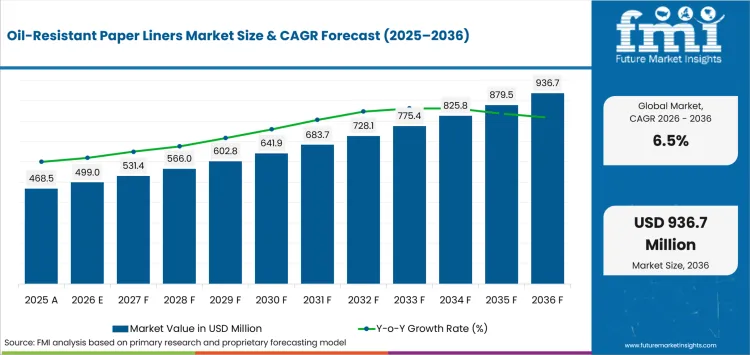
USD 499.0 million in 2026 and USD 936.7 million by 2036 at a 6.5% CAGR.
Demand for oil-resistant paper liners is projected to expand at 6.5% CAGR between 2026 and 2036. Valuation is forecast to increase from USD 499.0 million in 2026 to USD 936.7 million by 2036. The FDA determined in January 2025 that 35 PFAS-related food-contact notifications for grease-proof paper were no longer effective. Their withdrawal directs restaurant programs toward qualified barrier coated papers that preserve oil holdout during printing and cutting.
Country conditions determine how a successful liner trial becomes a repeat order across national foodservice networks. The United States combines high restaurant volumes with faster off-premises testing across national restaurant and delivery programs. Japan applies more detailed composition review under its positive-list system for imported food-contact materials and resin layers. The National Restaurant Association projected USD 1.55 trillion in United States restaurant and foodservice sales in February 2026. That scale supports larger pilots for food-grade packaging but approval depends on consistent barrier performance and regional supply.
Key Takeaways of Oil-Resistant Paper Liners Market
- Food-contact rules are redirecting grease-barrier specifications toward paper liners that maintain service performance without intentionally added PFAS.
- PFAS-free oil-resistant liners are projected to account for 32.0% of product type revenue in 2026 due to replacement qualification across restaurant programs.
- Virgin kraft pulp is estimated to hold 34.0% of material revenue in 2026 owing to controlled strength and surface formation across lightweight barrier structures.
- The 30-50 GSM range is forecast to represent 44.0% of basis weight revenue in 2026 driven by lower material use and practical handling strength.
- Commercial switching slows as new liners require validation for hot-oil resistance plus printing and cutting performance across intended service conditions.
- Ahlstrom Oyj and Nordic Paper serve the market alongside delfortgroup AG and Twin Rivers Paper Company. Koehler Paper SE and Sappi Europe also compete with UPM-Kymmene Corporation and Seaman Paper Company.
Analyst Perspective
“Oil-resistant paper liners compete on oil holdout plus food-contact evidence and converting stability under actual restaurant service conditions. Manufacturers that shorten qualification without increasing sheet weight can convert regulatory replacement into scheduled foodservice orders.”
- Nandini Roy Choudhury, Principal Consultant, Future Market Insights
How is the Oil-Resistant Paper Liners Market segmented?
The market is analyzed by product type, material, basis weight, application, end use and sales channel.
The oil-resistant paper liners market is segmented by product type, material, basis weight, application, end use and sales channel. Product types include PFAS-free, naturally densified, coated, glassine-parchment and other liners. Materials cover virgin kraft pulp, recycled fiber, vegetable parchment, glassine and others. Basis weights include below 30 GSM, 30-50 GSM and above 50 GSM. Applications span fried foods and QSR, snacks and confectionery, bakery, ready meals and others. End uses cover foodservice, food processing, retail and household and others. Sales channels include direct OEM supply, packaging distributors, online commerce and others.
What makes PFAS-free oil-resistant liners central to the product type category?
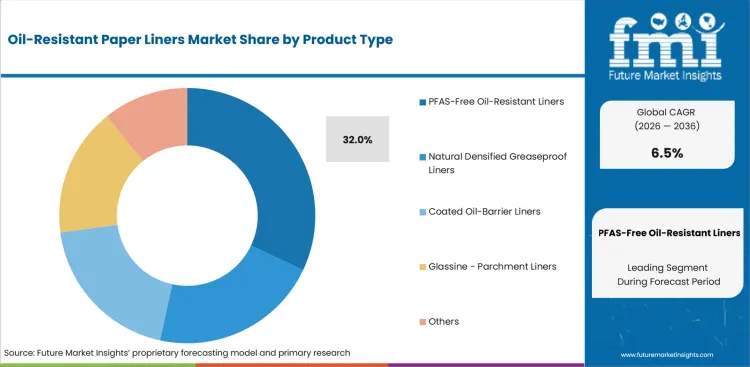
PFAS-free liners address the chemistry change facing paper placed in direct contact with oily food during restaurant preparation and delivery. European rules apply defined PFAS limits to food packaging from August 12 2026 and require replacement structures to preserve grease holdout without fluorochemical treatments.
- Based on product type, PFAS-free oil-resistant liners are projected to account for 32.0% in 2026 due to replacement qualification across restaurant programs.
- Restaurant packaging teams test these liners against actual food temperatures and holding periods during approval. Repeat orders depend on stable printing plus cutting performance across several service formats and approved converter locations.
How do food-contact converters evaluate virgin kraft pulp within the material category?
Virgin kraft pulp provides a controlled fiber base for strength and surface formation across lightweight liners exposed to hot oil and manual handling. Consistent formation lets paper mills manage coating holdout plus die-cut behavior during high-volume conversion for restaurant and bakery applications.
- By material, virgin kraft pulp is estimated to hold 34.0% in 2026 owing to predictable fiber strength across coated and densified structures.
- Food-contact converters tune porosity for vegetable parchment and related formats so printing remains stable across repeated production runs. Controlled fiber formation also limits coating variation during demanding oil exposure and scheduled replenishment across approved restaurant programs.
What role does 30-50 GSM play within the basis weight category?
The 30-50 GSM range balances material use with enough body for tray liners and wraps used during rapid service. The resulting balance supports manual placement plus high-speed cutting without adding unnecessary case weight across national distribution programs.
- In 2026, 30-50 GSM is expected to lead the basis weight category with 44.0% share due to practical handling strength at moderate sheet weight.
- Commercial line compatibility determines whether a lightweight grade advances beyond trial and enters scheduled food-packaging production. UPM and EvoPak reported in September 2025 that a 45 GSM flexible packaging paper wrapper maintained existing line speed with minor equipment adjustments.
What supports fried foods and QSR within the application category?
Fried foods expose liners to concentrated oil during short holding cycles that can stain trays or outer packs during service. QSR programs test greaseproof paper sheets under the same food load and temperature used across stores plus central kitchens.
- By application, fried foods and QSR is forecast to represent 34.0% in 2026 driven by direct hot-oil contact and recurring single-service consumption.
- Restaurant operators favor liners that release cleanly from food and remain stable during rapid placement. Standardized menu programs also require scheduled replenishment across multiple outlets without changes to wrapping or tray-loading routines nationwide.
What are the drivers, restraints and opportunities in the Oil-Resistant Paper Liners Market?
PFAS withdrawal resets barrier specifications but qualification cost slows changes and lightweight grades with local converting support provide the clearest revenue route.
- Driver: United States and European food-contact rules are resetting grease-barrier specifications around documented PFAS-free paper structures.
- Restraint: Commercial trials fail when laboratory grease resistance does not survive hot holding plus repeated printing and cutting.
- Opportunity: Paper mills can shorten approval by pairing lightweight base grades with local coating trials and dependable regional inventory.
Restaurant chains must replace withdrawn grease-proofing chemistries without weakening hot-food handling or existing converting performance. The FDA announced in February 2024 that PFAS grease-proofing substances were no longer sold for United States food-contact use. The withdrawal directs paper packaging trials toward barriers with complete chemistry declarations and repeatable oil holdout across menu formats.
Application qualification remains the principal restraint as laboratory oil resistance does not replicate every service condition. A liner can pass a standard test yet fail during hot holding or repeated commercial cutting. Each failed trial adds material waste and delays supply approval across restaurant programs using several converter sites.
Regional mills can combine lightweight base paper with local coating capacity for multi-format application trials. Shared test protocols reduce repeated work across menu items and shorten approval for recyclable packaging programs. Local inventory then supports faster replenishment for standard liner sizes across restaurant groups and regional distributors.
Which country CAGRs are profiled in the Oil-Resistant Paper Liners Market?
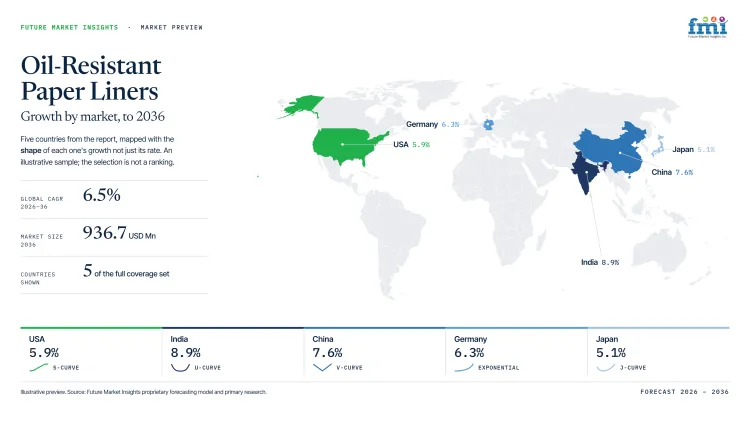
| Country | CAGR |
|---|---|
| Brazil | 6.9% |
| United Kingdom | 6.4% |
| Germany | 6.3% |
| United States | 5.9% |
| Japan | 5.1% |
How do country-level CAGRs compare in the Oil-Resistant Paper Liners Market?
The five-country range spans 1.8 percentage points and forms a compact middle group between Brazil and Japan. The spacing describes forecast pace instead of current revenue or installed volume across national foodservice and converting systems.
- Brazil forms the upper end of the displayed range as prepared-food services support trial volume. Extended import routes reward manufacturers that maintain local inventory and validated wet-strength performance across humid distribution conditions.
- The United Kingdom remains close to Brazil as delivery businesses require fat-resistant packaging and clear direct-contact statements. Regional distributors influence how quickly approved specifications reach restaurant groups with varied recovery instructions across local waste systems.
- Germany lies 0.1 percentage point from the United Kingdom as detailed constituent review shapes approval more strongly than basic paper availability. Manufacturers gain access by supporting BfR-aligned constituent records and migration review for unfamiliar coating systems.
- The United States follows the European pair as national restaurant programs provide meaningful pilot volume. Multi-site specifications require consistent oil holdout and regional supply before a successful trial becomes recurring business.
- Japan forms the lower end of the range as positive-list review extends qualification for imported coatings. Local technical support carries more commercial weight than rapid sample availability during controlled material changes.
Comparable CAGRs can produce different market entry conditions across foodservice systems with distinct qualification and distribution requirements.
The full report provides country-level CAGR analysis across North America, Latin America, Europe, East Asia, South Asia and Pacific, and the Middle East and Africa.
Country-wise Analysis
- Prepared-food operators in Brazil need liners that retain oil holdout during humid storage and long regional distribution across restaurant groups serving fried meals under varied urban conditions with limited specialist paper inventories. The Brazilian Institute of Geography and Statistics reported in March 2026 that feeding services increased 1.1% from January 2025 while domestic converting supports repeat trials for standard formats across regional outlets. Oil-resistant paper liner sales in Brazil are forecast to expand at 6.9% CAGR by 2036, supported by prepared-food demand but constrained by currency movement and extended import routes that reward local stock plus validated wet-strength performance.
- Food businesses in the United Kingdom evaluate liner changes against delivery hygiene duties and direct-contact statements across takeaway services, prepared-meal distribution and franchise networks with different holding times plus packaging instructions at small outlets across regional distribution networks. Food Standards Agency guidance updated in August 2026 states that delivery packaging may require liquid or fat resistance to prevent leakage and paper saturation during transport. The United Kingdom's oil-resistant paper liners outlook is anticipated to advance at 6.4% CAGR over the assessment period, supported by established foodservice distribution but constrained by recovery instructions for polymer-coated structures across local waste systems.
- German paper converters combine oil-barrier testing with detailed constituent review for unfamiliar coatings used in bakery sheets and quick-service liners across repeated printing plus cutting operations at approved sites serving national restaurant programs and regional bakery distributors requiring consistent output across repeated orders. The Federal Institute for Risk Assessment opened an April 2026 consultation covering revised paper and board recommendations for direct food-contact applications plus constituent documentation. Adoption of oil-resistant paper liners in Germany is estimated to expand at 6.3% CAGR through 2036, reinforced by specialty-paper expertise but constrained by documentation changes that require BfR-aligned records and migration support.
- United States restaurant chains use formal specifications and converter trials for paper liners serving national menus with different foods plus holding temperatures across approved production sites and scheduled replenishment networks across several large national distributor networks. The United States oil-resistant paper liners sector is projected to record 5.9% CAGR during the assessment period, supported by large pilot volumes and established foodservice distribution across national accounts. The National Restaurant Association reported in February 2025 that half of operators received more off-premises revenue than in 2019, yet recurring contracts require consistent oil holdout plus dependable supply across every approved converter site.
- Japanese food companies use detailed material review and controlled change procedures for packaging that contacts food across several formats plus imported coating systems serving national food brands and restaurant groups requiring stable repeat supply across major regional distribution networks. Japan is estimated to post 5.1% CAGR over the forecast period, supported by careful qualification but constrained by documentation requirements for imported coatings and unfamiliar resin layers. The Ministry of Health Labour and Welfare stated in March 2025 that importers must verify positive-list compliance ahead of June enforcement, which raises the value of precise constituent records plus local technical support.
Who are the notable companies in the Oil-Resistant Paper Liners Market?
Ahlstrom Oyj and Nordic Paper serve the market alongside delfortgroup AG and Twin Rivers Paper Company. Koehler Paper SE and Sappi Europe also compete with UPM-Kymmene Corporation and Seaman Paper Company.
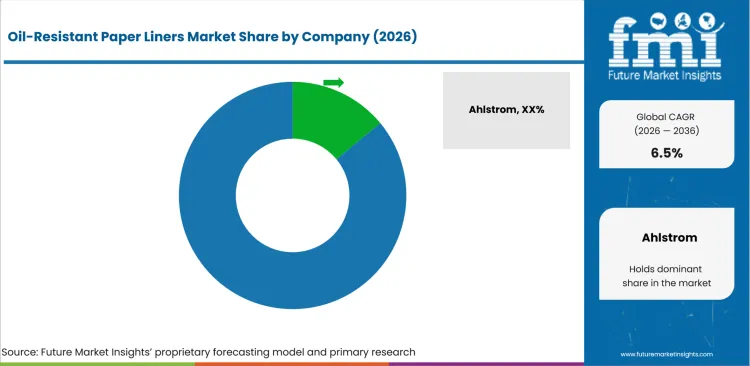
The field remains fragmented across specialty-material groups and parchment paper producers serving direct food-contact formats. Converters of greaseproof sheets compete closer to application testing and finished-format delivery across restaurant channels. Distinct production assets and qualification records separate natural greaseproof papers from coated-barrier routes across foodservice applications. Entry depends on repeatable oil holdout plus stable printing and complete food-contact documentation across multi-site programs.
- Ahlstrom Oyj and Koehler Paper SE compete with barrier-paper development tied to foodservice trials and grease-resistant formats.
- Nordic Paper and Twin Rivers Paper Company emphasize natural or uncoated greaseproof routes, while delfortgroup AG adds engineered barrier structures.
- Sappi Europe and UPM-Kymmene Corporation focus on coated barrier systems, while Seaman Paper Company brings lightweight conversion closer to finished foodservice formats.
Competitive Benchmarking: Oil-Resistant Paper Liners Market
| Company | Grease-Barrier Application Range | Lightweight Converting Evidence | Food-Contact Documentation Depth | Geographic Reach |
|---|---|---|---|---|
| Ahlstrom Oyj | Medium | Medium | Medium | Europe, North America and Asia |
| Nordic Paper | Medium | Medium | Medium | Europe, Canada and global exports |
| delfortgroup AG | High | High | Medium | Europe, North America and Asia |
| Twin Rivers Paper Company | Medium | Medium | Medium | North America |
| Koehler Paper SE | High | Medium | Medium | Europe and international exports |
| Sappi Europe | High | High | Medium | Europe and global customer coverage |
| UPM-Kymmene Corporation | High | High | High | Europe, Asia and international markets |
| Seaman Paper Company | Medium | High | Medium | North America, Europe and Asia |
Key Developments in the Oil-Resistant Paper Liners Market
- In April 2026, Koehler Paper SE introduced NexPlus OGR for burgers and fried-food wraps with PFAS-free grease resistance and recyclability.
- In March 2026, UPM-Kymmene Corporation and Paramelt introduced a low-coat-weight paper concept that runs on existing vertical form-fill-seal equipment.
- In May 2025, Ahlstrom Oyj inaugurated the EUR 15 million PMZ5 parchmentizer in France for grease-resistant vegetable parchment production.
Key Players in the Oil-Resistant Paper Liners Market
Integrated Barrier-Paper Platforms
- Ahlstrom Oyj
- Koehler Paper SE
- Sappi Europe
- UPM-Kymmene Corporation
Natural and Engineered Greaseproof Producers
- Nordic Paper
- delfortgroup AG
- Twin Rivers Paper Company
Foodservice Conversion Platform
- Seaman Paper Company
Oil-Resistant Paper Liners Market - Report Scope
| Coverage field | Report scope |
|---|---|
| Market breakdown | By product type, material, basis weight, application, end use, sales channel and region. |
| Quantitative Units | Revenue in USD million and CAGR in %. |
| Market Definition | Commercial oil-resistant paper sold as rolls, sheets or cut liners for direct food-contact applications. |
| Regions Covered | North America, Latin America, Europe, East Asia, South Asia and Pacific, and Middle East and Africa. |
| Countries Covered | Brazil, United Kingdom, Germany, United States, Japan, and 20+ countries included in the full report. |
| Key Companies Profiled | Ahlstrom Oyj, Nordic Paper, delfortgroup AG, Twin Rivers Paper Company, Koehler Paper SE, Sappi Europe, UPM-Kymmene Corporation, Seaman Paper Company. |
| Forecast Period | 2026 to 2036. |
| Approach | Primary and secondary research with market triangulation. |
Oil-Resistant Paper Liners Market - Research Methodology
| Method | Approach |
|---|---|
| Primary Research | FMI analysts gathered input from manufacturers, service providers, technology developers, distributors, end users, procurement teams, and subject-matter experts. Interviews examined purchasing decisions, product or service evaluation, adoption barriers, approval requirements, pricing considerations, and expectations for technical or commercial support. Respondents were also asked what evidence is required before a trial, pilot, or initial order develops into regular purchasing. |
| Desk Research | Desk research covered government statistics, regulatory publications, trade data, industry associations, technical literature, standards, company filings, product information, and official corporate announcements. Sources were reviewed for relevance, publication date, geographic coverage, and consistency with the defined market scope. Claims relating to performance, applications, approvals, capacity, investment, and commercial activity were retained only when supported by credible public evidence. |
| Market Sizing and Forecasting | The market model combined the baseline value with historical performance, segment structure, pricing and volume indicators, adoption levels, company participation, and country-level demand conditions. Forecast assumptions considered economic activity, investment trends, regulatory developments, technology adoption, purchasing cycles, supply availability, and barriers to wider market use. Segment and regional estimates were reconciled before the final market total was calculated. |
| Data Validation | Estimates were checked against multiple independent indicators, including public data, company activity, trade patterns, industry developments, and findings from primary interviews. Validation also tested whether products, services, applications, and company revenues fell within the defined market boundaries. Adjacent categories, unsupported claims, overlapping revenues, and activities without direct market relevance were excluded to reduce double counting and maintain consistency across segments and countries. |
Oil-Resistant Paper Liners Market by Segments
Product Type
- PFAS-Free Oil-Resistant Liners
- Natural Densified Greaseproof Liners
- Coated Oil-Barrier Liners
- Glassine - Parchment Liners
- Others
Material
- Virgin Kraft Pulp
- Recycled Fiber
- Vegetable Parchment
- Glassine
- Others
Basis Weight
- Below 30 GSM
- 30-50 GSM
- Above 50 GSM
Application
- Fried Foods & QSR
- Snacks & Confectionery
- Bakery
- Ready Meals
- Others
End Use
- Foodservice
- Food Processing
- Retail & Household
- Others
Sales Channel
- Direct - OEM Supply
- Packaging Distributors
- Online - E-commerce
- Others
Oil-Resistant Paper Liners Market by Region:
- North America
- United States
- Canada
- Latin America
- Brazil
- Mexico
- Chile
- Rest of Latin America
- Western Europe
- Germany
- United Kingdom
- Italy
- Spain
- France
- Nordics
- Benelux
- Rest of Western Europe
- Eastern Europe
- Russia
- Poland
- Hungary
- Balkan and Baltic States
- Rest of Eastern Europe
- East Asia
- China
- Japan
- South Korea
- South Asia and Pacific
- India
- ASEAN
- Australia and New Zealand
- Rest of South Asia and Pacific
- Middle East and Africa
- Kingdom of Saudi Arabia
- Other GCC Countries
- Türkiye
- South Africa
- Other African Union Countries
- Rest of Middle East and Africa
Research Sources and Bibliography
- USA Food and Drug Administration. (2025, January 3). FDA Determines Authorization for 35 Food Contact Notifications Related to PFAS Are No Longer Effective.
- National Restaurant Association. (2026, February 11). State of the Restaurant Industry 2026.
- European Parliament and Council of the European Union. (2025, January 22). Regulation (EU) 2025/40 of the European Parliament and of the Council of 19 December 2024 on packaging and packaging waste, amending Regulation (EU) 2019/1020 and Directive (EU) 2019/904, and repealing Directive 94/62/EC (Text with EEA relevance).
- UPM-Kymmene Corporation. (2025, September 9). Walkers Chocolates introduces recyclable paper wrapper co-created with UPM and EvoPak.
- USA Food and Drug Administration. (2024, February 28). FDA Announces PFAS Used in Grease-Proofing Agents for Food Packaging No Longer Being Sold in the USA
- Brazilian Institute of Geography and Statistics. (2026, March 13). Volume of Services changes by 0.3% in January.
- Food Standards Agency. (2026, August 5). Starting a food business.
- German Federal Institute for Risk Assessment. (2026, April 10). Public Consultation on the Draft Revision of BfR Recommendations on paper and board for food contact.
- National Restaurant Association. (2025, February 6). Restaurant Industry Poised for Growth in 2025: Industry Expected to Employ 15.9 Million People and Reach $1.5 Trillion in Sales.
- Ministry of Health, Labour and Welfare, Japan. (2025, March 27).
- Ahlstrom Oyj. (2025, May 21). Ahlstrom inaugurates new parchmentizer at the Saint-Séverin plant, strengthening customer partnerships and local commitment.
- Nordic Paper Holding AB. (2025, March 21). Nordic Paper’s annual report and sustainability report 2024.
- delfortgroup AG. (2025, June 17). new barrier paper for varying temperatures: thinbarrier 303 protects food from frozen to tropical.
- Twin Rivers Paper Company. (2025, September 4). Twin Rivers Paper Celebrates 100 Years of Papermaking.
- Koehler Paper SE. (2026, April 10). PFAS-Free and Recyclable Fast Food Packaging Paper.
- Sappi Europe. (2025, September 2). Sappi expands recyclable, high-barrier paper portfolio for primary packaging.
- UPM-Kymmene Corporation. (2026, March 24). UPM and Paramelt introduce bio-based food packaging concept.
- Seaman Paper Company. (2025, September 18). Seaman Paper Launches Heat-Sealable Paper Packaging: A Scalable, Recyclable Alternative to Single-Use Plastics.
This bibliography is provided for reader reference and is not exhaustive. The full report contains the complete reference list and detailed citations
This Report Answers
- How are PFAS restrictions changing liner qualification priorities?
- Which 2026 shares define primary product and material positions?
- Why does 30-50 GSM balance oil resistance with converting efficiency?
- How do fried-food conditions shape liner testing and replacement?
- Which technical checks delay repeat liner purchases?
- How do country approval and distribution conditions change entry?
- Which eight companies show verified grease-barrier activity?
- Which evidence thresholds determine competitive benchmark ratings?
Frequently Asked Questions
How big is the Oil-Resistant Paper Liners Market in 2026?
The Oil-Resistant Paper Liners Market is valued at USD 499.0 million in 2026 and is projected to reach USD 936.7 million by 2036. Foodservice replacement programs support this value but new grades must prove oil holdout and line compatibility to secure commercial conversion.
What is the CAGR of the Oil-Resistant Paper Liners Market from 2026 to 2036?
The Oil-Resistant Paper Liners Market is projected to expand at 6.5% CAGR from 2026 to 2036. Regulatory withdrawal of PFAS grease-proofing agents supports replacement demand but qualification cost and application testing moderate recurring orders across restaurant and food-processing programs.
Which basis weight segment is projected to account for 44.0% of the Oil-Resistant Paper Liners Market?
The 30-50 GSM segment is projected to account for 44.0% of the Oil-Resistant Paper Liners Market in 2026. The range limits fiber use and retains practical stiffness plus handling strength for tray liners across high-speed commercial restaurant converting sites.
Which different exhaustive segment is expected to expand fastest through 2036?
PFAS-free oil-resistant liners hold 32.0% of the Oil-Resistant Paper Liners Market by product type in 2026 and are expected to expand fastest. Regulatory replacement work directs commercial trials toward fluorochemical-free barriers that preserve oil resistance and existing converting performance.
Which companies are active in the Oil-Resistant Paper Liners Market?
Eight verified companies are active in the Oil-Resistant Paper Liners Market across natural greaseproof paper and coated barrier formats. Ahlstrom Oyj and Nordic Paper compete alongside delfortgroup AG and Twin Rivers Paper Company plus Koehler Paper SE and Sappi Europe with UPM-Kymmene Corporation and Seaman Paper Company.
Preview the report firsthand - request a free sample
Get SampleGet the brochure for pricing and purchase details.
Get PDFTable of Content
- Key Takeaways
- Market Size and CAGR
- Top Growth Driver
- Fastest Growing Segment
- Leading Region
- Key Companies
- Emerging Opportunities
- Executive Summary
- Global Market Outlook
- Demand-side Trends
- Supply-side Trends
- Technology Roadmap Analysis
- Analysis and Recommendations
- Analyst Perspective (What is happening? Why now? What should investors know?)
- Key Questions Answered
- How large is the market?
- What is the CAGR?
- What are key trends?
- Which region dominates?
- Who are the leaders?
- Market Overview
- Market Coverage / Taxonomy
- Market Definition / Scope / Limitations
- Research Methodology
- Chapter Orientation
- Analytical Lens and Working Hypotheses
- Market Structure, Signals, and Trend Drivers
- Benchmarking and Cross-market Comparability
- Market Sizing, Forecasting, and Opportunity Mapping
- Research Design and Evidence Framework
- Desk Research Programme (Secondary Evidence)
- Expert Input and Fieldwork (Primary Evidence)
- Tooling, Models, and Reference Databases
- Data Engineering and Model Build
- Quality Assurance and Audit Trail
- Market Background
- Market Dynamics (Drivers, Restraints, Opportunity, Trends)
- Scenario Forecast (Optimistic, Likely, Conservative)
- Impact Analysis
- AI Impact
- Sustainability Impact
- Regulatory Impact
- Technology Impact
- Consumer / Buyer Analysis
- Purchase Drivers
- Adoption Barriers
- Buyer Journey
- Opportunity Map Analysis
- Product Life Cycle Analysis
- Supply Chain Analysis
- Investment Feasibility Matrix
- Value Chain Analysis
- PESTLE and Porter's Analysis
- Regulatory Landscape
- Regional Parent Market Outlook
- Production and Consumption Statistics
- Import and Export Statistics
- Global Market Analysis and Forecast, 2021 to 2036
- Historical Market Size Value (USD Million) Analysis, 2021 to 2025
- Current and Future Market Size Value (USD Million) Projections, 2026 to 2036
- Y-o-Y Growth Trend Analysis
- Absolute $ Opportunity Analysis
- Global Market Pricing Analysis, 2021 to 2036
- Global Market Analysis and Forecast, By Product Type, 2021 to 2036
- Introduction / Key Findings
- Historical Market Size Value (USD Million) Analysis By Product Type, 2021 to 2025
- Current and Future Market Size Value (USD Million) Analysis and Forecast By Product Type, 2026 to 2036
- PFAS-Free Oil-Resistant Liners
- Natural Densified Greaseproof Liners
- Coated Oil-Barrier Liners
- Glassine - Parchment Liners
- Others
- PFAS-Free Oil-Resistant Liners
- Y-o-Y Growth Trend Analysis By Product Type, 2021 to 2025
- Absolute $ Opportunity Analysis By Product Type, 2026 to 2036
- Global Market Analysis and Forecast, By Material, 2021 to 2036
- Introduction / Key Findings
- Historical Market Size Value (USD Million) Analysis By Material, 2021 to 2025
- Current and Future Market Size Value (USD Million) Analysis and Forecast By Material, 2026 to 2036
- Virgin Kraft Pulp
- Recycled Fiber
- Vegetable Parchment
- Glassine
- Others
- Virgin Kraft Pulp
- Y-o-Y Growth Trend Analysis By Material, 2021 to 2025
- Absolute $ Opportunity Analysis By Material, 2026 to 2036
- Global Market Analysis and Forecast, By Basis Weight, 2021 to 2036
- Introduction / Key Findings
- Historical Market Size Value (USD Million) Analysis By Basis Weight, 2021 to 2025
- Current and Future Market Size Value (USD Million) Analysis and Forecast By Basis Weight, 2026 to 2036
- 30-50 GSM
- Above 50 GSM
- Below 30 GSM
- 30-50 GSM
- Y-o-Y Growth Trend Analysis By Basis Weight, 2021 to 2025
- Absolute $ Opportunity Analysis By Basis Weight, 2026 to 2036
- Global Market Analysis and Forecast, By Application, 2021 to 2036
- Introduction / Key Findings
- Historical Market Size Value (USD Million) Analysis By Application, 2021 to 2025
- Current and Future Market Size Value (USD Million) Analysis and Forecast By Application, 2026 to 2036
- Fried Foods & QSR
- Snacks & Confectionery
- Bakery
- Ready Meals
- Others
- Fried Foods & QSR
- Y-o-Y Growth Trend Analysis By Application, 2021 to 2025
- Absolute $ Opportunity Analysis By Application, 2026 to 2036
- Global Market Analysis and Forecast, By End Use, 2021 to 2036
- Introduction / Key Findings
- Historical Market Size Value (USD Million) Analysis By End Use, 2021 to 2025
- Current and Future Market Size Value (USD Million) Analysis and Forecast By End Use, 2026 to 2036
- Foodservice
- Food Processing
- Retail & Household
- Others
- Foodservice
- Y-o-Y Growth Trend Analysis By End Use, 2021 to 2025
- Absolute $ Opportunity Analysis By End Use, 2026 to 2036
- Global Market Analysis and Forecast, By Sales Channel
- Introduction / Key Findings
- Historical Market Size Value (USD Million) Analysis By Sales Channel, 2021 to 2025
- Current and Future Market Size Value (USD Million) Analysis and Forecast By Sales Channel, 2026 to 2036
- Direct - OEM Supply
- Packaging Distributors
- Online - E-commerce
- Others
- Direct - OEM Supply
- Y-o-Y Growth Trend Analysis By Sales Channel, 2021 to 2025
- Absolute $ Opportunity Analysis By Sales Channel, 2026 to 2036
- Global Market Analysis and Forecast, By Region, 2021 to 2036
- Introduction
- Historical Market Size Value (USD Million) Analysis By Region, 2021 to 2025
- Current Market Size Value (USD Million) Analysis and Forecast By Region, 2026 to 2036
- North America
- Latin America
- Western Europe
- Eastern Europe
- East Asia
- South Asia and Pacific
- Middle East & Africa
- Market Attractiveness Analysis By Region
- North America Market Analysis and Forecast, By Country, 2021 to 2036
- Historical Market Size Value (USD Million) Trend Analysis By Market Taxonomy, 2021 to 2025
- Market Size Value (USD Million) Forecast By Market Taxonomy, 2026 to 2036
- By Country
- USA
- Canada
- By Product Type
- By Material
- By Basis Weight
- By Application
- By End Use
- By Sales Channel
- By Country
- Market Attractiveness Analysis
- By Country
- By Product Type
- By Material
- By Basis Weight
- By Application
- By End Use
- By Sales Channel
- Key Takeaways
- Latin America Market Analysis and Forecast, By Country
- Historical Market Size Value (USD Million) Trend Analysis By Market Taxonomy, 2021 to 2025
- Market Size Value (USD Million) Forecast By Market Taxonomy, 2026 to 2036
- By Country
- Brazil
- Mexico
- Chile
- Rest of Latin America
- By Product Type
- By Material
- By Basis Weight
- By Application
- By End Use
- By Sales Channel
- By Country
- Market Attractiveness Analysis
- By Country
- By Product Type
- By Material
- By Basis Weight
- By Application
- By End Use
- By Sales Channel
- Key Takeaways
- Western Europe Market Analysis and Forecast, By Country
- Historical Market Size Value (USD Million) Trend Analysis By Market Taxonomy, 2021 to 2025
- Market Size Value (USD Million) Forecast By Market Taxonomy, 2026 to 2036
- By Country
- Germany
- UK
- Italy
- Spain
- France
- Nordic
- BENELUX
- Rest of Western Europe
- By Product Type
- By Material
- By Basis Weight
- By Application
- By End Use
- By Sales Channel
- By Country
- Market Attractiveness Analysis
- By Country
- By Product Type
- By Material
- By Basis Weight
- By Application
- By End Use
- By Sales Channel
- Key Takeaways
- Eastern Europe Market Analysis and Forecast, By Country
- Historical Market Size Value (USD Million) Trend Analysis By Market Taxonomy, 2021 to 2025
- Market Size Value (USD Million) Forecast By Market Taxonomy, 2026 to 2036
- By Country
- Russia
- Poland
- Hungary
- Balkan & Baltic
- Rest of Eastern Europe
- By Product Type
- By Material
- By Basis Weight
- By Application
- By End Use
- By Sales Channel
- By Country
- Market Attractiveness Analysis
- By Country
- By Product Type
- By Material
- By Basis Weight
- By Application
- By End Use
- By Sales Channel
- Key Takeaways
- East Asia Market Analysis and Forecast, By Country
- Historical Market Size Value (USD Million) Trend Analysis By Market Taxonomy, 2021 to 2025
- Market Size Value (USD Million) Forecast By Market Taxonomy, 2026 to 2036
- By Country
- China
- Japan
- South Korea
- By Product Type
- By Material
- By Basis Weight
- By Application
- By End Use
- By Sales Channel
- By Country
- Market Attractiveness Analysis
- By Country
- By Product Type
- By Material
- By Basis Weight
- By Application
- By End Use
- By Sales Channel
- Key Takeaways
- South Asia and Pacific Market Analysis and Forecast, By Country
- Historical Market Size Value (USD Million) Trend Analysis By Market Taxonomy, 2021 to 2025
- Market Size Value (USD Million) Forecast By Market Taxonomy, 2026 to 2036
- By Country
- India
- ASEAN
- Australia & New Zealand
- Rest of South Asia and Pacific
- By Product Type
- By Material
- By Basis Weight
- By Application
- By End Use
- By Sales Channel
- By Country
- Market Attractiveness Analysis
- By Country
- By Product Type
- By Material
- By Basis Weight
- By Application
- By End Use
- By Sales Channel
- Key Takeaways
- Middle East & Africa Market Analysis and Forecast, By Country
- Historical Market Size Value (USD Million) Trend Analysis By Market Taxonomy, 2021 to 2025
- Market Size Value (USD Million) Forecast By Market Taxonomy, 2026 to 2036
- By Country
- Kingdom of Saudi Arabia
- Other GCC Countries
- Türkiye
- South Africa
- Other African Union
- Rest of Middle East & Africa
- By Product Type
- By Material
- By Basis Weight
- By Application
- By End Use
- By Sales Channel
- By Country
- Market Attractiveness Analysis
- By Country
- By Product Type
- By Material
- By Basis Weight
- By Application
- By End Use
- By Sales Channel
- Key Takeaways
- Key Countries Market Analysis
- USA
- Pricing Analysis
- Market Share Analysis, 2025
- By Product Type
- By Material
- By Basis Weight
- By Application
- By End Use
- By Sales Channel
- Canada
- Pricing Analysis
- Market Share Analysis, 2025
- By Product Type
- By Material
- By Basis Weight
- By Application
- By End Use
- By Sales Channel
- Mexico
- Pricing Analysis
- Market Share Analysis, 2025
- By Product Type
- By Material
- By Basis Weight
- By Application
- By End Use
- By Sales Channel
- Brazil
- Pricing Analysis
- Market Share Analysis, 2025
- By Product Type
- By Material
- By Basis Weight
- By Application
- By End Use
- By Sales Channel
- Chile
- Pricing Analysis
- Market Share Analysis, 2025
- By Product Type
- By Material
- By Basis Weight
- By Application
- By End Use
- By Sales Channel
- Germany
- Pricing Analysis
- Market Share Analysis, 2025
- By Product Type
- By Material
- By Basis Weight
- By Application
- By End Use
- By Sales Channel
- UK
- Pricing Analysis
- Market Share Analysis, 2025
- By Product Type
- By Material
- By Basis Weight
- By Application
- By End Use
- By Sales Channel
- Italy
- Pricing Analysis
- Market Share Analysis, 2025
- By Product Type
- By Material
- By Basis Weight
- By Application
- By End Use
- By Sales Channel
- Spain
- Pricing Analysis
- Market Share Analysis, 2025
- By Product Type
- By Material
- By Basis Weight
- By Application
- By End Use
- By Sales Channel
- France
- Pricing Analysis
- Market Share Analysis, 2025
- By Product Type
- By Material
- By Basis Weight
- By Application
- By End Use
- By Sales Channel
- India
- Pricing Analysis
- Market Share Analysis, 2025
- By Product Type
- By Material
- By Basis Weight
- By Application
- By End Use
- By Sales Channel
- ASEAN
- Pricing Analysis
- Market Share Analysis, 2025
- By Product Type
- By Material
- By Basis Weight
- By Application
- By End Use
- By Sales Channel
- Australia & New Zealand
- Pricing Analysis
- Market Share Analysis, 2025
- By Product Type
- By Material
- By Basis Weight
- By Application
- By End Use
- By Sales Channel
- China
- Pricing Analysis
- Market Share Analysis, 2025
- By Product Type
- By Material
- By Basis Weight
- By Application
- By End Use
- By Sales Channel
- Japan
- Pricing Analysis
- Market Share Analysis, 2025
- By Product Type
- By Material
- By Basis Weight
- By Application
- By End Use
- By Sales Channel
- South Korea
- Pricing Analysis
- Market Share Analysis, 2025
- By Product Type
- By Material
- By Basis Weight
- By Application
- By End Use
- By Sales Channel
- Russia
- Pricing Analysis
- Market Share Analysis, 2025
- By Product Type
- By Material
- By Basis Weight
- By Application
- By End Use
- By Sales Channel
- Poland
- Pricing Analysis
- Market Share Analysis, 2025
- By Product Type
- By Material
- By Basis Weight
- By Application
- By End Use
- By Sales Channel
- Hungary
- Pricing Analysis
- Market Share Analysis, 2025
- By Product Type
- By Material
- By Basis Weight
- By Application
- By End Use
- By Sales Channel
- Kingdom of Saudi Arabia
- Pricing Analysis
- Market Share Analysis, 2025
- By Product Type
- By Material
- By Basis Weight
- By Application
- By End Use
- By Sales Channel
- Türkiye
- Pricing Analysis
- Market Share Analysis, 2025
- By Product Type
- By Material
- By Basis Weight
- By Application
- By End Use
- By Sales Channel
- South Africa
- Pricing Analysis
- Market Share Analysis, 2025
- By Product Type
- By Material
- By Basis Weight
- By Application
- By End Use
- By Sales Channel
- USA
- Market Structure Analysis
- Competition Dashboard
- Competition Benchmarking
- Market Share Analysis of Top Players
- By Regional
- By Product Type
- By Material
- By Basis Weight
- By Application
- By End Use
- By Sales Channel
- Emerging Startups
- Innovation Benchmarking
- Competition Analysis
- Competition Deep Dive
- Ahlstrom
- Overview
- Product Portfolio
- Profitability by Market Segments
- Sales Footprint
- Strategy Overview
- Marketing Strategy
- Product Strategy
- Channel Strategy
- Nordic Paper
- Delfort
- Twin Rivers Paper
- Koehler Paper
- Sappi
- UPM Specialty Papers
- Seaman Paper
- Pudumjee Paper Products
- Georgia-Pacific
- Ahlstrom
- Case Studies
- Success Stories
- Recent Developments
- Competition Deep Dive
- Assumptions & Acronyms Used


