

- Market Size (2026)
- USD 360.4 Mn
- Forecast (2036)
- USD 676.5 Mn
- CAGR (2026 to 2036)
- 6.5%
How big is Rosemary Oil Haircare Market in 2026?
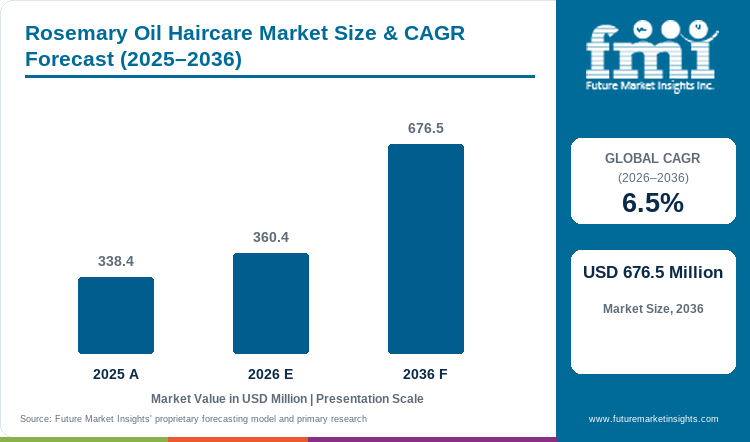
USD 360.4 million in 2026 and USD 676.5 million by 2036, expanding at 6.5% CAGR.
Sales of rosemary oil haircare are estimated to rise at a 6.5% CAGR through 2036, increasing from USD 338.4 million in 2025 to USD 360.4 million in 2026 before reaching USD 676.5 million by 2036. Haircare buyers are evaluating rosemary-based products alongside scalp-care and hair-growth treatments rather than as standalone botanical remedies. L'Oréal reported in July 2025 that consumer haircare recorded double-digit growth following launches that included Growth Booster. The development indicates that treatment-oriented positioning is already competing within mainstream retail haircare channels. Rosemary-oil brands therefore need claims and performance evidence that can withstand direct comparison with established hair-loss solutions.
Country regulation determines how quickly branded products move from digital discovery into scaled retail distribution for repeated use. FDA data showed 1,298,361 active cosmetic product listings and 16,398 active facility registrations in the United States on June 30 2026. Those records are not FDA approval but they remain mandatory market-access records under MoCRA. South Korea and Japan apply separate review routes for stronger hair-loss claims, so brands need country-specific plans before committing inventory and launch spending.
Key Takeaways
- Controlled scalp dosing is moving rosemary from informal oil mixing into repeatable cleansing and leave-in routines that consumers can follow.
- Based on product type, core - classic lines are projected to account for 36.0% in 2026, owing to familiar routines that lower first-use friction.
- By nature, conventional formulations are estimated to hold 55.0% in 2026, supported by broader preservation and sensory control.
- In 2026, liquid & serum formats are expected to lead the format category with 28.0% share, driven by direct scalp placement that improves dose control.
- Limited efficacy evidence and sensitivity risk raise the documentation burden whenever cosmetic language approaches a hair-growth treatment claim.
- Some of the key players in this market include Procter & Gamble, Amorepacific, Unilever, L'Oréal, Olaplex, Henkel, Church & Dwight, Wella Company, Shiseido Professional (Henkel), and Kao Corporation.
Analyst Perspective
"Rosemary brands win repeat orders when scalp application stays simple and claims remain supportable for the intended cosmetic route. Premium positioning weakens when treatment language outruns safety records or country classification rules."
- Rahul Pandita, Principal Consultant, Future Market Insights
How is the rosemary oil haircare market segmented?
Product Type | Nature | Format | Price Positioning | Sales Channel | Region
The rosemary oil haircare market is segmented by product type, nature, format, price positioning, sales channel, and region. Product type covers core - classic, targeted treatment, sensitive - gentle, premium - clinical, and kits - sets. Nature separates conventional, vegan - cruelty-free, natural - organic, dermocosmetic - clinical, and fragrance-free - sensitive positioning choices. Format covers liquid - serum, cream - balm, stick - solid, spray - mist, sheet - patch, and powder. Price positioning spans mass, masstige, premium, and professional while sales channels cover e-commerce - DTC, specialty beauty retail, pharmacies - drugstores, supermarkets - hypermarkets, and salons - spas.
What makes core - classic lines central to the product type category?
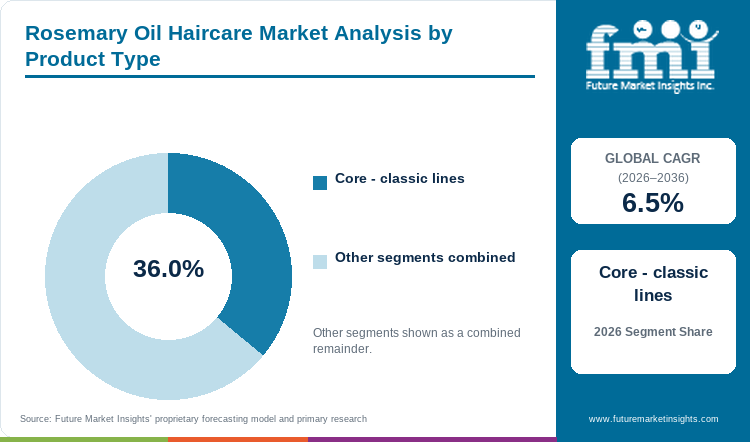
Core - classic lines fit wash-day and scalp-oiling habits that buyers already understand without special equipment. Amorepacific reported in April 2025 that Ryo and LABO-H showed strong first-quarter performance while online channels continued to grow. Familiar hair care formats can therefore carry targeted scalp benefits without requiring a separate purchase routine.
- By product type, core - classic lines are forecast to represent 36.0% in 2026, attributable to familiar wash-day and scalp-oiling routines.
- Retailers can place these products beside ordinary shampoos and oils without building a separate education path for first-time buyers.
How does conventional formulation secure its position within the nature category?
Conventional formulas give chemists wider control over preservation and scalp feel while rosemary provides the botanical cue. Henkel launched Schwarzkopf KERATÎME Care & Styling in March 2026 for distribution through Walmart stores. Mainstream natural cosmetics can carry treatment technologies without narrowing every stabilizer or sensory choice before retail scale.
- Conventional formulations are likely to capture 55.0% share in 2026, reinforced by broader formulation choices that suit mass distribution.
- Chemists can adjust preservation and sensory finish without forcing every rosemary product into a narrower natural-certification constraint.
What operating condition supports liquid & serum demand in the format category?
Liquid and serum formats place treatment directly on the scalp without requiring consumers to spread heavier balm. Olaplex reported in May 2026 that quarterly performance benefited from the successful N°3 PLUS treatment launch. Rosemary hair serum formats use the same advantage when controlled placement fits treatment between normal wash days.
- Liquid & serum formats are set to lead the format category with 28.0% share in 2026, owing to direct placement and controlled scalp dosing.
- Droppers and pumps let consumers repeat a scalp dose more consistently than heavier formats that require broader manual spreading.
What supports mass pricing within the price positioning category?
Mass pricing lowers the cost of testing rosemary before buyers commit to premium routines. L'Oréal's April 2025 sales update identified Growth Booster as a new Consumer Products haircare launch. The release shows treatment cues can enter mainstream haircare channels without specialist service support. Rosemary oils follow the same trial logic while solid hair styling formats provide another convenience benchmark.
- Mass products are projected to hold 31.0% share in 2026, supported by lower trial cost and frequent replenishment.
- Lower trial cost gives new users room to test scalp feel and routine fit before considering premium treatment alternatives.
How does e-commerce & DTC secure its position within the sales channel category?
E-commerce and DTC let rosemary brands explain application frequency before consumers repeat the routine. L'Oréal reported in February 2026 that Professional Products grew 7.5% like-for-like during 2025 as omnichannel premium haircare sales accelerated. Digital pages shorten replenishment while professional hair care channels add stylist guidance for treatment-oriented buyers.
- The sales channel category is forecast to be led by e-commerce & DTC at 35.0% share in 2026, shaped by digital education and repeat ordering.
- Detailed product pages can explain scalp use before checkout and keep replenishment close to the consumer after trial succeeds.
What are the drivers, restraints and opportunities in the Rosemary Oil Haircare Market?
Scalp-focused routines support demand while safety scrutiny limits stronger claims and documented treatment regimens support higher-value positioning.
- Driver: Scalp-focused routines are giving branded rosemary oils and serums a clearer role between standard wash steps.
- Restraint: Safety scrutiny and limited treatment evidence raise costs when botanical claims move beyond ordinary cosmetic maintenance.
- Opportunity: Documented scalp regimens can support premium pricing where brands match claims to each country’s regulatory route.
Scalp-Treatment Routines Move Into Mainstream Haircare
Hair-loss concerns are shifting routine haircare closer to the scalp and giving targeted leave-in products a clearer buying occasion. Procter & Gamble launched Pantene Abundant & Strong in February 2026 with shampoo and conditioner plus a daily scalp serum. The three-step system addresses shedding and hair-density concerns within a routine ordinary haircare buyers can repeat. Rosemary oils and serums fit the same buying decision when application stays simple and tolerable between wash steps.
Safety Scrutiny Raises the Cost of Stronger Botanical Claims
Cosmetic safety scrutiny raises costs when concentrated botanical products invite aggressive claims or inconsistent use instructions. The European Commission reported 4,671 Safety Gate alerts during 2025 and said cosmetics represented 36.0% of dangerous products reported. Chemical risks accounted for 53.0% of all alerts within the same European consumer-safety system during 2025. Rosemary formulas therefore need ingredient controls and documented safety assessment before large retailers widen distribution. Stronger hair-growth language can also trigger extra substantiation or classification work before commercial launch proceeds.
Functional Scalp Regimens Support Higher-Value Positioning
Higher-value growth appears where suppliers document a specific scalp benefit without presenting ordinary cosmetic care as medical treatment. Amorepacific presented RYO Jayangyunmo Hair Loss Care in November 2025 with next-generation anti-hair loss functional certification. The range combined shampoo with scalp-treatment formats and a leave-in essence inside one regimen. Rosemary treatment brands gain pricing room when frequent use remains tolerable and the evidence fits the country claim route.
Which country CAGRs are covered in the Rosemary Oil Haircare Market?
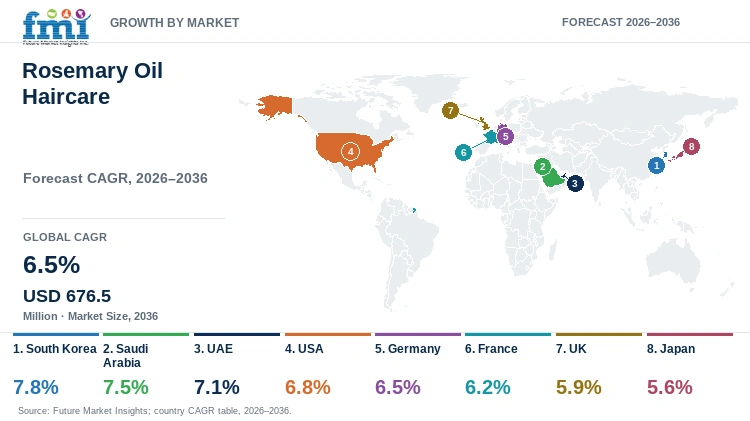
| Country | CAGR |
|---|---|
| South Korea | 7.8% |
| Saudi Arabia | 7.5% |
| UAE | 7.1% |
| USA | 6.8% |
| Germany | 6.5% |
| France | 6.2% |
| UK | 5.9% |
| Japan | 5.6% |
How do country-level CAGRs compare in the Rosemary Oil Haircare Market?
The country CAGRs span 5.6% to 7.8% within three distinct growth bands during the forecast period. South Korea forms the upper group with Saudi Arabia and the UAE before the USA-to-France middle range.
- South Korea pairs specialist scalp retail with fast digital product education for treatment-oriented beauty buyers.
- Saudi Arabia gives imported beauty brands strong pharmacy exposure but depends heavily on distributor replenishment discipline.
- UAE retailers refresh imported assortments quickly and reward launch-ready products with clear digital merchandising support.
- USA buyers compare many scalp treatments across mass retail and online channels before settling into routines.
- Germany's drugstore density favors familiar treatment formats that maintain consistent sensory performance between purchases.
- France gives selective beauty and pharmacy-adjacent channels a larger role in validating treatment-looking products.
- UK specialty retailers shorten discovery time but repeat purchase still depends on simple everyday application.
- Japan's mature haircare routines place unusual weight on texture and application feel during product comparison.
Similar growth rates produce different launch conditions because channel structure and claim thresholds vary. The full report provides country-level CAGR analysis across North America, Latin America, Western Europe, Eastern Europe, East Asia, South Asia and Pacific, and the Middle East and Africa.
Country-wise Analysis
- South Korea has a mature scalp-care channel where buyers already distinguish functional hair-loss products from ordinary cosmetic maintenance. By 2036, South Korea is projected to grow at 7.8% CAGR, driven by treatment routines that already occupy specialized digital beauty channels. MFDS amended functional-cosmetics review rules in December 2025 and revised procedures for qualifying products using stronger functional claims. Rosemary brands entering anti-hair loss positioning therefore need evidence matched to the declared function plus texture and regimen clarity before premium placement.
- Saudi Arabia depends on imported beauty ranges and formal marketing notification before new scalp-care lines reach pharmacies or digital shelves. Saudi Arabia's rosemary oil haircare outlook is anticipated to advance at 7.5% CAGR over the assessment period, supported by imported routines gaining pharmacy and digital access. SFDA maintains a national list of cosmetics whose manufacturers or importers submitted marketing notifications within the Kingdom. Brands therefore need complete local records and reliable distributor replenishment before digital or pharmacy demand becomes repeat purchase.
- UAE beauty retail gives imported assortments frequent digital exposure through local specialty and distribution channels. Rosemary oil haircare demand in the UAE is forecast to rise at 7.1% CAGR over the forecast period, attributable to imported scalp-care products entering specialty and online accounts. MoIAT changed twelve national conformity marks in April 2025 and maintains ECAS records for hair care products. Brands need conformity records before launch because delayed certificates or label corrections can miss fast-moving retail windows.
- USA demand develops inside crowded online and mass-retail channels where scalp treatments face rapid comparison and low switching costs. Adoption of rosemary oil haircare in the USA is estimated to expand at 6.8% CAGR through 2036, reinforced by broad digital and retail visibility for treatment formats. CPSC warned in July 2025 that about 18,500 VIOFAIRY hair growth serums lacked required child-resistant packaging. Rosemary brands therefore need compliant packaging and safety directions before broad retail traffic can become repeat volume.
- Germany's haircare trade rewards consistent formulations within drugstores and professional channels that already carry treatment-oriented products. Germany's rosemary oil haircare sector is projected to record 6.5% CAGR during the assessment period, shaped by botanical routines entering familiar retail formats. BfR states that cosmetic manufacturers must guarantee product safety through expert assessments before market placement. Rosemary products using botanical ingredients therefore need stable formulas and defensible directions before natural positioning supports broader placement.
- France routes treatment-looking haircare through selective beauty stores and pharmacy-adjacent retail channels with nationwide reach. In France, rosemary oil haircare demand is predicted to advance at 6.2% CAGR through 2036, aided by channels where buyers compare efficacy cues before adopting scalp routines. DGCCRF's December 2025 cosmetics guidance requires product claims to rest on adequate and verifiable evidence. Rosemary hair growth shampoos therefore need support that matches their cosmetic wording before wider retail placement.
- UK beauty buyers move quickly between specialty retailers and marketplaces so responsibility records matter before brands widen distribution. The UK is estimated to post 5.9% CAGR over the forecast period, influenced by digital discovery that moves specialized routines into mainstream consideration. OPSS reported 861,686 cosmetic notifications and 24,112 registered Responsible Persons as of May 28 2026. Brands linking rosemary with hair styling products therefore need a UK Responsible Person plus compliant safety documentation and labeling.
- Japan's haircare market places high weight on application feel and regulatory boundaries surrounding stronger hair-growth claims. Rosemary oil haircare sales in Japan are forecast to expand at 5.6% CAGR by 2036, owing to targeted scalp routines inside mature beauty channels. PMDA's February 2026 practical materials explain current application procedures and review expectations for quasi-drug approval submissions. Rosemary products remain simpler to launch when claims stay within ordinary cosmetic maintenance while stronger wording raises the evidence burden.
Who are the notable companies in the Rosemary Oil Haircare Market?
Procter & Gamble, Amorepacific, Unilever, L'Oréal, Olaplex, Henkel, Church & Dwight, Wella Company, Shiseido Professional (Henkel), and Kao Corporation are the notable companies serving this market.
Competition spans mass consumer groups and professional treatment businesses with different levels of scalp-care exposure. Henkel owns Olaplex and Shiseido Professional, while Procter & Gamble sells rosemary haircare through Mielle and Amorepacific documents scalp-care routines through RYO.
- Mass and digital haircare platforms include Procter & Gamble plus Unilever and Church & Dwight alongside Kao Corporation with broad consumer access.
- Professional and premium treatment systems include L'Oréal plus Olaplex and Henkel alongside Wella Company and Shiseido Professional (Henkel) with specialist-channel exposure.
- Scalp-care specialists include Amorepacific with functional hair-loss routines that compete directly for treatment-oriented consumer attention.
Competitive Benchmarking: Rosemary Oil Haircare Market
| Company | Treatment Routine Breadth | Specialty / Professional Access | Mass & Digital Reach | Geographic Reach |
|---|---|---|---|---|
| Procter & Gamble | High | Medium | High | Global consumer reach |
| Amorepacific | High | Medium | Medium | East Asia and international beauty channels |
| Unilever | Medium | High | High | Global consumer and prestige channels |
| L'Oréal | High | High | High | Global mass, specialty and salon channels |
| Olaplex | Medium | High | Medium | North America and international specialty channels |
| Henkel | High | High | High | Global consumer and professional haircare reach |
| Church & Dwight | Medium | Low | High | North America with international consumer distribution |
| Wella Company | High | High | Medium | Global professional and consumer haircare reach |
| Shiseido Professional (Henkel) | High | High | Low | Asia-Pacific professional haircare markets |
| Kao Corporation | High | Medium | High | Japan and wider Asian consumer haircare channels |
Scoring basis: High requires broad verified evidence that directly meets the buyer criterion named in the benchmark table. Medium reflects narrower documented capability that still establishes current participation within the evaluated market route. Low marks a documented limitation where public evidence shows narrower capability against that criterion.
Key Developments in the Rosemary Oil Haircare Market
- In July 2026, Kao Corporation announced an August rollout of Liese haircare products in seven Asian countries and regions using H-Linx TECH for post-color damage care.
- In July 2026, Henkel completed its acquisition of Olaplex after the required closing conditions and regulatory approvals were satisfied.
- In January 2026, Wella Company introduced Ultimate Color as a four-step professional color-care regimen for salon and home maintenance.
Key Players in the Rosemary Oil Haircare Market
Mass and Digital Haircare Platforms
- Procter & Gamble
- Unilever
- Church & Dwight
- Kao Corporation
Professional and Premium Treatment Systems
- L'Oréal
- Olaplex
- Henkel
- Wella Company
Scalp-Care and Specialist Haircare Platforms
- Amorepacific
- Shiseido Professional (Henkel)
Rosemary Oil Haircare Market - Report Scope
| Coverage field | Report scope |
|---|---|
| Market breakdown | By product type, nature, format, price positioning, sales channel, and region. |
| Quantitative Units | USD million. |
| Market Definition | Branded haircare products containing rosemary oil or explicitly positioned around rosemary oil for hair or scalp care. Bulk ingredient oil, supplements, devices, services, and non-rosemary haircare are excluded. |
| Regions Covered | North America, Latin America, Western Europe, Eastern Europe, East Asia, South Asia and Pacific, and Middle East and Africa. |
| Countries Covered | South Korea, Saudi Arabia, UAE, USA, Germany, France, UK, Japan, and 20+ countries included in the full report. |
| Key Companies Profiled | Procter & Gamble, Amorepacific, Unilever, L'Oréal, Olaplex, Henkel, Church & Dwight, Wella Company, Shiseido Professional (Henkel), and Kao Corporation. |
| Forecast Period | 2026 to 2036. |
| Approach | Primary and secondary research with market triangulation. |
Rosemary Oil Haircare Market - Research Methodology
| Method | Approach |
|---|---|
| Primary Research | FMI analysts gathered input from manufacturers, service providers, technology developers, distributors, end users, procurement teams, and subject-matter experts. Interviews examined purchasing decisions, product or service evaluation, adoption barriers, approval requirements, pricing considerations, and expectations for technical or commercial support. Respondents were also asked what evidence is required before a trial, pilot, or initial order develops into regular purchasing. |
| Desk Research | Desk research covered government statistics, regulatory publications, trade data, industry associations, technical literature, standards, company filings, product information, and official corporate announcements. Sources were reviewed for relevance, publication date, geographic coverage, and consistency with the defined market scope. Claims relating to performance, applications, approvals, capacity, investment, and commercial activity were retained only when supported by credible public evidence. |
| Market Sizing and Forecasting | The market model combined the baseline value with historical performance, segment structure, pricing and volume indicators, adoption levels, company participation, and country-level demand conditions. Forecast assumptions considered economic activity, investment trends, regulatory developments, technology adoption, purchasing cycles, supply availability, and barriers to wider market use. Segment and regional estimates were reconciled before the final market total was calculated. |
| Data Validation | Estimates were checked against multiple independent indicators, including public data, company activity, trade patterns, industry developments, and findings from primary interviews. Validation also tested whether products, services, applications, and company revenues fell within the defined market boundaries. Adjacent categories, unsupported claims, overlapping revenues, and activities without direct market relevance were excluded to reduce double counting and maintain consistency across segments and countries. |
Rosemary Oil Haircare Market by Segments
Rosemary Oil Haircare Market segmented by Product Type:
- Core - classic lines
- Targeted treatment lines
- Sensitive - gentle lines
- Premium - clinical lines
- Kits - sets
Rosemary Oil Haircare Market segmented by Nature:
- Conventional
- Vegan - cruelty-free
- Natural - organic
- Dermocosmetic - clinical
- Fragrance-free - sensitive
Rosemary Oil Haircare Market segmented by Format:
- Liquid & serum
- Cream - balm
- Stick - solid
- Spray - mist
- Sheet - patch
- Powder
Rosemary Oil Haircare Market segmented by Price Positioning:
- Mass
- Masstige
- Premium
- Professional
Rosemary Oil Haircare Market segmented by Sales Channel:
- E-commerce & DTC
- Specialty beauty retail
- Pharmacies - drugstores
- Supermarkets - hypermarkets
- Salons - spas
Rosemary Oil Haircare Market by Region:
- North America
- United States
- Canada
- Latin America
- Brazil
- Mexico
- Argentina
- Chile
- Western Europe
- Germany
- France
- United Kingdom
- Italy
- Spain
- Benelux
- Nordics
- Eastern Europe
- Poland
- Czech Republic
- Romania
- Hungary
- East Asia
- China
- Japan
- South Korea
- South Asia and Pacific
- India
- ASEAN
- Australia and New Zealand
- Middle East and Africa
- GCC Countries
- South Africa
- Türkiye
- Israel
Research Sources and Bibliography
- L'Oréal. (2025, July 29). 2025 Half-Year Results.
- USA Food and Drug Administration. (2026, September 9). Registration & Listing of Cosmetic Product Facilities and Products.
- Amorepacific. (2025, April 30). Amorepacific Holdings Consolidated Q1 2025 Business Performance.
- Henkel. (2026, March 5). Schwarzkopf® Brand Expands its Legacy of Hair Innovation with the Launch of KERATÎME™ Care & Styling.
- Olaplex Holdings, Inc. (2026, May 11). OLAPLEX Reports First Quarter 2026 Results.
- L'Oréal. (2025, April 18). L'Oréal First Quarter 2025 Sales.
- L'Oréal. (2026, February 12). 2025 Annual Results.
- Procter & Gamble. (2026, February 25). Unraveling the Hair Loss Challenge: Introducing Pantene Abundant & Strong.
- European Commission. (2026, March 5). Commission’s 2025 Safety Gate Report shows increased action against dangerous products and stronger consumer protection.
- Amorepacific. (2025, November 5). Encountering Beauty with Joy, Advancing Toward a New Era: Amorepacific Participates in the 8th China International Import Expo.
- Ministry of Food and Drug Safety, Republic of Korea. (2025, December 16). 「기능성화장품 심사에 관한 규정」 일부개정고시.
- Saudi Food and Drug Authority. (2025, March 5). List of Notification of Marketing for Cosmetic Products (Listed Products).
- Ministry of Industry and Advanced Technology, UAE. (2025, April 9). MoIAT transforms conformity labels elevating Made in the UAE products globally.
- Ministry of Industry and Advanced Technology, UAE. (n.d.). Product Conformity Data. Retrieved September 16, 2026.
- USA Consumer Product Safety Commission. (2025, July 31). CPSC Warns Consumers to Immediately Stop Using VIOFAIRY Hair Growth Serums Due to Risk of Serious Injury or Death to Young Children from Poisoning; Violates Mandatory Standard for Child-Resistant Packaging.
- German Federal Institute for Risk Assessment. (2025, May 6). Gesundheitliche Bewertung von kosmetischen Mitteln.
- Direction générale de la concurrence, de la consommation et de la répression des fraudes. (2025, December 4). Les produits cosmétiques.
- Office for Product Safety and Standards. (2026, July 17). New data on UK cosmetic product safety notifications.
- Pharmaceuticals and Medical Devices Agency, Japan. (2026, February 20). 令和7年度医薬部外品承認申請実務担当者説明会.
- Kao Corporation. (2026, July 13). Kao Aims to Make Liese Asia’s No. 1 Fashion Hair Color Brand and Accelerate Hair Care Business Growth.
- Henkel. (2026, July 7). Henkel successfully closes acquisition of premium hair care brand OLAPLEX.
- Wella Company. (2026, January 19). Wella Professionals Sets a New Standard With Ultimate Color: Its Next Generation of Color Care.
- Procter & Gamble. (2024). Celebrating the Leaders of Brand Success: The 2024 P&G Best of Brand Awards and Brand Mastery Society Induction.
- Henkel. (n.d.). Shiseido Professional. Retrieved September 16, 2026.
- Henkel. (2026, March 16). Henkel Announces New Consumer Brands Center of Research & Development in Trumbull, CT.
- Wella Company. (2025, July 2). NEW Wella Professionals Ultimate Smooth.
- K18 Hair. (2025, July 31). Meet HeatBounce: Deeper Heat Protection Than Ever Before*.
- L'Oréal. (2025, October 21). Sales at 30 September 2025.
- Wella Company. (2025, September 8). Sebastian Professional Announces Global Brand Relaunch Amplifying Self-Expression and Individuality Through Hair.
- Procter & Gamble. (2025, November 13). Beyond the Bottle: How Gemz is Redefining Haircare for the Modern Consumer.
- Amorepacific. (2026, March 30). Amorepacific Develops Novel Peptide to Reinforce Hair Keratin Through AI and Molecular Modeling.
- Unilever. (2025, October 23). Unilever Q3 2025 Trading Statement.
- L'Oréal. (2026, April 22). First quarter 2026 sales.
- Olaplex Holdings, Inc. (2026, March 26). Form 8-K.
- Henkel. (2026, March 11). Henkel delivers organic growth in 2025 and increases profitability through innovation and more efficiency.
- Church & Dwight Co., Inc. (2025, May 1). Church & Dwight Reports First Quarter 2025 Results.
- Wella Company. (2026, March 3). Wella Professionals Launches BlondorPlex 9: Welcome to the Blonde Technology Era.
- Henkel. (2026, January 27). Henkel strengthens global innovation and supply chain hub with move to Singapore Science Park.
- Kao Corporation. (2026, January 14). 「THE ANSWER PROGRAM(ジアンサープログラム)」始動.
This bibliography is provided for reader reference and is not exhaustive. The full report contains the complete reference list and detailed citations.
This Report Answers
- How large is rosemary oil haircare from 2026 through 2036?
- Which scalp routines convert rosemary interest into repeat purchases in branded haircare?
- Which product type holds 36.0% of product type demand in 2026?
- Why do conventional formulations hold 55.0% of nature demand in 2026?
- Why do liquid & serum formats hold 28.0% of format demand in 2026?
- How do country growth rates differ by local conditions?
- Which companies serve mass and professional routes plus scalp-care channels in this market?
- Which evidence requirements delay stronger rosemary treatment claims during commercial launch?
- What should retailers evaluate before adding rosemary haircare to repeat assortments?
Frequently Asked Questions
How big is the Rosemary Oil Haircare Market in 2026?
The rosemary oil haircare market is valued at USD 360.4 million in 2026 and is projected to reach USD 676.5 million by 2036. Repeatable scalp routines move rosemary beyond informal oil mixing into branded products consumers can repurchase.
What is the CAGR of the Rosemary Oil Haircare Market from 2026 to 2036?
The rosemary oil haircare market is projected to grow at a 6.5% CAGR between 2026 and 2036. Branded scalp-care use supports expansion while safety documentation and claim boundaries shape commercial rollout.
Which product type leads the Rosemary Oil Haircare Market in 2026?
The core - classic lines segment is expected to hold 36.0% of product type demand in 2026. Familiar oil and shampoo routines reduce first-use education and fit familiar retail shelves for repeat purchasing.
Which sales channel accounts for 35.0% of 2026 demand?
The e-commerce & DTC segment is expected to hold 35.0% of sales channel demand in 2026. Digital pages explain application frequency before purchase and make repeat ordering easy after a successful consumer trial.
Which countries have the upper growth rates in this market through 2036?
South Korea is projected at 7.8% CAGR and Saudi Arabia at 7.5% through 2036. UAE follows at 7.1% as product rules and channel conditions set different launch requirements.
Which companies are active in the Rosemary Oil Haircare Market?
Key companies include Procter & Gamble, Amorepacific, Unilever, L'Oréal, Olaplex, Henkel, Church & Dwight, Wella Company, Shiseido Professional (Henkel), and Kao Corporation. Their positions differ according to direct rosemary exposure plus treatment depth and channel access across consumer and professional haircare.
Preview the report firsthand - request a free sample
Get SampleGet the brochure for pricing and purchase details.
Get PDFTable of Content
- Key Takeaways
- Market Size and CAGR
- Top Growth Driver
- Fastest Growing Segment
- Leading Region
- Key Companies
- Emerging Opportunities
- Executive Summary
- Global Market Outlook
- Demand-side Trends
- Supply-side Trends
- Technology Roadmap Analysis
- Analysis and Recommendations
- Analyst Perspective (What is happening? Why now? What should investors know?)
- Key Questions Answered
- How large is the market?
- What is the CAGR?
- What are key trends?
- Which region dominates?
- Who are the leaders?
- Market Overview
- Market Coverage / Taxonomy
- Market Definition / Scope / Limitations
- Research Methodology
- Chapter Orientation
- Analytical Lens and Working Hypotheses
- Market Structure, Signals, and Trend Drivers
- Benchmarking and Cross-market Comparability
- Market Sizing, Forecasting, and Opportunity Mapping
- Research Design and Evidence Framework
- Desk Research Programme (Secondary Evidence)
- Expert Input and Fieldwork (Primary Evidence)
- Tooling, Models, and Reference Databases
- Data Engineering and Model Build
- Quality Assurance and Audit Trail
- Market Background
- Market Dynamics (Drivers, Restraints, Opportunity, Trends)
- Scenario Forecast (Optimistic, Likely, Conservative)
- Impact Analysis
- AI Impact
- Sustainability Impact
- Regulatory Impact
- Technology Impact
- Consumer / Buyer Analysis
- Purchase Drivers
- Adoption Barriers
- Buyer Journey
- Opportunity Map Analysis
- Product Life Cycle Analysis
- Supply Chain Analysis
- Investment Feasibility Matrix
- Value Chain Analysis
- PESTLE and Porter's Analysis
- Regulatory Landscape
- Regional Parent Market Outlook
- Production and Consumption Statistics
- Import and Export Statistics
- Global Market Analysis and Forecast, 2021 to 2036
- Historical Market Size Value (USD Million) Analysis, 2021 to 2025
- Current and Future Market Size Value (USD Million) Projections, 2026 to 2036
- Y-o-Y Growth Trend Analysis
- Absolute $ Opportunity Analysis
- Global Market Pricing Analysis, 2021 to 2036
- Global Market Analysis and Forecast, By Product Type, 2021 to 2036
- Introduction / Key Findings
- Historical Market Size Value (USD Million) Analysis By Product Type, 2021 to 2025
- Current and Future Market Size Value (USD Million) Analysis and Forecast By Product Type, 2026 to 2036
- Core - classic lines
- Targeted treatment lines
- Sensitive - gentle lines
- Premium - clinical lines
- Kits - sets
- Y-o-Y Growth Trend Analysis By Product Type, 2021 to 2025
- Absolute $ Opportunity Analysis By Product Type, 2026 to 2036
- Global Market Analysis and Forecast, By Nature, 2021 to 2036
- Introduction / Key Findings
- Historical Market Size Value (USD Million) Analysis By Nature, 2021 to 2025
- Current and Future Market Size Value (USD Million) Analysis and Forecast By Nature, 2026 to 2036
- Conventional
- Vegan - cruelty-free
- Natural - organic
- Dermocosmetic - clinical
- Fragrance-free - sensitive
- Y-o-Y Growth Trend Analysis By Nature, 2021 to 2025
- Absolute $ Opportunity Analysis By Nature, 2026 to 2036
- Global Market Analysis and Forecast, By Format, 2021 to 2036
- Introduction / Key Findings
- Historical Market Size Value (USD Million) Analysis By Format, 2021 to 2025
- Current and Future Market Size Value (USD Million) Analysis and Forecast By Format, 2026 to 2036
- Liquid & serum
- Cream - balm
- Stick - solid
- Spray - mist
- Sheet - patch
- Powder
- Y-o-Y Growth Trend Analysis By Format, 2021 to 2025
- Absolute $ Opportunity Analysis By Format, 2026 to 2036
- Global Market Analysis and Forecast, By Price Positioning, 2021 to 2036
- Introduction / Key Findings
- Historical Market Size Value (USD Million) Analysis By Price Positioning, 2021 to 2025
- Current and Future Market Size Value (USD Million) Analysis and Forecast By Price Positioning, 2026 to 2036
- Mass
- Masstige
- Premium
- Professional
- Y-o-Y Growth Trend Analysis By Price Positioning, 2021 to 2025
- Absolute $ Opportunity Analysis By Price Positioning, 2026 to 2036
- Global Market Analysis and Forecast, By Sales Channel, 2021 to 2036
- Introduction / Key Findings
- Historical Market Size Value (USD Million) Analysis By Sales Channel, 2021 to 2025
- Current and Future Market Size Value (USD Million) Analysis and Forecast By Sales Channel, 2026 to 2036
- E-commerce & DTC
- Specialty beauty retail
- Pharmacies - drugstores
- Supermarkets - hypermarkets
- Salons - spas
- Y-o-Y Growth Trend Analysis By Sales Channel, 2021 to 2025
- Absolute $ Opportunity Analysis By Sales Channel, 2026 to 2036
- Global Market Analysis and Forecast, By Region, 2021 to 2036
- Introduction
- Historical Market Size Value (USD Million) Analysis By Region, 2021 to 2025
- Current Market Size Value (USD Million) Analysis and Forecast By Region, 2026 to 2036
- North America
- Latin America
- Western Europe
- Eastern Europe
- East Asia
- South Asia and Pacific
- Middle East and Africa
- Market Attractiveness Analysis By Region
- North America Market Analysis and Forecast, By Country, 2021 to 2036
- Historical Market Size Value (USD Million) Trend Analysis By Market Taxonomy, 2021 to 2025
- Market Size Value (USD Million) Forecast By Market Taxonomy, 2026 to 2036
- By Country
- United States
- Canada
- By Product Type
- By Nature
- By Format
- By Price Positioning
- By Sales Channel
- By Country
- Market Attractiveness Analysis
- By Country
- By Product Type
- By Nature
- By Format
- By Price Positioning
- By Sales Channel
- Key Takeaways
- Latin America Market Analysis and Forecast, By Country
- Historical Market Size Value (USD Million) Trend Analysis By Market Taxonomy, 2021 to 2025
- Market Size Value (USD Million) Forecast By Market Taxonomy, 2026 to 2036
- By Country
- Brazil
- Mexico
- Argentina
- Chile
- By Product Type
- By Nature
- By Format
- By Price Positioning
- By Sales Channel
- By Country
- Market Attractiveness Analysis
- By Country
- By Product Type
- By Nature
- By Format
- By Price Positioning
- By Sales Channel
- Key Takeaways
- Western Europe Market Analysis and Forecast, By Country
- Historical Market Size Value (USD Million) Trend Analysis By Market Taxonomy, 2021 to 2025
- Market Size Value (USD Million) Forecast By Market Taxonomy, 2026 to 2036
- By Country
- Germany
- France
- United Kingdom
- Italy
- Spain
- Benelux
- Nordics
- By Product Type
- By Nature
- By Format
- By Price Positioning
- By Sales Channel
- By Country
- Market Attractiveness Analysis
- By Country
- By Product Type
- By Nature
- By Format
- By Price Positioning
- By Sales Channel
- Key Takeaways
- Eastern Europe Market Analysis and Forecast, By Country
- Historical Market Size Value (USD Million) Trend Analysis By Market Taxonomy, 2021 to 2025
- Market Size Value (USD Million) Forecast By Market Taxonomy, 2026 to 2036
- By Country
- Poland
- Czech Republic
- Romania
- Hungary
- By Product Type
- By Nature
- By Format
- By Price Positioning
- By Sales Channel
- By Country
- Market Attractiveness Analysis
- By Country
- By Product Type
- By Nature
- By Format
- By Price Positioning
- By Sales Channel
- Key Takeaways
- East Asia Market Analysis and Forecast, By Country
- Historical Market Size Value (USD Million) Trend Analysis By Market Taxonomy, 2021 to 2025
- Market Size Value (USD Million) Forecast By Market Taxonomy, 2026 to 2036
- By Country
- China
- Japan
- South Korea
- By Product Type
- By Nature
- By Format
- By Price Positioning
- By Sales Channel
- By Country
- Market Attractiveness Analysis
- By Country
- By Product Type
- By Nature
- By Format
- By Price Positioning
- By Sales Channel
- Key Takeaways
- South Asia and Pacific Market Analysis and Forecast, By Country
- Historical Market Size Value (USD Million) Trend Analysis By Market Taxonomy, 2021 to 2025
- Market Size Value (USD Million) Forecast By Market Taxonomy, 2026 to 2036
- By Country
- India
- ASEAN
- Australia and New Zealand
- By Product Type
- By Nature
- By Format
- By Price Positioning
- By Sales Channel
- By Country
- Market Attractiveness Analysis
- By Country
- By Product Type
- By Nature
- By Format
- By Price Positioning
- By Sales Channel
- Key Takeaways
- Middle East and Africa Market Analysis and Forecast, By Country
- Historical Market Size Value (USD Million) Trend Analysis By Market Taxonomy, 2021 to 2025
- Market Size Value (USD Million) Forecast By Market Taxonomy, 2026 to 2036
- By Country
- GCC Countries
- South Africa
- Türkiye
- Israel
- By Product Type
- By Nature
- By Format
- By Price Positioning
- By Sales Channel
- By Country
- Market Attractiveness Analysis
- By Country
- By Product Type
- By Nature
- By Format
- By Price Positioning
- By Sales Channel
- Key Takeaways
- Key Countries Market Analysis
- United States
- Pricing Analysis
- Market Share Analysis, 2025
- By Product Type
- By Nature
- By Format
- By Price Positioning
- By Sales Channel
- Canada
- Pricing Analysis
- Market Share Analysis, 2025
- By Product Type
- By Nature
- By Format
- By Price Positioning
- By Sales Channel
- Mexico
- Pricing Analysis
- Market Share Analysis, 2025
- By Product Type
- By Nature
- By Format
- By Price Positioning
- By Sales Channel
- Brazil
- Pricing Analysis
- Market Share Analysis, 2025
- By Product Type
- By Nature
- By Format
- By Price Positioning
- By Sales Channel
- Chile
- Pricing Analysis
- Market Share Analysis, 2025
- By Product Type
- By Nature
- By Format
- By Price Positioning
- By Sales Channel
- Germany
- Pricing Analysis
- Market Share Analysis, 2025
- By Product Type
- By Nature
- By Format
- By Price Positioning
- By Sales Channel
- United Kingdom
- Pricing Analysis
- Market Share Analysis, 2025
- By Product Type
- By Nature
- By Format
- By Price Positioning
- By Sales Channel
- Italy
- Pricing Analysis
- Market Share Analysis, 2025
- By Product Type
- By Nature
- By Format
- By Price Positioning
- By Sales Channel
- Spain
- Pricing Analysis
- Market Share Analysis, 2025
- By Product Type
- By Nature
- By Format
- By Price Positioning
- By Sales Channel
- France
- Pricing Analysis
- Market Share Analysis, 2025
- By Product Type
- By Nature
- By Format
- By Price Positioning
- By Sales Channel
- India
- Pricing Analysis
- Market Share Analysis, 2025
- By Product Type
- By Nature
- By Format
- By Price Positioning
- By Sales Channel
- ASEAN
- Pricing Analysis
- Market Share Analysis, 2025
- By Product Type
- By Nature
- By Format
- By Price Positioning
- By Sales Channel
- Australia and New Zealand
- Pricing Analysis
- Market Share Analysis, 2025
- By Product Type
- By Nature
- By Format
- By Price Positioning
- By Sales Channel
- China
- Pricing Analysis
- Market Share Analysis, 2025
- By Product Type
- By Nature
- By Format
- By Price Positioning
- By Sales Channel
- Japan
- Pricing Analysis
- Market Share Analysis, 2025
- By Product Type
- By Nature
- By Format
- By Price Positioning
- By Sales Channel
- South Korea
- Pricing Analysis
- Market Share Analysis, 2025
- By Product Type
- By Nature
- By Format
- By Price Positioning
- By Sales Channel
- Poland
- Pricing Analysis
- Market Share Analysis, 2025
- By Product Type
- By Nature
- By Format
- By Price Positioning
- By Sales Channel
- Hungary
- Pricing Analysis
- Market Share Analysis, 2025
- By Product Type
- By Nature
- By Format
- By Price Positioning
- By Sales Channel
- Türkiye
- Pricing Analysis
- Market Share Analysis, 2025
- By Product Type
- By Nature
- By Format
- By Price Positioning
- By Sales Channel
- South Africa
- Pricing Analysis
- Market Share Analysis, 2025
- By Product Type
- By Nature
- By Format
- By Price Positioning
- By Sales Channel
- Saudi Arabia
- Pricing Analysis
- Market Share Analysis, 2025
- By Product Type
- By Nature
- By Format
- By Price Positioning
- By Sales Channel
- UAE
- Pricing Analysis
- Market Share Analysis, 2025
- By Product Type
- By Nature
- By Format
- By Price Positioning
- By Sales Channel
- United States
- Market Structure Analysis
- Competition Dashboard
- Competition Benchmarking
- Market Share Analysis of Top Players
- By Regional
- By Product Type
- By Nature
- By Format
- By Price Positioning
- By Sales Channel
- Emerging Startups
- Innovation Benchmarking
- Competition Analysis
- Competition Deep Dive
- Procter & Gamble
- Overview
- Product Portfolio
- Profitability by Market Segments
- Sales Footprint
- Strategy Overview
- Marketing Strategy
- Product Strategy
- Channel Strategy
- Amorepacific
- Unilever
- L'Oréal
- Olaplex
- Henkel
- Church & Dwight
- Wella Company
- Shiseido Professional (Henkel)
- Kao Corporation
- Procter & Gamble
- Case Studies
- Success Stories
- Recent Developments
- Competition Deep Dive
- Assumptions & Acronyms Used


