

- Market Size (2026)
- USD 485.0 Mn
- Forecast (2036)
- USD 1269.4 Mn
- CAGR (2026 to 2036)
- 10.1%
How big is the batter depositors market in 2026?
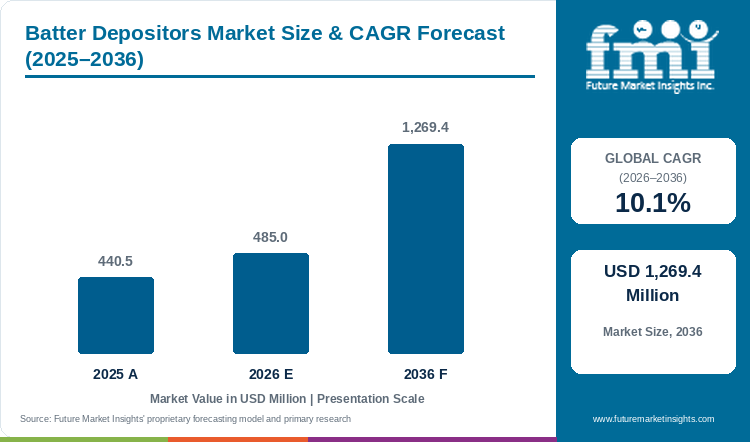
The market was valued at USD 440.5 million in 2025 and is expected to reach USD 485.0 million in 2026. It is projected to reach USD 1,269.4 million by 2036 at a CAGR of 10.1% from 2026 to 2036.
The batter depositors market was valued at USD 440.5 million in 2025 and is estimated at USD 485.0 million in 2026, with revenue projected to reach USD 1,269.4 million by 2036 at a CAGR of 10.1%. Dosa batter accounts for 37.0% of product type demand in 2026, illustrating the importance of depositing systems that handle different flow properties without losing portion accuracy. Middleby's Food Processing group reported 39.0% order growth over the trailing twelve months to the first quarter of 2026.[6] That broad equipment activity provides context, while an individual depositor purchase is usually judged on giveaway, residue, changeover time and the ability to hold an approved portion across shifts. Replacement demand can arise when an existing machine no longer suits a bakery's product assortment. The operating case changes with batter viscosity and solids content, so equipment trials should reflect the actual recipes and cleaning routine rather than only a supplier's standard test mixture.
Key Market Trends & Insights
- By product type: Dosa Batter represented 37.0% of 2026 product type demand. Fermented batter changes in flow over a run, so a start-of-shift setting may not suit the last hour. The test is a sample drawn from both ends of the holding window.
- By capacity: 500-2,000 kg/hr accounted for 42.0% of 2026 capacity demand. Hourly mass hides the deposit size, which sets cycle rate and hopper draw-down. Sizing starts with the deposit weight and refill interval, not the rated tonnage.
- By automation level: Fully Automatic / Robotic held 45.0% of 2026 automation level demand. This level leads because weight and position are controlled together. It's tested by the first portions after a conveyor stop, when the sequence has to recover without waste.
Regional Highlights
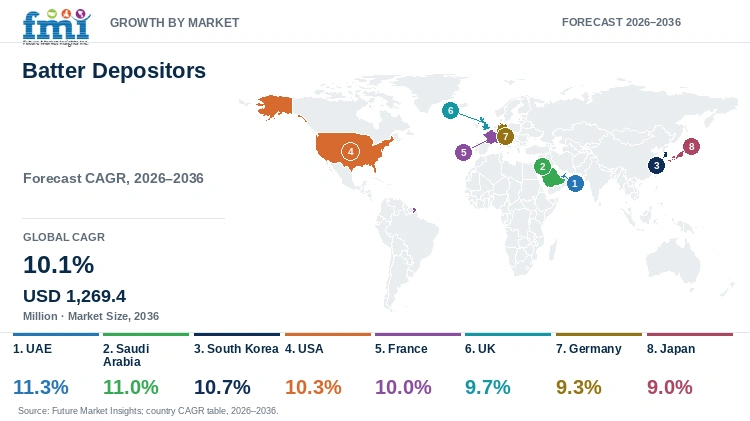
- The UAE has the fastest projected expansion for batter depositors at 11.3% CAGR over 2026 to 2036, as equipment decisions center on portion control across different batter formulations.
- Saudi Arabia's 11.0% forecast is followed by South Korea at 10.7% and the USA at 10.3%, while Japan's 9.0% rate is the lowest in the eight-country set.
Market Size & Forecast
Table 1: Batter Depositors Market Size and Forecast (USD million), 2025 to 2036
| Market size and forecast | Value |
|---|---|
| 2025 Value (actual) | USD 440.5 million |
| Estimated market size in 2026 | USD 485.0 million |
| Projected market size by 2036 | USD 1,269.4 million |
| CAGR (2026-2036) | 10.1% |
The practical opportunity depends on what the machine can portion across the recipes a bakery actually runs. Coperion lists its Unifiller MultiStation with up to 60 cycles per minute, six or eight nozzles and deposits of 7-248 g per nozzle.[5] Bühler’s SoftDrop, introduced in May 2026, adds depositing, wire-cutting and extrusion options for soft masses, and Coperion paired VMI mixing with Unifiller pumping and depositing at SERBOTEL 2025.[3][4] These offers widen the tasks that can be mechanised, although a specification sheet cannot show how much product is lost between recipes. FDA allergen-label guidance adds a cleaning and changeover discipline wherever one machine serves several formulations.[1] Consequently, actual demand will depend on whether a depositor cuts giveaway and manual placement without adding cleaning, residue or changeover time that offsets the gain.
Batter Depositors Market is segmented by Product Type, Capacity, Automation Level, End User, Sales Channel and Region. The forecast period runs from 2026 to 2036.
Batter depositing links mixing equipment with trays or a moving production belt. Preparation and holding determine the material that reaches the nozzle. Research on fermented rice-and-pulse idli batter records changes during fermentation, illustrating why time and batter condition belong in process design.[2] For a depositor, the relevant consequence is the need to control the incoming material over the working period. A machine adjusted on a freshly prepared sample may need a different setting later if the batter’s flow changes. This makes hopper replenishment, agitation where appropriate and the timing of batch preparation part of the commercial specification.
The breadth of an equipment offer also depends on the portion format. Unifiller’s published MultiStation specification combines a 42-litre hopper with several nozzle and attachment options.[5] A larger deposit empties the available supply sooner than a small decorative portion, while inclusions constrain the contact parts through which the product can pass. The production benefit therefore comes from matching the machine to the intended assortment. A compact multi-nozzle unit may replace repeated manual placement without requiring an entirely new line. A continuous industrial installation needs additional coordination with pumping, conveyor spacing and tray detection to maintain the same portion pattern.
Suppliers are increasingly presenting preparation and depositing as connected operations. Coperion’s SERBOTEL 2025 programme combined VMI mixing with Unifiller pumping and depositing technologies.[4] SoftDrop’s range of soft-mass processes addresses another form of flexibility: different forming actions within one equipment platform.[3] Both approaches create opportunities to automate more recipes, but the factory must still clear retained product and restore the next setup. FDA’s 2025 allergen-label guidance reinforces the need for declarations that correspond to the ingredients actually in use.[1] In a varied production schedule, the time and product lost between recipes can determine whether a flexible depositor earns its place on the line.
Table 2: Supporting Industry Indicators for the Batter Depositors Market, 2011 and 2025 to 2026, with current product specifications
| Indicator | Data point | Why it matters | Source |
|---|---|---|---|
| Wider processing-equipment orders | Middleby Food Processing reported 39.0% order growth over the trailing twelve months in Q1 2026. | Capital commitments provide a commercial setting for portioning-equipment projects. | [6] |
| Multi-nozzle cycle rate | Coperion specifies up to 60 cycles per minute for MultiStation. | Available cycle speed must be matched to portion size and conveyor movement. | [5] |
| Deposit-size range | The listed range is 7–248 g per nozzle. | Different portion sizes change feed demand and useful output. | [5] |
| Hopper and nozzle configuration | MultiStation has a 42-litre hopper and six- or eight-nozzle options. | Replenishment and pan layout affect the installation required. | [5] |
| Soft-mass process options | Bühler introduced SoftDrop in May 2026 for depositing, wire-cutting and extrusion. | More forming actions can serve a wider compatible assortment. | [3] |
| Integrated demonstrations | Coperion combined mixing, pumping and depositing at SERBOTEL 2025. | Upstream supply is part of a sustained portioning process. | [4] |
| Fermented batter behaviour | Research on idli batter documents fermentation-related changes. | Holding time can change the material presented to the depositor. | [2] |
Demand Intensity Analysis
The batter depositors market is forecast to generate an additional USD 784.4 million in annual revenue between 2026 and 2036, growing at a 10.1% value CAGR. Growth comes from mechanising repetitive dosing tasks and replacing machines that no longer suit the product assortment. Flexible equipment can spread investment across batters, fillings and other compatible soft masses, as illustrated by the configurations introduced by Bühler.[3] The limit is the time and material lost when one product gives way to another. Residue in the hopper and contact parts, cleaning and reassembly can erode the gain from a short production run. Purchases become attractive when the bakery can use the machine repeatedly across its actual recipes with less giveaway and preparation effort.
Fully automatic / robotic equipment accounts for USD 218.3 million in 2026. Its economic value begins with the portion: a small excess repeated across every tray consumes ingredients without adding another saleable unit. Inconsistent placement creates a separate loss when batter spreads beyond the intended area. Automation can address both weight and position, supporting replacement even on lines that already meet their volume targets. This makes ingredient yield and labour per batch distinct sources of demand. The customer does not always need a faster depositor; it may need one that holds a narrower, dependable operating range over repeated discharges.
The 500-2,000 kg/hr band represents USD 203.7 million in 2026. Hourly mass conceals substantial differences between products. MultiStation’s published deposit range illustrates the issue: small portions require many more placements, while large portions empty the hopper sooner.[5] Nozzle count, pumping and replenishment therefore shape the equipment package alongside the drive speed. A bakery producing both sizes may benefit from adjustable contact parts and feed arrangements. Capacity spending follows the point where that package becomes restrictive, whether the constraint is the number of placements, the supply of batter or the work involved in changing the portion format.
Industrial bakeries contribute USD 208.6 million and Direct OEM sales contributes USD 257.1 million in 2026. Industrial projects connect the depositor to existing mixers, transfer pumps and receiving conveyors. The engineering content grows where inclusions, a difficult cutoff or a particular tray pattern call for specific valves and nozzles. These components also create an ongoing parts requirement: wear can alter discharge before a machine stops altogether. Direct manufacturer involvement has value in defining the product path and resolving responsibility for those connected operations. The sale extends from the machine frame to the configuration needed for reliable portioning. Long-term sales are ultimately determined by whether that configuration keeps portion weight and placement within tolerance as recipes and production runs change.
Table 3: Demand Intensity Metrics for the Batter Depositors Market, 2026 to 2036 with relevant industry comparisons
| Demand intensity metric | Value | Basis |
|---|---|---|
| Batter depositors value CAGR | 10.1% | Global market value growth, 2026 to 2036. |
| Broader equipment order growth | 39.0% | Middleby Food Processing, trailing twelve months reported in Q1 2026.[6] |
| Documented multi-nozzle cycle rate | Up to 60 cycles/minute | Coperion MultiStation specification; selected product and configuration.[5] |
| Per-nozzle deposit range | 7-248 g | Coperion MultiStation manufacturer specification.[5] |
| Fully automatic / robotic revenue, 2026 | USD 218.3 million | Automation Level category. |
| 500-2,000 kg/hr revenue, 2026 | USD 203.7 million | Capacity category for depositing equipment. |
| Direct OEM sales revenue, 2026 | USD 257.1 million | Sales Channel category. |
| Added revenue through 2036 | USD 784.4 million | Increase in market revenue from 2026 to 2036. |
Analyst Perspective
A batter depositor earns a lasting place when it controls portion weight and placement without disrupting the recipes already in production. Suppliers that keep discharge consistent across the shift retain the line, while a machine that needs long cleaning between batters loses it.
- Nandini Roy Choudhury, Principal Analyst at Future Market Insights
How is the batter depositors market segmented?
The batter depositors market is segmented by Product Type (Dosa batter, Idli batter, Multigrain & millet batters, Organic batters), Capacity (500-2,000 kg/hr, Below 500 kg/hr, Above 2,000 kg/hr), Automation Level (Fully automatic / robotic, Semi-automatic, Manual), End User (Industrial bakeries, In-store & retail bakeries, Artisan bakeries, Foodservice / QSR central kitchens), and Sales Channel (Direct OEM sales, Dealers & distributors, Aftermarket & refurbished). Regionally, the market is segmented into North America, Latin America, Western Europe, Eastern Europe, East Asia, South Asia and Pacific, and Middle East and Africa.
Why does Dosa batter lead the Product Type category?
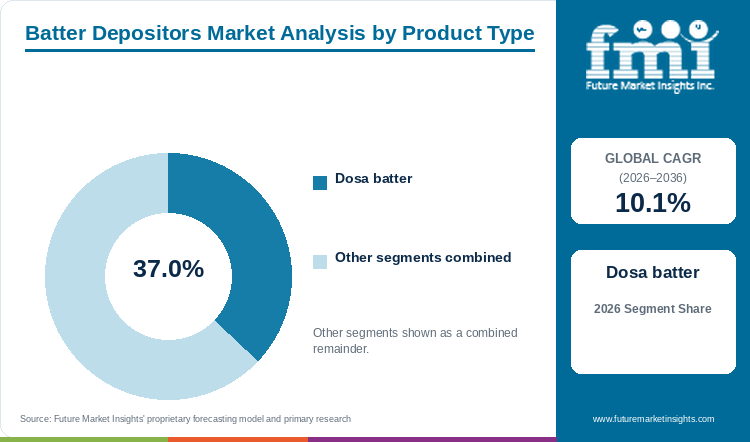
Dosa batter leads with 37.0% of Product Type revenue in 2026.
Dosa batter needs a consistent quantity and a clean cutoff between portions. Holding changes how the batter flows over a run, so a start-of-shift setting may need adjustment when later batter reaches the nozzle. Controlled supply and discharge reduce those repeated corrections, which ties the usefulness of the depositor to the preparation conditions in the kitchen.
- Dosa batter’s 37.0% share makes fermented-batter handling a central requirement within Product Type demand.
- The machine needs to hold portion weight at both the start and the end of the normal holding window.
What supports the 500-2,000 kg/hr Capacity segment?
500-2,000 kg/hr leads with 42.0% of Capacity revenue in 2026.
The 500-2,000 kg/hr band sits between short-run portioning and the largest continuous installations. Deposit size sets the requirement: small portions demand more cycling and positioning, while large portions draw down the hopper faster. Upstream pumping can become the constraint even when the depositor has spare speed, so the feed system carries commercial weight.
- The 500-2,000 kg/hr category leads Capacity with 42.0%; portion size and replenishment determine how that rate is achieved.
- The feed system needs to be sized for refill intervals and cleaning time, not only for rated depositor speed.
How does Fully automatic / robotic equipment lead Automation Level?
Fully automatic / robotic leads with 45.0% of Automation Level revenue in 2026.
Automatic depositing joins two controls: how much material is released and where it lands. Synchronisation with tray position or belt movement makes the second as important as the first. Stored settings reproduce an established discharge, but a blocked nozzle or worn valve still changes the result, so automation moves work from dosing to inspection and maintenance.
- Fully automatic / robotic holds 45.0% of Automation Level in 2026, coordinating portion delivery with the receiving tray or conveyor.
- The sequence must show consistent portions immediately after a conveyor stop, not only in steady running.
Why do Industrial bakeries lead the End User category?
Industrial bakeries hold 43.0% of End User revenue in 2026.
In an industrial bakery, a dosing error follows the product beyond the depositor. Excess weight consumes ingredients and can alter baking, while a misplaced deposit can spread into a tray edge. Consecutive mixer loads also have to reach the hopper with consistent flow, which brings pumping, valves and receiving controls into the purchase alongside the dosing mechanism.
- Industrial bakeries account for 43.0% of End User in 2026, where portion errors affect baking and downstream handling as well as ingredient use.
- Mixer, pump and hopper performance need to hold portion quality across consecutive batches.
What makes Direct OEM sales the leading Sales Channel?
Direct OEM sales hold 53.0% of Sales Channel revenue in 2026.
Seals, valves and nozzles are small components with a direct influence on dosing, and wear changes discharge before the machine visibly fails. Direct OEM purchasing brings contact-part selection and the replacement route into the same discussion as recipe trials. It also fixes who is responsible when the depositor connects to an upstream pump, conveyor or heating system.
- Direct OEM sales accounts for 53.0% of Sales Channel in 2026, providing a route to specify contact parts and responsibility for connected equipment.
- Wear-part availability needs to preserve the discharge behaviour established at commissioning.
What are the drivers, restraints and opportunities in the batter depositors market?
Ingredient giveaway makes repeated dosing accuracy economically visible
Ingredient giveaway accumulates one portion at a time. Raising the target weight to protect the smallest product increases the average quantity used across the run, and a placement error adds a second loss when batter spreads outside the intended area. Together they give depositing a measurable effect on yield, so a machine can justify replacement without a faster line. A supplier gains the order when its dosing holds weight and position over a full shift.
Changing batter condition can limit a machine’s usable recipe range
Solids, aeration and fermentation history change the mixture passing through a depositor’s valves. Research on idli batter documents fermentation-related changes in a rice-and-pulse mixture.[2] Ingredient declarations must stay aligned with the formulation under FDA guidance, so each changeover carries a cleaning obligation.[1] A supplier gains where its machine shortens the work between products rather than adding functions that the bakery rarely uses.
Coordinated preparation and depositing can widen the addressable workload
Connecting preparation with depositing removes a manual transfer between two mechanised tasks. Coperion’s SERBOTEL 2025 demonstrations brought VMI mixing and Unifiller pumping and depositing into one application,[4] and Bühler’s SoftDrop added several forming actions for soft masses.[3] These developments extend the workload to compatible pastry fillings, although one set of valves and outlets may not serve every recipe. A supplier gains where the added batches do not bring disproportionate cleaning or assembly time.
Which country CAGRs are profiled in the batter depositors market?
Table 4: Country growth outlook for the batter depositors market
| Country | CAGR, 2026 to 2036 |
|---|---|
| UAE | 11.3% |
| Saudi Arabia | 11.0% |
| South Korea | 10.7% |
| USA | 10.3% |
| France | 10.0% |
| UK | 9.7% |
| Germany | 9.3% |
| Japan | 9.0% |
UAE
The UAE is forecast at 11.3% CAGR between 2026 and 2036, the highest rate among the profiled countries and above the global rate of 10.1%. Dubai Municipality reported about 2,336 new food establishments opening in the first half of 2025. The count shows the pace of hospitality openings, not how many of them will prepare batter in-house. Central kitchens handling several breakfast or dessert products offer a different equipment opportunity from a dedicated factory line. A compact depositor can mechanise repeated placement and stay available for another portion size later in the day. However, hopper access, removable contact parts and refill routine decide whether that flexibility survives daily use. Demand will depend on how many kitchens keep the machine running across a varied menu.
Saudi Arabia
Saudi Arabia’s market is projected to grow at 11.0% CAGR from 2026 to 2036, above the global rate of 10.1%. The Ministry of Industry and Mineral Resources reported 1,660 new industrial licences in 2025, with 1,201 factories entering production. The totals cover all manufacturing, so they show industrial expansion rather than demand for depositors. In centralised preparation, the time between mixing and depositing can matter as much as the dosing mechanism. An operation handling fermented batter may need to control transfer and holding before the mixture reaches the nozzle. Purchases can consequently include pumping and feed control as well as the depositor. Demand will depend on how many kitchens can hold a repeatable preparation interval.
South Korea
South Korea has a 10.7% CAGR outlook over 2026 to 2036, above the global rate of 10.1%. The National Data Office reported in December 2025 that bakery franchise stores employed 4.25 people each in 2024, against 3.31 across all franchise industries. Labour intensity of that kind raises the value of mechanised placement, although the survey measures stores, not the factories where most depositors run. Product development creates demand where a new portion size or inclusion falls outside an existing machine’s working range. Nozzles and contact parts offer a focused way to extend that range, while a larger change in material flow may require another machine. Demand will depend on how much of an assortment can share one dosing arrangement.
USA
The USA is forecast at 10.3% CAGR from 2026 to 2036, above the global rate of 10.1%. The USDA Economic Research Service’s October 2026 outlook projects egg prices to fall 29.3% in 2026. Lower input costs reduce the value of each gram of giveaway, so the outlook weakens the yield case without saying anything about capital budgets. For cake and muffin lines, dosing still links ingredient cost with the dimensions of the baked product. Formula changes add a further requirement, since FDA allergen-label guidance ties declarations to the ingredients used.[1] However, equipment access decides how readily the bakery can clear and restore the product path between formulations. Replacement demand will depend on whether better portion control and easier changeover outweigh cheaper eggs.
France
France is projected to record 10.0% CAGR through 2036, just below the global rate of 10.1%. FranceAgriMer’s January 2026 egg sector sheet puts French consumption at 228 eggs per inhabitant in 2024, 35.0% of it as egg products. Eggs are a core ingredient in many cake batters, so residue in a hopper or valve carries a real cost, though the statistic does not show how much sits with depositors. Short pastry runs sharpen that cost by spreading the loss over fewer products. Coperion’s SERBOTEL 2025 programme in France demonstrated mixing, transfer and depositing together.[4] However, a compact system pays back only if it is ready again soon after cleaning. Demand will depend on how quickly the equipment turns round between short runs.
UK
The UK outlook is 9.7% CAGR over 2026 to 2036, below the global rate of 10.1%. The Office for National Statistics’ output price index for bread, fresh pastry goods and cakes stood at 147.4 in September 2026, 1.6% above a year earlier. Modest price growth leaves bakeries little room to recover costs through selling prices, which makes yield a more controllable lever, although the index does not measure equipment spending. The investment can begin with a single mobile depositor in an existing workroom, where tray movement and refilling remain manual. This creates a lower-scale entry point into depositing and forming equipment. Each addition must still leave room for product handling and dismantling food-contact parts. Demand will depend on how many workrooms have space for another stage.
Germany
Germany’s market is forecast at 9.3% CAGR from 2026 to 2036, below the global rate of 10.1%. Destatis reported that consumer prices for butter in December 2025 were 31.7% below a year earlier, while food overall rose 0.8%. Cheaper butter lowers the cost of each portion left in a line, which weakens the yield case but says nothing about capital spending. Material left in pipes, valves and hoppers still contributes to the replacement case, particularly for producers using costly ingredients in short runs. Inspectable contact parts make that loss easier to locate and the next setup easier to reproduce. However, the saving has to cover the cleaning interval and the installation. Demand will depend on whether residual batter stays large enough to justify the change.
Japan
Japan is projected at 9.0% CAGR between 2026 and 2036, below the global rate of 10.1%. The Statistics Bureau reported that food prices rose 6.8% in 2025, against 3.2% for all items. Higher ingredient costs raise the value of each gram of giveaway, although the figure says nothing about equipment budgets. For small product formats, a correct weight can still produce an unsuitable shape if cutoff or placement is inconsistent. The depositor therefore needs close coordination with the receiving tray and other food processing equipment. However, a compact design is useful only if the outlet assembly can be removed and cleaned without long stoppages. Demand will depend on how many bakeries need precision at modest portion sizes more than extra nozzles or cycle speed.
Who are the notable companies in the batter depositors market?
AMF Bakery Systems; Bühler; Unifiller; Hinds-Bock; Gorreri
AMF, Bühler, Unifiller, Hinds-Bock and Gorreri participate through different combinations of depositing, pumping and integrated bakery processing. The product-contact path is a major point of differentiation because it determines the mixtures, inclusions and portion sizes a machine can handle. A supplier with several discharge configurations can address more applications without treating every recipe as a complete new line project.
The customer relationship continues through seals, valves and nozzles whose condition influences discharge long before a major failure. Access to the correct parts helps preserve portion control, while application support can extend a machine to another recipe. These continuing needs favour suppliers able to connect maintenance with the way the product behaves inside the equipment.
Competitive Benchmarking: Batter Depositors Market
Table 5: Company capabilities in the batter depositors market
| Company | Relevant offer | Commercial capability |
|---|---|---|
| AMF Bakery Systems | Tromp batter and filling depositors | Depositing integrated with bakery production |
| Bühler | SoftDrop soft-mass depositor | Configurable depositing, extruding and wire-cutting functions |
| Unifiller | Cake-batter pumps and depositors | Transfer and portioning equipment |
| Hinds-Bock | Piston batter depositors | Portable and automated portioning arrangements |
| Gorreri | Depositing and dosing systems | Cake-production process integration |
Key Developments in the Batter Depositors Market
- Bühler launched SoftDrop in May 2026 for depositing, wire-cutting and extruding soft masses, with muffins, meringues and fillings among the stated applications.[3]
- Coperion's SERBOTEL 2025 bakery demonstrations combined VMI mixing with Unifiller pumping and depositing technologies, showing preparation and portioning in the same working sequence.[4]
Key Players in the Batter Depositors Market
- AMF Bakery Systems
- Bühler
- Unifiller
- Hinds-Bock
- Gorreri
Batter Depositors Market - Report Scope
Table 6: Report scope for the batter depositors market
| Coverage field | Report scope |
|---|---|
| Market breakdown | Product Type; Capacity; Automation Level; End User; Sales Channel. |
| Quantitative Units | USD Million |
| Market Definition | Revenue from sold batter-depositing machines and separately identifiable deposition modules used within the defined segments. Included refurbished transactions count the depositor machine sale only. Excludes downstream batter or finished-food revenue, standalone mixers, ovens, packaging systems, service-only charges and unallocable value of wider bakery lines; integrated systems count only the identifiable depositing element. |
| Regions Covered | North America, Latin America, Western Europe, Eastern Europe, East Asia, South Asia and Pacific, Middle East and Africa |
| Countries Covered | UAE; Saudi Arabia; South Korea; USA; France; UK; Germany; Japan |
| Key Companies Profiled | AMF Bakery Systems; Bühler; Unifiller; Hinds-Bock; Gorreri |
| Forecast Period | 2026 to 2036 |
| Approach | Market assessment supported by official technical and regulatory publications, company product information and country operating conditions. |
Batter Depositors Market - Research Methodology
Table 7: Research approach for the batter depositors market
| Method | Approach |
|---|---|
| Market coverage | The assessment follows the equipment sold, its bakery application and the revenue boundaries stated in the market definition. |
| Secondary evidence | Government and technical publications are considered alongside first-party product information and dated corporate announcements. |
| Commercial analysis | Purchasing requirements, operating constraints, service needs and country-specific routes to market inform the interpretation of demand. |
| Forecast presentation | Global values, leading segment shares and country growth rates are stated for the 2026 to 2036 forecast period. |
Batter Depositors Market by Segments
Product Type
- Dosa batter
- Idli batter
- Multigrain & millet batters
- Organic batters
Capacity
- 500-2,000 kg/hr
- Below 500 kg/hr
- Above 2,000 kg/hr
Automation Level
- Fully automatic / robotic
- Semi-automatic
- Manual
End User
- Industrial bakeries
- In-store & retail bakeries
- Artisan bakeries
- Foodservice / QSR central kitchens
Sales Channel
- Direct OEM sales
- Dealers & distributors
- Aftermarket & refurbished
Batter Depositors Market by Region
- North America
- United States
- Canada
- Latin America
- Brazil
- Mexico
- Argentina
- Chile
- Western Europe
- Germany
- France
- United Kingdom
- Italy
- Spain
- Benelux
- Nordics
- Eastern Europe
- Poland
- Czech Republic
- Romania
- Hungary
- East Asia
- China
- Japan
- South Korea
- South Asia and Pacific
- India
- ASEAN
- Australia and New Zealand
- Middle East and Africa
- GCC Countries
- South Africa
- Türkiye
- Israel
Research Sources and Bibliography
- [1] U.S. Food and Drug Administration. (2025, March 26). Frequently asked questions: Food allergen labeling guidance for industry.
- [2] Ghosh, D., & Chattopadhyay, P. (2011). Preparation of idli batter, its properties and nutritional improvement during fermentation.
- [3] Bühler Group. (2026, May 7). Bühler launches innovations and releases major upgrades to its Grains & Food portfolio.
- [4] Coperion. (2025, October). Coperion at SERBOTEL 2025.
- [5] Unifiller. (n.d.). MultiStation Depositor.
- [6] The Middleby Corporation. (2026, May 7). The Middleby Corporation reports first quarter results.
This Report Answers
- How large is the batter depositors market in 2026 and what revenue is projected for 2036?
- Which production pressures support adoption of batter depositing equipment?
- Why does Dosa batter lead the Product Type segmentation?
- Why does 500-2,000 kg/hr lead the Capacity segmentation?
- How do growth rates differ among the eight profiled countries?
- Which profiled companies document batter equipment or related processing capabilities?
Frequently Asked Questions
How big is the batter depositors market in 2026, and what is forecast for 2036?
The market is valued at USD 485.0 Million in 2026 and is projected to reach USD 1,269.4 Million by 2036.
What is the projected CAGR of the batter depositors market from 2026 to 2036?
The forecast CAGR is 10.1% from 2026 to 2036.
Which Product Type leads the batter depositors market in 2026?
Dosa batter leads Product Type with a 37.0% share in 2026. Preparation and holding conditions affect the flow that the depositor must control.
Which Capacity category leads the batter depositors market?
The 500-2,000 kg/hr segment leads with a 42.0% share in 2026. Deposit size, nozzle count and replenishment determine the useful output within this band.
Which profiled countries have the highest batter depositor growth rates?
The UAE leads at 11.3% CAGR, followed by Saudi Arabia at 11.0% and South Korea at 10.7% from 2026 to 2036.
Which companies participate in the batter depositors market?
Relevant participants include AMF Bakery Systems, Bühler, Unifiller, Hinds-Bock and Gorreri.
Preview the report firsthand - request a free sample
Get SampleGet the brochure for pricing and purchase details.
Get PDFTable of Content
- Key Takeaways
- Market Size and CAGR
- Top Growth Driver
- Fastest Growing Segment
- Leading Region
- Key Companies
- Emerging Opportunities
- Executive Summary
- Global Market Outlook
- Demand-side Trends
- Supply-side Trends
- Technology Roadmap Analysis
- Analysis and Recommendations
- Analyst Perspective (What is happening? Why now? What should investors know?)
- Key Questions Answered
- How large is the market?
- What is the CAGR?
- What are key trends?
- Which region dominates?
- Who are the leaders?
- Market Overview
- Market Coverage / Taxonomy
- Market Definition / Scope / Limitations
- Research Methodology
- Chapter Orientation
- Analytical Lens and Working Hypotheses
- Market Structure, Signals, and Trend Drivers
- Benchmarking and Cross-market Comparability
- Market Sizing, Forecasting, and Opportunity Mapping
- Research Design and Evidence Framework
- Desk Research Programme (Secondary Evidence)
- Expert Input and Fieldwork (Primary Evidence)
- Tooling, Models, and Reference Databases
- Data Engineering and Model Build
- Quality Assurance and Audit Trail
- Market Background
- Market Dynamics (Drivers, Restraints, Opportunity, Trends)
- Scenario Forecast (Optimistic, Likely, Conservative)
- Impact Analysis
- AI Impact
- Sustainability Impact
- Regulatory Impact
- Technology Impact
- Consumer / Buyer Analysis
- Purchase Drivers
- Adoption Barriers
- Buyer Journey
- Opportunity Map Analysis
- Product Life Cycle Analysis
- Supply Chain Analysis
- Investment Feasibility Matrix
- Value Chain Analysis
- PESTLE and Porter's Analysis
- Regulatory Landscape
- Regional Parent Market Outlook
- Production and Consumption Statistics
- Import and Export Statistics
- Global Market Analysis and Forecast, 2021 to 2036
- Historical Market Size Value (USD Million) Analysis, 2021 to 2025
- Current and Future Market Size Value (USD Million) Projections, 2026 to 2036
- Y-o-Y Growth Trend Analysis
- Absolute $ Opportunity Analysis
- Global Market Pricing Analysis, 2021 to 2036
- Global Market Analysis and Forecast, By Product Type, 2021 to 2036
- Introduction / Key Findings
- Historical Market Size Value (USD Million) Analysis By Product Type, 2021 to 2025
- Current and Future Market Size Value (USD Million) Analysis and Forecast By Product Type, 2026 to 2036
- Dosa batter
- Idli batter
- Multigrain & millet batters
- Organic batters
- Y-o-Y Growth Trend Analysis By Product Type, 2021 to 2025
- Absolute $ Opportunity Analysis By Product Type, 2026 to 2036
- Global Market Analysis and Forecast, By Capacity, 2021 to 2036
- Introduction / Key Findings
- Historical Market Size Value (USD Million) Analysis By Capacity, 2021 to 2025
- Current and Future Market Size Value (USD Million) Analysis and Forecast By Capacity, 2026 to 2036
- 500-2,000 kg/hr
- Below 500 kg/hr
- Above 2,000 kg/hr
- Y-o-Y Growth Trend Analysis By Capacity, 2021 to 2025
- Absolute $ Opportunity Analysis By Capacity, 2026 to 2036
- Global Market Analysis and Forecast, By Automation Level, 2021 to 2036
- Introduction / Key Findings
- Historical Market Size Value (USD Million) Analysis By Automation Level, 2021 to 2025
- Current and Future Market Size Value (USD Million) Analysis and Forecast By Automation Level, 2026 to 2036
- Fully automatic / robotic
- Semi-automatic
- Manual
- Y-o-Y Growth Trend Analysis By Automation Level, 2021 to 2025
- Absolute $ Opportunity Analysis By Automation Level, 2026 to 2036
- Global Market Analysis and Forecast, By End User, 2021 to 2036
- Introduction / Key Findings
- Historical Market Size Value (USD Million) Analysis By End User, 2021 to 2025
- Current and Future Market Size Value (USD Million) Analysis and Forecast By End User, 2026 to 2036
- Industrial bakeries
- In-store & retail bakeries
- Artisan bakeries
- Foodservice / QSR central kitchens
- Y-o-Y Growth Trend Analysis By End User, 2021 to 2025
- Absolute $ Opportunity Analysis By End User, 2026 to 2036
- Global Market Analysis and Forecast, By Sales Channel, 2021 to 2036
- Introduction / Key Findings
- Historical Market Size Value (USD Million) Analysis By Sales Channel, 2021 to 2025
- Current and Future Market Size Value (USD Million) Analysis and Forecast By Sales Channel, 2026 to 2036
- Direct OEM sales
- Dealers & distributors
- Aftermarket & refurbished
- Y-o-Y Growth Trend Analysis By Sales Channel, 2021 to 2025
- Absolute $ Opportunity Analysis By Sales Channel, 2026 to 2036
- Global Market Analysis and Forecast, By Region, 2021 to 2036
- Introduction
- Historical Market Size Value (USD Million) Analysis By Region, 2021 to 2025
- Current Market Size Value (USD Million) Analysis and Forecast By Region, 2026 to 2036
- North America
- Latin America
- Western Europe
- Eastern Europe
- East Asia
- South Asia and Pacific
- Middle East and Africa
- Market Attractiveness Analysis By Region
- North America Market Analysis and Forecast, By Country, 2021 to 2036
- Historical Market Size Value (USD Million) Trend Analysis By Market Taxonomy, 2021 to 2025
- Market Size Value (USD Million) Forecast By Market Taxonomy, 2026 to 2036
- By Country
- United States
- Canada
- By Product Type
- By Capacity
- By Automation Level
- By End User
- By Sales Channel
- By Country
- Market Attractiveness Analysis
- By Country
- By Product Type
- By Capacity
- By Automation Level
- By End User
- By Sales Channel
- Key Takeaways
- Latin America Market Analysis and Forecast, By Country
- Historical Market Size Value (USD Million) Trend Analysis By Market Taxonomy, 2021 to 2025
- Market Size Value (USD Million) Forecast By Market Taxonomy, 2026 to 2036
- By Country
- Brazil
- Mexico
- Argentina
- Chile
- By Product Type
- By Capacity
- By Automation Level
- By End User
- By Sales Channel
- By Country
- Market Attractiveness Analysis
- By Country
- By Product Type
- By Capacity
- By Automation Level
- By End User
- By Sales Channel
- Key Takeaways
- Western Europe Market Analysis and Forecast, By Country
- Historical Market Size Value (USD Million) Trend Analysis By Market Taxonomy, 2021 to 2025
- Market Size Value (USD Million) Forecast By Market Taxonomy, 2026 to 2036
- By Country
- Germany
- France
- United Kingdom
- Italy
- Spain
- Benelux
- Nordics
- By Product Type
- By Capacity
- By Automation Level
- By End User
- By Sales Channel
- By Country
- Market Attractiveness Analysis
- By Country
- By Product Type
- By Capacity
- By Automation Level
- By End User
- By Sales Channel
- Key Takeaways
- Eastern Europe Market Analysis and Forecast, By Country
- Historical Market Size Value (USD Million) Trend Analysis By Market Taxonomy, 2021 to 2025
- Market Size Value (USD Million) Forecast By Market Taxonomy, 2026 to 2036
- By Country
- Poland
- Czech Republic
- Romania
- Hungary
- By Product Type
- By Capacity
- By Automation Level
- By End User
- By Sales Channel
- By Country
- Market Attractiveness Analysis
- By Country
- By Product Type
- By Capacity
- By Automation Level
- By End User
- By Sales Channel
- Key Takeaways
- East Asia Market Analysis and Forecast, By Country
- Historical Market Size Value (USD Million) Trend Analysis By Market Taxonomy, 2021 to 2025
- Market Size Value (USD Million) Forecast By Market Taxonomy, 2026 to 2036
- By Country
- China
- Japan
- South Korea
- By Product Type
- By Capacity
- By Automation Level
- By End User
- By Sales Channel
- By Country
- Market Attractiveness Analysis
- By Country
- By Product Type
- By Capacity
- By Automation Level
- By End User
- By Sales Channel
- Key Takeaways
- South Asia and Pacific Market Analysis and Forecast, By Country
- Historical Market Size Value (USD Million) Trend Analysis By Market Taxonomy, 2021 to 2025
- Market Size Value (USD Million) Forecast By Market Taxonomy, 2026 to 2036
- By Country
- India
- ASEAN
- Australia and New Zealand
- By Product Type
- By Capacity
- By Automation Level
- By End User
- By Sales Channel
- By Country
- Market Attractiveness Analysis
- By Country
- By Product Type
- By Capacity
- By Automation Level
- By End User
- By Sales Channel
- Key Takeaways
- Middle East and Africa Market Analysis and Forecast, By Country
- Historical Market Size Value (USD Million) Trend Analysis By Market Taxonomy, 2021 to 2025
- Market Size Value (USD Million) Forecast By Market Taxonomy, 2026 to 2036
- By Country
- GCC Countries
- South Africa
- Türkiye
- Israel
- By Product Type
- By Capacity
- By Automation Level
- By End User
- By Sales Channel
- By Country
- Market Attractiveness Analysis
- By Country
- By Product Type
- By Capacity
- By Automation Level
- By End User
- By Sales Channel
- Key Takeaways
- Key Countries Market Analysis
- United States
- Pricing Analysis
- Market Share Analysis, 2025
- By Product Type
- By Capacity
- By Automation Level
- By End User
- By Sales Channel
- Canada
- Pricing Analysis
- Market Share Analysis, 2025
- By Product Type
- By Capacity
- By Automation Level
- By End User
- By Sales Channel
- Mexico
- Pricing Analysis
- Market Share Analysis, 2025
- By Product Type
- By Capacity
- By Automation Level
- By End User
- By Sales Channel
- Brazil
- Pricing Analysis
- Market Share Analysis, 2025
- By Product Type
- By Capacity
- By Automation Level
- By End User
- By Sales Channel
- Chile
- Pricing Analysis
- Market Share Analysis, 2025
- By Product Type
- By Capacity
- By Automation Level
- By End User
- By Sales Channel
- Germany
- Pricing Analysis
- Market Share Analysis, 2025
- By Product Type
- By Capacity
- By Automation Level
- By End User
- By Sales Channel
- United Kingdom
- Pricing Analysis
- Market Share Analysis, 2025
- By Product Type
- By Capacity
- By Automation Level
- By End User
- By Sales Channel
- Italy
- Pricing Analysis
- Market Share Analysis, 2025
- By Product Type
- By Capacity
- By Automation Level
- By End User
- By Sales Channel
- Spain
- Pricing Analysis
- Market Share Analysis, 2025
- By Product Type
- By Capacity
- By Automation Level
- By End User
- By Sales Channel
- France
- Pricing Analysis
- Market Share Analysis, 2025
- By Product Type
- By Capacity
- By Automation Level
- By End User
- By Sales Channel
- India
- Pricing Analysis
- Market Share Analysis, 2025
- By Product Type
- By Capacity
- By Automation Level
- By End User
- By Sales Channel
- ASEAN
- Pricing Analysis
- Market Share Analysis, 2025
- By Product Type
- By Capacity
- By Automation Level
- By End User
- By Sales Channel
- Australia and New Zealand
- Pricing Analysis
- Market Share Analysis, 2025
- By Product Type
- By Capacity
- By Automation Level
- By End User
- By Sales Channel
- China
- Pricing Analysis
- Market Share Analysis, 2025
- By Product Type
- By Capacity
- By Automation Level
- By End User
- By Sales Channel
- Japan
- Pricing Analysis
- Market Share Analysis, 2025
- By Product Type
- By Capacity
- By Automation Level
- By End User
- By Sales Channel
- South Korea
- Pricing Analysis
- Market Share Analysis, 2025
- By Product Type
- By Capacity
- By Automation Level
- By End User
- By Sales Channel
- Poland
- Pricing Analysis
- Market Share Analysis, 2025
- By Product Type
- By Capacity
- By Automation Level
- By End User
- By Sales Channel
- Hungary
- Pricing Analysis
- Market Share Analysis, 2025
- By Product Type
- By Capacity
- By Automation Level
- By End User
- By Sales Channel
- Türkiye
- Pricing Analysis
- Market Share Analysis, 2025
- By Product Type
- By Capacity
- By Automation Level
- By End User
- By Sales Channel
- South Africa
- Pricing Analysis
- Market Share Analysis, 2025
- By Product Type
- By Capacity
- By Automation Level
- By End User
- By Sales Channel
- UAE
- Pricing Analysis
- Market Share Analysis, 2025
- By Product Type
- By Capacity
- By Automation Level
- By End User
- By Sales Channel
- Saudi Arabia
- Pricing Analysis
- Market Share Analysis, 2025
- By Product Type
- By Capacity
- By Automation Level
- By End User
- By Sales Channel
- United States
- Market Structure Analysis
- Competition Dashboard
- Competition Benchmarking
- Market Share Analysis of Top Players
- By Regional
- By Product Type
- By Capacity
- By Automation Level
- By End User
- By Sales Channel
- Emerging Startups
- Innovation Benchmarking
- Competition Analysis
- Competition Deep Dive
- AMF Bakery Systems
- Overview
- Product Portfolio
- Profitability by Market Segments
- Sales Footprint
- Strategy Overview
- Marketing Strategy
- Product Strategy
- Channel Strategy
- Bühler
- Unifiller
- Hinds-Bock
- Gorreri
- AMF Bakery Systems
- Case Studies
- Success Stories
- Recent Developments
- Competition Deep Dive
- Assumptions & Acronyms Used


