
- Market Size (2026)
- USD 349.8 Mn
- Forecast (2036)
- USD 597.5 Mn
- CAGR (2026 to 2036)
- 5.5%
How big is the Benzathine Penicillin G Market in 2026?
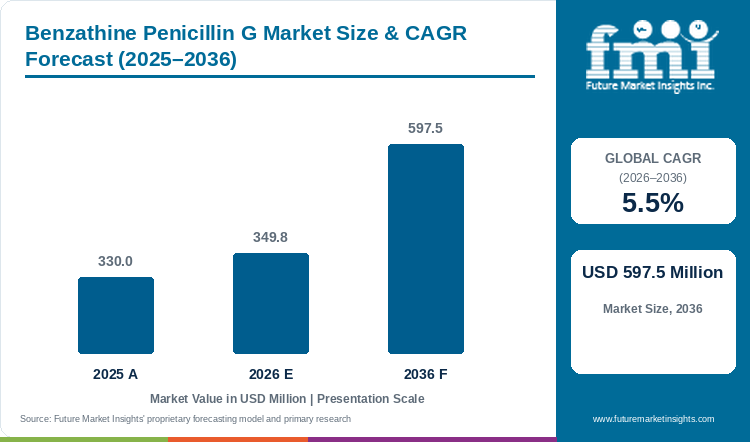
The global benzathine penicillin G market is on course to reach USD 597.5 million by 2036, a 5.5% CAGR from 2026 to 2036. The market was valued at USD 330.0 million in 2025 and is estimated at USD 349.8 million in 2026.
Benzathine Penicillin G Market Size and Forecast
Table 1: Benzathine Penicillin G Market Size and Forecast
| Market size and forecast | Value |
|---|---|
| Market size in 2025 | USD 330.0 million |
| Estimated market size in 2026 | USD 349.8 million |
| Projected market size by 2036 | USD 597.5 million |
| CAGR from 2026 to 2036 | 5.5% |
Source: Future Market Insights analysis of the benzathine penicillin G market, 2026.
Supply continuity has become a competitive distinction for this older essential medicine. CDC's September 2026 update records a shelf-life extension for Bicillin L-A and the temporary importation of Lentocilin earlier in the year. These measures address availability within an existing treatment market. FDA's March 2026 letter identifies Portugal's Laboratórios Atral as the Lentocilin manufacturer and Mark Cuban Cost Plus Drug Company as the coordinating importer. The imported product is not FDA-approved. FMI's view is that a supplier's route into a national market matters alongside its factory output.
The demand base is divided between infection treatment and continuing prophylaxis. WHO's May 2025 syphilis assessment estimated 8.0 million new adult infections worldwide in 2022. Its January 2025 rheumatic heart disease assessment identifies recurring antibiotic supply as a condition for effective prevention programmes. These are separate purchasing patterns. A screening campaign may create an immediate order, while a prophylaxis programme requires dependable repeat deliveries. The broader antibiotic drug market provides useful context, although this assessment covers only the long-acting benzathine formulation.
Key Market Trends & Insights
- A limited number of bulk-ingredient producers leaves finished-dose formulators exposed to upstream disruption. WHO links this concentration to investment requirements, low margins and environmental constraints. Multi-source finished-product contracts need to examine the underlying ingredient supply as well.
- Programme needs are shifting as congenital syphilis rises while primary and secondary syphilis declines in the US provisional 2024 surveillance release.
- Ready-to-use suspension increases its revenue share from 40.0% in 2026 to 42.9% in 2036 in FMI's outlook. Powder remains the leading presentation, but the mix points to continued demand for both formats.
Regional Highlights
- India, Pakistan and South Africa widen their share of global revenue. Projected 2036 shares are India 9.1% (from 8.0%), Pakistan 2.5% (from 2.0%) and South Africa 3.4% (from 3.0%).
- Share slips for the United States, France and the United Kingdom as revenue grows. FMI projects the United States slipping from 33.0% to 31.2%, France slipping from 4.0% to 3.4% and the United Kingdom slipping from 3.0% to 2.6% over 2026 to 2036.
Analyst Perspective
“The opportunity is strongest where dependable product availability closes the distance between a positive test and a completed treatment visit. Competitive strength rests on releasable batches, a valid national supply route and practical pharmacy support. Emergency imports provide an important bridge. Suppliers that convert that bridge into predictable deliveries hold a stronger position than those relying on a temporary shortage premium.”
- Anurag Sharma, Principal Consultant, FMI
How is the Benzathine Penicillin G Market segmented?
- By indication: Syphilis. Rheumatic fever and rheumatic heart disease. Streptococcal pharyngitis and other.
- By form: Powder for injection. Ready-to-use suspension. Imported unregistered supply.
- By channel: Hospital. Retail pharmacy. Public health programmes.
- By region: North America. Latin America. Western Europe. East Asia. South Asia and Pacific. Middle East and Africa. Rest of world aggregate.
Why does the Syphilis segment lead by Indication in the Benzathine Penicillin G Market in 2026?
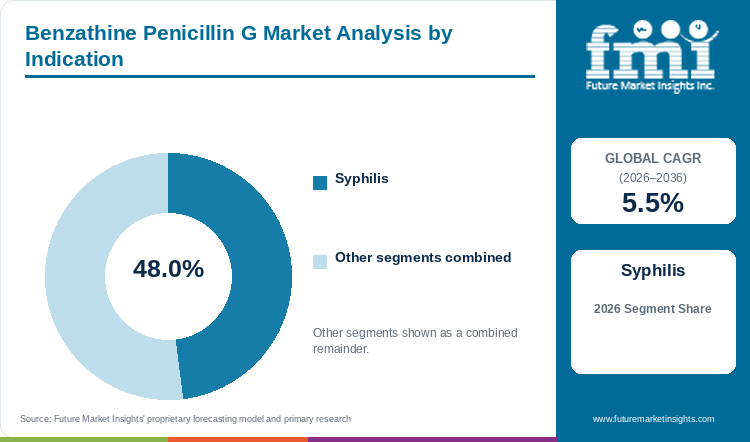
The Syphilis segment holds 48.0% of the Benzathine Penicillin G Market by indication in 2026.
Syphilis revenue is projected at USD 167.9 million in 2026 and USD 309.6 million by 2036. Its 6.3% forecast CAGR reflects an increasing share of the market. WHO identifies rapid testing and diagnosis of previously unrecognised infection as important routes to treatment. The market implication is specific: test availability and product availability have to coincide at the service level.
In FMI's assessment, the commercial opening is stock that testing programmes can deploy through antenatal, sexual-health and other eligible services. The WHO and UNICEF planning guidance published in July 2025 integrates maternal, infant and partner services within country elimination programmes. That approach makes fragmented purchasing less effective. A stockout in one service can undermine a wider programme even when central inventory is available.
Rheumatic fever and rheumatic heart disease retain 30.0% of indication value in 2026. Their continuing prophylaxis requirement provides a second material demand base. Streptococcal pharyngitis and other indications hold 22.0%. Suppliers should therefore distinguish campaign-linked infection treatment from recurring prophylaxis requirements when scheduling production and deliveries.
Rheumatic fever and rheumatic heart disease and Streptococcal pharyngitis and other together hold the remaining 52.0% by indication.
Table 2: Indication, 2026 Share
| Leading Share | 2026 market share |
|---|---|
| Syphilis | 48.0% |
| All Other Segments Combined Share | 52.0% |
Source: Future Market Insights analysis of the benzathine penicillin G market, 2026.
Why does the Powder for injection segment lead by Form in the Benzathine Penicillin G Market in 2026?
The Powder for injection segment holds 45.0% of the Benzathine Penicillin G Market by form in 2026.
Powder revenue rises from USD 157.4 million in 2026 to USD 262.0 million in 2036. Its 5.2% CAGR is lower than the 6.2% projected for ready-to-use suspension, which reaches USD 256.1 million. These formats remain commercially close in the terminal year. The outlook supports investment in presentation-specific supply capability for both formats.
Delbert's current Extencilline page lists powder-and-solvent packs marketed in France. Laboratórios Atral's Lentocilin label also identifies a powder-for-suspension presentation. Those products establish the commercial relevance of powder.
The imported unregistered category holds 15.0% in 2026 and 13.3% in 2036. Its presence reflects exceptional access arrangements within the commercial segmentation. A product supplied under temporary regulatory discretion can still be powder. For manufacturers, the more durable opportunity lies in a dependable registration and distribution position after immediate supply pressure eases. Packaging and product information are part of that process, linking the category to the wider parenteral packaging market.
Ready-to-use suspension and Imported unregistered supply together account for the remaining 55.0% by form.
Table 3: Form, 2026 Share
| Leading Share | 2026 market share |
|---|---|
| Powder for injection | 45.0% |
| All Other Segments Combined Share | 55.0% |
Source: Future Market Insights analysis of the benzathine penicillin G market, 2026.
Why does the Hospital segment lead by Channel in the Benzathine Penicillin G Market in 2026?
The Hospital segment holds 58.0% of the Benzathine Penicillin G Market by channel in 2026.
Hospital revenue is forecast to rise from USD 202.9 million to USD 331.4 million between 2026 and 2036. Its share declines to 55.5%, and it remains ahead of the other channels. Centralised pharmacy purchasing and institutional treatment services give hospitals a large commercial role. Public health programme purchasing grows faster, reaching USD 151.8 million and 25.4% of channel revenue by 2036.
Public procurement can support community services, while a patient may obtain prescribed stock through a retail pharmacy. Victoria's March 2026 shortage communication illustrates this interaction. It describes separate access arrangements for community patients, hospital pharmacies and sexual-health services. A hospital-only distribution plan would miss part of the practical market.
Hospital buyers also absorb the work created by product changes. Imported presentations require a review of packaging, product information and local systems before use. FDA's 2026 Atral communication specifically flags differences in barcode and tracing compatibility. A supplier that supports these institutional requirements can reduce disruption during a switch. The projected hospital share therefore reflects purchasing responsibility as well as clinical concentration.
Retail pharmacy and Public health programmes together hold the remaining 42.0% by channel.
Table 4: Channel, 2026 Share
| Leading Share | 2026 market share |
|---|---|
| Hospital | 58.0% |
| All Other Segments Combined Share | 42.0% |
Source: Future Market Insights analysis of the benzathine penicillin G market, 2026.
What are the key drivers restraints and opportunities?
Treatment programmes support demand, while concentrated supply and product-specific access requirements constrain fulfilment. More predictable procurement offers a route to growth beyond emergency shortage orders.
Driver
Syphilis screening and continuing rheumatic disease prophylaxis support two distinct sources of repeat purchasing.
Restraint
Limited ingredient supply and disrupted finished-product availability can prevent clinical need from becoming delivered sales.
Opportunity
Qualified suppliers can improve programme continuity through scheduled deliveries and presentation-specific distribution support.
How do purchasing rules and qualification affect benzathine penicillin G market demand?
Country screening programmes create a commercial requirement only when services can complete the next step. India's National AIDS Control Organisation includes syphilis testing and benzathine penicillin within targeted-intervention services. This is a concrete procurement connection between prevention work and an established medicine. It also makes demand uneven across service networks. A programme that expands screening needs aligned product deliveries to turn detected need into completed treatment.
FMI expects public health programme revenue to grow faster than hospital and retail channels. Programme buyers require continuing affordability as volumes expand. The more attractive contract is one that combines realistic ordering intervals with a credible delivery commitment.
What limits reliable benzathine penicillin G market supply and quality?
The market's small scale within the wider pharmaceutical industry complicates supply security. WHO's technical review points to few ingredient manufacturers and inflexible purchasing cycles. The constraint is therefore deeper than the number of brands on a tender list. Two finished products may remain vulnerable to a common upstream interruption. The wider ingredient base for antibiotic products is covered in FMI's antibiotics API market.
National access requirements add another layer. Delbert's historical US Extencilline import letter distinguished temporary importation from FDA approval. A medicine available in one country is not ordinary registered stock elsewhere. Additional regulatory and distribution work can delay commercial entry even when a manufacturer has finished packs ready for shipment. Broader developments in specialty active pharmaceutical ingredients provide a useful comparison for qualification requirements, although BPG's low-price essential-medicine economics are different.
Where can suppliers win additional business in the benzathine penicillin G market?
The strongest opportunity is to make routine supply more reliable before an emergency develops. WHO's rheumatic heart disease guidance covers long-term antibiotic prophylaxis and adherence support.
An effective supplier proposition also recognises different clinical settings. Retail pharmacy supply, hospital stocks and public health procurement are related but separate routes. Commercial teams can support the authorised presentation appropriate to each market and maintain clear information on packs and availability. This is a practical differentiation opportunity within an older molecule.
Benzathine Penicillin G Market by Country (2026 to 2036)
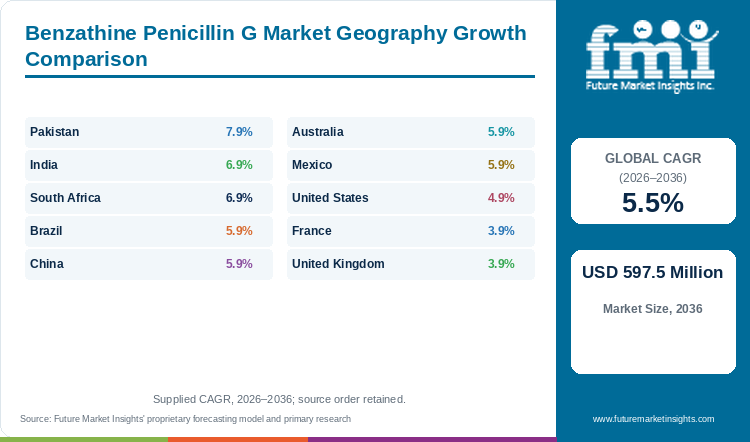
Table 5: Benzathine Penicillin G Market Country Growth Forecast
| Country | CAGR, 2026 to 2036 |
|---|---|
| Pakistan | 7.9% |
| India | 6.9% |
| South Africa | 6.9% |
| Brazil | 5.9% |
| China | 5.9% |
| Australia | 5.9% |
| Mexico | 5.9% |
| United States | 4.9% |
| France | 3.9% |
| United Kingdom | 3.9% |
Source: Future Market Insights analysis of the benzathine penicillin G market, 2026.
Pakistan
Pakistan has the highest percentage growth forecast among the ten named national markets, but starts from the smallest revenue base. FMI projects USD 7.0 million in 2026 and USD 15.0 million by 2036. The 7.9% CAGR over 2026 to 2036 increases the country's share from 2.0% to 2.5%. Pakistan adds USD 8.0 million, ranking eighth for increase. In the benzathine penicillin G market, Pakistan grows 7.9% a year, 2.4 points above the global rate.
Institutional procurement provides a concrete route into that opportunity. Dow University of Health Sciences' December 2025 bidding documents include benzathine penicillin among the medicines sought for the 2025 to 2026 procurement cycle. The tender invited manufacturers or authorised agents and distributors to submit electronic bids, with commercial conditions set by the procuring institution.
For a low-value injectable, participation depends on more than a catalogue entry. A supplier needs to meet the product and commercial terms of the actual institution. The forecast therefore favours a realistic delivery and distributor proposition over a claim of generic export capacity. Institutional orders may differ in pack configuration and timing, making country-average revenue a poor guide to the economics of an individual contract.
FMI sees the principal commercial task as building dependable access from this comparatively small base. Expansion remains tied to authorised purchasing, delivery and the services able to use the medicine.
India
India's targeted-intervention programme explicitly connects syphilis screening with benzathine penicillin access. NACO describes services delivered through community organisations, clinics and referral networks under the National AIDS and STD Control Programme. Its clinical service package includes BPG within the relevant treatment guidelines. This gives the market a defined institutional route beyond general retail antibiotic purchasing.
The Indian market is projected to grow at 6.9% CAGR from 2026 to 2036. Revenue increases from USD 28.0 million to USD 54.6 million, with the global share rising from 8.0% to 9.1%. India begins at the same revenue level as China in the outlook, but the faster rate produces a larger terminal value. Commercial coverage therefore needs to account for programme procurement as well as the country's broader pharmaceutical production role. In the benzathine penicillin G market, India contributes USD 26.6 million of new revenue, second of ten. India holds joint third place by 2026 revenue. In the benzathine penicillin G market, India's revenue grows 1.9 times over the decade, against 1.7 times globally.
NACO's service structure includes urban targeted interventions and a rural Link Worker Scheme. A distribution plan concentrated only on major urban accounts would provide incomplete coverage of that programme structure.
For manufacturers and distributors, the more sustainable opening is scheduled availability to the institutions that conduct testing and referrals. Product documentation and a workable regional distribution arrangement remain part of the commercial offer.
South Africa
South African demand is closely connected to detection and treatment within maternal health services. NICD's January 2025 surveillance report documented 1,739 congenital-syphilis notifications for 2023. Four provinces accounted for 89.9% of clinical notifications, and the report cautioned that increases could reflect better detection and reporting as well as disease burden. This qualification matters for suppliers interpreting national notification trends.
The market is forecast to rise from USD 10.5 million in 2026 to USD 20.5 million by 2036. Its 6.9% CAGR from 2026 to 2036 is above the global rate and lifts South Africa's revenue share from 3.0% to 3.4%. Growth from this base makes service-level availability important even where individual orders are smaller than those in the United States or Brazil.
In FMI's view, the practical opportunity lies in making product supply keep pace with screening and referral activity. A higher count of detected maternal infections measures detection and says little about product reaching the treating clinic. Improved notification can also raise counts without any rise in underlying incidence. The commercial response is to align inventory decisions with local service activity and preserve the scope of surveillance evidence.
Product availability also needs to be considered alongside the authorised national presentation and distribution route. Suppliers serving institutional buyers can differentiate through dependable deliveries, but this assessment makes no claim about manufacturer-level national sales or market shares.
Brazil
Brazil's public-service treatment network gives the market a different commercial structure from shortage-led US imports. The Ministry of Health identifies benzathine penicillin as the principal treatment option for syphilis and states that it can be administered through a nearby health unit. This places supply decisions close to primary-care access. Central procurement performance has value only if stock reaches the local service used by patients.
FMI projects Brazilian revenue of USD 31.5 million in 2026 and USD 55.9 million in 2036. The 5.9% CAGR from 2026 to 2036 places Brazil above the global forecast. Its global revenue share rises from 9.0% to 9.4%. In the benzathine penicillin G market, Brazil's 5.9% CAGR sits 0.4 points above the global 5.5%. Measured by 2026 revenue, Brazil sits second of ten.
Programme execution is a more useful commercial lens. A public network serving routine screening needs has to match purchasing schedules with distribution to treatment sites. Wider regional evidence reinforces the importance of that connection. PAHO reports that the Americas remained above the regional congenital-syphilis elimination target in 2024.
A supplier serving Brazil benefits from reliable pack availability and delivery coordination with public buyers. Sporadic availability creates a less useful proposition even when the quoted unit price is attractive. Local service reach is therefore central to the revenue opportunity.
China
China's official surveillance keeps syphilis visible within the national communicable-disease burden. The National Disease Control and Prevention Administration lists it among the five most frequently reported Class B infections in 2025.
FMI forecasts Chinese benzathine penicillin G revenue of USD 28.0 million in 2026, rising to USD 49.7 million by 2036. The 5.9% CAGR over 2026 to 2036 lifts the country's revenue share from 8.0% to 8.3%. The commercial outlook is for steady expansion from an already material base. China records a USD 21.7 million increase, fourth of the ten. China's 5.9% CAGR sits 0.4 points above the global 5.5%.
Treatment access and production scale are separate questions. National notifications identify diagnosed disease, while the purchase of a particular presentation depends on clinical practice, authorised products and delivery to the relevant institutions. Supplier assessment therefore needs to stay at product level. A company active in bulk antibiotics or other penicillin formulations is a BPG finished-product competitor only where it supplies that product.
The investment case is stronger when commercial teams can connect local distribution with specific institutional demand. FMI sees limited analytical value in treating every reported case as a vial order. Screening intensity, clinical eligibility and the timing of product deliveries affect realised purchases, making programme coordination more informative than population size on its own.
Australia
Australia elevated syphilis to a Communicable Disease Incident of National Significance in August 2025. The declaration cited continuing infection and congenital-syphilis concerns, including 5,968 infectious-syphilis notifications in 2024. The market implication is sustained coordination of testing and treatment services.
Victoria's March 2026 communication reported critical shortages affecting both Australian-registered BPG and alternative Section 19A products. It also noted that Special Access Scheme products could have different subsidy arrangements. This makes regulatory access, reimbursement and physical supply separate commercial considerations. An alternative permitted for import may still be difficult for a service or patient to obtain through its usual purchasing route.
FMI projects Australian revenue of USD 10.5 million in 2026 and USD 18.6 million in 2036, at a 5.9% CAGR over 2026 to 2036. The national share rises from 3.0% to 3.1%. The forecast includes both syphilis treatment and the continuing rheumatic disease prophylaxis requirement within the overall market definition. In the benzathine penicillin G market, Australia adds USD 8.1 million, ranking joint sixth for increase.
Distribution support has particular value in this setting. Buyers need accurate presentation information and realistic delivery expectations when usual stock cannot be supplied. A supplier with a valid exceptional route and irregular fulfilment offers less continuity than the permission suggests. Commercial assessment should therefore examine actual national access arrangements for each internationally marketed brand.
Mexico
Mexico's subnational surveillance shows that national demand varies by region. Guanajuato's week-17 bulletin for 2025 recorded 23 congenital-syphilis cases against three in the comparable 2024 period, while acquired-syphilis notifications in the same bulletin were lower. The observations are preliminary and specific to one state.
FMI forecasts Mexican revenue at USD 10.5 million in 2026 and USD 18.6 million in 2036. The 5.9% CAGR through the 2026 to 2036 period increases its global share from 3.0% to 3.1%. Mexico adds USD 8.1 million, ranking joint sixth for increase. Mexico grows at 5.9% a year, 0.4 points faster than the global rate. Mexico's 2026 revenue ranks joint sixth of ten. The gain of USD 8.1 million equals 3.3% of the global increase of USD 247.7 million.
The commercial consequence of uneven notifications is a need for purchasing and distribution that can respond to where care is delivered. A central stock position says little about whether a particular treatment site has a suitable pack when required. Mexico City's official 2025 weekly bulletin separately tracks acquired and congenital syphilis by health jurisdiction, showing the operational geography available to local planners.
Supplier account coverage benefits from that local perspective. It supports a distinction between routine purchasing and a temporary concentration of treatment activity. FMI expects national expansion to reward continuity across the eligible institutional network.
United States
US purchasing is shaped by the contrast between a large established revenue base and limited routine availability. FMI forecasts USD 115.4 million in 2026, increasing to USD 186.5 million by 2036 at a 4.9% CAGR. The United States accounts for 33.0% of global revenue initially, declining to 31.2% in the terminal year as other national markets expand faster. High present value should therefore be separated from the rate of future expansion.
CDC's provisional 2024 surveillance reported 190,242 total syphilis cases and 3,941 congenital syphilis cases. Primary and secondary cases fell, while congenital cases increased. The figures remain provisional and describe reported disease. For suppliers, the relevant implication is a changing mix of programme needs. For forecasting, treated patients and programme purchases are more useful measures than notified cases.
The commercial route also matters. CDC's April 2026 update described ongoing constrained availability of the only FDA-approved BPG formulation and a temporary import alternative. This creates work for institutional pharmacies and distributors as they manage presentation changes. A supplier's ability to serve qualified orders is more consequential than a broad claim of international reach. Pharmacy and public-health buyers therefore value dependable fulfilment and clear communication on product changes. FMI expects the US market to remain important in value despite its slower growth relative to India, South Africa and Pakistan.
France
France combines a documented domestic powder presentation with a continuing testing-linked treatment requirement. The French public medicines register identifies Delbert as the Extencilline authorisation holder and lists a powder-and-solvent presentation. Across 29 EU/EEA countries, ECDC reported 45,577 confirmed syphilis cases in 2024.
Santé publique France's December 2025 update estimated around 6,500 people diagnosed and treated for syphilis in the private sector in 2024. The measure covers a subset of treatment settings. It nevertheless identifies a purchasing requirement extending beyond hospital-only care. The commercial task is to support the channel through which patients and clinicians obtain the prescribed product.
The French market is forecast at USD 14.0 million in 2026 and USD 20.5 million by 2036. A 3.9% CAGR from 2026 to 2036 is below the global rate, and France's revenue share declines from 4.0% to 3.4%. By absolute increase, France ranks ninth with USD 6.5 million over the decade. In the benzathine penicillin G market, France's revenue grows 1.5 times over the decade, against 1.7 times globally.
For suppliers, an established national product position provides a different advantage from emergency import access. It supports repeat purchasing through an ordinary registered route. Competition is therefore partly about maintaining reliable availability in an ordinary treatment pathway. Larger international pharmaceutical revenue or an extensive antibiotic catalogue is a poor substitute for evidence of an available BPG presentation.
United Kingdom
Recent English surveillance shows that infection counts vary by patient group. UKHSA reported 8,262 infectious syphilis diagnoses in England in 2025, a 13.5% decline from the revised 2024 figure. Diagnoses among women who have sex with men increased despite the overall reduction.
FMI projects UK revenue from USD 10.5 million in 2026 to USD 15.4 million by 2036. The 3.9% forecast CAGR over 2026 to 2036 matches France, while the UK's global share falls from 3.0% to 2.6%. Future value therefore depends on treatment access and product availability within a changing epidemiological pattern. The UK's 3.9% CAGR trails the 5.5% global rate by 1.6 percentage points. The United Kingdom adds USD 4.9 million, ranking last for increase. On 2026 revenue, the United Kingdom stands joint sixth in the ten-country set.
National service organisation matters to commercial coverage. Sexual-health services detect and manage a significant share of diagnosed infection, but different UK nations maintain separate surveillance and service arrangements. The surveillance finding covers England only. Delbert's product portfolio also lists a UK benzathine benzylpenicillin product, providing a product-specific reference point for national supply.
Suppliers gain a clearer proposition by supporting the actual presentation and institutional accounts involved. FMI expects the UK to remain a measured-growth market where continuity and precise channel coverage matter more than broad expansion claims.
Who are the notable companies in the Benzathine Penicillin G Market?
Notable companies in the Benzathine Penicillin G Market include Pfizer, Laboratoires Delbert, Laboratorios Atral and Provepharm.
The competitive set contains manufacturers, marketing businesses and distribution partners whose roles should be compared separately. Pfizer's King Pharmaceuticals subsidiary supplies Bicillin L-A in the United States. Delbert's Extencilline product position is documented in France, while Atral's Lentocilin label identifies its powder product. These are specific finished-product positions, not interchangeable evidence of access in every country.
Provepharm's role is different. The FDA-hosted November 2023 Extencilline communication named it alongside Delbert and Direct Success in a temporary US import arrangement. That historical participation should not be presented as the same transaction as the 2026 Atral import.
FMI's assessment places most weight on the product's actual national supply position. A manufacturer, importer and local distributor may all participate in one supply route. Counting each as an independent source of production would overstate competitive depth. The distinction is especially important where a country's alternatives depend on temporary access arrangements.
Key Developments in the Benzathine Penicillin G Market
- In March 2026, Atral's FDA-hosted communication set out temporary US importation of Lentocilin through Mark Cuban Cost Plus Drug Company. The product remained unapproved by FDA under the stated shortage arrangement.
Key Players in the Benzathine Penicillin G Market
- Pfizer
- Laboratoires Delbert
- Laboratorios Atral
- Provepharm
Benzathine Penicillin G Market Report Scope
Table 6: Benzathine Penicillin G Market Report Scope
| Coverage field | Report scope |
|---|---|
| Market definition | Long-acting benzathine penicillin G injectable products supplied as powder or suspension for intramuscular use. |
| Indications | Syphilis. Rheumatic fever and rheumatic heart disease. Streptococcal pharyngitis and other. |
| Exclusions | Other penicillin salts and combination products, bulk API revenue, diagnostic-test revenue and administration-service fees. |
| Revenue units | USD million. |
| Volume measure | Million vials. Not a count of patients or completed courses. |
| Presentation and access status | Powder for injection. Ready-to-use suspension. Imported unregistered supply as a separately allocated exceptional-access category. |
| Channels | Hospital. Retail pharmacy. Public health programmes. |
| Geographic coverage | United States, Brazil, India, China, France, United Kingdom, Australia, South Africa, Mexico, Pakistan and rest-of-world aggregate. |
| Companies discussed | Pfizer, Laboratoires Delbert, Laboratorios Atral and Provepharm, with product and commercial roles distinguished. |
| Quantitative Units | USD million |
Source: Future Market Insights analysis of the benzathine penicillin G market, 2026.
Benzathine Penicillin G Market Research Methodology
The assessment combines FMI's quantitative outlook with secondary review of official surveillance, medicine-availability communications, company product records and institutional procurement evidence. Revenue comparisons preserve the stated BPG finished-product boundary. Segment and country figures were checked for consistent years and units. Manufacturer, importer and distribution roles were reviewed separately. Reported disease counts inform the commercial interpretation but are not treated as sales, while temporary import arrangements are distinguished from ordinary marketing approval.
Benzathine Penicillin G Market by Segments
Benzathine Penicillin G Market segmented by Indication:
- Syphilis
- Rheumatic fever and rheumatic heart disease
- Streptococcal pharyngitis and other
Benzathine Penicillin G Market segmented by Form:
- Powder for injection
- Ready-to-use suspension
- Imported unregistered supply
Benzathine Penicillin G Market segmented by Channel:
- Hospital
- Retail pharmacy
- Public health programmes
Benzathine Penicillin G Market by Region
- North America
- United States
- Latin America
- Brazil
- Mexico
- Western Europe
- France
- United Kingdom
- East Asia
- China
- South Asia and Pacific
- India
- Pakistan
- Australia
- Middle East and Africa
- South Africa
- Rest of world aggregate
Research Sources and Bibliography
- Australian Government Department of Health, Disability and Ageing. (2025, August 7). Chief Medical Officer's statement declaring syphilis a Communicable Disease Incident of National Significance. https://www.health.gov.au/news/cmo-statement-syphilis-cdins?language=en
- Centers for Disease Control and Prevention. (2025, September 24). Sexually Transmitted Infections Surveillance, 2024 (Provisional). https://www.cdc.gov/sti-statistics/annual/index.html
- Centers for Disease Control and Prevention. (2026, April 23). Updates on Bicillin L-A Shortage. https://www.cdc.gov/nchhstp/whats-new/bicillin-updates.html
- Centers for Disease Control and Prevention. (2026, September 21). Availability of STI Testing & Treatment Products. https://www.cdc.gov/sti/hcp/clinical-guidance/availability-of-products.html
- Delbert Pharma. (Accessed 2026, November 9). Benzylpenicillin benzathine: United Kingdom portfolio. https://delbertpharma.com/fr/produit/benzylpenicillin-benzathine/
- Delbert Pharma. (Accessed 2026, November 9). Extencilline product information and national portfolio. https://delbertpharma.com/fr/produit/extencilline/
- Dow University of Health Sciences. (2025, December 3). Bidding Documents DUHS/DP/2025/337, procurement of drugs and medicines for 2025–2026. https://www.duhs.edu.pk/wp-content/uploads/2025/12/337%20Medicin%202025-26%20BD_2025.pdf
- European Centre for Disease Prevention and Control. (2026, May 21). Syphilis: Annual Epidemiological Report for 2024. https://www.ecdc.europa.eu/en/publications-data/syphilis-annual-epidemiological-report-2024
- French Ministry of Health. (2026, November 3). Base de Données Publique des Médicaments: Extencilline, CIS 64615821. https://base-donnees-publique.medicaments.gouv.fr/medicament/64615821/extrait
- Kufa, T., Thabane, E., Leshaba, D., Makhubele, M. and Puren, A. (2025, January). Congenital syphilis annual surveillance report, South Africa 2023. Public Health Bulletin South Africa, National Institute for Communicable Diseases. https://www.phbsa.ac.za/wp-content/uploads/2025/01/Congenital-syphilis-annual-surveillance-report-South-Africa-2023.pdf
- Laboratórios Atral. (2024, June). Lentocilin prescribing information. US National Library of Medicine, DailyMed. https://www.dailymed.nlm.nih.gov/dailymed/fda/fdaDrugXsl.cfm?setid=1a4e5124-618b-ce44-e063-6394a90a43e3&type=display
- Laboratórios Atral. (2026, March 20). Temporary Importation of Lentocilin to Address Supply Shortage. FDA-hosted healthcare-provider communication. https://www.fda.gov/media/192256/download
- Laboratoires Delbert. (2023, November 21). Temporary Importation of Extencilline to Address Supply Shortage. FDA-hosted healthcare-provider communication. https://www.fda.gov/media/175366/download
- Ministério da Saúde, Brazil. (Accessed 2026, November 9). Sífilis. https://www.gov.br/saude/pt-br/assuntos/saude-de-a-a-z/l/s/sifilis
- National AIDS Control Organisation, India. (Accessed 2026, November 9). Prevention: Targeted Interventions and Clinical Services. https://naco.mohfw.gov.in/division/targeted-interventions/
- National Disease Control and Prevention Administration, China. (Accessed 2026, November 9). Overview of Notifiable Infectious Diseases in China 2025. https://en.ndcpa.gov.cn/gjjkjywwz/EpidemicReports/common/content/content_2104547356927496192.html
- Pan American Health Organization. (Accessed 2026, November 9). EOB 2024–2025: Tasa de incidencia de la sífilis congénita. https://pbdigital.paho.org/es/eob-2024-2025/resultados-impacto/18-tasa-de-incidencia-de-la-sifilis-congenita-incluidos-los
- Santé publique France. (2025, December 30). Syphilis: Données. https://www.santepubliquefrance.fr/index.php/syphilis/donnees
- Secretaría de Salud de Guanajuato. (2025, April 20–26). Boletín Epidemiológico, Semana Epidemiológica 17. https://salud.guanajuato.gob.mx/download/epidemiologia/2025/Boletin-Epidemiologico-SE-No_17_2025.pdf
- Servicios de Salud Pública de la Ciudad de México. (2025). Boletín Semanal de la Ciudad de México, número 37, table 4.2. https://sersalud.cdmx.gob.mx/sspcdmx/Documentos/direccion/demp/boletin/2025/Boletin%20Semanal%20de%20la%20Ciudad%20de%20Mexico%20n%C3%BAmero%2037%20del%202025.pdf
- UK Health Security Agency. (2026, June 2). Sexually transmitted infections and screening for chlamydia in England: 2025 report. https://www.gov.uk/government/statistics/sexually-transmitted-infections-stis-annual-data-tables/sexually-transmitted-infections-and-screening-for-chlamydia-in-england-2025-report
- Victoria Department of Health. (2026, March 30). Bicillin L-A (benzathine benzylpenicillin) shortage. https://www.health.vic.gov.au/medicines-and-poisons/bicillin-l-a-benzathine-benzylpenicillin-shortage
- World Health Organization. (2024). WHO guideline on the prevention and diagnosis of rheumatic fever and rheumatic heart disease. ISBN 978-92-4-010007-7. https://iris.who.int/bitstream/handle/10665/379374/9789240100077-eng.pdf?sequence=1
- World Health Organization. (2025, January 24). Rheumatic heart disease. https://www.who.int/news-room/fact-sheets/detail/rheumatic-heart-disease
- World Health Organization. (2025, May 29). Syphilis. https://www.who.int/news-room/fact-sheets/detail/syphilis
- World Health Organization. (Accessed 2026, November 9). Ensuring demand and supply of benzathine penicillin to treat syphilis. https://www.who.int/teams/global-hiv-hepatitis-and-stis-programmes/stis/treatment/shortages-of-penicillin
- World Health Organization Prequalification Unit. (2025, March 18). Recommended comparator products: Reproductive Health medicines. https://extranet.who.int/prequal/sites/default/files/document_files/Comparator-RH2025-18March_1.pdf
- World Health Organization and UNICEF. (2025, July 14). Country guidance for planning triple elimination of mother-to-child transmission of HIV, syphilis and hepatitis B virus programmes. https://www.who.int/publications/i/item/9789240112490/
This bibliography is provided for reader reference and is not exhaustive. The full report contains the complete reference list and detailed citations.
Table of Content
- Key Takeaways
- Market Size and CAGR
- Top Growth Driver
- Fastest Growing Segment
- Leading Region
- Key Companies
- Emerging Opportunities
- Executive Summary
- Global Market Outlook
- Demand-side Trends
- Supply-side Trends
- Technology Roadmap Analysis
- Analysis and Recommendations
- Analyst Perspective (What is happening? Why now? What should investors know?)
- Key Questions Answered
- How large is the market?
- What is the CAGR?
- What are key trends?
- Which region dominates?
- Who are the leaders?
Read More...
- Market Overview
- Market Coverage / Taxonomy
- Market Definition / Scope / Limitations
- Research Methodology
- Chapter Orientation
- Analytical Lens and Working Hypotheses
- Market Structure, Signals, and Trend Drivers
- Benchmarking and Cross-market Comparability
- Market Sizing, Forecasting, and Opportunity Mapping
- Research Design and Evidence Framework
- Desk Research Programme (Secondary Evidence)
- Expert Input and Fieldwork (Primary Evidence)
- Tooling, Models, and Reference Databases
- Data Engineering and Model Build
- Quality Assurance and Audit Trail
- Market Background
- Market Dynamics (Drivers, Restraints, Opportunity, Trends)
- Scenario Forecast (Optimistic, Likely, Conservative)
- Impact Analysis
- AI Impact
- Sustainability Impact
- Regulatory Impact
- Technology Impact
- Consumer / Buyer Analysis
- Purchase Drivers
- Adoption Barriers
- Buyer Journey
- Opportunity Map Analysis
- Product Life Cycle Analysis
- Supply Chain Analysis
- Investment Feasibility Matrix
- Value Chain Analysis
- PESTLE and Porter's Analysis
- Regulatory Landscape
- Regional Parent Market Outlook
- Production and Consumption Statistics
- Import and Export Statistics
- Global Market Analysis and Forecast, 2021 to 2036
- Historical Market Size Value (USD Million) Analysis, 2021 to 2025
- Current and Future Market Size Value (USD Million) Projections, 2026 to 2036
- Y-o-Y Growth Trend Analysis
- Absolute $ Opportunity Analysis
- Global Market Pricing Analysis, 2021 to 2036
- Global Market Analysis and Forecast, By Indication, 2021 to 2036
- Introduction / Key Findings
- Historical Market Size Value (USD Million) Analysis By Indication, 2021 to 2025
- Current and Future Market Size Value (USD Million) Analysis and Forecast By Indication, 2026 to 2036
- Syphilis
- Rheumatic fever and rheumatic heart disease
- Streptococcal pharyngitis and other
- Y-o-Y Growth Trend Analysis By Indication, 2021 to 2025
- Absolute $ Opportunity Analysis By Indication, 2026 to 2036
- Global Market Analysis and Forecast, By Form, 2021 to 2036
- Introduction / Key Findings
- Historical Market Size Value (USD Million) Analysis By Form, 2021 to 2025
- Current and Future Market Size Value (USD Million) Analysis and Forecast By Form, 2026 to 2036
- Powder for injection
- Ready-to-use suspension
- Imported unregistered supply
- Y-o-Y Growth Trend Analysis By Form, 2021 to 2025
- Absolute $ Opportunity Analysis By Form, 2026 to 2036
- Global Market Analysis and Forecast, By Channel, 2021 to 2036
- Introduction / Key Findings
- Historical Market Size Value (USD Million) Analysis By Channel, 2021 to 2025
- Current and Future Market Size Value (USD Million) Analysis and Forecast By Channel, 2026 to 2036
- Hospital
- Retail pharmacy
- Public health programmes
- Y-o-Y Growth Trend Analysis By Channel, 2021 to 2025
- Absolute $ Opportunity Analysis By Channel, 2026 to 2036
- Global Market Analysis and Forecast, By Region, 2021 to 2036
- Introduction
- Historical Market Size Value (USD Million) Analysis By Region, 2021 to 2025
- Current Market Size Value (USD Million) Analysis and Forecast By Region, 2026 to 2036
- North America
- Latin America
- Western Europe
- East Asia
- South Asia and Pacific
- Middle East and Africa
- Market Attractiveness Analysis By Region
- North America Market Analysis and Forecast, By Country, 2021 to 2036
- Historical Market Size Value (USD Million) Trend Analysis By Market Taxonomy, 2021 to 2025
- Market Size Value (USD Million) Forecast By Market Taxonomy, 2026 to 2036
- By Country
- United States
- By Indication
- By Form
- By Channel
- By Country
- Market Attractiveness Analysis
- By Country
- By Indication
- By Form
- By Channel
- Key Takeaways
- Latin America Market Analysis and Forecast, By Country
- Historical Market Size Value (USD Million) Trend Analysis By Market Taxonomy, 2021 to 2025
- Market Size Value (USD Million) Forecast By Market Taxonomy, 2026 to 2036
- By Country
- Brazil
- Mexico
- By Indication
- By Form
- By Channel
- By Country
- Market Attractiveness Analysis
- By Country
- By Indication
- By Form
- By Channel
- Key Takeaways
- Western Europe Market Analysis and Forecast, By Country
- Historical Market Size Value (USD Million) Trend Analysis By Market Taxonomy, 2021 to 2025
- Market Size Value (USD Million) Forecast By Market Taxonomy, 2026 to 2036
- By Country
- France
- United Kingdom
- By Indication
- By Form
- By Channel
- By Country
- Market Attractiveness Analysis
- By Country
- By Indication
- By Form
- By Channel
- Key Takeaways
- East Asia Market Analysis and Forecast, By Country
- Historical Market Size Value (USD Million) Trend Analysis By Market Taxonomy, 2021 to 2025
- Market Size Value (USD Million) Forecast By Market Taxonomy, 2026 to 2036
- By Country
- China
- By Indication
- By Form
- By Channel
- By Country
- Market Attractiveness Analysis
- By Country
- By Indication
- By Form
- By Channel
- Key Takeaways
- South Asia and Pacific Market Analysis and Forecast, By Country
- Historical Market Size Value (USD Million) Trend Analysis By Market Taxonomy, 2021 to 2025
- Market Size Value (USD Million) Forecast By Market Taxonomy, 2026 to 2036
- By Country
- India
- Pakistan
- Australia
- By Indication
- By Form
- By Channel
- By Country
- Market Attractiveness Analysis
- By Country
- By Indication
- By Form
- By Channel
- Key Takeaways
- Middle East and Africa Market Analysis and Forecast, By Country
- Historical Market Size Value (USD Million) Trend Analysis By Market Taxonomy, 2021 to 2025
- Market Size Value (USD Million) Forecast By Market Taxonomy, 2026 to 2036
- By Country
- South Africa
- Rest of world aggregate
- By Indication
- By Form
- By Channel
- By Country
- Market Attractiveness Analysis
- By Country
- By Indication
- By Form
- By Channel
- Key Takeaways
- Key Countries Market Analysis
- United States
- Pricing Analysis
- Market Share Analysis, 2025
- By Indication
- By Form
- By Channel
- Mexico
- Pricing Analysis
- Market Share Analysis, 2025
- By Indication
- By Form
- By Channel
- Brazil
- Pricing Analysis
- Market Share Analysis, 2025
- By Indication
- By Form
- By Channel
- United Kingdom
- Pricing Analysis
- Market Share Analysis, 2025
- By Indication
- By Form
- By Channel
- France
- Pricing Analysis
- Market Share Analysis, 2025
- By Indication
- By Form
- By Channel
- India
- Pricing Analysis
- Market Share Analysis, 2025
- By Indication
- By Form
- By Channel
- China
- Pricing Analysis
- Market Share Analysis, 2025
- By Indication
- By Form
- By Channel
- South Africa
- Pricing Analysis
- Market Share Analysis, 2025
- By Indication
- By Form
- By Channel
- Pakistan
- Pricing Analysis
- Market Share Analysis, 2025
- By Indication
- By Form
- By Channel
- Australia
- Pricing Analysis
- Market Share Analysis, 2025
- By Indication
- By Form
- By Channel
- United States
- Market Structure Analysis
- Competition Dashboard
- Competition Benchmarking
- Market Share Analysis of Top Players
- By Regional
- By Indication
- By Form
- By Channel
- Emerging Startups
- Innovation Benchmarking
- Competition Analysis
- Competition Deep Dive
- Pfizer
- Overview
- Product Portfolio
- Profitability by Market Segments
- Sales Footprint
- Strategy Overview
- Marketing Strategy
- Product Strategy
- Channel Strategy
- Laboratoires Delbert
- Laboratorios Atral
- Provepharm
- Pfizer
- Case Studies
- Success Stories
- Recent Developments
- Competition Deep Dive
- Assumptions & Acronyms Used
List of Tables
- Table 1: Global Market Value (USD Million) Forecast by Region, 2021 to 2036
- Table 2: Global Market Value (USD Million) Forecast by Indication, 2021 to 2036
- Table 3: Global Market Value (USD Million) Forecast by Form, 2021 to 2036
- Table 4: Global Market Value (USD Million) Forecast by Channel, 2021 to 2036
- Table 5: North America Market Value (USD Million) Forecast by Country, 2021 to 2036
- Table 6: North America Market Value (USD Million) Forecast by Indication, 2021 to 2036
- Table 7: North America Market Value (USD Million) Forecast by Form, 2021 to 2036
- Table 8: North America Market Value (USD Million) Forecast by Channel, 2021 to 2036
- Table 9: Latin America Market Value (USD Million) Forecast by Country, 2021 to 2036
- Table 10: Latin America Market Value (USD Million) Forecast by Indication, 2021 to 2036
- Table 11: Latin America Market Value (USD Million) Forecast by Form, 2021 to 2036
- Table 12: Latin America Market Value (USD Million) Forecast by Channel, 2021 to 2036
- Table 13: Western Europe Market Value (USD Million) Forecast by Country, 2021 to 2036
- Table 14: Western Europe Market Value (USD Million) Forecast by Indication, 2021 to 2036
- Table 15: Western Europe Market Value (USD Million) Forecast by Form, 2021 to 2036
- Table 16: Western Europe Market Value (USD Million) Forecast by Channel, 2021 to 2036
- Table 17: East Asia Market Value (USD Million) Forecast by Country, 2021 to 2036
- Table 18: East Asia Market Value (USD Million) Forecast by Indication, 2021 to 2036
- Table 19: East Asia Market Value (USD Million) Forecast by Form, 2021 to 2036
- Table 20: East Asia Market Value (USD Million) Forecast by Channel, 2021 to 2036
- Table 21: South Asia and Pacific Market Value (USD Million) Forecast by Country, 2021 to 2036
- Table 22: South Asia and Pacific Market Value (USD Million) Forecast by Indication, 2021 to 2036
- Table 23: South Asia and Pacific Market Value (USD Million) Forecast by Form, 2021 to 2036
- Table 24: South Asia and Pacific Market Value (USD Million) Forecast by Channel, 2021 to 2036
- Table 25: Middle East and Africa Market Value (USD Million) Forecast by Country, 2021 to 2036
- Table 26: Middle East and Africa Market Value (USD Million) Forecast by Indication, 2021 to 2036
- Table 27: Middle East and Africa Market Value (USD Million) Forecast by Form, 2021 to 2036
- Table 28: Middle East and Africa Market Value (USD Million) Forecast by Channel, 2021 to 2036
List of Figures
- Figure 1: Global Market Pricing Analysis
- Figure 2: Global Market Value (USD Million) Forecast 2021-2036
- Figure 3: Global Market Value Share and BPS Analysis by Indication, 2026 and 2036
- Figure 4: Global Market Y-o-Y Growth Comparison by Indication, 2026-2036
- Figure 5: Global Market Attractiveness Analysis by Indication
- Figure 6: Global Market Value Share and BPS Analysis by Form, 2026 and 2036
- Figure 7: Global Market Y-o-Y Growth Comparison by Form, 2026-2036
- Figure 8: Global Market Attractiveness Analysis by Form
- Figure 9: Global Market Value Share and BPS Analysis by Channel, 2026 and 2036
- Figure 10: Global Market Y-o-Y Growth Comparison by Channel, 2026-2036
- Figure 11: Global Market Attractiveness Analysis by Channel
- Figure 12: Global Market Value (USD Million) Share and BPS Analysis by Region, 2026 and 2036
- Figure 13: Global Market Y-o-Y Growth Comparison by Region, 2026-2036
- Figure 14: Global Market Attractiveness Analysis by Region
- Figure 15: North America Market Incremental Dollar Opportunity, 2026-2036
- Figure 16: Latin America Market Incremental Dollar Opportunity, 2026-2036
- Figure 17: Western Europe Market Incremental Dollar Opportunity, 2026-2036
- Figure 18: East Asia Market Incremental Dollar Opportunity, 2026-2036
- Figure 19: South Asia and Pacific Market Incremental Dollar Opportunity, 2026-2036
- Figure 20: Middle East and Africa Market Incremental Dollar Opportunity, 2026-2036
- Figure 21: North America Market Value Share and BPS Analysis by Country, 2026 and 2036
- Figure 22: North America Market Value Share and BPS Analysis by Indication, 2026 and 2036
- Figure 23: North America Market Y-o-Y Growth Comparison by Indication, 2026-2036
- Figure 24: North America Market Attractiveness Analysis by Indication
- Figure 25: North America Market Value Share and BPS Analysis by Form, 2026 and 2036
- Figure 26: North America Market Y-o-Y Growth Comparison by Form, 2026-2036
- Figure 27: North America Market Attractiveness Analysis by Form
- Figure 28: North America Market Value Share and BPS Analysis by Channel, 2026 and 2036
- Figure 29: North America Market Y-o-Y Growth Comparison by Channel, 2026-2036
- Figure 30: North America Market Attractiveness Analysis by Channel
- Figure 31: Latin America Market Value Share and BPS Analysis by Country, 2026 and 2036
- Figure 32: Latin America Market Value Share and BPS Analysis by Indication, 2026 and 2036
- Figure 33: Latin America Market Y-o-Y Growth Comparison by Indication, 2026-2036
- Figure 34: Latin America Market Attractiveness Analysis by Indication
- Figure 35: Latin America Market Value Share and BPS Analysis by Form, 2026 and 2036
- Figure 36: Latin America Market Y-o-Y Growth Comparison by Form, 2026-2036
- Figure 37: Latin America Market Attractiveness Analysis by Form
- Figure 38: Latin America Market Value Share and BPS Analysis by Channel, 2026 and 2036
- Figure 39: Latin America Market Y-o-Y Growth Comparison by Channel, 2026-2036
- Figure 40: Latin America Market Attractiveness Analysis by Channel
- Figure 41: Western Europe Market Value Share and BPS Analysis by Country, 2026 and 2036
- Figure 42: Western Europe Market Value Share and BPS Analysis by Indication, 2026 and 2036
- Figure 43: Western Europe Market Y-o-Y Growth Comparison by Indication, 2026-2036
- Figure 44: Western Europe Market Attractiveness Analysis by Indication
- Figure 45: Western Europe Market Value Share and BPS Analysis by Form, 2026 and 2036
- Figure 46: Western Europe Market Y-o-Y Growth Comparison by Form, 2026-2036
- Figure 47: Western Europe Market Attractiveness Analysis by Form
- Figure 48: Western Europe Market Value Share and BPS Analysis by Channel, 2026 and 2036
- Figure 49: Western Europe Market Y-o-Y Growth Comparison by Channel, 2026-2036
- Figure 50: Western Europe Market Attractiveness Analysis by Channel
- Figure 51: East Asia Market Value Share and BPS Analysis by Country, 2026 and 2036
- Figure 52: East Asia Market Value Share and BPS Analysis by Indication, 2026 and 2036
- Figure 53: East Asia Market Y-o-Y Growth Comparison by Indication, 2026-2036
- Figure 54: East Asia Market Attractiveness Analysis by Indication
- Figure 55: East Asia Market Value Share and BPS Analysis by Form, 2026 and 2036
- Figure 56: East Asia Market Y-o-Y Growth Comparison by Form, 2026-2036
- Figure 57: East Asia Market Attractiveness Analysis by Form
- Figure 58: East Asia Market Value Share and BPS Analysis by Channel, 2026 and 2036
- Figure 59: East Asia Market Y-o-Y Growth Comparison by Channel, 2026-2036
- Figure 60: East Asia Market Attractiveness Analysis by Channel
- Figure 61: South Asia and Pacific Market Value Share and BPS Analysis by Country, 2026 and 2036
- Figure 62: South Asia and Pacific Market Value Share and BPS Analysis by Indication, 2026 and 2036
- Figure 63: South Asia and Pacific Market Y-o-Y Growth Comparison by Indication, 2026-2036
- Figure 64: South Asia and Pacific Market Attractiveness Analysis by Indication
- Figure 65: South Asia and Pacific Market Value Share and BPS Analysis by Form, 2026 and 2036
- Figure 66: South Asia and Pacific Market Y-o-Y Growth Comparison by Form, 2026-2036
- Figure 67: South Asia and Pacific Market Attractiveness Analysis by Form
- Figure 68: South Asia and Pacific Market Value Share and BPS Analysis by Channel, 2026 and 2036
- Figure 69: South Asia and Pacific Market Y-o-Y Growth Comparison by Channel, 2026-2036
- Figure 70: South Asia and Pacific Market Attractiveness Analysis by Channel
- Figure 71: Middle East and Africa Market Value Share and BPS Analysis by Country, 2026 and 2036
- Figure 72: Middle East and Africa Market Value Share and BPS Analysis by Indication, 2026 and 2036
- Figure 73: Middle East and Africa Market Y-o-Y Growth Comparison by Indication, 2026-2036
- Figure 74: Middle East and Africa Market Attractiveness Analysis by Indication
- Figure 75: Middle East and Africa Market Value Share and BPS Analysis by Form, 2026 and 2036
- Figure 76: Middle East and Africa Market Y-o-Y Growth Comparison by Form, 2026-2036
- Figure 77: Middle East and Africa Market Attractiveness Analysis by Form
- Figure 78: Middle East and Africa Market Value Share and BPS Analysis by Channel, 2026 and 2036
- Figure 79: Middle East and Africa Market Y-o-Y Growth Comparison by Channel, 2026-2036
- Figure 80: Middle East and Africa Market Attractiveness Analysis by Channel
- Figure 81: Global Market - Tier Structure Analysis
- Figure 82: Global Market - Company Share Analysis
Frequently Asked Questions
How big is the benzathine penicillin G market in 2026?
FMI estimates the market at USD 349.8 million in 2026, up from USD 330.0 million in 2025. It is forecast to reach USD 597.5 million by 2036 at a 5.5% CAGR.
Which indication leads the benzathine penicillin G market in 2026?
Syphilis leads by indication with 48.0% in 2026. All other segments together hold 52.0%.
Which form and channel lead in 2026?
Powder for injection holds 45.0% by form and Hospital holds 58.0% by channel in FMI's 2026 assessment.
Which market is forecast to grow fastest through 2036?
Pakistan has the highest forecast CAGR at 7.9% during 2026 to 2036, followed by India and South Africa at 6.9%.
Does temporary importation mean that a product has ordinary national approval?
No. FDA's March 2026 Lentocilin communication explicitly distinguishes temporary importation from FDA approval. National supply status must be assessed for the particular product and route.[2]
Preview the report firsthand - request a free sample
Get SampleGet the brochure for pricing and purchase details.
Get PDF
