

- Industry Size (2026)
- USD 278.31 Bn
- Forecast (2036)
- USD 475.39 Bn
- CAGR (2026 to 2036)
- 5.50%
Benzylamine Market Size, Market Forecast and Outlook By FMI
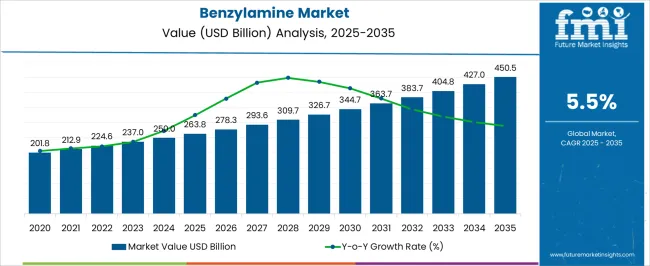
The benzylamine market was valued at USD 263.80 billion in 2025, projected to reach USD 278.31 billion in 2026, and is forecast to expand to USD 475.39 billion by 2036 at a 5.50% CAGR. Pharmaceutical intermediate synthesis and agrochemical active ingredient production are sustaining structural demand for benzylamine as a versatile nitrogen-containing building block. Expanding paint and coatings manufacturing capacity in Asia Pacific and Latin America is creating parallel consumption channels that diversify demand beyond traditional chemical synthesis applications.
Summary of Benzylamine Market
- Market Overview
- The benzylamine market is valued at USD 263.80 billion in 2025 and is projected to reach USD 475.39 billion by 2036.
- The industry is expected to grow at a 5.50% CAGR from 2026 to 2036, creating an incremental opportunity of USD 197.08 billion.
- The market is a multi-application chemical intermediate category where synthesis versatility, grade purity, and distribution channel reach define competitive positioning.
- Demand and Growth Drivers
- Pharmaceutical intermediate demand: Drug manufacturers developing nitrogen-containing active pharmaceutical ingredients continue to specify benzylamine as a synthesis intermediate, with demand linked to expanding generic drug production capacity in India and China.
- Coatings formulation complexity: Automotive OEM and industrial coatings producers formulating high-performance epoxy and polyurethane systems are increasing consumption of benzylamine-derived curing agents and adhesion promoters that improve coating durability and chemical resistance.
- Digital distribution channel migration: Industrial chemical buyers migrating procurement to internet retailing platforms are accessing broader supplier networks, competitive pricing, and reduced minimum order quantities that accelerate small and mid-scale manufacturer adoption.
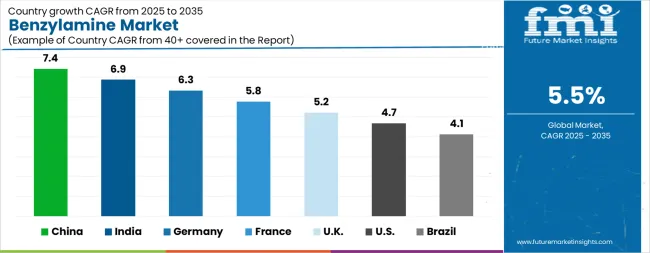
- Among tracked countries, China at 7.4% CAGR, India at 6.9% CAGR, Germany at 6.3% CAGR, France at 5.8% CAGR, UK at 5.2% CAGR, USA at 4.7% CAGR, Brazil at 4.1% CAGR.
- Product and Segment View
- Benzylamine is an organic amine compound (C6H5CH2NH2) produced through the catalytic hydrogenation of benzonitrile or the reaction of benzyl chloride with ammonia.
- Chemicals leads by Industry Type with 22.6% share in 2026.
- Chemical Manufacturing leads the Application Type segment with 28.4% share in 2026.
- Scope includes: Market scope covers benzylamine consumed across chemicals, agriculture, pest control, paint and coatings, automotive and transportation coatings, industrial coatings, and other industry verticals.
- Exclusions: Downstream finished pharmaceutical dosage forms, packaged agrochemical formulations, and retail paint products containing benzylamine-derived intermediates are excluded.
- Geography and Competitive Outlook
- China and India are the fastest-growing markets, while UK and USA represent established demand bases.
- Key players include BASF AG, LANXESS, Huntsman Corporation, Dow Chemical Company, Eastman Chemical Company.
Benzylamine Market Key Takeaways
| Metric | Details |
|---|---|
| Industry Size (2026) | USD 278.31 Billion |
| Industry Value (2036) | USD 475.39 Billion |
| CAGR (2026-2036) | 5.50% |
Source: Future Market Insights, 2026
Internet retailing channels now command 34.7% of distribution share as industrial buyers consolidate procurement through online platforms that offer transparent pricing, technical specification access, and flexible order quantities. Chemical manufacturing remains the largest industry vertical at 22.6% share, anchored by ongoing pharmaceutical and agrochemical intermediate production. Surface coatings manufacturers specifying benzylamine-derived curing agents and adhesion promoters are contributing incremental demand growth as automotive and industrial coating formulation complexity increases.
China leads growth at 7.4% CAGR, driven by pharmaceutical and agrochemical synthesis capacity expansion. India follows at 6.9%, supported by growing chemical manufacturing and pesticide production volumes. Germany records 6.3% growth from specialty chemical and pharmaceutical intermediate demand. France posts 5.8% and the United Kingdom tracks 5.2%. The United States advances at 4.7%, while Brazil maintains 4.1% growth from agrochemical and paint manufacturing demand.
Benzylamine Market Definition
Benzylamine is an organic amine compound (C6H5CH2NH2) produced through the catalytic hydrogenation of benzonitrile or the reaction of benzyl chloride with ammonia. It functions as a chemical intermediate in the synthesis of pharmaceuticals, agrochemicals, dyes, and surface coatings. End-use applications span chemical manufacturing, paint and lacquer production, pesticide and fertilizer formulation, pharmaceutical synthesis, and specialty industrial processes. The compound is distributed through internet retailing, mass retail, direct selling, and other channels serving industrial and institutional buyers.
Benzylamine Market Inclusions
Market scope covers benzylamine consumed across chemicals, agriculture, pest control, paint and coatings, automotive and transportation coatings, industrial coatings, and other industry verticals. Application coverage includes chemical manufacturing, paint and lacquer production, pesticide and fertilizer manufacturing, pharmaceutical manufacturing, and other synthesis operations. Regional and country-level market sizes, segment breakdowns by industry type, application type, and distribution channel, and forecast projections through 2036 are included.
Benzylamine Market Exclusions
Downstream finished pharmaceutical dosage forms, packaged agrochemical formulations, and retail paint products containing benzylamine-derived intermediates are excluded. N-benzylamine derivatives and dibenzylamine sold as separately classified specialty chemicals fall outside the defined scope. Laboratory-grade benzylamine sold in sub-kilogram analytical reference quantities is also excluded.
Benzylamine Market Research Methodology
- Primary Research: Analysts engaged with industry procurement specialists, materials engineers, and supply chain managers to map decision triggers and specification requirements.
- Desk Research: Data collection phases aggregated regulatory filings, industry association publications, trade statistics, and company disclosure documents.
- Market-Sizing and Forecasting: Baseline values derive from a bottom-up aggregation of product-level shipments and revenue, applying region-specific adoption curves to project future demand velocity.
- Data Validation and Update Cycle: Projections are tested against publicly reported industry expenditure guidance and cross-validated with primary interview inputs.
Why is the Benzylamine Market Growing?
The Benzylamine market is experiencing steady growth, driven by increasing demand for specialty chemicals across diverse industrial applications. The compound is widely utilized as an intermediate in the production of agrochemicals, pharmaceuticals, rubber chemicals, and other chemical derivatives. Rising industrial activity, particularly in chemical manufacturing and pharmaceutical production, is fueling market expansion.
Advancements in synthesis methods and cost-effective production processes are enhancing availability and reducing operational costs. Regulatory emphasis on quality, safety, and environmental compliance is shaping product adoption, while the growing trend of green chemistry is encouraging manufacturers to optimize processes and reduce waste. Additionally, increasing investments in research and development for new chemical applications are creating additional opportunities for market growth.
The rising need for high-purity intermediates in advanced manufacturing processes and the expansion of chemical-based industries in emerging markets are expected to further drive demand As a result, the Benzylamine market is projected to maintain steady growth, with sustained opportunities arising from innovation, process optimization, and expanding application scope.
Segmental Analysis
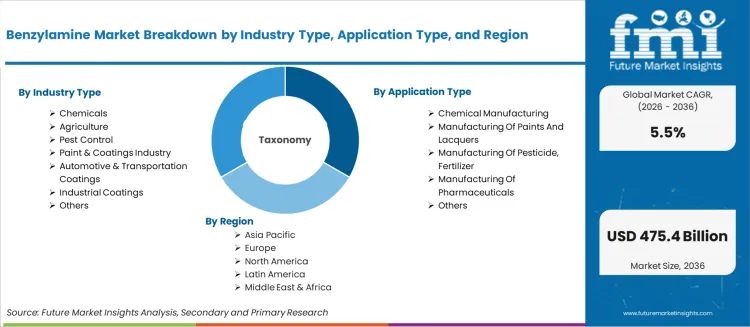
The benzylamine market is segmented by industry type, application type, distribution channels, and geographic regions. By industry type, benzylamine market is divided into Chemicals, Agriculture, Pest Control, Paint & Coatings Industry, Automotive & Transportation Coatings, Industrial Coatings, and Others. In terms of application type, benzylamine market is classified into Chemical Manufacturing, Manufacturing Of Paints And Lacquers, Manufacturing Of Pesticide, Fertilizer, Manufacturing Of Pharmaceuticals, and Others. Based on distribution channels, benzylamine market is segmented into Internet Retailing, Mass Retailers, Direct Selling, and Others. Regionally, the benzylamine industry is classified into North America, Latin America, Western Europe, Eastern Europe, Balkan & Baltic Countries, Russia & Belarus, Central Asia, East Asia, South Asia & Pacific, and the Middle East & Africa.
Insights into the Chemicals Industry Type Segment
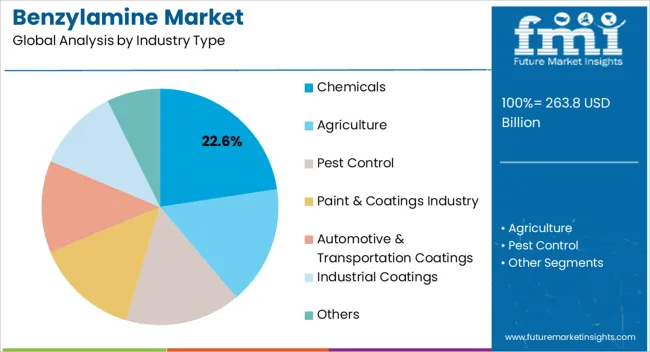
The chemicals industry type segment is projected to hold 22.6% of the Benzylamine market revenue in 2026, establishing it as the leading industry type. Its dominance is being driven by extensive usage of benzylamine as an intermediate in chemical synthesis, where it contributes to the production of pharmaceuticals, agrochemicals, and specialty chemical formulations. The compound’s versatility, high purity, and reactivity make it a preferred choice for manufacturers seeking efficient and reliable chemical intermediates.
Process optimization and cost-effective sourcing are further enhancing adoption in the chemical industry. Growing investments in chemical manufacturing infrastructure, coupled with increasing demand for advanced chemical derivatives, are supporting market growth.
Regulatory compliance and environmental standards have reinforced the use of standardized, high-quality benzylamine products As chemical manufacturers continue to prioritize efficiency, scalability, and safety in their production processes, the chemicals industry segment is expected to maintain its leading position, supported by consistent demand and continued technological improvements in chemical synthesis.
Insights into the Chemical Manufacturing Application Type Segment
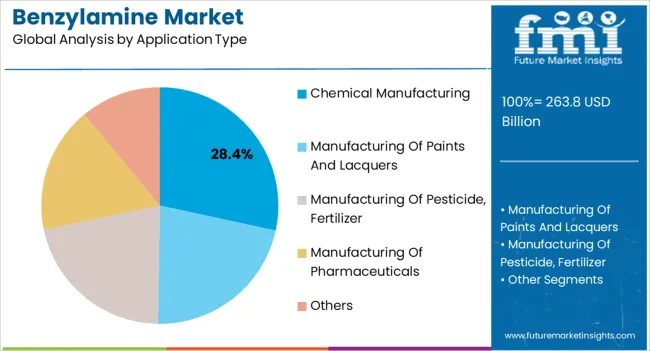
The chemical manufacturing application segment is anticipated to account for 28.4% of the market revenue in 2026, making it the leading application area. Growth in this segment is being driven by the high demand for benzylamine as a critical intermediate in the production of pharmaceuticals, agrochemicals, and polymer additives. Manufacturers are increasingly integrating benzylamine into complex synthesis processes to enhance production efficiency and maintain product quality.
The ability to support large-scale chemical production while maintaining purity and consistency has strengthened the adoption of this application. Continuous innovation in synthetic methods and improved process yields has further reinforced its market position.
Regulatory compliance related to chemical handling and environmental standards has increased the preference for standardized benzylamine products As the demand for specialty chemicals grows in emerging and established markets, the chemical manufacturing application segment is expected to remain the primary growth driver, supported by technological advancements and the expanding scope of chemical derivatives produced using benzylamine.
Insights into the Internet Retailing Distribution Channels Segment
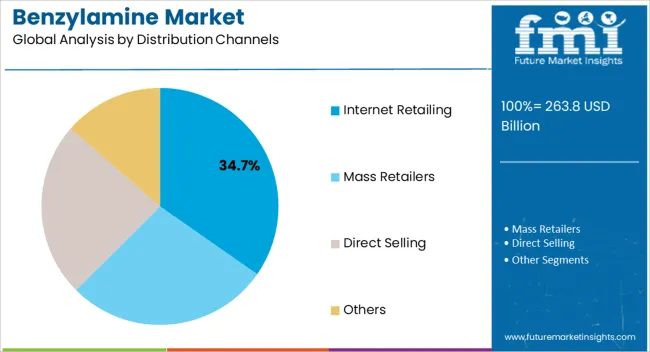
The internet retailing distribution channel segment is projected to hold 34.7% of the market revenue in 2026, establishing it as the leading channel. Its growth is being driven by the increasing adoption of digital procurement platforms for chemical intermediates, enabling manufacturers and smaller enterprises to source high-purity benzylamine efficiently. Online platforms provide streamlined ordering processes, real-time inventory tracking, and timely delivery, which reduce lead times and operational costs.
The availability of product information, safety data sheets, and regulatory compliance details online further supports adoption by businesses. Internet retailing also enables access to global suppliers, expanding market reach and supporting small- and medium-sized manufacturers who may not have direct sourcing capabilities.
Growing digitalization in the chemical supply chain, coupled with convenience and transparency in online transactions, has reinforced internet retailing as the preferred distribution channel As organizations continue to adopt e-commerce solutions for industrial procurement, this segment is expected to maintain its market leadership, supported by efficiency, accessibility, and technological integration in chemical supply networks.
Market Overview
Benzylamine Market Overview
Benzylamine is a chemical organic compound with the abridged structural formula C6H5CH2NH2. Benzylamine comprises of a C6H5CH2, benzyl group, bonded to an amine functional group, NH2. Benzylamine is a collective precursor in organic synthesis and used in the industrial production of numerous pharmaceuticals.
Benzylamine is a primary alkylamine and valuable intermediate for several applications and a building block for chemical synthesis such as crop protection agents, and the production of active Pharma Ingredients which is used within the coatings industry. Benzylamine is also used as a disguised source of ammonia, and a sub component of Benzylamine that is isoquinolines are a class of compounds which are used in medical frameworks.
Analysis of Benzylamine Market By Key Countries
.webp "Top Country Growth Comparison Benzylamine Market Cagr (2026 2036)")
| Country | CAGR |
|---|---|
| China | 7.4% |
| India | 6.9% |
| Germany | 6.3% |
| France | 5.8% |
| UK | 5.2% |
| USA | 4.7% |
| Brazil | 4.1% |
Country-wise Analysis
The Benzylamine Market is expected to register a CAGR of 5.5% during the forecast period, exhibiting varied country level momentum. China leads with the highest CAGR of 7.4%, followed by India at 6.9%. Developed markets such as Germany, France, and the UK continue to expand steadily, while the USA is likely to grow at consistent rates. Brazil posts the lowest CAGR at 4.1%, yet still underscores a broadly positive trajectory for the global Benzylamine Market. In 2026, Germany held a dominant revenue in the Western Europe market and is expected to grow with a CAGR of 6.3%. The USA Benzylamine Market is estimated to be valued at USD 99.5 billion in 2026 and is anticipated to reach a valuation of USD 157.2 billion by 2036. Sales are projected to rise at a CAGR of 4.7% over the forecast period between 2026 and 2036. While Japan and South Korea markets are estimated to be valued at USD 13.4 billion and USD 8.6 billion respectively in 2026.
Key Players in the Benzylamine Market
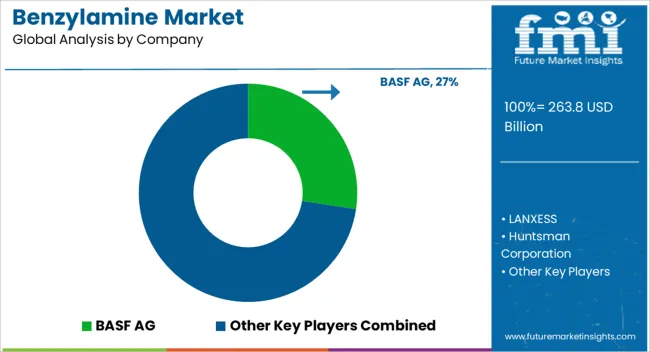
- BASF AG
- LANXESS
- Huntsman Corporation
- Dow Chemical Company
- Eastman Chemical Company
Scope of the Report
| Metric | Value |
|---|---|
| Quantitative Units | USD 278.31 Bn to USD 475.39 Bn, at a CAGR of 5.50% |
| Market Definition | Benzylamine encompasses organic amine intermediates consumed across chemical manufacturing, paint and lacquer production, pesticide and fertilizer formulation, pharmaceutical synthesis, and specialty industrial applications distributed through internet retailing, mass retail, direct selling, and institutional procurement channels. |
| Segmentation | Industry Type: Chemicals, Agriculture, Pest Control, Paint & Coatings Industry, Automotive & Transportation Coatings, Industrial Coatings, Others; Application Type: Chemical Manufacturing, Manufacturing Of Paints And Lacquers, Manufacturing Of Pesticide, Fertilizer, Manufacturing Of Pharmaceuticals, Others; Distribution Channels: Internet Retailing, Mass Retailers, Direct Selling, Others |
| Regions Covered | North America, Latin America, Europe, East Asia, South Asia, Oceania, Middle East & Africa |
| Countries Covered | China, India, Germany, France, UK, USA, Brazil, and 40 plus countries |
| Key Companies Profiled | BASF AG, LANXESS, Huntsman Corporation, Dow Chemical Company, Eastman Chemical Company |
| Forecast Period | 2026 to 2036 |
| Approach | Forecasting models apply a bottom-up methodology starting with global production and consumption metrics for the defined product category and projecting regional demand conversion rates. |
Benzylamine Market by Segments
Industry Type:
- Chemicals
- Agriculture
- Pest Control
- Paint & Coatings Industry
- Automotive & Transportation Coatings
- Industrial Coatings
- Others
Application Type:
- Chemical Manufacturing
- Manufacturing Of Paints And Lacquers
- Manufacturing Of Pesticide, Fertilizer
- Manufacturing Of Pharmaceuticals
- Others
Distribution Channels:
- Internet Retailing
- Mass Retailers
- Direct Selling
- Others
Region:
- North America
- USA
- Canada
- Mexico
- Latin America
- Brazil
- Chile
- Rest of Latin America
- Western Europe
- Germany
- UK
- Italy
- Spain
- France
- Nordic
- BENELUX
- Rest of Western Europe
- Eastern Europe
- Russia
- Poland
- Hungary
- Balkan & Baltic
- Rest of Eastern Europe
- East Asia
- China
- Japan
- South Korea
- South Asia and Pacific
- India
- ASEAN
- Australia & New Zealand
- Rest of South Asia and Pacific
- Middle East & Africa
- Kingdom of Saudi Arabia
- Other GCC Countries
- Turkiye
- South Africa
- Other African Union
- Rest of Middle East & Africa
Bibliography
- 1. European Chemicals Agency. (2024). REACH registration dossier: Benzylamine, CAS 100-46-9. ECHA.
- 2. United States Environmental Protection Agency. (2024). Chemical data reporting: Benzylamine manufacturing and processing volumes. EPA.
- 3. International Labour Organization. (2024). International chemical safety cards: Benzylamine, ICSC 0662. ILO.
- 4. Organisation for Economic Co-operation and Development. (2024). SIDS Initial Assessment Report: Benzylamine. OECD.
- 5. National Institute for Occupational Safety and Health. (2024). Pocket guide to chemical hazards: Benzylamine. NIOSH.
This bibliography is provided for reader reference. The full Future Market Insights report contains the complete reference list with primary research documentation.
Frequently Asked Questions
How large is the demand for Benzylamine in the global market in 2026?
Demand for Benzylamine in the global market is estimated to be valued at USD 278.31 billion in 2026.
What will be the market size of Benzylamine in the global market by 2036?
Market size for Benzylamine is projected to reach USD 475.39 billion by 2036.
What is the expected demand growth for Benzylamine in the global market between 2026 and 2036?
Demand for Benzylamine is expected to grow at a CAGR of 5.50% between 2026 and 2036.
Which Industry Type segment is poised to lead global sales by 2026?
Chemicals accounts for 22.6% share in 2026.
How is the Application Type segment structured in the Benzylamine market?
Chemical Manufacturing leads the Application Type segment with 28.4% share in 2026.
What is the China growth outlook in this report?
China is projected to grow at a CAGR of 7.4% during 2026 to 2036.
What is Benzylamine and what is it mainly used for?
Benzylamine covers the specialty materials and chemical products within the defined market scope. Refer to the market definition section for detailed coverage.
How does FMI build and validate the Benzylamine forecast?
Forecasting models apply a bottom-up methodology starting with global production and consumption metrics and cross-validate projections against publicly reported industry expenditure volumes.
Preview the report firsthand - request a free sample
Get SampleGet the brochure for pricing and purchase details.
Get PDFTable of Content
- Executive Summary
- Global Market Outlook
- Demand-side Trends
- Supply-side Trends
- Technology Roadmap Analysis
- Analysis and Recommendations
- Market Overview
- Market Coverage / Taxonomy
- Market Definition / Scope / Limitations
- Research Methodology
- Chapter Orientation
- Analytical Lens and Working Hypotheses
- Market Structure, Signals, and Trend Drivers
- Benchmarking and Cross-market Comparability
- Market Sizing, Forecasting, and Opportunity Mapping
- Research Design and Evidence Framework
- Desk Research Programme (Secondary Evidence)
- Company Annual and Sustainability Reports
- Peer-reviewed Journals and Academic Literature
- Corporate Websites, Product Literature, and Technical Notes
- Earnings Decks and Investor Briefings
- Statutory Filings and Regulatory Disclosures
- Technical White Papers and Standards Notes
- Trade Journals, Industry Magazines, and Analyst Briefs
- Conference Proceedings, Webinars, and Seminar Materials
- Government Statistics Portals and Public Data Releases
- Press Releases and Reputable Media Coverage
- Specialist Newsletters and Curated Briefings
- Sector Databases and Reference Repositories
- FMI Internal Proprietary Databases and Historical Market Datasets
- Subscription Datasets and Paid Sources
- Social Channels, Communities, and Digital Listening Inputs
- Additional Desk Sources
- Expert Input and Fieldwork (Primary Evidence)
- Primary Modes
- Qualitative Interviews and Expert Elicitation
- Quantitative Surveys and Structured Data Capture
- Blended Approach
- Why Primary Evidence is Used
- Field Techniques
- Interviews
- Surveys
- Focus Groups
- Observational and In-context Research
- Social and Community Interactions
- Stakeholder Universe Engaged
- C-suite Leaders
- Board Members
- Presidents and Vice Presidents
- R&D and Innovation Heads
- Technical Specialists
- Domain Subject-matter Experts
- Scientists
- Physicians and Other Healthcare Professionals
- Governance, Ethics, and Data Stewardship
- Research Ethics
- Data Integrity and Handling
- Primary Modes
- Tooling, Models, and Reference Databases
- Desk Research Programme (Secondary Evidence)
- Data Engineering and Model Build
- Data Acquisition and Ingestion
- Cleaning, Normalisation, and Verification
- Synthesis, Triangulation, and Analysis
- Quality Assurance and Audit Trail
- Market Background
- Market Dynamics
- Drivers
- Restraints
- Opportunity
- Trends
- Scenario Forecast
- Demand in Optimistic Scenario
- Demand in Likely Scenario
- Demand in Conservative Scenario
- Opportunity Map Analysis
- Product Life Cycle Analysis
- Supply Chain Analysis
- Investment Feasibility Matrix
- Value Chain Analysis
- PESTLE and Porter’s Analysis
- Regulatory Landscape
- Regional Parent Market Outlook
- Production and Consumption Statistics
- Import and Export Statistics
- Market Dynamics
- Global Market Analysis 2021 to 2025 and Forecast, 2026 to 2036
- Historical Market Size Value (USD Million) Analysis, 2021 to 2025
- Current and Future Market Size Value (USD Million) Projections, 2026 to 2036
- Y-o-Y Growth Trend Analysis
- Absolute $ Opportunity Analysis
- Global Market Pricing Analysis 2021 to 2025 and Forecast 2026 to 2036
- Global Market Analysis 2021 to 2025 and Forecast 2026 to 2036, By Industry Type
- Introduction / Key Findings
- Historical Market Size Value (USD Million) Analysis By Industry Type , 2021 to 2025
- Current and Future Market Size Value (USD Million) Analysis and Forecast By Industry Type , 2026 to 2036
- Chemicals
- Agriculture
- Pest Control
- Paint & Coatings Industry
- Automotive & Transportation Coatings
- Industrial Coatings
- Others
- Chemicals
- Y-o-Y Growth Trend Analysis By Industry Type , 2021 to 2025
- Absolute $ Opportunity Analysis By Industry Type , 2026 to 2036
- Global Market Analysis 2021 to 2025 and Forecast 2026 to 2036, By Application Type
- Introduction / Key Findings
- Historical Market Size Value (USD Million) Analysis By Application Type, 2021 to 2025
- Current and Future Market Size Value (USD Million) Analysis and Forecast By Application Type, 2026 to 2036
- Chemical Manufacturing
- Manufacturing Of Paints And Lacquers
- Manufacturing Of Pesticide, Fertilizer
- Manufacturing Of Pharmaceuticals
- Others
- Chemical Manufacturing
- Y-o-Y Growth Trend Analysis By Application Type, 2021 to 2025
- Absolute $ Opportunity Analysis By Application Type, 2026 to 2036
- Global Market Analysis 2021 to 2025 and Forecast 2026 to 2036, By Distribution Channels
- Introduction / Key Findings
- Historical Market Size Value (USD Million) Analysis By Distribution Channels, 2021 to 2025
- Current and Future Market Size Value (USD Million) Analysis and Forecast By Distribution Channels, 2026 to 2036
- Internet Retailing
- Mass Retailers
- Direct Selling
- Others
- Internet Retailing
- Y-o-Y Growth Trend Analysis By Distribution Channels, 2021 to 2025
- Absolute $ Opportunity Analysis By Distribution Channels, 2026 to 2036
- Global Market Analysis 2021 to 2025 and Forecast 2026 to 2036, By Region
- Introduction
- Historical Market Size Value (USD Million) Analysis By Region, 2021 to 2025
- Current Market Size Value (USD Million) Analysis and Forecast By Region, 2026 to 2036
- North America
- Latin America
- Western Europe
- Eastern Europe
- East Asia
- South Asia and Pacific
- Middle East & Africa
- Market Attractiveness Analysis By Region
- North America Market Analysis 2021 to 2025 and Forecast 2026 to 2036, By Country
- Historical Market Size Value (USD Million) Trend Analysis By Market Taxonomy, 2021 to 2025
- Market Size Value (USD Million) Forecast By Market Taxonomy, 2026 to 2036
- By Country
- USA
- Canada
- Mexico
- By Industry Type
- By Application Type
- By Distribution Channels
- By Country
- Market Attractiveness Analysis
- By Country
- By Industry Type
- By Application Type
- By Distribution Channels
- Key Takeaways
- Latin America Market Analysis 2021 to 2025 and Forecast 2026 to 2036, By Country
- Historical Market Size Value (USD Million) Trend Analysis By Market Taxonomy, 2021 to 2025
- Market Size Value (USD Million) Forecast By Market Taxonomy, 2026 to 2036
- By Country
- Brazil
- Chile
- Rest of Latin America
- By Industry Type
- By Application Type
- By Distribution Channels
- By Country
- Market Attractiveness Analysis
- By Country
- By Industry Type
- By Application Type
- By Distribution Channels
- Key Takeaways
- Western Europe Market Analysis 2021 to 2025 and Forecast 2026 to 2036, By Country
- Historical Market Size Value (USD Million) Trend Analysis By Market Taxonomy, 2021 to 2025
- Market Size Value (USD Million) Forecast By Market Taxonomy, 2026 to 2036
- By Country
- Germany
- UK
- Italy
- Spain
- France
- Nordic
- BENELUX
- Rest of Western Europe
- By Industry Type
- By Application Type
- By Distribution Channels
- By Country
- Market Attractiveness Analysis
- By Country
- By Industry Type
- By Application Type
- By Distribution Channels
- Key Takeaways
- Eastern Europe Market Analysis 2021 to 2025 and Forecast 2026 to 2036, By Country
- Historical Market Size Value (USD Million) Trend Analysis By Market Taxonomy, 2021 to 2025
- Market Size Value (USD Million) Forecast By Market Taxonomy, 2026 to 2036
- By Country
- Russia
- Poland
- Hungary
- Balkan & Baltic
- Rest of Eastern Europe
- By Industry Type
- By Application Type
- By Distribution Channels
- By Country
- Market Attractiveness Analysis
- By Country
- By Industry Type
- By Application Type
- By Distribution Channels
- Key Takeaways
- East Asia Market Analysis 2021 to 2025 and Forecast 2026 to 2036, By Country
- Historical Market Size Value (USD Million) Trend Analysis By Market Taxonomy, 2021 to 2025
- Market Size Value (USD Million) Forecast By Market Taxonomy, 2026 to 2036
- By Country
- China
- Japan
- South Korea
- By Industry Type
- By Application Type
- By Distribution Channels
- By Country
- Market Attractiveness Analysis
- By Country
- By Industry Type
- By Application Type
- By Distribution Channels
- Key Takeaways
- South Asia and Pacific Market Analysis 2021 to 2025 and Forecast 2026 to 2036, By Country
- Historical Market Size Value (USD Million) Trend Analysis By Market Taxonomy, 2021 to 2025
- Market Size Value (USD Million) Forecast By Market Taxonomy, 2026 to 2036
- By Country
- India
- ASEAN
- Australia & New Zealand
- Rest of South Asia and Pacific
- By Industry Type
- By Application Type
- By Distribution Channels
- By Country
- Market Attractiveness Analysis
- By Country
- By Industry Type
- By Application Type
- By Distribution Channels
- Key Takeaways
- Middle East & Africa Market Analysis 2021 to 2025 and Forecast 2026 to 2036, By Country
- Historical Market Size Value (USD Million) Trend Analysis By Market Taxonomy, 2021 to 2025
- Market Size Value (USD Million) Forecast By Market Taxonomy, 2026 to 2036
- By Country
- Kingdom of Saudi Arabia
- Other GCC Countries
- Turkiye
- South Africa
- Other African Union
- Rest of Middle East & Africa
- By Industry Type
- By Application Type
- By Distribution Channels
- By Country
- Market Attractiveness Analysis
- By Country
- By Industry Type
- By Application Type
- By Distribution Channels
- Key Takeaways
- Key Countries Market Analysis
- USA
- Pricing Analysis
- Market Share Analysis, 2025
- By Industry Type
- By Application Type
- By Distribution Channels
- Canada
- Pricing Analysis
- Market Share Analysis, 2025
- By Industry Type
- By Application Type
- By Distribution Channels
- Mexico
- Pricing Analysis
- Market Share Analysis, 2025
- By Industry Type
- By Application Type
- By Distribution Channels
- Brazil
- Pricing Analysis
- Market Share Analysis, 2025
- By Industry Type
- By Application Type
- By Distribution Channels
- Chile
- Pricing Analysis
- Market Share Analysis, 2025
- By Industry Type
- By Application Type
- By Distribution Channels
- Germany
- Pricing Analysis
- Market Share Analysis, 2025
- By Industry Type
- By Application Type
- By Distribution Channels
- UK
- Pricing Analysis
- Market Share Analysis, 2025
- By Industry Type
- By Application Type
- By Distribution Channels
- Italy
- Pricing Analysis
- Market Share Analysis, 2025
- By Industry Type
- By Application Type
- By Distribution Channels
- Spain
- Pricing Analysis
- Market Share Analysis, 2025
- By Industry Type
- By Application Type
- By Distribution Channels
- France
- Pricing Analysis
- Market Share Analysis, 2025
- By Industry Type
- By Application Type
- By Distribution Channels
- India
- Pricing Analysis
- Market Share Analysis, 2025
- By Industry Type
- By Application Type
- By Distribution Channels
- ASEAN
- Pricing Analysis
- Market Share Analysis, 2025
- By Industry Type
- By Application Type
- By Distribution Channels
- Australia & New Zealand
- Pricing Analysis
- Market Share Analysis, 2025
- By Industry Type
- By Application Type
- By Distribution Channels
- China
- Pricing Analysis
- Market Share Analysis, 2025
- By Industry Type
- By Application Type
- By Distribution Channels
- Japan
- Pricing Analysis
- Market Share Analysis, 2025
- By Industry Type
- By Application Type
- By Distribution Channels
- South Korea
- Pricing Analysis
- Market Share Analysis, 2025
- By Industry Type
- By Application Type
- By Distribution Channels
- Russia
- Pricing Analysis
- Market Share Analysis, 2025
- By Industry Type
- By Application Type
- By Distribution Channels
- Poland
- Pricing Analysis
- Market Share Analysis, 2025
- By Industry Type
- By Application Type
- By Distribution Channels
- Hungary
- Pricing Analysis
- Market Share Analysis, 2025
- By Industry Type
- By Application Type
- By Distribution Channels
- Kingdom of Saudi Arabia
- Pricing Analysis
- Market Share Analysis, 2025
- By Industry Type
- By Application Type
- By Distribution Channels
- Turkiye
- Pricing Analysis
- Market Share Analysis, 2025
- By Industry Type
- By Application Type
- By Distribution Channels
- South Africa
- Pricing Analysis
- Market Share Analysis, 2025
- By Industry Type
- By Application Type
- By Distribution Channels
- USA
- Market Structure Analysis
- Competition Dashboard
- Competition Benchmarking
- Market Share Analysis of Top Players
- By Regional
- By Industry Type
- By Application Type
- By Distribution Channels
- Competition Analysis
- Competition Deep Dive
- BASF AG
- Overview
- Product Portfolio
- Profitability by Market Segments (Product/Age /Sales Channel/Region)
- Sales Footprint
- Strategy Overview
- Marketing Strategy
- Product Strategy
- Channel Strategy
- LANXESS
- Huntsman Corporation
- Dow Chemical Company
- Eastman Chemical Company
- BASF AG
- Competition Deep Dive
- Assumptions & Acronyms Used


