

- Industry Size (2025)
- USD 63.7 Mn
- Forecast (2035)
- USD 189.5 Mn
- CAGR (2025 to 2035)
- 11.5%
Bio-Fermented Hyaluronic Acid Market Forecast and Outlook 2025 to 2035
The global demand for bio-fermented hyaluronic acid is expected to grow from USD 63.7 million in 2025 to USD 189.5 million by 2035, reflecting a compound annual growth rate (CAGR) of 11.5%. Bio-fermented hyaluronic acid, derived through fermentation processes, is gaining popularity in the skincare and cosmetics industry for its superior moisturizing, anti-aging, and skin-plumping benefits. As consumers increasingly seek natural, bio-based ingredients, demand for bio-fermented hyaluronic acid is expected to rise, driven by growing awareness of its effectiveness and the broader shift towards clean beauty products. This growth is further fueled by the rising demand for anti-aging skincare and the ongoing development of innovative cosmetic formulations that leverage the benefits of hyaluronic acid.
The market will experience steady growth, starting at USD 63.7 million in 2025 and rising to USD 71.1 million in 2026, USD 79.3 million in 2027, and USD 88.4 million in 2028. By 2029, demand for bio-fermented hyaluronic acid will rise to USD 98.6 million, continuing its upward trajectory through the 2030s. By 2035, the demand for bio-fermented hyaluronic acid is projected to reach USD 189.5 million, driven by increasing consumer demand for hydrating, anti-aging skincare solutions and the growing use of fermented ingredients in the beauty industry.
Quick Stats of the Bio-Fermented Hyaluronic Acid Market
- Bio-Fermented Hyaluronic Acid Market Value (2025): USD 63.7 million
- Bio-Fermented Hyaluronic Acid Market Forecast Value (2035): USD 189.5 million
- Bio-Fermented Hyaluronic Acid Market Forecast CAGR (2025-2035): 11.5%
- Bio-Fermented Hyaluronic Acid Market Leading Product Form: Powder (16.6%)
- Bio-Fermented Hyaluronic Acid Market Key Growth Regions: India, China, Japan, UK, Germany, USA
- Bio-Fermented Hyaluronic Acid Market Key Players: BASF SE, Croda International, Evonik Industries, Symrise (incl. IFF/Givaudan actives), Dow / Dow Inc., Ashland, Clariant, Seppic

What is the Growth Forecast for the Global Bio-Fermented Hyaluronic Acid Industry through 2035?
The 10-year growth comparison for the Bio-Fermented Hyaluronic Acid market highlights a consistent upward trajectory in demand over the forecast period. From USD 63.7 million in 2025 to USD 189.5 million by 2035, the market is expected to expand by USD 125.8 million over the next decade. In the first five years (2025 to 2029), the market will grow from USD 63.7 million to USD 98.6 million, showing a solid increase of USD 34.9 million. This early growth phase will be driven by increasing awareness and adoption of bio-fermented hyaluronic acid in skincare products as consumers seek effective and natural beauty solutions.
In the second five years (2029 to 2035), the market will continue to see strong growth, with demand rising from USD 98.6 million in 2029 to USD 189.5 million by 2035, marking an increase of USD 90.9 million. This acceleration in the later years is expected to be driven by continued innovation in hyaluronic acid formulations, a shift towards sustainable and eco-friendly beauty products, and increasing consumer preference for clean, bio-based ingredients. The latter half of the decade will likely see heightened demand as more skincare brands adopt bio-fermented hyaluronic acid in their product offerings and as the ingredient becomes a mainstream component in premium skincare solutions.
Bio-Fermented Hyaluronic Acid Market Key Takeaways
| Metric | Value |
|---|---|
| Industry Sales Value (2025) | USD 63.7 million |
| Industry Forecast Value (2035) | USD 189.5 million |
| Industry Forecast CAGR (2025-2035) | 11.5% |
Why is the Demand for Bio-Fermented Hyaluronic Acid Growing Globally?
Demand for bio-fermented hyaluronic acid is rising sharply because it combines the well-known benefits of traditional hyaluronic acid (HA) such as hydration, skin elasticity improvement, joint lubrication, and wound healing support with advantages in sustainability, safety, and production scalability. Microbial fermentation enables production of HA without relying on animal-derived sources, making it more attractive to consumers and manufacturers focused on vegan, cruelty-free, and environmentally friendly products. Fermented HA retains the moisturizing and visco-elastic properties that make HA a staple in skincare, dermal fillers, eye drops, medical implants, and joint care, ensuring that existing demand for HA-based products increasingly shifts toward bio-fermented versions.
Growth of the overall global HA market supports strong growth for the bio-fermented segment. The global hyaluronic acid market was valued at around USD 5.4 billion in 2024 and is forecast to grow to USD 11 billion by 2034, reflecting growing demand in cosmetics, medical, and nutraceutical applications. A substantial share, above 70%, of HA production already uses microbial fermentation, underscoring the global industry shift away from animal-derived HA. The rising geriatric population, increasing demand for anti-aging skincare and minimally invasive aesthetic treatments, and expanding use in joint and eye care all contribute. As consumers and manufacturers more strongly favor clean-label, sustainable, and high-purity ingredients, demand for bio-fermented hyaluronic acid is expected to outpace overall HA growth in coming years.
What Drives the Global Demand for Bio-Fermented Hyaluronic Acid in Terms of Application and Product Form?
The global demand for bio-fermented hyaluronic acid is primarily driven by application and product form. The leading end-use application is skin care, accounting for 10.1% of the market share, while powder is the dominant product form, holding 16.6% of the demand. Bio-fermented hyaluronic acid, known for its moisturizing, anti-aging, and skin-rejuvenating properties, is gaining increasing popularity in various beauty and personal care formulations. The demand for this ingredient continues to grow as consumers seek high-performance, natural ingredients in their skincare and beauty routines.
Why Is Skin Care the Leading Application for Bio-Fermented Hyaluronic Acid?
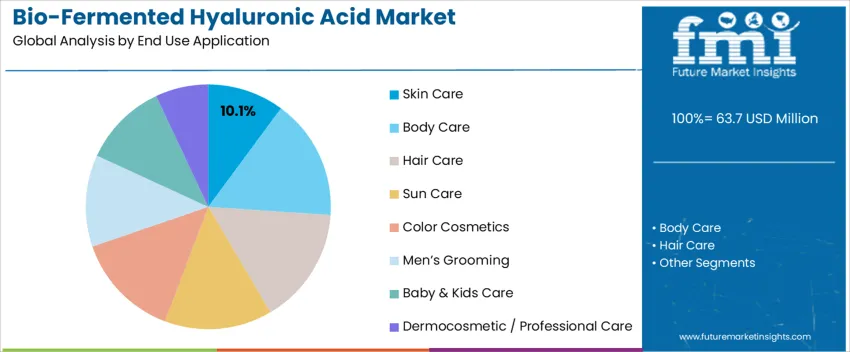
Skin care leads the end-use application demand for bio-fermented hyaluronic acid, capturing 10.1% of the market share. Bio-fermented hyaluronic acid is highly valued in skin care products for its ability to retain moisture, reduce the appearance of fine lines and wrinkles, and enhance the skin’s elasticity. It is a key ingredient in moisturizers, serums, and anti-aging formulations, offering benefits like deep hydration and improved skin texture.
The demand for bio-fermented hyaluronic acid in skin care is driven by the growing consumer interest in natural, effective ingredients that can help maintain youthful and healthy-looking skin. As more consumers prioritize hydration and skin regeneration in their beauty routines, bio-fermented hyaluronic acid is becoming a staple in skincare products. The increasing awareness of the benefits of fermented ingredients, coupled with the rising demand for sustainable and clean beauty products, ensures that bio-fermented hyaluronic acid will remain a key ingredient in the global skin care market.
Why Is Powder the Leading Product Form for Bio-Fermented Hyaluronic Acid?
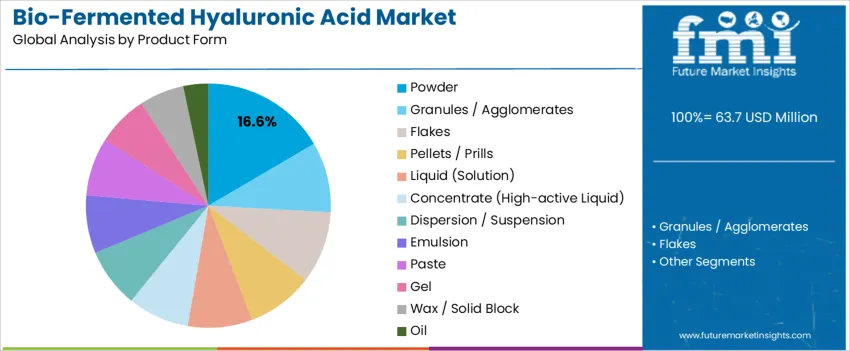
Powder is the leading product form for bio-fermented hyaluronic acid globally, holding 16.6% of the market share. The powdered form of bio-fermented hyaluronic acid is favored for its stability, longer shelf life, and versatility in various formulations. It can be easily incorporated into a wide range of cosmetic products, including serums, creams, masks, and other skin care treatments. The powder form also allows for precise dosing and is more efficient in terms of storage and shipping compared to liquid forms.
The demand for powdered bio-fermented hyaluronic acid is driven by its ability to offer high-concentration formulations while maintaining stability and effectiveness. As consumers increasingly seek customized skincare solutions, the flexibility of powdered hyaluronic acid allows manufacturers to create targeted, high-performance products. The growing trend toward clean, sustainable, and multifunctional beauty products further supports the popularity of the powder form in the global market for bio-fermented hyaluronic acid.
What is the Summary of Demand for Bio-Fermented Hyaluronic Acid Globally?
Demand for bio-fermented hyaluronic acid (HA) is growing worldwide as interest rises in skincare, medical, and wellness applications that rely on HA’s hydration, tissue support, and cosmetic benefits. Bio-fermented HA - produced via microbial fermentation rather than animal extraction - is perceived as safer, more sustainable, and compatible with clean-beauty and “bio-derived” ingredient trends. The global HA market is already large and expanding rapidly, driven by both aesthetic uses (skin-care, dermal fillers) and therapeutic/medical uses (joint treatments, ophthalmology, wound healing). As consumer awareness about skin health, anti-aging, joint care, and minimally invasive treatments increases, bio-fermented HA is increasingly adopted across regions around the world.
What are the Drivers of Global Demand for Bio-Fermented Hyaluronic Acid?
One major driver is growing demand for skincare and anti-aging products that deliver hydration, skin plumping, wrinkle reduction and improved skin elasticity. HA’s ability to retain water and support skin structure makes it a go-to ingredient in serums, creams, and injectables. Another driver is the aging global population, which increases demand for joint care, viscosupplementation for osteoarthritis, and other medical applications where HA is used to support mobility and joint fluid function. The rise of minimally invasive aesthetic procedures also supports HA use - injectables and skin-boosters based on HA are increasingly popular worldwide. Growing consumer preference for products based on non-animal, bio-fermented ingredients supports bio-fermented HA specifically. Advances in fermentation technology and scalable non-animal HA production make HA more accessible, cost-effective, and acceptable across markets.
What are the Restraints on Global Demand for Bio-Fermented Hyaluronic Acid?
Despite strong demand drivers, some factors limit broader adoption globally. One restraint is competition from alternative skincare or joint-care solutions - other moisturizing agents, synthetic fillers, peptides, or non-HA actives may be preferred for cost, convenience, or efficacy depending on region or consumer preference. Another challenge involves regulatory and quality-control standards: different countries may have varying rules for cosmetic or medical-grade HA, which can complicate global distribution and formulation. Cost remains a factor for high-purity, bio-fermented HA, especially for smaller brands or low-priced product segments. Also, for certain applications the benefits of HA (e.g. topical hydration) may be perceived as incremental or transient, which may limit repeat purchases.
What are the Key Trends Influencing Global Demand for Bio-Fermented Hyaluronic Acid?
A key trend is the shift toward non-animal and sustainably sourced ingredients in cosmetics and personal care. Bio-fermented HA fits well with consumer demand for clean-label, cruelty-free, and environmentally conscious products. Another trend is convergence of medical and cosmetic applications: HA is used not just for skin hydration or aesthetics, but also in joint therapies, ophthalmic solutions, wound healing, and regenerative medicine - broadening the demand base across cosmetics, pharma, and healthcare. Formulation innovation is rising: HA is increasingly combined with other bio-actives (antioxidants, peptides, growth factors) to deliver multifunctional benefits - hydration, anti-aging, joint support - in one product. Growth in global e-commerce and direct-to-consumer sales helps HA-based products reach consumers in emerging markets, where awareness of skin care and wellness is rising rapidly. As research advances and regulatory acceptance grows, bio-fermented HA is likely to become more standardized and widely used across regions.
What is the Regional Demand Outlook for the Bio-Fermented Hyaluronic Acid Market?

The demand for bio-fermented hyaluronic acid (BFHA) is witnessing significant growth globally, with India leading at a projected CAGR of 15.5%. China follows closely with a growth rate of 14.4%, while Japan is expected to grow at 13.2%. The UK, Germany, and the USA are also seeing steady growth, with CAGRs of 12.1%, 10.9%, and 9.8%, respectively. This surge in demand can be attributed to the growing consumer preference for clean, sustainable, and effective skincare ingredients, with bio-fermented hyaluronic acid being recognized for its skin-hydrating and anti-aging properties. As consumers seek natural, plant-based, and environmentally friendly alternatives in their beauty routines, bio-fermented hyaluronic acid is increasingly becoming a preferred choice in the cosmetics and personal care industries.
| Country | CAGR (%) |
|---|---|
| India | 15.5 |
| China | 14.4 |
| Japan | 13.2 |
| UK | 12.1 |
| Germany | 10.9 |
| USA | 9.8 |
What is Driving the Growth of Bio-Fermented Hyaluronic Acid in India?
India’s projected CAGR of 15.5% for bio-fermented hyaluronic acid is driven by the rapid expansion of the skincare and beauty markets, particularly in urban centers where consumers are becoming increasingly aware of the benefits of sustainable and natural ingredients. The growing demand for products that hydrate, rejuvenate, and protect the skin aligns perfectly with the properties of bio-fermented hyaluronic acid, which is known for its deep moisturizing and anti-aging effects. Additionally, India’s young population, along with a shift toward clean beauty and eco-friendly products, has created an ideal environment for the growth of bio-fermented hyaluronic acid-based formulations. As consumers in India move away from chemical-laden products, there is a significant increase in demand for skincare that supports long-term skin health using natural ingredients. The rise of e-commerce platforms has further amplified accessibility to such products, contributing to the ongoing growth of the BFHA market.
Why is Bio-Fermented Hyaluronic Acid Gaining Popularity in China?
In China, the demand for bio-fermented hyaluronic acid is projected to grow at a CAGR of 14.4%. The increasing awareness of the benefits of sustainable, clean beauty products is driving this growth. Bio-fermented hyaluronic acid, which is praised for its ability to hydrate the skin deeply and promote a youthful glow, is particularly appealing to Chinese consumers who are highly focused on skin health and anti-aging solutions. The growing influence of K-beauty and J-beauty trends, which emphasize natural ingredients and skin hydration, has further accelerated the adoption of BFHA in China. With the rising interest in high-quality, innovative skincare solutions, the demand for bio-fermented ingredients is expected to continue growing. Furthermore, as China’s skincare market expands and consumers demand products that are both effective and safe, bio-fermented hyaluronic acid is gaining momentum in the personal care industry.
How is Bio-Fermented Hyaluronic Acid Becoming Popular in Japan?
In Japan, the projected CAGR of 13.2% for bio-fermented hyaluronic acid is supported by the country’s long-standing tradition of using fermented ingredients in skincare. Japanese consumers have a high level of trust in natural, bio-fermented components, which has made BFHA a natural fit for the Japanese market. The popularity of products that hydrate and rejuvenate the skin is growing, and bio-fermented hyaluronic acid’s ability to deeply moisturize and improve skin elasticity makes it an ideal ingredient for anti-aging and skin repair formulations. Japan’s skincare market is characterized by its focus on high-quality, premium products, and BFHA is seen as a top-tier ingredient due to its effectiveness and the natural fermentation process. As Japan’s beauty standards evolve, more consumers are turning toward eco-friendly, cruelty-free, and sustainable ingredients, making bio-fermented hyaluronic acid increasingly popular in the country’s skincare and beauty industry.
What Supports the Growth of Bio-Fermented Hyaluronic Acid in the UK?
The UK is expected to see steady growth in the demand for bio-fermented hyaluronic acid, with a projected CAGR of 12.1%. The growing interest in clean and sustainable beauty products has led to an increased demand for bio-fermented ingredients like hyaluronic acid, which is widely known for its hydrating and skin-plumping effects. UK consumers are increasingly seeking products that not only improve their skin’s appearance but also support its long-term health, and BFHA fits these requirements perfectly. The trend towards natural and cruelty-free skincare is also playing a key role in driving this demand, as consumers become more conscious of ingredient sourcing and product sustainability. Moreover, the rise of “green” beauty brands in the UK has created an ideal market for bio-fermented hyaluronic acid, which aligns with the growing demand for products that are effective, environmentally friendly, and safe for the skin.
What is Driving Bio-Fermented Hyaluronic Acid Growth in Germany?
Germany’s skincare market is experiencing steady growth in the demand for bio-fermented hyaluronic acid, with a projected CAGR of 10.9%. Germany’s highly developed beauty industry has seen a shift toward more sustainable and natural beauty product, and BFHA, with its deeply moisturizing and anti-aging properties, aligns perfectly with these evolving consumer preferences. German consumers are increasingly focused on product efficacy and sustainability, and bio-fermented hyaluronic acid fits well into this trend due to its natural fermentation process and long-lasting effects on the skin. Furthermore, Germany's reputation for high-quality, dermatologically tested products drives the adoption of premium ingredients like BFHA. The increasing demand for functional, environmentally conscious skincare products, combined with the rise in awareness of the benefits of probiotics and fermented ingredients, is expected to continue driving the demand for bio-fermented hyaluronic acid in Germany’s skincare market.
How is Bio-Fermented Hyaluronic Acid Evolving in the USA?
In the USA, bio-fermented hyaluronic acid is projected to grow at a CAGR of 9.8%. The American skincare market is characterized by a growing preference for natural, high-performance ingredients, with bio-fermented hyaluronic acid being a popular choice due to its superior hydrating and anti-aging benefits. As more consumers look for skincare products that support healthy, glowing skin while being free from harsh chemicals, BFHA is becoming a key ingredient in many skincare formulations. Additionally, the growing interest in clean beauty and eco-friendly products, combined with increasing consumer education on the importance of microbiome health, is driving the demand for fermented ingredients. The USA’s large and diverse consumer base, along with the increasing influence of e-commerce platforms, ensures that bio-fermented hyaluronic acid will continue to see strong adoption across the country, particularly in premium skincare products targeting anti-aging, hydration, and skin barrier support.
What is the Competitive Landscape for the Global Bio-Fermented Hyaluronic Acid Market?

Global demand for bio-fermented hyaluronic acid (HA) has risen as manufacturers and consumers shift toward sustainably sourced, cruelty-free and biotechnologically produced skincare actives. Fermented HA is produced through microbial fermentation rather than extraction from animal or animal-derived tissues. Its increasing adoption is driven by rising consumer interest in hydration, skin elasticity, and anti-aging benefits. HA is widely valued for its capacity to retain moisture in the skin, improve hydration, and support skin elasticity and smoothness. These attributes make HA a core ingredient in moisturizers, serums, anti-aging creams, and medical-cosmetic preparations globally. The trend toward plant-based, vegan and “clean-label” skincare further supports demand for bio-fermented HA, especially in regions such as North America, Europe and Asia-Pacific where consumer awareness and regulatory scrutiny of ingredient sourcing are high.
Within this growing market a handful of ingredient-specialist firms lead supply and compete for share. According to your list, BASF SE holds a leading share of approximately 11.7%. Other significant players include Croda International, Evonik Industries, Symrise (including IFF/Givaudan actives), Dow Inc., Ashland Global Holdings Inc., Clariant, and Seppic. These firms supply bio-fermented HA in standardized, cosmetic-grade forms to skincare, personal care and medical-cosmetic product manufacturers worldwide.
Competition among these suppliers centers on product purity, molecular-weight control, fermentation technology, consistency of supply, and compliance with global regulatory standards. Some firms differentiate by investing in advanced microbial fermentation techniques that produce high-molecular-weight HA with defined quality and reproducibility. Others emphasize sustainable sourcing, cruelty-free certification, and scalability to meet growing demand. As the global skin-care and aesthetic market continues to expand and consumers increasingly favor sustainable, effective and ethically sourced ingredients, firms that deliver high-quality, bio-fermented HA with robust quality control and supply-chain practices are best positioned to capture growth.
Key Players of the Bio-Fermented Hyaluronic Acid Market
- BASF SE
- Croda International
- Evonik Industries
- Symrise (incl. IFF/Givaudan actives)
- Dow / Dow Inc.
- Ashland
- Clariant
- Seppic
Scope of the Report
| Items | Details |
|---|---|
| Quantitative Units | USD Million |
| Regions Covered | North America, Europe, Asia Pacific, The Middle East & Africa, Latin America |
| Countries Covered | United States, Canada, United Kingdom, Germany, France, China, Japan, South Korea, Brazil, Australia |
| End Use Application | Skin Care, Body Care, Hair Care, Sun Care, Color Cosmetics, Men’s Grooming, Baby & Kids Care, Dermocosmetic / Professional Care |
| Product Form | Powder, Granules / Agglomerates, Flakes, Pellets / Prills, Liquid (Solution), Concentrate (High-active Liquid), Dispersion / Suspension, Emulsion, Paste, Gel, Wax / Solid Block, Oil |
| Key Companies Profiled | BASF SE, Croda International, Evonik Industries, Symrise (incl. IFF/Givaudan actives), Dow / Dow Inc., Ashland, Clariant, Seppic |
| Additional Attributes | Dollar sales by end-use application and product form show strong demand for bifida ferment lysate, particularly in skin care and body care products. Liquid solutions and emulsions are the most popular product forms, with concentrate forms also growing in demand. Major companies like BASF, Evonik, and Ashland dominate the market, offering a range of active ingredients for the cosmetic and dermocosmetic industries. The market is expected to grow with rising demand for innovative skincare solutions and natural ingredients. |
Key Segments in the Bio-Fermented Hyaluronic Acid Market
End Use Application
- Skin Care
- Body Care
- Hair Care
- Sun Care
- Color Cosmetics
- Men’s Grooming
- Baby & Kids Care
- Dermocosmetic / Professional Care
Product Form
- Powder
- Granules / Agglomerates
- Flakes
- Pellets / Prills
- Liquid (Solution)
- Concentrate (High-active Liquid)
- Dispersion / Suspension
- Emulsion
- Paste
- Gel
- Wax / Solid Block
- Oil
Region
- Asia Pacific
- China
- Japan
- South Korea
- India
- Australia & New Zealand
- ASEAN
- Rest of Asia Pacific
- Europe
- Germany
- United Kingdom
- France
- Italy
- Spain
- Nordic
- BENELUX
- Rest of Europe
- North America
- United States
- Canada
- Mexico
- Latin America
- Brazil
- Chile
- Rest of Latin America
- Middle East & Africa
- Kingdom of Saudi Arabia
- Other GCC Countries
- Turkey
- South Africa
- Other African Union
- Rest of Middle East & Africa
Frequently Asked Questions
How big is the bio-fermented hyaluronic acid market in 2025?
The global bio-fermented hyaluronic acid market is estimated to be valued at USD 63.7 million in 2025.
What will be the size of bio-fermented hyaluronic acid market in 2035?
The market size for the bio-fermented hyaluronic acid market is projected to reach USD 189.5 million by 2035.
How much will be the bio-fermented hyaluronic acid market growth between 2025 and 2035?
The bio-fermented hyaluronic acid market is expected to grow at a 11.5% CAGR between 2025 and 2035.
What are the key product types in the bio-fermented hyaluronic acid market?
The key product types in bio-fermented hyaluronic acid market are skin care, body care, hair care, sun care, color cosmetics, men’s grooming, baby & kids care and dermocosmetic / professional care.
Which product form segment to contribute significant share in the bio-fermented hyaluronic acid market in 2025?
In terms of product form , powder segment to command 16.6% share in the bio-fermented hyaluronic acid market in 2025.
Preview the report firsthand - request a free sample
Get SampleGet the brochure for pricing and purchase details.
Get PDFTable of Content
- Executive Summary
- Global Market Outlook
- Demand-side Trends
- Supply-side Trends
- Technology Roadmap Analysis
- Analysis and Recommendations
- Market Overview
- Market Coverage / Taxonomy
- Market Definition / Scope / Limitations
- Market Background
- Market Dynamics
- Drivers
- Restraints
- Opportunity
- Trends
- Scenario Forecast
- Demand in Optimistic Scenario
- Demand in Likely Scenario
- Demand in Conservative Scenario
- Opportunity Map Analysis
- Product Life Cycle Analysis
- Supply Chain Analysis
- Investment Feasibility Matrix
- Value Chain Analysis
- PESTLE and Porter’s Analysis
- Regulatory Landscape
- Regional Parent Market Outlook
- Production and Consumption Statistics
- Import and Export Statistics
- Market Dynamics
- Global Market Analysis 2020 to 2024 and Forecast, 2025 to 2035
- Historical Market Size Value (USD Million) Analysis, 2020 to 2024
- Current and Future Market Size Value (USD Million) Projections, 2025 to 2035
- Y-o-Y Growth Trend Analysis
- Absolute $ Opportunity Analysis
- Global Market Pricing Analysis 2020 to 2024 and Forecast 2025 to 2035
- Global Market Analysis 2020 to 2024 and Forecast 2025 to 2035, By End Use Application
- Introduction / Key Findings
- Historical Market Size Value (USD Million) Analysis By End Use Application , 2020 to 2024
- Current and Future Market Size Value (USD Million) Analysis and Forecast By End Use Application , 2025 to 2035
- Skin Care
- Body Care
- Hair Care
- Sun Care
- Color Cosmetics
- Men’s Grooming
- Baby & Kids Care
- Dermocosmetic / Professional Care
- Y-o-Y Growth Trend Analysis By End Use Application , 2020 to 2024
- Absolute $ Opportunity Analysis By End Use Application , 2025 to 2035
- Global Market Analysis 2020 to 2024 and Forecast 2025 to 2035, By Product Form
- Introduction / Key Findings
- Historical Market Size Value (USD Million) Analysis By Product Form, 2020 to 2024
- Current and Future Market Size Value (USD Million) Analysis and Forecast By Product Form, 2025 to 2035
- Powder
- Granules / Agglomerates
- Flakes
- Pellets / Prills
- Liquid (Solution)
- Concentrate (High-active Liquid)
- Dispersion / Suspension
- Emulsion
- Paste
- Gel
- Wax / Solid Block
- Y-o-Y Growth Trend Analysis By Product Form, 2020 to 2024
- Absolute $ Opportunity Analysis By Product Form, 2025 to 2035
- Global Market Analysis 2020 to 2024 and Forecast 2025 to 2035, By Region
- Introduction
- Historical Market Size Value (USD Million) Analysis By Region, 2020 to 2024
- Current Market Size Value (USD Million) Analysis and Forecast By Region, 2025 to 2035
- North America
- Latin America
- Western Europe
- Eastern Europe
- East Asia
- South Asia and Pacific
- Middle East & Africa
- Market Attractiveness Analysis By Region
- North America Market Analysis 2020 to 2024 and Forecast 2025 to 2035, By Country
- Historical Market Size Value (USD Million) Trend Analysis By Market Taxonomy, 2020 to 2024
- Market Size Value (USD Million) Forecast By Market Taxonomy, 2025 to 2035
- By Country
- USA
- Canada
- Mexico
- By End Use Application
- By Product Form
- By Country
- Market Attractiveness Analysis
- By Country
- By End Use Application
- By Product Form
- Key Takeaways
- Latin America Market Analysis 2020 to 2024 and Forecast 2025 to 2035, By Country
- Historical Market Size Value (USD Million) Trend Analysis By Market Taxonomy, 2020 to 2024
- Market Size Value (USD Million) Forecast By Market Taxonomy, 2025 to 2035
- By Country
- Brazil
- Chile
- Rest of Latin America
- By End Use Application
- By Product Form
- By Country
- Market Attractiveness Analysis
- By Country
- By End Use Application
- By Product Form
- Key Takeaways
- Western Europe Market Analysis 2020 to 2024 and Forecast 2025 to 2035, By Country
- Historical Market Size Value (USD Million) Trend Analysis By Market Taxonomy, 2020 to 2024
- Market Size Value (USD Million) Forecast By Market Taxonomy, 2025 to 2035
- By Country
- Germany
- UK
- Italy
- Spain
- France
- Nordic
- BENELUX
- Rest of Western Europe
- By End Use Application
- By Product Form
- By Country
- Market Attractiveness Analysis
- By Country
- By End Use Application
- By Product Form
- Key Takeaways
- Eastern Europe Market Analysis 2020 to 2024 and Forecast 2025 to 2035, By Country
- Historical Market Size Value (USD Million) Trend Analysis By Market Taxonomy, 2020 to 2024
- Market Size Value (USD Million) Forecast By Market Taxonomy, 2025 to 2035
- By Country
- Russia
- Poland
- Hungary
- Balkan & Baltic
- Rest of Eastern Europe
- By End Use Application
- By Product Form
- By Country
- Market Attractiveness Analysis
- By Country
- By End Use Application
- By Product Form
- Key Takeaways
- East Asia Market Analysis 2020 to 2024 and Forecast 2025 to 2035, By Country
- Historical Market Size Value (USD Million) Trend Analysis By Market Taxonomy, 2020 to 2024
- Market Size Value (USD Million) Forecast By Market Taxonomy, 2025 to 2035
- By Country
- China
- Japan
- South Korea
- By End Use Application
- By Product Form
- By Country
- Market Attractiveness Analysis
- By Country
- By End Use Application
- By Product Form
- Key Takeaways
- South Asia and Pacific Market Analysis 2020 to 2024 and Forecast 2025 to 2035, By Country
- Historical Market Size Value (USD Million) Trend Analysis By Market Taxonomy, 2020 to 2024
- Market Size Value (USD Million) Forecast By Market Taxonomy, 2025 to 2035
- By Country
- India
- ASEAN
- Australia & New Zealand
- Rest of South Asia and Pacific
- By End Use Application
- By Product Form
- By Country
- Market Attractiveness Analysis
- By Country
- By End Use Application
- By Product Form
- Key Takeaways
- Middle East & Africa Market Analysis 2020 to 2024 and Forecast 2025 to 2035, By Country
- Historical Market Size Value (USD Million) Trend Analysis By Market Taxonomy, 2020 to 2024
- Market Size Value (USD Million) Forecast By Market Taxonomy, 2025 to 2035
- By Country
- Kingdom of Saudi Arabia
- Other GCC Countries
- Turkiye
- South Africa
- Other African Union
- Rest of Middle East & Africa
- By End Use Application
- By Product Form
- By Country
- Market Attractiveness Analysis
- By Country
- By End Use Application
- By Product Form
- Key Takeaways
- Key Countries Market Analysis
- USA
- Pricing Analysis
- Market Share Analysis, 2024
- By End Use Application
- By Product Form
- Canada
- Pricing Analysis
- Market Share Analysis, 2024
- By End Use Application
- By Product Form
- Mexico
- Pricing Analysis
- Market Share Analysis, 2024
- By End Use Application
- By Product Form
- Brazil
- Pricing Analysis
- Market Share Analysis, 2024
- By End Use Application
- By Product Form
- Chile
- Pricing Analysis
- Market Share Analysis, 2024
- By End Use Application
- By Product Form
- Germany
- Pricing Analysis
- Market Share Analysis, 2024
- By End Use Application
- By Product Form
- UK
- Pricing Analysis
- Market Share Analysis, 2024
- By End Use Application
- By Product Form
- Italy
- Pricing Analysis
- Market Share Analysis, 2024
- By End Use Application
- By Product Form
- Spain
- Pricing Analysis
- Market Share Analysis, 2024
- By End Use Application
- By Product Form
- France
- Pricing Analysis
- Market Share Analysis, 2024
- By End Use Application
- By Product Form
- India
- Pricing Analysis
- Market Share Analysis, 2024
- By End Use Application
- By Product Form
- ASEAN
- Pricing Analysis
- Market Share Analysis, 2024
- By End Use Application
- By Product Form
- Australia & New Zealand
- Pricing Analysis
- Market Share Analysis, 2024
- By End Use Application
- By Product Form
- China
- Pricing Analysis
- Market Share Analysis, 2024
- By End Use Application
- By Product Form
- Japan
- Pricing Analysis
- Market Share Analysis, 2024
- By End Use Application
- By Product Form
- South Korea
- Pricing Analysis
- Market Share Analysis, 2024
- By End Use Application
- By Product Form
- Russia
- Pricing Analysis
- Market Share Analysis, 2024
- By End Use Application
- By Product Form
- Poland
- Pricing Analysis
- Market Share Analysis, 2024
- By End Use Application
- By Product Form
- Hungary
- Pricing Analysis
- Market Share Analysis, 2024
- By End Use Application
- By Product Form
- Kingdom of Saudi Arabia
- Pricing Analysis
- Market Share Analysis, 2024
- By End Use Application
- By Product Form
- Turkiye
- Pricing Analysis
- Market Share Analysis, 2024
- By End Use Application
- By Product Form
- South Africa
- Pricing Analysis
- Market Share Analysis, 2024
- By End Use Application
- By Product Form
- USA
- Market Structure Analysis
- Competition Dashboard
- Competition Benchmarking
- Market Share Analysis of Top Players
- By Regional
- By End Use Application
- By Product Form
- Competition Analysis
- Competition Deep Dive
- BASF SE
- Overview
- Product Portfolio
- Profitability by Market Segments (Product/Age /Sales Channel/Region)
- Sales Footprint
- Strategy Overview
- Marketing Strategy
- Product Strategy
- Channel Strategy
- Croda International
- Evonik Industries
- Symrise (incl. IFF/Givaudan actives)
- Dow / Dow Inc.
- Ashland
- Clariant
- Seppic
- BASF SE
- Competition Deep Dive
- Assumptions & Acronyms Used
- Research Methodology


