

- Market Size (2026)
- USD 1120.7 Mn
- Forecast (2036)
- USD 3770.8 Mn
- CAGR (2026 to 2036)
- 12.9%
How big is the bio-oil upgrading market in 2026?
USD 1,120.7 million in 2026 and USD 3,770.8 million by 2036 at a 12.9% CAGR.
The bio-oil upgrading industry value is forecast to rise from USD 992.6 million in 2025 to USD 3,770.8 million by 2036 at 12.9% CAGR as fuel producers qualify advanced liquid feedstocks for renewable diesel, marine fuels, and sustainable aviation fuel. Pilot / Demo projects are forecast to represent 62.0% share in 2026 as feedstock variability keeps qualification work active before full commercial contracts. Refinery Co-processing is expected to secure 57.0% share in 2026, led by use of existing hydroprocessing assets before standalone upgrading units.
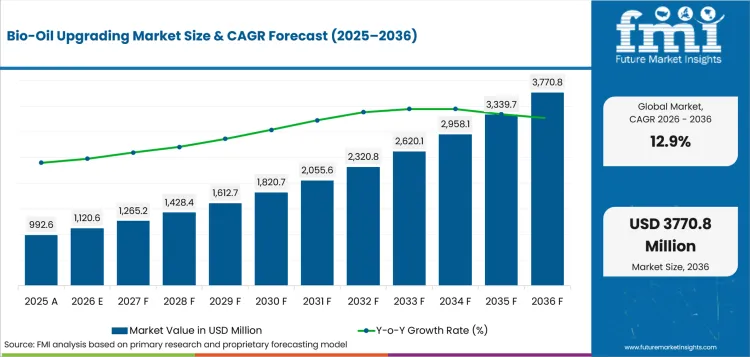
Bio-Oil Upgrading Market Overview: Size and Forecast
- 2026 Market Size: USD 1,120.7 million
- 2036 Market Size: USD 3,770.8 million
- Forecast CAGR: 12.9% from 2026 to 2036
- Leading Project Stage: Pilot / Demo
- Pilot / Demo Share in 2026: 62.0%
- Leading Facility Type: Refinery Co-processing
- Refinery Co-processing Share in 2026: 57.0%
- Fastest-growing Country: China
- China CAGR: 14.2% by 2036
Summary of the Bio-Oil Upgrading Market
- Demand and Growth Drivers
- Refiners are moving from raw bio-oil evaluation toward upgraded intermediates with lower acidity and better storage stability.
- Aviation fuel suppliers are reviewing advanced feedstock pathways as SAF obligations move from voluntary supply into formal compliance planning.
- Technology licensors are extending refinery-facing process packages through catalysts, pilot skids, and carbon accounting support.
- Product and Segment View
- Pilot / Demo projects are projected to represent 62.0% share in 2026, led by long testing cycles and variable feedstock quality.
- Refinery Co-processing is projected to hold 57.0% share in 2026, influenced by lower capital risk and existing hydrotreating assets.
- Fast Pyrolysis Oil is expected to secure 41.0% share in 2026, supported by forestry residues and agricultural waste availability.
- Geography and Competitive Outlook
- China is projected to record 14.2% CAGR by 2036, backed by SAF export capacity and coastal refinery trials.
- India is expected to expand at 13.8% CAGR by 2036 through SAF blending targets and biomass support programs.
- Honeywell UOP and Topsoe compete through refinery technology depth and catalyst service capability.
- Axens, Chevron Lummus Global, KBR, BTG Bioliquids, NanosTech, and Neste focus on feedstock tolerance and project qualification.
- Analyst Opinion
- Nikhil Kaitwade, Associate Vice President at FMI, observes, “Bio-oil upgrading is becoming a refinery risk-reduction business before it becomes a broad renewable fuel platform. Buyers are asking whether catalysts survive oxygenated feeds, whether upgraded oils meet storage needs, and whether each pathway fits hydrogen balance at existing sites. Suppliers with pilot data, catalyst replacement planning, and refinery integration support should gain stronger shortlist positions.”
Outlook is moving toward refinery-ready intermediates that can prove oxygen removal, catalyst durability, carbon yield, and fuel blending quality before offtake decisions. The U.S. SAF Grand Challenge targets 3 billion gallons per year of domestic SAF production by 2030 and 35 billion gallons by 2050, giving upgrading suppliers a direct signal for non-lipid fuel pathways. The IEA expects SAF consumption to expand from 1 billion litres in 2024 to 9 billion litres in 2030, raising demand for process packages that can handle biomass residues. Honeywell introduced a biomass-to-renewable-fuels technology in October 2025 that converts agricultural and forestry waste into lower-carbon marine fuel, gasoline, and SAF, showing how licensors are moving bio-oil upgrading closer to commercial fuel markets.
Which factors support expansion in the bio-oil upgrading market?
Refinery qualification, SAF mandates, carbon accounting, and residue conversion support market value across process licensing and catalyst services.
- Market value is supported by process licensing revenue before catalyst replacement and technical service contracts add recurring demand.
- Supplier pricing reflects catalyst systems and engineering packages before feedstock pretreatment affects final project economics.
- Revenue improves as refiners convert biomass residues and HTL bio-crudes into refinery-ready hydrocarbon intermediates.
- Buyer confidence rises as oxygen removal, acidity control, and carbon accounting records become easier to compare.
Why is the bio-oil upgrading market growing?
Fuel producers are widening advanced feedstock use as SAF and renewable diesel pathways move beyond lipid-only supply.
Growth outlook has become more structured as aviation and maritime fuel buyers seek drop-in hydrocarbons for hard-to-electrify transport. The IEA stated in Renewables 2024 that aviation and maritime renewable fuel use increases nearly 9 billion litres from 2024 to 2030. This supports bio-oil upgrading as fuel buyers need stable intermediates that do not require new aircraft or ship engines. Refinery buyers are therefore moving from raw bio-oil interest toward sustainable aviation fuel market outlook with lower oxygen, predictable acidity, and documented fuel quality. Suppliers that combine process data with catalyst life evidence reduce approval risk for first commercial units.
How is the bio-oil upgrading market segmented?
The bio-oil upgrading industry is segmented by upgrading process, feedstock, end product, facility type, and project stage.
- Hydrodeoxygenation is expected to account for 38.0% share in 2026, influenced by its direct role in oxygen removal and refinery feed stability.
- Fast Pyrolysis Oil is estimated to capture 41.0% share in 2026, attributable to residue access and liquid intermediate production near biomass collection points.
- Renewable Diesel is projected to represent 39.0% share in 2026, reflected by clearer blending pathways and faster acceptance in existing diesel infrastructure.
- Refinery Co-processing is anticipated to hold 57.0% share in 2026, supported by existing hydroprocessing assets and lower approval risk for early renewable fuel trials.
- Pilot / Demo projects are projected to secure 62.0% share in 2026, led by feedstock variability and long catalyst qualification cycles before commercial offtake decisions.
Why does hydrodeoxygenation dominate the bio-oil upgrading process segment?
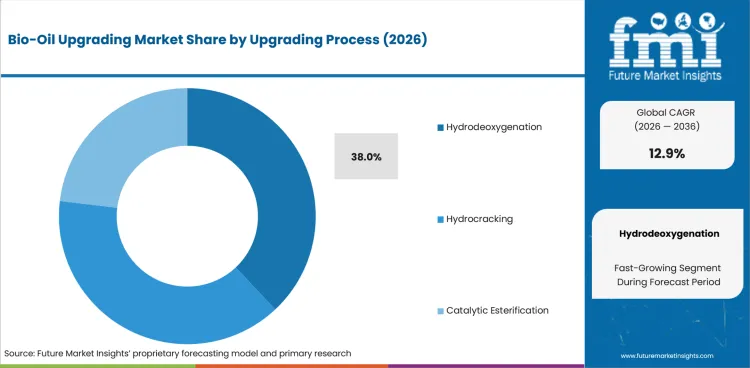
- Hydrodeoxygenation is projected to account for 38.0% share in 2026, influenced by its direct role in removing oxygen from acidic bio-oil before refinery use.
- Catalyst choice in this process is shaped by sulfur tolerance and coke control under high-oxygen feeds, making pilot runtime data more valuable than catalog activity ratings.
Which feedstock leads the bio-oil upgrading market?
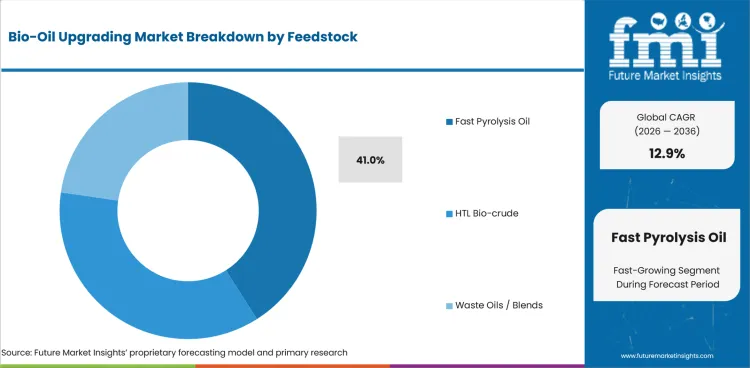
- Fast Pyrolysis Oil is estimated to hold 41.0% share in 2026 through dry biomass residue access and distributed liquid intermediate production near feedstock sources.
- HTL Bio-crude gains relevance across wet waste streams that avoid energy-heavy drying, although impurity control and water handling keep qualification selective.
Which end product leads the bio-oil upgrading market?
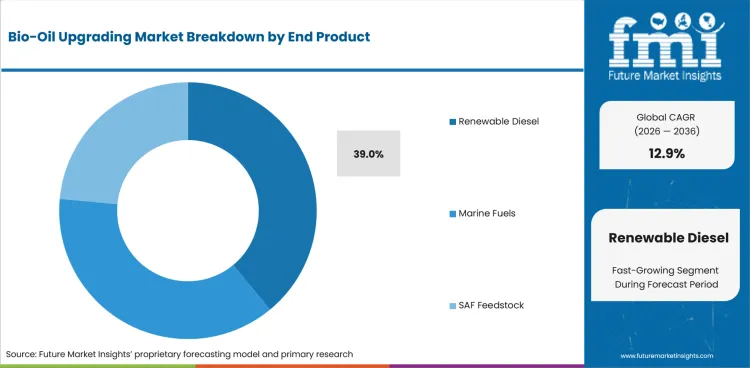
- Renewable Diesel is expected to account for 39.0% share in 2026 as diesel-range hydrocarbons have clearer blending pathways and refinery demand.
- SAF Feedstock gains long-term value as airline decarbonization targets expand, but jet-range qualification requires stricter testing than road fuel pathways.
Which facility type leads the bio-oil upgrading market?
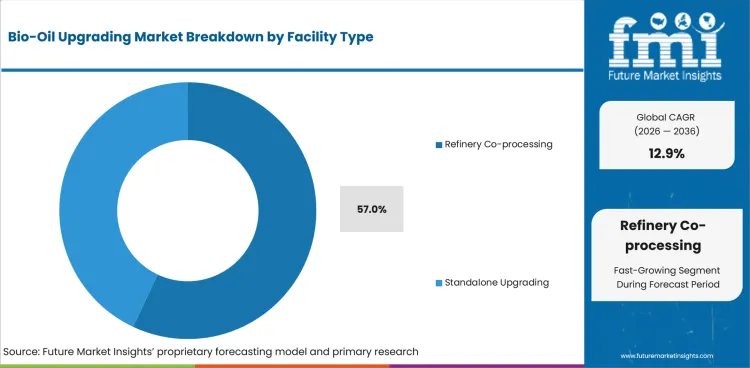
- Refinery Co-processing is anticipated to represent 57.0% share in 2026 as refiners test upgraded bio-crudes inside existing hydroprocessing assets.
- Standalone Upgrading gains relevance when biomass residues are distant from refineries and local conversion reduces transport of unstable raw bio-oil.
Which project stage leads the bio-oil upgrading market?
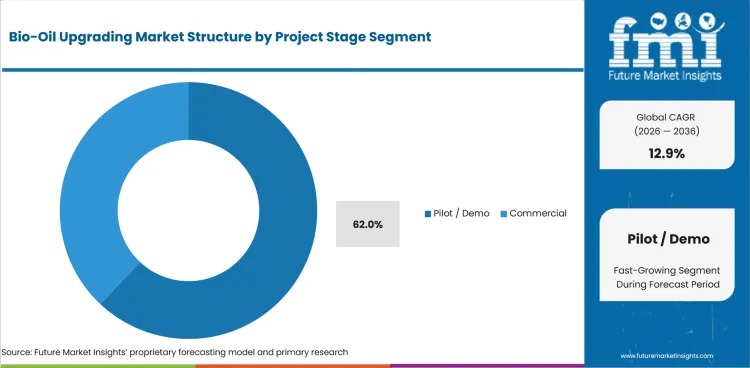
- Pilot / Demo is projected to account for 62.0% share in 2026 as feedstock quality, catalyst cycle length, and fuel certification delay full commercial decisions.
- Commercial projects gain when suppliers prove carbon yield, low coke formation, and repeatable product quality under refinery-style operating conditions.
What are the driver, restraints, and opportunities in the bio-oil upgrading market?
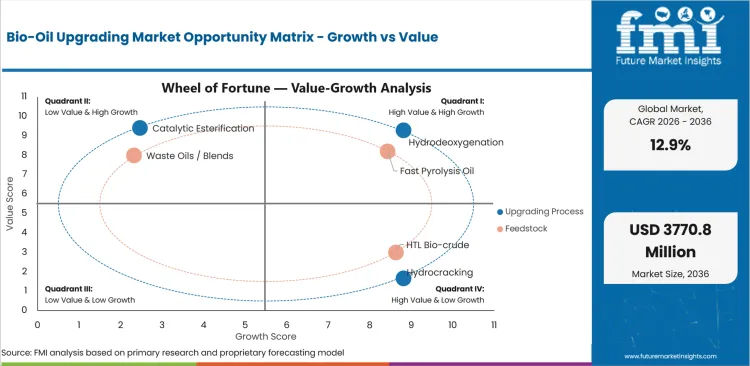
Advanced fuel demand supports adoption while hydrogen use and catalyst durability limit wider commercial rollout.
- Driver: Fuel producers are seeking advanced liquid feedstocks that reduce reliance on lipid-only renewable fuel pathways.
- Restraint: Hydrogen demand and catalyst fouling can slow project approvals when refinery integration is not proven.
- Opportunity: Co-processing and modular upgrading create a practical entry point for licensors that can document fuel quality.
Bio-Oil Upgrading Market Demand Outlook
Demand outlook is shifting from raw pyrolysis oil handling toward stable upgraded intermediates that can meet refinery intake rules and fuel blending specifications. The European Commission stated in February 2025 that the industry is on track to meet the 2025 ReFuelEU Aviation target of 2% SAF at EU airports and is progressing toward the 6% target for 2030. This supports catalyst and licensor demand because compliant SAF supply must scale beyond conventional lipid pathways. Buyers with advanced biofuels market outlook exposure are screening hydrodeoxygenation and hydrocracking packages for product consistency before commercial offtake.
Hydrogen Cost and Catalyst Constraint Analysis
Hydrogen supply is a practical restraint because oxygen removal and hydrocracking consume hydrogen before products reach fuel specifications. IEA’s World Energy Investment 2024 notes that investments in sustainable aviation fuels reached USD 1 billion, a level that shows early momentum but also highlights selective capital access. Early bio-oil upgrading projects therefore concentrate around refinery hubs with existing hydrogen systems. Remote standalone plants need stronger economics or integrated low-carbon hydrogen support before buyers accept wider commercialization risk.
Co-processing Opportunity and Buyer Decision Analysis
Government-backed pilots create an opportunity for suppliers to move from lab conversion into refinery qualification. The DOE SAF Grand Challenge progress report published in January 2025 states that BETO awarded USD 151 million for 28 pre-pilot, pilot, and demonstration-scale projects. That public-private project base raises demand for test skids, catalyst monitoring, process engineering, and carbon accounting services. Suppliers with verified pilot outputs can connect process catalysts market outlook with licensing discussions more quickly.
Which countries are growing fastest in the bio-oil upgrading market?
China 14.2% CAGR, India 13.8% CAGR, United States 13.6% CAGR, South Korea 13.4% CAGR, France 13.1% CAGR, Japan 12.8% CAGR, Germany 12.7% CAGR, and United Kingdom 12.5% CAGR through 2036.
.webp "Top Country Growth Comparison Bio Oil Upgrading Market Cagr (2026 2036)")
| Country | CAGR |
|---|---|
| United States | 13.6% |
| United Kingdom | 12.5% |
| Germany | 12.7% |
| France | 13.1% |
| Japan | 12.8% |
| China | 14.2% |
| South Korea | 13.4% |
| India | 13.8% |
Source: Future Market Insights, 2026.
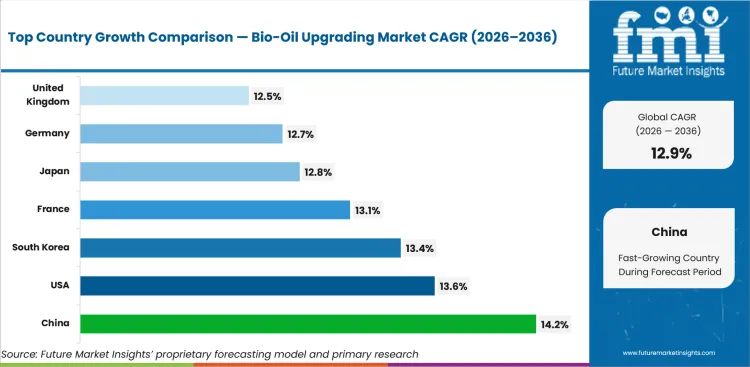
How do country-level CAGRs compare in the bio-oil upgrading market?
China leads country growth while the United Kingdom records the most measured expansion outlook among profiled markets.
- China is forecast to record 14.2% CAGR by 2036 as SAF export capacity and refinery trials expand.
- India is expected to advance at 13.8% CAGR from 2026 to 2036 through aviation fuel targets and biomass availability.
- The United States is projected to grow at 13.6% CAGR through 2036 due to SAF goals and refinery co-processing interest.
- South Korea is estimated to rise at 13.4% CAGR by 2036 with SAF blending plans and HVO capacity investment.
- France is forecast to expand at 13.1% CAGR through 2036 as biomass-to-SAF project activity supports advanced pathways.
- Japan is expected to post 12.8% CAGR by 2036 as airline fuel security and supply assurance influence buying behavior.
- Germany is projected to increase at 12.7% CAGR through 2036 as technical qualification supports selective deployment.
- The United Kingdom is forecast to grow at 12.5% CAGR by 2036 as SAF certificate compliance shapes supplier demand.
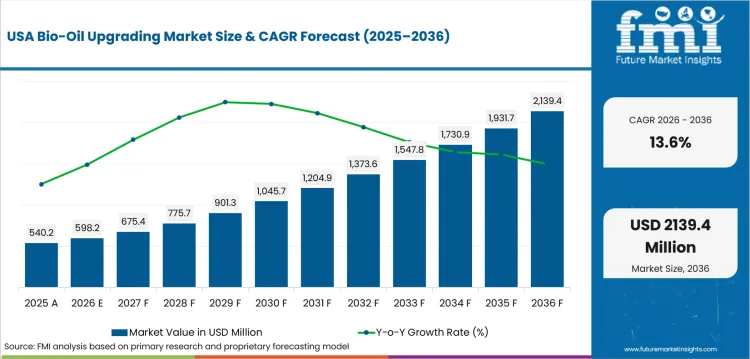
How fast is the bio-oil upgrading market growing in the United States?
A 13.6% CAGR through 2036 reflects SAF targets, refinery co-processing interest, and national laboratory support.
Country Market Snapshot Table
| Parameter | Value |
|---|---|
| Market Size in 2025 (Value) | USD 250.9 million |
| Market Size in 2026 (Value) | USD 285.0 million |
| Market Forecast in 2036 (Value) | USD 1,020.1 million |
| CAGR (2026 to 2036) | 13.6% |
| Years Considered | 2021 to 2036 |
| Base Year | 2025 |
| Forecast Period | 2026 to 2036 |
| Units Considered | Value (USD million) |
| Leading Sub-Region | Gulf Coast and West Coast refinery corridors |
United States Bio-Oil Upgrading Market Outlook
United States bio-oil upgrading demand is shaped by federal SAF targets and a large refinery base. Buyers evaluate upgraded bio-oil on oxygen removal, hydrogen balance, catalyst life, and biogenic carbon tracking before wider use.
Co-processing pathways are expected to attract early attention as refiners can test intermediates inside existing hydroprocessing systems. Suppliers with pilot data and refinery integration support should gain stronger technical acceptance.
Key Growth Drivers
- Renewable diesel familiarity gives refiners a stronger basis to evaluate drop-in fuel pathways. AFDC reported domestic renewable diesel production grew 23% from 2023 to 2024.
- Federal R&D funding supports new conversion pathways using domestic biomass and waste resources. DOE announced up to USD 23 million in January 2025 for chemicals and fuels from biomass and waste resources.
- Gulf Coast and West Coast refining assets support trial campaigns as large hydrotreaters and fuel logistics are already established.
- National laboratory validation improves buyer confidence by connecting feedstock testing with refinery-oriented fuel quality evidence.
Key Restraints
- Biodiesel weakness can make fuel buyers cautious when renewable fuel economics shift. EIA forecast annual biodiesel production in 2025 to be 15% lower than in 2024.
- Hydrogen intensity can weaken project returns when sites lack affordable low-carbon hydrogen access.
- Fuel certification steps slow SAF-linked pathways when developers cannot document repeatable product quality.
What makes United States unique
The United States is unique due to federal SAF targets, national laboratory testing, and large refinery assets in one market structure.
Key Companies
- Honeywell UOP
- Chevron Lummus Global
- KBR
- Neste
- BTG Bioliquids
- Topsoe
- Shell Catalysts & Technologies
Sales & Marketing Channels
- Direct refinery technology licensing
- DOE-backed demonstration partnerships
- EPC and FEED service agreements
- Airline and fuel offtake alliances
- Catalyst replacement service contracts
- National laboratory collaboration pathways
Country Segment Breakdown Table
| Segment | Sub-Segments |
|---|---|
| By Upgrading Process | Hydrodeoxygenation · Hydrocracking · Catalytic Esterification · Other |
| By Feedstock | Fast Pyrolysis Oil · HTL Bio-crude · Waste Oils / Blends · Other |
| By End Product | Renewable Diesel · Marine Fuels · SAF Feedstock · Chemical Intermediates |
| By Facility Type | Standalone Upgrading · Refinery Co-processing |
| By Project Stage | Pilot / Demo · Commercial |
| Key Sub-Regions Covered, Refinery and Aviation Fuel Corridors | Gulf Coast · California · Midwest · Pacific Northwest · Rocky Mountain states · Northeast fuel hubs |
Frequently Asked Questions
How fast is United States bio-oil upgrading market growing?
Demand in United States is expected to grow at 13.6% CAGR from 2026 to 2036, supported by refinery qualification and advanced fuel pathways.
Who leads United States bio-oil upgrading market?
Honeywell UOP, Chevron Lummus Global, KBR, Neste compete based on technology licensing, process validation, and fuel qualification support.
What is driving adoption in United States bio-oil upgrading market?
Adoption is driven by SAF policy, refinery compatibility needs, residue feedstock planning, and stronger demand for verified drop-in fuel pathways.
What is the bio-oil upgrading market outlook in the United Kingdom?
A 12.5% CAGR through 2036 is supported by SAF certificates, aviation fuel obligations, and refinery-linked project evaluation.
Country Market Snapshot Table
| Parameter | Value |
|---|---|
| Market Size in 2025 (Value) | USD 65.8 million |
| Market Size in 2026 (Value) | USD 74.0 million |
| Market Forecast in 2036 (Value) | USD 240.3 million |
| CAGR (2026 to 2036) | 12.5% |
| Years Considered | 2021 to 2036 |
| Base Year | 2025 |
| Forecast Period | 2026 to 2036 |
| Units Considered | Value (USD million) |
| Leading Sub-Region | Humber, Teesside, and airport fuel corridors |
United Kingdom Bio-Oil Upgrading Market Outlook
United Kingdom demand is policy-driven as fuel suppliers prepare for SAF compliance obligations. Bio-oil upgrading suppliers must prove pathway eligibility, carbon accounting, and reliable blending quality before commercial placement.
The market is expected to favor licensor-led projects and offtake-backed development. Domestic capacity is selective, so import pathways and project partnerships will influence near-term buying behavior.
Key Growth Drivers
- The SAF mandate creates a measurable fuel-supplier obligation. UK government analysis places the 2025 requirement at about 230,000 tonnes of SAF.
- Project grants improve domestic developer confidence. The UK government announced GBP 63 million in July 2025 to accelerate clean aviation fuel projects.
- Airport fuel systems provide centralized demand points for certified renewable fuel supply aggregation and auditing.
- Certificate trading creates a commercial reason for fuel suppliers to compare approved advanced feedstock pathways.
Key Restraints
- Jet fuel demand keeps the compliance burden high. The UK final-stage SAF mandate analysis forecast about 11.5 million tonnes of jet fuel use in 2025.
- Limited domestic upgrading capacity can increase dependence on imported SAF and licensed project buildout.
- Higher fuel cost pass-through can slow airline acceptance when passenger demand is price-sensitive.
What makes United Kingdom unique
The United Kingdom is unique due to a standalone SAF mandate with defined compliance volumes and tradeable certificate incentives.
Key Companies
- Velocys
- Johnson Matthey
- BP
- Shell Catalysts & Technologies
- Honeywell UOP
- KBR
- Topsoe
Sales & Marketing Channels
- Aviation fuel supplier compliance sales
- Airport fuel infrastructure partnerships
- Technology licensing to fuel producers
- Government-backed grant pathways
- Airline offtake contracts
- Specialty catalyst distributor support
Country Segment Breakdown Table
| Segment | Sub-Segments |
|---|---|
| By Upgrading Process | Hydrodeoxygenation · Hydrocracking · Catalytic Esterification · Other |
| By Feedstock | Fast Pyrolysis Oil · HTL Bio-crude · Waste Oils / Blends · Other |
| By End Product | Renewable Diesel · Marine Fuels · SAF Feedstock · Chemical Intermediates |
| By Facility Type | Standalone Upgrading · Refinery Co-processing |
| By Project Stage | Pilot / Demo · Commercial |
| Key Sub-Regions Covered, Refinery and Aviation Fuel Corridors | London · Heathrow corridor · Teesside · Humber · Manchester · Scottish refinery links |
Frequently Asked Questions
How fast is United Kingdom bio-oil upgrading market growing?
Demand in United Kingdom is expected to grow at 12.5% CAGR from 2026 to 2036, supported by refinery qualification and advanced fuel pathways.
Who leads United Kingdom bio-oil upgrading market?
Velocys, Johnson Matthey, BP, Shell Catalysts & Technologies compete based on technology licensing, process validation, and fuel qualification support.
What is driving adoption in United Kingdom bio-oil upgrading market?
Adoption is driven by SAF policy, refinery compatibility needs, residue feedstock planning, and stronger demand for verified drop-in fuel pathways.
How is the bio-oil upgrading market developing in Germany?
A 12.7% CAGR through 2036 reflects strict fuel validation, hydrogen planning, and EU aviation fuel requirements.
Country Market Snapshot Table
| Parameter | Value |
|---|---|
| Market Size in 2025 (Value) | USD 76.3 million |
| Market Size in 2026 (Value) | USD 86.0 million |
| Market Forecast in 2036 (Value) | USD 284.3 million |
| CAGR (2026 to 2036) | 12.7% |
| Years Considered | 2021 to 2036 |
| Base Year | 2025 |
| Forecast Period | 2026 to 2036 |
| Units Considered | Value (USD million) |
| Leading Sub-Region | North Rhine-Westphalia and northern refinery corridors |
Germany Bio-Oil Upgrading Market Outlook
Germany demand is tied to EU aviation fuel rules and a technically demanding refinery and chemical base. Buyers require proof of fuel quality, emissions accounting, hydrogen efficiency, and process reliability before approving new bio-oil pathways.
Demand will concentrate around refiners, engineering firms, and catalyst suppliers able to demonstrate stable operation. Imported low-carbon fuels can remain competitive when local energy costs reduce project returns.
Key Growth Drivers
- EU aviation rules create a direct compliance signal for German fuel suppliers. ReFuelEU Aviation requires a 2% SAF share at EU airports from 2025.
- Hydrogen infrastructure planning supports hydrodeoxygenation and hydrocracking economics. Germany targets at least 10 GW of domestic electrolyser capacity by 2030.
- Germany’s refinery and chemical engineering base supports catalyst qualification work for technically strict buyers.
- Industrial buyers value process packages that document carbon intensity, refinery safety, and feedstock traceability.
Key Restraints
- Cost pressure can weaken hydrogen-intensive projects. Destatis reported German producer prices were 2.2% higher year over year in May 2026.
- Strict emissions validation slows approval for new bio-oil feedstocks when documentation is incomplete.
- Power and hydrogen costs can push some fuel buyers toward imported certified products.
What makes Germany unique
Germany is unique as technical qualification, process engineering, and compliance-grade fuel supply influence buyer decisions more than early feedstock abundance.
Key Companies
- Topsoe
- Axens
- Shell Catalysts & Technologies
- Honeywell UOP
- BASF
- Johnson Matthey
- KBR
Sales & Marketing Channels
- Refinery technology licensing
- EPC-led project design
- Catalyst technical service contracts
- Aviation fuel supplier compliance sales
- Industrial hydrogen partnerships
- Applied research pilot pathways
Country Segment Breakdown Table
| Segment | Sub-Segments |
|---|---|
| By Upgrading Process | Hydrodeoxygenation · Hydrocracking · Catalytic Esterification · Other |
| By Feedstock | Fast Pyrolysis Oil · HTL Bio-crude · Waste Oils / Blends · Other |
| By End Product | Renewable Diesel · Marine Fuels · SAF Feedstock · Chemical Intermediates |
| By Facility Type | Standalone Upgrading · Refinery Co-processing |
| By Project Stage | Pilot / Demo · Commercial |
| Key Sub-Regions Covered, Refinery and Aviation Fuel Corridors | North Rhine-Westphalia · Hamburg · Lower Saxony · Bavaria · Saxony · Berlin-Brandenburg |
Frequently Asked Questions
How fast is Germany bio-oil upgrading market growing?
Demand in Germany is expected to grow at 12.7% CAGR from 2026 to 2036, supported by refinery qualification and advanced fuel pathways.
Who leads Germany bio-oil upgrading market?
Topsoe, Axens, Shell Catalysts & Technologies, Honeywell UOP compete based on technology licensing, process validation, and fuel qualification support.
What is driving adoption in Germany bio-oil upgrading market?
Adoption is driven by SAF policy, refinery compatibility needs, residue feedstock planning, and stronger demand for verified drop-in fuel pathways.
What supports bio-oil upgrading growth in France?
A 13.1% CAGR through 2036 is supported by biomass-to-SAF project activity and aviation fuel compliance.
Country Market Snapshot Table
| Parameter | Value |
|---|---|
| Market Size in 2025 (Value) | USD 69.0 million |
| Market Size in 2026 (Value) | USD 78.0 million |
| Market Forecast in 2036 (Value) | USD 267.1 million |
| CAGR (2026 to 2036) | 13.1% |
| Years Considered | 2021 to 2036 |
| Base Year | 2025 |
| Forecast Period | 2026 to 2036 |
| Units Considered | Value (USD million) |
| Leading Sub-Region | Normandy, Grand Est, and aviation fuel corridors |
France Bio-Oil Upgrading Market Outlook
France has a clearer project pathway as biomass-to-SAF work is linked to named industrial consortia. Buyers value technology packages that connect residue conversion, hydrogen integration, and aviation fuel output.
Demand is expected to center on integrated project groups rather than many small buyers. Suppliers with biomass handling, gasification, upgrading, and refinery product knowledge should have stronger tender positions.
Key Growth Drivers
- European technology strength supports French project development. The European Commission stated in November 2025 that European companies hold 60% of innovative patents in renewable and low-carbon fuel production.
- Named project activity gives suppliers a direct qualification pathway. Avril stated in April 2026 that the BioTJet facility is expected to supply 87,000 tonnes of sustainable aviation fuels from local forestry residues and end-of-life wood waste.
- Forestry residues provide a stronger non-lipid feedstock case for advanced aviation fuel projects.
- Public-private consortium structures support integrated technology packages instead of isolated equipment purchases.
Key Restraints
- Aviation cost pressure can raise scrutiny of advanced fuel economics. EU ETS free allocation for aviation was reduced by 50% in 2025 before full auctioning from 2026.
- Biomass logistics can raise delivered feedstock cost when residues are dispersed across regions.
- Hydrogen supply and permitting can delay commercial plant schedules before final investment decisions.
What makes France unique
France stands out through named biomass-to-SAF project activity using local wood residues and consortium-based project design.
Key Companies
- Axens
- IFPEN-linked BioTfueL partners
- thyssenkrupp Uhde
- Elyse Energy
- TotalEnergies
- Honeywell UOP
- KBR
Sales & Marketing Channels
- Consortium-led project development
- Aviation fuel offtake contracts
- Engineering procurement packages
- Public-private innovation funding
- Refinery and chemical buyer partnerships
- Biomass residue aggregator channels
Country Segment Breakdown Table
| Segment | Sub-Segments |
|---|---|
| By Upgrading Process | Hydrodeoxygenation · Hydrocracking · Catalytic Esterification · Other |
| By Feedstock | Fast Pyrolysis Oil · HTL Bio-crude · Waste Oils / Blends · Other |
| By End Product | Renewable Diesel · Marine Fuels · SAF Feedstock · Chemical Intermediates |
| By Facility Type | Standalone Upgrading · Refinery Co-processing |
| By Project Stage | Pilot / Demo · Commercial |
| Key Sub-Regions Covered, Refinery and Aviation Fuel Corridors | Normandy · Grand Est · Hauts-de-France · Paris Basin · Nouvelle-Aquitaine · Provence-Alpes-Cote d’Azur |
Frequently Asked Questions
How fast is France bio-oil upgrading market growing?
Demand in France is expected to grow at 13.1% CAGR from 2026 to 2036, supported by refinery qualification and advanced fuel pathways.
Who leads France bio-oil upgrading market?
Axens, IFPEN-linked BioTfueL partners, thyssenkrupp Uhde, Elyse Energy compete based on technology licensing, process validation, and fuel qualification support.
What is driving adoption in France bio-oil upgrading market?
Adoption is driven by SAF policy, refinery compatibility needs, residue feedstock planning, and stronger demand for verified drop-in fuel pathways.
What is the bio-oil upgrading market forecast for Japan?
A 12.8% CAGR through 2036 reflects airline decarbonization, import security, and high-certification buyer behavior.
Country Market Snapshot Table
| Parameter | Value |
|---|---|
| Market Size in 2025 (Value) | USD 57.6 million |
| Market Size in 2026 (Value) | USD 65.0 million |
| Market Forecast in 2036 (Value) | USD 216.8 million |
| CAGR (2026 to 2036) | 12.8% |
| Years Considered | 2021 to 2036 |
| Base Year | 2025 |
| Forecast Period | 2026 to 2036 |
| Units Considered | Value (USD million) |
| Leading Sub-Region | Tokyo Bay, Kansai, and refinery import corridors |
Japan Bio-Oil Upgrading Market Outlook
Japan demand is built around aviation fuel security and airline decarbonization. Buyers prioritize certification, supply assurance, and product reliability as domestic low-cost feedstock availability is limited.
The market should favor high-reliability technology packages over low-cost experimental systems. Suppliers need strong documentation for feedstock origin, emissions reduction, and final fuel quality.
Key Growth Drivers
- Japan’s SAF demand target gives airlines and refiners a direct reason to seek approved pathways. USDA reporting says Japanese airports may consume up to 5.6 billion litres of SAF annually by fiscal 2030.
- Domestic demonstration activity supports buyer confidence. JGC’s 2025 sustainability reporting estimated SAF-related greenhouse gas reduction contribution at 73,687 t-CO2/year.
- Trading houses can connect imported residues with domestic refining and aviation fuel channels.
- Fuel quality culture supports premium licensors that provide strong certification records and technical service.
Key Restraints
- Policy ambition increases supplier documentation burdens. Japan aims to replace 10% of conventional jet fuel with SAF by 2030.
- Domestic biomass and waste oil limitations keep buyers exposed to imported feedstock prices.
- Strict product qualification can slow entry for smaller bio-oil upgrading firms without refinery references.
What makes Japan unique
Japan is unique as a high-discipline buyer market where certification, traceability, and supply assurance weigh heavily in purchasing decisions.
Key Companies
- JGC Holdings
- Cosmo Oil
- ENEOS
- Idemitsu Kosan
- Mitsubishi Corporation
- Honeywell UOP
- Topsoe
Sales & Marketing Channels
- Airline fuel offtake agreements
- Refinery and trading house partnerships
- Technology licensing to fuel producers
- Government-backed consortium projects
- Imported residue supply agreements
- Quality testing and certification services
Country Segment Breakdown Table
| Segment | Sub-Segments |
|---|---|
| By Upgrading Process | Hydrodeoxygenation · Hydrocracking · Catalytic Esterification · Other |
| By Feedstock | Fast Pyrolysis Oil · HTL Bio-crude · Waste Oils / Blends · Other |
| By End Product | Renewable Diesel · Marine Fuels · SAF Feedstock · Chemical Intermediates |
| By Facility Type | Standalone Upgrading · Refinery Co-processing |
| By Project Stage | Pilot / Demo · Commercial |
| Key Sub-Regions Covered, Refinery and Aviation Fuel Corridors | Tokyo Bay · Osaka-Kobe · Chiba · Yokohama · Nagoya · Kyushu coastal terminals |
Frequently Asked Questions
How fast is Japan bio-oil upgrading market growing?
Demand in Japan is expected to grow at 12.8% CAGR from 2026 to 2036, supported by refinery qualification and advanced fuel pathways.
Who leads Japan bio-oil upgrading market?
JGC Holdings, Cosmo Oil, ENEOS, Idemitsu Kosan compete based on technology licensing, process validation, and fuel qualification support.
What is driving adoption in Japan bio-oil upgrading market?
Adoption is driven by SAF policy, refinery compatibility needs, residue feedstock planning, and stronger demand for verified drop-in fuel pathways.
Why is China the fastest-growing bio-oil upgrading market?
A 14.2% CAGR through 2036 reflects SAF export capacity, coastal refinery scale, and fast aviation fuel pilots.
Country Market Snapshot Table
| Parameter | Value |
|---|---|
| Market Size in 2025 (Value) | USD 179.5 million |
| Market Size in 2026 (Value) | USD 205.0 million |
| Market Forecast in 2036 (Value) | USD 773.4 million |
| CAGR (2026 to 2036) | 14.2% |
| Years Considered | 2021 to 2036 |
| Base Year | 2025 |
| Forecast Period | 2026 to 2036 |
| Units Considered | Value (USD million) |
| Leading Sub-Region | Yangtze River Delta and coastal refinery export corridors |
China Bio-Oil Upgrading Market Outlook
China demand is moving fastest on the supply side as producers evaluate SAF export pathways and domestic aviation pilots. Early buyers focus on international certification, product quality, and refinery conversion economics before domestic mandates mature.
The market should favor suppliers that can handle residue feedstocks, used cooking oil blends, and bio-crude upgrading for export-grade fuel products. Coastal refinery clusters create practical pathways for pilots and scale-up.
Key Growth Drivers
- China has a visible SAF production base for export and domestic pilots. USDA reporting in 2025 projected SAF production capacity at up to 3.8 billion litres.
- Aviation pilots are creating practical fuel-use evidence. CAAC reported 12 SAF-refueled flights during the September 2024 pilot.
- Coastal refinery clusters support scale-up by connecting feedstock collection with processing and export logistics.
- Private biodiesel producers can shift toward SAF when export conditions and certification pathways support higher-value fuel demand.
Key Restraints
- Existing aviation efficiency progress can raise the performance bar for new fuels. China’s 2025 climate report states airport CO2 emissions per passenger dropped 64.8% from the baseline level.
- Domestic demand policy is less defined than EU and UK mandates, making early project revenue more export-oriented.
- Feedstock traceability can become a restraint when export buyers require auditable sustainability records.
What makes China unique
China is unique as SAF production scale, export orientation, and aviation pilot activity are developing before a fully mature domestic blending mandate.
Key Companies
- Sinopec
- PetroChina
- China National Aviation Fuel Group
- Beijing Haixin Energy Technology
- Honeywell UOP
- Topsoe
- Axens
Sales & Marketing Channels
- Refinery technology licensing
- SAF export offtake channels
- Airline pilot procurement
- Government aviation demonstration pathways
- Used cooking oil aggregator networks
- Catalyst and testing service contracts
Country Segment Breakdown Table
| Segment | Sub-Segments |
|---|---|
| By Upgrading Process | Hydrodeoxygenation · Hydrocracking · Catalytic Esterification · Other |
| By Feedstock | Fast Pyrolysis Oil · HTL Bio-crude · Waste Oils / Blends · Other |
| By End Product | Renewable Diesel · Marine Fuels · SAF Feedstock · Chemical Intermediates |
| By Facility Type | Standalone Upgrading · Refinery Co-processing |
| By Project Stage | Pilot / Demo · Commercial |
| Key Sub-Regions Covered, Refinery and Aviation Fuel Corridors | Shanghai · Jiangsu · Zhejiang · Guangdong · Shandong · Sichuan aviation corridors |
Frequently Asked Questions
How fast is China bio-oil upgrading market growing?
Demand in China is expected to grow at 14.2% CAGR from 2026 to 2036, supported by refinery qualification and advanced fuel pathways.
Who leads China bio-oil upgrading market?
Sinopec, PetroChina, China National Aviation Fuel Group, Beijing Haixin Energy Technology compete based on technology licensing, process validation, and fuel qualification support.
What is driving adoption in China bio-oil upgrading market?
Adoption is driven by SAF policy, refinery compatibility needs, residue feedstock planning, and stronger demand for verified drop-in fuel pathways.
How fast is South Korea bio-oil upgrading demand rising?
A 13.4% CAGR through 2036 is supported by SAF blending policy, HVO capacity, and refinery-led technology interest.
Country Market Snapshot Table
| Parameter | Value |
|---|---|
| Market Size in 2025 (Value) | USD 51.1 million |
| Market Size in 2026 (Value) | USD 58.0 million |
| Market Forecast in 2036 (Value) | USD 204.0 million |
| CAGR (2026 to 2036) | 13.4% |
| Years Considered | 2021 to 2036 |
| Base Year | 2025 |
| Forecast Period | 2026 to 2036 |
| Units Considered | Value (USD million) |
| Leading Sub-Region | Ulsan, Yeosu, and Incheon refinery corridors |
South Korea Bio-Oil Upgrading Market Outlook
South Korea demand is shaped by refinery capability and policy moves toward SAF use on international flights. Buyers are expected to prioritize reliable feedstock sourcing, HVO integration, and certifiable fuel output.
The market is likely to develop through refiners, petrochemical companies, airlines, and government-backed fuel initiatives. Bio-oil upgrading suppliers must prove compatibility with imported residues and used cooking oil blends.
Key Growth Drivers
- A mandatory SAF pathway gives suppliers a planning signal. MOLIT stated in September 2025 that SAF blending will start at 1% in 2027 for international flights departing Korea.
- HVO capacity investment strengthens local upgrading demand. USDA reporting in March 2026 stated Korea’s first HVO plant is expected to reach 300,000 MT annual capacity by 2027.
- Large refinery clusters in Ulsan, Yeosu, and Daesan support technology licensing and catalyst service pathways.
- Airline decarbonization needs can pull qualifying fuels into airport supply networks and offtake agreements.
Key Restraints
- Energy import dependence can keep buyers cautious about feedstock security. IEA reported Korea’s energy self-sufficiency rate at 19% in 2025.
- Policy timing can delay early revenue as mandatory blending begins after initial demonstration and planning work.
- Refinery buyers may favor proven HVO pathways before adopting higher-risk oxygen-rich bio-oil streams.
What makes South Korea unique
South Korea is unique as refinery scale, petrochemical integration, and mandatory international-flight SAF blending create a concentrated buyer base.
Key Companies
- SK Innovation
- GS Caltex
- HD Hyundai Oilbank
- S-Oil
- LG Chem
- Honeywell UOP
- Topsoe
Sales & Marketing Channels
- Refinery licensing agreements
- Airline fuel supply contracts
- Petrochemical partnership pathways
- Government-backed SAF demonstrations
- Imported residue supply contracts
- Catalyst technical service programs
Country Segment Breakdown Table
| Segment | Sub-Segments |
|---|---|
| By Upgrading Process | Hydrodeoxygenation · Hydrocracking · Catalytic Esterification · Other |
| By Feedstock | Fast Pyrolysis Oil · HTL Bio-crude · Waste Oils / Blends · Other |
| By End Product | Renewable Diesel · Marine Fuels · SAF Feedstock · Chemical Intermediates |
| By Facility Type | Standalone Upgrading · Refinery Co-processing |
| By Project Stage | Pilot / Demo · Commercial |
| Key Sub-Regions Covered, Refinery and Aviation Fuel Corridors | Ulsan · Yeosu · Incheon · Busan · Daesan · Seoul aviation corridor |
Frequently Asked Questions
How fast is South Korea bio-oil upgrading market growing?
Demand in South Korea is expected to grow at 13.4% CAGR from 2026 to 2036, supported by refinery qualification and advanced fuel pathways.
Who leads South Korea bio-oil upgrading market?
SK Innovation, GS Caltex, HD Hyundai Oilbank, S-Oil compete based on technology licensing, process validation, and fuel qualification support.
What is driving adoption in South Korea bio-oil upgrading market?
Adoption is driven by SAF policy, refinery compatibility needs, residue feedstock planning, and stronger demand for verified drop-in fuel pathways.
What is driving bio-oil upgrading growth in India?
A 13.8% CAGR through 2036 is supported by SAF targets, biomass supply programs, and refinery modernization interest.
Country Market Snapshot Table
| Parameter | Value |
|---|---|
| Market Size in 2025 (Value) | USD 39.5 million |
| Market Size in 2026 (Value) | USD 45.0 million |
| Market Forecast in 2036 (Value) | USD 163.9 million |
| CAGR (2026 to 2036) | 13.8% |
| Years Considered | 2021 to 2036 |
| Base Year | 2025 |
| Forecast Period | 2026 to 2036 |
| Units Considered | Value (USD million) |
| Leading Sub-Region | Western refinery and aviation fuel corridors |
India Bio-Oil Upgrading Market Outlook
India demand is shaped by aviation decarbonization, residue availability, and refinery modernization. Buyers will evaluate whether upgraded bio-oils can fit existing fuel systems while supporting local biomass and waste feedstock use.
The market should gain momentum as public fuel targets and biomass support schemes create stronger project visibility. Suppliers need to address feedstock aggregation, hydrogen access, and commercial validation before wider deployment.
Key Growth Drivers
- SAF blending targets create a direct planning signal for fuel suppliers. PIB stated in September 2025 that India is targeting 1% blending by 2027.
- Biomass support improves feedstock preprocessing economics. MNRE’s 2025 Biomass Programme provides Rs. 9 lakh per MTPH for briquette and pellet capacity.
- Refinery modernization and airline expansion create a buyer base for drop-in renewable fuel pathways.
- Agricultural residue availability supports local interest in fast pyrolysis and other biomass conversion processes.
Key Restraints
- Ethanol procurement can compete for biomass and policy attention. PIB reported average ethanol blending of 19.05% as of 31 July 2025.
- Feedstock aggregation remains difficult when residues are seasonal and dispersed across rural regions.
- Hydrogen availability and commercial demonstration depth can slow refinery qualification for oxygen-rich bio-oil streams.
What makes India unique
India is unique as aviation fuel targets, biomass support, and large residue availability can combine into a localized advanced fuel pathway.
Key Companies
- Indian Oil Corporation
- Bharat Petroleum Corporation
- Hindustan Petroleum Corporation
- Reliance Industries
- Numaligarh Refinery
- Honeywell UOP
- Topsoe
Sales & Marketing Channels
- Refinery technology licensing
- Public-sector fuel procurement
- Biomass aggregator partnerships
- EPC and FEED service agreements
- Airline fuel offtake pathways
- Government demonstration programs
Country Segment Breakdown Table
| Segment | Sub-Segments |
|---|---|
| By Upgrading Process | Hydrodeoxygenation · Hydrocracking · Catalytic Esterification · Other |
| By Feedstock | Fast Pyrolysis Oil · HTL Bio-crude · Waste Oils / Blends · Other |
| By End Product | Renewable Diesel · Marine Fuels · SAF Feedstock · Chemical Intermediates |
| By Facility Type | Standalone Upgrading · Refinery Co-processing |
| By Project Stage | Pilot / Demo · Commercial |
| Key Sub-Regions Covered, Refinery and Aviation Fuel Corridors | Gujarat · Maharashtra · Delhi NCR · Karnataka · Tamil Nadu · Telangana |
Frequently Asked Questions
How fast is India bio-oil upgrading market growing?
Demand in India is expected to grow at 13.8% CAGR from 2026 to 2036, supported by refinery qualification and advanced fuel pathways.
Who leads India bio-oil upgrading market?
Indian Oil Corporation, Bharat Petroleum Corporation, Hindustan Petroleum Corporation, Reliance Industries compete based on technology licensing, process validation, and fuel qualification support.
What is driving adoption in India bio-oil upgrading market?
Adoption is driven by SAF policy, refinery compatibility needs, residue feedstock planning, and stronger demand for verified drop-in fuel pathways.
Who are the leading companies in the bio-oil upgrading market?
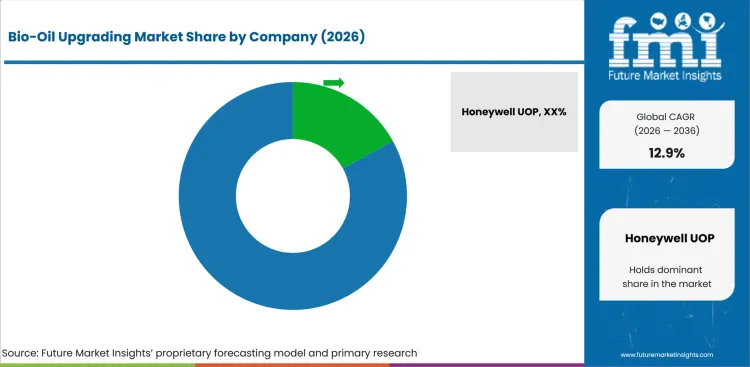
Honeywell UOP, Topsoe, Axens, Chevron Lummus Global, KBR, BTG Bioliquids, and Neste.
- Established refinery technology licensors hold an advantage through hydroprocessing service relationships and process integration depth.
- Catalyst specialists gain shortlisting strength when they prove low coke formation and stable cycle length under oxygen-rich feed conditions.
- Fast pyrolysis and modular specialists gain project access by linking feedstock conversion with downstream upgrading partnerships.
- Integrated fuel producers support commercialization by connecting upgraded intermediates with offtake, certification, and finished fuel distribution.
Refinery technology groups in the market compete by combining process licenses with catalyst support and feedstock testing. Honeywell UOP and Topsoe benefit from established hydroprocessing customer bases. Axens and Chevron Lummus Global compete through advanced renewable fuel pathways and technology packages. KBR supports project delivery through FEED and engineering services. BTG Bioliquids and NanosTech provide specialist positioning around fast pyrolysis and water-rich upgrading concepts.
Commercial strength is increasingly linked to proof data rather than conversion chemistry alone. Buyers compare bio-oil upgrading offers against renewable diesel market outlook, SAF feedstock qualification, and co-processing readiness. Suppliers that show feedstock tolerance, carbon yield, hydrogen balance, and refinery safety records should gain better listing decisions. Scale alone is not enough if the upgraded oil cannot pass fuel quality checks.
Smaller and regional suppliers can win through local feedstock knowledge and faster technical support. China and India create opportunities for suppliers that can manage residue logistics and refinery integration. Germany, Japan, and South Korea create more selective conditions because technical validation and certification carry heavy weight. Companies with conservative claims and strong documentation should gain more durable project positions.
How do top bio-oil upgrading companies compare?
Honeywell UOP and Topsoe score strongest on refinery integration while Axens and Chevron Lummus Global lead project pathway relevance.
| Company | Relevance to Market Title | Refinery Integration Depth | Catalyst / Process Portfolio | Project Qualification Support | Channel Reach | Geographic Footprint |
|---|---|---|---|---|---|---|
| Honeywell UOP | Very High | Very Strong | Strong | Very Strong | Very Strong | Global |
| Topsoe | Very High | Very Strong | Very Strong | Strong | Very Strong | Global |
| Axens | Very High | Strong | Very Strong | Very Strong | Strong | Europe and Global |
| Chevron Lummus Global | Very High | Strong | Strong | Very Strong | Strong | Global |
| KBR | High | Strong | Moderate | Very Strong | Strong | Global |
| BTG Bioliquids | High | Moderate | Strong | Strong | Moderate | Europe and Projects |
| NanosTech | Moderate to High | Moderate | Strong | Strong | Moderate | Specialist Projects |
| Neste | High | Strong | Moderate | Strong | Very Strong | Global |
| Shell Catalysts & Technologies | High | Strong | Strong | Moderate | Strong | Global |
| Johnson Matthey | Moderate to High | Strong | Moderate | Moderate | Strong | Global |
Source: Future Market Insights competitive analysis, 2026.
Who are the key players in the bio-oil upgrading market?
Honeywell UOP, Topsoe, Axens and Chevron Lummus Global are listed with KBR and BTG Bioliquids among other suppliers.
Key global companies leading the bio-oil upgrading market include:
- Honeywell UOP
- Topsoe
- Axens
- Chevron Lummus Global
- KBR
- BTG Bioliquids
- NanosTech
- Neste
- Shell Catalysts & Technologies
- Johnson Matthey
Key Developments in Bio-Oil Upgrading Market
- In October 2025, Honeywell introduced a biomass-to-renewable-fuels technology that converts agricultural and forestry waste into lower-carbon marine fuel, gasoline, and sustainable aviation fuel.
- In September 2025, BTG Bioliquids and NanosTech signed a memorandum of understanding to integrate fast pyrolysis and AQP upgrading for refinery-ready feedstocks serving SAF, renewable diesel, and marine fuels.
- In June 2025, Neste and Chevron Lummus Global announced cooperation to develop technology for converting lignocellulosic waste and residues into renewable fuels such as SAF and renewable diesel.
Key Players in the Bio-Oil Upgrading Market
Technology Licensors
- Honeywell UOP
- Topsoe
- Axens
- Chevron Lummus Global
- KBR
Catalyst and Process Specialists
- Shell Catalysts & Technologies
- Johnson Matthey
- BASF
- BTG Bioliquids
- NanosTech
Integrated Fuel and Refinery Companies
- Neste
- Sinopec
- TotalEnergies
- Indian Oil Corporation
- SK Innovation
Bio-Oil Upgrading Market - Report Scope
| Parameter | Details |
|---|---|
| Forecast period | 2026 to 2036 |
| Historical period | 2021 to 2025 |
| Quantitative unit | Revenue in USD million |
| By upgrading process | Hydrodeoxygenation, hydrocracking, catalytic esterification, other |
| By feedstock | Fast pyrolysis oil, HTL bio-crude, waste oils / blends, other |
| By end product | Renewable diesel, marine fuels, SAF feedstock, chemical intermediates |
| By facility type | Standalone upgrading, refinery co-processing |
| By project stage | Pilot / demo, commercial |
| Regions covered | North America, Latin America, Europe, East Asia, South Asia and Pacific, Middle East and Africa |
| Countries covered | United States, United Kingdom, Germany, France, Japan, China, South Korea, India |
| Key companies profiled | Honeywell UOP, Topsoe, Axens, Chevron Lummus Global, KBR, BTG Bioliquids, NanosTech, Neste |
| Approach | Hybrid bottom-up and top-down approach using project activity, technology penetration, segment readiness, and country policy signals |
Source: Future Market Insights, 2026.
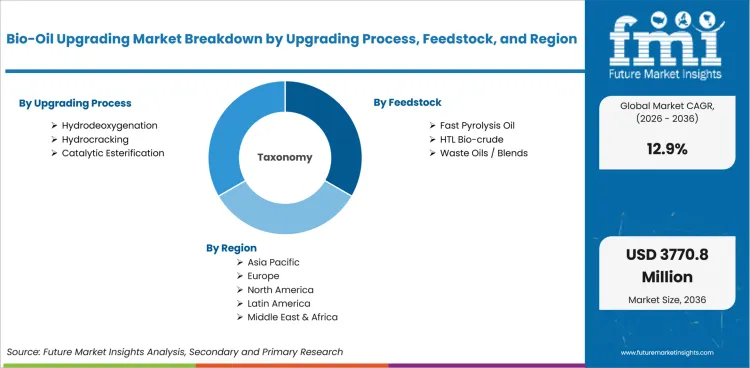
Bio-Oil Upgrading Market Breakdown by Upgrading Process, Feedstock, End Product, Facility Type, Project Stage, and Region
Bio-Oil Upgrading Market Segmented by Upgrading Process:
- Hydrodeoxygenation
- Hydrocracking
- Catalytic Esterification
- Other
Bio-Oil Upgrading Market Segmented by Feedstock:
- Fast Pyrolysis Oil
- HTL Bio-crude
- Waste Oils / Blends
- Other
Bio-Oil Upgrading Market Segmented by End Product:
- Renewable Diesel
- Marine Fuels
- SAF Feedstock
- Chemical Intermediates
Bio-Oil Upgrading Market Segmented by Facility Type:
- Standalone Upgrading
- Refinery Co-processing
Bio-Oil Upgrading Market Segmented by Project Stage:
- Pilot / Demo
- Commercial
Bio-Oil Upgrading Market by Region:
- North America
- Latin America
- Europe
- East Asia
- South Asia and Pacific
- Middle East and Africa
Research Sources and Bibliography
- Alternative Fuels Data Center. (2025). Renewable diesel production and consumption.
- Avril. (2026, April). Efficient and sustainable transitions.
- BTG Bioliquids. (2025, September 4). BTG Bioliquids and NanosTech sign memorandum of understanding for integrated bio-oil upgrading solutions.
- Civil Aviation Administration of China. (2024, September 27). China launches pilot project for the application of sustainable aviation fuel.
- Department for Transport. (2024, December 19). The SAF mandate: An essential guide.
- Department for Transport. (2025, July 22). Government backs 17 companies with funding to accelerate sustainable aviation fuel projects.
- Department for Transport. (2026). Treatment of sustainable aviation fuel in the UK Emissions Trading Scheme analytical annex.
- Destatis. (2026, June 19). Producer prices in May 2026.
- European Commission. (2025, February 28). Commission brings clarity on ReFuelEU Aviation implementation.
- European Commission. (2025, November 5). Sustainable transport investment plan.
- Honeywell. (2025, October 28). Honeywell introduces new technology that produces renewable fuels from biomass.
- International Energy Agency. (2024, June). World Energy Investment 2024.
- International Energy Agency. (2024, October). Renewables 2024: Renewable fuels.
- International Energy Agency. (2025). Renewables 2025: Renewable transport.
- International Energy Agency. (2025). Japan and Korea: World Energy Investment 2025.
- JGC Holdings. (2025). Sustainability and governance report.
- Federal Ministry for Economic Affairs and Climate Action. (2024). System Development Strategy 2024.
- Ministry of Environment of the People’s Republic of China. (2025, November). China’s policies and actions for addressing climate change.
- Ministry of Land, Infrastructure and Transport. (2025, September 22). SAF blending becomes mandatory for international flights departing Korea in 2027.
- Ministry of New and Renewable Energy. (2025, November 24). Biomass Programme.
- National Renewable Energy Laboratory. (2025). Wet waste hydrothermal liquefaction sustainable aviation fuel technical case study.
- Neste. (2025, June 11). Neste and Chevron Lummus Global are developing technology for lignocellulosic waste and residues into renewable fuels.
- Press Information Bureau. (2025, August 11). Government speeds up ethanol blending with expanded feedstock use.
- Press Information Bureau. (2025, September 3). Sustainable aviation fuel is a practical and immediate solution for aviation decarbonization.
- Press Information Bureau. (2026, April 23). Government brings SAF-blended aviation fuel under aviation turbine fuel definition.
- USDA Foreign Agricultural Service. (2025, August 27). Biofuels Annual: China.
- USDA Foreign Agricultural Service. (2025, December 10). Biofuels Annual: Japan.
- USDA Foreign Agricultural Service. (2026, March 4). Oilseeds and Products Annual: Korea.
- U.S. Department of Energy. (2024, December). Sustainable Aviation Fuel Grand Challenge progress report factsheet.
- U.S. Department of Energy. (2025, January 10). Department of Energy announces up to USD 23 million to propel renewable chemicals and fuels.
- U.S. Energy Information Administration. (2025, June 4). U.S. renewable diesel production and biodiesel production declined in the first quarter of 2025.
- thyssenkrupp Uhde. (2025, March 19). thyssenkrupp Uhde selected for Elyse Energy’s biomass-to-SAF project in France.
This bibliography is provided for reader reference and is not exhaustive. The full report contains the complete reference list and detailed citations.
Bio-Oil Upgrading Market - Scope & Definition
| Attribute | Detail |
|---|---|
| Market Definition | Catalysts, process technologies, engineering services, and integrated systems used to upgrade bio-oils into refinery-ready or fuel-ready hydrocarbons. |
| Functions Covered | Oxygen removal, acidity control, hydrocracking, esterification, impurity reduction, fuel slate control, and refinery compatibility support. |
| Applications Covered | Renewable diesel, marine fuels, SAF feedstock, chemical intermediates, and refinery co-processing support. |
| End-Use Industries | Refining, aviation fuel supply, marine fuel supply, renewable fuels, specialty chemicals, and bioenergy technology services. |
| Grades Covered | Pilot-grade upgraded oils, refinery-ready intermediates, renewable diesel-range products, marine fuel-range products, and SAF feedstock streams. |
| Inclusions | Commercial and pilot upgrading catalysts, reactor systems, process licenses, engineering services, pretreatment support, and selected country-level forecast coverage. |
| Exclusions | Raw bio-oil used only as boiler fuel, syngas-only conversion, fermentation-only biofuels, untreated biodiesel, and fossil hydrotreating without bio-based liquid input. |
Bio-Oil Upgrading Market - Research Methodology
| Method | Description |
|---|---|
| Primary Research | FMI analyst interviews with refinery technology buyers, biofuel project developers, catalyst suppliers, engineering firms, and fuel offtake teams across selected markets. |
| Desk Research | Review of DOE, IEA, NREL, national SAF policy sources, government statistics, official company releases, and peer-reviewed technical publications. |
| Market Sizing & Forecasting | Hybrid model using known project activity, process penetration, catalyst service intensity, engineering package value, and country-level fuel policy signals. |
| Data Validation | Cross-verification using fuel mandates, technology announcements, refinery capability, feedstock availability, and company licensing activity checks. |
This Report Answers
- Market size estimates for 2026 and forecasts through 2036 for the bio-oil upgrading market.
- Insights across more than 30 regional and country-level markets.
- Analysis of demand drivers, feedstock adoption patterns, fuel qualification trends, and buyer behavior.
- Evaluation of leading upgrading processes and facility types including hydrodeoxygenation and refinery co-processing.
- Assessment of SAF policy, refinery compatibility, catalyst durability, and hydrogen-balance impacts on market development.
- Identification of opportunities across process catalysts, pilot systems, engineering packages, and co-processing services.
- Evaluation of supply chain dynamics, project qualification cycles, and feedstock preprocessing needs.
- Country-level growth analysis covering the United States, United Kingdom, Germany, France, Japan, China, South Korea, and India.
- Assessment of the competitive landscape, including leading technology licensors and process specialists.
- Analysis of refinery qualification trends, project risks, and emerging growth opportunities.
- Regional outlooks across North America, Europe, East Asia, South Asia and Pacific, and the rest of the world.
- Delivery of market data, forecasts, and supporting analysis in PDF and Excel formats.
Frequently Asked Questions
What is the growth prospect for bio-oil upgrading?
Demand for bio-oil upgrading is expected to rise at a considerable pace as refiners and SAF developers seek residue-based renewable fuel pathways.
Which companies are expected to shape the bio-oil upgrading market?
Honeywell UOP, Topsoe, Axens, Chevron Lummus Global, KBR, BTG Bioliquids, NanosTech, and Neste are expected to shape market competition through process licensing and refinery support.
Why are refinery technology companies investing in bio-oil upgrading?
Refinery technology companies are investing in bio-oil upgrading to serve demand for non-lipid renewable hydrocarbons and co-processing-ready intermediates.
Why is refinery co-processing important in the bio-oil upgrading market?
Refinery co-processing supports lower-capital trials by allowing upgraded intermediates to enter existing hydroprocessing systems.
Which product pathways are gaining attention in bio-oil upgrading?
Renewable diesel and SAF feedstock pathways are gaining attention as buyers seek drop-in fuels with stronger compatibility and carbon records.
How do regulations influence bio-oil upgrading project decisions?
Regulations influence project decisions through SAF mandates, carbon accounting requirements, fuel certification, and feedstock sustainability rules.
Why is catalyst performance important for bio-oil upgrading?
Catalyst performance is important as oxygenated feeds can cause coke formation, shorter cycle length, and inconsistent product quality.
What role do biomass residues play in bio-oil upgrading?
Biomass residues support adoption by widening the feedstock base beyond used cooking oil and animal fats.
How do pilot projects support commercial bio-oil upgrading?
Pilot projects support commercial adoption by proving feedstock tolerance, oxygen removal, and fuel slate consistency before final investment decisions.
Preview the report firsthand - request a free sample
Get SampleGet the brochure for pricing and purchase details.
Get PDFTable of Content
- Executive Summary
- Global Market Outlook
- Demand to side Trends
- Supply to side Trends
- Technology Roadmap Analysis
- Analysis and Recommendations
- Market Overview
- Market Coverage / Taxonomy
- Market Definition / Scope / Limitations
- Research Methodology
- Chapter Orientation
- Analytical Lens and Working Hypotheses
- Market Structure, Signals, and Trend Drivers
- Benchmarking and Cross-market Comparability
- Market Sizing, Forecasting, and Opportunity Mapping
- Research Design and Evidence Framework
- Desk Research Programme (Secondary Evidence)
- Company Annual and Sustainability Reports
- Peer-reviewed Journals and Academic Literature
- Corporate Websites, Product Literature, and Technical Notes
- Earnings Decks and Investor Briefings
- Statutory Filings and Regulatory Disclosures
- Technical White Papers and Standards Notes
- Trade Journals, Industry Magazines, and Analyst Briefs
- Conference Proceedings, Webinars, and Seminar Materials
- Government Statistics Portals and Public Data Releases
- Press Releases and Reputable Media Coverage
- Specialist Newsletters and Curated Briefings
- Sector Databases and Reference Repositories
- FMI Internal Proprietary Databases and Historical Market Datasets
- Subscription Datasets and Paid Sources
- Social Channels, Communities, and Digital Listening Inputs
- Additional Desk Sources
- Expert Input and Fieldwork (Primary Evidence)
- Primary Modes
- Qualitative Interviews and Expert Elicitation
- Quantitative Surveys and Structured Data Capture
- Blended Approach
- Why Primary Evidence is Used
- Field Techniques
- Interviews
- Surveys
- Focus Groups
- Observational and In-context Research
- Social and Community Interactions
- Stakeholder Universe Engaged
- C-suite Leaders
- Board Members
- Presidents and Vice Presidents
- R&D and Innovation Heads
- Technical Specialists
- Domain Subject-matter Experts
- Scientists
- Physicians and Other Healthcare Professionals
- Governance, Ethics, and Data Stewardship
- Research Ethics
- Data Integrity and Handling
- Primary Modes
- Tooling, Models, and Reference Databases
- Desk Research Programme (Secondary Evidence)
- Data Engineering and Model Build
- Data Acquisition and Ingestion
- Cleaning, Normalisation, and Verification
- Synthesis, Triangulation, and Analysis
- Quality Assurance and Audit Trail
- Market Background
- Market Dynamics
- Drivers
- Restraints
- Opportunity
- Trends
- Scenario Forecast
- Demand in Optimistic Scenario
- Demand in Likely Scenario
- Demand in Conservative Scenario
- Opportunity Map Analysis
- Product Life Cycle Analysis
- Supply Chain Analysis
- Investment Feasibility Matrix
- Value Chain Analysis
- PESTLE and Porter’s Analysis
- Regulatory Landscape
- Regional Parent Market Outlook
- Production and Consumption Statistics
- Import and Export Statistics
- Market Dynamics
- Global Market Analysis 2021 to 2025 and Forecast, 2026 to 2036
- Historical Market Size Value (USD Million) Analysis, 2021 to 2025
- Current and Future Market Size Value (USD Million) Projections, 2026 to 2036
- Y to o to Y Growth Trend Analysis
- Absolute $ Opportunity Analysis
- Global Market Pricing Analysis 2021 to 2025 and Forecast 2026 to 2036
- Global Market Analysis 2021 to 2025 and Forecast 2026 to 2036, By Upgrading Process
- Introduction / Key Findings
- Historical Market Size Value (USD Million) Analysis By Upgrading Process , 2021 to 2025
- Current and Future Market Size Value (USD Million) Analysis and Forecast By Upgrading Process , 2026 to 2036
- Hydrodeoxygenation
- Hydrocracking
- Catalytic Esterification
- Hydrodeoxygenation
- Y to o to Y Growth Trend Analysis By Upgrading Process , 2021 to 2025
- Absolute $ Opportunity Analysis By Upgrading Process , 2026 to 2036
- Global Market Analysis 2021 to 2025 and Forecast 2026 to 2036, By Feedstock
- Introduction / Key Findings
- Historical Market Size Value (USD Million) Analysis By Feedstock, 2021 to 2025
- Current and Future Market Size Value (USD Million) Analysis and Forecast By Feedstock, 2026 to 2036
- Fast Pyrolysis Oil
- HTL Bio-crude
- Waste Oils / Blends
- Fast Pyrolysis Oil
- Y to o to Y Growth Trend Analysis By Feedstock, 2021 to 2025
- Absolute $ Opportunity Analysis By Feedstock, 2026 to 2036
- Global Market Analysis 2021 to 2025 and Forecast 2026 to 2036, By End Product
- Introduction / Key Findings
- Historical Market Size Value (USD Million) Analysis By End Product, 2021 to 2025
- Current and Future Market Size Value (USD Million) Analysis and Forecast By End Product, 2026 to 2036
- Renewable Diesel
- Marine Fuels
- SAF Feedstock
- Renewable Diesel
- Y to o to Y Growth Trend Analysis By End Product, 2021 to 2025
- Absolute $ Opportunity Analysis By End Product, 2026 to 2036
- Global Market Analysis 2021 to 2025 and Forecast 2026 to 2036, By Facility Type
- Introduction / Key Findings
- Historical Market Size Value (USD Million) Analysis By Facility Type, 2021 to 2025
- Current and Future Market Size Value (USD Million) Analysis and Forecast By Facility Type, 2026 to 2036
- Refinery Co-processing
- Standalone Upgrading
- Refinery Co-processing
- Y to o to Y Growth Trend Analysis By Facility Type, 2021 to 2025
- Absolute $ Opportunity Analysis By Facility Type, 2026 to 2036
- Global Market Analysis 2021 to 2025 and Forecast 2026 to 2036, By Project Stage
- Introduction / Key Findings
- Historical Market Size Value (USD Million) Analysis By Project Stage, 2021 to 2025
- Current and Future Market Size Value (USD Million) Analysis and Forecast By Project Stage, 2026 to 2036
- Pilot / Demo
- Commercial
- Pilot / Demo
- Y to o to Y Growth Trend Analysis By Project Stage, 2021 to 2025
- Absolute $ Opportunity Analysis By Project Stage, 2026 to 2036
- Global Market Analysis 2021 to 2025 and Forecast 2026 to 2036, By Region
- Introduction
- Historical Market Size Value (USD Million) Analysis By Region, 2021 to 2025
- Current Market Size Value (USD Million) Analysis and Forecast By Region, 2026 to 2036
- North America
- Latin America
- Western Europe
- Eastern Europe
- East Asia
- South Asia and Pacific
- Middle East & Africa
- Market Attractiveness Analysis By Region
- North America Market Analysis 2021 to 2025 and Forecast 2026 to 2036, By Country
- Historical Market Size Value (USD Million) Trend Analysis By Market Taxonomy, 2021 to 2025
- Market Size Value (USD Million) Forecast By Market Taxonomy, 2026 to 2036
- By Country
- USA
- Canada
- Mexico
- By Upgrading Process
- By Feedstock
- By End Product
- By Facility Type
- By Project Stage
- By Country
- Market Attractiveness Analysis
- By Country
- By Upgrading Process
- By Feedstock
- By End Product
- By Facility Type
- By Project Stage
- Key Takeaways
- Latin America Market Analysis 2021 to 2025 and Forecast 2026 to 2036, By Country
- Historical Market Size Value (USD Million) Trend Analysis By Market Taxonomy, 2021 to 2025
- Market Size Value (USD Million) Forecast By Market Taxonomy, 2026 to 2036
- By Country
- Brazil
- Chile
- Rest of Latin America
- By Upgrading Process
- By Feedstock
- By End Product
- By Facility Type
- By Project Stage
- By Country
- Market Attractiveness Analysis
- By Country
- By Upgrading Process
- By Feedstock
- By End Product
- By Facility Type
- By Project Stage
- Key Takeaways
- Western Europe Market Analysis 2021 to 2025 and Forecast 2026 to 2036, By Country
- Historical Market Size Value (USD Million) Trend Analysis By Market Taxonomy, 2021 to 2025
- Market Size Value (USD Million) Forecast By Market Taxonomy, 2026 to 2036
- By Country
- Germany
- UK
- Italy
- Spain
- France
- Nordic
- BENELUX
- Rest of Western Europe
- By Upgrading Process
- By Feedstock
- By End Product
- By Facility Type
- By Project Stage
- By Country
- Market Attractiveness Analysis
- By Country
- By Upgrading Process
- By Feedstock
- By End Product
- By Facility Type
- By Project Stage
- Key Takeaways
- Eastern Europe Market Analysis 2021 to 2025 and Forecast 2026 to 2036, By Country
- Historical Market Size Value (USD Million) Trend Analysis By Market Taxonomy, 2021 to 2025
- Market Size Value (USD Million) Forecast By Market Taxonomy, 2026 to 2036
- By Country
- Russia
- Poland
- Hungary
- Balkan & Baltic
- Rest of Eastern Europe
- By Upgrading Process
- By Feedstock
- By End Product
- By Facility Type
- By Project Stage
- By Country
- Market Attractiveness Analysis
- By Country
- By Upgrading Process
- By Feedstock
- By End Product
- By Facility Type
- By Project Stage
- Key Takeaways
- East Asia Market Analysis 2021 to 2025 and Forecast 2026 to 2036, By Country
- Historical Market Size Value (USD Million) Trend Analysis By Market Taxonomy, 2021 to 2025
- Market Size Value (USD Million) Forecast By Market Taxonomy, 2026 to 2036
- By Country
- China
- Japan
- South Korea
- By Upgrading Process
- By Feedstock
- By End Product
- By Facility Type
- By Project Stage
- By Country
- Market Attractiveness Analysis
- By Country
- By Upgrading Process
- By Feedstock
- By End Product
- By Facility Type
- By Project Stage
- Key Takeaways
- South Asia and Pacific Market Analysis 2021 to 2025 and Forecast 2026 to 2036, By Country
- Historical Market Size Value (USD Million) Trend Analysis By Market Taxonomy, 2021 to 2025
- Market Size Value (USD Million) Forecast By Market Taxonomy, 2026 to 2036
- By Country
- India
- ASEAN
- Australia & New Zealand
- Rest of South Asia and Pacific
- By Upgrading Process
- By Feedstock
- By End Product
- By Facility Type
- By Project Stage
- By Country
- Market Attractiveness Analysis
- By Country
- By Upgrading Process
- By Feedstock
- By End Product
- By Facility Type
- By Project Stage
- Key Takeaways
- Middle East & Africa Market Analysis 2021 to 2025 and Forecast 2026 to 2036, By Country
- Historical Market Size Value (USD Million) Trend Analysis By Market Taxonomy, 2021 to 2025
- Market Size Value (USD Million) Forecast By Market Taxonomy, 2026 to 2036
- By Country
- Kingdom of Saudi Arabia
- Other GCC Countries
- Turkiye
- South Africa
- Other African Union
- Rest of Middle East & Africa
- By Upgrading Process
- By Feedstock
- By End Product
- By Facility Type
- By Project Stage
- By Country
- Market Attractiveness Analysis
- By Country
- By Upgrading Process
- By Feedstock
- By End Product
- By Facility Type
- By Project Stage
- Key Takeaways
- Key Countries Market Analysis
- USA
- Pricing Analysis
- Market Share Analysis, 2025
- By Upgrading Process
- By Feedstock
- By End Product
- By Facility Type
- By Project Stage
- Canada
- Pricing Analysis
- Market Share Analysis, 2025
- By Upgrading Process
- By Feedstock
- By End Product
- By Facility Type
- By Project Stage
- Mexico
- Pricing Analysis
- Market Share Analysis, 2025
- By Upgrading Process
- By Feedstock
- By End Product
- By Facility Type
- By Project Stage
- Brazil
- Pricing Analysis
- Market Share Analysis, 2025
- By Upgrading Process
- By Feedstock
- By End Product
- By Facility Type
- By Project Stage
- Chile
- Pricing Analysis
- Market Share Analysis, 2025
- By Upgrading Process
- By Feedstock
- By End Product
- By Facility Type
- By Project Stage
- Germany
- Pricing Analysis
- Market Share Analysis, 2025
- By Upgrading Process
- By Feedstock
- By End Product
- By Facility Type
- By Project Stage
- UK
- Pricing Analysis
- Market Share Analysis, 2025
- By Upgrading Process
- By Feedstock
- By End Product
- By Facility Type
- By Project Stage
- Italy
- Pricing Analysis
- Market Share Analysis, 2025
- By Upgrading Process
- By Feedstock
- By End Product
- By Facility Type
- By Project Stage
- Spain
- Pricing Analysis
- Market Share Analysis, 2025
- By Upgrading Process
- By Feedstock
- By End Product
- By Facility Type
- By Project Stage
- France
- Pricing Analysis
- Market Share Analysis, 2025
- By Upgrading Process
- By Feedstock
- By End Product
- By Facility Type
- By Project Stage
- India
- Pricing Analysis
- Market Share Analysis, 2025
- By Upgrading Process
- By Feedstock
- By End Product
- By Facility Type
- By Project Stage
- ASEAN
- Pricing Analysis
- Market Share Analysis, 2025
- By Upgrading Process
- By Feedstock
- By End Product
- By Facility Type
- By Project Stage
- Australia & New Zealand
- Pricing Analysis
- Market Share Analysis, 2025
- By Upgrading Process
- By Feedstock
- By End Product
- By Facility Type
- By Project Stage
- China
- Pricing Analysis
- Market Share Analysis, 2025
- By Upgrading Process
- By Feedstock
- By End Product
- By Facility Type
- By Project Stage
- Japan
- Pricing Analysis
- Market Share Analysis, 2025
- By Upgrading Process
- By Feedstock
- By End Product
- By Facility Type
- By Project Stage
- South Korea
- Pricing Analysis
- Market Share Analysis, 2025
- By Upgrading Process
- By Feedstock
- By End Product
- By Facility Type
- By Project Stage
- Russia
- Pricing Analysis
- Market Share Analysis, 2025
- By Upgrading Process
- By Feedstock
- By End Product
- By Facility Type
- By Project Stage
- Poland
- Pricing Analysis
- Market Share Analysis, 2025
- By Upgrading Process
- By Feedstock
- By End Product
- By Facility Type
- By Project Stage
- Hungary
- Pricing Analysis
- Market Share Analysis, 2025
- By Upgrading Process
- By Feedstock
- By End Product
- By Facility Type
- By Project Stage
- Kingdom of Saudi Arabia
- Pricing Analysis
- Market Share Analysis, 2025
- By Upgrading Process
- By Feedstock
- By End Product
- By Facility Type
- By Project Stage
- Turkiye
- Pricing Analysis
- Market Share Analysis, 2025
- By Upgrading Process
- By Feedstock
- By End Product
- By Facility Type
- By Project Stage
- South Africa
- Pricing Analysis
- Market Share Analysis, 2025
- By Upgrading Process
- By Feedstock
- By End Product
- By Facility Type
- By Project Stage
- USA
- Market Structure Analysis
- Competition Dashboard
- Competition Benchmarking
- Market Share Analysis of Top Players
- By Regional
- By Upgrading Process
- By Feedstock
- By End Product
- By Facility Type
- By Project Stage
- Competition Analysis
- Competition Deep Dive
- Honeywell UOP
- Overview
- Product Portfolio
- Profitability by Market Segments (Product/Age /Sales Channel/Region)
- Sales Footprint
- Strategy Overview
- Marketing Strategy
- Product Strategy
- Channel Strategy
- Topsoe
- Axens
- Chevron Lummus Global
- KBR
- Honeywell UOP
- Competition Deep Dive
- Assumptions & Acronyms Used


