

- Market Size (2026)
- USD 395.1 Mn
- Forecast (2036)
- USD 952.7 Mn
- CAGR (2026 to 2036)
- 9.2%
How Big is the Biscuit Crumb Bases Market in 2026?
The biscuit crumb bases market is estimated at USD 395.1 million in 2026.
The global biscuit crumb bases market was valued at USD 361.8 million in 2025 and is estimated to reach USD 395.1 million in 2026. The market is projected to reach USD 952.7 million by 2036, expanding at a compound annual growth rate (CAGR) of 9.2% between 2026 and 2036. Standard grade accounted for the largest share of the market, contributing 43.0% of total revenue in 2026. Demand is supported by bakeries and dessert makers that buy prepared crumbs to avoid crushing biscuits in-house and to obtain a consistent base for cheesecakes, slices and layered desserts. Branded biscuit flavours are growing quickly. Lotus Bakeries reported 2025 revenue of EUR 1.4 billion, up 10.0%, with Lotus Biscoff recording organic growth of 13.0% and revenue of EUR 670.0 million[5]. Mondelēz International, which owns OREO, reported that its biscuits and baked snacks category accounted for 48.0% of its 2025 net revenue of USD 38.5 billion[6]. Input costs are rising. The Food and Agriculture Organization of the United Nations (FAO) Cereal Price Index stood 17.2% above its year-earlier level in September 2026, while its Sugar Price Index was 14.7% higher[7].
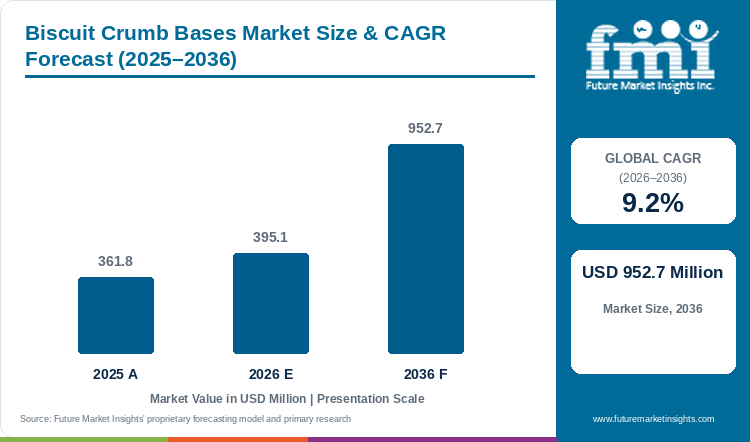
Table 1: Biscuit Crumb Bases Market Size and Forecast (USD million), 2025 to 2036
| Market size and forecast | Value |
|---|---|
| 2025 market size | USD 361.8 million |
| Estimated market size in 2026 | USD 395.1 million |
| Projected market size by 2036 | USD 952.7 million |
| CAGR (2026-2036) | 9.2% |
| Added revenue, 2026 to 2036 | USD 557.6 million |
Key Market Trends & Insights
- By Product Type: The Standard grade segment accounted for the largest share of the biscuit crumb bases market in 2026, representing 43.0% of total market revenue.
- By Form: Powder / dry products held the leading market position with a share of 43.0% in 2026, with fat addition and forming carried out during base assembly.
- By Application: Bread & rolls remained the largest application segment, accounting for 34.0% of the market in 2026.
Regional Highlights
- Fastest-growing country: The UAE is expected to record the highest growth rate among the eight profiled countries, with a projected CAGR of 10.5% between 2026 and 2036.
- Growth across other countries: Saudi Arabia is projected to expand at a CAGR of 10.2%, followed by South Korea at 9.9% and Germany at 9.5%. France is expected to register comparatively slower growth, with a CAGR of 8.2% during the forecast period.
The performance of biscuit producers provides an indication of demand for crumb ingredients. Mondelēz reported that organic revenue in biscuits and baked snacks rose by 0.8% in 2025, while volume/mix declined by 1.7%, with mid-single-digit growth internationally partly offset by weak performance in the United States[6]. Lotus Bakeries recorded stronger growth, as Biscoff revenue rose organically by 13.0% and its new production facility in Thailand was expected to become fully operational in early 2026[5]. Branded crumbs can carry this consumer recognition into desserts. Preparation remains with the bakery, however. Bakels specifies butter or margarine addition to its Biscuit Crumb Base for cheesecakes and slices[1], so the bakery ingredient removes crushing while leaving fat ratio and forming under bakery control.
Raw material costs remain an important factor influencing crumb prices. According to the FAO, world wheat prices rose by 6.3% in September 2026 to their highest level since August 2023, and the Sugar Price Index reached its highest level since April 2025[7]. Since wheat flour and sugar are the main components of most biscuits, these increases feed directly into the cost of crumbs. Dairy costs moved in the opposite direction, with the FAO Dairy Price Index 19.1% lower than a year earlier, although butter prices were little changed in September[7]. Bakeries adding butter to crumbs therefore saw limited relief. Mondelēz's OREO Base Cake, a finely ground cookie wafer for professional use[4], shows how a defined biscuit identity can be combined with a specified grind.
Lotus Bakeries' February 2026 annual-results release reported the first deliveries of Biscoff cookies from Thailand to Asia-Pacific by the end of 2025, extending production across three continents[3]. This upstream expansion broadens the brand's manufacturing base, although professional crumb supply remains tied to product availability in each destination. Composition records are another condition of use. The US Food and Drug Administration's (FDA) January 2025 guidance addresses major food allergen declarations in covered foods[2], so wheat, milk or soy from the biscuit must remain connected with the finished dessert, together with records for fat, filling and decoration added during assembly.
Table 2: Supporting Industry Indicators for the Biscuit Crumb Bases Market, 2025 to 2026
| Indicator | Data point | Why it matters | Source |
|---|---|---|---|
| Branded biscuit growth | Lotus Bakeries reported 2025 revenue of EUR 1.4 billion, up 10.0%, with Biscoff organic growth of 13.0%. | Strong branded biscuit demand supports branded crumb use in desserts. | [5] |
| Biscoff revenue | Lotus Biscoff revenue reached EUR 670.0 million in 2025. | Biscoff is one of the most recognised biscuit flavours used in crumb bases. | [5] |
| Biscuit category | Mondelēz biscuits and baked snacks accounted for 48.0% of 2025 net revenue of USD 38.5 billion. | The category provides a benchmark for global biscuit demand. | [6] |
| Biscuit volumes | Mondelēz biscuits and baked snacks organic revenue rose by 0.8% in 2025, while volume/mix declined by 1.7%. | Flat biscuit volumes mean crumb growth depends on new dessert uses. | [6] |
| Wheat prices | World wheat prices rose by 6.3% in September 2026 to their highest level since August 2023. | Flour is the main component of biscuit crumbs. | [7] |
| Sugar prices | The FAO Sugar Price Index stood 14.7% above its year-earlier level in September 2026. | Sugar costs feed into crumb prices. | [7] |
| Dairy prices | The FAO Dairy Price Index was 19.1% lower than a year earlier, while butter prices were little changed. | Butter is added to crumbs during base assembly. | [7] |
| Capacity expansion | Lotus reported first Thailand-produced Biscoff deliveries to Asia-Pacific by the end of 2025. | New capacity extends branded biscuit supply in Asia. | [3] |
| Base preparation | Bakels specifies butter or margarine addition for its cheesecake and slice crumb base. | The crumb removes crushing while retaining fat addition at the bakery. | [1] |
| Fine cookie-wafer format | Mondelēz supplies OREO Base Cake as finely ground cookie wafer for professional use. | A defined grind combines recognisable flavour with a specified input. | [4] |
Demand Intensity Analysis
A comparison of FMI's market estimate with the biscuit sales of a leading manufacturer provides a measure of the scale of crumb use. Mondelēz's biscuits and baked snacks category represented approximately USD 18.5 billion of its 2025 net revenue[6]. FMI estimated the biscuit crumb bases market at USD 361.8 million in 2025, which is equivalent to approximately 2.0% of the biscuit revenue of this single manufacturer. The comparison indicates that crumb bases remain a small, specialised outlet for biscuit production, focused on desserts and foodservice rather than retail snacking.
Volume trends provide another reference point. Mondelēz's biscuits and baked snacks volume/mix declined by 1.7% in 2025[6], while FMI expects the crumb bases market to grow at a CAGR of 9.2% between 2026 and 2036. The difference implies that growth will rely on wider use of crumbs in desserts and bakery products, and on branded flavours such as Biscoff, whose revenue grew organically by 13.0%[5], rather than on growth in overall biscuit consumption.
A similar comparison can be made with input costs. The FAO Cereal Price Index rose by 17.2% and the Sugar Price Index by 14.7% in the year to September 2026[7]. If these costs are passed through, part of the market's value growth in the near term will reflect higher crumb prices rather than higher volumes.
Segment values show where demand is concentrated. Standard grade and Powder / dry each represented USD 169.9 million within their respective Product Type and Form dimensions in 2026. Direct to industrial bakeries accounted for USD 185.7 million of Sales Channel revenue. FMI projects USD 557.6 million in added market revenue between 2026 and 2036, with the market reaching 2.4 times its 2026 value.
Table 3: Demand Intensity Metrics for the Biscuit Crumb Bases Market, 2025 Industry Data Against 2025 and 2026 Market Values
| Demand intensity metric | Value | Basis |
|---|---|---|
| FMI market value, 2025 | USD 361.8 million | FMI estimate of biscuit crumb base revenue. |
| Mondelēz biscuits and baked snacks revenue, 2025 | Approximately USD 18.5 billion | 48.0% of USD 38.5 billion net revenue. |
| FMI value as a share of Mondelēz biscuit revenue | Approximately 2.0% | USD 361.8 million divided by USD 18.5 billion. |
| Mondelēz biscuit volume/mix change, 2025 | -1.7% | Mondelēz full-year 2025 results. |
| Lotus Biscoff organic growth, 2025 | 13.0% | Lotus Bakeries 2025 results. |
| FAO Cereal Price Index, year-on-year change | +17.2% | September 2026. |
| FAO Sugar Price Index, year-on-year change | +14.7% | September 2026. |
| FMI value CAGR, 2026 to 2036 | 9.2% | FMI market forecast. |
| Standard grade revenue, 2026 | USD 169.9 million | 43.0% of the market. |
| Direct industrial bakery revenue, 2026 | USD 185.7 million | 47.0% of the market. |
| Market expansion multiple | 2.4 times | Projected 2036 market value relative to 2026. |
Analyst Perspective
"Branded biscuits like Biscoff are growing far faster than the biscuit category as a whole, and dessert makers are using those flavours in the base to make a familiar cheesecake look new."
- Nandini Roy Choudhury, Principal Analyst at Future Market Insights
How is the biscuit crumb bases market segmented?
The biscuit crumb bases market is segmented by product type, form, application, claim and sales channel. Product Type comprises Standard grade, Premium / specialty grade, Organic certified and Clean label grade. Form comprises Powder / dry, Liquid, Paste / semi-solid and Granules / pieces. Application comprises Bread & rolls, Cakes & muffins, Biscuits & cookies, Viennoiserie & pastry and Other bakery & snacks. Claim comprises Conventional, Clean label, Organic and Non-GMO / identity preserved. Sales Channel comprises Direct to industrial bakeries, Ingredient distributors, Foodservice & artisan supply and Online B2B.
What keeps Standard grade central to Product Type?
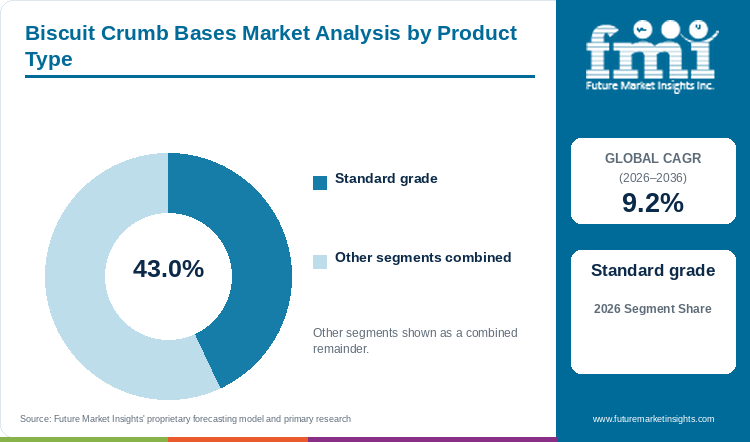
Standard grade: 43.0% of Product Type in 2026.
For standard crumb grades, a defined particle profile and flavour set the starting specification, and the segment generated approximately USD 169.9 million in 2026. Fat addition and pressing then determine how the material forms a base at the intended thickness. Bakels' product is mixed with butter or margarine for cheesecakes and slices[1], which illustrates this division of work. The assembled layer must retain cohesion and cutting behaviour after chilling or baking. Consistency between deliveries limits correction of the fat ratio or forming pressure, which gives an established standard grade continuing value.
- Standard grade: 43.0% of Product Type in 2026.
- Fat addition and forming pressure determine whether the agreed grade holds at the intended base thickness.
Why does Powder / dry lead the Form category?
Powder / dry: 43.0% of Form in 2026.
With dry crumbs, final assembly stays with the bakery, and Powder / dry products generated approximately USD 169.9 million in 2026. They can be weighed and combined with the selected fat, provided opened material is protected from humidity. Grind influences the result, as fine particles form a more uniform layer while larger pieces give a more pronounced bite. Mondelēz's OREO Base Cake is a finely ground cookie wafer for professional applications[4]. Comparing dry samples alone misses how much fat each needs and how it compacts, which becomes clear only after the base has been formed and held in the finished dessert.
- Powder / dry: 43.0% of Form in 2026.
- Grind is best compared after mixing and compaction, when its effect on fat demand and bite is visible.
How do Bread & rolls shape the Application category?
Bread & rolls: 34.0% of Application in 2026.
The Bread & rolls application accounted for approximately USD 134.3 million in 2026, reflecting crumb use as toppings and fillings in sweet breads as well as in desserts. Product qualification centres on the composition and particle profile of the purchased material and its behaviour in the complete recipe. Fat addition, thickness and contact with surrounding ingredients determine whether a formed layer keeps its intended texture. Sugar and fat already present in the biscuit also affect the formulation, so assessment after cooling and storage connects the incoming specification with usable output.
- Bread & rolls: 34.0% of Application in 2026.
- Particle distribution, composition and complete-product holding conditions define the accepted crumb specification.
What sustains the Conventional position in Claim?
Conventional: 54.0% of Claim in 2026.
Conventional bases held 54.0% of the Claim segment in 2026, but the biscuit recipe remains part of the finished food even when the crumb is bought separately. Wheat, milk or other relevant ingredients need to carry through accurately into the bakery's product information, as addressed in FDA's January 2025 allergen guidance[2]. Conventional bases allow broad sourcing choices, while additional claims change composition and the records needed to support it. Assessment must also include ingredients added during assembly, as a change to the fat or filling can affect the finished declaration.
- Conventional: 54.0% of Claim in 2026.
- Finished-product information needs to include both the biscuit ingredients and those added during assembly.
Why do direct industrial bakery orders lead Sales Channel?
Direct to industrial bakeries: 47.0% of Sales Channel in 2026.
Large-volume orders require agreement on how crumbs will be fed, mixed and pressed on a particular line, and direct supply to industrial bakeries accounted for approximately USD 185.7 million in 2026. Direct purchasing lets the bakery agree particle distribution and pack handling with the supplier, then check the complete product after filling and chilling or freezing. Problems with strength or eating quality may only become visible at those later stages. Smaller customers may obtain crumbs through distributors, and changes to biscuit formulation need to be communicated early enough to assess their effect.
- Direct to industrial bakeries: 47.0% of Sales Channel in 2026.
- Qualification continues through filling, chilling or freezing, where later structural changes become apparent.
What are the drivers, restraints and opportunities in the biscuit crumb bases market?
Prepared crumbs and branded flavours drive dessert demand, although rising input costs and texture risks restrain the market, while biscuit identity can become part of the dessert proposition.
Prepared crumbs and branded flavours drive dessert demand
Prepared crumbs remove biscuit crushing from the bakery's assembly sequence and provide a more consistent particle distribution across batches. The effect is particularly relevant where base thickness and slicing must be repeated. Branded flavours add a second driver. Lotus Biscoff grew organically by 13.0% in 2025[5], and dessert makers can use such recognised biscuits in the base to differentiate a familiar product. On bakery production lines, pack handling and feeding add further requirements, while smaller kitchens place greater weight on batch convenience. Both settings benefit when the same crumb profile supports predictable assembly.
Rising input costs and texture risks restrain the market
Biscuit input costs are rising, with the FAO Cereal Price Index up 17.2% and the Sugar Price Index up 14.7% in the year to September 2026[7]. Higher crumb prices may encourage some bakeries to return to crushing their own biscuits. Texture is a further restraint. Moisture transfer from a filling can soften a biscuit base during chilled storage, while fat composition can leave another formulation too firm at serving temperature. A change from a large cheesecake to individual portions also alters base thickness and contact with the filling. A new fat, filling or portion design can require renewed assessment before the crumb can be relied on to deliver the same result.
Biscuit identity can become part of the dessert proposition
For some desserts, biscuit flavour is part of the product's identity. OREO Base Cake gives professional users a finely ground cookie wafer with a recognisable profile[4], and Lotus' expansion of Biscoff production into Thailand[3][5] widens the availability of another branded flavour in Asia-Pacific. A branded crumb can refresh a range while the bakery continues to use familiar assembly equipment. Its flavour must still fit the cream, fruit or other dessert filling, and the base must remain strong enough to support the complete item. Pack sizes that match actual production also make a specialty flavour easier to keep in the range.
Which country CAGRs are profiled in the biscuit crumb bases market?
Table 4: Country growth outlook for the biscuit crumb bases market
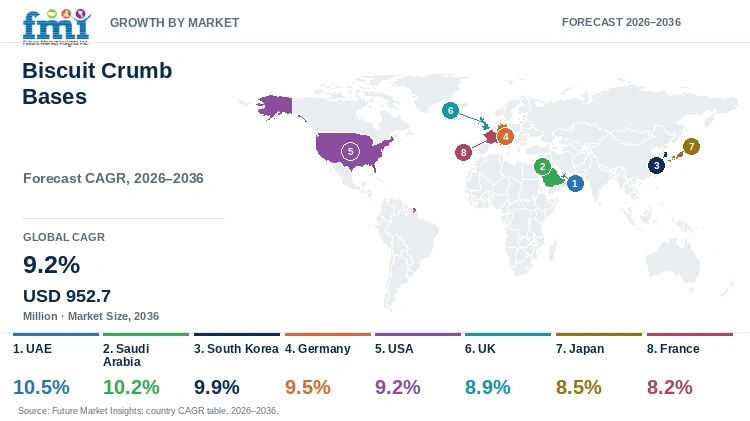
| Country | CAGR |
|---|---|
| UAE | 10.5% |
| Saudi Arabia | 10.2% |
| South Korea | 9.9% |
| Germany | 9.5% |
| USA | 9.2% |
| UK | 8.9% |
| Japan | 8.5% |
| France | 8.2% |
UAE
- The UAE is the fastest-growing market among the profiled countries, with a forecast CAGR of 10.5% from 2026 to 2036. Crumb bases supplied through UAE central kitchens face transport, final service and in some cases freezing and thawing, so initial forming is only the start of texture assessment. The base must retain cohesion through distribution and remain convenient to cut or spoon. Prepared crumbs remove the crushing operation, while fat addition and portion thickness remain under kitchen control.
Saudi Arabia
- In Saudi cakes and dessert cups, layer thickness and cohesion influence the weight and handling of crumb bases. Excessive firmness reduces eating convenience, while insufficient binding affects the usable portion. Saudi Arabia is forecast to grow at a CAGR of 10.2% for 2026 to 2036. A stable particle profile links the incoming crumb with the same pressing and mixing method across batches, which becomes more valuable when several outlets serve a common dessert.
South Korea
- With a projected CAGR of 9.9% from 2026 to 2036, South Korea ranks third among the profiled countries. In layered cakes and individual desserts, the base contributes to presentation as well as texture. A cocoa or caramelised biscuit profile, such as Biscoff, whose production now includes a Thai facility serving Asia-Pacific[3], needs to be balanced against the cream or fruit above it. Clean slicing and performance after chilled holding are useful tests, and consistent crumb colour helps repeat the intended appearance.
Germany
- Germany is projected to grow at a CAGR of 9.5% for 2026 to 2036, the fastest rate among the profiled European countries. Industrial crumb-base production in Germany links feeding and compaction with the condition of the assembled dessert during distribution, and frozen products extend assessment through thawing. Controlled particle distribution and a defined fat-mixing method establish the preparation, while yield over longer runs shows whether the result can be sustained. Grade continuity also supports transfer between shifts.
USA
- US biscuit demand has been weaker than elsewhere, with Mondelēz describing its US biscuits and baked snacks performance as soft in 2025[6]. The USA market is nevertheless forecast to grow at a CAGR of 9.2% from 2026 to 2036, supported by dessert applications. OREO Base Cake offers US professional bakers a defined cocoa-biscuit ingredient for cheesecakes and slices[4]. The bakery must still establish the right fat addition and portion, and ingredient information must follow the crumb into the finished food, including major allergens addressed in FDA guidance[2].
UK
- UK foodservice dessert kitchens use prepared crumbs to remove crushing and provide a repeatable input for mixing and pressing. The UK is forecast to grow at a CAGR of 8.9% from 2026 to 2036. Case sizes influence the suitability of a crumb for smaller operators, whereas larger accounts can specify a particular texture or flavour for recurring use. A grade that performs in several compatible desserts also reduces the number of ingredients held.
Japan
- In a small Japanese dessert portion, the firmness of the base is immediately noticeable. A fine crumb can create a uniform layer, but that layer must hold together without resisting the spoon or knife. Japan is projected to grow at a CAGR of 8.5% for 2026 to 2036. Shipment quantities for imported crumbs need to fit the initial production plan, and when a specialty dessert becomes a regular item, consistent grind and flavour preserve the portioning and presentation established during development.
France
- France is expected to register the slowest growth among the profiled countries, with a forecast CAGR of 8.2% from 2026 to 2036. In French tart-style desserts and layered pastries, a biscuit base can contribute a toasted or cocoa note alongside its texture. The right level of sweetness and thickness depends on what sits above it, so the complete recipe is the useful point of comparison. Convenient packs matter to artisan users, while larger producers need dependable compaction and slicing.
Who are the notable companies in the biscuit crumb bases market?
Bakels; Zeelandia; Lotus Bakeries; Mondelēz International; Pecan Deluxe
Prepared-base suppliers and biscuit producers meet in this market. Bakels and Zeelandia offer products linked to dessert assembly, while Lotus Bakeries and Mondelēz bring recognisable biscuit brands. Lotus reported 2025 revenue of EUR 1.4 billion and underlying EBITDA of EUR 273.4 million, up 12.4%[5], while Mondelēz reported net revenue of USD 38.5 billion[6]. Pecan Deluxe supplies cookie and biscuit inclusions for manufacturers seeking a particular texture.
Grind, sweetness, fat composition and pack handling determine the preparation required at the mixing and pressing stage. Recognisable biscuit profiles differentiate the dessert, while the accepted specification must retain a stable layer through assembly and holding.
Competitive Benchmarking: Biscuit Crumb Bases Market
Table 5: Company capabilities in the biscuit crumb bases market
| Company | Relevant offering | Purchasing consideration |
|---|---|---|
| Bakels | Biscuit Crumb Base | Control added fat and base thickness |
| Zeelandia | Cheesecake crust mix | Match the crust to the complete dessert system |
| Lotus Bakeries | Biscoff biscuit crumbs | Balance branded flavor with the required crust texture |
| Mondelēz International | OREO Base Cake Grind | Select grind and inclusion level |
| Pecan Deluxe | Cookie crumbs and biscuit pieces | Choose particle profile for the intended base or layer |
Key Developments in the Biscuit Crumb Bases Market
- In January 2025, the FDA revised its food allergen guidance, which requires wheat, milk, soy or other major allergens contributed by a biscuit to be declared accurately in the finished food[2].
- In February 2026, Mondelēz reported that biscuits and baked snacks accounted for 48.0% of its 2025 net revenue, with organic revenue up 0.8% and volume/mix down 1.7%[6].
- In February 2026, Lotus Bakeries reported 2025 revenue of EUR 1.4 billion and Biscoff organic growth of 13.0%, and confirmed first deliveries from its new Thailand facility to Asia-Pacific[3][5].
- In October 2026, the FAO reported that its Cereal Price Index was 17.2% higher and its Sugar Price Index 14.7% higher than a year earlier[7].
Key Players in the Biscuit Crumb Bases Market
- Bakels
- Zeelandia
- Lotus Bakeries
- Mondelēz International
- Pecan Deluxe
Biscuit Crumb Bases Market - Report Scope
Table 6: Report scope for the biscuit crumb bases market
| Coverage field | Report scope |
|---|---|
| Market breakdown | Product Type; Form; Application; Claim; Sales Channel; Region |
| Quantitative Units | USD Million |
| Market Definition | Revenue from formulated biscuit-derived crumbs and prepared crumb-base mixes sold as bakery or dessert intermediates. Excludes downstream finished baked products, ordinary non-biscuit bread crumbs, unrelated mixes and fillings, and non-crumb inclusions; embedded base value is included only when separately identifiable, without double counting bundled finished goods. |
| Regions Covered | North America; Latin America; Western Europe; Eastern Europe; East Asia; South Asia and Pacific; Middle East and Africa |
| Countries Covered | UAE; Saudi Arabia; South Korea; Germany; USA; UK; Japan; France |
| Key Companies Profiled | Bakels; Zeelandia; Lotus Bakeries; Mondelēz International; Pecan Deluxe |
| Forecast Period | 2026 to 2036 |
| Approach | Market assessment supported by official technical and regulatory publications, company product information and country operating conditions. |
Biscuit Crumb Bases Market - Research Methodology
Table 7: Research approach for the biscuit crumb bases market
| Method | Approach |
|---|---|
| Market definition | The assessment separates qualifying ingredient revenue from finished bakery products and unrelated formulation inputs. |
| Secondary evidence | Government publications, regulatory material, technical literature and first-party product documentation establish the operating context. |
| Commercial assessment | Product performance, supply continuity and customer qualification requirements are considered within each segment and country profile. |
| Comparability | Market values, segment shares and country forecasts use the stated revenue boundary, units and forecast period. |
Biscuit Crumb Bases Market by Segments
Product Type
- Standard grade
- Premium / specialty grade
- Organic certified
- Clean label grade
Form
- Powder / dry
- Liquid
- Paste / semi-solid
- Granules / pieces
Application
- Bread & rolls
- Cakes & muffins
- Biscuits & cookies
- Viennoiserie & pastry
- Other bakery & snacks
Claim
- Conventional
- Clean label
- Organic
- Non-GMO / identity preserved
Sales Channel
- Direct to industrial bakeries
- Ingredient distributors
- Foodservice & artisan supply
- Online B2B
Biscuit Crumb Bases Market by Region
- North America
- United States
- Canada
- Latin America
- Brazil
- Mexico
- Argentina
- Chile
- Western Europe
- Germany
- France
- United Kingdom
- Italy
- Spain
- Benelux
- Nordics
- Eastern Europe
- Poland
- Czech Republic
- Romania
- Hungary
- East Asia
- China
- Japan
- South Korea
- South Asia and Pacific
- India
- ASEAN
- Australia and New Zealand
- Middle East and Africa
- GCC Countries
- South Africa
- Türkiye
- Israel
Research Sources and Bibliography
- [1] Australian Bakels. (n.d.). Bakels Biscuit Crumb Base.
- [2] U.S. Food and Drug Administration. (2025, January 6). Frequently Asked Questions: Food Allergen Labeling Guidance for Industry.
- [3] Lotus Bakeries. (2026, February 6). Highlights 2025: Annual results.
- [4] Mondelēz International. (n.d.). OREO Base Cake Grind.
- [5] Edelbrock, L. (2026, February 13). ESM Magazine. Lotus Bakeries posts 10% revenue growth in FY 2025.
- [6] Redman, R. (2026, February 5). Food Business News. Mondelez offers cautious guidance for 2026.
- [7] Food and Agriculture Organization of the United Nations. (2026, October 2). FAO Food Price Index.
Future Market Insights. (2026). Biscuit Crumb Bases Market: Global Industry Analysis and Opportunity Assessment 2036.
This Report Answers
- How large is the biscuit crumb bases market in 2026 and what size is projected for 2036?
- Which industrial bakery pressures sustain demand for prepared biscuit crumb bases?
- Why is Standard grade the leading Product Type category?
- Why do Powder / dry formats account for the largest Form segment?
- How do the profiled country growth rates differ between the UAE and France?
- Which profiled companies document prepared crust mixes or related bakery ingredient systems?
Frequently Asked Questions
How big is the biscuit crumb bases market in 2026, and what is forecast for 2036?
The market is valued at USD 395.1 million in 2026 and is forecast to reach USD 952.7 million by 2036. These figures refer to ingredient revenue rather than finished bakery sales.
What is the CAGR for the biscuit crumb bases market from 2026 to 2036?
The market is forecast to grow at a CAGR of 9.2% from 2026 to 2036, well ahead of biscuit volumes at leading manufacturers.
Which Product Type segment leads biscuit crumb bases?
Standard grade leads with a 43.0% share in 2026, as repeatable mix performance supports recurring production.
Which Form segment is largest in the biscuit crumb bases market?
Powder / dry leads with a 43.0% share in 2026, as dry handling supports storage and controlled dosing.
Which profiled countries show the fastest growth in biscuit crumb bases?
The UAE leads at 10.5%, followed by Saudi Arabia at 10.2% from 2026 to 2036. These are growth rates rather than rankings by market size.
Which companies are active or profiled in biscuit crumb bases?
The report profiles Bakels, Zeelandia, Lotus Bakeries, Mondelēz International and Pecan Deluxe.
Preview the report firsthand - request a free sample
Get SampleGet the brochure for pricing and purchase details.
Get PDFTable of Content
- Key Takeaways
- Market Size and CAGR
- Top Growth Driver
- Fastest Growing Segment
- Leading Region
- Key Companies
- Emerging Opportunities
- Executive Summary
- Global Market Outlook
- Demand-side Trends
- Supply-side Trends
- Technology Roadmap Analysis
- Analysis and Recommendations
- Analyst Perspective (What is happening? Why now? What should investors know?)
- Key Questions Answered
- How large is the market?
- What is the CAGR?
- What are key trends?
- Which region dominates?
- Who are the leaders?
- Market Overview
- Market Coverage / Taxonomy
- Market Definition / Scope / Limitations
- Research Methodology
- Chapter Orientation
- Analytical Lens and Working Hypotheses
- Market Structure, Signals, and Trend Drivers
- Benchmarking and Cross-market Comparability
- Market Sizing, Forecasting, and Opportunity Mapping
- Research Design and Evidence Framework
- Desk Research Programme (Secondary Evidence)
- Expert Input and Fieldwork (Primary Evidence)
- Tooling, Models, and Reference Databases
- Data Engineering and Model Build
- Quality Assurance and Audit Trail
- Market Background
- Market Dynamics (Drivers, Restraints, Opportunity, Trends)
- Scenario Forecast (Optimistic, Likely, Conservative)
- Impact Analysis
- AI Impact
- Sustainability Impact
- Regulatory Impact
- Technology Impact
- Consumer / Buyer Analysis
- Purchase Drivers
- Adoption Barriers
- Buyer Journey
- Opportunity Map Analysis
- Product Life Cycle Analysis
- Supply Chain Analysis
- Investment Feasibility Matrix
- Value Chain Analysis
- PESTLE and Porter's Analysis
- Regulatory Landscape
- Regional Parent Market Outlook
- Production and Consumption Statistics
- Import and Export Statistics
- Global Market Analysis and Forecast, 2021 to 2036
- Historical Market Size Value (USD Million) Analysis, 2021 to 2025
- Current and Future Market Size Value (USD Million) Projections, 2026 to 2036
- Y-o-Y Growth Trend Analysis
- Absolute $ Opportunity Analysis
- Global Market Pricing Analysis, 2021 to 2036
- Global Market Analysis and Forecast, By Product Type, 2021 to 2036
- Introduction / Key Findings
- Historical Market Size Value (USD Million) Analysis By Product Type, 2021 to 2025
- Current and Future Market Size Value (USD Million) Analysis and Forecast By Product Type, 2026 to 2036
- Standard grade
- Premium / specialty grade
- Organic certified
- Clean label grade
- Y-o-Y Growth Trend Analysis By Product Type, 2021 to 2025
- Absolute $ Opportunity Analysis By Product Type, 2026 to 2036
- Global Market Analysis and Forecast, By Form, 2021 to 2036
- Introduction / Key Findings
- Historical Market Size Value (USD Million) Analysis By Form, 2021 to 2025
- Current and Future Market Size Value (USD Million) Analysis and Forecast By Form, 2026 to 2036
- Powder / dry
- Liquid
- Paste / semi-solid
- Granules / pieces
- Y-o-Y Growth Trend Analysis By Form, 2021 to 2025
- Absolute $ Opportunity Analysis By Form, 2026 to 2036
- Global Market Analysis and Forecast, By Application, 2021 to 2036
- Introduction / Key Findings
- Historical Market Size Value (USD Million) Analysis By Application, 2021 to 2025
- Current and Future Market Size Value (USD Million) Analysis and Forecast By Application, 2026 to 2036
- Bread & rolls
- Cakes & muffins
- Biscuits & cookies
- Viennoiserie & pastry
- Other bakery & snacks
- Y-o-Y Growth Trend Analysis By Application, 2021 to 2025
- Absolute $ Opportunity Analysis By Application, 2026 to 2036
- Global Market Analysis and Forecast, By Claim, 2021 to 2036
- Introduction / Key Findings
- Historical Market Size Value (USD Million) Analysis By Claim, 2021 to 2025
- Current and Future Market Size Value (USD Million) Analysis and Forecast By Claim, 2026 to 2036
- Conventional
- Clean label
- Organic
- Non-GMO / identity preserved
- Y-o-Y Growth Trend Analysis By Claim, 2021 to 2025
- Absolute $ Opportunity Analysis By Claim, 2026 to 2036
- Global Market Analysis and Forecast, By Sales Channel, 2021 to 2036
- Introduction / Key Findings
- Historical Market Size Value (USD Million) Analysis By Sales Channel, 2021 to 2025
- Current and Future Market Size Value (USD Million) Analysis and Forecast By Sales Channel, 2026 to 2036
- Direct to industrial bakeries
- Ingredient distributors
- Foodservice & artisan supply
- Online B2B
- Y-o-Y Growth Trend Analysis By Sales Channel, 2021 to 2025
- Absolute $ Opportunity Analysis By Sales Channel, 2026 to 2036
- Global Market Analysis and Forecast, By Region, 2021 to 2036
- Introduction
- Historical Market Size Value (USD Million) Analysis By Region, 2021 to 2025
- Current Market Size Value (USD Million) Analysis and Forecast By Region, 2026 to 2036
- North America
- Latin America
- Western Europe
- Eastern Europe
- East Asia
- South Asia and Pacific
- Middle East and Africa
- Market Attractiveness Analysis By Region
- North America Market Analysis and Forecast, By Country, 2021 to 2036
- Historical Market Size Value (USD Million) Trend Analysis By Market Taxonomy, 2021 to 2025
- Market Size Value (USD Million) Forecast By Market Taxonomy, 2026 to 2036
- By Country
- United States
- Canada
- By Product Type
- By Form
- By Application
- By Claim
- By Sales Channel
- By Country
- Market Attractiveness Analysis
- By Country
- By Product Type
- By Form
- By Application
- By Claim
- By Sales Channel
- Key Takeaways
- Latin America Market Analysis and Forecast, By Country
- Historical Market Size Value (USD Million) Trend Analysis By Market Taxonomy, 2021 to 2025
- Market Size Value (USD Million) Forecast By Market Taxonomy, 2026 to 2036
- By Country
- Brazil
- Mexico
- Argentina
- Chile
- By Product Type
- By Form
- By Application
- By Claim
- By Sales Channel
- By Country
- Market Attractiveness Analysis
- By Country
- By Product Type
- By Form
- By Application
- By Claim
- By Sales Channel
- Key Takeaways
- Western Europe Market Analysis and Forecast, By Country
- Historical Market Size Value (USD Million) Trend Analysis By Market Taxonomy, 2021 to 2025
- Market Size Value (USD Million) Forecast By Market Taxonomy, 2026 to 2036
- By Country
- Germany
- France
- United Kingdom
- Italy
- Spain
- Benelux
- Nordics
- By Product Type
- By Form
- By Application
- By Claim
- By Sales Channel
- By Country
- Market Attractiveness Analysis
- By Country
- By Product Type
- By Form
- By Application
- By Claim
- By Sales Channel
- Key Takeaways
- Eastern Europe Market Analysis and Forecast, By Country
- Historical Market Size Value (USD Million) Trend Analysis By Market Taxonomy, 2021 to 2025
- Market Size Value (USD Million) Forecast By Market Taxonomy, 2026 to 2036
- By Country
- Poland
- Czech Republic
- Romania
- Hungary
- By Product Type
- By Form
- By Application
- By Claim
- By Sales Channel
- By Country
- Market Attractiveness Analysis
- By Country
- By Product Type
- By Form
- By Application
- By Claim
- By Sales Channel
- Key Takeaways
- East Asia Market Analysis and Forecast, By Country
- Historical Market Size Value (USD Million) Trend Analysis By Market Taxonomy, 2021 to 2025
- Market Size Value (USD Million) Forecast By Market Taxonomy, 2026 to 2036
- By Country
- China
- Japan
- South Korea
- By Product Type
- By Form
- By Application
- By Claim
- By Sales Channel
- By Country
- Market Attractiveness Analysis
- By Country
- By Product Type
- By Form
- By Application
- By Claim
- By Sales Channel
- Key Takeaways
- South Asia and Pacific Market Analysis and Forecast, By Country
- Historical Market Size Value (USD Million) Trend Analysis By Market Taxonomy, 2021 to 2025
- Market Size Value (USD Million) Forecast By Market Taxonomy, 2026 to 2036
- By Country
- India
- ASEAN
- Australia and New Zealand
- By Product Type
- By Form
- By Application
- By Claim
- By Sales Channel
- By Country
- Market Attractiveness Analysis
- By Country
- By Product Type
- By Form
- By Application
- By Claim
- By Sales Channel
- Key Takeaways
- Middle East and Africa Market Analysis and Forecast, By Country
- Historical Market Size Value (USD Million) Trend Analysis By Market Taxonomy, 2021 to 2025
- Market Size Value (USD Million) Forecast By Market Taxonomy, 2026 to 2036
- By Country
- GCC Countries
- South Africa
- Türkiye
- Israel
- By Product Type
- By Form
- By Application
- By Claim
- By Sales Channel
- By Country
- Market Attractiveness Analysis
- By Country
- By Product Type
- By Form
- By Application
- By Claim
- By Sales Channel
- Key Takeaways
- Key Countries Market Analysis
- United States
- Pricing Analysis
- Market Share Analysis, 2025
- By Product Type
- By Form
- By Application
- By Claim
- By Sales Channel
- Canada
- Pricing Analysis
- Market Share Analysis, 2025
- By Product Type
- By Form
- By Application
- By Claim
- By Sales Channel
- Mexico
- Pricing Analysis
- Market Share Analysis, 2025
- By Product Type
- By Form
- By Application
- By Claim
- By Sales Channel
- Brazil
- Pricing Analysis
- Market Share Analysis, 2025
- By Product Type
- By Form
- By Application
- By Claim
- By Sales Channel
- Chile
- Pricing Analysis
- Market Share Analysis, 2025
- By Product Type
- By Form
- By Application
- By Claim
- By Sales Channel
- Germany
- Pricing Analysis
- Market Share Analysis, 2025
- By Product Type
- By Form
- By Application
- By Claim
- By Sales Channel
- United Kingdom
- Pricing Analysis
- Market Share Analysis, 2025
- By Product Type
- By Form
- By Application
- By Claim
- By Sales Channel
- Italy
- Pricing Analysis
- Market Share Analysis, 2025
- By Product Type
- By Form
- By Application
- By Claim
- By Sales Channel
- Spain
- Pricing Analysis
- Market Share Analysis, 2025
- By Product Type
- By Form
- By Application
- By Claim
- By Sales Channel
- France
- Pricing Analysis
- Market Share Analysis, 2025
- By Product Type
- By Form
- By Application
- By Claim
- By Sales Channel
- India
- Pricing Analysis
- Market Share Analysis, 2025
- By Product Type
- By Form
- By Application
- By Claim
- By Sales Channel
- ASEAN
- Pricing Analysis
- Market Share Analysis, 2025
- By Product Type
- By Form
- By Application
- By Claim
- By Sales Channel
- Australia and New Zealand
- Pricing Analysis
- Market Share Analysis, 2025
- By Product Type
- By Form
- By Application
- By Claim
- By Sales Channel
- China
- Pricing Analysis
- Market Share Analysis, 2025
- By Product Type
- By Form
- By Application
- By Claim
- By Sales Channel
- Japan
- Pricing Analysis
- Market Share Analysis, 2025
- By Product Type
- By Form
- By Application
- By Claim
- By Sales Channel
- South Korea
- Pricing Analysis
- Market Share Analysis, 2025
- By Product Type
- By Form
- By Application
- By Claim
- By Sales Channel
- Poland
- Pricing Analysis
- Market Share Analysis, 2025
- By Product Type
- By Form
- By Application
- By Claim
- By Sales Channel
- Hungary
- Pricing Analysis
- Market Share Analysis, 2025
- By Product Type
- By Form
- By Application
- By Claim
- By Sales Channel
- Türkiye
- Pricing Analysis
- Market Share Analysis, 2025
- By Product Type
- By Form
- By Application
- By Claim
- By Sales Channel
- South Africa
- Pricing Analysis
- Market Share Analysis, 2025
- By Product Type
- By Form
- By Application
- By Claim
- By Sales Channel
- UAE
- Pricing Analysis
- Market Share Analysis, 2025
- By Product Type
- By Form
- By Application
- By Claim
- By Sales Channel
- Saudi Arabia
- Pricing Analysis
- Market Share Analysis, 2025
- By Product Type
- By Form
- By Application
- By Claim
- By Sales Channel
- United States
- Market Structure Analysis
- Competition Dashboard
- Competition Benchmarking
- Market Share Analysis of Top Players
- By Regional
- By Product Type
- By Form
- By Application
- By Claim
- By Sales Channel
- Emerging Startups
- Innovation Benchmarking
- Competition Analysis
- Competition Deep Dive
- Bakels
- Overview
- Product Portfolio
- Profitability by Market Segments
- Sales Footprint
- Strategy Overview
- Marketing Strategy
- Product Strategy
- Channel Strategy
- Zeelandia
- Lotus Bakeries
- Mondelēz International
- Pecan Deluxe
- Bakels
- Case Studies
- Success Stories
- Recent Developments
- Competition Deep Dive
- Assumptions & Acronyms Used


