

- Market Size (2026)
- USD 760.6 Mn
- Forecast (2036)
- USD 1735.6 Mn
- CAGR (2026 to 2036)
- 8.6%
How big is the Crumb Rubber Compatibilizers Market?
USD 760.6 million in 2026 and USD 1,735.6 million by 2036 at an 8.6% CAGR.
Crumb rubber compatibilizers support engineered reuse of tyre-derived rubber by helping rubber particles bond inside asphalt binders and polymer blends. Tyres Europe reported that Europe generated 3.9 million tonnes of end-of-life tyres in 2024 and treated 97.0% of that volume, providing additive suppliers with a large post-collection material base for higher-value road and compounder applications.
Asphalt producers need additives that keep ground tyre rubber dispersed during heat, pumping, and storage. National Asphalt Pavement Association data showed 101.4 million tons of Recycled Asphalt Pavement returned to USA asphalt mixtures in the 2024 construction season, which conserved 5.1 million tons of asphalt binder and replaced 96.0 million tons of virgin aggregate.
Polymer compounders evaluate maleated polymers, reactive elastomers, sulfur systems, and coupling agents through adhesion gains in PP, PE, SBS, TPE, and PVC blends. NITI Aayog reported that India processed 1.6 million metric tons of domestic waste tyres and 1.4 million metric tons of imported waste tyres through formal recycling in FY2024, providing crumb-rubber processors with a measurable supply base for engineered blends.
Buyers compare compatibilizers through dosage cost, storage stability, and rejection control before shifting from laboratory trials to repeat purchase programs. Evonik identifies VESTENAMER as a polyoctenamer additive that acts as a compatibilizer between bitumen and ground tire rubber, offering asphalt suppliers a direct product reference for rubberized binder performance.
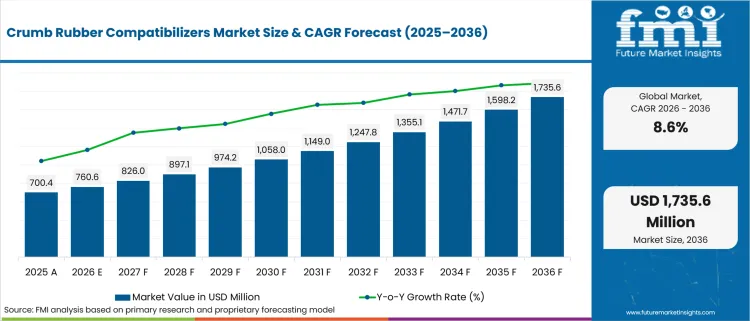
| Metric | Value |
|---|---|
| 2025 Market Size | USD 700.4 million |
| 2026 Market Size | USD 760.6 million |
| 2036 Market Size | USD 1,735.6 million |
| Forecast CAGR (2026-2036) | 8.6% |
| Leading Compatibilizer Type | Maleated Polymers |
| Maleated Polymers Share (2026) | 38.0% |
| Leading Application | Asphalt Modification |
| Asphalt Modification Share (2026) | 46.0% |
| Leading Polymer Compatibility | Bitumen |
| Bitumen Share (2026) | 44.0% |
| Fastest-growing Country | China |
| China CAGR by 2036 | 9.6% |
Summary of the Crumb Rubber Compatibilizers Market
| Market Signal | Commercial Impact |
|---|---|
| Demand and Growth Drivers | Demand for crumb rubber compatibilizers is increasing as road construction companies, recyclers, and polymer compounders seek improved compatibility, storage stability, and higher-value utilization of recycled tire rubber.
|
| Product and Segment View | Maleated polymers, asphalt modification, and bitumen compatibility continue to represent the leading commercial opportunities across the market.
|
| Geography and Growth Outlook | Asia and North America continue to expand market opportunities through tire recycling, sustainable road construction, and circular economy initiatives.
|
| Competitive Landscape | Competition increasingly focuses on asphalt compatibility technologies, polymer modification expertise, and technical support for recycled rubber applications.
|
| Analyst Perspective | Crumb rubber compatibilizers are evolving from recycling additives into process-control technologies that improve product consistency, manufacturing efficiency, and long-term recycled material performance.
- Nikhil Kaitwade, Principal Consultant at Future Market Insights |
How is Crumb Rubber Compatibilizers Market segmented?
Crumb rubber compatibilizers industry is segmented by compatibilizer type, application, polymer compatibility, end use, sales channel, and region.
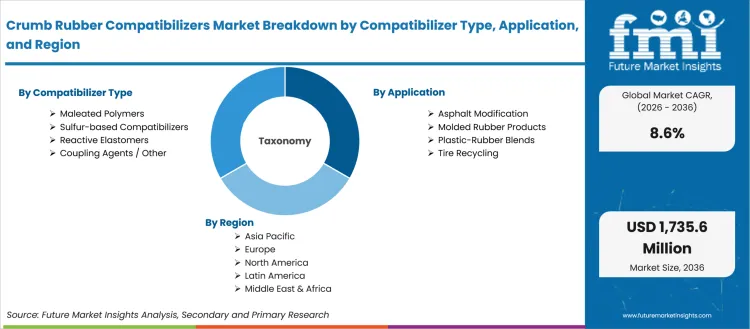
Crumb rubber compatibilizers market is segmented by compatibilizer type, application, polymer compatibility, end use, sales channel, and region. Compatibilizer-type coverage includes maleated polymers, sulfur-based compatibilizers, reactive elastomers, and coupling agents or other systems. Application coverage includes asphalt modification, molded rubber products, plastic-rubber blends, and tire recycling. Polymer-compatibility coverage includes PP / PE, SBS / TPE, bitumen, and PVC / other systems. End-use demand comes from road construction, automotive rubber, construction products, and consumer goods. Sales-channel coverage includes direct to compounders, distributors, and asphalt additive suppliers across North America, Latin America, Europe, East Asia, South Asia and Pacific, and Middle East and Africa.
Why do Maleated Polymers lead within compatibilizer-type segment?
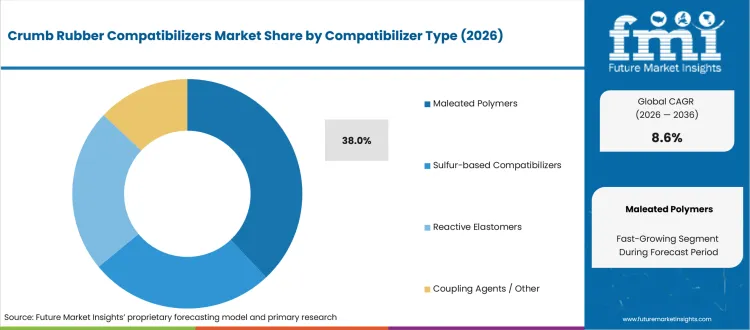
Maleated Polymers lead through polar graft chemistry suited to recycled rubber and polyolefin blends. PP and PE compatibility needs are reflected in the 38.0% share for Maleated Polymers in 2026, while Kraton’s recycled polyolefin blend guidance lists 3.0% to 5.0% addition levels for CirKular+ additive use. Such dosing guidance helps compounders assess crumb rubber bonding before larger recycled-content batches move into production.
- Maleated Polymers are expected to account for 38.0% share in 2026, supported by compounding demand for PP and PE bonding. Rubber powder can behave as a weak filler unless graft chemistry improves interaction between crumb rubber and polyolefin chains.
- Compounders evaluate maleated systems through impact behavior and rejection control before approving recycled blend recipes. Arkema’s Virtucycle program covers PA11, PA12, and PEBA grades with 30.0% to 95.0% minimum recycled content, showing how recycled-polymer buyers already compare material quality through quantified content claims.
What supports demand for Asphalt Modification applications?
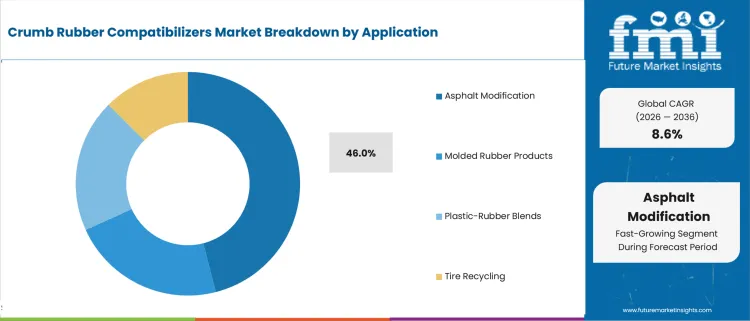
Asphalt Modification gains demand as road buyers assess rubberized binders through storage stability and plant handling. Asphalt Modification is anticipated to hold 46.0% share in 2026, and USA asphalt producers reused more than 101 million tons of reclaimed asphalt pavement during the 2024 construction season. Compatibilizers help producers manage crumb rubber dispersion as recycled road materials become part of routine mix design.
- Asphalt Modification is anticipated to hold 46.0% share in 2026, led by road agencies and asphalt suppliers seeking rubberized binder stability. Plant trials focus on mixing temperature and contractor acceptance before rubber-modified binders are approved.
- Rubberized binder buyers need additives supported by field guidance instead of catalogue claims. USA asphalt industry data showed 5.1 million tons of asphalt binder conserved in 2024 through RAP reuse, providing producers with a cost reference for recycled-material formulations.
How do buyers evaluate Bitumen within polymer compatibility?
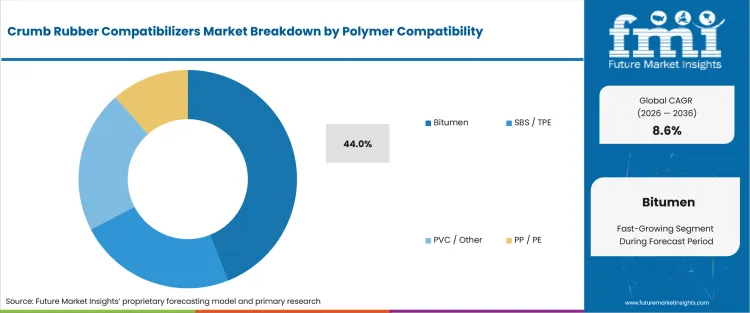
Bitumen creates a direct technical test for crumb rubber compatibilizers as hot binders need rubber dispersion under heat and shear. Bitumen compatibility holds 44.0% share in 2026, and Evonik identifies VESTENAMER as a polyoctenamer additive that acts as a compatibilizer between bitumen and ground tire rubber. Such product evidence helps buyers connect chemistry selection with storage-stability targets.
- Bitumen is projected to represent 44.0% share in 2026, shaped by hot asphalt binder applications requiring dispersion support. Storage-stability checks influence additive approval before higher rubber loading moves into commercial paving batches.
- Binder suppliers compare compatibilizers through viscosity control and separation resistance. Kraton’s 2025 paving series supports reclaimed-asphalt surface mixtures at 50.0% or more RAP content, providing asphalt suppliers with a quantified recycled-material target during additive assessment.
What market factors influence Road Construction end use?
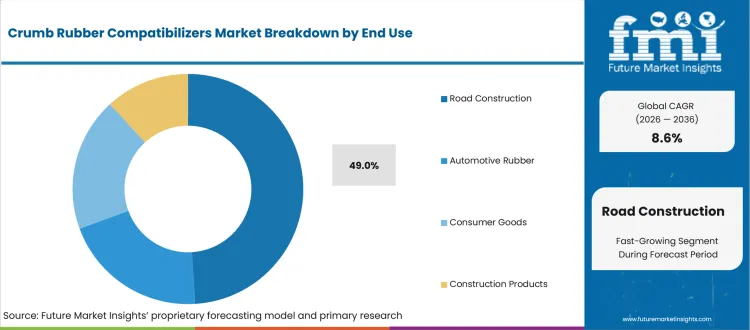
Road Construction influences crumb rubber compatibilizer demand through pavement durability testing and public-budget discipline. Road Construction accounts for 49.0% share in 2026, while England’s RIS3 plan provides GBP 24.99 billion to operate and enhance the strategic road network during 2026 to 2031. Highway buyers examine recycled-content materials through service performance and contractor acceptance.
- Road Construction is expected to account for 49.0% share in 2026, reflecting pavement-owner testing of recycled tire rubber in asphalt systems. Approval decisions rely on storage behavior and durability evidence before agencies authorize repeat use.
- Public road buyers prefer additives supported by mix-design data and field-placement records. Germany’s Special Fund for Infrastructure and Climate Neutrality provides EUR 500.0 billion for infrastructure and climate-neutrality investments, which can raise attention to recycled road-material systems.
How is Direct to Compounders positioned within sales-channel segment?
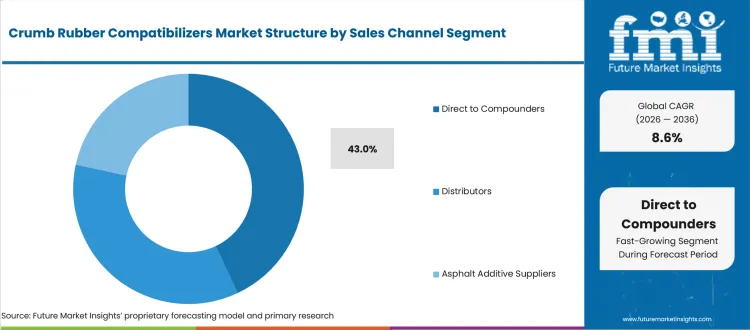
Direct to Compounders leads as buyers need technical guidance during recipe changes. Direct sales account for 43.0% share in 2026, reflecting formulation support needs across PP / PE and PVC systems. Powder size and additive dosage all influence the decision to buy directly from technical suppliers.
- Direct to Compounders is set to secure 43.0% share in 2026, supported by custom dosing and trial feedback needs. Processors prefer direct supplier support once crumb rubber enters recycled PP or PVC blends.
- Direct selling improves access to batch data and failure analysis during plastic compounding trials. Arkema reported more than 26 certified recycled references after June 2024 recertification, providing compounders with a benchmark for audited recycled-content programs.
What are the drivers, restraints, and opportunities in Crumb Rubber Compatibilizers Market?
Near-term purchases are shaped by binder stability and documentation needs.
- Driver: Asphalt-rubber stability drives additive demand once road producers need uniform binders that can manage recycled tyre rubber under heat. NAPA reported that warm-mix asphalt technologies represented 40.2% of the USA asphalt mixture market in 2024, showing producer openness to processing aids that improve plant handling.
- Restraint: Documentation needs can slow approvals for crumb rubber applications used near public users. Federal tire-crumb research in the United States involved EPA, CDC, and CPSC, providing buyers with a three-agency evidence path before approving recycled rubber in sensitive surfaces.
- Opportunity: Formal recycling certificates create a stronger route from tyre waste processing to additive demand. India’s waste tyre EPR portal states that FY2025 to FY2026 certificates remain valid for two years after generation, improving traceability for downstream rubber powder buyers.
Asphalt-rubber stability remains a core purchase reason once ground tire rubber raises viscosity and separation risk in hot binder tanks. Reclaimed asphalt shingles stockpiled nationwide reached about 1.44 million tons at the end of the 2024 USA construction season, providing asphalt producers with another recycled input that requires disciplined formulation control.
Public-surface and worker-exposure questions keep technical documentation in the buying process. EPA and CDC released tire crumb exposure characterization Part 2 in April 2024, adding human-exposure data for chemicals found in tire crumb rubber used on synthetic turf fields.
Recycled-polymer compatibility offers an expansion path beyond asphalt. CHINAPLAS 2026 is expected to cover more than 390,000 square metres with over 5,000 exhibitors from 40 countries and regions, creating a large venue for Polymer Additives suppliers serving recycled rubber-plastic blends.
Which country CAGRs are profiled in Crumb Rubber Compatibilizers Market?
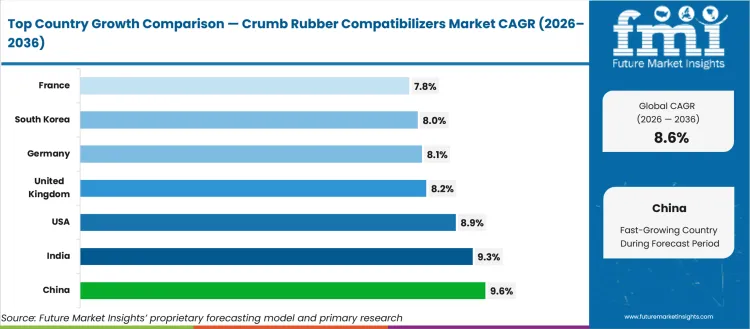
| Country | CAGR |
|---|---|
| China | 9.6% |
| India | 9.3% |
| United States | 8.9% |
| United Kingdom | 8.2% |
| Germany | 8.1% |
| South Korea | 8.0% |
| France | 7.8% |
| Japan | 7.4% |
Source: Future Market Insights analysis, 2026.
How do country-level CAGRs compare in Crumb Rubber Compatibilizers Market?
Country expansion in crumb rubber compatibilizers is led by tyre recovery scale and polymer compounding capacity. China, India, and the United States connect demand with large vehicle or asphalt recycling systems, while European and Asian countries link adoption with road renewal and tyre collection discipline. Senior buyers should compare asphalt-trial activity and compounder support capacity before selecting suppliers.
- China is projected at 9.6% CAGR by 2036 as vehicle and tyre replacement scale support future crumb-rubber availability. Official data reported 34.531 million vehicles produced in 2025, up 10.4% from 2024, while vehicle sales reached 34.4 million units.
- India is estimated at 9.3% CAGR by 2036 as formal tyre circularity planning provides processors with a clearer route toward engineered outlets. NITI Aayog reported 1.4 million metric tons of imported waste tyres processed in formal recycling channels during FY2024, adding supply for crumb-rubber powder applications.
- United States is forecast at 8.9% CAGR by 2036 as recycled asphalt practice supports acceptance of rubber-modified road materials. NAPA reported 22.9% average RAP content in USA asphalt mixtures during 2024, providing producers with a practical base for further recycled-input formulation.
- United Kingdom is anticipated at 8.2% CAGR by 2036 as strategic road funding supports renewal work that can include recycled-material testing. RIS3 provides over GBP 27.0 billion for England’s strategic road network during 2026 to 2031, including GBP 402.0 million for two inward investment projects.
- Germany is expected at 8.1% CAGR by 2036 as infrastructure funding raises attention to durable road-material systems. Federal finance ministry materials state that EUR 300.0 billion of the special fund is earmarked for federal investments, while EUR 100.0 billion is allocated to Länder and local authorities.
- South Korea is projected at 8.0% CAGR by 2036 as automotive exports and domestic production sustain rubber-processing capability. Korea’s automobile exports reached USD 72.0 billion in 2025, while domestic production topped 4.1 million units during the same year.
- France is estimated at 7.8% CAGR by 2036 as tyre producer responsibility data supports collection and treatment planning. ADEME reported 591,000 tonnes of tyres placed on the French market in 2024, alongside 583,000 tonnes collected and 602,000 tonnes treated.
- Japan is forecast at 7.4% CAGR by 2036 as tyre recovery discipline supports higher-quality material routing. Japan tyre industry data counted 90.0 million end-of-life tyres generated in 2025, including 79.0 million tyres from replacement activity.
Who are notable companies in Crumb Rubber Compatibilizers Market?
Evonik, Kraton, BASF, Arkema, Struktol Company of America, LANXESS Rhein Chemie, Lehigh Technologies, Dow, SI Group, and King Industries are notable companies shaping crumb rubber compatibilizer demand across asphalt rubber and rubber-processing additive pathways.
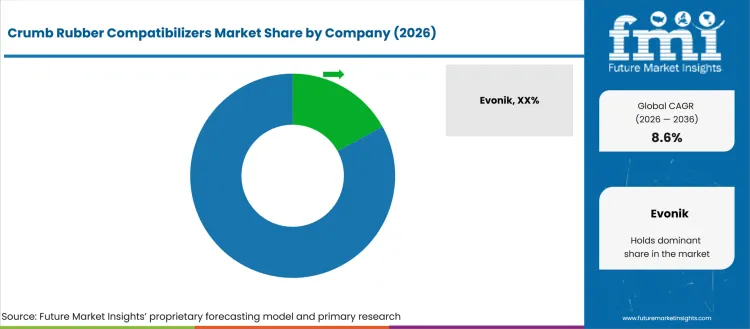
Competition in crumb rubber compatibilizers is grouped by how buyers need compatibility support to function. Evonik has direct bitumen and ground tire rubber evidence through VESTENAMER, while Kraton, BASF, Arkema, and Dow compete through recycled plastic additive systems that support rubber-plastic blend decisions. Rubber-processing suppliers add value through dosing support and failure analysis linked to Tire Recycling outlets.
- Evonik brings direct asphalt-rubber compatibility evidence through polyoctenamer chemistry. Buyers compare its position through binder stability and road-construction use.
- Kraton strengthens paving additive competition through CirKular+ Paving Circularity Series. Asphalt suppliers can compare processability and performance claims near rubberized binder projects.
- BASF, Arkema, and Dow compete through additive portfolios for recycled polymers. Arkema’s certified recycled offer provides specialty-polymer customers with audited recycled-content ranges for selected grades.
- Struktol Company of America, LANXESS Rhein Chemie, SI Group, King Industries, and Lehigh Technologies support adjacent rubber processing and micronized rubber routes. Buyer selection rests on application testing and technical service depth.
Competitive Benchmarking: Crumb Rubber Compatibilizers Market
| Company | Bitumen-Rubber Compatibility Depth | Recycled Polymer Blend Support | Compounder Technical Service | Geographic Reach |
|---|---|---|---|---|
| Evonik | High | Medium | Advanced | Global |
| Kraton | Medium | High | Advanced | Global |
| BASF | Low | High | Advanced | Global |
| Arkema | Low | High | Advanced | Global |
| Struktol Company of America | Low | Medium | Advanced | North America and Europe |
| LANXESS Rhein Chemie | Low | Medium | Advanced | Global |
| Lehigh Technologies | Medium | Low | Medium | North America |
| Dow | Low | Medium | Advanced | Global |
| SI Group | Low | Medium | Medium | Global |
| King Industries | Low | Low | Medium | North America |
Source: Future Market Insights competitive analysis, 2026.
Key Developments in Crumb Rubber Compatibilizers Market
- In April 2025, Kraton launched CirKular+ Paving Circularity Series for reclaimed asphalt reuse. Surface asphalt mixtures can incorporate 50.0% or more reclaimed asphalt content, supporting pavement circularity chemistry near rubberized asphalt formulation.
- In March 2025, Arkema announced recycled material displays for PRSE 2025, including PA11 and Virtucycle materials. Such displays provide compounders with four recycled polymer families to compare near rubber-plastic blend qualification work.
- In March 2026, BASF announced CHINAPLAS 2026 additive innovation displays for plasticulture and industrial plastics from April 21 to April 24. Four exhibition days in Shanghai give additive buyers a focused platform for plastic durability and recycling support.
Key Players in Crumb Rubber Compatibilizers Market
Asphalt Rubber Compatibilizer Specialists
- Evonik
- Lehigh Technologies
Recycled Polymer Additive Leaders
- Kraton
- BASF
- Arkema
- Dow
Rubber Processing Additive Suppliers
- Struktol Company of America
- LANXESS Rhein Chemie
- SI Group
- King Industries
Crumb Rubber Compatibilizers Market - Report Scope
| Coverage field | Report scope |
|---|---|
| Market breakdown | Crumb Rubber Compatibilizers Market Breakdown By Compatibilizer Type, Application, Polymer Compatibility, End Use, Sales Channel, and Region |
| Market Definition | Additives that improve bonding between recycled tire crumb rubber and asphalt, rubber compounds, or polymer matrices |
| Regions Covered | North America, Latin America, Europe, East Asia, South Asia and Pacific, Middle East and Africa |
| Countries Covered | United States, United Kingdom, Germany, France, Japan, China, South Korea, India and 30+ countries |
| Key Companies Profiled | Evonik, Kraton, BASF, Arkema, Struktol Company of America, LANXESS Rhein Chemie, Lehigh Technologies, Dow, SI Group, King Industries |
| Forecast Period | 2026 to 2036 |
| Approach | Hybrid bottom-up and top-down methodology using additive demand by application, country use patterns, and technical adoption rates |
Source: Future Market Insights analysis, 2026.
Crumb Rubber Compatibilizers Market - Research Methodology
| Method | Approach |
|---|---|
| Primary Research | FMI analysts reviewed inputs from asphalt additive suppliers, rubber compounders, tire recyclers, road material buyers, and distributor networks. Discussions covered dosing cost, binder stability, powder quality, and repeat purchase behavior. |
| Desk Research | Desk research covered tire recycling data, pavement references, company product literature, recycled polymer additive information, road investment programs, and regulator guidance. Product coverage was checked against compatibilizer type, application, polymer compatibility, and sales channel. |
| Market Sizing and Forecasting | The model combined additive consumption by application, estimated dosing ranges, tyre recovery activity, road construction demand, and recycled compounder adoption signals. Forecast assumptions were adjusted for asphalt formulation intensity and plastic-rubber blend adoption. |
| Data Validation | Forecasts were checked against end-of-life tyre treatment data, rubberized asphalt product evidence, recycled polymer additive portfolios, and company product fit. Company portfolios were reviewed to avoid counting adjacent chemistry without crumb rubber compatibility use. |
Crumb Rubber Compatibilizers Market by Segments
Crumb Rubber Compatibilizers Market segmented by Compatibilizer Type:
- Maleated Polymers
- Sulfur-based Compatibilizers
- Reactive Elastomers
- Coupling Agents / Other
Crumb Rubber Compatibilizers Market segmented by Application:
- Asphalt Modification
- Molded Rubber Products
- Plastic-Rubber Blends
- Tire Recycling
Crumb Rubber Compatibilizers Market segmented by Polymer Compatibility:
- PP / PE
- SBS / TPE
- Bitumen
- PVC / Other
Crumb Rubber Compatibilizers Market segmented by End Use:
- Road Construction
- Automotive Rubber
- Construction Products
- Consumer Goods
Crumb Rubber Compatibilizers Market segmented by Sales Channel:
- Direct to Compounders
- Distributors
- Asphalt Additive Suppliers
Crumb Rubber Compatibilizers Market by Region:
- North America
- United States
- Canada
- Latin America
- Brazil
- Mexico
- Argentina
- Europe
- Germany
- France
- United Kingdom
- Italy
- Spain
- Nordic Countries
- East Asia
- China
- Japan
- South Korea
- South Asia and Pacific
- India
- ASEAN
- Australia and New Zealand
- Middle East and Africa
- GCC Countries
- South Africa
Research Sources and Bibliography
- Tyres Europe. (2025, June 13). End-of-life tyres in a circular economy: ETRMA’s perspective on a competitive recycling sector. Tyres Europe.
- NITI Aayog. (2026, January). Enhancing circular economy of waste tyres in India. Government of India.
- Central Pollution Control Board. (2026). Waste Tyre EPR Portal. Central Pollution Control Board.
- USA Environmental Protection Agency. (2024, April 16). Federal research on recycled tire crumb used on playing fields and playgrounds. USA Environmental Protection Agency.
- USA Consumer Product Safety Commission. (2024, February 26). Crumb rubber safety information center. USA Consumer Product Safety Commission.
- National Asphalt Pavement Association. (2026, April 21). Reclaimed asphalt pavement nears 100% recycling rate, remains America’s most recycled product. National Asphalt Pavement Association.
- National Asphalt Pavement Association. (2026). Asphalt pavement industry survey on recycled materials and warm-mix asphalt usage: 2024. National Asphalt Pavement Association.
- Department for Transport. (2026, March 26). Road Investment Strategy 3: 2026 to 2031. Department for Transport.
- State Council of China. (2026, January 14). China’s auto output, sales reach new highs in 2025. State Council of China.
- Japan Automobile Tyre Manufacturers Association. (2026). End of Life Tyres. Japan Automobile Tyre Manufacturers Association.
- Ministry of Trade, Industry and Resources, Republic of Korea. (2026, February 6). MOTIR to invest KRW 464.5 billion in Korea’s automotive industry. Ministry of Trade, Industry and Resources.
- ADEME. (2026). Pneumatiques: Filières REP. ADEME.
- Federal Ministry of Finance. (2026). Special Fund for Infrastructure and Climate Neutrality. Federal Ministry of Finance.
- Evonik Industries. (2026). VESTENAMER for road construction. Evonik Industries.
- Evonik Industries. (2026). Scrap tires: From waste material to raw material. Evonik Industries.
- Kraton Corporation. (2025, April 21). Kraton launches CirKular+ Paving Circularity Series for reclaimed asphalt reuse maximization. Kraton Corporation.
- Arkema. (2025, March 6). Arkema will showcase advanced recycled materials at Plastics Recycling Show Europe 2025. Arkema.
- Arkema. (2026). Virtucycle recycling program. Arkema.
- BASF. (2026, March 16). CHINAPLAS 2026: BASF showcases innovative additive solutions. BASF.
- CHINAPLAS. (2026). International exhibition on plastics and rubber industries. CHINAPLAS.
This bibliography is provided for reader reference and is not exhaustive. The full report contains the complete reference list and detailed citations.
This Report Answers
- What is expected global value of crumb rubber compatibilizers market in 2026 and 2036?
- What CAGR is forecast for crumb rubber compatibilizers during 2026 to 2036?
- Which compatibilizer type segment is used to assess Maleated Polymers demand in 2026?
- Why do asphalt producers and compounders buy controlled crumb rubber compatibilizer systems?
- How do bitumen compatibility and polyolefin compatibility shape additive choices?
- Which countries are compared in crumb rubber compatibilizers forecast?
- Which companies compete across asphalt rubber and rubber-processing additive pathways?
- What compatibilizer systems and applications are included within crumb rubber compatibilizers definition?
- How does FMI size and forecast crumb rubber compatibilizer demand across segments and countries?
- What implementation and supplier-selection factors should executives assess?
Frequently Asked Questions
What is driving expansion in Crumb Rubber Compatibilizers Market?
Commercial expansion is driven by rubberized asphalt performance needs and compounder demand for better bonding between crumb rubber powder and host polymers.
Why should executives track Crumb Rubber Compatibilizers Market?
Executives should track this market as compatibility chemistry affects molded-part rejection rates and additive cost recovery.
What business problem does Crumb Rubber Compatibilizers Market address?
Crumb rubber compatibilizers help processors bond recycled tire crumb rubber with rubber compounds or polymer matrices.
What should sourcing leaders evaluate before selecting suppliers?
Sourcing leaders should compare bitumen-rubber compatibility evidence and documentation quality.
What can limit return on investment for buyers?
Return on investment can slow if additive cost rises without measurable durability gains or lower rejection rates. Buyers can reduce risk through staged trials and application-specific dosage checks.
How can suppliers build executive confidence?
Suppliers build confidence through plant-scale trials and technical support during formulation changes.
Preview the report firsthand - request a free sample
Get SampleGet the brochure for pricing and purchase details.
Get PDFTable of Content
- Key Takeaways
- Market Size and CAGR
- Top Growth Driver
- Fastest Growing Segment
- Leading Region
- Key Companies
- Emerging Opportunities
- Executive Summary
- Global Market Outlook
- Demand-side Trends
- Supply-side Trends
- Technology Roadmap Analysis
- Analysis and Recommendations
- Analyst Perspective (What is happening? Why now? What should investors know?)
- Key Questions Answered
- How large is the market?
- What is the CAGR?
- What are key trends?
- Which region dominates?
- Who are the leaders?
- Market Overview
- Market Coverage / Taxonomy
- Market Definition / Scope / Limitations
- Research Methodology
- Chapter Orientation
- Analytical Lens and Working Hypotheses
- Market Structure, Signals, and Trend Drivers
- Benchmarking and Cross-market Comparability
- Market Sizing, Forecasting, and Opportunity Mapping
- Research Design and Evidence Framework
- Desk Research Programme (Secondary Evidence)
- Expert Input and Fieldwork (Primary Evidence)
- Tooling, Models, and Reference Databases
- Data Engineering and Model Build
- Quality Assurance and Audit Trail
- Market Background
- Market Dynamics (Drivers, Restraints, Opportunity, Trends)
- Scenario Forecast (Optimistic, Likely, Conservative)
- Impact Analysis
- AI Impact
- Sustainability Impact
- Regulatory Impact
- Technology Impact
- Consumer / Buyer Analysis
- Purchase Drivers
- Adoption Barriers
- Buyer Journey
- Opportunity Map Analysis
- Product Life Cycle Analysis
- Supply Chain Analysis
- Investment Feasibility Matrix
- Value Chain Analysis
- PESTLE and Porter's Analysis
- Regulatory Landscape
- Regional Parent Market Outlook
- Production and Consumption Statistics
- Import and Export Statistics
- Global Market Analysis and Forecast, 2021 to 2036
- Historical Market Size Value (USD Million) & Volume (Unit) Analysis, 2021 to 2025
- Current and Future Market Size Value (USD Million) & Volume (Unit) Projections, 2026 to 2036
- Y-o-Y Growth Trend Analysis
- Absolute $ Opportunity Analysis
- Global Market Pricing Analysis, 2021 to 2036
- Global Market Analysis and Forecast, By Compatibilizer Type, 2021 to 2036
- Introduction / Key Findings
- Historical Market Size Value (USD Million) & Volume (Unit) Analysis By Compatibilizer Type, 2021 to 2025
- Current and Future Market Size Value (USD Million) & Volume (Unit) Analysis and Forecast By Compatibilizer Type, 2026 to 2036
- Maleated Polymers
- Sulfur-based Compatibilizers
- Reactive Elastomers
- Coupling Agents / Other
- Maleated Polymers
- Y-o-Y Growth Trend Analysis By Compatibilizer Type, 2021 to 2025
- Absolute $ Opportunity Analysis By Compatibilizer Type, 2026 to 2036
- Global Market Analysis and Forecast, By Application, 2021 to 2036
- Introduction / Key Findings
- Historical Market Size Value (USD Million) & Volume (Unit) Analysis By Application, 2021 to 2025
- Current and Future Market Size Value (USD Million) & Volume (Unit) Analysis and Forecast By Application, 2026 to 2036
- Asphalt Modification
- Molded Rubber Products
- Plastic-Rubber Blends
- Tire Recycling
- Asphalt Modification
- Y-o-Y Growth Trend Analysis By Application, 2021 to 2025
- Absolute $ Opportunity Analysis By Application, 2026 to 2036
- Global Market Analysis and Forecast, By Polymer Compatibility, 2021 to 2036
- Introduction / Key Findings
- Historical Market Size Value (USD Million) & Volume (Unit) Analysis By Polymer Compatibility, 2021 to 2025
- Current and Future Market Size Value (USD Million) & Volume (Unit) Analysis and Forecast By Polymer Compatibility, 2026 to 2036
- Bitumen
- SBS / TPE
- PVC / Other
- PP / PE
- Bitumen
- Y-o-Y Growth Trend Analysis By Polymer Compatibility, 2021 to 2025
- Absolute $ Opportunity Analysis By Polymer Compatibility, 2026 to 2036
- Global Market Analysis and Forecast, By End Use, 2021 to 2036
- Introduction / Key Findings
- Historical Market Size Value (USD Million) & Volume (Unit) Analysis By End Use, 2021 to 2025
- Current and Future Market Size Value (USD Million) & Volume (Unit) Analysis and Forecast By End Use, 2026 to 2036
- Road Construction
- Automotive Rubber
- Consumer Goods
- Construction Products
- Road Construction
- Y-o-Y Growth Trend Analysis By End Use, 2021 to 2025
- Absolute $ Opportunity Analysis By End Use, 2026 to 2036
- Global Market Analysis and Forecast, By Sales Channel, 2021 to 2036
- Introduction / Key Findings
- Historical Market Size Value (USD Million) & Volume (Unit) Analysis By Sales Channel, 2021 to 2025
- Current and Future Market Size Value (USD Million) & Volume (Unit) Analysis and Forecast By Sales Channel, 2026 to 2036
- Direct to Compounders
- Distributors
- Asphalt Additive Suppliers
- Direct to Compounders
- Y-o-Y Growth Trend Analysis By Sales Channel, 2021 to 2025
- Absolute $ Opportunity Analysis By Sales Channel, 2026 to 2036
- Global Market Analysis and Forecast, By Region, 2021 to 2036
- Introduction
- Historical Market Size Value (USD Million) & Volume (Unit) Analysis By Region, 2021 to 2025
- Current Market Size Value (USD Million) & Volume (Unit) Analysis and Forecast By Region, 2026 to 2036
- North America
- Latin America
- Western Europe
- Eastern Europe
- East Asia
- South Asia and Pacific
- Middle East & Africa
- Market Attractiveness Analysis By Region
- North America Market Analysis and Forecast, By Country, 2021 to 2036
- Historical Market Size Value (USD Million) & Volume (Unit) Trend Analysis By Market Taxonomy, 2021 to 2025
- Market Size Value (USD Million) & Volume (Unit) Forecast By Market Taxonomy, 2026 to 2036
- By Country
- USA
- Canada
- Mexico
- By Compatibilizer Type
- By Application
- By Polymer Compatibility
- By End Use
- By Sales Channel
- By Country
- Market Attractiveness Analysis
- By Country
- By Compatibilizer Type
- By Application
- By Polymer Compatibility
- By End Use
- By Sales Channel
- Key Takeaways
- Latin America Market Analysis and Forecast, By Country
- Historical Market Size Value (USD Million) & Volume (Unit) Trend Analysis By Market Taxonomy, 2021 to 2025
- Market Size Value (USD Million) & Volume (Unit) Forecast By Market Taxonomy, 2026 to 2036
- By Country
- Brazil
- Chile
- Rest of Latin America
- By Compatibilizer Type
- By Application
- By Polymer Compatibility
- By End Use
- By Sales Channel
- By Country
- Market Attractiveness Analysis
- By Country
- By Compatibilizer Type
- By Application
- By Polymer Compatibility
- By End Use
- By Sales Channel
- Key Takeaways
- Western Europe Market Analysis and Forecast, By Country
- Historical Market Size Value (USD Million) & Volume (Unit) Trend Analysis By Market Taxonomy, 2021 to 2025
- Market Size Value (USD Million) & Volume (Unit) Forecast By Market Taxonomy, 2026 to 2036
- By Country
- Germany
- UK
- Italy
- Spain
- France
- Nordic
- BENELUX
- Rest of Western Europe
- By Compatibilizer Type
- By Application
- By Polymer Compatibility
- By End Use
- By Sales Channel
- By Country
- Market Attractiveness Analysis
- By Country
- By Compatibilizer Type
- By Application
- By Polymer Compatibility
- By End Use
- By Sales Channel
- Key Takeaways
- Eastern Europe Market Analysis and Forecast, By Country
- Historical Market Size Value (USD Million) & Volume (Unit) Trend Analysis By Market Taxonomy, 2021 to 2025
- Market Size Value (USD Million) & Volume (Unit) Forecast By Market Taxonomy, 2026 to 2036
- By Country
- Russia
- Poland
- Hungary
- Balkan & Baltic
- Rest of Eastern Europe
- By Compatibilizer Type
- By Application
- By Polymer Compatibility
- By End Use
- By Sales Channel
- By Country
- Market Attractiveness Analysis
- By Country
- By Compatibilizer Type
- By Application
- By Polymer Compatibility
- By End Use
- By Sales Channel
- Key Takeaways
- East Asia Market Analysis and Forecast, By Country
- Historical Market Size Value (USD Million) & Volume (Unit) Trend Analysis By Market Taxonomy, 2021 to 2025
- Market Size Value (USD Million) & Volume (Unit) Forecast By Market Taxonomy, 2026 to 2036
- By Country
- China
- Japan
- South Korea
- By Compatibilizer Type
- By Application
- By Polymer Compatibility
- By End Use
- By Sales Channel
- By Country
- Market Attractiveness Analysis
- By Country
- By Compatibilizer Type
- By Application
- By Polymer Compatibility
- By End Use
- By Sales Channel
- Key Takeaways
- South Asia and Pacific Market Analysis and Forecast, By Country
- Historical Market Size Value (USD Million) & Volume (Unit) Trend Analysis By Market Taxonomy, 2021 to 2025
- Market Size Value (USD Million) & Volume (Unit) Forecast By Market Taxonomy, 2026 to 2036
- By Country
- India
- ASEAN
- Australia & New Zealand
- Rest of South Asia and Pacific
- By Compatibilizer Type
- By Application
- By Polymer Compatibility
- By End Use
- By Sales Channel
- By Country
- Market Attractiveness Analysis
- By Country
- By Compatibilizer Type
- By Application
- By Polymer Compatibility
- By End Use
- By Sales Channel
- Key Takeaways
- Middle East & Africa Market Analysis and Forecast, By Country
- Historical Market Size Value (USD Million) & Volume (Unit) Trend Analysis By Market Taxonomy, 2021 to 2025
- Market Size Value (USD Million) & Volume (Unit) Forecast By Market Taxonomy, 2026 to 2036
- By Country
- Kingdom of Saudi Arabia
- Other GCC Countries
- Türkiye
- South Africa
- Other African Union
- Rest of Middle East & Africa
- By Compatibilizer Type
- By Application
- By Polymer Compatibility
- By End Use
- By Sales Channel
- By Country
- Market Attractiveness Analysis
- By Country
- By Compatibilizer Type
- By Application
- By Polymer Compatibility
- By End Use
- By Sales Channel
- Key Takeaways
- Key Countries Market Analysis
- USA
- Pricing Analysis
- Market Share Analysis, 2025
- By Compatibilizer Type
- By Application
- By Polymer Compatibility
- By End Use
- By Sales Channel
- Canada
- Pricing Analysis
- Market Share Analysis, 2025
- By Compatibilizer Type
- By Application
- By Polymer Compatibility
- By End Use
- By Sales Channel
- Mexico
- Pricing Analysis
- Market Share Analysis, 2025
- By Compatibilizer Type
- By Application
- By Polymer Compatibility
- By End Use
- By Sales Channel
- Brazil
- Pricing Analysis
- Market Share Analysis, 2025
- By Compatibilizer Type
- By Application
- By Polymer Compatibility
- By End Use
- By Sales Channel
- Chile
- Pricing Analysis
- Market Share Analysis, 2025
- By Compatibilizer Type
- By Application
- By Polymer Compatibility
- By End Use
- By Sales Channel
- Germany
- Pricing Analysis
- Market Share Analysis, 2025
- By Compatibilizer Type
- By Application
- By Polymer Compatibility
- By End Use
- By Sales Channel
- UK
- Pricing Analysis
- Market Share Analysis, 2025
- By Compatibilizer Type
- By Application
- By Polymer Compatibility
- By End Use
- By Sales Channel
- Italy
- Pricing Analysis
- Market Share Analysis, 2025
- By Compatibilizer Type
- By Application
- By Polymer Compatibility
- By End Use
- By Sales Channel
- Spain
- Pricing Analysis
- Market Share Analysis, 2025
- By Compatibilizer Type
- By Application
- By Polymer Compatibility
- By End Use
- By Sales Channel
- France
- Pricing Analysis
- Market Share Analysis, 2025
- By Compatibilizer Type
- By Application
- By Polymer Compatibility
- By End Use
- By Sales Channel
- India
- Pricing Analysis
- Market Share Analysis, 2025
- By Compatibilizer Type
- By Application
- By Polymer Compatibility
- By End Use
- By Sales Channel
- ASEAN
- Pricing Analysis
- Market Share Analysis, 2025
- By Compatibilizer Type
- By Application
- By Polymer Compatibility
- By End Use
- By Sales Channel
- Australia & New Zealand
- Pricing Analysis
- Market Share Analysis, 2025
- By Compatibilizer Type
- By Application
- By Polymer Compatibility
- By End Use
- By Sales Channel
- China
- Pricing Analysis
- Market Share Analysis, 2025
- By Compatibilizer Type
- By Application
- By Polymer Compatibility
- By End Use
- By Sales Channel
- Japan
- Pricing Analysis
- Market Share Analysis, 2025
- By Compatibilizer Type
- By Application
- By Polymer Compatibility
- By End Use
- By Sales Channel
- South Korea
- Pricing Analysis
- Market Share Analysis, 2025
- By Compatibilizer Type
- By Application
- By Polymer Compatibility
- By End Use
- By Sales Channel
- Russia
- Pricing Analysis
- Market Share Analysis, 2025
- By Compatibilizer Type
- By Application
- By Polymer Compatibility
- By End Use
- By Sales Channel
- Poland
- Pricing Analysis
- Market Share Analysis, 2025
- By Compatibilizer Type
- By Application
- By Polymer Compatibility
- By End Use
- By Sales Channel
- Hungary
- Pricing Analysis
- Market Share Analysis, 2025
- By Compatibilizer Type
- By Application
- By Polymer Compatibility
- By End Use
- By Sales Channel
- Kingdom of Saudi Arabia
- Pricing Analysis
- Market Share Analysis, 2025
- By Compatibilizer Type
- By Application
- By Polymer Compatibility
- By End Use
- By Sales Channel
- Türkiye
- Pricing Analysis
- Market Share Analysis, 2025
- By Compatibilizer Type
- By Application
- By Polymer Compatibility
- By End Use
- By Sales Channel
- South Africa
- Pricing Analysis
- Market Share Analysis, 2025
- By Compatibilizer Type
- By Application
- By Polymer Compatibility
- By End Use
- By Sales Channel
- USA
- Market Structure Analysis
- Competition Dashboard
- Competition Benchmarking
- Market Share Analysis of Top Players
- By Regional
- By Compatibilizer Type
- By Application
- By Polymer Compatibility
- By End Use
- By Sales Channel
- Emerging Startups
- Innovation Benchmarking
- Competition Analysis
- Competition Deep Dive
- Evonik
- Overview
- Product Portfolio
- Profitability by Market Segments (Product/Region/Sales Channel)
- Sales Footprint
- Strategy Overview
- Marketing Strategy
- Product Strategy
- Channel Strategy
- Lehigh Technologies
- Kraton
- BASF
- Arkema
- Dow
- Evonik
- Case Studies
- Success Stories
- Recent Developments
- Competition Deep Dive
- Assumptions & Acronyms Used


