

- Market Size (2026)
- USD 568.4 Mn
- Forecast (2036)
- USD 1383.0 Mn
- CAGR (2026 to 2036)
- 9.3%
How big is Botanical Energy Shots Market in 2026?
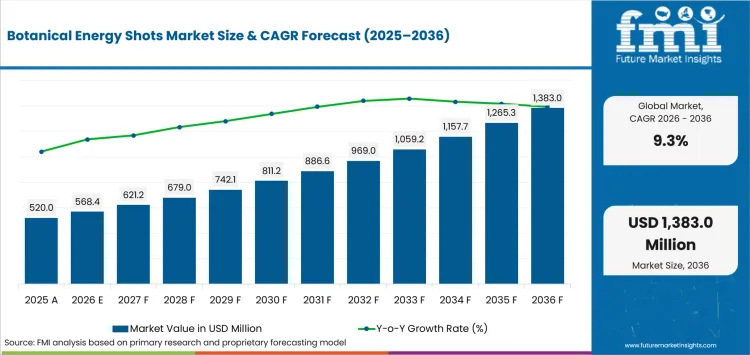
USD 568.4 million in 2026 and USD 1,383.0 million by 2036 at a 9.3% CAGR.
Demand for botanical energy shots is projected to expand at 9.3% CAGR between 2026 and 2036, increasing valuation from USD 568.4 million in 2026 to USD 1,383.0 million by 2036. The format addresses adults who want a small ready-to-consume caffeine dose without a full-size beverage or a mixing step. Repeat purchase depends on predictable flavor and clear per-bottle caffeine because a compact pack concentrates convenience and dosage scrutiny in the same purchase.
A 2022 peer-reviewed review of popular energy drinks and shots found caffeine in every product assessed, confirming how central stimulant disclosure is to the category. The USA Food and Drug Administration cites 400 mg of caffeine per day as an amount not generally associated with negative effects for a typical adult, while noting wide variation in sensitivity. That combination makes dose transparency a commercial requirement rather than a secondary label detail for a small-format energy product.
Key Takeaways of Botanical Energy Shots Market
- Portable dosing paired with botanical caffeine supports adult energy occasions where a consumer values a small ready-to-use format over beverage volume.
- Green Tea & Matcha is projected at 27.8% of Botanical Base demand in 2026.
- 2-oz Shots are estimated at 37.0% of Product Type demand in 2026.
- Natural Caffeine is forecast at 27.5% of Claim demand in 2026.
- PET Mini Bottles are projected at 39.7% of Packaging demand in 2026.
- Supermarkets & Hypermarkets are estimated at 32.3% of Sales Channel demand in 2026.
- Concentrated caffeine and age-channel controls can slow listing approval when serving instructions or buyer controls are unclear.
- Living Essentials (5-hour Energy); Proper Wild; Guayaki; MatchaBar (Hustle); Zhou Nutrition; Sambazon; Ethan's; and RUNA are used in direct, adjacent or legacy competitive analysis.
Analyst Perspective
"A botanical energy shot has to make two things obvious at the shelf: where the caffeine comes from and how much sits in one serving. Retailers can trial a small bottle quickly, but repeat facings depend on taste, adult-use clarity and evidence behind organic or sugar claims."
- Nandini Roy Choudhury, Principal Consultant, Future Market Insights
How is the Botanical Energy Shots Market segmented?
The botanical energy shots market is segmented by Botanical Base, Product Type, Claim, Packaging, Sales Channel and Region.
Botanical Base separates the plant source used to support the energy proposition and shapes flavor expectations. Product Type distinguishes fixed-volume shots from larger shots or concentrated drops. Claim captures the front-of-pack message, while Packaging defines the small container used to carry the dose. Sales Channel determines how consumers discover a product and how brands build repeat purchase. These axes interact without becoming interchangeable, so a single product can combine a tea-derived caffeine source with a 2-oz format and a retail-first route to market.
Why do supermarkets & hypermarkets lead the sales channel category?
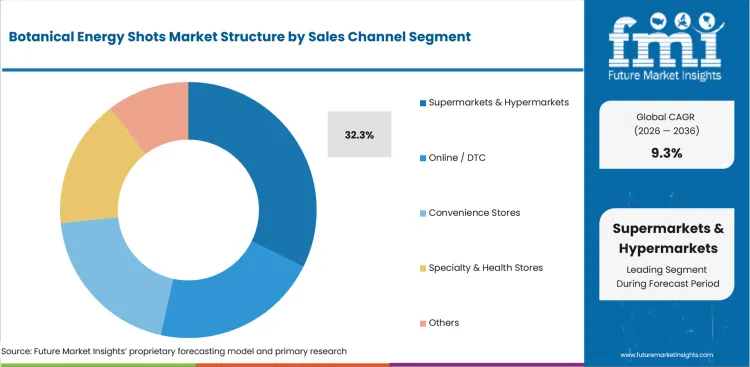
Supermarkets and hypermarkets place energy shots beside familiar beverage and supplement choices, allowing shoppers to compare price per use and caffeine quantity during an existing trip. The same retail environment supports adjacent functional beverage products, so a botanical shot must earn its facing through repeat velocity rather than novelty alone. Retail distribution can widen trial, while DTC remains useful for education and repeat ordering.
- Supermarkets & Hypermarkets are projected at 32.3% of Sales Channel demand in 2026 because the channel combines frequent shopping trips with established small-format merchandising.
- Living Essentials uses mass retail for its shot portfolio, while direct brands use online channels to explain ingredients and collect repeat orders before or alongside wider store placement.
Why does green tea & matcha lead the botanical base category?
Green tea and matcha combine recognizable tea provenance with a direct caffeine source, which makes the botanical story easier to inspect on an ingredient panel. The matcha market also gives suppliers an established vocabulary around grade, source and preparation, while energy shots compress that story into a ready-to-use serving. The commercial value is traceability and familiarity, not a claim that plant-derived caffeine behaves differently from other caffeine at the same dose.
- Based on Botanical Base, Green Tea & Matcha is projected to account for 27.8% in 2026 because the source is familiar and can be formulated in concentrated liquid products.
- Proper Wild currently markets energy shots with 100 mg of caffeine from green tea per serving, giving a direct example of tea-derived caffeine in the compact shot format.
Why do 2-oz shots lead the product type category?
A 2-oz shot is small enough for one-use dosing and already has a familiar merchandising code in the energy-shot aisle. Its commercial advantage comes from speed and portability: the consumer can use the product without preparing powder or committing to a full beverage. The small serving also raises the importance of per-bottle caffeine disclosure because the physical size provides little visual guidance about stimulant quantity.
- In 2026, 2-oz Shots are expected to lead Product Type demand with 37.0% share as brands use the format for single-use energy occasions.
- Living Essentials stated in August 2025 that 5-hour ENERGY SPORT is a 2-fl oz pre-workout shot sold through Walmart stores across the USA, select Meijer stores and online channels, showing how the format can extend into a defined fitness occasion.
Why does natural caffeine lead the claim category?
Natural Caffeine gives a brand an ingredient-source story that can be checked against the formulation. Green tea, guayusa and other plant sources can support the claim when the caffeine source is stated clearly. Related plant-based energy demand reinforces the value of source transparency, but a botanical claim cannot replace responsible dose communication. FDA guidance treats caffeine risk as a function of dose and individual sensitivity rather than the marketing description attached to the source.
- Natural Caffeine is projected to represent 27.5% of Claim demand in 2026 because buyers can connect the energy message with a named plant source.
- Ethan's current Organic Energy Shots state that caffeine is derived from green tea and guayusa, while the company discloses 150 mg for its standard flavors and 200 mg for Orange Mango.
Why do PET mini bottles lead the packaging category?
Mini bottles fit the physical job of the category because they protect a concentrated liquid dose while keeping the pack easy to carry. PET can reduce breakage exposure versus glass and lower handling weight, practical benefits for high-turnover retail and multipack shipping. Packaging still has to preserve product quality and give the label enough space for serving information, caffeine quantity and mandatory warnings where applicable.
- PET Mini Bottles are forecast to account for 39.7% of Packaging demand in 2026 as suppliers balance portability with routine retail handling.
- The packaging decision is operational as well as visual: a small bottle has to survive case packing, shelf handling and home delivery while keeping the dosage panel legible.
What are the drivers, restraints and opportunities in the Botanical Energy Shots Market?
Portable adult energy occasions support botanical shot demand, while concentrated caffeine raises label and channel requirements as organic and sugar-related claims create room for evidence-backed differentiation.
- Driver: Compact dosing lets adults add caffeine to work, fitness or travel routines without consuming a full-size beverage.
- Restraint: Concentrated caffeine increases the importance of serving guidance, sensitivity warnings and age-channel controls in regulated markets.
- Opportunity: Organic and no-added-sugar positioning can improve differentiation when certification, ingredient evidence and dose disclosure support the claim.
The demand driver starts with the use occasion. A small shot reduces the amount of liquid a consumer must carry or finish, and a named botanical source gives the energy proposition a recognizable ingredient story. The 2022 Jagim study found caffeine across every energy drink and shot it assessed, showing why stimulant content is structurally central to the category. Growth in yerba mate and tea-derived caffeine broadens the ingredient set available to shot formulators without changing the need to disclose the actual dose.
The restraint becomes sharper as caffeine concentration rises. FDA guidance notes wide individual variation in caffeine sensitivity. Germany's BfR states that adverse effects depend strongly on dose and personal sensitivity, while England decided in July 2026 to legislate an under-16 sales ban for high-caffeine energy drinks, expected to take effect in April 2027. Suppliers therefore need an adult-use route to market that can withstand retailer review and local warning requirements.
The opportunity lies in making claims easier to verify. USDA organic rules govern how the term organic can be used on qualifying products in the USA, so certification can carry more weight than a loose naturalness message. Brands can pair that evidence with visible caffeine quantity and a short ingredient story. The commercial payoff comes when the claim helps repeat purchase without forcing a retailer or consumer to decode what the serving actually contains.
What are the country CAGRs in the Botanical Energy Shots Market?
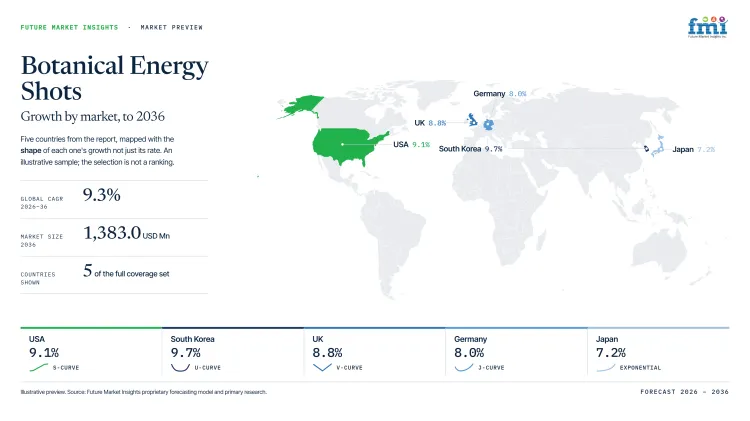
| Country | CAGR |
|---|---|
| South Korea | 9.7% |
| USA | 9.1% |
| UK | 8.8% |
| Germany | 8.0% |
| Japan | 7.2% |
How do country-level CAGRs compare in the Botanical Energy Shots Market?
The five country growth rates span 2.5 percentage points across different retail controls and caffeine communication norms. The spacing describes expected expansion from 2026 to 2036 and does not indicate current market size. Commercial entry therefore depends on how a supplier fits local product rules and channel practices as much as on the growth rate itself.
- South Korea is forecast at 9.7% CAGR, with retail controls around high-caffeine products making compliant adult-channel execution important.
- The USA is projected at 9.1% CAGR as broad retail access supports trial, while FDA caffeine guidance keeps per-serving transparency central to product communication.
- The UK is expected to expand at 8.8% CAGR as suppliers prepare for England's under-16 high-caffeine sales ban, expected from April 2027.
- Germany is forecast at 8.0% CAGR, with BfR guidance reinforcing caution around high caffeine intake and individual sensitivity.
- Japan is projected at 7.2% CAGR as the Consumer Affairs Agency continues to advise consumers to check caffeine content and avoid excessive intake.
Comparable country rates can still produce different entry conditions. The full report covers demand across North America, Latin America, Western Europe, Eastern Europe, East Asia, South Asia and Pacific, and the Middle East and Africa.
Country-wise Analysis
- South Korean demand is projected to advance at 9.7% CAGR through 2036. On July 28, 2026, the Ministry of Food and Drug Safety published the list for August 2026 of high-caffeine children's preferred foods subject to sales restrictions in schools and designated exemplary sales outlets. That policy environment favors clear adult positioning and retailer controls for concentrated energy products rather than broad youth-oriented merchandising.
- USA demand is forecast to expand at 9.1% CAGR through 2036. The FDA cites 400 mg per day as an amount not generally associated with negative effects for a typical adult, while noting wide variation in sensitivity and metabolism. For energy shots, the practical implication is visible per-bottle caffeine and serving guidance that lets a buyer account for caffeine from other foods or beverages.
- UK demand is expected to rise at 8.8% CAGR through 2036. On July 16, 2026, the Department of Health and Social Care confirmed that England will introduce legislation banning sales of high-caffeine energy drinks to children under 16, with implementation expected in April 2027. Adult-focused shot brands will need retailer processes that work in shops, online and other in-scope channels once the rules take effect.
- German demand is projected at 8.0% CAGR through 2036. BfR's January 5, 2026 caffeine FAQ states that undesirable effects depend strongly on intake and individual sensitivity, and it identifies children, pregnant or breastfeeding people, and caffeine-sensitive individuals as groups that should avoid drinks with elevated caffeine content. This raises the value of clear serving instructions for compact products.
- Japanese demand is forecast at 7.2% CAGR through 2036. Japan's Consumer Affairs Agency advises consumers to check the caffeine content shown on products and avoid excessive intake, while noting large differences in individual sensitivity. Brands therefore need straightforward dosage communication alongside any botanical-source story.
Who are the notable companies in the Botanical Energy Shots Market?
Living Essentials (5-hour Energy), Proper Wild, Guayaki, MatchaBar (Hustle), Zhou Nutrition, Sambazon, Ethan's and RUNA are notable companies connected with botanical energy-shot demand or adjacent plant-caffeine formats.
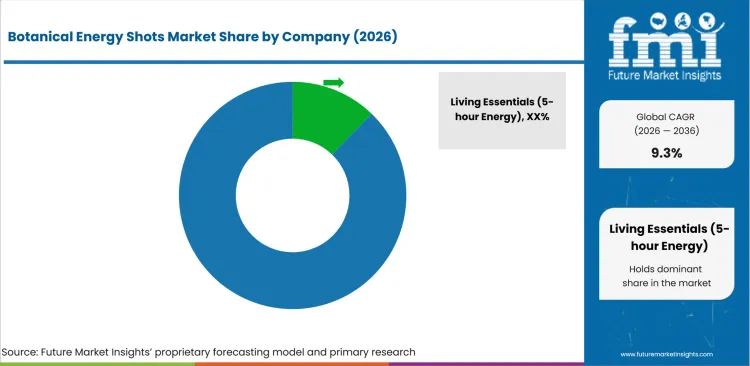
Competition separates between current shot sellers and botanical caffeine brands that influence the same consumer energy occasion from adjacent formats. Living Essentials brings established shot-format retail access. Proper Wild, Zhou Nutrition and Ethan's provide current evidence of compact energy-shot products. Guayaki's current Yerba Madre brand, MatchaBar and Sambazon shape expectations around plant-derived caffeine through broader beverage or matcha formats. RUNA remains a legacy reference because its prior owner ceased sales in December 2023, so no current RUNA revenue should be treated as active market participation.
- Living Essentials (5-hour Energy), Proper Wild, Zhou Nutrition and Ethan's have current evidence of compact energy-shot products or shot-format extensions.
- Guayaki, through the current Yerba Madre brand, plus MatchaBar (Hustle) and Sambazon influence botanical caffeine expectations through adjacent ready-to-drink or matcha platforms.
- RUNA is retained as a legacy plant-caffeine brand in the company analysis, with The Vita Coco Company reporting that it stopped selling RUNA in December 2023.
Competitive Benchmarking: Botanical Energy Shots Market
| Company | Shot-format depth | Botanical caffeine | Omnichannel access | Geographic Reach |
|---|---|---|---|---|
| Living Essentials (5-hour Energy) | High | Low | High | USA mass retail and online |
| Proper Wild | High | High | Medium | USA DTC and selected retail access |
| Guayaki | Low | High | High | USA retail and online; adjacent yerba mate formats |
| MatchaBar (Hustle) | Low | High | Medium | USA online; current shot evidence limited |
| Zhou Nutrition | Medium | High | Medium | USA online and supplement channels |
| Sambazon | Low | High | High | USA and international beverage channels; adjacent canned format |
| Ethan's | High | High | High | USA DTC and retail channels |
| RUNA | Low | High | Low | Legacy Americas brand; prior owner stopped sales in December 2023 |
Key Developments in the Botanical Energy Shots Market
- In April 2026, 5-hour ENERGY added a limited-edition Red Licorice flavor to its Extra Strength energy-shot line, showing continued flavor rotation within an established compact-shot architecture.
- In 2026, Zhou Nutrition listed Lite Up GO in its current product range as an energy shot with 115 mg of caffeine from green tea, extending a supplement platform into ready-to-use liquid energy.
- In February 2026, Guayaki's current Yerba Madre brand announced a refreshed sparkling yerba mate line with 115 mg of naturally occurring caffeine for Sprouts and select Albertsons locations. The line is an adjacent full-size format but competes for the same botanical caffeine occasion.
Key Players in the Botanical Energy Shots Market
Current Energy-Shot Specialists
- Living Essentials (5-hour Energy)
- Proper Wild
- Zhou Nutrition
- Ethan's
Botanical Caffeine Platforms
- Guayaki
- MatchaBar (Hustle)
- Sambazon
Legacy Botanical Energy Brand
- RUNA
Botanical Energy Shots Market - Report Scope
| Coverage field | Report scope |
|---|---|
| Market breakdown | By Botanical Base, Product Type, Claim, Packaging, Sales Channel and Region. |
| Quantitative Units | Revenue in USD million and CAGR in %. |
| Market Definition | Revenue from branded, pre-packaged, ready-to-consume or directly doseable energy-shot products whose energy positioning is supported by botanical caffeine sources or botanical functional ingredients. Full-size canned or bottled energy drinks, conventional tea and yerba mate beverages, powders and capsules, wellness shots without an energy positioning, downstream prepared beverages and substitute-category revenue are excluded. |
| Regions Covered | North America, Latin America, Western Europe, Eastern Europe, East Asia, South Asia and Pacific, and Middle East and Africa. |
| Countries Covered | South Korea, USA, UK, Germany, Japan and additional countries included in the full report. |
| Notable Companies | Living Essentials (5-hour Energy), Proper Wild, Guayaki, MatchaBar (Hustle), Zhou Nutrition, Sambazon, Ethan's and RUNA. |
| Forecast Period | 2026 to 2036. |
| Approach | Primary and secondary research with market triangulation. |
Botanical Energy Shots Market - Research Methodology
| Method | Approach |
|---|---|
| Primary Research | FMI analysts gather input from manufacturers, distributors, retailers, procurement stakeholders and end users. Interviews examine purchase triggers, product qualification, channel economics, adoption frictions, pricing considerations and the evidence required before trial develops into recurring purchase. |
| Desk Research | Desk research covers regulatory guidance, government publications, peer-reviewed literature, company filings, product documentation and official company announcements. Evidence is assessed for date, relevance and fit with the market definition before it is used in country or competitive analysis. |
| Market Sizing and Forecasting | The market model combines the baseline value with segment structure, channel indicators, botanical ingredient positioning, company participation and country-level demand conditions. Forecast assumptions consider regulatory change, retail access, repeat-purchase economics and substitution pressure from adjacent energy formats. |
| Data Validation | Estimates are checked against independent evidence types where available. The process excludes double counting, unsupported claims, full-size adjacent beverages and other substitute formats that fall outside the defined botanical energy-shot market. |
Botanical Energy Shots Market by Segments
Botanical Energy Shots Market segmented by Botanical Base:
- Green Tea & Matcha
- Guarana
- Yerba Mate
- Ginseng
- Others
Botanical Energy Shots Market segmented by Product Type:
- 2-oz Shots
- 3-oz Shots
- Concentrated Drops
- Others
Botanical Energy Shots Market segmented by Claim:
- Natural Caffeine
- Sugar-Free
- Organic
- No Artificial Ingredients
- Others
Botanical Energy Shots Market segmented by Packaging:
- PET Mini Bottles
- Aluminum Shots
- Glass Vials
- Others
Botanical Energy Shots Market segmented by Sales Channel:
- Supermarkets & Hypermarkets
- Online / DTC
- Convenience Stores
- Specialty & Health Stores
- Others
Botanical Energy Shots Market by Region:
- North America
- United States
- Canada
- Latin America
- Brazil
- Chile
- Mexico
- Rest of Latin America
- Western Europe
- Germany
- United Kingdom
- Italy
- Spain
- France
- Nordics
- Benelux
- Rest of Western Europe
- Eastern Europe
- Russia
- Poland
- Hungary
- Balkan and Baltic States
- Rest of Eastern Europe
- East Asia
- China
- Japan
- South Korea
- South Asia and Pacific
- India
- ASEAN
- Australia and New Zealand
- Rest of South Asia and Pacific
- Middle East and Africa
- Kingdom of Saudi Arabia
- Other GCC Countries
- Türkiye
- South Africa
- Other African Union Countries
- Rest of Middle East and Africa
Research Sources and Bibliography
- USA Food and Drug Administration. (2024, August 28). Spilling the Beans: How Much Caffeine is Too Much?
- German Federal Institute for Risk Assessment. (2026, January 5). Coffee, Energy Drinks or Caffeine Powder: Stimulants with Health Risks?
- UK Department of Health and Social Care. (2026, July 16). Banning the sale of high-caffeine energy drinks to children: consultation outcome.
- Consumer Affairs Agency, Japan. (2024, May 23). Excessive intake of caffeine contained in food.
- Ministry of Food and Drug Safety, South Korea. (2026, July 28). August list of high-caffeine foods subject to sales restrictions in schools and designated outlets.
- European Food Safety Authority. (2015, May 27). Caffeine: EFSA estimates safe intakes.
- Jagim, A. R., et al. (2022). Prevalence and Amounts of Common Ingredients Found in Energy Drinks and Shots.
- USA Department of Agriculture, Agricultural Marketing Service. (2026, June). Labeling Requirements for the USA Organic Market.
- 5-hour ENERGY. (2025, August 27). 5-hour ENERGY SPORT Now Available in Stores Nationwide - Pre-Workout Just Got Portable.
- 5-hour ENERGY. (2026, April 8). 5-hour ENERGY Debuts New Limited-Edition Red Licorice Flavor.
- Proper Wild. Clean All Day Energy Shots. Current product page accessed August 2026.
- Zhou Nutrition. Lite Up GO 6-Pack. Current product page accessed August 2026.
- Ethan's. Clean, Organic Energy Shots. Current product page accessed August 2026.
- Yerba Madre. (2026, February 10). Yerba Madre Builds on 30 Years of Yerba Mate with New Flavors and Formats.
- SAMBAZON. Low Calorie Acai Energy Drink. Current product page accessed August 2026.
- MatchaBar. Ceremonial Grade Matcha Powder. Current product page accessed August 2026.
- The Vita Coco Company, Inc. (2026). Form 10-K for the year ended December 31, 2025.
This bibliography is provided for reader reference and is not exhaustive. The full report contains the complete reference list and detailed citations.
This Report Answers
- How large is the Botanical Energy Shots Market in 2026 and 2036?
- Which operating conditions support repeat demand for portable botanical energy dosing?
- Which Botanical Base segment accounts for 27.8% share in 2026?
- How does the 2-oz shot format influence retail and repeat-purchase demand?
- Why does Natural Caffeine account for 27.5% of Claim demand in 2026?
- How do country growth rates compare across South Korea, USA, UK, Germany and Japan?
- Which companies compete directly in shots and which companies shape adjacent botanical-caffeine demand?
- How do concentrated caffeine doses and country-specific retail rules affect commercial entry?
Frequently Asked Questions
How big is the Botanical Energy Shots Market in 2026?
USD 568.4 million represents the botanical energy shots market value in 2026. The market is projected to reach USD 1,383.0 million by 2036 as compact caffeine dosing expands across adult retail and online energy occasions.
What is the CAGR of the Botanical Energy Shots Market from 2026 to 2036?
A 9.3% CAGR is projected for the botanical energy shots market between 2026 and 2036. Growth depends on repeat use, clear caffeine quantities and botanical-source claims that withstand local retail and labeling requirements.
Which Botanical Base segment is projected to account for 27.8% of the market?
Green Tea & Matcha is projected to account for 27.8% of Botanical Base demand in 2026. Tea-derived caffeine gives brands a recognizable source story that can fit compact liquid formulations without changing the need for dose transparency.
How much will the Botanical Energy Shots Market add between 2026 and 2036?
USD 814.6 million is expected to be added to the botanical energy shots market between 2026 and 2036. The increase reflects wider use of compact energy formats while retailer scrutiny of caffeine, claims and repeat velocity remains part of commercial expansion.
Which companies are active in the Botanical Energy Shots Market?
The company analysis includes Living Essentials (5-hour Energy), Proper Wild, Guayaki, MatchaBar (Hustle), Zhou Nutrition, Sambazon, Ethan's and RUNA. Current direct shot evidence is clear for Living Essentials, Proper Wild, Zhou Nutrition and Ethan's; other names are used for adjacent or legacy competitive context where appropriate.
Preview the report firsthand - request a free sample
Get SampleGet the brochure for pricing and purchase details.
Get PDFTable of Content
- Key Takeaways
- Market Size and CAGR
- Top Growth Driver
- Fastest Growing Segment
- Leading Region
- Key Companies
- Emerging Opportunities
- Executive Summary
- Global Market Outlook
- Demand-side Trends
- Supply-side Trends
- Technology Roadmap Analysis
- Analysis and Recommendations
- Analyst Perspective (What is happening? Why now? What should investors know?)
- Key Questions Answered
- How large is the market?
- What is the CAGR?
- What are key trends?
- Which region dominates?
- Who are the leaders?
- Market Overview
- Market Coverage / Taxonomy
- Market Definition / Scope / Limitations
- Research Methodology
- Chapter Orientation
- Analytical Lens and Working Hypotheses
- Market Structure, Signals, and Trend Drivers
- Benchmarking and Cross-market Comparability
- Market Sizing, Forecasting, and Opportunity Mapping
- Research Design and Evidence Framework
- Desk Research Programme (Secondary Evidence)
- Expert Input and Fieldwork (Primary Evidence)
- Tooling, Models, and Reference Databases
- Data Engineering and Model Build
- Quality Assurance and Audit Trail
- Market Background
- Market Dynamics (Drivers, Restraints, Opportunity, Trends)
- Scenario Forecast (Optimistic, Likely, Conservative)
- Impact Analysis
- AI Impact
- Sustainability Impact
- Regulatory Impact
- Technology Impact
- Consumer / Buyer Analysis
- Purchase Drivers
- Adoption Barriers
- Buyer Journey
- Opportunity Map Analysis
- Product Life Cycle Analysis
- Supply Chain Analysis
- Investment Feasibility Matrix
- Value Chain Analysis
- PESTLE and Porter's Analysis
- Regulatory Landscape
- Regional Parent Market Outlook
- Production and Consumption Statistics
- Import and Export Statistics
- Global Market Analysis and Forecast, 2021 to 2036
- Historical Market Size Value (USD Million) Analysis, 2021 to 2025
- Current and Future Market Size Value (USD Million) Projections, 2026 to 2036
- Y-o-Y Growth Trend Analysis
- Absolute $ Opportunity Analysis
- Global Market Pricing Analysis, 2021 to 2036
- Global Market Analysis and Forecast, By Botanical Base, 2021 to 2036
- Introduction / Key Findings
- Historical Market Size Value (USD Million) Analysis By Botanical Base, 2021 to 2025
- Current and Future Market Size Value (USD Million) Analysis and Forecast By Botanical Base, 2026 to 2036
- Green Tea & Matcha
- Guarana
- Yerba Mate
- Ginseng
- Others
- Green Tea & Matcha
- Y-o-Y Growth Trend Analysis By Botanical Base, 2021 to 2025
- Absolute $ Opportunity Analysis By Botanical Base, 2026 to 2036
- Global Market Analysis and Forecast, By Product Type, 2021 to 2036
- Introduction / Key Findings
- Historical Market Size Value (USD Million) Analysis By Product Type, 2021 to 2025
- Current and Future Market Size Value (USD Million) Analysis and Forecast By Product Type, 2026 to 2036
- 2-oz Shots
- 3-oz Shots
- Concentrated Drops
- Others
- 2-oz Shots
- Y-o-Y Growth Trend Analysis By Product Type, 2021 to 2025
- Absolute $ Opportunity Analysis By Product Type, 2026 to 2036
- Global Market Analysis and Forecast, By Claim, 2021 to 2036
- Introduction / Key Findings
- Historical Market Size Value (USD Million) Analysis By Claim, 2021 to 2025
- Current and Future Market Size Value (USD Million) Analysis and Forecast By Claim, 2026 to 2036
- Natural Caffeine
- Sugar-Free
- Organic
- No Artificial Ingredients
- Others
- Natural Caffeine
- Y-o-Y Growth Trend Analysis By Claim, 2021 to 2025
- Absolute $ Opportunity Analysis By Claim, 2026 to 2036
- Global Market Analysis and Forecast, By Packaging, 2021 to 2036
- Introduction / Key Findings
- Historical Market Size Value (USD Million) Analysis By Packaging, 2021 to 2025
- Current and Future Market Size Value (USD Million) Analysis and Forecast By Packaging, 2026 to 2036
- PET Mini Bottles
- Aluminum Shots
- Glass Vials
- Others
- PET Mini Bottles
- Y-o-Y Growth Trend Analysis By Packaging, 2021 to 2025
- Absolute $ Opportunity Analysis By Packaging, 2026 to 2036
- Global Market Analysis and Forecast, By Sales Channel, 2021 to 2036
- Introduction / Key Findings
- Historical Market Size Value (USD Million) Analysis By Sales Channel, 2021 to 2025
- Current and Future Market Size Value (USD Million) Analysis and Forecast By Sales Channel, 2026 to 2036
- Supermarkets & Hypermarkets
- Online / DTC
- Convenience Stores
- Specialty & Health Stores
- Others
- Supermarkets & Hypermarkets
- Y-o-Y Growth Trend Analysis By Sales Channel, 2021 to 2025
- Absolute $ Opportunity Analysis By Sales Channel, 2026 to 2036
- Global Market Analysis and Forecast, By Region, 2021 to 2036
- Introduction
- Historical Market Size Value (USD Million) Analysis By Region, 2021 to 2025
- Current Market Size Value (USD Million) Analysis and Forecast By Region, 2026 to 2036
- North America
- Latin America
- Western Europe
- Eastern Europe
- East Asia
- South Asia and Pacific
- Middle East & Africa
- Market Attractiveness Analysis By Region
- North America Market Analysis and Forecast, By Country, 2021 to 2036
- Historical Market Size Value (USD Million) Trend Analysis By Market Taxonomy, 2021 to 2025
- Market Size Value (USD Million) Forecast By Market Taxonomy, 2026 to 2036
- By Country
- USA
- Canada
- By Botanical Base
- By Product Type
- By Claim
- By Packaging
- By Sales Channel
- By Country
- Market Attractiveness Analysis
- By Country
- By Botanical Base
- By Product Type
- By Claim
- By Packaging
- By Sales Channel
- Key Takeaways
- Latin America Market Analysis and Forecast, By Country
- Historical Market Size Value (USD Million) Trend Analysis By Market Taxonomy, 2021 to 2025
- Market Size Value (USD Million) Forecast By Market Taxonomy, 2026 to 2036
- By Country
- Brazil
- Mexico
- Chile
- Rest of Latin America
- By Botanical Base
- By Product Type
- By Claim
- By Packaging
- By Sales Channel
- By Country
- Market Attractiveness Analysis
- By Country
- By Botanical Base
- By Product Type
- By Claim
- By Packaging
- By Sales Channel
- Key Takeaways
- Western Europe Market Analysis and Forecast, By Country
- Historical Market Size Value (USD Million) Trend Analysis By Market Taxonomy, 2021 to 2025
- Market Size Value (USD Million) Forecast By Market Taxonomy, 2026 to 2036
- By Country
- Germany
- UK
- Italy
- Spain
- France
- Nordic
- BENELUX
- Rest of Western Europe
- By Botanical Base
- By Product Type
- By Claim
- By Packaging
- By Sales Channel
- By Country
- Market Attractiveness Analysis
- By Country
- By Botanical Base
- By Product Type
- By Claim
- By Packaging
- By Sales Channel
- Key Takeaways
- Eastern Europe Market Analysis and Forecast, By Country
- Historical Market Size Value (USD Million) Trend Analysis By Market Taxonomy, 2021 to 2025
- Market Size Value (USD Million) Forecast By Market Taxonomy, 2026 to 2036
- By Country
- Russia
- Poland
- Hungary
- Balkan & Baltic
- Rest of Eastern Europe
- By Botanical Base
- By Product Type
- By Claim
- By Packaging
- By Sales Channel
- By Country
- Market Attractiveness Analysis
- By Country
- By Botanical Base
- By Product Type
- By Claim
- By Packaging
- By Sales Channel
- Key Takeaways
- East Asia Market Analysis and Forecast, By Country
- Historical Market Size Value (USD Million) Trend Analysis By Market Taxonomy, 2021 to 2025
- Market Size Value (USD Million) Forecast By Market Taxonomy, 2026 to 2036
- By Country
- China
- Japan
- South Korea
- By Botanical Base
- By Product Type
- By Claim
- By Packaging
- By Sales Channel
- By Country
- Market Attractiveness Analysis
- By Country
- By Botanical Base
- By Product Type
- By Claim
- By Packaging
- By Sales Channel
- Key Takeaways
- South Asia and Pacific Market Analysis and Forecast, By Country
- Historical Market Size Value (USD Million) Trend Analysis By Market Taxonomy, 2021 to 2025
- Market Size Value (USD Million) Forecast By Market Taxonomy, 2026 to 2036
- By Country
- India
- ASEAN
- Australia & New Zealand
- Rest of South Asia and Pacific
- By Botanical Base
- By Product Type
- By Claim
- By Packaging
- By Sales Channel
- By Country
- Market Attractiveness Analysis
- By Country
- By Botanical Base
- By Product Type
- By Claim
- By Packaging
- By Sales Channel
- Key Takeaways
- Middle East & Africa Market Analysis and Forecast, By Country
- Historical Market Size Value (USD Million) Trend Analysis By Market Taxonomy, 2021 to 2025
- Market Size Value (USD Million) Forecast By Market Taxonomy, 2026 to 2036
- By Country
- Kingdom of Saudi Arabia
- Other GCC Countries
- Türkiye
- South Africa
- Other African Union
- Rest of Middle East & Africa
- By Botanical Base
- By Product Type
- By Claim
- By Packaging
- By Sales Channel
- By Country
- Market Attractiveness Analysis
- By Country
- By Botanical Base
- By Product Type
- By Claim
- By Packaging
- By Sales Channel
- Key Takeaways
- Key Countries Market Analysis
- USA
- Pricing Analysis
- Market Share Analysis, 2025
- By Botanical Base
- By Product Type
- By Claim
- By Packaging
- By Sales Channel
- Canada
- Pricing Analysis
- Market Share Analysis, 2025
- By Botanical Base
- By Product Type
- By Claim
- By Packaging
- By Sales Channel
- Mexico
- Pricing Analysis
- Market Share Analysis, 2025
- By Botanical Base
- By Product Type
- By Claim
- By Packaging
- By Sales Channel
- Brazil
- Pricing Analysis
- Market Share Analysis, 2025
- By Botanical Base
- By Product Type
- By Claim
- By Packaging
- By Sales Channel
- Chile
- Pricing Analysis
- Market Share Analysis, 2025
- By Botanical Base
- By Product Type
- By Claim
- By Packaging
- By Sales Channel
- Germany
- Pricing Analysis
- Market Share Analysis, 2025
- By Botanical Base
- By Product Type
- By Claim
- By Packaging
- By Sales Channel
- UK
- Pricing Analysis
- Market Share Analysis, 2025
- By Botanical Base
- By Product Type
- By Claim
- By Packaging
- By Sales Channel
- Italy
- Pricing Analysis
- Market Share Analysis, 2025
- By Botanical Base
- By Product Type
- By Claim
- By Packaging
- By Sales Channel
- Spain
- Pricing Analysis
- Market Share Analysis, 2025
- By Botanical Base
- By Product Type
- By Claim
- By Packaging
- By Sales Channel
- France
- Pricing Analysis
- Market Share Analysis, 2025
- By Botanical Base
- By Product Type
- By Claim
- By Packaging
- By Sales Channel
- India
- Pricing Analysis
- Market Share Analysis, 2025
- By Botanical Base
- By Product Type
- By Claim
- By Packaging
- By Sales Channel
- ASEAN
- Pricing Analysis
- Market Share Analysis, 2025
- By Botanical Base
- By Product Type
- By Claim
- By Packaging
- By Sales Channel
- Australia & New Zealand
- Pricing Analysis
- Market Share Analysis, 2025
- By Botanical Base
- By Product Type
- By Claim
- By Packaging
- By Sales Channel
- China
- Pricing Analysis
- Market Share Analysis, 2025
- By Botanical Base
- By Product Type
- By Claim
- By Packaging
- By Sales Channel
- Japan
- Pricing Analysis
- Market Share Analysis, 2025
- By Botanical Base
- By Product Type
- By Claim
- By Packaging
- By Sales Channel
- South Korea
- Pricing Analysis
- Market Share Analysis, 2025
- By Botanical Base
- By Product Type
- By Claim
- By Packaging
- By Sales Channel
- Russia
- Pricing Analysis
- Market Share Analysis, 2025
- By Botanical Base
- By Product Type
- By Claim
- By Packaging
- By Sales Channel
- Poland
- Pricing Analysis
- Market Share Analysis, 2025
- By Botanical Base
- By Product Type
- By Claim
- By Packaging
- By Sales Channel
- Hungary
- Pricing Analysis
- Market Share Analysis, 2025
- By Botanical Base
- By Product Type
- By Claim
- By Packaging
- By Sales Channel
- Kingdom of Saudi Arabia
- Pricing Analysis
- Market Share Analysis, 2025
- By Botanical Base
- By Product Type
- By Claim
- By Packaging
- By Sales Channel
- Türkiye
- Pricing Analysis
- Market Share Analysis, 2025
- By Botanical Base
- By Product Type
- By Claim
- By Packaging
- By Sales Channel
- South Africa
- Pricing Analysis
- Market Share Analysis, 2025
- By Botanical Base
- By Product Type
- By Claim
- By Packaging
- By Sales Channel
- USA
- Market Structure Analysis
- Competition Dashboard
- Competition Benchmarking
- Market Share Analysis of Top Players
- By Regional
- By Botanical Base
- By Product Type
- By Claim
- By Packaging
- By Sales Channel
- Emerging Startups
- Innovation Benchmarking
- Competition Analysis
- Competition Deep Dive
- Living Essentials (5-hour Energy)
- Overview
- Product Portfolio
- Profitability by Market Segments
- Sales Footprint
- Strategy Overview
- Marketing Strategy
- Product Strategy
- Channel Strategy
- Proper Wild
- Guayaki
- MatchaBar (Hustle)
- Zhou Nutrition
- Sambazon
- Ethan's
- RUNA
- Living Essentials (5-hour Energy)
- Case Studies
- Success Stories
- Recent Developments
- Competition Deep Dive
- Assumptions & Acronyms Used


