

- Market Size (2026)
- USD 640.7 Mn
- Forecast (2036)
- USD 1422.1 Mn
- CAGR (2026 to 2036)
- 8.3%
How big is the Cabinet Access Sensor Market in 2026?
USD 640.7 million in 2026 and USD 1,422.1 million by 2036 at an 8.3% CAGR.
Cabinet access sensors are shifting from simple cabinet accessories into proof points for infrastructure access. Facility teams need a record showing who opened a rack and whether entry matched approved service work. Demand strengthens as data center load growth has tripled over the past decade, which makes cabinet-level access control more important inside data center market outlook planning.
Telecom and edge sites add another demand path since remote equipment often sits outside staffed rooms. India reported 99.6% district availability for 5G services in 2025, showing how wide field infrastructure raises the value of cabinet access evidence. Similar needs appear in telecom network infrastructure projects where service visits must be separated from intrusion events.
Buyers compare cabinet sensors through installation effort, audit quality and software connection. Vertiv notes that AI and ML workloads can push rack densities to 100 kW per rack, which raises operational risk around every rack visit. Supplier advantage improves when door contacts, smart handles and tamper signals connect with access control platforms without custom wiring.
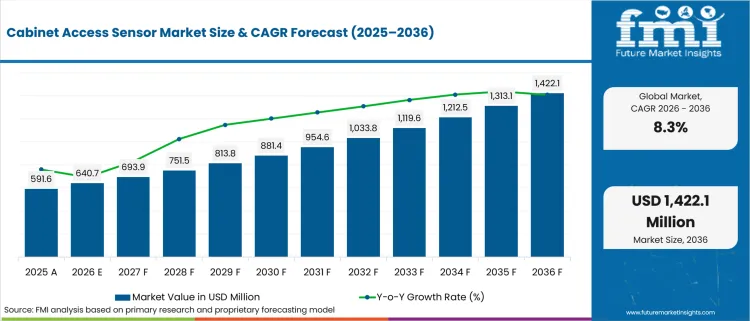
| Metric | Value |
|---|---|
| 2025 Market Size | USD 591.6 million |
| 2026 Market Size | USD 640.7 million |
| 2036 Market Size | USD 1,422.1 million |
| Forecast CAGR (2026-2036) | 8.3% |
| End Use Focus | Data Centers |
| Data Centers Share (2026) | 58.0% |
| Cabinet Type Focus | Server Cabinets |
| Server Cabinets Share (2026) | 52.0% |
| Sensor Type Focus | Door Contact Sensors |
| Door Contact Sensors Share (2026) | 41.0% |
| Fastest-growing Country | India |
| India CAGR by 2036 | 9.4% |
Summary of the Cabinet Access Sensor Market
| Market Signal | Commercial Impact |
|---|---|
| Demand and Growth Drivers | Demand for cabinet access sensors is expected to expand steadily through 2036 as data centers, telecom networks, and industrial facilities strengthen physical security and access monitoring.
|
| Product and Segment View | Door contact sensors, server cabinets, and data centers continue to lead their respective market segments.
|
| Geography and Growth Outlook | Asia and North America continue to lead market expansion through data center investment, telecom infrastructure growth, and digital transformation initiatives.
|
| Competitive Landscape | Competition increasingly focuses on hardware integration, platform compatibility, and secure access management capabilities.
|
| Analyst Perspective | Cabinet access sensors are evolving into essential infrastructure for secure facility operations as organizations prioritize traceable access events, cybersecurity, and integrated physical security.
- Nikhil Kaitwade, Principal Consultant for Industrial Automation at Future Market Insights |
How is the Cabinet Access Sensor Market segmented?
The cabinet access sensor industry is segmented by sensor type, cabinet type, connectivity, end use, sales channel and region.
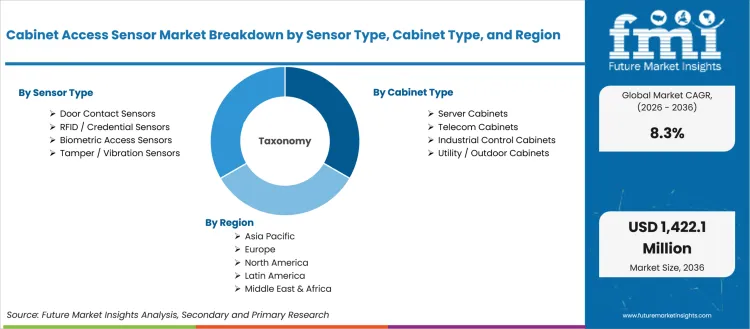
The Cabinet Access Sensor Market is segmented by five parent segments and region. By sensor type, demand covers door contact sensors, RFID or credential sensors, biometric access sensors and tamper or vibration sensors. By cabinet type, demand includes server cabinets, telecom cabinets, industrial control cabinets and utility or outdoor cabinets. By connectivity, demand covers wired, wireless and PoE or networked systems. By end use, demand comes from data centers, telecom networks, industrial facilities and utilities or critical infrastructure. By sales channel, demand is segmented into direct OEM, security integrators and IT distributors, with regional coverage across six global regions.
Why do Door Contact Sensors lead within the sensor-type category?
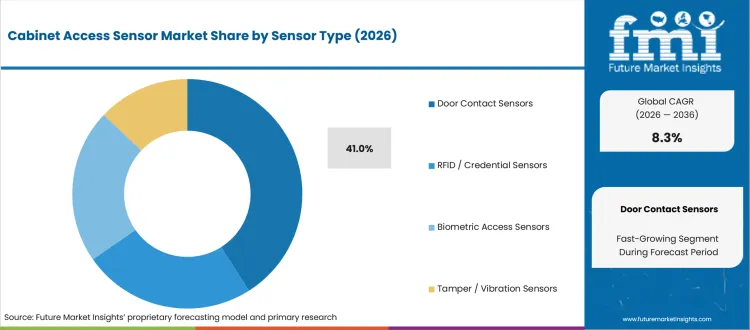
Door Contact Sensors lead because access monitoring starts with a clear door event before credential or biometric data is added. Raritan’s SmartLock material identifies dry contact sensors and electronic swinghandles inside the system, giving buyers 3 hardware routes for cabinet-level event capture.
- Door Contact Sensors are expected to account for 41.0% share in 2026, backed by operators needing a low-cost proof point for every cabinet opening. Contact sensors help facilities identify the first access event before higher-cost identity hardware is justified.
- Retrofit demand supports contact sensor adoption among older racks. SmartLock literature says the system is compatible with common electronic door handles and proximity card technologies including iClass and HID Prox, giving buyers 4 credential-technology references for later upgrades.
What supports demand for Server Cabinets?
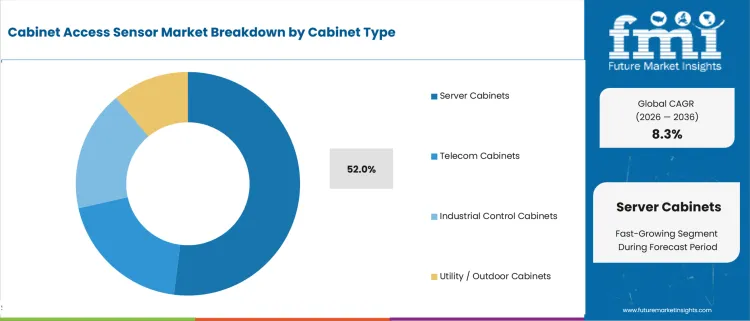
Server Cabinets dominate because rack rows are the access point where service work and tenant custody meet. Vertiv Frontiers 2026 notes that systems previously filling a data hall can now fit into one rack-like unit or pod, making cabinet-level control more valuable in data center industry analysis discussions.
- Server Cabinets are anticipated to hold 52.0% share in 2026, led by dense rack rooms that need front and rear access records. Colocation teams use cabinet logs to connect service actions with customer custody expectations.
- Cabinet-ready designs reduce installation burden at new sites. Vertiv SmartRow2 documentation states that wiring for power and communication between cabinets is completed as part of assembly, which makes pre-installed door locks and sensors easier to support during rollout.
How do buyers evaluate Wired connectivity within connectivity?
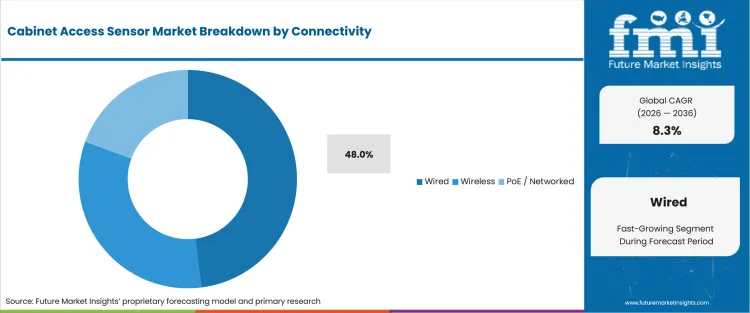
Wired connectivity remains preferred where access records must reach alarms, monitoring software and facility security systems without battery uncertainty. Johnson Controls listed 6 feature-set items for CCURE Cloud, showing why buyers expect access systems to support continuous operation.
- Wired connectivity is projected to represent 48.0% share in 2026, with buyers favoring stable cabinet signals at sites requiring continuous access capture. Permanent cabling also reduces service checks for battery-powered devices.
- Wireless sensors remain useful in retrofit rooms and outdoor cabinets. Site managers use wireless units when recabling would delay work, while wired pathways stay preferred for alarm-connected cabinets that need uninterrupted event flow.
What market factors influence demand from Data Centers?
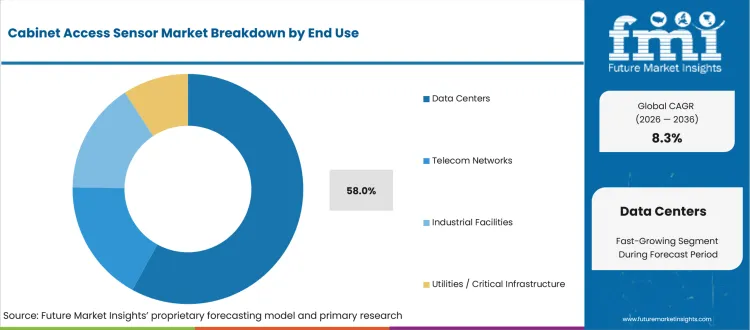
Data Centers lead end use because rack access now connects with uptime and high-density equipment management. Schneider Electric reported Q1 2026 revenues of EUR 9.8 billion, with Energy Management up 12.8% organically and led by data center strength.
- Data Centers are expected to account for 58.0% share in 2026, reflecting rack custody needs inside colocation and enterprise sites. Operators want cabinet activity to appear inside access or DCIM-linked workflows.
- AI rooms increase the value of controlled cabinet entry. Vertiv’s high-density cooling guide states that liquid cooling can be 3,000 times more efficient than air alone for high-performance computing workloads, reinforcing why service activity near racks requires documented control.
How is Direct OEM positioned within the sales-model category?
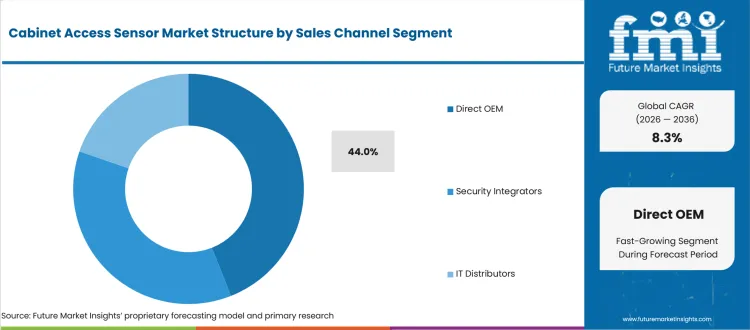
Direct OEM supply matters because cabinet access hardware works best when locks, sensors and cabling are planned before cabinets ship. Eaton’s 2026 modular data center update said the company would supply critical power backup and cable management technologies for Flexnode modules, linking cabinet hardware with faster infrastructure delivery.
- Direct OEM is set to secure 44.0% share in 2026, driven by preplanned sensor placement and cabinet-ready cabling. Buyers reduce field modification risk when access hardware arrives as part of the cabinet package.
- Integrator-led projects remain useful in complex estates. Direct OEM channels gain confidence in new builds when cabinet design, lock selection and controller space can be finalized before installation teams reach the site.
What are the drivers, restraints, and opportunities in the Cabinet Access Sensor Market?
Near-term purchases are being shaped by the integration constraint and OEM supply route outlined below.
- Driver: Cabinet-level audit programs drive sensor demand when rack access must be linked to approved service work. IEA projected global data center electricity consumption to reach around 945 TWh by 2030 in its base case.
- Restraint: Retrofit complexity restrains adoption when legacy cabinets need wiring changes or controller space. Raritan SmartLock material states that the system works through 2 power-product routes, Smart Rack Controller and PX intelligent PDU hardware, which means compatibility still affects deployment design.
- Opportunity: OEM-ready packages open an opportunity where buyers want sensors built into cabinets before site delivery. Vertiv SmartRow2 material includes 3 assembly-related device groups, door locks along with sensors and temperature sensors, supporting integrated cabinet security packages.
Sensor demand rises when access records become part of service control. Johnson Controls introduced CCURE Cloud with 6 listed feature-set items, showing why buyers want access platforms able to support live infrastructure operations.
Retrofit barriers remain a practical constraint for multi-site buyers. Raritan states that SmartLock can connect through Raritan or Server Technology power devices without occupying 1U of cabinet space, showing how equipment layout can influence project economics.
OEM and modular channels create a stronger expansion path than standalone sensor supply. Eaton’s collaboration with Flexnode links 3 infrastructure elements, racks along with backup power and cable management, supporting factory integration as a commercial argument.
Which country CAGRs are profiled in the Cabinet Access Sensor Market?
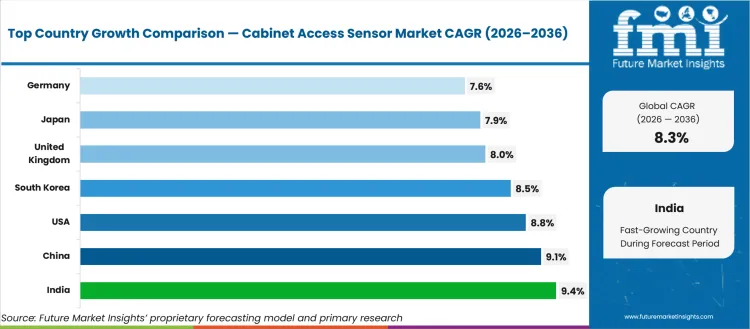
| Country | CAGR |
|---|---|
| India | 9.4% |
| China | 9.1% |
| United States | 8.8% |
| South Korea | 8.5% |
| United Kingdom | 8.0% |
| Japan | 7.9% |
| Germany | 7.6% |
| France | 7.4% |
Source: Future Market Insights competitive analysis, 2026.
How do country-level CAGRs compare in the Cabinet Access Sensor Market?
Country growth in cabinet access sensors is shaped by infrastructure density, telecom field equipment and the need to connect cabinet events with security workflows. India, China and the United States lead through larger data center or telecom infrastructure programs. South Korea, the United Kingdom and Japan connect adoption with AI compute and disciplined facility management. Germany and France move through data center expansion and equipment-room controls across 8 profiled countries.
- India is estimated at 9.4% CAGR through 2036, supported by telecom site expansion and enterprise data center buildout. Ministry of Communications reported 4.69 lakh 5G base transceiver stations by February 2025, strengthening the need for remote cabinet access evidence across field equipment.
- China is projected at 9.1% CAGR by 2036, helped by compute infrastructure planning and national efficiency targets. State Council material said average data center PUE would be lowered below 1.5 by 2025, supporting monitored facility upgrades that include cabinet access control.
- United States is forecast to record 8.8% CAGR through 2036, reinforced by power-dense data center growth. USA Department of Energy projected data center electricity use at 325 TWh to 580 TWh by 2028, which supports tighter cabinet-access review near high-load racks.
- South Korea is projected to post 8.5% CAGR by 2036, reinforced by AI compute and semiconductor infrastructure planning. MSIT selected 17 consortia and 59 R&D institutions for the 2025 K-Cloud Technology Development Project, pointing to programs that can integrate cabinet event records.
- United Kingdom is expected to grow at 8.0% CAGR during the forecast period, helped by AI infrastructure investment and data center security planning. Government’s AI sector study cited 51 AI-related inward investment projects in 2024, representing more than GBP 15 billion in capital investment.
- Japan is likely to expand at 7.9% CAGR by 2036, supported by energy-performance disclosure and disciplined facility-management practices. METI’s June 2025 industrial policy material said data center goals, implementation policies and performance would be visualized to promote energy conservation.
- Germany is estimated to rise at 7.6% CAGR between 2026 and 2036, shaped by data center capacity and industrial enclosure security. Federal ministry material says Germany has more than 2,000 data centers and over 2,700 MW of installed IT power demand, giving cabinet vendors a strong infrastructure base.
- France is projected to rise at 7.4% CAGR through 2036, reinforced by national AI infrastructure commitments and local electrical equipment capability. Élysée material from February 2025 cited more than EUR 109 billion in AI infrastructure investments, supporting monitored cabinets in compute clusters.
Who are the notable companies in the Cabinet Access Sensor Market?
Legrand, Southco, Vertiv, ASSA ABLOY, Johnson Controls, Honeywell, Eaton, Panduit, Rittal and Schneider Electric are the notable companies shaping cabinet access sensors and related access-control workflows.
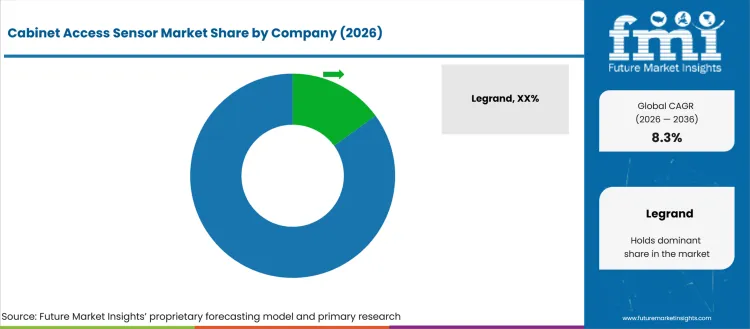
Competition in the cabinet access sensor market is grouped by how buyers want access control to work. Legrand and Southco are stronger when cabinet lock hardware and electronic handles shape the purchase. Vertiv, Eaton, Rittal and Panduit matter when rack packages and cabinet accessories determine specification timing. Johnson Controls, Honeywell, ASSA ABLOY and Schneider Electric add value when cabinet events must connect with facility-level access systems. For senior buyers, supplier selection depends on whether control should sit at the cabinet hardware layer, the facility security layer or the infrastructure monitoring layer across 3 operating routes.
- Legrand has an advantage through Raritan SmartLock and rack power integration. Legrand reported 13% record revenue growth in 2025, giving buyers a stronger supplier reference for data center infrastructure packages.
- Southco is positioned through electronic access hardware and enclosure-ready locking products. The cabinet value is strongest when buyers need monitored latching and access control around a large population of field or facility enclosures.
- Vertiv and Eaton strengthen competition through rack and modular infrastructure channels. Vertiv’s 2025 Annual Report cited more than 5,000 field service engineers globally, while Eaton’s modular update links racks with cable management and backup power supply.
- Johnson Controls, Honeywell, ASSA ABLOY and Schneider Electric are important where cabinet events must connect with building access and identity records. Schneider Electric reported FY25 revenues crossing EUR 40 billion for the first time, led by data centers.
Competitive Benchmarking: Cabinet Access Sensor Market
| Company | Cabinet Lock Integration | Credential Event Capture | DCIM Access Compatibility | Geographic Reach |
|---|---|---|---|---|
| Legrand / Raritan | High | High | Strong | Global |
| Southco | High | Strong | Medium | Global |
| Vertiv | High | High | Strong | Global |
| ASSA ABLOY | Medium | High | Medium | Global |
| Johnson Controls | Medium | High | Strong | Global |
| Honeywell | Medium | High | Strong | Global |
| Eaton | Medium | Medium | Medium | Global |
| Rittal | High | Medium | Medium | Global |
| Panduit | Medium | Medium | Medium | Global |
| Schneider Electric | Medium | Medium | Strong | Global |
Source: Future Market Insights competitive analysis, 2026.
Key Developments in the Cabinet Access Sensor Market
- In December 2024, Legrand highlighted AI-ready data centers with cabinets, containment and sensors. The update supports cabinet access sensor demand because Legrand said data center growth helped deliver 13% record revenue growth in 2025.
- In September 2024, Johnson Controls introduced CCURE Cloud at GSX 2024. The offering lists 24/7 infrastructure monitoring and 24/7 technical support for critical issues, giving cabinet access projects a clearer route into cloud-managed security workflows.
- In January 2026, Eaton expanded modular data center work with Flexnode and cited 35% average deployment schedule reduction. Faster modular rollout favors cabinet controls integrated before site installation.
Key Players in the Cabinet Access Sensor Market
Rack Access and Cabinet Hardware Companies
- Legrand
- Southco
- Vertiv
- Rittal
- Panduit
- Eaton
Access Control and Identity Platform Companies
- ASSA ABLOY
- Johnson Controls
- Honeywell
- Schneider Electric
Cabinet Access Sensor Market - Report Scope
| Coverage field | Report scope |
|---|---|
| Market breakdown | Cabinet Access Sensor Market Breakdown By Sensor Type, Cabinet Type, Connectivity, End Use, Sales Channel, and Region |
| Market Definition | Hardware and connected devices that detect or authenticate access to server, telecom, industrial and utility cabinets |
| Regions Covered | North America, Latin America, Europe, East Asia, South Asia and Pacific, Middle East and Africa |
| Countries Covered | United States, United Kingdom, Germany, France, Japan, China, South Korea, India and 30+ countries |
| Key Companies Profiled | Legrand, Southco, Vertiv, ASSA ABLOY, Johnson Controls, Honeywell, Eaton, Panduit, Rittal, Schneider Electric |
| Forecast Period | 2026 to 2036 |
| Approach | Hybrid bottom-up and top-down methodology using cabinet volumes, sensor attachment rates, retrofit demand, pricing bands and country-level adoption signals |
Source: Future Market Insights analysis, 2026.
Cabinet Access Sensor Market - Research Methodology
| Method | Approach |
|---|---|
| Primary Research | FMI analysts reviewed inputs from data center operators, telecom network owners, industrial facility teams, security integrators, rack OEMs and IT infrastructure distributors. Supplier interviews focused on sensor selection, retrofit barriers, channel behavior and site-support requirements. |
| Desk Research | Desk research covered government data center references, official telecom infrastructure data, company product information, access control updates, modular infrastructure releases and public infrastructure indicators. Product coverage was checked against cabinet monitoring, access logging, intrusion alerts and maintenance verification. |
| Market Sizing and Forecasting | The model combined cabinet shipment assumptions, access sensor attachment rates, pricing bands, retrofit penetration, channel mix and country-level demand differences. Forecast assumptions were adjusted for data center density, telecom cabinet expansion and facility-security spending. |
| Data Validation | Forecasts were checked against supplier portfolios, cabinet OEM routes, data center expansion signals, telecom infrastructure patterns and access control platform evidence. Company portfolios were reviewed to avoid counting building-level access products without cabinet-level relevance. |
Cabinet Access Sensor Market by Segments
Cabinet Access Sensor Market segmented by Sensor Type:
- Door Contact Sensors
- RFID / Credential Sensors
- Biometric Access Sensors
- Tamper / Vibration Sensors
Cabinet Access Sensor Market segmented by Cabinet Type:
- Server Cabinets
- Telecom Cabinets
- Industrial Control Cabinets
- Utility / Outdoor Cabinets
Cabinet Access Sensor Market segmented by Connectivity:
- Wired
- Wireless
- PoE / Networked
Cabinet Access Sensor Market segmented by End Use:
- Data Centers
- Telecom Networks
- Industrial Facilities
- Utilities / Critical Infrastructure
Cabinet Access Sensor Market segmented by Sales Channel:
- Direct OEM
- Security Integrators
- IT Distributors
Cabinet Access Sensor Market by Region:
- North America
- United States
- Canada
- Mexico
- Latin America
- Brazil
- Chile
- Rest of Latin America
- Western Europe
- Germany
- UK
- Italy
- Spain
- France
- Nordic
- BENELUX
- Rest of Western Europe
- Eastern Europe
- Russia
- Poland
- Hungary
- Balkan & Baltic
- Rest of Eastern Europe
- East Asia
- China
- Japan
- South Korea
- South Asia and Pacific
- India
- ASEAN
- Australia & New Zealand
- Rest of South Asia and Pacific
- Middle East & Africa
- Kingdom of Saudi Arabia
- Other GCC Countries
- Turkiye
- South Africa
- Other African Union
- Rest of Middle East & Africa
Research Sources and Bibliography
- USA Department of Energy. (2024, December 20). DOE releases new report evaluating increase in electricity demand from data centers. USA Department of Energy.
- International Energy Agency. (2025). Energy and AI: Energy demand from AI. International Energy Agency.
- Press Information Bureau. (2025, March 21). Expansion of 5G network in the country. Ministry of Communications, Government of India.
- Cybersecurity and Infrastructure Security Agency. (2025, June 10). CISA releases four industrial control systems advisories. Cybersecurity and Infrastructure Security Agency.
- Vertiv. (2025, January 14). High-density cooling: A guide to advanced thermal solutions for AI and ML workloads in data centers. Vertiv.
- Vertiv. (2025, April 7). SmartRow2 submittal drawing package. Vertiv.
- Vertiv. (2026, January 6). Vertiv Frontiers 2026 report. Vertiv.
- Raritan. (2025). SmartLock system data sheet. Legrand.
- Johnson Controls. (2024, September 23). Johnson Controls Global Security Products introduces C CURE Cloud at GSX 2024. Johnson Controls.
- Eaton. (2026, January 28). Eaton expands modular data center offering for rapid deployment of AI factories from grid to chip. Eaton.
- Department for Business and Trade. (2025, September 3). Artificial Intelligence sector study 2024. Government of the United Kingdom.
- Federal Ministry for Economic Affairs and Climate Action. (2024). Status and development of the German data centre landscape: Executive summary. Federal Ministry for Economic Affairs and Climate Action.
- Élysée. (2025, February 11). Make France an AI powerhouse. Presidency of the French Republic.
- Ministry of Economy, Trade and Industry. (2025, June 3). Industrial Structure in 2040 Led by Growth Investment. Government of Japan.
- State Council of the People’s Republic of China. (2024, July 24). China sets green targets for data centers. State Council of the People’s Republic of China.
- Ministry of Science and ICT. (2025). MSIT launches KRW 400 billion K-Cloud R&D project based on domestic AI semiconductors. Government of South Korea.
- Legrand. (2026, February 12). 2025 full-year results. Legrand.
- Schneider Electric. (2026, February 26). 2025 full year financial results. Schneider Electric.
- Vertiv. (2026, April 24). Annual report 2025. Vertiv.
This bibliography is provided for reader reference and is not exhaustive. The full report contains the complete reference list and detailed citations.
This Report Answers
- What is the expected global value of the Cabinet Access Sensor Market in 2026 and 2036?
- What CAGR is forecast for cabinet access sensors during the 2026 to 2036 period?
- Which sensor type category is used to assess Door Contact Sensor demand in 2026?
- Why do data center and telecom operators buy controlled cabinet access sensor systems?
- How do wired and networked sensors shape cabinet security choices?
- Which countries are compared in the cabinet access sensor forecast?
- Which companies compete across cabinet locks, access platforms and rack infrastructure?
- What sensor systems and end uses are included within the cabinet access sensor definition?
- How does FMI size and forecast cabinet access sensor demand across segments and countries?
- What implementation and supplier-selection factors should executives assess?
Frequently Asked Questions
What is driving growth in the Cabinet Access Sensor Market?
Demand is driven by rack custody records and smart access systems, with Data Centers holding 58.0% of end-use demand in 2026.
Why should executives track the Cabinet Access Sensor Market?
Executives should track this market since cabinet access records affect uptime assurance and tenant custody, while active rear-door heat exchangers can reach up to 50 kW nominal capacity and test beyond 70 kW.
What business problem does the Cabinet Access Sensor Market address?
The market addresses unauthorized or unverified cabinet entry by recording door status, user identity and tamper signals across 4 cabinet environments.
What should procurement leaders evaluate before selecting suppliers?
Sourcing leaders should compare lock compatibility and service coverage across the 5 main purchasing dimensions used in cabinet access projects.
What can limit return on investment for buyers?
Return on investment can be delayed when legacy racks need wiring changes or controller space, especially across 3 retrofit settings.
How can suppliers build executive confidence?
Suppliers build confidence through proven access logs and accountable support, with SmartLock documentation describing 2 redundancy options across networking and power.
Preview the report firsthand - request a free sample
Get SampleGet the brochure for pricing and purchase details.
Get PDFTable of Content
- Key Takeaways
- Market Size and CAGR
- Top Growth Driver
- Fastest Growing Segment
- Leading Region
- Key Companies
- Emerging Opportunities
- Executive Summary
- Global Market Outlook
- Demand-side Trends
- Supply-side Trends
- Technology Roadmap Analysis
- Analysis and Recommendations
- Analyst Perspective (What is happening? Why now? What should investors know?)
- Key Questions Answered
- How large is the market?
- What is the CAGR?
- What are key trends?
- Which region dominates?
- Who are the leaders?
- Market Overview
- Market Coverage / Taxonomy
- Market Definition / Scope / Limitations
- Research Methodology
- Chapter Orientation
- Analytical Lens and Working Hypotheses
- Market Structure, Signals, and Trend Drivers
- Benchmarking and Cross-market Comparability
- Market Sizing, Forecasting, and Opportunity Mapping
- Research Design and Evidence Framework
- Desk Research Programme (Secondary Evidence)
- Expert Input and Fieldwork (Primary Evidence)
- Tooling, Models, and Reference Databases
- Data Engineering and Model Build
- Quality Assurance and Audit Trail
- Market Background
- Market Dynamics (Drivers, Restraints, Opportunity, Trends)
- Scenario Forecast (Optimistic, Likely, Conservative)
- Impact Analysis
- AI Impact
- Sustainability Impact
- Regulatory Impact
- Technology Impact
- Consumer / Buyer Analysis
- Purchase Drivers
- Adoption Barriers
- Buyer Journey
- Opportunity Map Analysis
- Product Life Cycle Analysis
- Supply Chain Analysis
- Investment Feasibility Matrix
- Value Chain Analysis
- PESTLE and Porter's Analysis
- Regulatory Landscape
- Regional Parent Market Outlook
- Production and Consumption Statistics
- Import and Export Statistics
- Global Market Analysis and Forecast, 2021 to 2036
- Historical Market Size Value (USD Million) & Volume (Unit) Analysis, 2021 to 2025
- Current and Future Market Size Value (USD Million) & Volume (Unit) Projections, 2026 to 2036
- Y-o-Y Growth Trend Analysis
- Absolute $ Opportunity Analysis
- Global Market Pricing Analysis, 2021 to 2036
- Global Market Analysis and Forecast, By Sensor Type, 2021 to 2036
- Introduction / Key Findings
- Historical Market Size Value (USD Million) & Volume (Unit) Analysis By Sensor Type, 2021 to 2025
- Current and Future Market Size Value (USD Million) & Volume (Unit) Analysis and Forecast By Sensor Type, 2026 to 2036
- Door Contact Sensors
- RFID / Credential Sensors
- Biometric Access Sensors
- Tamper / Vibration Sensors
- Door Contact Sensors
- Y-o-Y Growth Trend Analysis By Sensor Type, 2021 to 2025
- Absolute $ Opportunity Analysis By Sensor Type, 2026 to 2036
- Global Market Analysis and Forecast, By Cabinet Type, 2021 to 2036
- Introduction / Key Findings
- Historical Market Size Value (USD Million) & Volume (Unit) Analysis By Cabinet Type, 2021 to 2025
- Current and Future Market Size Value (USD Million) & Volume (Unit) Analysis and Forecast By Cabinet Type, 2026 to 2036
- Server Cabinets
- Telecom Cabinets
- Industrial Control Cabinets
- Utility / Outdoor Cabinets
- Server Cabinets
- Y-o-Y Growth Trend Analysis By Cabinet Type, 2021 to 2025
- Absolute $ Opportunity Analysis By Cabinet Type, 2026 to 2036
- Global Market Analysis and Forecast, By Connectivity, 2021 to 2036
- Introduction / Key Findings
- Historical Market Size Value (USD Million) & Volume (Unit) Analysis By Connectivity, 2021 to 2025
- Current and Future Market Size Value (USD Million) & Volume (Unit) Analysis and Forecast By Connectivity, 2026 to 2036
- Wired
- Wireless
- PoE / Networked
- Wired
- Y-o-Y Growth Trend Analysis By Connectivity, 2021 to 2025
- Absolute $ Opportunity Analysis By Connectivity, 2026 to 2036
- Global Market Analysis and Forecast, By End Use, 2021 to 2036
- Introduction / Key Findings
- Historical Market Size Value (USD Million) & Volume (Unit) Analysis By End Use, 2021 to 2025
- Current and Future Market Size Value (USD Million) & Volume (Unit) Analysis and Forecast By End Use, 2026 to 2036
- Data Centers
- Telecom Networks
- Industrial Facilities
- Utilities / Critical Infrastructure
- Data Centers
- Y-o-Y Growth Trend Analysis By End Use, 2021 to 2025
- Absolute $ Opportunity Analysis By End Use, 2026 to 2036
- Global Market Analysis and Forecast, By Sales Channel, 2021 to 2036
- Introduction / Key Findings
- Historical Market Size Value (USD Million) & Volume (Unit) Analysis By Sales Channel, 2021 to 2025
- Current and Future Market Size Value (USD Million) & Volume (Unit) Analysis and Forecast By Sales Channel, 2026 to 2036
- Direct OEM
- Security Integrators
- IT Distributors
- Direct OEM
- Y-o-Y Growth Trend Analysis By Sales Channel, 2021 to 2025
- Absolute $ Opportunity Analysis By Sales Channel, 2026 to 2036
- Global Market Analysis and Forecast, By Region, 2021 to 2036
- Introduction
- Historical Market Size Value (USD Million) & Volume (Unit) Analysis By Region, 2021 to 2025
- Current Market Size Value (USD Million) & Volume (Unit) Analysis and Forecast By Region, 2026 to 2036
- North America
- Latin America
- Western Europe
- Eastern Europe
- East Asia
- South Asia and Pacific
- Middle East & Africa
- Market Attractiveness Analysis By Region
- North America Market Analysis and Forecast, By Country, 2021 to 2036
- Historical Market Size Value (USD Million) & Volume (Unit) Trend Analysis By Market Taxonomy, 2021 to 2025
- Market Size Value (USD Million) & Volume (Unit) Forecast By Market Taxonomy, 2026 to 2036
- By Country
- USA
- Canada
- Mexico
- By Sensor Type
- By Cabinet Type
- By Connectivity
- By End Use
- By Sales Channel
- By Country
- Market Attractiveness Analysis
- By Country
- By Sensor Type
- By Cabinet Type
- By Connectivity
- By End Use
- By Sales Channel
- Key Takeaways
- Latin America Market Analysis and Forecast, By Country
- Historical Market Size Value (USD Million) & Volume (Unit) Trend Analysis By Market Taxonomy, 2021 to 2025
- Market Size Value (USD Million) & Volume (Unit) Forecast By Market Taxonomy, 2026 to 2036
- By Country
- Brazil
- Chile
- Rest of Latin America
- By Sensor Type
- By Cabinet Type
- By Connectivity
- By End Use
- By Sales Channel
- By Country
- Market Attractiveness Analysis
- By Country
- By Sensor Type
- By Cabinet Type
- By Connectivity
- By End Use
- By Sales Channel
- Key Takeaways
- Western Europe Market Analysis and Forecast, By Country
- Historical Market Size Value (USD Million) & Volume (Unit) Trend Analysis By Market Taxonomy, 2021 to 2025
- Market Size Value (USD Million) & Volume (Unit) Forecast By Market Taxonomy, 2026 to 2036
- By Country
- Germany
- UK
- Italy
- Spain
- France
- Nordic
- BENELUX
- Rest of Western Europe
- By Sensor Type
- By Cabinet Type
- By Connectivity
- By End Use
- By Sales Channel
- By Country
- Market Attractiveness Analysis
- By Country
- By Sensor Type
- By Cabinet Type
- By Connectivity
- By End Use
- By Sales Channel
- Key Takeaways
- Eastern Europe Market Analysis and Forecast, By Country
- Historical Market Size Value (USD Million) & Volume (Unit) Trend Analysis By Market Taxonomy, 2021 to 2025
- Market Size Value (USD Million) & Volume (Unit) Forecast By Market Taxonomy, 2026 to 2036
- By Country
- Russia
- Poland
- Hungary
- Balkan & Baltic
- Rest of Eastern Europe
- By Sensor Type
- By Cabinet Type
- By Connectivity
- By End Use
- By Sales Channel
- By Country
- Market Attractiveness Analysis
- By Country
- By Sensor Type
- By Cabinet Type
- By Connectivity
- By End Use
- By Sales Channel
- Key Takeaways
- East Asia Market Analysis and Forecast, By Country
- Historical Market Size Value (USD Million) & Volume (Unit) Trend Analysis By Market Taxonomy, 2021 to 2025
- Market Size Value (USD Million) & Volume (Unit) Forecast By Market Taxonomy, 2026 to 2036
- By Country
- China
- Japan
- South Korea
- By Sensor Type
- By Cabinet Type
- By Connectivity
- By End Use
- By Sales Channel
- By Country
- Market Attractiveness Analysis
- By Country
- By Sensor Type
- By Cabinet Type
- By Connectivity
- By End Use
- By Sales Channel
- Key Takeaways
- South Asia and Pacific Market Analysis and Forecast, By Country
- Historical Market Size Value (USD Million) & Volume (Unit) Trend Analysis By Market Taxonomy, 2021 to 2025
- Market Size Value (USD Million) & Volume (Unit) Forecast By Market Taxonomy, 2026 to 2036
- By Country
- India
- ASEAN
- Australia & New Zealand
- Rest of South Asia and Pacific
- By Sensor Type
- By Cabinet Type
- By Connectivity
- By End Use
- By Sales Channel
- By Country
- Market Attractiveness Analysis
- By Country
- By Sensor Type
- By Cabinet Type
- By Connectivity
- By End Use
- By Sales Channel
- Key Takeaways
- Middle East & Africa Market Analysis and Forecast, By Country
- Historical Market Size Value (USD Million) & Volume (Unit) Trend Analysis By Market Taxonomy, 2021 to 2025
- Market Size Value (USD Million) & Volume (Unit) Forecast By Market Taxonomy, 2026 to 2036
- By Country
- Kingdom of Saudi Arabia
- Other GCC Countries
- Türkiye
- South Africa
- Other African Union
- Rest of Middle East & Africa
- By Sensor Type
- By Cabinet Type
- By Connectivity
- By End Use
- By Sales Channel
- By Country
- Market Attractiveness Analysis
- By Country
- By Sensor Type
- By Cabinet Type
- By Connectivity
- By End Use
- By Sales Channel
- Key Takeaways
- Key Countries Market Analysis
- USA
- Pricing Analysis
- Market Share Analysis, 2025
- By Sensor Type
- By Cabinet Type
- By Connectivity
- By End Use
- By Sales Channel
- Canada
- Pricing Analysis
- Market Share Analysis, 2025
- By Sensor Type
- By Cabinet Type
- By Connectivity
- By End Use
- By Sales Channel
- Mexico
- Pricing Analysis
- Market Share Analysis, 2025
- By Sensor Type
- By Cabinet Type
- By Connectivity
- By End Use
- By Sales Channel
- Brazil
- Pricing Analysis
- Market Share Analysis, 2025
- By Sensor Type
- By Cabinet Type
- By Connectivity
- By End Use
- By Sales Channel
- Chile
- Pricing Analysis
- Market Share Analysis, 2025
- By Sensor Type
- By Cabinet Type
- By Connectivity
- By End Use
- By Sales Channel
- Germany
- Pricing Analysis
- Market Share Analysis, 2025
- By Sensor Type
- By Cabinet Type
- By Connectivity
- By End Use
- By Sales Channel
- UK
- Pricing Analysis
- Market Share Analysis, 2025
- By Sensor Type
- By Cabinet Type
- By Connectivity
- By End Use
- By Sales Channel
- Italy
- Pricing Analysis
- Market Share Analysis, 2025
- By Sensor Type
- By Cabinet Type
- By Connectivity
- By End Use
- By Sales Channel
- Spain
- Pricing Analysis
- Market Share Analysis, 2025
- By Sensor Type
- By Cabinet Type
- By Connectivity
- By End Use
- By Sales Channel
- France
- Pricing Analysis
- Market Share Analysis, 2025
- By Sensor Type
- By Cabinet Type
- By Connectivity
- By End Use
- By Sales Channel
- India
- Pricing Analysis
- Market Share Analysis, 2025
- By Sensor Type
- By Cabinet Type
- By Connectivity
- By End Use
- By Sales Channel
- ASEAN
- Pricing Analysis
- Market Share Analysis, 2025
- By Sensor Type
- By Cabinet Type
- By Connectivity
- By End Use
- By Sales Channel
- Australia & New Zealand
- Pricing Analysis
- Market Share Analysis, 2025
- By Sensor Type
- By Cabinet Type
- By Connectivity
- By End Use
- By Sales Channel
- China
- Pricing Analysis
- Market Share Analysis, 2025
- By Sensor Type
- By Cabinet Type
- By Connectivity
- By End Use
- By Sales Channel
- Japan
- Pricing Analysis
- Market Share Analysis, 2025
- By Sensor Type
- By Cabinet Type
- By Connectivity
- By End Use
- By Sales Channel
- South Korea
- Pricing Analysis
- Market Share Analysis, 2025
- By Sensor Type
- By Cabinet Type
- By Connectivity
- By End Use
- By Sales Channel
- Russia
- Pricing Analysis
- Market Share Analysis, 2025
- By Sensor Type
- By Cabinet Type
- By Connectivity
- By End Use
- By Sales Channel
- Poland
- Pricing Analysis
- Market Share Analysis, 2025
- By Sensor Type
- By Cabinet Type
- By Connectivity
- By End Use
- By Sales Channel
- Hungary
- Pricing Analysis
- Market Share Analysis, 2025
- By Sensor Type
- By Cabinet Type
- By Connectivity
- By End Use
- By Sales Channel
- Kingdom of Saudi Arabia
- Pricing Analysis
- Market Share Analysis, 2025
- By Sensor Type
- By Cabinet Type
- By Connectivity
- By End Use
- By Sales Channel
- Türkiye
- Pricing Analysis
- Market Share Analysis, 2025
- By Sensor Type
- By Cabinet Type
- By Connectivity
- By End Use
- By Sales Channel
- South Africa
- Pricing Analysis
- Market Share Analysis, 2025
- By Sensor Type
- By Cabinet Type
- By Connectivity
- By End Use
- By Sales Channel
- USA
- Market Structure Analysis
- Competition Dashboard
- Competition Benchmarking
- Market Share Analysis of Top Players
- By Regional
- By Sensor Type
- By Cabinet Type
- By Connectivity
- By End Use
- By Sales Channel
- Emerging Startups
- Innovation Benchmarking
- Competition Analysis
- Competition Deep Dive
- Legrand
- Overview
- Product Portfolio
- Profitability by Market Segments (Product/Region/Sales Channel)
- Sales Footprint
- Strategy Overview
- Marketing Strategy
- Product Strategy
- Channel Strategy
- Southco
- Vertiv
- Rittal
- Panduit
- Eaton
- Legrand
- Case Studies
- Success Stories
- Recent Developments
- Competition Deep Dive
- Assumptions & Acronyms Used


