

- Market Size (2026)
- USD 1476.6 Mn
- Forecast (2036)
- USD 2428.2 Mn
- CAGR (2026 to 2036)
- 5.1%
How big is Carton Flow Racks Market in 2026?
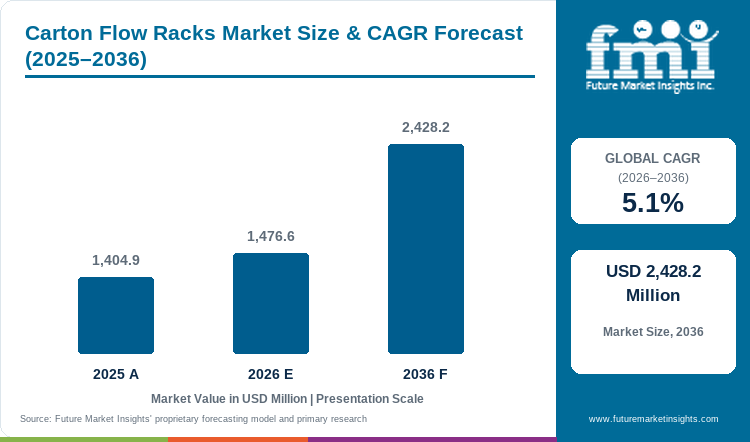
USD 1,476.6 million in 2026 and USD 2,428.2 million by 2036, expanding at 5.1% CAGR.
Carton flow rack sales are expected to reach USD 1,476.6 million in 2026 from USD 1,404.9 million in 2025. The carton flow racks market is projected to reach USD 2,428.2 million by 2036 at a 5.1% CAGR. Warehouse teams place fast-moving cases in shorter pick paths because orders need more SKU faces in each bay. Carton flow uses gravity to move the next case or tote toward the picker without powered travel. UNEX showcased SpanTrack rollers and wheel beds at MODEX 2026 in light- to heavy-duty configurations. The range supports adjustable gravity-fed presentation for warehousing and order-picking. Teams still test lane pitch and container condition before they approve a repeatable layout.
National standards and workplace rules shape how teams commission gravity-flow systems. ANSI MH16.1-2023 includes case-flow racks and pick modules in U.S. industrial steel-rack requirements. Germany's DGUV Information 208-061 covers storage-equipment operation and inspection. Japan's JIS Z 0620 includes flow racks. Mexico's NOM-006-STPS-2023 governs workplace material storage and handling. An update must fit the host rack and leave a maintainable operating condition. Integrators can reduce start-up rework by documenting both needs.
Key Takeaways
- Warehouse teams use carton flow to place more fast-moving SKUs inside existing forward-pick bays.
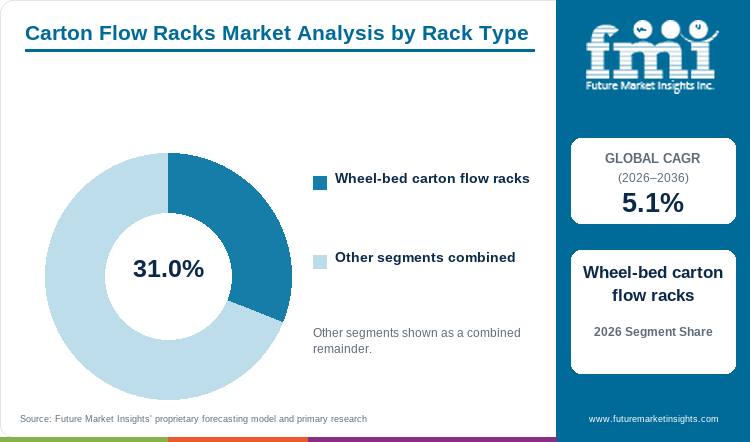
- Wheel-bed carton flow racks are set to account for 31.0% of rack type in 2026 because broad wheel contact supports frequent lane changes.
- Cartons are expected to account for 36.0% of load type in 2026 because standard case shapes support predictable gravity travel.
- E-commerce order-picking is projected to account for 31.0% of end use in 2026 because dense product presentation supports small order lines.
- Steel is expected to account for 53.0% of frame material in 2026 because structural duty and rack compatibility remain key purchase tests.
- Rack setup firms are set to account for 38.0% of sales channel in 2026 because design responsibility and setup coordination shape final performance.
Analyst Perspective
“What decides whether a carton-flow lane remains useful after the first re-slot? The answer is load contact. Operators can change dividers and lane widths but the carton still needs enough wheel or roller support to travel at the specified slope. Suppliers that test real packages and document the working window can reduce redesign during commissioning. Warehouse robotics may handle other velocity classes while carton flow remains effective for stable gravity-fed each-pick tasks.”
- Nikhil Kaitwade, Principal Analyst at Future Market Insights
How is the carton flow racks market segmented?
The carton flow racks market is segmented by rack type, load type, end use, frame material, sales channel and region.
Rack type defines the gravity surface and how easily teams can adjust it. Load type separates the containers that move through each lane. End use describes the picking pattern that creates demand. Frame material identifies the structure or roller material used for each duty and environment. Sales channel shows who turns user needs into an installed system. Material handling equipment around the pick face affects integration without changing the carton-flow market boundary.
What makes wheel-bed carton flow racks central to the rack type category?
Wheel-bed designs support cartons across a broad field of wheels instead of one fixed track width. Teams can move lane dividers as the product mix changes. The format works inside pallet racking because teams can fit a wheel bed into an existing bay without rebuilding the full structure. UNEX documents SpanTrack wheel beds and rollers for light- through heavy-duty warehousing and order-picking. Approval still depends on package contact and lane pitch. Broad wheel coverage helps engineers handle changing carton widths while keeping gravity movement stable. Buyers favor layouts that allow re-slotting without rebuilding the host rack or disrupting the active pick face.
- Wheel-bed carton flow racks are projected to account for 31.0% of rack type in 2026 because flexible lanes can handle changing carton widths.
- UNEX showcased SpanTrack carton-flow rollers and wheel beds in light- through heavy-duty options at MODEX 2026.
Why do cartons lead the load type category?
Cartons provide a familiar load surface for case-pick and split-case work when the bottom is flat and rigid. Teams can match carton shape to common wheel pitch and roller spacing. Interroll states that Carton Wheel Flow supports cartons and totes with flat solid undersides. Package condition therefore becomes part of lane design instead of a separate packaging issue. Softer bases may need denser support or a different flow surface. Standard cartons reduce these exceptions in routine distribution work. Engineers can use repeatable test loads and more stable guide settings. Predictable contact also reduces site-specific adjustment before start-up.
- Cartons are expected to account for 36.0% of load type in 2026 because standard case shapes support predictable gravity flow.
- Interroll states that Carton Wheel Flow works with totes and cartons that have flat rigid bottoms.
How does e-commerce fulfillment shape the end use category?
E-commerce order-picking needs access to many SKU faces because orders often contain small quantities from a broad product mix. Carton flow makes the forward-pick area denser and keeps replenishment behind the active pick face. PRODEX lists logistics and e-commerce among current uses for dynamic carton racking. E-commerce logistics operations also need frequent lane changes as products and promotions change. Gravity lanes support these changes without powered movement at every pick point. The system works well for fast-moving items that justify dedicated forward space. Teams can shorten travel and replenish from the rear while keeping product presentation dense for repeated each-pick work.
- E-commerce order-picking is expected to account for 31.0% of end use in 2026 because dense product presentation supports small order lines.
- PRODEX lists logistics and e-commerce among current uses for dynamic carton racking.
How does structural duty shape steel's position in the frame material category?
Steel remains the main frame material because carton-flow levels must carry repeated loads and fit established rack structures. Structural stiffness matters when teams re-slot lanes or load them at different depths. Nucor Warehouse Systems documents carton flow with steel and polycarbonate skate-wheel rollers inside warehouse rack systems. Galvanized steel adds corrosion resistance in humid or cold environments. Aluminum can reduce component weight in selected designs. Composite or HDPE rollers can reduce rolling resistance when the load and temperature allow them. Buyers still match frame material to rated duty and service conditions. Steel suits projects that value long service life and compatibility with installed rack over lower structural weight.
- Steel is expected to account for 53.0% of frame material in 2026 because structural duty and rack compatibility remain key purchase tests.
- Nucor Warehouse Systems documents carton flow with steel and polycarbonate skate-wheel rollers for flexible case movement.
Why are racking integrators central to the sales channel category?
Rack setup firms match the flow bed to beam spacing and lane depth in the surrounding rack. They also set the slope and picking height for the intended load. Ridg-U-Rak documents pick modules that combine pallet and carton flow with conveyor systems and setup support. pick-to-light systems can extend the same module into a wider picking workflow. The coordination reduces handoffs between rack design and equipment that presents or moves cases. Direct manufacturer sales work for repeatable layouts while dealers support local replacement work. Integrators help when one party must align structural fit with flow behavior and setup order before the active pick face opens.
- Rack setup firms are expected to account for 38.0% of sales channel in 2026 because they manage design and setup across the working pick module.
- Ridg-U-Rak documents pick modules that combine pallet and carton flow with conveyors and setup support.
What are the drivers, restraints and opportunities in the Carton Flow Racks Market?
Higher each-pick intensity expands use, package-specific flow testing slows approval and modular retrofit hardware opens staged upgrade opportunities.
- Driver: More SKU touches inside forward-pick zones raise the value of dense gravity-fed presentation.
- Restraint: Carton bottoms and rack geometry must pass use testing before teams release a lane.
- Opportunity: Drop-in beds and adjustable hardware can upgrade usable rack without a full replacement.
Dense each-pick activity makes forward-pick space more valuable
High each-pick activity increases walking and replenishment work inside forward-pick zones. Teams respond by placing more fast-moving SKUs near the picker and keeping replenishment away from active picking. In April 2026, PRODEX described its carton-flow racking as a gravity system that moves cartons toward the pick face. PRODEX also states that the format uses rack depth and height to store more items in the same space. Frazier's SelecDeck turns floor-level pallet positions into organized case-flow pick slots. These designs reduce extra travel without adding powered movement to every lane. Labor exposure and SKU access can therefore justify an added flow level.
Use proof remains a technical gate before release
Use approval slows when a carton or tote cannot stay in stable contact with the flow surface. Flexible bottoms can sag between rollers. Uneven packages can also skew inside a lane. Existing beam spacing may limit the slope needed for reliable travel. Interroll states that its Carton Wheel Flow works with unit loads that have flat rigid bottoms. Warehouse engineers need sample tests because a setup that works for one case may fail with another. A failed trial can delay setup and add engineering work before capital approval.
Update designs create a staged route to higher pick density
Installed pallet rack creates an update option because facilities can replace a picking level without rebuilding the surrounding structure. UNEX states that SpanTrack drops into new or existing pallet rack without intermediate shelves. Frazier also documents SelecDeck wheel beds that fit over existing shelf beams when the rack meets its criteria. Teams can upgrade one aisle or velocity class at a time and keep lane-change options as carton sizes change. Automated material handling systems can work around the pick face without removing gravity flow from suitable SKUs. Teams can begin by surveying the host warehouse racking and recording load behavior.
Which country CAGRs are profiled in the Carton Flow Racks Market?
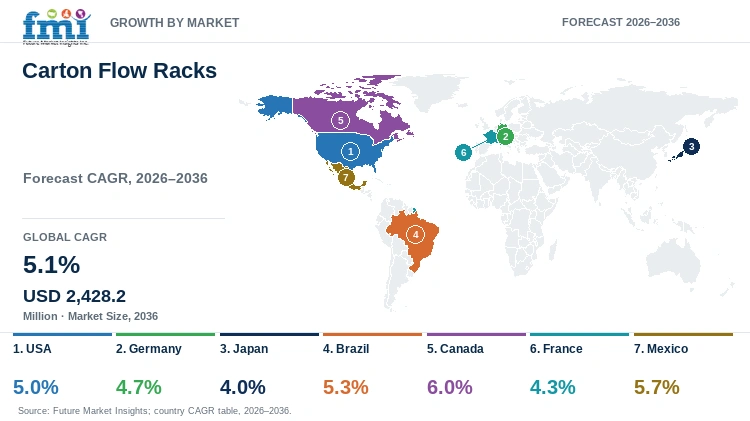
| Country | CAGR |
|---|---|
| USA | 5.0% |
| Germany | 4.7% |
| Japan | 4.0% |
| Brazil | 5.3% |
| Canada | 6.0% |
| France | 4.3% |
| Mexico | 5.7% |
How do country-level CAGRs compare in the Carton Flow Racks Market?
Country CAGRs show forecast pace. National rack rules and service conditions shape how teams specify projects. The USA emphasizes recognized rack design requirements for update approval. Germany places operation and inspection within formal storage-equipment guidance. Japan includes flow racks in a national industrial-rack standard for project review. Canada stresses posted load limits and rack capacity during setup. France and Mexico use storage or material-handling guidance that affects setup planning. Brazil keeps material storage within national workplace-safety rules.
- USA: Rack design rules keep the host structure in the update approval process.
- Germany: Storage-equipment guidance puts operation and inspection in the project record.
- Japan: A national rack standard includes flow racks in its scope.
- Brazil: National storage rules include load control and handling in setup plans.
- Canada: National safety guidance stresses posted load limits and rack-capacity control.
- France: National safety guidance links rack size with product rotation and safer picking.
- Mexico: National handling rules require teams to record setup and maintenance steps.
The full report provides country-level CAGR analysis across North America, Latin America, Western Europe, Eastern Europe, East Asia, South Asia and Pacific, and the Middle East and Africa.
Country-wise Analysis
- The USA is expected to post 5.0% CAGR over the forecast period. Projects must match carton-flow performance with rack design rules. ANSI MH16.1-2023 sets minimum requirements for steel storage racks and includes case-flow racks and pick modules. U.S. teams therefore assess a flow bed as part of the host rack instead of a separate accessory. Wheel pitch and lane slope still need package testing before release. Update drawings can record the existing beams and planned load. Local setup support matters because changes to a live pick module can disrupt active order-picking work. Engineering teams can reduce rework by closing rack assumptions and carton tests before setup.
- Carton flow rack demand in Germany is forecast to rise at 4.7% CAGR over the forecast period. Formal controls support this outlook by covering storage-equipment operation and inspection. DGUV updated Information 208-061 in July 2024 for storage equipment and load carriers. The guidance covers construction and equipment as well as operation and inspection. It also covers maintenance. German teams need each carton-flow update to fit the load and the existing rack condition. Measured lane tests can confirm carton travel before start-up. Modular beds reduce work in active picking areas and still allow future lane changes. Integrators add value when records follow the equipment through setup and maintenance.
- Carton flow rack demand in Japan is expected to grow at 4.0% CAGR over the assessment period. A national rack standard that includes flow racks shapes this outlook. The Japan Standards Association lists JIS Z 0620:2018 as a current standard for industrial racks. Its scope covers flow racks with pallet racks and other industrial rack forms. Japanese teams therefore have a clear rack basis for reviewing a gravity-flow level. The carton still needs enough wheel or roller contact for stable travel. Local start-up tests can confirm that fit before routine use. Adjusted lanes keep flexibility as product mixes change. Clear records also help maintenance teams separate product adjustments from host-rack work.
- Carton flow rack adoption in Brazil is expected to expand at 5.3% CAGR through 2036. Workplace rules place material storage and handling under formal safety controls. Brazil's Ministry of Labor and Employment maintains NR-11 for transport and material storage. The rule requires stored material to stay within floor load limits and keep access routes clear. Carton-flow projects therefore form part of wider controls for stored loads and handling work. Teams still need package testing because safe storage does not ensure reliable gravity travel. Dealers add value by pairing spare parts with recorded lane changes and setup support.
- Carton flow rack sales in Canada are projected to grow at 6.0% CAGR during the assessment period. Attention to rack capacity and safe material storage supports this outlook. The Canadian Centre for Occupational Health and Safety asks whether teams post approved maximum loads for shelving. Its manufacturing checklist also asks whether racks and platforms stay within capacity. Canadian update projects benefit from clear load records before teams add a flow bed. Cold chain logistics operations add temperature needs for components in selected facilities. Dealers can improve service by combining local stock with use testing and lane-change support. The added flow level must preserve safe rack loading and move the actual carton reliably.
- Carton flow rack demand in France is forecast to rise at 4.3% CAGR over the forecast period. National prevention guidance for storage and picking work shapes project planning. Assurance Maladie published Recommendation R.519 in 2025 for shelf stocking and storage. It advises teams to match racking to product size and rotation while keeping often-handled goods within practical reach. Carton-flow projects use the same operating logic for high-turnover cases that need dense presentation. The lane still must fit the host structure and actual carton base. Low-disruption setup matters inside active facilities. Integrators can work one aisle at a time and verify slope plus carton contact before expanding to other bays.
- Carton flow rack sales in Mexico are forecast to expand at 5.7% CAGR by 2036. National safety requirements for material storage and machine handling shape this outlook. NOM-006-STPS-2023 applies across Mexico to workplaces that perform these activities. The standard defines storage as the orderly placement of materials or containers and sets safety requirements for the work. Carton-flow retrofits therefore need recorded host-rack conditions and stable package travel. Local engineering can reduce rework during slope adjustment and lane changes. Trained service teams also help workers re-slot the system after start-up without repeated long-distance support visits. Project approval becomes easier when setup procedures match equipment instructions and workplace safety controls.
Who are the notable companies in the Carton Flow Racks Market?
UNEX Manufacturing, Interroll, Mallard Manufacturing, PRODEX, SSI Schaefer, Mecalux, Steel King, Frazier Industrial, Ridg-U-Rak and Nucor Warehouse Systems are profiled in this market.
Suppliers differ in the type of carton-flow work they cover. UNEX and Interroll offer adjustable carton-flow hardware for warehouse picking. Mallard and PRODEX focus on gravity-flow setups built for each site. SSI Schaefer and Mecalux connect live storage with wider picking systems. Steel King and Nucor Warehouse Systems bring rack design skills to flow projects. Frazier and Ridg-U-Rak combine engineered rack with case-flow or pick-module work. Buyers compare flow tests and update options before company scale.
- UNEX Manufacturing and Interroll focus on carton-flow systems for picking. Mallard Manufacturing and PRODEX also offer wheel or roller setups made to fit each site.
- SSI Schaefer and Mecalux link gravity storage to manual or automated picking work across the site.
- Steel King and Frazier Industrial provide engineered rack platforms. Ridg-U-Rak and Nucor Warehouse Systems also build rack structures that can hold flow-ready pick modules.
Competitive Benchmarking: Carton Flow Racks Market
| Company | Carton-Flow Product Depth | Retrofit and Re-slotting | Structural Rack Engineering | Geographic Reach |
|---|---|---|---|---|
| UNEX Manufacturing | High | High | Medium | North America |
| Interroll | High | High | Medium | Global |
| Mallard Manufacturing | High | High | Medium | North America |
| PRODEX | Medium | High | Medium | France with global clientele |
| SSI Schaefer | Medium | Medium | High | Global |
| Mecalux | Medium | Medium | High | Europe and the Americas |
| Steel King | Medium | Medium | High | United States |
| Frazier Industrial | Medium | High | High | North America |
| Ridg-U-Rak | Medium | Medium | High | North America |
| Nucor Warehouse Systems | Medium | Medium | High | North America |
Scoring basis: Carton-Flow Product Depth counts the wheel-bed or roller solutions each company shows. Update and Changing lanes checks how well shown products fit existing racks or changing SKU profiles. Structural Rack Engineering checks documented rack design skills. High means the company shows broad and direct exact-market evidence. Medium means the evidence is direct across a smaller exact-market range. Low means the public evidence shows a clear documented limit.
Key Developments in the Carton Flow Racks Market
- In April 2026, UNEX Manufacturing showed SpanTrack carton-flow rollers and wheel beds at MODEX 2026. The display covered light-duty through heavy-duty options for warehouse work and order-picking. The event showed that the range can support more than one case-picking setup.
- In April 2026, PRODEX published its carton-flow rack setup for dynamic case storage. The company said the system can fit existing medium-duty or heavy-duty rack. It also listed roller materials and load-specific angles that users can adjust. The release gave buyers more detail on its update offer for manual picking.
- In February 2026, Mallard Manufacturing launched online maintenance resources for pallet and carton flow racks. The resources cover checks and upkeep for gravity-flow equipment already in use. The action adds service support after start-up and helps teams manage long-term rack performance.
Key Players in the Carton Flow Racks Market
Dedicated carton-flow specialists
- UNEX Manufacturing
- Interroll
- Mallard Manufacturing
- PRODEX
Integrated picking and racking providers
- SSI Schaefer
- Mecalux
- Frazier Industrial
Structural rack and pick-module platforms
- Steel King
- Ridg-U-Rak
- Nucor Warehouse Systems
Carton Flow Racks Market - Report Scope
| Coverage field | Report scope |
|---|---|
| Market breakdown | Rack type, load type, end use, frame material, sales channel and region. |
| Quantitative Units | USD million. |
| Market Definition | Revenue includes complete carton flow rack assemblies and dedicated carton-flow hardware sold within the stated segmentation universe. Static shelving, pallet-only flow racks, powered conveyors, automation equipment, software and the value of handled goods are excluded. |
| Regions Covered | North America, Latin America, Western Europe, Eastern Europe, East Asia, South Asia and Pacific, and Middle East and Africa. |
| Countries Covered | USA, Germany, Japan, Brazil, Canada, France, Mexico and more than twenty-five additional countries in the full report. |
| Key Companies Profiled | UNEX Manufacturing, Interroll, Mallard Manufacturing, PRODEX, SSI Schaefer, Mecalux, Steel King, Frazier Industrial, Ridg-U-Rak and Nucor Warehouse Systems. |
| Forecast Period | 2026 to 2036. |
| Approach | Primary and secondary research with market triangulation. |
Carton Flow Racks Market - Research Methodology
| Method | Approach |
|---|---|
| Primary Research | FMI analysts gathered input from manufacturers, service providers, technology developers, distributors, end users, procurement teams, and subject-matter experts. Interviews examined purchasing decisions, product or service evaluation, adoption barriers, approval requirements, pricing considerations, and expectations for technical or commercial support. Respondents were also asked what evidence is required before a trial, pilot, or initial order develops into regular purchasing. |
| Desk Research | Desk research covered government statistics, regulatory publications, trade data, industry associations, technical literature, standards, company filings, product information, and official corporate announcements. Sources were reviewed for relevance, publication date, geographic coverage, and consistency with the defined market scope. Claims relating to performance, applications, approvals, capacity, investment, and commercial activity were retained only when supported by credible public evidence. |
| Market Sizing and Forecasting | The market model combined the baseline value with historical performance, segment structure, pricing and volume indicators, adoption levels, company participation, and country-level demand conditions. Forecast assumptions considered economic activity, investment trends, regulatory developments, technology adoption, purchasing cycles, supply availability, and barriers to wider market use. Segment and regional estimates were reconciled before the final market total was calculated. |
| Data Validation | Estimates were checked against multiple independent indicators, including public data, company activity, trade patterns, industry developments, and findings from primary interviews. Validation also tested whether products, services, applications, and company revenues fell within the defined market boundaries. Adjacent categories, unsupported claims, overlapping revenues, and activities without direct market relevance were excluded to reduce double counting and maintain consistency across segments and countries. |
Carton Flow Racks Market by Segments
Carton Flow Racks Market segmented by Rack Type:
- Wheel-bed carton flow racks
- Roller track racks
- Full-width roller racks
- Pallet rack-integrated flow
- Mobile carton flow racks
Carton Flow Racks Market segmented by Load Type:
- Cartons
- Totes
- Case goods
- Small parts bins
- Mixed SKU inventory
Carton Flow Racks Market segmented by End Use:
- E-commerce fulfillment
- Retail distribution
- Automotive parts
- Pharma distribution
- Industrial MRO
Carton Flow Racks Market segmented by Frame Material:
- Steel
- Aluminum
- Galvanized steel
- Composite/HDPE rollers
Carton Flow Racks Market segmented by Sales Channel:
- Racking integrators
- Material handling dealers
- Direct manufacturer sales
- Aftermarket retrofit
Carton Flow Racks Market by Region:
- North America
- United States
- Canada
- Latin America
- Brazil
- Mexico
- Argentina
- Chile
- Western Europe
- Germany
- France
- United Kingdom
- Italy
- Spain
- Benelux
- Nordics
- Eastern Europe
- Poland
- Czech Republic
- Romania
- Hungary
- East Asia
- China
- Japan
- South Korea
- South Asia and Pacific
- India
- ASEAN
- Australia and New Zealand
- Middle East and Africa
- GCC Countries
- South Africa
- Türkiye
- Israel
Research Sources and Bibliography
- ANSI. (2023). ANSI MH16.1-2023: Design, testing, and utilization of industrial steel storage racks.
- Deutsche Gesetzliche Unfallversicherung. (2024, July). DGUV Information 208-061: Lagereinrichtungen und Ladungsträger.
- Japanese Standards Association. (2018). JIS Z 0620:2018 industrial racks.
- Ministry of Labor and Employment, Brazil. (n.d.). Norma Regulamentadora No. 11 (NR-11): Transporte, movimentação, armazenagem e manuseio de materiais. Retrieved September 21, 2026.
- Canadian Centre for Occupational Health and Safety. (2025). Inspection checklists - Sample checklist for manufacturing facilities.
- Assurance Maladie - Risques professionnels. (2025, September 19). Recommandation: mise en rayon ou stockage, protéger vos équipes et optimiser votre organisation.
- Secretaría del Trabajo y Previsión Social. (2024). NOM-006-STPS-2023: Almacenamiento y manejo de materiales mediante el uso de maquinaria - Condiciones de seguridad en el trabajo.
- UNEX Manufacturing. (2026). MODEX 2026 in review.
- PRODEX. (2026, April 2). PRODEX carton flow racking.
- Mallard Manufacturing. (2026, February 18). Gravity flow maintenance resources: New pallet & carton flow rack pages now live.
- Interroll Group. (n.d.). Innovative carton flow solutions. Retrieved September 20, 2026.
- Frazier Industrial Company. (n.d.). SelecDeck case flow rack. Retrieved September 20, 2026.
- Steel King Industries. (2024, July 2). Craig Heil named as Specialty Products Manager for Steel King.
- Ridg-U-Rak. (n.d.). Pick module systems. Retrieved September 20, 2026.
- Nucor Warehouse Systems. (n.d.). Carton/pallet flow. Retrieved September 20, 2026.
- SSI Schaefer. (n.d.). Pick by Light and Put to Light. Retrieved September 20, 2026.
- Mecalux. (n.d.). Live storage for picking. Retrieved September 20, 2026.
- Mallard Manufacturing. (2026, August 25). One carton flow rack goal, multiple ways to pick.
- Interroll Group. (2026, March). High Performance Conveyor Platform catalog.
- Mecalux. (2026, January 27). Split case picking: How to organise it to optimise order fulfilment.
This bibliography is provided for reader reference and is not exhaustive. The full report contains the complete reference list and detailed citations.
This Report Answers
- How large is the Carton Flow Racks Market in 2026 and 2036?
- Why do wheel-bed carton flow racks lead the rack type category?
- How do cartons shape design choices within the load type category?
- Why does e-commerce order-picking lead the end use category in 2026?
- Why does steel lead the frame material category during the 2026 base year?
- Why do rack setup firms lead the sales channel category in 2026?
- Which companies provide dedicated carton-flow hardware or integrated rack platforms globally?
Frequently Asked Questions
What is driving growth in the Carton Flow Racks Market?
The Carton Flow Racks Market is driven by growing demand for dense each-pick operations in warehouses and distribution centers. Compact gravity-fed storage capacity helps improve picking efficiency and optimize forward-pick areas.
Who are the key players in the Carton Flow Racks Market?
Key companies in the Carton Flow Racks Market include UNEX, Interroll, Mallard, and Frazier, along with integrated picking solution providers. Competition is shaped by product performance, system integration capabilities, and warehouse optimization expertise.
What is a notable restraint in the Carton Flow Racks Market?
Package shape and rack compatibility often require testing before lane approval. These qualification requirements can extend implementation timelines and increase evaluation efforts.
Why do buyers consider updated carton flow systems?
Buyers adopt retrofit carton flow systems to add pick faces while preserving existing rack infrastructure. These upgrades help expand storage efficiency while limiting installation time and operational disruption.
Which segment leads the Carton Flow Racks Market by rack type?
Wheel-bed carton flow racks are expected to account for 31.0% of rack type demand in 2026. Their reliable carton movement and suitability for high-throughput picking applications support widespread adoption.
What should procurement teams test before purchasing carton flow racks?
Procurement teams should evaluate carton contact and lane slope before purchase. They should also assess loading duty requirements and lane-adjustment needs to ensure compatibility with warehouse operations.
Preview the report firsthand - request a free sample
Get SampleGet the brochure for pricing and purchase details.
Get PDFTable of Content
- Key Takeaways
- Market Size and CAGR
- Top Growth Driver
- Fastest Growing Segment
- Leading Region
- Key Companies
- Emerging Opportunities
- Executive Summary
- Global Market Outlook
- Demand-side Trends
- Supply-side Trends
- Technology Roadmap Analysis
- Analysis and Recommendations
- Analyst Perspective (What is happening? Why now? What should investors know?)
- Key Questions Answered
- How large is the market?
- What is the CAGR?
- What are key trends?
- Which region dominates?
- Who are the leaders?
- Market Overview
- Market Coverage / Taxonomy
- Market Definition / Scope / Limitations
- Research Methodology
- Chapter Orientation
- Analytical Lens and Working Hypotheses
- Market Structure, Signals, and Trend Drivers
- Benchmarking and Cross-market Comparability
- Market Sizing, Forecasting, and Opportunity Mapping
- Research Design and Evidence Framework
- Desk Research Programme (Secondary Evidence)
- Expert Input and Fieldwork (Primary Evidence)
- Tooling, Models, and Reference Databases
- Data Engineering and Model Build
- Quality Assurance and Audit Trail
- Market Background
- Market Dynamics (Drivers, Restraints, Opportunity, Trends)
- Scenario Forecast (Optimistic, Likely, Conservative)
- Impact Analysis
- AI Impact
- Sustainability Impact
- Regulatory Impact
- Technology Impact
- Consumer / Buyer Analysis
- Purchase Drivers
- Adoption Barriers
- Buyer Journey
- Opportunity Map Analysis
- Product Life Cycle Analysis
- Supply Chain Analysis
- Investment Feasibility Matrix
- Value Chain Analysis
- PESTLE and Porter's Analysis
- Regulatory Landscape
- Regional Parent Market Outlook
- Production and Consumption Statistics
- Import and Export Statistics
- Global Market Analysis and Forecast, 2021 to 2036
- Historical Market Size Value (USD Million) Analysis, 2021 to 2025
- Current and Future Market Size Value (USD Million) Projections, 2026 to 2036
- Y-o-Y Growth Trend Analysis
- Absolute $ Opportunity Analysis
- Global Market Pricing Analysis, 2021 to 2036
- Global Market Analysis and Forecast, By Rack Type, 2021 to 2036
- Introduction / Key Findings
- Historical Market Size Value (USD Million) Analysis By Rack Type, 2021 to 2025
- Current and Future Market Size Value (USD Million) Analysis and Forecast By Rack Type, 2026 to 2036
- Wheel-bed carton flow racks
- Roller track racks
- Full-width roller racks
- Pallet rack-integrated flow
- Mobile carton flow racks
- Y-o-Y Growth Trend Analysis By Rack Type, 2021 to 2025
- Absolute $ Opportunity Analysis By Rack Type, 2026 to 2036
- Global Market Analysis and Forecast, By Load Type, 2021 to 2036
- Introduction / Key Findings
- Historical Market Size Value (USD Million) Analysis By Load Type, 2021 to 2025
- Current and Future Market Size Value (USD Million) Analysis and Forecast By Load Type, 2026 to 2036
- Cartons
- Totes
- Case goods
- Small parts bins
- Mixed SKU inventory
- Y-o-Y Growth Trend Analysis By Load Type, 2021 to 2025
- Absolute $ Opportunity Analysis By Load Type, 2026 to 2036
- Global Market Analysis and Forecast, By End Use, 2021 to 2036
- Introduction / Key Findings
- Historical Market Size Value (USD Million) Analysis By End Use, 2021 to 2025
- Current and Future Market Size Value (USD Million) Analysis and Forecast By End Use, 2026 to 2036
- E-commerce fulfillment
- Retail distribution
- Automotive parts
- Pharma distribution
- Industrial MRO
- Y-o-Y Growth Trend Analysis By End Use, 2021 to 2025
- Absolute $ Opportunity Analysis By End Use, 2026 to 2036
- Global Market Analysis and Forecast, By Frame Material, 2021 to 2036
- Introduction / Key Findings
- Historical Market Size Value (USD Million) Analysis By Frame Material, 2021 to 2025
- Current and Future Market Size Value (USD Million) Analysis and Forecast By Frame Material, 2026 to 2036
- Steel
- Aluminum
- Galvanized steel
- Composite/HDPE rollers
- Y-o-Y Growth Trend Analysis By Frame Material, 2021 to 2025
- Absolute $ Opportunity Analysis By Frame Material, 2026 to 2036
- Global Market Analysis and Forecast, By Sales Channel, 2021 to 2036
- Introduction / Key Findings
- Historical Market Size Value (USD Million) Analysis By Sales Channel, 2021 to 2025
- Current and Future Market Size Value (USD Million) Analysis and Forecast By Sales Channel, 2026 to 2036
- Racking integrators
- Material handling dealers
- Direct manufacturer sales
- Aftermarket retrofit
- Y-o-Y Growth Trend Analysis By Sales Channel, 2021 to 2025
- Absolute $ Opportunity Analysis By Sales Channel, 2026 to 2036
- Global Market Analysis and Forecast, By Region, 2021 to 2036
- Introduction
- Historical Market Size Value (USD Million) Analysis By Region, 2021 to 2025
- Current Market Size Value (USD Million) Analysis and Forecast By Region, 2026 to 2036
- North America
- Latin America
- Western Europe
- Eastern Europe
- East Asia
- South Asia and Pacific
- Middle East and Africa
- Market Attractiveness Analysis By Region
- North America Market Analysis and Forecast, By Country, 2021 to 2036
- Historical Market Size Value (USD Million) Trend Analysis By Market Taxonomy, 2021 to 2025
- Market Size Value (USD Million) Forecast By Market Taxonomy, 2026 to 2036
- By Country
- United States
- Canada
- By Rack Type
- By Load Type
- By End Use
- By Frame Material
- By Sales Channel
- By Country
- Market Attractiveness Analysis
- By Country
- By Rack Type
- By Load Type
- By End Use
- By Frame Material
- By Sales Channel
- Key Takeaways
- Latin America Market Analysis and Forecast, By Country
- Historical Market Size Value (USD Million) Trend Analysis By Market Taxonomy, 2021 to 2025
- Market Size Value (USD Million) Forecast By Market Taxonomy, 2026 to 2036
- By Country
- Brazil
- Mexico
- Argentina
- Chile
- By Rack Type
- By Load Type
- By End Use
- By Frame Material
- By Sales Channel
- By Country
- Market Attractiveness Analysis
- By Country
- By Rack Type
- By Load Type
- By End Use
- By Frame Material
- By Sales Channel
- Key Takeaways
- Western Europe Market Analysis and Forecast, By Country
- Historical Market Size Value (USD Million) Trend Analysis By Market Taxonomy, 2021 to 2025
- Market Size Value (USD Million) Forecast By Market Taxonomy, 2026 to 2036
- By Country
- Germany
- France
- United Kingdom
- Italy
- Spain
- Benelux
- Nordics
- By Rack Type
- By Load Type
- By End Use
- By Frame Material
- By Sales Channel
- By Country
- Market Attractiveness Analysis
- By Country
- By Rack Type
- By Load Type
- By End Use
- By Frame Material
- By Sales Channel
- Key Takeaways
- Eastern Europe Market Analysis and Forecast, By Country
- Historical Market Size Value (USD Million) Trend Analysis By Market Taxonomy, 2021 to 2025
- Market Size Value (USD Million) Forecast By Market Taxonomy, 2026 to 2036
- By Country
- Poland
- Czech Republic
- Romania
- Hungary
- By Rack Type
- By Load Type
- By End Use
- By Frame Material
- By Sales Channel
- By Country
- Market Attractiveness Analysis
- By Country
- By Rack Type
- By Load Type
- By End Use
- By Frame Material
- By Sales Channel
- Key Takeaways
- East Asia Market Analysis and Forecast, By Country
- Historical Market Size Value (USD Million) Trend Analysis By Market Taxonomy, 2021 to 2025
- Market Size Value (USD Million) Forecast By Market Taxonomy, 2026 to 2036
- By Country
- China
- Japan
- South Korea
- By Rack Type
- By Load Type
- By End Use
- By Frame Material
- By Sales Channel
- By Country
- Market Attractiveness Analysis
- By Country
- By Rack Type
- By Load Type
- By End Use
- By Frame Material
- By Sales Channel
- Key Takeaways
- South Asia and Pacific Market Analysis and Forecast, By Country
- Historical Market Size Value (USD Million) Trend Analysis By Market Taxonomy, 2021 to 2025
- Market Size Value (USD Million) Forecast By Market Taxonomy, 2026 to 2036
- By Country
- India
- ASEAN
- Australia and New Zealand
- By Rack Type
- By Load Type
- By End Use
- By Frame Material
- By Sales Channel
- By Country
- Market Attractiveness Analysis
- By Country
- By Rack Type
- By Load Type
- By End Use
- By Frame Material
- By Sales Channel
- Key Takeaways
- Middle East and Africa Market Analysis and Forecast, By Country
- Historical Market Size Value (USD Million) Trend Analysis By Market Taxonomy, 2021 to 2025
- Market Size Value (USD Million) Forecast By Market Taxonomy, 2026 to 2036
- By Country
- GCC Countries
- South Africa
- Türkiye
- Israel
- By Rack Type
- By Load Type
- By End Use
- By Frame Material
- By Sales Channel
- By Country
- Market Attractiveness Analysis
- By Country
- By Rack Type
- By Load Type
- By End Use
- By Frame Material
- By Sales Channel
- Key Takeaways
- Key Countries Market Analysis
- United States
- Pricing Analysis
- Market Share Analysis, 2025
- By Rack Type
- By Load Type
- By End Use
- By Frame Material
- By Sales Channel
- Canada
- Pricing Analysis
- Market Share Analysis, 2025
- By Rack Type
- By Load Type
- By End Use
- By Frame Material
- By Sales Channel
- Mexico
- Pricing Analysis
- Market Share Analysis, 2025
- By Rack Type
- By Load Type
- By End Use
- By Frame Material
- By Sales Channel
- Brazil
- Pricing Analysis
- Market Share Analysis, 2025
- By Rack Type
- By Load Type
- By End Use
- By Frame Material
- By Sales Channel
- Chile
- Pricing Analysis
- Market Share Analysis, 2025
- By Rack Type
- By Load Type
- By End Use
- By Frame Material
- By Sales Channel
- Germany
- Pricing Analysis
- Market Share Analysis, 2025
- By Rack Type
- By Load Type
- By End Use
- By Frame Material
- By Sales Channel
- United Kingdom
- Pricing Analysis
- Market Share Analysis, 2025
- By Rack Type
- By Load Type
- By End Use
- By Frame Material
- By Sales Channel
- Italy
- Pricing Analysis
- Market Share Analysis, 2025
- By Rack Type
- By Load Type
- By End Use
- By Frame Material
- By Sales Channel
- Spain
- Pricing Analysis
- Market Share Analysis, 2025
- By Rack Type
- By Load Type
- By End Use
- By Frame Material
- By Sales Channel
- France
- Pricing Analysis
- Market Share Analysis, 2025
- By Rack Type
- By Load Type
- By End Use
- By Frame Material
- By Sales Channel
- India
- Pricing Analysis
- Market Share Analysis, 2025
- By Rack Type
- By Load Type
- By End Use
- By Frame Material
- By Sales Channel
- ASEAN
- Pricing Analysis
- Market Share Analysis, 2025
- By Rack Type
- By Load Type
- By End Use
- By Frame Material
- By Sales Channel
- Australia and New Zealand
- Pricing Analysis
- Market Share Analysis, 2025
- By Rack Type
- By Load Type
- By End Use
- By Frame Material
- By Sales Channel
- China
- Pricing Analysis
- Market Share Analysis, 2025
- By Rack Type
- By Load Type
- By End Use
- By Frame Material
- By Sales Channel
- Japan
- Pricing Analysis
- Market Share Analysis, 2025
- By Rack Type
- By Load Type
- By End Use
- By Frame Material
- By Sales Channel
- South Korea
- Pricing Analysis
- Market Share Analysis, 2025
- By Rack Type
- By Load Type
- By End Use
- By Frame Material
- By Sales Channel
- Poland
- Pricing Analysis
- Market Share Analysis, 2025
- By Rack Type
- By Load Type
- By End Use
- By Frame Material
- By Sales Channel
- Hungary
- Pricing Analysis
- Market Share Analysis, 2025
- By Rack Type
- By Load Type
- By End Use
- By Frame Material
- By Sales Channel
- Türkiye
- Pricing Analysis
- Market Share Analysis, 2025
- By Rack Type
- By Load Type
- By End Use
- By Frame Material
- By Sales Channel
- South Africa
- Pricing Analysis
- Market Share Analysis, 2025
- By Rack Type
- By Load Type
- By End Use
- By Frame Material
- By Sales Channel
- United States
- Market Structure Analysis
- Competition Dashboard
- Competition Benchmarking
- Market Share Analysis of Top Players
- By Regional
- By Rack Type
- By Load Type
- By End Use
- By Frame Material
- By Sales Channel
- Emerging Startups
- Innovation Benchmarking
- Competition Analysis
- Competition Deep Dive
- UNEX Manufacturing
- Overview
- Product Portfolio
- Profitability by Market Segments
- Sales Footprint
- Strategy Overview
- Marketing Strategy
- Product Strategy
- Channel Strategy
- Interroll
- Mallard Manufacturing
- PRODEX
- SSI Schaefer
- Mecalux
- Steel King
- Frazier Industrial
- Ridg-U-Rak
- Nucor Warehouse Systems
- UNEX Manufacturing
- Case Studies
- Success Stories
- Recent Developments
- Competition Deep Dive
- Assumptions & Acronyms Used


